Fermi-LAT View on Three Ultra-high-energy 1LHAASO Sources in the 52^(circ)<l<55^(circ) Region
Pith reviewed 2026-06-29 11:13 UTC · model grok-4.3
The pith
Fermi-LAT data split the region into five GeV sources whose spectra and positions do not match the three LHAASO ultra-high-energy sources.
A machine-rendered reading of the paper's core claim, the machinery that carries it, and where it could break.
Core claim
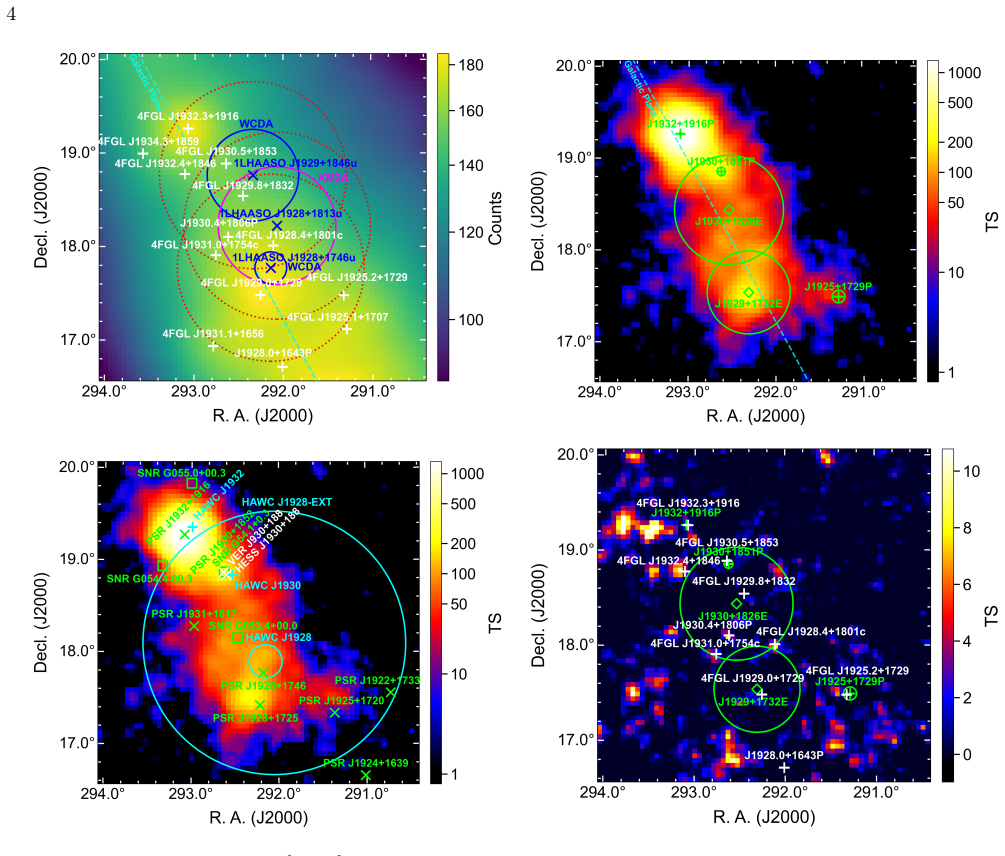
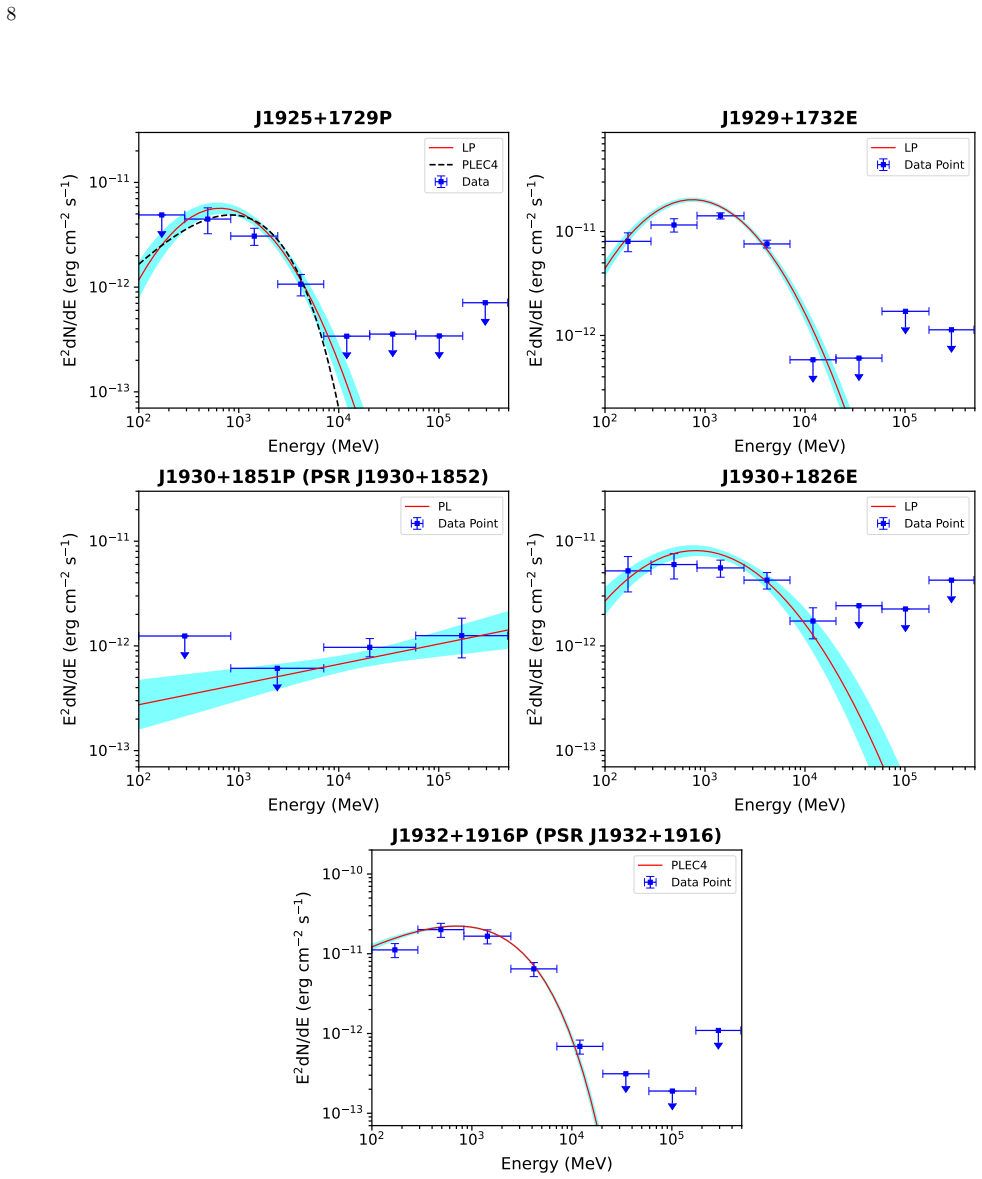
More than 17 years of Fermi-LAT data resolve the GeV emission in the 52°<l<55° region into three pointlike sources (J1925+1729P, J1930+1851P, J1932+1916P) and two extended sources (J1929+1732E, J1930+1826E). J1932+1916P is identified as PSR J1932+1916 and J1930+1851P coincides with PWN/SNR G54.1+0.3, while the GeV-TeV spectra of the sources are consistent with leptonic or hybrid interpretations in some cases; however, spectral and morphological mismatches mean none of the five GeV sources can be clearly associated with the three 1LHAASO UHE sources.
What carries the argument
Spatial and spectral fitting of Fermi-LAT photon data to isolate point-like and extended sources from each other and from the modeled Galactic diffuse background.
If this is right
- The three LHAASO ultra-high-energy sources likely have origins distinct from the identified GeV sources or involve particle populations visible only at higher energies.
- Deeper HAWC and LHAASO observations combined with CTAO data at higher angular resolution can test possible associations.
- A dedicated study of the Galactic diffuse emission in this region is required to confirm or revise the source catalog.
- Timing analysis of J1925+1729P may reveal pulsations and establish it as a new gamma-ray pulsar.
Where Pith is reading between the lines
- If the mismatches hold under improved modeling, the ultra-high-energy emission may trace a distinct acceleration process not coupled to the lower-energy sources.
- The region could contain multiple overlapping particle accelerators whose emissions blend at current resolutions.
- Refined diffuse models might uncover faint bridges of emission connecting the GeV and TeV components.
Load-bearing premise
The current model of Galactic diffuse emission is accurate enough to separate the five GeV sources reliably from one another and from the background.
What would settle it
A revised diffuse emission model that produces large changes in the residual maps after the five sources are subtracted would show the reported source separation is not robust.
Figures
read the original abstract
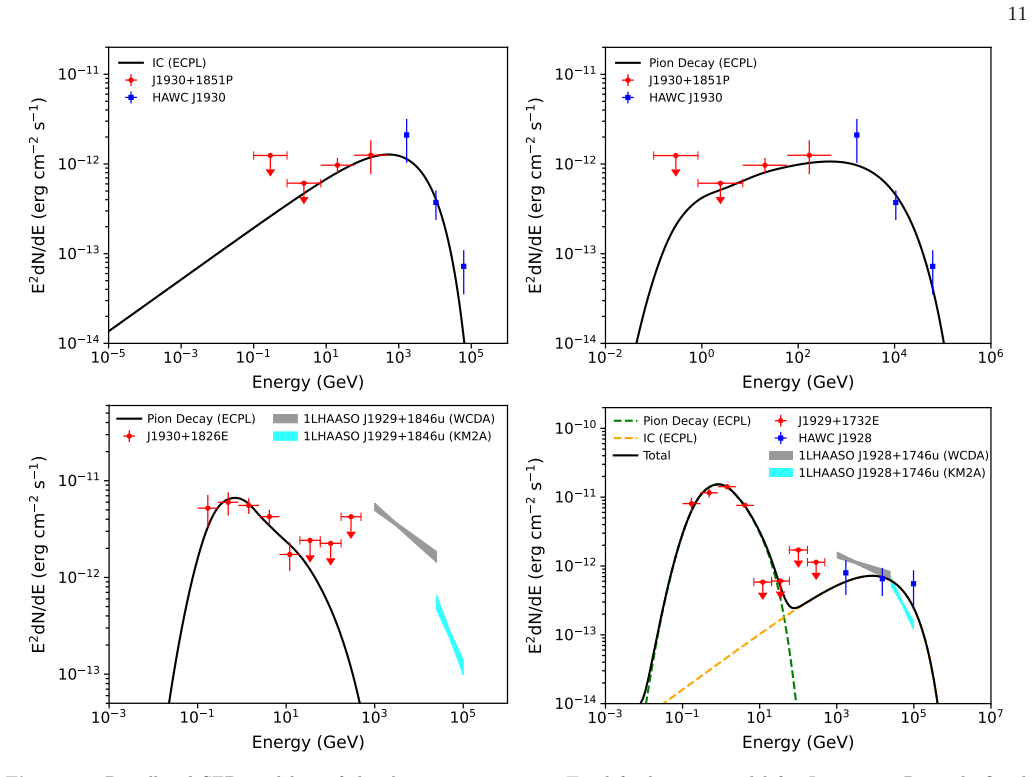
Using more than 17 yr of Fermi-LAT data, we performed a detailed investigation of the complex $52^{\circ}<l<55^{\circ}$ region, which encompasses the three ultra-high-energy sources 1LHAASO J1928+1746u, 1LHAASO J1928+1813u, and 1LHAASO J1929+1846u. This region hosts multiple SNRs, pulsars, GeV and TeV sources. Our analysis resolves the GeV emission into three pointlike sources (J1925+1729P, J1930+1851P, and J1932+1916P) and two extended sources (J1929+1732E and J1930+1826E), and improves significantly on the description based on the 4FGL-DR4 catalog. Source J1932+1916P is identified as the known gamma-ray pulsar PSR J1932+1916, while J1925+1729P may be a new gamma-ray pulsar candidate distinct from the known gamma-ray pulsar PSR J1925+1720. This warrants future investigation and a search for pulsations. Source J1930+1851P coincides with the TeV source PWN/SNR G54.1+0.3 and its GeV-TeV spectrum is consistent with both leptonic and hadronic interpretations, although a leptonic origin in relation to the known PWN is more likely. The GeV-TeV spectrum of J1929+1732E is consistent with a hybrid lepto-hadronic scenario in which the TeV emission traces the PWN powered by the pulsar PSR J1928+1746, while the GeV emission may result from interactions between particles escaped from the parent SNR and illuminating the gas environment. Similarly, J1930+1826E is likely connected to PWN/SNR G54.1+0.3 under a hadronic scenario involving escaped particles in their early propagation stage. Owing to spectral and/or morphological mismatches, the connection of these five GeV sources to the three LHAASO sources is not clear. This warrants deeper observations with HAWC and LHAASO, and a dedicated study of the modeling of the Galactic diffuse emission. Future CTAO observations with higher angular resolution are expected to deliver crucial information for the study of this region.
Editorial analysis
A structured set of objections, weighed in public.
Referee Report
Summary. The paper analyzes >17 yr of Fermi-LAT data in the 52°<l<55° region containing three LHAASO UHE sources. It resolves the GeV emission into three point-like sources (J1925+1729P, J1930+1851P, J1932+1916P) and two extended sources (J1929+1732E, J1930+1826E), improving on 4FGL-DR4. J1932+1916P is identified as PSR J1932+1916; J1930+1851P coincides with PWN/SNR G54.1+0.3; spectral fits support leptonic/hybrid scenarios for the extended sources, but spectral/morphological mismatches preclude clear links to the three LHAASO sources. J1925+1729P is flagged as a possible new pulsar candidate. The work calls for deeper HAWC/LHAASO data, CTAO observations, and dedicated Galactic diffuse modeling.
Significance. If the source separation and spectral associations hold, the result supplies a detailed GeV view of a crowded field with multiple SNRs, PWNe and pulsars, offering concrete leptonic vs. hadronic interpretations and a candidate new gamma-ray pulsar. The explicit call for improved diffuse modeling is itself a useful contribution, as it quantifies a systematic limitation that affects many Galactic-plane studies.
major comments (1)
- [Methods/Results] Methods and Results sections: The resolution into five distinct sources (three point-like, two extended) and the subsequent mismatch arguments with the LHAASO sources both rest on accurate subtraction of the Galactic diffuse emission. The manuscript itself states that “a dedicated study of the modeling of the Galactic diffuse emission” is warranted, indicating that residuals from the standard model may produce spurious detections or biased localizations/extensions in the 52°<l<55° region. This is load-bearing for the central claim of an improved description over 4FGL-DR4.
minor comments (1)
- [Abstract] Abstract: The statement that the analysis “improves significantly on the description based on the 4FGL-DR4 catalog” is not accompanied by a quantitative metric (e.g., ΔTS or likelihood-ratio test) that would allow readers to judge the improvement.
Simulated Author's Rebuttal
We thank the referee for their thorough review and for identifying this key methodological consideration. We address the major comment below and will revise the manuscript accordingly to strengthen the presentation of systematic uncertainties.
read point-by-point responses
-
Referee: [Methods/Results] Methods and Results sections: The resolution into five distinct sources (three point-like, two extended) and the subsequent mismatch arguments with the LHAASO sources both rest on accurate subtraction of the Galactic diffuse emission. The manuscript itself states that “a dedicated study of the modeling of the Galactic diffuse emission” is warranted, indicating that residuals from the standard model may produce spurious detections or biased localizations/extensions in the 52°<l<55° region. This is load-bearing for the central claim of an improved description over 4FGL-DR4.
Authors: We agree that accurate modeling of the Galactic diffuse emission is essential for the source separation and for the subsequent arguments regarding mismatches with the LHAASO sources. The analysis employs the standard gll_iem_v07 model, and the manuscript already notes that a dedicated study of diffuse emission modeling in this region is warranted. This systematic uncertainty is indeed relevant to the robustness of the five-source description relative to 4FGL-DR4. In the revised manuscript we will expand the Methods section to provide additional detail on the diffuse model choice and any residual checks performed, and we will add a dedicated paragraph in the Results and Discussion sections that explicitly quantifies this limitation and qualifies the source detections, localizations, and mismatch conclusions accordingly. This will make the load-bearing nature of the diffuse subtraction transparent to readers while preserving the value of the current analysis as an improvement over the catalog under the standard model. revision: partial
Circularity Check
No circularity: data-driven Fermi-LAT source resolution
full rationale
The paper conducts a standard observational analysis of >17 yr Fermi-LAT data, performing likelihood fits to resolve five GeV sources (three pointlike, two extended) and comparing their positions/spectra to external catalogs (PSR J1932+1916, PWN/SNR G54.1+0.3, etc.). No equations, predictions, or uniqueness claims reduce by construction to fitted parameters or self-citations. Source associations use positional coincidence and spectral shape matching against independent data; the diffuse-model caveat is flagged as a limitation rather than a hidden assumption that forces the result. The derivation chain is self-contained against external benchmarks.
Axiom & Free-Parameter Ledger
Reference graph
Works this paper leans on
-
[1]
, " * write output.state after.block = add.period write newline
ENTRY address archivePrefix author booktitle chapter doi edition editor eprint howpublished institution journal key month number organization pages publisher school series title misctitle type volume year version url label extra.label sort.label short.list INTEGERS output.state before.all mid.sentence after.sentence after.block FUNCTION init.state.consts ...
-
[2]
write newline
" write newline "" before.all 'output.state := FUNCTION format.url url empty "" new.block "" url * "" * if FUNCTION format.eprint eprint empty "" archivePrefix empty "" archivePrefix "arXiv" = new.block " " eprint * " " * new.block " " eprint * " " * if if if FUNCTION format.doi doi empty "" " " doi * " " * if FUNCTION format.pid doi empty eprint empty ur...
-
[3]
- [1] #1 = = ^ ^ ^ .\!\!^ d .\!\!^ h .\!\!^ m .\!\!^ s .\!\!^ @mss
thebibliography [1] 20pt to REFERENCES 6pt =0pt -12pt 10pt plus 3pt =0pt =0pt =1pt plus 1pt =0pt =0pt -12pt =13pt plus 1pt =20pt =13pt plus 1pt \@M =10000 =-1.0em =0pt =0pt 0pt =0pt =1.0em @enumiv\@empty 10000 10000 `\.\@m \@noitemerr \@latex@warning Empty `thebibliography' environment \@ifnextchar \@reference \@latexerr Missing key on reference command E...
discussion (0)
Sign in with ORCID, Apple, or X to comment. Anyone can read and Pith papers without signing in.