REVIEW 2 major objections 2 minor 42 references
Topology optimized plasmonic metasurfaces for optical trapping of nanoparticles
T0 review · 2 major / 2 minor · reviewed 2026-07-03 · grok-4.3
Pith's one-line read Topology optimization of plasmonic metasurfaces produces designs whose shapes depend on nanoparticle size and material while delivering higher trapping stiffness for smaller particles.
desk verdict The paper applies density-based topology optimization to plasmonic metasurfaces for nanoparticle trapping with MST force calculations, but does not establish that the designs reach global force maxima. read the letter →
The pith
A machine-rendered reading of the paper's core claim, the machinery that carries it, and where it could break.
The reading
What carries the argument
Density-based topology optimization that maximizes the gradient optical force on nanoparticles as computed by the Maxwell stress tensor.
What would settle it
Fabricate an optimized metasurface design and measure the actual optical force exerted on nanoparticles of the modeled size and material, then compare the measured force magnitude and direction to both the simulation prediction and to forces measured on a non-optimized reference structure.
Extended reading notes
Core claim
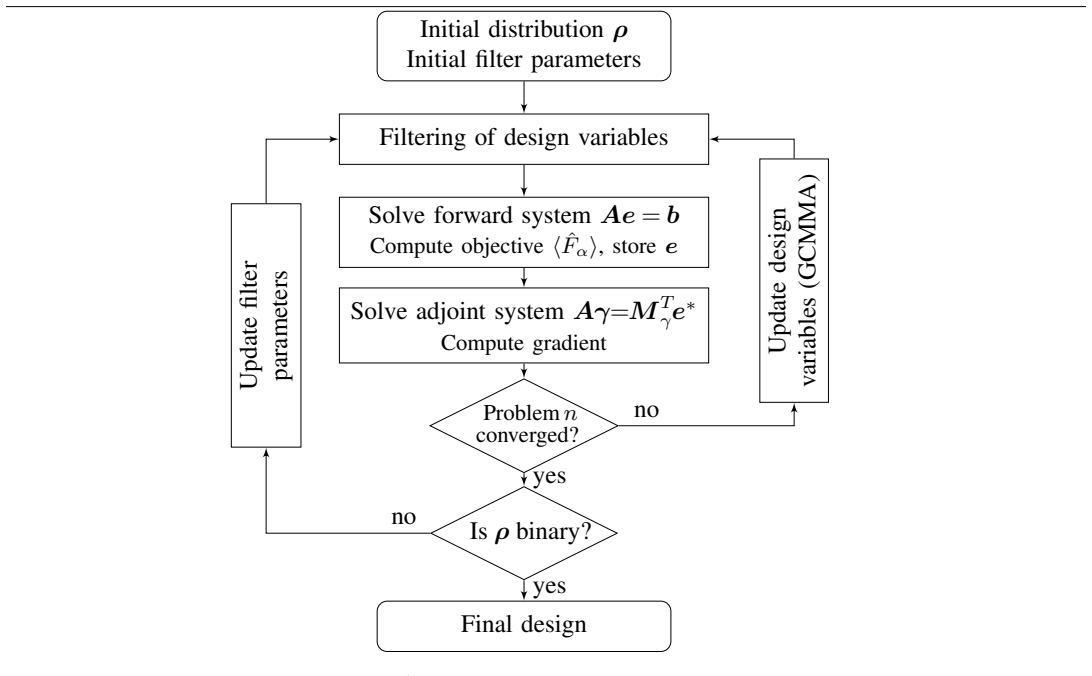
When plasmonic metasurfaces undergo density-based topology optimization to maximize the gradient force on nanoparticles, the resulting topologies depend on nanoparticle size and material, with higher trapping stiffness obtained for small nanoparticles. The optimization is performed first without and then with manufacturing constraints to produce planar designs, all under normally incident monochromatic excitation, and the force is evaluated via the Maxwell stress tensor.
Load-bearing premise
The density-based topology optimization procedure, applied under fixed normal-incidence monochromatic conditions and manufacturing limits, will reliably generate designs that achieve the intended maximum gradient force without convergence failures or the need for manual corrections.
Editorial extensions
If this is right
- The optimized metasurfaces enable selective mass trapping of nanoparticles distinguished by size or material.
- Incorporating manufacturing constraints still produces planar, fabricable metasurface layouts.
- Small nanoparticles experience higher trapping stiffness than larger ones in the optimized designs.
- The resulting structures support applications in biosensing, microfabrication, and assembly of quantum systems.
Reading between the lines
- Different optimized designs could be combined on one substrate to sort mixed nanoparticle populations by size or material in a single illumination step.
- The same optimization loop could be rerun at multiple wavelengths to create wavelength-selective trapping sites within one device.
- Experimental validation would require comparing measured stiffness values against the simulated ones for the reported nanoparticle sizes.
Signed reviews
Editorial analysis
A structured set of objections, weighed in public.
Referee Report
Summary. The manuscript proposes a density-based topology optimization framework for designing plasmonic metasurfaces that maximize the attractive gradient force on nanoparticles, computed via the Maxwell stress tensor under normally incident monochromatic illumination. Free-form designs are first optimized, followed by versions incorporating manufacturing constraints; results indicate that optimal topologies vary with nanoparticle size and material, with higher trapping stiffness for smaller particles, enabling potential selective trapping applications.
Significance. If the reported designs reliably maximize the MST-derived force and the optimization converges to near-global solutions, the work could contribute to practical metasurface-based optical trapping platforms for biosensing and micro-assembly. The approach builds on established MST force evaluation and standard density-based TO, which is a methodological strength when accompanied by convergence validation.
major comments (2)
- [Optimization framework / Results] Optimization section: the central claim that the reported topologies maximize the gradient force relies on density-based TO, but no evidence is provided of multiple random initializations, continuation schedules, or post-optimization local refinement to address the known non-convexity of the problem; without this, it is unclear whether the designs represent reliable (near-)global optima or initialization-dependent artifacts.
- [Numerical results] Results on nanoparticle dependence: the claim that topology depends on size/material and that small nanoparticles yield higher stiffness is presented without quantitative comparison to reference (e.g., unoptimized or periodic) metasurfaces, or error bars from mesh convergence studies, making it difficult to assess the magnitude of improvement.
minor comments (2)
- [Abstract] Abstract: the statement that 'the topology of the optimized metasurfaces depends on the nanoparticle size and material' would benefit from a brief quantitative example (e.g., feature size or resonance shift) to convey the effect size.
- [Figures] Figure captions: ensure all panels explicitly label the nanoparticle parameters (size, material, wavelength) used for each optimization run.
Simulated Author's Rebuttal
We thank the referee for the detailed and constructive review. The comments highlight important aspects of validation for the optimization framework and quantitative assessment of results. We address each major comment below and have revised the manuscript to strengthen these areas.
read point-by-point responses
-
Referee: [Optimization framework / Results] Optimization section: the central claim that the reported topologies maximize the gradient force relies on density-based TO, but no evidence is provided of multiple random initializations, continuation schedules, or post-optimization local refinement to address the known non-convexity of the problem; without this, it is unclear whether the designs represent reliable (near-)global optima or initialization-dependent artifacts.
Authors: We agree that additional validation is warranted given the non-convexity of density-based topology optimization. In the revised manuscript, we have added a dedicated paragraph in Section 2 (Methods) describing the optimization procedure, including a continuation schedule on the density penalization parameter (from p=1 to p=3 over 50 iterations) and results from five independent optimizations starting from different random initial density fields. All runs converged to topologically similar designs with objective function values (trapping force) differing by less than 4%, supporting that the reported metasurfaces are robust near-optimal solutions rather than initialization artifacts. No post-optimization local refinement was performed, as the continuation approach already yielded consistent results. revision: yes
-
Referee: [Numerical results] Results on nanoparticle dependence: the claim that topology depends on size/material and that small nanoparticles yield higher stiffness is presented without quantitative comparison to reference (e.g., unoptimized or periodic) metasurfaces, or error bars from mesh convergence studies, making it difficult to assess the magnitude of improvement.
Authors: We appreciate this observation. The revised manuscript now includes a new figure (Figure 7) and accompanying text in Section 3.3 that provides direct quantitative comparisons: the optimized trapping stiffness is benchmarked against both a uniform (unoptimized) gold film and a reference periodic grating metasurface for each nanoparticle size and material. Improvements range from 1.8x to 3.2x depending on particle parameters. Additionally, mesh convergence studies were conducted using three successively refined meshes (element sizes 5 nm, 2.5 nm, and 1.25 nm); the reported force values include error bars representing the standard deviation across these meshes, with convergence within 3% for all cases. These additions allow clearer assessment of the performance gains. revision: yes
Circularity Check
No circularity: standard forward MST force computation plus density-based optimization to maximize an independent physical objective.
full rationale
The derivation chain consists of (1) computing optical force via the established Maxwell stress tensor on nanoparticles under monochromatic illumination and (2) using density-based topology optimization to maximize the gradient component of that force, subject to manufacturing constraints. Neither step reduces to the other by definition, nor is any fitted parameter relabeled as a prediction, nor is a uniqueness result imported from self-citation. The abstract and described framework are self-contained against external benchmarks (MST is a standard, independently validated method). This matches the default expectation of no significant circularity.
Assumptions & free parameters
Cite this review
Pith. "Pith review of Topology optimized plasmonic metasurfaces for optical trapping of nanoparticles." pith.science (2026). https://pith.science/paper/5EHGBS5N
@misc{pith2026260702352,
  author       = {Pith},
  title        = {Pith review of: Topology optimized plasmonic metasurfaces for optical trapping of nanoparticles},
  year         = {2026},
  howpublished = {\url{https://pith.science/paper/5EHGBS5N}},
  note         = {Machine review of arXiv:2607.02352}
}
read the original abstract
Smart metasurfaces capable of employing the momentum of light for manipulating nanoparticles hold the key to potential applications in science and nanotechnology. This article proposes a density-based topology optimization framework for optimizing plasmonic metasurfaces for nanoparticles optical trapping. The Maxwell stress tensor (MST) is employed to compute the optical force exerted on nanoparticles of different sizes and types. The metasurfaces' topologies are optimized to maximize the gradient (attractive) force on such nanoparticles subject to normally incident monochromatic excitation. Designs based on free-form optimization are investigated first, then manufacturing constraints are imposed to provide easy-to-manufacture planar designs. The results show that the topology of the optimized metasurfaces depends on the nanoparticle size and material, with a higher trapping stiffness associated with small nanoparticles. The optimized metasurfaces could offer selective mass trapping of nanoparticles for applications in biosensing, microfabrication, or assembly of quantum systems.
Figures


Figures from the paper (3 more)


Reference graph
Works this paper leans on
-
[1]
Ashkin, Physical Review Letters 1970, 24, 4 156
A. Ashkin, Physical Review Letters 1970, 24, 4 156
work page 1970
-
[2]
J. P. Gordon, Phys. Rev. A 1973, 8 14
work page 1973
- [3]
- [4]
-
[5]
W. D. Phillips, Rev. Mod. Phys. 1998, 70, 3
work page 1998
-
[6]
Ashkin, Physical Review Letters 1978, 40, 12 729
A. Ashkin, Physical Review Letters 1978, 40, 12 729
work page 1978
-
[7]
K. Kim, K. Kim, J. Ahn, Advanced Quantum Technologies 2025, e00531
work page 2025
-
[8]
D. Bar-Lev, R. J. England, K. P. Wootton, W. Liu, A. Gover, R. Byer, K. J. Leedle, D. Black, J. Scheuer, Physical Review Accelerators and Beams 2019, 22, 2 021303
work page 2019
Show all 42 references
-
[9]
L. Shao, M. Käll, Advanced Functional Materials 2018, 28, 25 1706272
2018
-
[10]
Serrera, Y
G. Serrera, Y. Y. Tanaka, P. Albella, Nanophotonics 2025, 14, 20 3339
2025
-
[11]
Y. Ji, Z. Jin, J. Zhou, Y. Peng, X. Dai, Y. Zhong, J. Zhang, H. Liu, M. Wang, J. Qu, H. Ho, S. Zeng, Y. Wang, J. Chen, Y. Shao, Advanced Optical Materials 2025, 13, 21 2403140
2025
-
[12]
M. M. Salary, H. Mosallaei, Physical Review B 2016, 94, 3 035410
2016
-
[13]
Righini, P
M. Righini, P. Ghenuche, S. Cherukulappurath, V. Myroshnychenko, F. J. García De Abajo, R. Quidant, Nano Letters 2009, 9, 10 3387
2009
-
[14]
Ploschner, M
M. Ploschner, M. Mazilu, T. F. Krauss, K. Dholakia, Journal of Nanophotonics 2010, 4, 1 041570
2010
-
[15]
Novotny, R
L. Novotny, R. X. Bian, X. S. Xie, Phys. Rev. Lett. 1997, 79 645
1997
-
[16]
Belkin, S.-H
M. Belkin, S.-H. Chao, M. P. Jonsson, C. Dekker, A. Aksimentiev, ACS Nano 2015, 9, 11 10598, pMID: 26401685
2015
-
[17]
Z. Kang, J. Chen, S.-Y. Wu, K. Chen, S.-K. Kong, K.-T. Yong, H.-P. Ho, Scientific Reports 2015, 5, 1 9978
2015
-
[18]
Z. Xu, W. Song, K. B. Crozier, ACS Photonics 2018, 5, 7 2850
2018
-
[19]
M. L. Juan, R. Gordon, Y. Pang, F. Eftekhari, R. Quidant, Nature Physics 2009, 5, 12 915
2009
-
[20]
Novotny, B
L. Novotny, B. Hecht, Principles of Nano-Optics, Cambridge University Press, Cambridge, 2nd edition, 2012
2012
-
[21]
Nelson, S
D. Nelson, S. Kim, K. B. Crozier, ACS Photonics 2024, 11, 1 85
2024
-
[22]
Martinez De Aguirre Jokisch, B
B. Martinez De Aguirre Jokisch, B. F. Gøtzsche, P. T. Kristensen, M. Wubs, O. Sigmund, R. E. Christiansen, ACS Photonics 2024, 11, 12 5118
2024
-
[23]
Martinez De Aguirre Jokisch, R
B. Martinez De Aguirre Jokisch, R. E. Christiansen, O. Sigmund, Journal of the Optical Society of America B 2025, 42, 4 731
2025
-
[24]
M. P. Bends e, O. Sigmund, Topology Optimization -- Theory, Methods, and Applications, Springer Verlag, Germany, 2003
2003
-
[25]
Hassan, E
E. Hassan, E. Wadbro, M. Berggren, IEEE Trans. Antennas Propag. 2014, 63, 5 2488 2500
2014
-
[26]
Gedeon, I
J. Gedeon, I. Allayarov, A. Calà Lesina, E. Hassan, IEEE Trans. Antennas Propag. 2025, 73, 5 3079
2025
-
[27]
Hassan, A
E. Hassan, A. Cal\` a Lesina , Opt. Express 2022, 30, 11 19557
2022
-
[28]
D. J. Griffiths, Introduction to electrodynamics, Cambridge University Press, 5 edition, 2023
2023
-
[29]
J. P. Barton, D. R. Alexander, S. A. Schaub, Journal of Applied Physics 1989, 66, 10 4594
1989
-
[30]
Jin, The finite element method in electromagnetics, Wiley, third edition, 2014
J.-M. Jin, The finite element method in electromagnetics, Wiley, third edition, 2014
2014
-
[31]
Sharkawy, V
M. Sharkawy, V. Demir, A. Elsherbeni, IEEE Trans. Antennas Propag. 2006, 54, 2 666
2006
-
[32]
Zainud-Deen, E
S. Zainud-Deen, E. Hassan, M. Ibrahim, K. Awadalla, A. Botros, Progress In Electromagnetics Research B 2009, 16 351
2009
-
[33]
Taflove, S
A. Taflove, S. Hagness, Computational Electrodynamics: The Finite-Difference Time-Domain Method, Artech House, third edition, 2005
2005
-
[34]
R. C. Rumpf, Progress In Electromagnetics Research B 2012, 36 221
2012
-
[35]
Wadbro, C
E. Wadbro, C. Engström, Computer Methods in Applied Mechanics and Engineering 2015, 293 155
2015
-
[36]
R. E. Christiansen, J. Vester-Petersen, S. P. Madsen, O. Sigmund, Comput. Methods Appl. Mech. Eng. 2019, 343 23
2019
-
[37]
Sigmund, Struct
O. Sigmund, Struct. Multidiscip. Optim. 2007, 33, 4--5 401
2007
-
[38]
Svanberg, H
K. Svanberg, H. Sv \"a rd, Struct. Multidiscip. Optim. 2013, 48, 5 859
2013
-
[39]
H \"a gg, E
L. H \"a gg, E. Wadbro, Struct. Multidiscip. Optim. 2017, 55, 3 1017 1028
2017
-
[40]
Hassan, E
E. Hassan, E. Wadbro, L. H \"a gg, M. Berggren, Struct. Multidiscip. Optim. 2018, 57, 4 1765
2018
-
[41]
Svanberg, SIAMJ J
K. Svanberg, SIAMJ J. Optim. 2002, 12, 2 555 573
2002
-
[42]
P. B. Johnson, R. W. Christy, Phys. Rev. B 1972, 6 4370
1972
Reviewed July 3, 2026 · model on record in the stance chip above.
Discussion (0). Continue with ORCID to comment.