REVIEW 4 major objections 6 minor 23 references
Calculation of a force effect from muscle action to a quaternion-based musculoskeletal model
T0 review · 4 major / 6 minor · reviewed 2026-08-10 · deepseek-v4-flash
Pith's one-line read Muscle torque can be computed in quaternion coordinates through a constrained Jacobian map, avoiding the Euler-angle gimbal lock.
desk verdict A useful, honest methods paper with a locally correct mapping; the 180-degree singularity is acknowledged but the proposed workaround is incomplete, so the large-range-of-motion claim outruns the math. read the letter →
The pith
A machine-rendered reading of the paper's core claim, the machinery that carries it, and where it could break.
The reading
What carries the argument
The load-bearing object is the constrained quaternion muscle-length Jacobian $R^*_Q = \partial l_m/\partial Q^*_i$, where $Q^* = (Q_1,Q_2,Q_3)$ and $Q_0$ is eliminated through the unit-norm constraint. The matrix $E = 2 G T$, formed from the quaternion angular-velocity matrix $G$ and the $4\times3$ parametrization matrix $T$ from the constraint, converts between this Jacobian and the spatial Jacobian $R_S$ through $R^*_Q = E^T R_S$ and $R_S = (E^T)^{-1} R^*_Q$. Muscle torque is then $\tau = R_S F_m$. The machinery works because constraining the quaternion removes the redundant degree of freedom, making the mapping from spatial to quaternion coordinates unique and invertible, at the price of a singularity when $Q_0=0$.
What would settle it
Let the double pendulum pass through an orientation where a joint is rotated exactly 180 degrees, and evaluate Eq. 15 for a muscle spanning that joint: the torque should diverge or become undefined at that instant, while the unconstrained quaternion Jacobian $R_Q = 2G^T R_S$ remains finite. A finite torque at $Q_0=0$ would contradict the paper's singularity analysis.
Extended reading notes
Core claim
The paper's central claim is that in a quaternion-based musculoskeletal model, muscle torque can be obtained from the muscle-length Jacobian through the constrained mapping $R^*_Q = E^T R_S$ and $R_S = (E^T)^{-1} R^*_Q$, with torque $\tau = R_S F_m$. Here $R^*_Q$ is the derivative of muscle length with respect to the three independent quaternion components after enforcing $Q_0^2+Q_1^2+Q_2^2+Q_3^2=1$ and taking $Q_0 = \sqrt{1-Q_1^2-Q_2^2-Q_3^2}$. The matrix $E$ encodes the relation between quaternion rates and spatial angular velocity; the constraint makes $E$ square and invertible, whereas the naive unconstrained map from spatial to quaternion Jacobian is ambiguous. The authors demonstrate in a double-pendulum simulation that this constrained route produces moment arms identical to the analytical Euler-angle calculation, and they apply it to approximate a shoulder muscle path. Their stated benefit is a dynamical muscle representation that is free of Euler-angle gimbal lock and suitable for joints with large ranges of motion.
Load-bearing premise
All conversions rely on the scalar quaternion component $Q_0$ being positive and nonzero; at any 180-degree joint rotation $Q_0=0$ for both equivalent quaternions, the matrix $E$ cannot be inverted, and the muscle-torque calculation becomes singular.
Editorial extensions
If this is right
- Quaternion-based forward dynamics can include muscle actuation directly, without converting muscle paths to Euler angles at each step.
- Muscle moment arms exported from Euler-angle-based models can be transformed into quaternion Jacobians (Eqs. 6 and 14) and used for approximation or control.
- Polynomial muscle-path approximations in quaternion coordinates are feasible: the shoulder example required 13 polynomial terms versus 15 in Euler coordinates, with 10.01 mm versus 10.18 mm RMSE in moment arms.
- Simulations of joints with large ranges of motion, such as the shoulder, can avoid changing rotation sequences to dodge gimbal lock.
- The constrained form reduces the number of derivatives from four to three, lowering computational cost per muscle evaluation.
Reading between the lines
- The paper leaves implicit that its singularity at $Q_0=0$ can be handled by switching to the other quaternion chart or to the unconstrained four-component Jacobian near 180-degree rotations; the method as stated is local, not global.
- Because the constrained mapping makes quaternion Jacobians and Euler moment arms algebraically interchangeable (Eqs. 5, 6, 14, 15), muscle paths defined in existing Euler-angle models could be re-expressed in quaternion form and run in quaternion-based solvers without re-deriving muscle geometry.
- The shoulder example's comparable accuracy with fewer polynomial terms hints that quaternion coordinates may be a smoother domain for muscle-path regression, but the paper notes the comparison depends on the fitting algorithm; testing multiple muscles and motions would tell whether the hint is general.
- An optimal-control extension follows naturally: a quaternion state avoids the discontinuous rotation-sequence switches that Euler coordinates force, which could make all feasible joint trajectories reachable in trajectory optimization.
Editorial analysis
A structured set of objections, weighed in public.
Referee Report
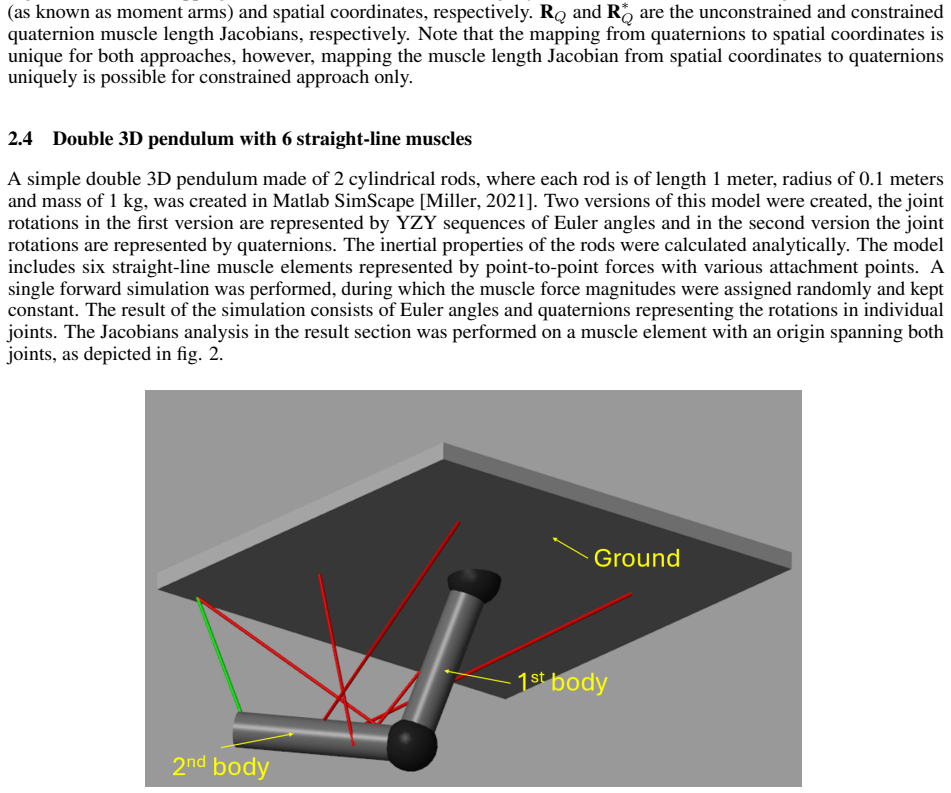
Summary. The paper proposes a mathematical framework for computing muscle torques in quaternion-based musculoskeletal models. It introduces a constrained mapping between the muscle length Jacobian in spatial coordinates and the Jacobian in a reduced quaternion parametrization, derived by imposing the unit-quaternion constraint and selecting Q0 = sqrt(1-Q1^2-Q2^2-Q3^2) with Q0>0. The mapping is validated on a three-dimensional double-pendulum model with six straight-line muscles, showing exact agreement with analytic YZY Euler-angle moment arms (Fig. 3), and is applied to polynomial approximation of the serratus anterior muscle length in a shoulder model (Section 3.2).
Significance. If valid, the method provides a practical route to muscle torque computation in quaternion-based dynamic simulations, potentially avoiding Euler-angle gimbal lock for joints with large range of motion such as the shoulder. The paper includes a strong validation step (machine-checkable exact agreement in Fig. 3) and demonstrates a relevant application to a realistic shoulder muscle path approximation. However, the singularity at 180-degree rotations is acknowledged but not resolved, and the absence of a full dynamic simulation limits the strength of the claims about robust torque estimation for the intended application domain.
major comments (4)
- [Section 2.3, Eq. (11) and Discussion] The constrained mapping R*_Q = E^T R_S and R_S = (E^T)^{-1} R*_Q is singular when Q0=0, i.e., for any 180-degree rotation. The sign-flip remedy proposed in the Discussion (multiplying the quaternion by -1 when Q0<0) fails exactly at Q0=0 and introduces a discontinuous jump in the reduced coordinates Q* when a continuous motion crosses the Q0=0 hypersurface. Because the paper explicitly targets shoulder models with large range of motion, and a 180-degree rotation is physically possible, the method is not globally valid for the claimed application. The authors should either provide a global chart (e.g., switching the dependent quaternion component) or explicitly restrict the claims and characterize the region of validity.
- [Section 2.3, Eqs. (13)-(15)] The derivation is presented for a single quaternion, but the validation and application involve multiple joints (double pendulum with two 3D joints; shoulder with sternoclavicular and acromioclavicular joints). The paper does not define how the matrix E and the quaternion Jacobian R*_Q are assembled for multiple quaternions. While the empirical agreement in Fig. 3 suggests a correct block-diagonal extension, the formalism should be stated explicitly for the multi-quaternion case so that the reader can reproduce the mapping without inference.
- [Section 3.2 and Figure 4] The polynomial approximation of the muscle length is performed after mapping to a reduced quaternion representation requiring Q0>0. If the training data, which includes added random noise, contains configurations with Q0<0, the sign-flip makes Q* discontinuous at Q0=0, violating the differentiability assumptions of the polynomial fitting algorithm. The paper should report whether any training configuration had Q0 near zero, and specify how the sign-flip is handled in the polynomial approximation; otherwise, the comparison of RMSE for the quaternion-based approximation is not meaningful for motions that cross the singularity.
- [Section 3.1 and Discussion] The validation compares muscle length Jacobians, not actual torques in a dynamic simulation. The abstract and introduction suggest that the method estimates muscle torques for dynamic models, and the Discussion claims 'robust estimation of muscle torques in dynamic motion'. A forward dynamics simulation using the quaternion-based torque (e.g., comparing the resulting motion with the Euler-angle model) would substantiate this claim more directly than a static Jacobian comparison.
minor comments (6)
- [Abstract] The phrase 'transformation of muscle moment arms obtained from muscle paths based on Euler angles into quaternions description' is grammatically awkward; consider rephrasing to 'transformation of muscle moment arms from Euler-angle-based muscle paths into the quaternion representation'.
- [Section 2.2 and 2.3] The notation RQ, R*_Q, RS, and RE is easy to confuse. Please provide a table or explicit definitions of each Jacobian's dimensions and reference frame (e.g., RQ is a 4-vector, R*_Q is a 3-vector, RS is a 3-vector in body coordinates, RE is a 3-vector in Euler coordinates).
- [Figure 3] The caption states that the mapped and analytic curves are 'identical', but the plot likely shows overlapping lines. Consider adding a second subplot with the pointwise difference to visually confirm the agreement, and state the numerical maximum error in the text.
- [Section 2.4] The double-pendulum model is described as '3D' but the number of degrees of freedom (two joints with three rotational DOF each) is not explicitly stated. Clarify this to avoid ambiguity about the size of the Jacobians.
- [Section 2.5] The stopping criterion 'the change of the RMSE of an approximation and OpenSim generated values was less than 4%' is not fully specified. Please state the exact error measure, the direction of the change, and how the 4% threshold was chosen.
- [Section 2.5] The description of adding 'random noise to the angles' is not reproducible. Specify the noise distribution, standard deviation, and whether the noise was added to the measured angles or to the corresponding quaternions.
Circularity Check
No significant circularity: the quaternion torque mapping is derived from quaternion kinematics and the unit-norm constraint, and the application is checked against independent Euler-angle benchmarks.
full rationale
The paper's central derivation, Eqs. 14-16, is a coordinate transformation, not a fitted or self-referential construction. Starting from the standard relation omega = 2G Qdot (Eq. 1) and the unit-quaternion constraint, the paper introduces the local parametrization Q0 = sqrt(1 - Q1^2 - Q2^2 - Q3^2), so Qdot = T Qdot* (Eq. 11) and omega = E Qdot* with E = 2GT (Eq. 12). The muscle-length Jacobian identity R*_Q = E^T R_S (Eq. 14) follows by the chain rule for the infinitesimal work balance, so it is not assumed as the result it claims to prove. The verification in Section 3.1 compares the quaternion-derived moment arms against an analytically computed YZY Euler-angle moment arm, which is an independent benchmark rather than a restatement of the paper's own outputs. The upper-limb example uses OpenSim's serratus anterior data and the van den Bogert polynomial algorithm; because the RMSE is reported for approximations of the same exported lengths and moment arms, it is a regression-error report rather than a claimed out-of-sample prediction, so it does not constitute a fitted input renamed as a prediction. Self-citations to Chadwick et al. (2014) and van den Bogert et al. (2011) appear only as application tools for the shoulder model and polynomial fitting, respectively; neither supplies a load-bearing premise of the mathematical derivation. The acknowledged singularity at Q0 = 0 for 180-degree rotations is a genuine limitation of the local parametrization, but the paper states this limitation openly in the Discussion, and a limitation is not circularity. No load-bearing step is equivalent to its inputs by construction, and no uniqueness claim is imported from the authors' prior work. The derivation is self-contained and independently verifiable, so the appropriate circularity score is 0.
Assumptions & free parameters
free parameters (3)
- Polynomial coefficients for Euler approximation =
not reported
- Polynomial coefficients for quaternion approximation =
not reported
- Stopping-criterion threshold =
4% RMSE change
assumptions (5)
- standard math Angular velocity is related to quaternion derivative by omega = 2 G Qdot (Eq. 1), as defined by Graf 2008.
- domain assumption Muscle length lm is a differentiable function of quaternion elements (or of Q* after substitution).
- domain assumption The unit quaternion constraint Q0^2+Q1^2+Q2^2+Q3^2=1 and the chart Q0 = +sqrt(...) with Q0 > 0 cover all relevant orientations.
- domain assumption Moment arms exported from OpenSim can be treated as muscle length Jacobians in Euler coordinates and mapped via Eq. 5.
- domain assumption Polynomial approximation (van den Bogert et al. 2011) captures muscle path behavior within a 4% RMSE stopping criterion.
Cite this review
Pith. "Pith review of Calculation of a force effect from muscle action to a quaternion-based musculoskeletal model." pith.science (2026). https://pith.science/paper/5F7UWIIW
@misc{pith2026250203475,
  author       = {Pith},
  title        = {Pith review of: Calculation of a force effect from muscle action to a quaternion-based musculoskeletal model},
  year         = {2026},
  howpublished = {\url{https://pith.science/paper/5F7UWIIW}},
  note         = {Machine review of arXiv:2502.03475}
}
read the original abstract
Euler angle representation in biomechanical analysis allows straightforward description of joints rotations. However, application of Euler angles could be limited due to singularity called gimbal lock. Quaternions offer an alternative way to describe rotations but they have been mostly avoided in biomechanics as they are complex and not inherently intuitive, specifically in dynamic models actuated by muscles. This study introduces a mathematical framework for describing muscle actions in dynamic quaternion-based musculoskeletal simulations. The proposed method estimates muscle torques in quaternion-based musculoskeletal model. Its application is shown on three-dimensional double-pendulum system actuated by muscle elements. Furthermore, transformation of muscle moment arms obtained from muscle paths based on Euler angles into quaternions description is presented. The proposed method is advantageous for dynamic modeling of musculoskeletal models with complex kinematics and large range of motion like the shoulder joint.
Figures


Figures from the paper (1 more)

Reference graph
Works this paper leans on
-
[1]
Ge Wu, Frans C. T. van der Helm, H. E. J. DirkJan Veeger, Mohsen Makhsous, Peter Van Roy, Carolyn Anglin, Jochem Nagels, Andrew R. Karduna, Kevin McQuade, Xuguang Wang, Frederick W. Werner, Bryan Buchholz, and International Society of Biomechanics . ISB recommendation on definitions of joint coordinate systems of various joints for the reporting of human ...
work page 2005
-
[2]
A. Bonnefoy-Mazure, J. Slawinski, A. Riquet, J. M. Lévèque, C. Miller, and L. Chèze. Rotation sequence is an important factor in shoulder kinematics. Application to the elite players’ flat serves. Journal of Biomechanics, 43 0 (10): 0 2022--2025, July 2010. ISSN 0021-9290. doi:10.1016/j.jbiomech.2010.03.028. URL https://www.sciencedirect.com/science/artic...
-
[3]
Barrett, Kyle Parrish, and Hunter J
Kiara B. Barrett, Kyle Parrish, and Hunter J. Bennett. Rotation sequences for the calculation of shoulder kinematics of the volleyball attack. Journal of Biomechanics, 162: 0 111906, January 2024. ISSN 0021-9290. doi:10.1016/j.jbiomech.2023.111906. URL https://www.sciencedirect.com/science/article/pii/S0021929023004773
-
[4]
Ryan Clark, Taylor Dickinson, Johnfredy Loaiza, Daniel W. Geiger, and Steven K. Charles. Tracking Joint Angles During Whole - Arm Movements Using Electromagnetic Sensors . Journal of Biomechanical Engineering, 142 0 (074502), March 2020. ISSN 0148-0731. doi:10.1115/1.4045814. URL https://doi.org/10.1115/1.4045814
-
[5]
Thomas Creveaux, Violaine Sevrez, Raphaël Dumas, Laurence Chèze, and Isabelle Rogowski. Rotation sequence to report humerothoracic kinematics during 3D motion involving large horizontal component: application to the tennis forehand drive. Sports Biomechanics, 17 0 (1): 0 131--141, January 2018. ISSN 1476-3141. doi:10.1080/14763141.2016.1260765. URL https:...
-
[6]
Vandana Phadke, Jonathan P. Braman, Robert F. LaPrade, and Paula M. Ludewig. Comparison of Glenohumeral Motion Using Different Rotation Sequences . Journal of biomechanics, 44 0 (4): 0 700, February 2011. doi:10.1016/j.jbiomech.2010.10.042. URL https://www.ncbi.nlm.nih.gov/pmc/articles/PMC3042544/. Publisher: NIH Public Access
-
[7]
Rotation sequence as an important factor in shoulder kinematics
Miroslav Šenk and Laurence Chèze. Rotation sequence as an important factor in shoulder kinematics. Clinical Biomechanics, 21: 0 S3--S8, January 2006. ISSN 0268-0033. doi:10.1016/j.clinbiomech.2005.09.007. URL https://www.sciencedirect.com/science/article/pii/S0268003305002214
-
[8]
Micah Prendergast, Irene Beck, Cosimo Della Santina, Luka Peternel, and Ajay Seth
Italo Belli, Sagar Joshi, J. Micah Prendergast, Irene Beck, Cosimo Della Santina, Luka Peternel, and Ajay Seth. Does enforcing glenohumeral joint stability matter? A new rapid muscle redundancy solver highlights the importance of non-superficial shoulder muscles. PLOS ONE, 18 0 (11): 0 e0295003, 2023. ISSN 1932-6203. doi:10.1371/journal.pone.0295003. URL ...
Show all 23 references
-
[9]
Animating rotation with quaternion curves
Ken Shoemake. Animating rotation with quaternion curves. ACM SIGGRAPH Computer Graphics, 19 0 (3): 0 245--254, July 1985. ISSN 0097-8930. doi:10.1145/325165.325242. URL https://dl.acm.org/doi/10.1145/325165.325242
1985
-
[10]
A method for determination of upper extremity kinematics
George Rab, Kyria Petuskey, and Anita Bagley. A method for determination of upper extremity kinematics. Gait & Posture, 15 0 (2): 0 113--119, April 2002. ISSN 0966-6362. doi:10.1016/S0966-6362(01)00155-2. URL https://www.sciencedirect.com/science/article/pii/S0966636201001552
2002 doi
-
[11]
Schnorenberg and Brooke A
Alyssa J. Schnorenberg and Brooke A. Slavens. Effect of Rotation Sequence on Thoracohumeral Joint Kinematics during Various Shoulder Postures . In 2021 43rd Annual International Conference of the IEEE Engineering in Medicine & Biology Society ( EMBC ) , pages 4912--4915, Novem...
2021
-
[12]
John H. Challis. Quaternions as a solution to determining the angular kinematics of human movement. BMC Biomedical Engineering, 2 0 (1): 0 5, March 2020. ISSN 2524-4426. doi:10.1186/s42490-020-00039-z. URL https://doi.org/10.1186/s42490-020-00039-z
2020 doi
-
[13]
Comparative analysis of upper body kinematics in stroke, Parkinson 's disease, and healthy subjects: An observational study using IMU -based targeted box and block test
Elena Sofia Cocco, Sanaz Pournajaf, Paola Romano, Giovanni Morone, Carrie-Louise Thouant, Leonardo Buscarini, Carlotta Maria Manzia, Matteo Cioeta, Giorgio Felzani, Francesco Infarinato, Marco Franceschini, and Michela Goffredo. Comparative analysis of upper body kinematics in...
2024 doi
-
[14]
Kezhe Zhu, Jinxuan Li, Dongxuan Li, Bingfei Fan, and Peter B. Shull. IMU Shoulder Angle Estimation : Effects of Sensor -to- Segment Misalignment and Sensor Orientation Error . IEEE Transactions on Neural Systems and Rehabilitation Engineering, 31: 0 4481--4491, 2023. ISSN 1558...
2023
-
[15]
QMEDNet : A quaternion-based multi-order differential encoder–decoder model for 3D human motion prediction
Wenming Cao, Shuangshuang Li, and Jianqi Zhong. QMEDNet : A quaternion-based multi-order differential encoder–decoder model for 3D human motion prediction. Neural Networks, 154: 0 141--151, October 2022. ISSN 0893-6080. doi:10.1016/j.neunet.2022.07.005. URL https://www.science...
2022 doi
-
[16]
Modeling Human Motion with Quaternion - Based Neural Networks
Dario Pavllo, Christoph Feichtenhofer, Michael Auli, and David Grangier. Modeling Human Motion with Quaternion - Based Neural Networks . International Journal of Computer Vision, 128, April 2020. doi:10.1007/s11263-019-01245-6
2020 doi
-
[17]
Delp, Frank C
Scott L. Delp, Frank C. Anderson, Allison S. Arnold, Peter Loan, Ayman Habib, Chand T. John, Eran Guendelman, and Darryl G. Thelen. OpenSim : Open - Source Software to Create and Analyze Dynamic Simulations of Movement . IEEE Transactions on Biomedical Engineering, 54 0 (11): ...
1940
-
[18]
Quaternions and dynamics, 2008
Basile Graf. Quaternions and dynamics, 2008. URL https://arxiv.org/abs/0811.2889. Version Number: 1
2008 arXiv
-
[19]
Simscape multibody contact forces library, February 2021
Steve Miller. Simscape multibody contact forces library, February 2021. URL https://github.com/mathworks/Simscape-Multibody-Contact-Forces-Library/releases/tag/20.2.5.0. [Online; accessed Feb 2021]
2021
-
[20]
Chadwick, Dimitra Blana, Robert F
Edward K. Chadwick, Dimitra Blana, Robert F. Kirsch, and Antonie J. Van Den Bogert. Real- Time Simulation of Three - Dimensional Shoulder Girdle and Arm Dynamics . IEEE Transactions on Biomedical Engineering, 61 0 (7): 0 1947--1956, July 2014. ISSN 0018-9294, 1558-2531. doi:10...
1947
-
[21]
van den Bogert, Dimitra Blana, and Dieter Heinrich
Antonie J. van den Bogert, Dimitra Blana, and Dieter Heinrich. Implicit methods for efficient musculoskeletal simulation and optimal control. Procedia IUTAM, 2: 0 297--316, January 2011. ISSN 2210-9838. doi:10.1016/j.piutam.2011.04.027. URL https://www.sciencedirect.com/scienc...
2011 doi
-
[22]
K.N. An, Y. Ueba, E.Y. Chao, W.P. Cooney, and R.L. Linscheid. Tendon excursion and moment arm of index finger muscles. Journal of Biomechanics, 16 0 (6): 0 419--425, January 1983. ISSN 00219290. doi:10.1016/0021-9290(83)90074-X. URL https://linkinghub.elsevier.com/retrieve/pii...
1983
-
[23]
Boots, Valeriya Gritsenko, Lee E
Anton Sobinov, Matthew T. Boots, Valeriya Gritsenko, Lee E. Fisher, Robert A. Gaunt, and Sergiy Yakovenko. Approximating complex musculoskeletal biomechanics using multidimensional autogenerating polynomials. PLOS Computational Biology, 16 0 (12): 0 e1008350, December 2020. IS...
2020 doi
Reviewed August 10, 2026 · model on record in the stance chip above.
Discussion (0). Continue with ORCID to comment.