Channel Estimation for Movable Intelligent Surface
Pith reviewed 2026-06-28 20:49 UTC · model grok-4.3
The pith
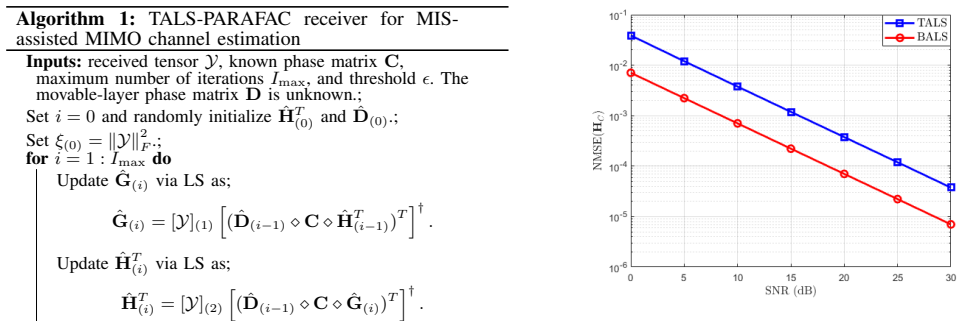
A fourth-order PARAFAC tensor model recovers MIMO channels and the unknown movable-layer phase response without any prior calibration of that layer.
A machine-rendered reading of the paper's core claim, the machinery that carries it, and where it could break.
Core claim
The received pilots in this architecture admit an exact fourth-order PARAFAC decomposition whose factors are the fixed-layer phase patterns, the movable-layer position responses, the individual user channels, and the unknown movable-layer phase response; a trilinear ALS receiver recovers all these quantities from the tensor without any prior information about the movable response.
What carries the argument
The fourth-order PARAFAC tensor formed by the received pilots, with modes corresponding to fixed-layer phase patterns, movable-layer positions, receive antennas, and transmit users.
If this is right
- The individual channels and the position-dependent response can be estimated separately without prior knowledge of the movable-layer phase.
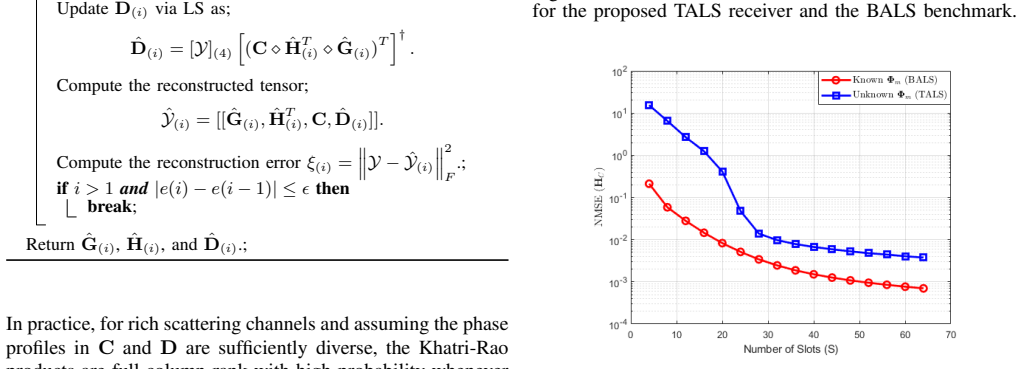
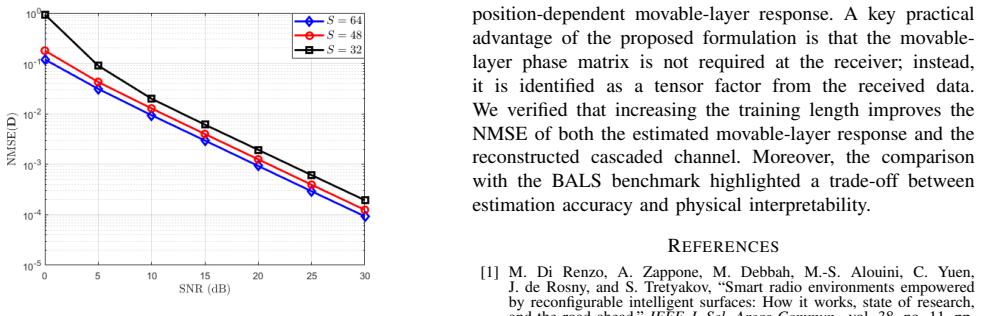
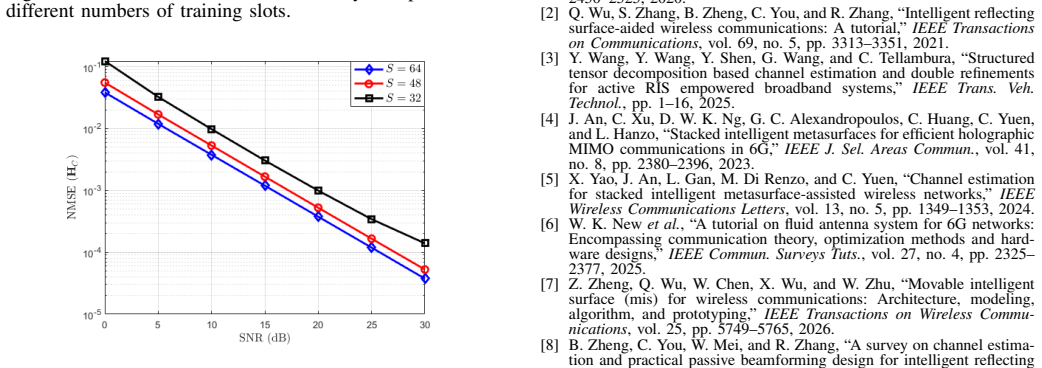
- Normalized mean-square error of the estimated factors and the reconstructed cascaded channel decreases as training length increases.
- The cascaded channel is obtained by combining the estimated factors after the decomposition.
- The method applies directly to the uplink MIMO setting with the described fixed-plus-movable surface architecture.
Where Pith is reading between the lines
- The same tensor structure could be exploited when the movable layer takes continuous rather than discrete positions, provided the position factor can still be parameterized.
- The approach may extend to multi-cell or downlink scenarios if the additional position dimension remains observable at the receiver.
- If PARAFAC uniqueness conditions hold under realistic noise, the method could reduce pilot overhead compared with separate calibration of each movable position.
Load-bearing premise
The received pilots can be exactly represented as a fourth-order PARAFAC tensor whose factors correspond to fixed-layer phase patterns, movable-layer positions, and the individual channels.
What would settle it
Run the trilinear ALS algorithm on measured or simulated pilots whose tensor rank or factor structure deviates from the assumed PARAFAC model and check whether the estimated channels still match the true cascaded channel within the reported NMSE.
Figures

read the original abstract
This paper proposes a tensor-based channel estimation framework for an uplink MIMO system assisted by a movable intelligent surface. The considered architecture combines a fixed transmissive metasurface with a smaller movable layer, whose discrete positions create an additional structured training dimension. By jointly exploiting fixed-layer phase patterns and movable-layer positions, the received pilots are modeled as a fourth-order PARAFAC tensor. A trilinear alternating least-squares receiver is then derived to estimate the individual channels and the position-dependent response. Importantly, the proposed method does not require prior knowledge of the movable-layer phase response at the receiver, since this unknown factor is estimated from the tensor structure of the received signal. Simulation results show that increasing the training length improves the NMSE of the estimated factors and the reconstructed cascaded channel.
Editorial analysis
A structured set of objections, weighed in public.
Referee Report
Summary. The manuscript proposes a tensor-based channel estimation framework for an uplink MIMO system assisted by a movable intelligent surface. It combines a fixed transmissive metasurface with a smaller movable layer whose discrete positions add a structured training dimension. The received pilots are modeled as a fourth-order PARAFAC tensor, from which a trilinear alternating least-squares algorithm jointly estimates the individual channels and the unknown position-dependent phase response of the movable layer. The method claims to recover this unknown factor directly from the tensor structure without requiring prior knowledge at the receiver. Simulations are asserted to demonstrate that longer training lengths improve the NMSE of the estimated factors and the reconstructed cascaded channel.
Significance. If the exact multilinear PARAFAC structure holds and the recovery is reliable, the approach would allow channel estimation in movable intelligent surface systems without prior calibration of the movable layer, addressing a practical limitation. The exploitation of an additional position-based training dimension via tensor factorization is a potentially useful idea for structured estimation problems in reconfigurable surfaces.
major comments (2)
- [Abstract] Abstract: the assertion that 'simulation results show that increasing the training length improves the NMSE of the estimated factors and the reconstructed cascaded channel' supplies no quantitative values, error bars, baseline comparisons, or details on simulation parameters and data generation, leaving the performance claims uninspectable and preventing assessment of whether the improvement is meaningful.
- [Abstract] Abstract: the central claim that the unknown movable-layer phase response can be recovered without prior knowledge rests on the received pilots being exactly representable as a fourth-order PARAFAC tensor whose factors correspond to fixed-layer patterns, movable positions, channels, and the position-dependent response; no uniqueness analysis (Kruskal ranks or condition for four-way tensors) or robustness discussion against model mismatch (mutual coupling, phase quantization, near-field effects) is provided, which is load-bearing for the recovery guarantee.
minor comments (1)
- The description of a 'trilinear' ALS receiver for a fourth-order tensor is unclear; explicit statement of how the fourth mode is incorporated (e.g., via unfolding or mode-specific updates) would aid reproducibility.
Simulated Author's Rebuttal
We thank the referee for the constructive comments. We address each major comment below and agree that revisions to the abstract and addition of analysis are warranted.
read point-by-point responses
-
Referee: [Abstract] Abstract: the assertion that 'simulation results show that increasing the training length improves the NMSE of the estimated factors and the reconstructed cascaded channel' supplies no quantitative values, error bars, baseline comparisons, or details on simulation parameters and data generation, leaving the performance claims uninspectable and preventing assessment of whether the improvement is meaningful.
Authors: We agree that the abstract statement is too brief and lacks quantitative support. The full manuscript (Section IV) contains NMSE plots versus training length with specific parameter settings (e.g., antenna counts, SNR), but these details are not summarized in the abstract. We will revise the abstract to include representative quantitative improvements and a brief mention of simulation parameters. revision: yes
-
Referee: [Abstract] Abstract: the central claim that the unknown movable-layer phase response can be recovered without prior knowledge rests on the received pilots being exactly representable as a fourth-order PARAFAC tensor whose factors correspond to fixed-layer patterns, movable positions, channels, and the position-dependent response; no uniqueness analysis (Kruskal ranks or condition for four-way tensors) or robustness discussion against model mismatch (mutual coupling, phase quantization, near-field effects) is provided, which is load-bearing for the recovery guarantee.
Authors: The referee correctly notes the absence of a formal uniqueness analysis or robustness discussion. The manuscript derives the trilinear ALS estimator under the assumed PARAFAC model and validates it via simulation, but does not supply Kruskal-rank conditions for the four-way tensor or examine mismatches such as mutual coupling or quantization. We will add a dedicated subsection on identifiability conditions and limitations in the revised manuscript. revision: yes
Circularity Check
No circularity; PARAFAC modeling assumption is independent of the ALS estimator
full rationale
The paper states that the architecture leads to a fourth-order PARAFAC model for the received pilots, then derives a trilinear ALS procedure to recover the factors including the unknown movable-layer response. This is a standard tensor decomposition workflow with no self-definitional steps, no fitted parameters renamed as predictions, and no load-bearing self-citations or uniqueness theorems from the authors. The central claim follows directly from the multilinear model without reducing to its own inputs by construction.
Axiom & Free-Parameter Ledger
axioms (1)
- domain assumption Received pilots admit an exact fourth-order PARAFAC decomposition whose factors are the fixed-layer phases, movable positions, and channels
Reference graph
Works this paper leans on
-
[1]
Smart radio environments empowered by reconfigurable intelligent surfaces: How it works, state of research, and the road ahead,
M. Di Renzo, A. Zappone, M. Debbah, M.-S. Alouini, C. Yuen, J. de Rosny, and S. Tretyakov, “Smart radio environments empowered by reconfigurable intelligent surfaces: How it works, state of research, and the road ahead,”IEEE J. Sel. Areas Commun., vol. 38, no. 11, pp. 2450–2525, 2020
2020
-
[2]
Intelligent reflecting surface-aided wireless communications: A tutorial,
Q. Wu, S. Zhang, B. Zheng, C. You, and R. Zhang, “Intelligent reflecting surface-aided wireless communications: A tutorial,”IEEE Transactions on Communications, vol. 69, no. 5, pp. 3313–3351, 2021
2021
-
[3]
Structured tensor decomposition based channel estimation and double refinements for active RIS empowered broadband systems,
Y . Wang, Y . Wang, Y . Shen, G. Wang, and C. Tellambura, “Structured tensor decomposition based channel estimation and double refinements for active RIS empowered broadband systems,”IEEE Trans. Veh. Technol., pp. 1–16, 2025
2025
-
[4]
Stacked intelligent metasurfaces for efficient holographic MIMO communications in 6G,
J. An, C. Xu, D. W. K. Ng, G. C. Alexandropoulos, C. Huang, C. Yuen, and L. Hanzo, “Stacked intelligent metasurfaces for efficient holographic MIMO communications in 6G,”IEEE J. Sel. Areas Commun., vol. 41, no. 8, pp. 2380–2396, 2023
2023
-
[5]
Channel estimation for stacked intelligent metasurface-assisted wireless networks,
X. Yao, J. An, L. Gan, M. Di Renzo, and C. Yuen, “Channel estimation for stacked intelligent metasurface-assisted wireless networks,”IEEE Wireless Communications Letters, vol. 13, no. 5, pp. 1349–1353, 2024
2024
-
[6]
A tutorial on fluid antenna system for 6G networks: Encompassing communication theory, optimization methods and hard- ware designs,
W. K. Newet al., “A tutorial on fluid antenna system for 6G networks: Encompassing communication theory, optimization methods and hard- ware designs,”IEEE Commun. Surveys Tuts., vol. 27, no. 4, pp. 2325– 2377, 2025
2025
-
[7]
Movable intelligent surface (mis) for wireless communications: Architecture, modeling, algorithm, and prototyping,
Z. Zheng, Q. Wu, W. Chen, X. Wu, and W. Zhu, “Movable intelligent surface (mis) for wireless communications: Architecture, modeling, algorithm, and prototyping,”IEEE Transactions on Wireless Commu- nications, vol. 25, pp. 5749–5765, 2026
2026
-
[8]
A survey on channel estima- tion and practical passive beamforming design for intelligent reflecting surface aided wireless communications,
B. Zheng, C. You, W. Mei, and R. Zhang, “A survey on channel estima- tion and practical passive beamforming design for intelligent reflecting surface aided wireless communications,”IEEE Commun. Surveys Tuts., vol. 24, no. 2, pp. 1035–1071, 2022
2022
-
[9]
Channel esti- mation with reconfigurable intelligent surfaces—a general framework,
A. L. Swindlehurst, G. Zhou, R. Liu, C. Pan, and M. Li, “Channel esti- mation with reconfigurable intelligent surfaces—a general framework,” Proceedings of the IEEE, vol. 110, no. 9, pp. 1312–1338, 2022
2022
-
[10]
Channel estimation for intelligent reflecting surface assisted MIMO systems: A tensor modeling approach,
G. T. de Araújo, A. L. F. de Almeida, and R. Boyer, “Channel estimation for intelligent reflecting surface assisted MIMO systems: A tensor modeling approach,”IEEE J. Sel. Topics Signal Process., vol. 15, no. 3, pp. 789–802, Apr 2021
2021
-
[11]
Channel estimation in RIS-assisted MIMO systems operating under imperfections,
P. R. B. Gomes, G. T. de Araújo, B. Sokal, A. L. F. de Almeida, B. Makki, and G. Fodor, “Channel estimation in RIS-assisted MIMO systems operating under imperfections,”IEEE Trans. Veh. Technol, vol. 72, no. 11, pp. 14 200–14 213, 2023
2023
-
[12]
PARAFAC- based unified tensor modeling for wireless communication systems with application to blind multiuser equalization,
A. L. F. de Almeida, G. Favier, and J. C. M. Mota, “PARAFAC- based unified tensor modeling for wireless communication systems with application to blind multiuser equalization,”Signal Process., vol. 87, no. 2, pp. 337–351, 2007
2007
-
[13]
A constrained factor decomposition with application to MIMO antenna systems,
——, “A constrained factor decomposition with application to MIMO antenna systems,”IEEE Trans. Signal Process., vol. 56, no. 6, pp. 2429– 2442, 2008
2008
-
[14]
Tensor space–time (TST) coding for mimo wireless communication systems,
G. Favier, M. N. da Costa, A. L. de Almeida, and J. M. T. Romano, “Tensor space–time (TST) coding for mimo wireless communication systems,”Signal Process., vol. 92, no. 4, pp. 1079–1092, 2012
2012
-
[15]
Double Khatri-Rao space-time- frequency coding using semi-blind PARAFAC based receiver,
A. L. F. de Almeida and G. Favier, “Double Khatri-Rao space-time- frequency coding using semi-blind PARAFAC based receiver,”IEEE Signal Process. Lett., vol. 20, no. 5, pp. 471–474, 2013
2013
-
[16]
Tensor space-time-frequency coding with semi-blind receivers for MIMO wireless communication systems,
G. Favier and A. L. F. de Almeida, “Tensor space-time-frequency coding with semi-blind receivers for MIMO wireless communication systems,” IEEE Trans. Signal Process., vol. 62, no. 22, pp. 5987–6002, 2014
2014
-
[17]
PARAFAC-based channel estimation for intelligent reflective surface assisted MIMO system,
G. T. de Araújo and A. L. F. de Almeida, “PARAFAC-based channel estimation for intelligent reflective surface assisted MIMO system,” in SAM 2020, 2020, pp. 1–5
2020
-
[18]
Channel estimation for RIS-empowered multi-user MISO wireless communications,
L. Wei, C. Huang, G. C. Alexandropoulos, C. Yuen, Z. Zhang, and M. Debbah, “Channel estimation for RIS-empowered multi-user MISO wireless communications,”IEEE Trans. Commun., vol. 69, no. 6, pp. 4144–4157, 2021
2021
-
[19]
TRICE: A channel estimation framework for RIS-aided millimeter-wave MIMO systems,
K. Ardah, S. Gherekhloo, A. L. F. de Almeida, and M. Haardt, “TRICE: A channel estimation framework for RIS-aided millimeter-wave MIMO systems,”IEEE Signal Process. Lett., vol. 28, pp. 513–517, 2021
2021
-
[20]
Two-timescale channel estimation for reconfigurable intelligent surface aided wireless communications,
C. Hu, L. Dai, S. Han, and X. Wang, “Two-timescale channel estimation for reconfigurable intelligent surface aided wireless communications,” IEEE Trans. Commun., vol. 69, no. 11, pp. 7736–7747, 2021
2021
-
[21]
Tensor decompositions, alternating least squares and other tales,
P. Comon, X. Luciani, and A. L. F. de Almeida, “Tensor decompositions, alternating least squares and other tales,”J. Chemometrics, vol. 23, no. 7-8, pp. 393–405, 2009
2009
discussion (0)
Sign in with ORCID, Apple, or X to comment. Anyone can read and Pith papers without signing in.