REVIEW 3 major objections 5 minor 48 references
Asymptotically rigid mapping class groups of infinite graphs
T0 review · 3 major / 5 minor · reviewed 2026-08-05 · deepseek-v4-flash
Pith's one-line read A new family of graph Houghton groups has finiteness properties exactly controlled by the number of ends of the underlying graph.
desk verdict New Houghton-type groups with a strong presentation and non-commensurability results, but the central finiteness theorem rests on an unproved connectivity result that needs to be supplied or made precise before the paper is fully convincing. read the letter →
The pith
A machine-rendered reading of the paper's core claim, the machinery that carries it, and where it could break.
The reading
What carries the argument
The carrying mechanism is a Stein–Farley cube complex X (and its doubled handlebody analogue X), whose vertices are equivalence classes [Z,f] of suited subgraphs Z of the rigidified graph together with a group element f; edges and cubes record nesting of suited subgraphs. The group acts by left multiplication, the complexity function h([Z,f]) = rank(π1(Z)) is a discrete Morse function, and Brown's criterion turns high connectivity of descending links into finiteness properties. Descending links are analyzed through the piece complex P(Z,Q) of a compact doubled handlebody with boundary spheres and the injective tethered handle complex TH1(Z,Q); complete join maps (in the sense of Hatcher–Wahl
What would settle it
Find a doubled handlebody Z with rk(π1(Z)) ≥ 4k+4 and at least k+2 boundary spheres whose injective tethered handle complex TH1(Z,Q) is not k-connected—for example, a non-null-homotopic k-sphere in the complex. Because Theorem 5.20 is the only unproved input in the Brown's criterion chain, such a complex would invalidate the proof of Theorem 1.1 (though not necessarily the statement).
Extended reading notes
Core claim
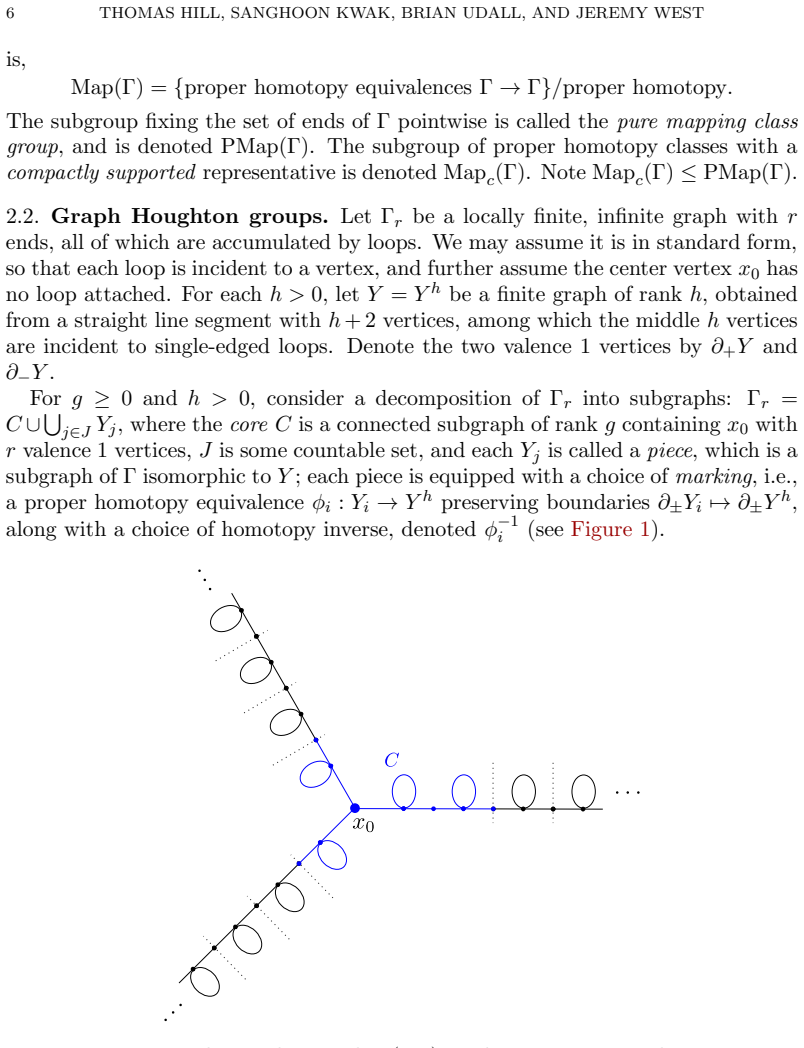
On the paper's own terms, the discovery is a rigidity-to-finiteness dictionary for infinite graphs: once a rigid structure (a finite core plus tails that are copies of a fixed rank-h graph) is fixed, the asymptotically rigid mapping class group B(g,h,r) has the same finiteness type as the classical Houghton group H_r. For r < ∞ ends, all accumulated by loops, B(g,h,r) is of type F_{r-1} but not of type FP_r; when the end space is a Cantor set, the asymptotically rigid subgroup is of type F∞. The proof runs through a Stein–Farley cube complex on which the group acts; Brown's criterion reduces the task to showing descending links are (r-2)-connected, which is achieved by identifying the links
Load-bearing premise
The proof of the main finiteness theorem depends on Theorem 5.20, which asserts that injective tethered handle complexes of doubled handlebodies are highly connected under rank and boundary-sphere bounds; the paper states this follows as in the surface case but does not carry out the induction.
Editorial extensions
If this is right
- For every r ≥ 2, B(g,h,r) and its doubled handlebody counterpart are finitely generated, and for r ≥ 3 finitely presented; no finite classifying space exists with finitely many r-cells, so the type exactly matches H_r.
- When the end space is a Cantor set, the asymptotically rigid mapping class group is of type F∞, extending the finite-end result to a natural 'big' limit.
- The pure graph Houghton group PBr, r ≥ 3, has an explicit finite presentation and contains a copy of Aut(F_n) for every n; this makes PBr one concrete finitely presented group housing all Aut(F_n).
- The graph and doubled handlebody Houghton groups are not commensurable with the classical, braided, surface, or handlebody Houghton groups, so the graph construction genuinely enlarges the Houghton family.
- PBr is one-ended for r ≥ 2, has solvable word problem, fails the Tits alternative, and its BNSR-invariants coincide with those of the ordinary and surface Houghton groups; the Dehn function remains an open upper-bound problem.
Reading between the lines
- A natural test: use the explicit presentation of PBr as an algorithmic normal form for elements of Aut(F_n) and for end-periodic graph maps; success would give computational access to dynamics that the paper only raises as an open question.
- The non-commensurability result suggests that the 'Houghton phenomenon'—finiteness type F_{r-1} but not FP_r—is not a commensurability invariant of the underlying space but a common feature of many rigid structures; quasi-isometry classification (Question 3.1) would be the sharper invariant to pursue.
- One could try to close the Dehn function gap by tracking the quasi-isometry constants in the exponential upper bound for Aut(F_m), since the paper shows the missing ingredient is control of those constants for its particular generating set.
- If Theorem 5.20's unproved induction collapses, a weakened theorem might still hold with modified bounds on rank or number of boundary components; checking the bad-simplex links in the doubled handlebody setting would separate the method's robustness from the present formulation.
Editorial analysis
A structured set of objections, weighed in public.
Referee Report
Summary. This paper introduces asymptotically rigid mapping class groups of locally finite infinite graphs and their associated doubled handlebodies, and studies the resulting 'graph Houghton groups' and 'doubled handlebody Houghton groups'. The main results are: Theorem 1.1, finiteness properties F_{r-1} but not FP_r for graphs/doubled handlebodies with r finitely many ends all accumulated by loops/genus, and F_∞ for a Cantor set of ends; Theorem 1.2, non-commensurability of graph and doubled handlebody Houghton groups with classical, braided, surface, and handlebody Houghton groups; and Theorem 1.3, an explicit finite presentation of the pure graph Houghton group P B_r for r ≥ 3. The paper also studies ends, the Tits alternative, BNSR-invariants, the word problem, and the Dehn function, and gives a stable homology result in the Cantor case.
Significance. If the results hold, this is a natural and valuable contribution: it extends the Houghton-group phenomenon to asymptotically rigid mapping class groups of graphs, gives a concrete new family of groups with explicit presentations, and proves they are not commensurable with previously known Houghton-type groups. The paper is notably transparent about its limitations: Theorem 5.20 is deferred to an analogy with [ABKL23], Theorems 8.4 and 8.5 are stated without proof, and Section 8.4 explicitly records a failed strategy for bounding the Dehn function. This honesty is a strength, but those deferrals are load-bearing for the main theorem and must be addressed.
major comments (3)
- [§5.4, Theorem 5.20] The proof of Theorem 1.1 runs through Brown's criterion; condition (c) is supplied by Corollary 5.22, which relies on Theorem 5.15, which in turn relies on Theorem 5.20. The proof of Theorem 5.20 is not contained in the paper: it says 'This follows as in the proof of [ABKL23, Theorem 5.7]' and 'we do not repeat it here.' The earlier remark in §5.1 explicitly says that bad simplices are skipped because they are used only in proving Theorem 5.20. Since adapting from the surface setting to doubled handlebodies with boundary spheres is precisely where the rank and boundary-count bounds and the good-link identification must be checked, this is a load-bearing gap. Please provide the full induction or a detailed reduction, not just an analogy.
- [§8.3, Theorems 8.4 and 8.5] Theorems 8.4 and 8.5 are stated as results, but Section 8.3 contains no proof. The sentence 'with occasional modifications, the entire analysis of [TW24, Section 3 & 4] can be carried out unchanged' is insufficient to establish the BNSR-invariant statement in this new setting. Either provide the proof or explicitly present these as conditional claims/conjectures.
- [§7.2, Theorem 7.4] Theorem 7.4, the stable homology computation, is stated with a proof sketch that says 'after making the appropriate modifications, the proof of [DZ25, Theorem 6.4] can be directly adapted.' The adaptation is not described. Since this is a standalone theorem, the proof should be supplied or the statement should be downgraded to a conjecture.
minor comments (5)
- [Theorem 1.3] The phrase 'in each case, 2 ≤ i < j ≤ n' should use r instead of n; the symbol n is not defined in the statement.
- [Notation 2.9 / Theorem 1.1] The same symbol B(g,h,r) is used for both the graph Houghton group and the doubled handlebody Houghton group. Although Remark 2.6 introduces calligraphic notation, the theorem statements do not consistently use it. Please add a clarifying sentence in Theorem 1.1 or in Notation 2.9.
- [§3.2 and Figure 10] Typo: 'Genovois' should be 'Genevois'; the Figure 10 caption uses 'Stein–Farely' instead of 'Stein–Farley'.
- [§8.4] The section title promises a Dehn-function result, but the section ends with an open question and a statement that no bound is obtained. Consider retitling the section or making the open status explicit in the first sentence.
- [Lemma 2.7] The proof says the kernel contains all finite products of sphere twists and no infinite products, but the forward inclusion is only implicit. Please spell out why every element of the kernel of Ψ_B is a finite product of sphere twists.
Circularity Check
No significant circularity: the derivation is self-contained except for external cited theorems; the main proof gap (Theorem 5.20) is an omitted proof, not a circular reduction.
full rationale
The paper's central finiteness proof (Theorem 1.1) applies Brown's criterion to Stein–Farley complexes. The descending-link connectivity is imported from Theorem 5.20, which is not proved in the paper: "This follows as in the proof of [ABKL23, Theorem 5.7]" and "we do not repeat it here." This is a verifiability gap and a load-bearing external citation, but it is not circular: [ABKL23] shares no authors with this paper, and the connectivity of TH_1(Z,Q) is not defined in terms of the F_{r-1} conclusion being proved. Similarly, Section 5.1 explicitly skips "the discussion of bad simplices" because they are only used in the same external proof; again a delegation, not a self-referential equation. The self-citations that do occur—[DHK23]/[DHK25] for flux maps and the unique finite-index subgroup SAut_infty, [Uda24] for the sphere-twist kernel of Map(M_Gamma)->Map(Gamma), and [TW24] for BNSR-invariant computations—are prior results with their own stated assumptions; none is fitted to the present paper's conclusions, and none renames a conclusion as a hypothesis. The commensurability proof also uses [She25] and [ABKL23, Cor 1.3] as independent inputs. No parameter is fitted and no 'prediction' is equivalent by construction to an input. The presentation theorem uses [AFV08] externally. The admitted gap in Section 8.4 (no analog of [Lee12, Lemma 4.3]) is an honest limitation, not circularity. Therefore: no circular steps.
Assumptions & free parameters
assumptions (7)
- domain assumption Proper homotopy classification of locally finite graphs by (E(Γ), E_ℓ(Γ)) and rank (ADMQ90).
- domain assumption Flux map short exact sequence for PMap(Γ_n) from [DHK25, Theorem B].
- standard math Brown's criterion for finiteness properties (Theorem 5.1, from [ABKL23]).
- standard math Presentation of Aut(F_n) by Armstrong-Forrest-Vogtmann [AFV08, Theorem 1].
- domain assumption Laudenbach/Udall theorem: Ψ: Map(M_Γ) → Map(Γ) is surjective with kernel Twists(M_Γ) [Uda24, Theorem 1.1].
- standard math Complete join connectivity results of Hatcher-Wahl [HW10, Proposition 3.5] and Aramayona-Bux-Flechsig-Petrosyan-Wu [ABF+24].
- domain assumption Connectivity of the injective tethered handle complex for doubled handlebodies, deferred to the argument of [ABKL23, Theorem 5.7].
Cite this review
Pith. "Pith review of Asymptotically rigid mapping class groups of infinite graphs." pith.science (2026). https://pith.science/paper/5HESZGA6
@misc{pith2026250821264,
  author       = {Pith},
  title        = {Pith review of: Asymptotically rigid mapping class groups of infinite graphs},
  year         = {2026},
  howpublished = {\url{https://pith.science/paper/5HESZGA6}},
  note         = {Machine review of arXiv:2508.21264}
}
read the original abstract
We introduce and study asymptotically rigid mapping class groups of certain infinite graphs. We determine their finiteness properties and show that these depend on the number of ends of the underlying graph. In a special case where the graph has finitely many ends, we construct an explicit presentation for the so-called pure graph Houghton group and investigate several of its algebraic and geometric properties. Additionally, we show that the graph Houghton groups are not commensurable with other known Houghton-type groups, namely the classical, surface, braided, handlebody, and doubled handlebody Houghton groups, demonstrating that this graph-based construction defines a genuinely new class of groups.
Figures


Figures from the paper (11 more)




Reference graph
Works this paper leans on
-
[1]
Anderson, Javier Aramayona, and Kenneth J
James W. Anderson, Javier Aramayona, and Kenneth J. Shackleton. A simple criterion for non-relative hyperbolicity and one-endedness of groups. arXiv preprint arXiv:0504271 , 2005
work page 2005
-
[2]
Groups of proper homotopy equivalences of graphs and N ielsen R ealization
Yael Algom - Kfir and Mladen Bestvina. Groups of proper homotopy equivalences of graphs and N ielsen R ealization. In Topology at infinity of discrete groups , volume 812 of Contemp. Math. , pages 1--31. Amer. Math. Soc., Providence, RI, 2025
work page 2025
-
[3]
Asymptotic mapping class groups of C antor manifolds and their finiteness properties
Javier Aramayona, Kai-Uwe Bux, Jonas Flechsig, Nansen Petrosyan, and Xiaolei Wu. Asymptotic mapping class groups of C antor manifolds and their finiteness properties. Rev. Mat. Iberoam. , 40(6):2003--2072, 2024. With an appendix by Oscar Randal-Williams
work page 2003
- [4]
- [5]
- [6]
-
[7]
Asymptotic mapping class groups of closed surfaces punctured along Cantor sets
Javier Aramayona and Louis Funar. Asymptotic mapping class groups of closed surfaces punctured along Cantor sets. Moscow Mathematical Journal , 2017
work page 2017
-
[8]
Heather Armstrong, Bradley Forrest, and Karen Vogtmann. A presentation for Aut (F_n) . J. Group Theory , 11(2):267--276, 2008
work page 2008
Show all 48 references
-
[9]
Finiteness conditions on groups and quasi-isometries
Juan M Alonso. Finiteness conditions on groups and quasi-isometries. Journal of Pure and Applied Algebra , 95(2):121--129, 1994
1994
-
[10]
Morse theory and finiteness properties of groups
Mladen Bestvina and Noel Brady. Morse theory and finiteness properties of groups. Invent. Math. , 129(3):445--470, 1997
1997
-
[11]
The T its alternative for Out (F_n)
Mladen Bestvina, Mark Feighn, and Michael Handel. The T its alternative for Out (F_n) . I . D ynamics of exponentially-growing automorphisms. Ann. of Math. (2) , 151(2):517--623, 2000
2000
-
[12]
Solvable subgroups of Out ( F _n) are virtually abelian
Mladen Bestvina, Mark Feighn, and Michael Handel. Solvable subgroups of Out ( F _n) are virtually abelian. Geometriae Dedicata , 104(1):71--96, 2004
2004
-
[13]
The T its alternative for Out (F_n)
Mladen Bestvina, Mark Feighn, and Michael Handel. The T its alternative for Out (F_n) . II . A K olchin type theorem. Ann. of Math. (2) , 161(1):1--59, 2005
2005
-
[14]
James Belk, Francesco Fournier - Facio, James Hyde, and Matthew C. B. Zaremsky. Boone--Higman embeddings of Aut (F_n) and mapping class groups of punctured surfaces. arXiv preprint arXiv:2503.21882 , 2025
2025 arXiv
-
[15]
Boone and Graham Higman
William W. Boone and Graham Higman. An algebraic characterization of groups with soluble word problem. J. Austral. Math. Soc. , 18:41--53, 1974
1974
-
[16]
Kenneth S. Brown. Finiteness properties of groups. Journal of Pure and Applied Algebra , 44(1):45--75, 1987
1987
-
[17]
Moduli of graphs and automorphisms of free groups
Marc Culler and Karen Vogtmann. Moduli of graphs and automorphisms of free groups. Inventiones mathematicae , 84(1):91--119, 1986
1986
-
[18]
Degenhardt
F. Degenhardt. Endlichkeitseigeinschaften gewisser gruppen von zöpfen unendlicher ordnung. University of Frankfurt , 2000. PhD Thesis
2000
-
[19]
Coarse geometry of pure mapping class groups of infinite graphs
George Domat, Hannah Hoganson, and Sanghoon Kwak. Coarse geometry of pure mapping class groups of infinite graphs. Adv. Math. , 413:Paper No. 108836, 57, 2023
2023
-
[20]
Surfaces proper homotopy equivalent to graphs and their D ehn- N ielsen- B aer maps
Ryan Dickmann, Hannah Hoganson, and Sanghoon Kwak. Surfaces proper homotopy equivalent to graphs and their D ehn- N ielsen- B aer maps. arXiv preprint arXiv:2410.20877 , 2024
2024 arXiv
-
[21]
Generating Sets and Algebraic Properties of Pure Mapping Class Groups of Infinite Graphs
George Domat, Hannah Hoganson, and Sanghoon Kwak. Generating Sets and Algebraic Properties of Pure Mapping Class Groups of Infinite Graphs . Annales Henri Lebesgue , 8:373--416, 2025
2025
-
[22]
Finiteness properties of asymptotically rigid handlebody groups
Sergio Domingo-Zubiaga. Finiteness properties of asymptotically rigid handlebody groups. arXiv preprint arXiv:2504.05787 , 2025
2025 arXiv
-
[23]
Homological and finiteness properties of picture groups
Daniel Farley. Homological and finiteness properties of picture groups. Transactions of the American Mathematical Society , 357(9):3567--3584, 2005
2005
-
[24]
An infinite genus mapping class group and stable cohomology
Louis Funar and Christophe Kapoudjian. An infinite genus mapping class group and stable cohomology. Communications in Mathematical Physics , 287(3):787–804, February 2009
2009
-
[25]
L. Funar. Braided H oughton groups as mapping class groups. An. Ştiinţ. Univ. Al. I. Cuza Iaşi. Mat. (N.S.) , 52(2):229--240, 2007
2007
-
[26]
Asymptotically rigid mapping class groups, I : Finiteness properties of braided T hompson’s and H oughton’s groups
Anthony Genevois, Anne Lonjou, and Christian Urech. Asymptotically rigid mapping class groups, I : Finiteness properties of braided T hompson’s and H oughton’s groups. Geometry & Topology , 26(3):1385–1434, August 2022
2022
-
[27]
M. Gromov. Asymptotic invariants of infinite groups. In Geometric group theory, V ol.\ 2 ( S ussex, 1991) , volume 182 of London Math. Soc. Lecture Note Ser. , pages 1--295. Cambridge Univ. Press, Cambridge, 1993
1991
-
[28]
G. Higman. Subgroups of finitely presented groups. Proc. Roy. Soc. London Ser. A , 262:455--475, 1961
1961
-
[29]
Large-scale geometry of pure mapping class groups of infinite-type surfaces
Thomas Hill. Large-scale geometry of pure mapping class groups of infinite-type surfaces. Proceedings of the American Mathematical Society , 153(06):2667--2680, 2025
2025
-
[30]
Kopreski, Rebecca Rechkin, George Shaji, and Brian Udall
Thomas Hill, Michael C. Kopreski, Rebecca Rechkin, George Shaji, and Brian Udall. Automorphisms of the sphere complex of an infinite graph. arXiv preprint arXiv:2410.06531 , 2024
2024 arXiv
-
[31]
The first cohomology of a group with permutation module coefficients
CH Houghton. The first cohomology of a group with permutation module coefficients. Archiv der Mathematik , 31:254--258, 1978
1978
-
[32]
Isoperimetric inequalities for automorphism groups of free groups
Allen Hatcher and Karen Vogtmann. Isoperimetric inequalities for automorphism groups of free groups. Pacific Journal of Mathematics , 173(2):425--441, 1996
1996
-
[33]
Homology stability for outer automorphism groups of free groups
Allen Hatcher and Karen Vogtmann. Homology stability for outer automorphism groups of free groups. Algebr. Geom. Topol. , 4:1253--1272, 2004
2004
-
[34]
Stabilization for mapping class groups of 3-manifolds
Allen Hatcher and Nathalie Wahl. Stabilization for mapping class groups of 3-manifolds. Duke Mathematical Journal , 155(2), November 2010
2010
-
[35]
Relative train tracks and endperiodic graph maps
Yan Mary He and Chenxi Wu. Relative train tracks and endperiodic graph maps. arXiv preprint arXiv:2408.13401 , 2024
2024 arXiv
-
[36]
D. L. Johnson. Embedding some recursively presented groups. In Groups S t. A ndrews 1997 in B ath, II , volume 261 of London Math. Soc. Lecture Note Ser. , pages 410--416. Cambridge Univ. Press, Cambridge, 1999
1997
-
[37]
Topologie de la dimension trois: homotopie et isotopie , volume 12
Fran c ois Laudenbach. Topologie de la dimension trois: homotopie et isotopie , volume 12. Soci \'e t \'e math \'e matique de France, 1974
1974
-
[38]
Geometry of H oughton's groups
Sang Rae Lee. Geometry of H oughton's groups . ProQuest LLC, Ann Arbor, MI, 2012. Thesis (Ph.D.)--The University of Oklahoma
2012
-
[39]
End- P eriodic T rain T rack M aps and D ynamics on F ree-by- C yclic G roups
Ruth Meadow - MacLeod. End- P eriodic T rain T rack M aps and D ynamics on F ree-by- C yclic G roups . ProQuest LLC, Ann Arbor, MI, 2024. Thesis (Ph.D.)--Temple University
2024
-
[40]
Algebraic and topological properties of big mapping class groups
Priyam Patel and Nicholas Vlamis. Algebraic and topological properties of big mapping class groups. Algebraic & Geometric Topology , 18(7):4109–4142, December 2018
2018
-
[41]
Coarse geometry of topological groups , volume 223 of Cambridge Tracts in Mathematics
Christian Rosendal. Coarse geometry of topological groups , volume 223 of Cambridge Tracts in Mathematics . Cambridge University Press, Cambridge, 2022
2022
-
[42]
Normal Closure of Finite Subgroups of Aut(F_n) and Out(F_n)
Jiayi Shen. Normal Closure of Finite Subgroups of Aut(F_n) and Out(F_n) . PhD thesis, Notre Dame, 2025
2025
-
[43]
On torsion-free groups with infinitely many ends
John R Stallings. On torsion-free groups with infinitely many ends. Annals of Mathematics , 88(2):312--334, 1968
1968
-
[44]
Groups of piecewise linear homeomorphisms
Melanie Stein. Groups of piecewise linear homeomorphisms. Transactions of the American Mathematical Society , 332(2):477--514, 1992
1992
-
[45]
BNSR -invariants of surface H oughton groups
Noah Torgerson and Jeremy West. BNSR -invariants of surface H oughton groups. arXiv preprint arXiv:2403.04941 , 03 2024
2024
-
[46]
The sphere complex of a locally finite graph
Brian Udall. The sphere complex of a locally finite graph. arXiv preprint arXiv:2407.07976 , 07 2024
2024 arXiv
-
[47]
On the -invariants of generalized T hompson groups and H oughton groups
Matthew CB Zaremsky. On the -invariants of generalized T hompson groups and H oughton groups. International Mathematics Research Notices , 2017(19):5861--5896, 2017
2017
-
[48]
The BNSR -invariants of the H oughton groups, concluded
Matthew CB Zaremsky. The BNSR -invariants of the H oughton groups, concluded. Proceedings of the Edinburgh Mathematical Society , 63(1):1--11, 2020
2020
Reviewed August 5, 2026 · model on record in the stance chip above.
Discussion (0). Continue with ORCID to comment.