Opinion Dynamics over Migration Networks
Pith reviewed 2026-06-25 20:04 UTC · model grok-4.3
The pith
A stochastic master equation couples opinion changes, births and deaths, and migration to produce consensus, polarization, and stabilized opinion cycles.
A machine-rendered reading of the paper's core claim, the machinery that carries it, and where it could break.
Core claim
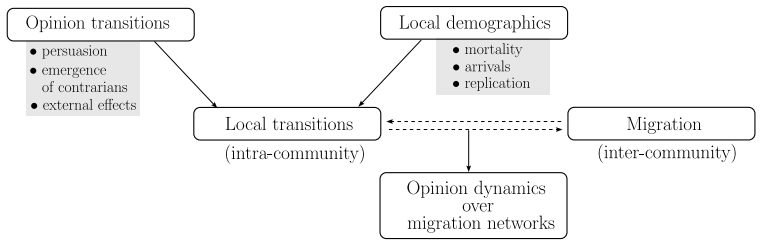
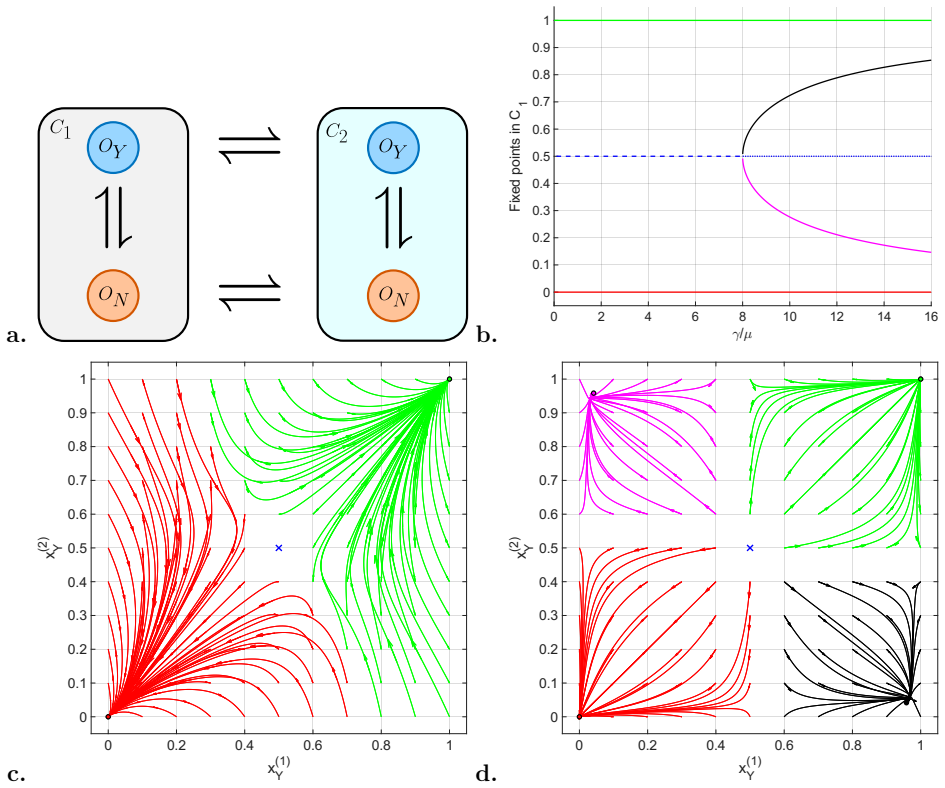
The central discovery is a unifying stochastic framework for opinion dynamics over migration networks that couples local opinion transitions, demographic processes and migration between communities. The dynamics are formulated through a spatio-temporal master equation, which provides a probabilistic description of the underlying population process. From this microscopic representation, deterministic mean-field equations are derived that govern the co-evolution of community sizes and opinion compositions. Two case studies demonstrate that stochasticity and migration can qualitatively change emergent dynamics and collective outcomes, including the emergence of consensus, polarization and the s
What carries the argument
The spatio-temporal master equation that simultaneously encodes local opinion transitions, demographic birth-death processes, and migration flows between communities.
If this is right
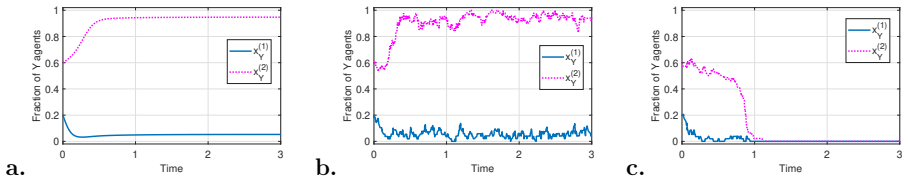
- Deterministic models without stochasticity or migration miss certain transitions between collective states.
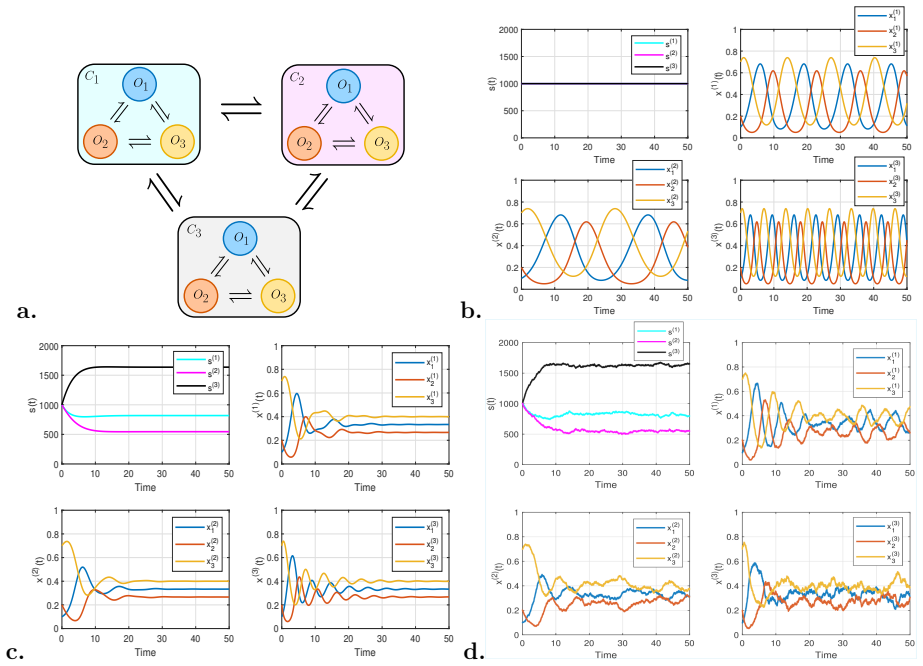
- Migration flows can stabilize oscillatory opinion dynamics that would otherwise persist or decay.
- Community sizes and opinion shares co-evolve through the derived mean-field equations.
- Finite-size fluctuations and random transitions become visible only in the stochastic formulation.
- Migration must be treated as an internal component of opinion formation rather than an external demographic input.
Where Pith is reading between the lines
- The same master-equation structure could be used to track cultural traits or voting preferences that travel with migrating populations.
- Surveys that record both residence changes and opinion shifts over time could directly test whether the predicted qualitative changes appear.
- Adjusting migration rates in the model would offer a way to explore how movement policies might affect levels of political division.
Load-bearing premise
A single master equation can be written that accurately combines opinion transitions, demographic processes, and migration without extra unstated interaction terms that would remove the claimed qualitative changes.
What would settle it
Real data from a migration network in which opinion patterns show no difference in consensus, polarization, or oscillation behavior between versions that include versus exclude stochasticity and migration.
Figures
read the original abstract
Opinions play a crucial role in shaping collective phenomena such as political polarization, cultural integration and demographic change. By continuously changing social environments in which opinions evolve, human migration serves as an important driver of collective opinion formation. While migration and opinion dynamics have both been extensively studied, the few existing models that couple the two are primarily deterministic and therefore cannot capture demographic fluctuations, finite-size effects or stochastic transitions between emergent collective states. To address this limitation, we introduce a unifying stochastic framework for opinion dynamics over migration networks that couples local opinion transitions, demographic processes and migration between communities. The dynamics are formulated through a spatio--temporal master equation, which provides a probabilistic description of the underlying population process. From this microscopic representation, we derive deterministic mean-field equations governing the co-evolution of community sizes and opinion compositions, thereby linking agent-level interactions to macroscopic population behavior. Using two representative case studies, we demonstrate how stochasticity and migration can qualitatively change the emergent dynamics and collective outcomes, including the emergence of consensus, polarization and the stabilization of oscillatory opinion dynamics. These examples highlight the rich interplay between social interactions, demographic change and migration in deterministic and stochastic settings, and they demonstrate that migration should be viewed as an integral component of collective opinion formation rather than only an external demographic process.
Editorial analysis
A structured set of objections, weighed in public.
Referee Report
Summary. The manuscript introduces a unifying stochastic framework for opinion dynamics over migration networks. It formulates the coupled processes of local opinion transitions, demographic birth-death processes, and inter-community migration via a single spatio-temporal master equation, derives deterministic mean-field equations for community sizes and opinion compositions, and uses two case studies to demonstrate that stochasticity and migration can qualitatively alter collective outcomes including consensus, polarization, and stabilization of oscillations.
Significance. If the central construction and derivations hold, the work supplies a principled stochastic-to-deterministic link for social dynamics that treats migration as an endogenous driver rather than an external parameter; the explicit master-equation starting point and the reported qualitative distinctions between stochastic and deterministic regimes are strengths that could inform subsequent modeling in sociophysics.
minor comments (3)
- [mean-field derivation section] The abstract states that mean-field equations are derived from the master equation, but the manuscript should explicitly state the closure or approximation steps used in that derivation (e.g., in the section presenting the mean-field limit) to allow readers to assess when the qualitative changes survive the limit.
- [case-studies section] The two case studies are described as representative, yet the specific functional forms chosen for the opinion-transition rates and migration probabilities are not compared against alternative functional forms; a brief sensitivity check would strengthen the claim that the reported behaviors are generic rather than model-specific.
- [model-formulation section] Notation for the state variables (e.g., community size N_i and opinion fraction x_i) should be introduced once with a clear table or list of symbols to avoid ambiguity when the master equation is written in component form.
Simulated Author's Rebuttal
We thank the referee for the positive assessment of the manuscript, the accurate summary of its contributions, and the recommendation for minor revision. No major comments were provided in the report.
Circularity Check
No significant circularity detected
full rationale
The paper formulates a spatio-temporal master equation as the central modeling step to couple opinion transitions, demographic birth-death processes, and migration flows, then derives deterministic mean-field equations from this microscopic representation. This constitutes a standard forward derivation from a probabilistic description to macroscopic equations, with no reduction of any claimed prediction or qualitative outcome (consensus, polarization, oscillatory stabilization) to a fitted parameter or self-referential definition. Case studies illustrate emergent behaviors from the constructed dynamics rather than tautologically reproducing inputs. No self-citation load-bearing steps, ansatz smuggling, or renaming of known results are present in the provided text. The derivation chain is self-contained against external benchmarks.
Axiom & Free-Parameter Ledger
Reference graph
Works this paper leans on
-
[1]
A data-driven kinetic model for opinion dynamics with social network contacts
Giacomo Albi, Elisa Calzola, and Giacomo Dimarco. A data-driven kinetic model for opinion dynamics with social network contacts. European Journal of Applied Mathe- matics, 36(2):264–290, 2025. 25
2025
-
[2]
Opinion dynamics over com- plex networks: Kinetic modelling and numerical methods
Giacomo Albi, Lorenzo Pareschi, and Mattia Zanella. Opinion dynamics over com- plex networks: Kinetic modelling and numerical methods. Kinetic and Related Models , 10(1):1–32, 2017
2017
-
[3]
Anderson and Thomas G
David F. Anderson and Thomas G. Kurtz. Stochastic analysis of biochemical systems , volume 674. Springer, 2015
2015
-
[4]
Opinion polarization by learning from social feed- back
Sven Banisch and Eckehard Olbrich. Opinion polarization by learning from social feed- back. The Journal of Mathematical Sociology , 43(2):76–103, 2019
2019
-
[5]
James, Maxime Lenor- mand, Thomas Louail, Ronaldo Menezes, José J
Hugo Barbosa, Marc Barthelemy, Gourab Ghoshal, Charlotte R. James, Maxime Lenor- mand, Thomas Louail, Ronaldo Menezes, José J. Ramasco, Filippo Simini, and Marcello Tomasini. Human mobility: Models and applications. Physics Reports, 734:1–74, 2018
2018
-
[6]
Intergroup contact and negative attitudes towards immigrants among youth in Sweden: Individual and contextual factors
Beint Magnus Aamodt Bentsen. Intergroup contact and negative attitudes towards immigrants among youth in Sweden: Individual and contextual factors. Journal of International Migration and Integration , 23(1):243–266, 2022
2022
-
[7]
The scaling laws of human travel
Dirk Brockmann, Lars Hufnagel, and Theo Geisel. The scaling laws of human travel. Nature, 439(7075):462–465, Jan 2006
2006
-
[8]
Statistical physics of social dynamics
Claudio Castellano, Santo Fortunato, and Vittorio Loreto. Statistical physics of social dynamics. Reviews of Modern Physics , 81(2):591–646, 2009
2009
-
[9]
International migration as a driver of political and social change: Evidence from Morocco
Hein de Haas, Frédéric Docquier, and Maurice Schiff. International migration as a driver of political and social change: Evidence from Morocco. Journal of Population Economics, 32:1171–1203, 2019
2019
-
[10]
del Razo and Margarita Kostré
Mauricio J. del Razo and Margarita Kostré. Open reaction-diffusion systems: bridging probabilistic theory and simulations across scales. Journal of Physics A: Mathematical and Theoretical, 58(14):145001, 2025
2025
-
[11]
del Razo, Tommaso Lamma, and Wout Merbis
Mauricio J. del Razo, Tommaso Lamma, and Wout Merbis. Field theories and quan- tum methods for stochastic reaction-diffusion systems. Reviews of Modern Physics , 98(1):015001, 2026
2026
-
[12]
del Razo, Hong Qian, and Frank Noé
Mauricio J. del Razo, Hong Qian, and Frank Noé. Grand canonical diffusion-influenced reactions: A stochastic theory with applications to multiscale reaction-diffusion simu- lations. The Journal of Chemical Physics , 149(4):044102, 2018
2018
-
[13]
Feedback loops in opin- ion dynamics of agent-based models with multiplicative noise
Nataša Djurdjevac Conrad, Jonas Köppl, and Ana Djurdjevac. Feedback loops in opin- ion dynamics of agent-based models with multiplicative noise. Entropy, 24(10):1352, 2022
2022
-
[14]
Second quantization representation for classical many-particle system
Masao Doi. Second quantization representation for classical many-particle system. Jour- nal of Physics A: Mathematical and General , 9(9):1465, 1976. 26
1976
-
[15]
Jonathan Chapman
Radek Erban and S. Jonathan Chapman. Stochastic modelling of reaction–diffusion processes: algorithms for bimolecular reactions. Physical Biology, 6(4):046001, 2009
2009
-
[16]
Jonathan Chapman
Radek Erban and S. Jonathan Chapman. Stochastic modelling of reaction–diffusion processes, volume 60. Cambridge University Press, 2020
2020
-
[17]
Mapping citizens’ attitudes towards soil ecosystem services: A case study from New South Wales, Australia
Luisa Eusse-Villa, Alex McBratney, Cristiano Franceschinis, Jürgen Meyerhoff, Damien Field, and Mara Thiene. Mapping citizens’ attitudes towards soil ecosystem services: A case study from New South Wales, Australia. Soil Security, 7:100063, 2022
2022
-
[18]
Electoral Shocks: The Volatile Voter in a Turbulent World
Edward Fieldhouse, Jane Green, Geoffrey Evans, Jonathan Mellon, Christopher Prosser, Hermann Schmitt, and Cees van der Eijk. Electoral Shocks: The Volatile Voter in a Turbulent World. Oxford University Press, 2019
2019
-
[19]
Traditions of tolerance: The long-run persistence of regional variation in attitudes towards English immigrants
David Fielding. Traditions of tolerance: The long-run persistence of regional variation in attitudes towards English immigrants. British Journal of Political Science , 48(1):167– –188, 2018
2018
-
[20]
Stochastic methods, volume 4
Crispin Gardiner. Stochastic methods, volume 4. Springer Berlin Heidelberg, 2009
2009
-
[21]
Gibson and Jehoshua Bruck
Michael A. Gibson and Jehoshua Bruck. Efficient exact stochastic simulation of chemical systems with many species and many channels. The Journal of Physical Chemistry A , 104(9):1876–1889, 2000
2000
-
[22]
Exact stochastic simulation of coupled chemical reactions
Daniel T Gillespie. Exact stochastic simulation of coupled chemical reactions. The Journal of Physical Chemistry , 81(25):2340–2361, 1977
1977
-
[23]
Contrarian voter model under the influence of an oscillating propaganda: Consensus, bimodal behavior and stochastic resonance
Maria Cecilia Gimenez, Luis Reinaudi, and Federico Vazquez. Contrarian voter model under the influence of an oscillating propaganda: Consensus, bimodal behavior and stochastic resonance. Entropy, 24(8):1140, 2022
2022
-
[24]
Goerg, Andreas Pondorfer, and Valentina Stöhr
Sebastian J. Goerg, Andreas Pondorfer, and Valentina Stöhr. Regional variation in social norm nudges. Scientific Reports, 14(1):16773, Jul 2024
2024
-
[25]
Cultural transmission and political attitudes: Explaining differences between natives and immigrants in Western Europe
Jérôme Gonnot and Federica lo Polito. Cultural transmission and political attitudes: Explaining differences between natives and immigrants in Western Europe. Working Paper 2023-12, CEPII research center, May 2023
2023
-
[26]
Haddad, Vijay Sekhar Chellaboina, and Qing Hui
Wassim M. Haddad, Vijay Sekhar Chellaboina, and Qing Hui. Nonnegative and Com- partmental Dynamical Systems . Princeton University Press, 2010
2010
-
[27]
Strong convergence rates for Markovian representations of fractional processes
Philipp Harms. Strong convergence rates for Markovian representations of fractional processes. https://arxiv.org/abs/1902.01471, 2019
arXiv 1902
-
[28]
The replicator equation as an inference dynamic
Marc Harper. The replicator equation as an inference dynamic. https://arxiv.org/abs/0911.1763, 2009. 27
Pith/arXiv arXiv 2009
-
[29]
Opinion dynamics and bounded confidence: models, analysis and simulation
Rainer Hegselmann and Ulrich Krause. Opinion dynamics and bounded confidence: models, analysis and simulation. Journal of Artificial Societies and Social Simulation , 5(3), 2002
2002
-
[30]
Modelling opinion dynamics under the impact of influencer and media strate- gies
Luzie Helfmann, Nataša Djurdjevac Conrad, Philipp Lorenz-Spreen, and Christof Schütte. Modelling opinion dynamics under the impact of influencer and media strate- gies. Scientific Reports, 13(1):19375, 2023
2023
-
[31]
Evolutionary games and population dynamics
Josef Hofbauer and Karl Sigmund. Evolutionary games and population dynamics . Cam- bridge university press, 1998
1998
-
[32]
Holley and Thomas M
Richard A. Holley and Thomas M. Liggett. Ergodic theorems for weakly interacting infinite systems and the voter model. The Annals of Probability , 3(4), 1975
1975
-
[33]
A multilevel spatial model to investigate voting behaviour in the 2019 UK general election
Kevin Horan, Chris Brunsdon, and Katarina Domijan. A multilevel spatial model to investigate voting behaviour in the 2019 UK general election. Applied Spatial Analysis and Policy , 17(2):703–727, Jun 2024
2019
-
[34]
Isaacson
Samuel A. Isaacson. A convergent reaction-diffusion master equation. The Journal of chemical physics, 139(5), 2013
2013
-
[35]
Isaacson, Jingwei Ma, and Konstantinos Spiliopoulos
Samuel A. Isaacson, Jingwei Ma, and Konstantinos Spiliopoulos. Mean field limits of particle-based stochastic reaction-diffusion models. SIAM Journal on Mathematical Analysis, 54(1):453–511, 2022
2022
-
[36]
Does Emigration Affect Political and Institutional Development in Mi- grants’ Countries of Origin? , pages 761–783
Artjoms Ivlevs. Does Emigration Affect Political and Institutional Development in Mi- grants’ Countries of Origin? , pages 761–783. Springer International Publishing, Cham, 2021
2021
-
[37]
del Razo
Margarita Kostré, Christof Schütte, Frank Noé, and Mauricio J. del Razo. Cou- pling particle-based reaction-diffusion simulations with reservoirs mediated by reaction- diffusion PDEs. Multiscale Modeling & Simulation , 19(4):1659–1683, 2021
2021
-
[38]
Thomas G. Kurtz. Solutions of ordinary differential equations as limits of pure jump Markov processes. Journal of Applied Probability , 7(1):49–58, 1970
1970
-
[39]
Thomas G. Kurtz. The relationship between stochastic and deterministic models for chemical reactions. The Journal of Chemical Physics , 57(7):2976–2978, 1972
1972
-
[40]
Stewart Fotheringham
Ziqi Li and A. Stewart Fotheringham. The spatial and temporal dynamics of voter preference determinants in four U.S. presidential elections (2008–2020). Transactions in GIS , 26(3):1609–1628, 2022
2008
-
[41]
Aden, Neil F
Jiazhen Liu, Shengda Huang, Nathaniel M. Aden, Neil F. Johnson, and Chaoming Song. Emergence of polarization in coevolving networks. Physics Review Letters , 130:037401, Jan 2023. 28
2023
-
[42]
Hangos, and Attila Magyar
Lőrinc Márton, Katalin M. Hangos, and Attila Magyar. Migration-connected networks of Lotka–Volterra and quasi-polynomial systems: modeling and decentralized control. Nonlinear Dynamics , 113(9):10577–10596, May 2025
2025
-
[43]
Diffusion-driven pattern formation in an opinion dynam- ical network model
Tim Mauch and Thilo Gross. Diffusion-driven pattern formation in an opinion dynam- ical network model. Phys. Rev. E , 113:064302, Jun 2026
2026
-
[44]
Analyzing political preferences of second-generation immigrants across the rural–urban divide
Simone Moriconi, Giovanni Peri, and Riccardo Turati. Analyzing political preferences of second-generation immigrants across the rural–urban divide. Journal of Urban Eco- nomics, 146:103740, 2025
2025
-
[45]
Modeling and migration-based control of depopulation
Lőrinc Márton. Modeling and migration-based control of depopulation. Theoretical Population Biology, 148:86–94, 2022
2022
-
[46]
O’Meara, Stephen Karuru, Louis E
Wendy P. O’Meara, Stephen Karuru, Louis E. Fazen, Julius Koech, Brian Kizito, Car- ren Tarus, and Diana Menya. Heterogeneity in health seeking behaviour for treat- ment, prevention and urgent care in four districts in western Kenya. Public Health , 128(11):993–1008, 2014
2014
-
[47]
The effect of income and immigration policies on international migration
Francesc Ortega and Giovanni Peri. The effect of income and immigration policies on international migration. Migration Studies, 1(1):47–74, 2013
2013
-
[48]
Path integral approach to birth-death processes on a lattice
Luca Peliti. Path integral approach to birth-death processes on a lattice. Journal de Physique, 46(9):1469–1483, 1985
1985
-
[49]
Sampson, Juan G
Corbit R. Sampson, Juan G. Restrepo, and Mason A. Porter. Oscillatory and excitable dynamics in an opinion model with group opinions. Physical Review E , 112:024303, 2025
2025
-
[50]
Frank Schweitzer and Janusz A. Hołyst. Modelling collective opinion formation by means of active brownian particles. The European Physical Journal B - Condensed Matter and Complex Systems , 15(4):723–732, Jun 2000
2000
-
[51]
Migrant and non-migrant views on immigration in Europe
Michaela Šedovič and Lenka Dražanová. Migrant and non-migrant views on immigration in Europe. European Journal of Population , 41(1):13, 2025
2025
-
[52]
González, Amos Maritan, and Albert-László Barabási
Filippo Simini, Marta C. González, Amos Maritan, and Albert-László Barabási. A universal model for mobility and migration patterns. Nature, 484(7392):96–100, Apr 2012
2012
-
[53]
From diffusion in compartmentalized media to non-Gaussian random walks
Jakub Ślkezak and Stanislav Burov. From diffusion in compartmentalized media to non-Gaussian random walks. Scientific Reports, 11(1):5101, 2021
2021
-
[54]
Smith and Christian A
Cameron A. Smith and Christian A. Yates. Spatially extended hybrid methods: a review. Journal of The Royal Society Interface , 15(139):20170931, 2018. 29
2018
-
[55]
Stokes, Samuel E
Beth M. Stokes, Samuel E. Jackson, Philip Garnett, and Jingxi Luo. Extremism, seg- regation and oscillatory states emerge through collective opinion dynamics in a novel agent-based model. The Journal of Mathematical Sociology , 48(1):42–80, 2024
2024
-
[56]
Opinion evolution in closed community
Katarzyna Sznajd-Weron and Józef Sznajd. Opinion evolution in closed community. International Journal of Modern Physics C , 11(06):1157–1165, 2000
2000
-
[57]
Stochastic processes in physics and chemistry, volume 1
Nicolaas Godfried Van Kampen. Stochastic processes in physics and chemistry, volume 1. Elsevier, 1992
1992
-
[58]
Vitanov, Marcel Ausloos, and Giula Rotundo
Nikolay K. Vitanov, Marcel Ausloos, and Giula Rotundo. Discrete model of ideological struggle accounting for migration. Advances in Complex Systems , 15(supp01):1250049, 2012
2012
-
[59]
Opinion evolution in divided community
Tomasz Weron and Janusz Szwabiński. Opinion evolution in divided community. En- tropy, 24(2), 2022
2022
-
[60]
The spatiotemporal master equation: Ap- proximation of reaction-diffusion dynamics via Markov state modeling
Stefanie Winkelmann and Christof Schütte. The spatiotemporal master equation: Ap- proximation of reaction-diffusion dynamics via Markov state modeling. The Journal of Chemical Physics , 145(21), 2016
2016
-
[61]
Hybrid models for chemical reaction net- works: Multiscale theory and application to gene regulatory systems
Stefanie Winkelmann and Christof Schütte. Hybrid models for chemical reaction net- works: Multiscale theory and application to gene regulatory systems. The Journal of Chemical Physics , 147(11):114115, 2017
2017
-
[62]
Stochastic Dynamics in Computational Biology
Stefanie Winkelmann and Christof Schütte. Stochastic Dynamics in Computational Biology. Springer, 2020
2020
-
[63]
Mathematical modeling of spatio-temporal population dynamics and application to epidemic spreading
Stefanie Winkelmann, Johannes Zonker, Christof Schütte, and Nataša Djurdjevac Con- rad. Mathematical modeling of spatio-temporal population dynamics and application to epidemic spreading. Mathematical Biosciences, 336:108619 – 108619, 2021
2021
-
[64]
Mean-field optimal control with stochastic leaders
Sebastian Zimper, Ana Djurdjevac, Carsten Hartmann, Christof Schütte, and Nataša Djurdjevac Conrad. Mean-field optimal control with stochastic leaders. https://arxiv.org/abs/2512.19201, 2025. 30
arXiv 2025
discussion (0)
Sign in with ORCID, Apple, or X to comment. Anyone can read and Pith papers without signing in.