REVIEW 2 major objections 4 minor 31 references
A search for IceCube events in the direction of ANITA neutrino candidates
T0 review · 2 major / 4 minor · reviewed 2026-08-14 · deepseek-v4-flash
Pith's one-line read Under the standard astrophysical-source hypothesis, IceCube should have detected lower-energy neutrinos from the same spots; seven years of data show no such events, with the most significant excess at p=0.08.
desk verdict Clean null IceCube search for counterparts to ANITA candidates; the p=0.08 is background-consistent, and the only real caveat is that the prompt limits don't reach bursts shorter than the ~60 s run gap at AAE-141220. read the letter →
The pith
A machine-rendered reading of the paper's core claim, the machinery that carries it, and where it could break.
The reading
What carries the argument
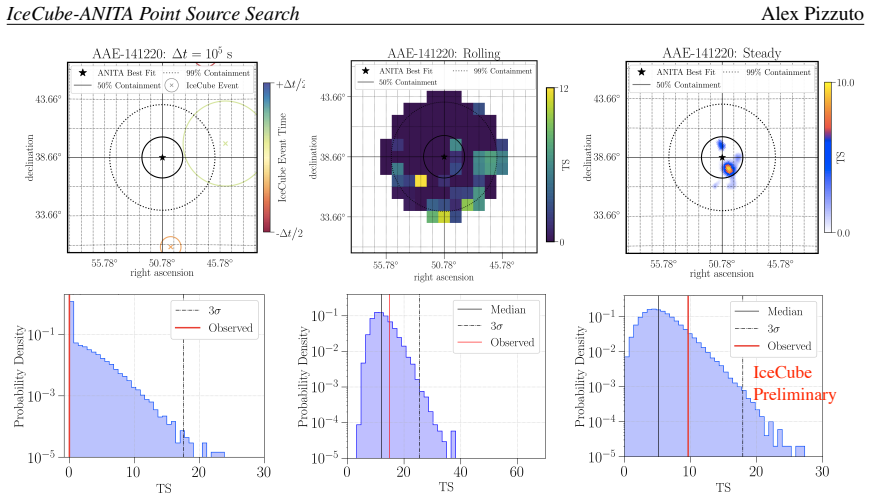
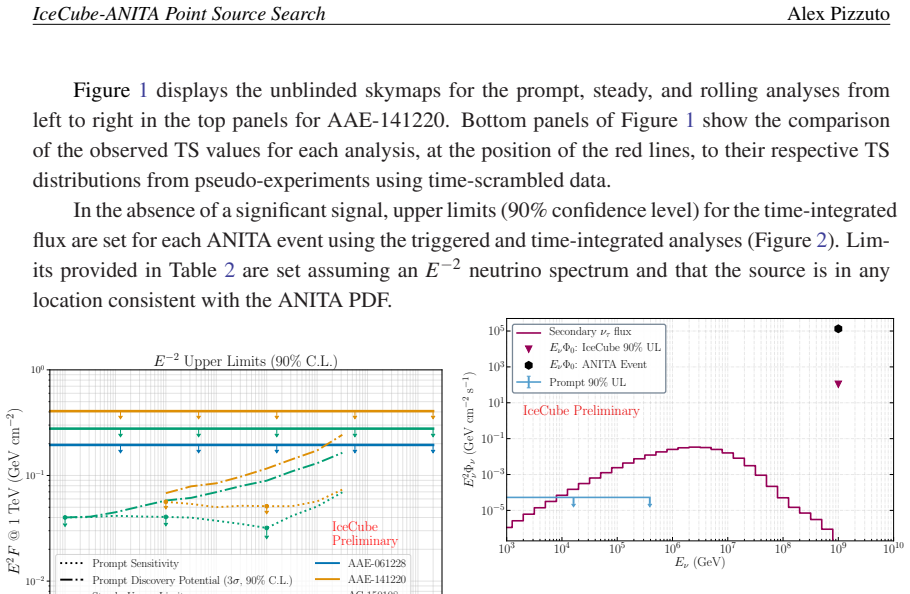
The engine of the search is an unbinned joint likelihood that includes the ANITA localization uncertainty as a spatial prior $P_A(x_s)$ and maximizes over the number of signal events $n_s$ (and, in the steady analysis, the spectral index $\gamma$). Three variants probe different emission timescales: prompt windows of $10$ to $10^5$ seconds, a rolling Gaussian-in-time flare search, and a seven-year time-integrated steady search. A second piece of machinery is the TauRunner simulation of the secondary neutrino flux produced when an EeV tau neutrino traverses the Earth; comparing that predicted cascade flux to IceCube's observed zero coincident events yields the most direct constraint on the ANITA events' possible EeV neutrino sources.
What would settle it
Observe a single IceCube neutrino inside the ANITA directional PDF and within the relevant time window (10 to $10^5$ seconds) of an ANITA candidate, with a post-trial p-value below 0.01; that would overturn the no-correlation conclusion. A reader could also check for a future independently measured coincident neutrino excess from the direction of AAE-141220 at a time consistent with the ANITA event.
Extended reading notes
Core claim
On the paper's own terms, the discovery is a quantitative non-detection: after folding in the large directional uncertainty of the ANITA events through their spatial probability distributions, no IceCube event cluster appears in the prompt, rolling, or time-integrated analyses. For the two Anomalous ANITA Events that would require EeV tau neutrinos to have crossed the Earth, the time-integrated search for AAE-141220 gives p=0.08, and all other searches give larger p-values. The accompanying 90% confidence upper limits on $E^{-2}$ power-law flux, together with the observation that the flux implied by ANITA's acceptance overshoots the prompt-analysis limit by many orders of magnitude, are what carry the conclusion that a standard astrophysical origin for these events is hard to sustain.
Load-bearing premise
The search's constraining power depends on the assumption that an astrophysical source producing the EeV neutrinos ANITA saw would also emit a detectable flux of TeV-PeV neutrinos following an $E^{-2}$ power law over many energy decades; the paper acknowledges this interpolation may not be justified if the source spectrum cuts off or differs.
Editorial extensions
If this is right
- For each ANITA candidate, the searches place 90% confidence upper limits on the time-integrated $E^{-2}$ neutrino flux from any point source located inside the ANITA uncertainty region.
- No astrophysical transient with a standard power-law spectrum that could produce an EeV ANITA event escaped detection in seven years of IceCube data, so the hypothesis that these events are astrophysical neutrinos is not supported.
- The secondary-flux limit for AAE-141220 over the $10^3$ s window is many orders of magnitude below the flux ANITA's own acceptance would imply, tightening the inconsistency with a point-source interpretation.
- The null result strengthens the case for non-astrophysical explanations of the anomalous events, such as emission from cosmic-ray air showers reflected off subsurface Antarctic ice features.
Reading between the lines
- The constraint is only as strong as the assumed spectral bridge: if a real source produced EeV neutrinos without the broad power-law extension to TeV-PeV energies, IceCube's direct limits would not apply, though the secondary-flux argument is less vulnerable than the $E^{-2}$ limits.
- The same joint-likelihood-with-prior technique could be applied to future ultra-high-energy radio-neutrino candidates whenever directional uncertainties are large, not just to ANITA events.
- If the ANITA events are instead down-going cosmic-ray air showers reflected by sub-surface ice, one testable prediction is that high-resolution radar mapping of Antarctic firn structure should reveal features capable of producing such reflections at these particular locations.
- The null result suggests that constraining individual EeV transients will require detectors with sensitivity bridging the EeV and TeV-PeV bands, or a dense enough source population that neutrino telescopes could catch multiple events.
Signed reviews
Editorial analysis
A structured set of objections, weighed in public.
Referee Report
Summary. This paper searches for neutrino counterparts in seven years of IceCube data (2011–2018) to the three published ANITA candidate events (AAE-061228, AAE-141220, AC-150108). Three unbinned likelihood analyses are used: a prompt search over time windows (10 s–10^5 s), a rolling search for Gaussian time clusters, and a time-integrated steady search; the ANITA directional localization uncertainties enter through a spatial prior. No significant excess is found; the smallest p-value is 0.08 for the steady AAE-141220 search, judged consistent with background. The paper sets 90% C.L. upper limits on an E^-2 point-source flux normalization and uses a TauRunner calculation of secondary neutrino fluxes from an injected 1 EeV tau-neutrino flux to argue that an astrophysical source producing AAE-141220 with constant 10^3 s emission would be strongly constrained by the IceCube non-observation.
Significance. The analysis is well posed and addresses an important question: whether the ANITA 'anomalous' events can be astrophysical. The use of external ANITA candidate positions and an independent IceCube dataset avoids circularity; the likelihood formalism and time-scrambled pseudo-experiment p-values are standard; and the TauRunner secondary-flux calculation makes a concrete, falsifiable prediction. If the constraints hold, they substantially strengthen the case for non-standard or non-astrophysical explanations of the AAE events. The paper is a conference proceeding and defers event-selection details, but the central statistical methodology is reproducible from the text. The main caveat, discussed below, concerns the interpretation of the prompt AAE-141220 limits in the presence of the run-transition dead time.
major comments (2)
- [Section 3.1, Table 2, Section 5] The paper notes that IceCube was not collecting data for about one minute around AAE-141220 because of a run transition that began approximately 0.5 s before the event, but it does not explicitly include this dead time in the signal expectation of Eq. (3.2) or in the limits reported in Table 2 and Figure 3. For source emission timescales much shorter than this gap, the expected number of prompt signal events is zero, so the p=1.0 values and the 10^3 s upper limit do not constrain such bursts at all. Please state explicitly that the prompt AAE-141220 limits apply only to emission over the full time window, correct the signal expectation for the live-time fraction (about 6% loss for the 10^3 s window) if this is not already accounted for, and explicitly state that sub-minute transients coincident with the ANITA event time are unconstrained by the prompt analysis.
- [Section 5, final paragraph] The sentence 'the limits set on any potential neutrino source that created AAE-141220 are constraining' is too strong in light of the constant-emission assumption stated only in the Figure 3 caption. The TauRunner-based secondary-flux bound does not apply to bursts shorter than the run-transition gap, which is a plausible scenario for a single ANITA event. The conclusion should be qualified to specify the validity domain of the constraint, and the abstract or conclusion should be softened accordingly so that the reader is not led to believe that all astrophysical transient interpretations of AAE-141220 are excluded.
minor comments (4)
- [Table 2] All prompt rows have p-values of exactly 1.0; the text should state explicitly that these correspond to zero observed events in the on-time window, so the prompt rows for AAE-141220 do not by themselves indicate a constraining measurement.
- [Section 3.1] The sentence excluding AAE-061228 because it 'occurred before the start of our event selection' could state the start date (2011) for clarity, although this is implied by the data description in Section 2.
- [Table 2 and Figure 2] The table and figure captions should either state that the 90% C.L. prompt upper limits for AAE-141220 are computed without an explicit dead-time correction, or indicate that the effective livetime is already folded into nb and the exposure calculation.
- [Section 2] The sentence 'about 8.97 · 10^5 events from 2532 days' should clarify that this number refers to events passing the point-source event selection, not to all triggered events.
Circularity Check
No significant circularity: the search treats ANITA's published candidate directions and uncertainties as external inputs and tests an independent IceCube dataset with standard likelihood and simulation methods.
full rationale
The paper's central claim is a null result: no significant IceCube excess is found toward the ANITA candidate directions. The inputs are (a) the published ANITA event positions and localization uncertainties from Refs. [5,8,9], (b) seven years of IceCube data, (c) standard point-source likelihood machinery, and (d) the TauRunner secondary-flux simulation used in the Section 5 cross-check. The ANITA positions are not fitted from IceCube data, and the IceCube dataset is not used to define the ANITA candidates, so the search is self-contained against external benchmarks. The likelihood in Eq. 3.1 uses PA as a fixed ANITA localization prior, not as a fitted output, and the TS terms involving PA are prior ratios, not fitted predictions. The upper limits in Table 2 and Figure 2 are limits on an assumed E^-2 source spectrum; they are not derived quantities that have been inserted back into the model as inputs. The Section 5 TauRunner argument is an independent physics calculation: a monoenergetic 1 EeV tau neutrino is injected at the AAE-141220 chord angle, propagated with standard neutrino interactions, and the resulting lower-energy secondary flux is compared with the observed zero coincident events in the 10^3 s prompt window. That comparison does not use the ANITA flux normalization as an input to define the IceCube expectation, so it is not circular by construction. The paper itself flags in Section 5 that interpolating between IceCube's energy range and ANITA's may not be justified; this is a model-assumption limitation, not a circular step. The run-transition gap for AAE-141220 is disclosed in Section 3.1 and affects sensitivity to very short transients, but this is a data-live-time and constraining-power concern, not a circularity. None of the seven enumerated circularity patterns is present: no self-definitional quantities, no fitted inputs renamed as predictions, and no load-bearing self-citation chain. The citation to TauRunner in Ref. [25] is to a physics simulation tool whose assumptions do not include the target result, so it provides independent support rather than circularity.
Assumptions & free parameters
free parameters (3)
- spectral index gamma (steady and rolling analyses) =
fitted in range 1 to 4 (steady); prompt fixed to 2
- flare width sigma_t and central time t0 (rolling analysis) =
fitted, not reported
- signal normalization n_s =
fitted, not reported
assumptions (5)
- domain assumption Standard Model neutrino cross-sections and Earth model (TauRunner)
- domain assumption Background estimation from time-scrambled data
- domain assumption E^-2 power-law spectrum for prompt analysis and quoted upper limits
- domain assumption Gaussian spatial PDF for ANITA localization
- domain assumption ANITA events are neutrino candidates (hypothesis under test)
Cite this review
Pith. "Pith review of A search for IceCube events in the direction of ANITA neutrino candidates." pith.science (2026). https://pith.science/paper/5HN5V5GA
@misc{pith2026190808060,
  author       = {Pith},
  title        = {Pith review of: A search for IceCube events in the direction of ANITA neutrino candidates},
  year         = {2026},
  howpublished = {\url{https://pith.science/paper/5HN5V5GA}},
  note         = {Machine review of arXiv:1908.08060}
}
read the original abstract
The Antarctic Impulsive Transient Antenna (ANITA) collaboration has reported a total of three neutrino candidates from the experiment's first three flights. One of these was the lone candidate in a search for Askaryan radio emission, and the others can be interpreted as tau-neutrinos, with important caveats. Among a variety of explanations for these events, they may be produced by astrophysical transients with various characteristic timescales. We test the hypothesis that these events are astrophysical in origin by searching for IceCube counterparts. Using seven years of IceCube data from 2011 through 2018, we search for neutrino point sources using integrated, triggered, and untriggered approaches, and account for the substantial uncertainty in the directional reconstruction of the ANITA events. Due to its large livetime and effective area over many orders of magnitude in energy, IceCube is well suited to test the astrophysical origin of the ANITA events.
Figures
Reference graph
Works this paper leans on
-
[1]
IceCube Collaboration, M. G. Aartsen et al., Science 342 (2013) 1242856
2013
-
[2]
IceCube Collaboration, M. G. Aartsen et al., Phys. Rev. Lett. 113 (2014) 101101
2014
-
[3]
IceCube Collaboration, M. G. Aartsen et al., Science 361 (2018) 147–151
2018
-
[4]
ANITA Collaboration, S. Hoover et al., Phys. Rev. Lett. 105 (2010) 151101
work page 2010
-
[5]
ANITA Collaboration, P. W. Gorham et al.,Phys. Rev. D98 (2018) 022001
work page 2018
- [6]
-
[7]
G. T. Zatsepin and V . A. Kuzmin,JETP Lett. 4 (1966) 78–80. [Pisma Zh. Eksp. Teor. Fiz.4,114(1966)]
work page 1966
-
[8]
ANITA Collaboration, P. W. Gorham et al.,Phys. Rev. Lett. 117 (2016) 071101
work page 2016
Show all 31 references
-
[9]
ANITA Collaboration, P. W. Gorham et al.,Phys. Rev. Lett. 121 (2018) 161102
2018
- [10]
-
[11]
N. L. Strotjohann, M. Kowalski, and A. Franckowiak, Astron. Astrophys. 622 (2019) L9
2019
-
[12]
IceCube Collaboration, M. G. Aartsen et al., JINST 12 (2017) P03012
2017
-
[13]
Haack and C
IceCube Collaboration, C. Haack and C. Wiebusch, PoS(ICRC2017)1005 (2018)
2018
-
[14]
IceCube Collaboration, PoS(ICRC2019)851 (these proceedings)
-
[15]
Schumacher, EPJ Web Conf
ANTARES, IceCube, Pierre Auger, Telescope ArrayCollaboration, L. Schumacher, EPJ Web Conf. 207 (2019) 02010
2019
-
[16]
IceCube Collaboration, M. G. Aartsen et al., Astrophys. J. 857 (2018) 117
2018
-
[17]
IceCube Collaboration, M. G. Aartsen et al., Astrophys. J. 805 (2015) L5
2015
-
[18]
Braun, et al., Astropart
J. Braun, et al., Astropart. Phys. 33 (2010) 175–181
2010
-
[19]
IceCube Collaboration, M. G. Aartsen et al., Astrophys. J. 807 (2015) 46
2015
-
[20]
IceCube Collaboration, M. G. Aartsen et al., Astrophys. J. 824 (2016) L28
2016
-
[21]
IceCube Collaboration, M. G. Aartsen et al., Astrophys. J. 835 (2017) 151
2017
-
[22]
IceCube Collaboration, M. G. Aartsen et al., Astrophys. J. 779 (2013) 132
2013
-
[23]
Abbasi et al., Astrophys
IceCube Collaboration, R. Abbasi et al., Astrophys. J. 732 (2011) 18
2011
-
[24]
IceCube Collaboration, M. G. Aartsen et al., Astrophys. J. 796 (2014) 109
2014
-
[25]
Safa et al., PoS ICRC2019 (these proceedings)
I. Safa et al., PoS ICRC2019 (these proceedings)
-
[26]
J. F. Cherry and I. M. Shoemaker, Phys. Rev. D99 (2019) 063016
2019
- [27]
-
[28]
D. B. Fox, et al., Submitted to: Phys. Rev. D (2018)
2018
- [29]
-
[30]
I. M. Shoemaker, et al., arXiv:1905.02846
1905 arXiv
-
[31]
K. D. de Vries and S. Prohira, arXiv:1903.08750. 8
1903 arXiv
Reviewed August 14, 2026 · model on record in the stance chip above.
Discussion (0). Continue with ORCID to comment.