REVIEW 3 major objections 4 minor 94 references
A Semi-analytic but Biased Uncertainty Assessment Method using Sample Extensions, Analysed for Nonlinear Travel Time Tomography
T0 review · 3 major / 4 minor · reviewed 2026-08-06 · deepseek-v4-flash
Pith's one-line read This paper claims that Bayesian travel-time tomography can be made semi-analytic by extracting entire regions of known travel times from each forward simulation.
desk verdict Genuine methods contribution with an honest error analysis, but the on-ray extension at its core is never validated directly. read the letter →
The pith
A machine-rendered reading of the paper's core claim, the machinery that carries it, and where it could break.
The reading
What carries the argument
The central mechanism is the extension subspace formed by combining off-ray and on-ray extensions: within it, travel time is exactly linear in the on-ray slownesses, so the likelihood and posterior are analytically tractable. The deterministic sampling step solves an interior-point optimization problem whose objective is the negative logarithm of the extension hypervolume, subject to the constraint that the chosen ray remains fastest; this selects models whose extensions cover the most prior probability. The analytic posterior inside one extension is written as an integral over that subspace, and the multi-datum construction multiplies single-datum posterior marginals, an approximation the paper explicitly labels as a mean-field assumption.
What would settle it
A direct test is to take the 51 optimal models from the 5 by 5 example, sample many models uniformly inside their extension subspaces, and compare the extension-predicted travel time with the true first-arrival travel time computed by the fast marching method on the same model. If a non-negligible fraction of these models give differences larger than half the assumed data uncertainty, or if the actual fastest ray differs from the stored ray, the extension approximation is failing at the scale the method uses, exactly as the appendix predicts.
Extended reading notes
Core claim
The central claim is that combining the off-ray extension (changing slowness in cells off the fastest ray leaves travel time unchanged) with the on-ray extension (changing slowness on the ray changes travel time linearly, exact in the small-cell limit) gives a continuous high-dimensional block of model space where travel times are known from a single forward evaluation. Within each such extension the travel-time function is exactly linear, so the posterior pdf can be written analytically. The authors define an optimization problem that picks slowness models maximizing the extension hypervolume while keeping the chosen ray fastest, apply it to a dictionary of 61 rays, and obtain 51 valid optimal samples that yield 709 extensions covering 3.3 percent of the 25-dimensional prior space. They compute single-datum posterior marginals analytically, correct some of the resulting bias using prior replacement, and combine single-datum marginals into multi-datum results using a mean-field product. In a 7 by 7 synthetic tomography example the method recovers the main anomaly, and the paper identifies two dominant error sources: the limited hypervolume spanned by the extensions and the neglect of parameter correlations in the mean-field construction.
Load-bearing premise
The load-bearing assumption is that the on-ray extension holds: lowering the slowness in cells along the current fastest ray never lets a different ray become faster, so every travel time inside the extension is simply the old time minus the slowness decrease times the path length, a condition the paper's own appendix says is exact only for vanishingly small cells and can fail for realistic finite cells.
Editorial extensions
If this is right
- A practitioner who trusts the extension approximations can obtain first-order posterior statistics—means, standard deviations, and marginals—with a small fixed number of forward evaluations, here 51, instead of hundreds of thousands or millions.
- Inside each extension the Bayesian update is exactly linear, so the method yields reproducible analytic posteriors for those regions rather than sampling noise; the error appears as a known bias rather than random Monte Carlo error.
- Because one solved template of rays and optimal samples can be scaled and rotated to different source-receiver pairs with the same local grid, the optimization cost is paid once and reused for many data.
- The two dominant error sources identified in the paper—extension hypervolume and cross-parameter correlations—are separated, so each can be attacked independently in future work.
- In the synthetic 7 by 7 example the method recovers the low-slowness anomaly with a mean model comparable to that from a full Markov chain Monte Carlo inversion, suggesting it can serve as a fast reconnaissance uncertainty estimate before more expensive sampling.
Reading between the lines
- The bias of extensions toward hypercorners of parameter space means the analytic prior over the covered region is not representative of the full prior; a natural test is to use these analytic extensions as proposals inside an informed-proposal Monte Carlo chain, which the paper itself flags as a possible remedy.
- If the on-ray extension fails for finite cells as the paper's own appendix warns, the analytic posterior inside each extension will be overconfident; running a full-wave solver on models sampled inside the extensions would quantify how often a competing ray overtakes the stored fastest ray.
- Because the extension hypervolume as a fraction of the prior shrinks exponentially with dimension, the semi-analytic advantage is likely to be confined to problems of modest dimensionality or with strong priors; a scaling study would show where the method stops beating direct Monte Carlo.
- The mean-field error identified in the paper suggests a direct upgrade path: approximate each single-datum posterior by a mixture of Gaussians (as in boosting variational inference) and combine full distributions rather than marginals, which the paper proposes as a future direction.
Signed reviews
Editorial analysis
A structured set of objections, weighed in public.
Referee Report
Summary. This manuscript proposes a semi-analytic Bayesian uncertainty assessment method for nonlinear travel time tomography based on the concept of sample extensions introduced by Curtis [16]. Two extension types are defined for a single forward evaluation: the off-ray extension, under which increasing slownesses in cells not on the fastest ray leaves the travel time unchanged, and the on-ray extension, under which decreasing slownesses in on-ray cells leaves the ray path unchanged and changes the travel time by the product of the slowness change and the ray segment length. Using a dictionary of 61 rays in a 5-by-5 grid, the authors solve an optimization problem to choose 51 slowness samples whose extensions maximize prior probability mass, obtaining 709 distinct extensions covering 3.3% of the prior space. Inside each extension the forward operator is linear (Eq. 1), so the single-datum posterior is an analytically tractable truncated Gaussian (Eq. 13). The analytic marginals are compared with McMC in the extension subspace and in the full space (Figures 6 and 7), and a multi-datum algorithm is built by combining single-datum marginals under a mean-field approximation (Eq. 17). Applied to a synthetic 7-by-7 tomography example with 28 travel times, the method recovers the low-slowness anomaly roughly but shows biases in several cells. An error decomposition (Table 1) attributes the largest errors to the limited extension hypervolume and to the mean-field combination of marginals.
Significance. If the extensions were physically valid over their stated hypervolumes, the method would be a notable efficiency gain: analytic posterior information from tens of deterministic forward evaluations instead of hundreds of thousands of McMC samples. The paper is unusually honest in its title and text about the method being biased and about its two fundamental inefficiency problems, and the analytic calculation inside a single extension is clean and internally self-consistent. The main scientific value is the demonstration that sample extensions for travel-time tomography provide a concrete, algorithmically usable subspace in which forward values are known analytically, together with a documented error budget for the subsequent approximations. However, the central physical assumption underlying the on-ray extension---that the fastest ray does not change when on-ray slownesses are decreased---is admitted in Appendix B to be 'not absolutely valid' for finite cells, and the manuscript never quantifies how often or by how much it fails. Because Eq.
major comments (3)
- [Section 2.1 and Appendix B, in relation to Eq. 13] The on-ray extension is load-bearing for the analytic posterior, but its validity is only asserted heuristically. Appendix B states that the extension is 'not absolutely valid' and that the competing-ray problem becomes less likely when cells are small or when many on-ray cells are decreased simultaneously. That reasoning is plausible but is not quantified. I ask for a direct numerical test: sample models uniformly from the extension of an optimized sample, compute the travel time using the extension formula l_k^T m, and compare it with a genuine nonlinear forward solver (e.g., FMM) for the same models. Report the fraction of the extension hypervolume in which the argmin in f(m) = min(L^T m) shifts to a different ray, or in which the travel-time error exceeds a meaningful threshold, across a range of cell sizes, contrast levels, and source-receiver geometries. Without this, the domain of validity of Eq. 13 is unknown.
- [Section 4.2 and Table 1] The paper's error decomposition omits the on-ray extension approximation as a source of bias. Table 1 lists five error sources, but the row 'Different forward modellers' compares the ray-dictionary forward operator (Eq. 2) with FMM in the full parameter space; it does not quantify the error caused by the on-ray extension itself inside an extension. This is a consequential omission because the optimized samples are constructed to lie at the boundary of ray validity: on-ray slownesses are at their upper bounds and off-ray slownesses at their lower bounds, so extension moves push directly into the region where a competing ray may become faster. The claim that the two dominant errors are 'limited extensions hypervolume' and 'construction of posterior pdf using marginals' can only be made after the on-ray approximation error has been measured and shown to be small, or explicitly acknowledged as a third major error source.
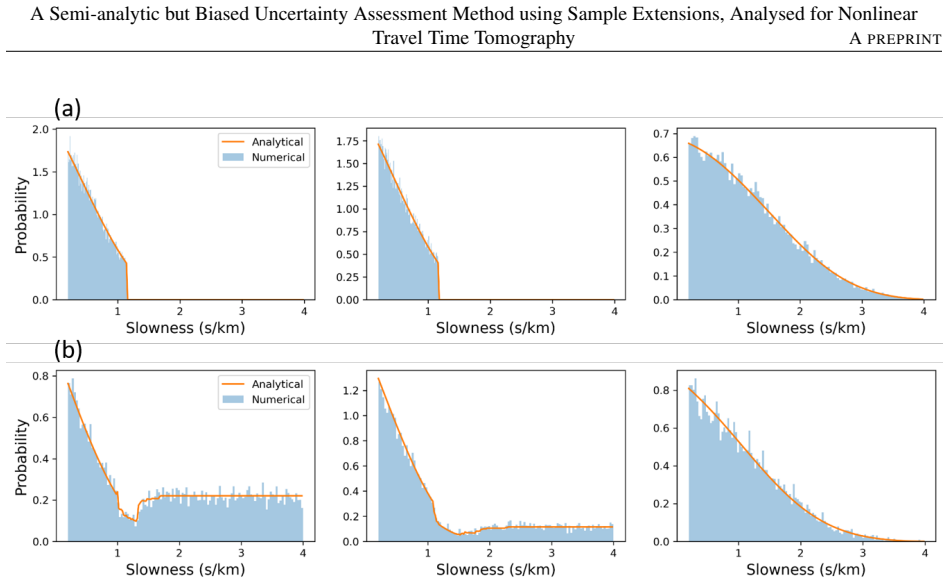
- [Section 3.2 and Figures 6a/6b] The validation of the analytic posterior inside an extension is potentially circular. The text says the McMC inversions shown in Figures 6a and 6b are run 'inside this extension' and 'within extensions subspaces', but it does not state which forward operator was used for those McMC runs. If the McMC used the same linear formula l_k^T m that defines the extension, then the agreement between the orange analytic curves and the blue histograms only confirms the calculus of truncated Gaussian normalization; it does not test whether the extension travel-time prediction is physically correct. Please specify the forward solver used in the McMC runs of Figure 6, and if the current runs used the linear extension formula, add a comparison using FMM on a subsample of points inside the extension to directly test the on-ray assumption.
minor comments (4)
- [Author affiliation] The affiliation line contains a typo: 'Unite Kingdom' should be 'United Kingdom'.
- [Equation 6] The formatting of the inequality constraints in Eq. 6 is inconsistent: 'm min < mj ≤ mmax, m min ≤ mk < mmax' uses an unspaced placeholder for m_min; please render the subscripts consistently.
- [Section 3.2 and Figure 5] The comparison between the analytic prior of Eq. 10 and numerical sampling inside extensions is a useful check, but the sentence 'the only explanation for deviations is due to any overlaps between hypervolumes of different extensions' is too strong; numerical sampling error and the non-normalized union in Eq. 10 could also contribute. Please soften or justify.
- [Section 4.2, Figure 12] The panel labels (a)-(f) are described in the text, but the reader must map each panel to its method description manually; adding a short caption item per panel would improve clarity.
Circularity Check
No significant circularity: the extension-based analytic posterior is a genuine calculation from explicit, separately testable assumptions, with no fitted parameter or self-cited uniqueness claim forcing the result.
full rationale
The paper's derivation chain is self-contained. The sample extensions are constructed from two explicit physical assumptions (off-ray slowness increases leave the fastest ray and travel time unchanged; on-ray slowness decreases leave the fastest ray unchanged), rather than from the posterior being fitted. Equation 13 is a direct analytic evaluation of the Gaussian likelihood under the linear travel-time form f(m)=l_k^T m inside each extension, and it is checked against McMC runs both inside the extensions and in the full parameter space. The deterministic samples solve the optimisation problem in equation 6, whose objective depends only on the prior bounds and the ray dictionary, with no observed data or posterior target entering the objective, so the resulting posterior comparison is not a case of fitted input being called prediction. The on-ray assumption is admittedly not absolutely valid for finite cells (Appendix B), but that limitation is acknowledged and discussed by the authors as a source of bias; it is a modelling error, not a circular reduction of the prediction to its input. Self-citations such as Curtis [16] introduce the general extension concept and the factorisation in equation 16, but the present paper independently derives the travel-time extensions, computes their hypervolumes, and tests the resulting posterior against external McMC references; those citations are background support rather than load-bearing circular arguments.
Assumptions & free parameters
free parameters (3)
- Interior-point barrier parameter q =
not specified (increased iteratively)
- Ray dictionary size =
61 rays
- Local grid size per source-receiver pair =
5x5 cells
assumptions (7)
- domain assumption First-arrival travel time is the minimum over all rays of the path-length-weighted slowness sum: f(m) = min_i l_i^T m (equation 2).
- domain assumption Off-ray extension: increasing slowness in cells not traversed by the fastest ray leaves the ray path and travel time unchanged.
- domain assumption On-ray extension: decreasing slowness in cells on the fastest ray does not change the fastest ray path, so the new travel time is the old time plus the slowness change times the path length.
- domain assumption The set of 61 rays in the dictionary L approximates all possible ray geometries between a source and receiver.
- domain assumption The same 5x5 template grid can be scaled, rotated, and shifted to any source-receiver pair, and the optimized deterministic samples are identical for all pairs.
- domain assumption Mean-field approximation: posterior marginals from individual data can be combined by multiplying marginal pdf's as in equation 17.
- standard math Prior replacement formula (equation 14) is valid when dividing a biased posterior by the biased prior and multiplying by the unbiased prior.
Cite this review
Pith. "Pith review of A Semi-analytic but Biased Uncertainty Assessment Method using Sample Extensions, Analysed for Nonlinear Travel Time Tomography." pith.science (2026). https://pith.science/paper/5HXZGNGV
@misc{pith2026250716353,
  author       = {Pith},
  title        = {Pith review of: A Semi-analytic but Biased Uncertainty Assessment Method using Sample Extensions, Analysed for Nonlinear Travel Time Tomography},
  year         = {2026},
  howpublished = {\url{https://pith.science/paper/5HXZGNGV}},
  note         = {Machine review of arXiv:2507.16353}
}
read the original abstract
Many geophysical problems can be cast as inverse problems that estimate a set of parameter values from observed data. Within a Bayesian framework, solutions to such problems are described probabilistically by the so-called posterior probability distribution functions (pdf's). To obtain robust inference results often requires millions of model parameter value samples to be drawn, and their simulation to be performed; this is a computationally expensive procedure. We investigate the concept of sample extensions as a means to improve efficiency when solving fully nonlinear inverse problems. A sample's extension is defined as the set of models or parameter values whose forward function values are directly accessible from a sample for which the forward function has already been evaluated, obviating the need for additional forward function evaluations. In a specific case of first-arrival travel time calculations used in seismic travel time tomography, we apply sample extensions to obtain a continuous region with non-zero hypervolume within parameter space, across all of which the forward function values are known given only a single forward simulation. We devise a deterministic sampling technique that identifies the most informative extensions by solving an optimisation problem. In an illustrative tomographic example that involves a single travel time datum, we find 51 optimal samples, and use them to construct an analytic approximation to the Bayesian posterior pdf. Additionally, we propose an extensions-based algorithm for real-world tomography scenarios and apply it to a synthetic 2D example. This study highlights two fundamental problems that make the method inefficient: (1) limited hypervolumes of extensions and (2) neglecting parameter correlations to simplify analytic calculations. Finding solutions to these problems defines possible directions for future research.
Figures


Figures from the paper (11 more)




Reference graph
Works this paper leans on
-
[16]
Samples, symmetries and extensions: Exploring parameter space in nonlinear problems
Andrew Curtis. Samples, symmetries and extensions: Exploring parameter space in nonlinear problems. Earth- ArXiv, 2020. doi: https://doi.org/10.31223/X5V31K
-
[1]
A tutorial on adaptive MCMC
Christophe Andrieu and Johannes Thoms. A tutorial on adaptive MCMC. Statistics and computing, 18:343–373, 2008
2008
-
[2]
Interrogation theory
Richard Arnold and Andrew Curtis. Interrogation theory. Geophysical Journal International, 214(3):1830–1846, 2018
2018
-
[3]
On adaptive Markov chain Monte Carlo algorithms
Yves F Atchadé and Jeffrey S Rosenthal. On adaptive Markov chain Monte Carlo algorithms. Bernoulli, 11(5): 815–828, 2005
2005
-
[4]
Spatial statistics and bayesian computation
Julian Besag and Peter J Green. Spatial statistics and bayesian computation. Journal of the Royal Statistical Society Series B: Statistical Methodology , 55(1):25–37, 1993
1993
-
[5]
Pattern recognition and machine learning
Christopher M Bishop. Pattern recognition and machine learning. springer, 2006
2006
-
[6]
Experimental design for fully nonlinear source location problems: which method should I choose? Geophysical Journal International, 223(2):944–958, 2020
Hugo Bloem, Andrew Curtis, and H Maurer. Experimental design for fully nonlinear source location problems: which method should I choose? Geophysical Journal International, 223(2):944–958, 2020
2020
-
[7]
Introducing conceptual geological information into Bayesian tomographic imaging
Hugo Bloem, Andrew Curtis, and Daniel Tetzlaff. Introducing conceptual geological information into Bayesian tomographic imaging. Basin Research, 36(1):e12811, 2024
2024
Show all 94 references
-
[8]
Seismic tomography with the reversible jump algorithm
Thomas Bodin and Malcolm Sambridge. Seismic tomography with the reversible jump algorithm. Geophysical Journal International, 178(3):1411–1436, 2009
2009
-
[9]
Transdimensional tomography with unknown data noise
Thomas Bodin, Malcolm Sambridge, Nick Rawlinson, and Pierre Arroucau. Transdimensional tomography with unknown data noise. Geophysical Journal International, 189(3):1536–1556, 2012
2012
-
[10]
Empirical model-building and response surfaces
George EP Box and Norman R Draper. Empirical model-building and response surfaces. John Wiley & Sons, 1987
1987
-
[11]
Convex optimization
Stephen Boyd and Lieven Vandenberghe. Convex optimization. Cambridge university press, 2004. 21 A Semi-analytic but Biased Uncertainty Assessment Method using Sample Extensions, Analysed for Nonlinear Travel Time Tomography A PREPRINT
2004
-
[12]
An interior point algorithm for large-scale nonlinear pro- gramming
Richard H Byrd, Mary E Hribar, and Jorge Nocedal. An interior point algorithm for large-scale nonlinear pro- gramming. SIAM Journal on Optimization, 9(4):877–900, 1999
1999
-
[13]
Near-real-time near-surface 3D seismic velocity and uncertainty models by wavefield gradiometry and neural network inversion of ambient seismic noise
Ruikun Cao, Stephanie Earp, Sjoerd AL de Ridder, Andrew Curtis, and Erica Galetti. Near-real-time near-surface 3D seismic velocity and uncertainty models by wavefield gradiometry and neural network inversion of ambient seismic noise. Geophysics, 85(1):KS13–KS27, 2020
2020
-
[14]
Theory of model-based geophysical survey and experimental design: Part 1—Linear problems
Andrew Curtis. Theory of model-based geophysical survey and experimental design: Part 1—Linear problems. The Leading Edge, 23(10):997–1004, 2004
2004
-
[15]
Theory of model-based geophysical survey and experimental design: Part 2—Nonlinear prob- lems
Andrew Curtis. Theory of model-based geophysical survey and experimental design: Part 2—Nonlinear prob- lems. The Leading Edge, 23(11):1112–1117, 2004
2004
-
[17]
Prior information, sampling distributions, and the curse of dimensionality
Andrew Curtis and Anthony Lomax. Prior information, sampling distributions, and the curse of dimensionality. Geophysics, 66(2):372–378, 2001
2001
-
[18]
Probing the earth’s interior with seismic tomography.International Geophysics Series, 81(A):861–874, 2002
Andrew Curtis and Roel Snieder. Probing the earth’s interior with seismic tomography.International Geophysics Series, 81(A):861–874, 2002
2002
-
[19]
Acoustic full waveform inversion with Hamiltonian Monte Carlo method
Paulo Douglas S de Lima, Gilberto Corso, Mauro S Ferreira, and João M de Araújo. Acoustic full waveform inversion with Hamiltonian Monte Carlo method. Physica A: Statistical Mechanics and its Applications , 617: 128618, 2023
2023
-
[20]
Bayesian inference of Earth’s radial seismic structure from body-wave traveltimes using neural networks
Ralph WL de Wit, Andrew P Valentine, and Jeannot Trampert. Bayesian inference of Earth’s radial seismic structure from body-wave traveltimes using neural networks. Geophysical Journal International , 195(1):408– 422, 2013
2013
-
[21]
An efficient, probabilistic neural network approach to solv- ing inverse problems: inverting surface wave velocities for Eurasian crustal thickness
RJR Devilee, A Curtis, and K Roy-Chowdhury. An efficient, probabilistic neural network approach to solv- ing inverse problems: inverting surface wave velocities for Eurasian crustal thickness. Journal of Geophysical Research: Solid Earth, 104(B12):28841–28857, 1999
1999
-
[22]
Probabilistic neural network-based 2D travel-time tomography
Stephanie Earp and Andrew Curtis. Probabilistic neural network-based 2D travel-time tomography. Neural Computing and Applications, 32(22):17077–17095, 2020
2020
-
[23]
Probabilistic neural network tomography across Grane field (North Sea) from surface wave dispersion data
Stephanie Earp, Andrew Curtis, Xin Zhang, and Fredrik Hansteen. Probabilistic neural network tomography across Grane field (North Sea) from surface wave dispersion data. Geophysical Journal International , 223(3): 1741–1757, 2020
2020
-
[24]
Assessing uncertainties in velocity models and images with a fast nonlinear uncertainty quantification method
Gregory Ely, Alison Malcolm, and Oleg V Poliannikov. Assessing uncertainties in velocity models and images with a fast nonlinear uncertainty quantification method. Geophysics, 83(2):R63–R75, 2018
2018
-
[25]
Hamiltonian Monte Carlo inversion of seismic sources in complex media
Andreas Fichtner and Saule Simut ˙e. Hamiltonian Monte Carlo inversion of seismic sources in complex media. Journal of Geophysical Research: Solid Earth , 123(4):2984–2999, 2018
2018
-
[26]
Hamiltonian Monte Carlo solution of tomographic inverse problems
Andreas Fichtner, Andrea Zunino, and Lars Gebraad. Hamiltonian Monte Carlo solution of tomographic inverse problems. Geophysical Journal International, 216(2):1344–1363, 2019
2019
-
[27]
Transdimensional Love-wave tomography of the British Isles and shear-velocity structure of the East Irish Sea Basin from ambient-noise interferometry
Erica Galetti, Andrew Curtis, Brian Baptie, David Jenkins, and Heather Nicolson. Transdimensional Love-wave tomography of the British Isles and shear-velocity structure of the East Irish Sea Basin from ambient-noise interferometry. Geophysical Journal International, 208(1):36–58, 2017
2017
-
[28]
Stochastic gradient MCMC with repulsive forces
Victor Gallego and David Rios Insua. Stochastic gradient MCMC with repulsive forces. stat, 1050:30, 2018
2018
-
[29]
Bayesian elastic full-waveform inversion using Hamilto- nian Monte Carlo
Lars Gebraad, Christian Boehm, and Andreas Fichtner. Bayesian elastic full-waveform inversion using Hamilto- nian Monte Carlo. Journal of Geophysical Research: Solid Earth , 125(3):e2019JB018428, 2020
2020
-
[30]
Deep learning
Ian Goodfellow, Yoshua Bengio, and Aaron Courville. Deep learning. MIT press, 2016
2016
-
[31]
Reversible jump Markov chain Monte Carlo computation and Bayesian model determination
Peter J Green. Reversible jump Markov chain Monte Carlo computation and Bayesian model determination. Biometrika, 82(4):711–732, 1995
1995
-
[32]
Iteratively constructive sequential design of experiments and surveys with nonlinear parameter-data relationships
T Guest and A Curtis. Iteratively constructive sequential design of experiments and surveys with nonlinear parameter-data relationships. Journal of Geophysical Research: Solid Earth , 114(B4), 2009
2009
-
[33]
Boosting variational inference
Fangjian Guo, Xiangyu Wang, Kai Fan, Tamara Broderick, and David B Dunson. Boosting variational inference. Advances in Neural Information Processing Systems , 2016
2016
-
[34]
Use of machine learning to estimate statistics of the posterior distribution in probabilistic inverse problems - an application to airborne EM data
Thomas Mejer Hansen and Christopher C Finlay. Use of machine learning to estimate statistics of the posterior distribution in probabilistic inverse problems - an application to airborne EM data. Journal of Geophysical Research: Solid Earth, 127(11):e2022JB024703, 2022. 22 A Se...
2022
-
[35]
A framework for fast probabilistic centroid-moment-tensor determination—inversion of regional static displacement measurements
Paul Käufl, Andrew P Valentine, Thomas B O’Toole, and Jeannot Trampert. A framework for fast probabilistic centroid-moment-tensor determination—inversion of regional static displacement measurements. Geophysical Journal International, 196(3):1676–1693, 2014
2014
-
[36]
Valentine, Ralph W
Paul Käufl, Andrew P. Valentine, Ralph W. de Wit, and Jeannot Trampert. Solving probabilistic inverse problems rapidly with prior samples. Geophysical Journal International, 205(3):1710–1728, 2016
2016
-
[37]
Informed proposal Monte Carlo
Sarouyeh Khoshkholgh, Andrea Zunino, and Klaus Mosegaard. Informed proposal Monte Carlo. Geophysical Journal International, 226(2):1239–1248, 2021
2021
-
[38]
Full-waveform inversion by informed-proposal Monte Carlo
Sarouyeh Khoshkholgh, Andrea Zunino, and Klaus Mosegaard. Full-waveform inversion by informed-proposal Monte Carlo. Geophysical Journal International, 230(3):1824–1833, 2022
2022
-
[39]
Optimization by simulated annealing
Scott Kirkpatrick, C Daniel Gelatt Jr, and Mario P Vecchi. Optimization by simulated annealing. science, 220 (4598):671–680, 1983
1983
-
[40]
Automatic differentiation variational inference
Alp Kucukelbir, Dustin Tran, Rajesh Ranganath, Andrew Gelman, and David M Blei. Automatic differentiation variational inference. The Journal of Machine Learning Research , 18(1):430–474, 2017
2017
-
[41]
Training-image based geostatistical inversion using a spatial generative adversarial neural network
Eric Laloy, Romain Hérault, Diederik Jacques, and Niklas Linde. Training-image based geostatistical inversion using a spatial generative adversarial neural network. Water Resources Research, 54(1):381–406, 2018
2018
-
[42]
Using deep generative neural networks to account for model errors in Markov chain Monte Carlo inversion
Shiran Levy, Jürg Hunziker, Eric Laloy, James Irving, and Niklas Linde. Using deep generative neural networks to account for model errors in Markov chain Monte Carlo inversion. Geophysical Journal International, 228(2): 1098–1118, 2022
2022
-
[43]
Variational Bayesian inference with complex geostatistical priors using inverse autoregressive flows
Shiran Levy, Eric Laloy, and Niklas Linde. Variational Bayesian inference with complex geostatistical priors using inverse autoregressive flows. Computers & Geosciences, page 105263, 2022
2022
-
[44]
Falsification and corroboration of conceptual hydrological models using geophysical data
Niklas Linde. Falsification and corroboration of conceptual hydrological models using geophysical data. Wiley Interdisciplinary Reviews: Water, 1(2):151–171, 2014
2014
-
[45]
Stein variational gradient descent: A general purpose Bayesian inference algorithm
Qiang Liu and Dilin Wang. Stein variational gradient descent: A general purpose Bayesian inference algorithm. In Advances in neural information processing systems , pages 2378–2386, 2016
2016
-
[46]
3D probabilistic full waveform inversion: Application to Gulf of Mexico field data
A Lomas, S Luo, M Irakarama, R Johnston, M Vyas, and X Shen. 3D probabilistic full waveform inversion: Application to Gulf of Mexico field data. In 84th EAGE Annual Conference & Exhibition , volume 2023, pages 1–5. European Association of Geoscientists & Engineers, 2023
2023
-
[47]
Fast, probabilistic earthquake location in 3d models using oct-tree impor- tance sampling
Anthony Lomax and Andrew Curtis. Fast, probabilistic earthquake location in 3d models using oct-tree impor- tance sampling. In Geophys. Res. Abstr, volume 3, pages 10–1007, 2001
2001
-
[48]
Earthquake location, direct, global-search methods
Anthony Lomax, Alberto Michelini, Andrew Curtis, and RA Meyers. Earthquake location, direct, global-search methods. Encyclopedia of complexity and systems science , 5:2449–2473, 2009
2009
-
[49]
Exhaustive probabilistic neural network for attribute selection and supervised seismic facies classification.Inter- pretation, 9(2):T421–T441, 2021
David Lubo-Robles, Thang Ha, Sivaramakrishnan Lakshmivarahan, Kurt J Marfurt, and Matthew J Pranter. Exhaustive probabilistic neural network for attribute selection and supervised seismic facies classification.Inter- pretation, 9(2):T421–T441, 2021
2021
-
[50]
Parsimonious Bayesian Markov chain Monte Carlo inversion in a nonlinear geophysical problem
Alberto Malinverno. Parsimonious Bayesian Markov chain Monte Carlo inversion in a nonlinear geophysical problem. Geophysical Journal International, 151(3):675–688, 2002
2002
-
[51]
Fully nonlinear inversion of fundamental mode surface waves for a global crustal model
U Meier, A Curtis, and J Trampert. Fully nonlinear inversion of fundamental mode surface waves for a global crustal model. Geophysical Research Letters, 34(16), 2007
2007
-
[52]
Global crustal thickness from neural network inversion of surface wave data
Ueli Meier, Andrew Curtis, and Jeannot Trampert. Global crustal thickness from neural network inversion of surface wave data. Geophysical Journal International, 169(2):706–722, 2007
2007
-
[53]
Inconsistency and acausality in Bayesian inference for physical problems
Klaus Mosegaard and Andrew Curtis. Inconsistency and acausality in Bayesian inference for physical problems. arXiv preprint arXiv:2411.13570, 2024
2024 arXiv
-
[54]
Monte Carlo sampling of solutions to inverse problems
Klaus Mosegaard and Albert Tarantola. Monte Carlo sampling of solutions to inverse problems. Journal of Geophysical Research: Solid Earth , 100(B7):12431–12447, 1995
1995
-
[55]
Stochastic seismic waveform inversion using generative adversarial networks as a geological prior
Lukas Mosser, Olivier Dubrule, and Martin J Blunt. Stochastic seismic waveform inversion using generative adversarial networks as a geological prior. Mathematical Geosciences, 52(1):53–79, 2020
2020
-
[56]
Variational Bayesian inversion (VBI) of quasi-localized seismic attributes for the spatial distribution of geological facies
Atif Nawaz and Andrew Curtis. Variational Bayesian inversion (VBI) of quasi-localized seismic attributes for the spatial distribution of geological facies. Geophysical Journal International, 214(2):845–875, 2018
2018
-
[57]
Rapid discriminative variational Bayesian inversion of geophysical data for the spatial distribution of geological properties
Atif Nawaz and Andrew Curtis. Rapid discriminative variational Bayesian inversion of geophysical data for the spatial distribution of geological properties. Journal of Geophysical Research: Solid Earth , 124(6):5867–5887, 2019. 23 A Semi-analytic but Biased Uncertainty Assessm...
2019
-
[58]
The effect of velocity uncertainty on migrated reflectors: Improve- ments from relative-depth imaging
Oleg V Poliannikov and Alison E Malcolm. The effect of velocity uncertainty on migrated reflectors: Improve- ments from relative-depth imaging. Geophysics, 81(1):S21–S29, 2016
2016
-
[59]
Earth models obtained by Monte Carlo inversion
Frank Press. Earth models obtained by Monte Carlo inversion. Journal of Geophysical Research, 73(16):5223– 5234, 1968
1968
-
[60]
Exact sampling with coupled Markov chains and applications to statistical mechanics
James Gary Propp and David Bruce Wilson. Exact sampling with coupled Markov chains and applications to statistical mechanics. Random Structures & Algorithms, 9(1-2):223–252, 1996
1996
-
[61]
Wave front evolution in strongly heterogeneous layered media using the fast marching method
Nicholas Rawlinson and Malcolm Sambridge. Wave front evolution in strongly heterogeneous layered media using the fast marching method. Geophysical Journal International, 156(3):631–647, 2004
2004
-
[62]
The fast marching method: an effective tool for tomographic imaging and tracking multiple phases in complex layered media
Nicholas Rawlinson and Malcolm Sambridge. The fast marching method: an effective tool for tomographic imaging and tracking multiple phases in complex layered media. Exploration Geophysics, 36(4):341–350, 2005
2005
-
[63]
Amit K Ray and Samir Biswal. An efficient method of effective porosity prediction using an unconventional attribute through multi-attribute regression and probabilistic neural network: A case study in a deep-water gas field, east coast of india. In SEG Technical Program Expand...
2010
-
[64]
Variational inference with normalizing flows
Danilo Rezende and Shakir Mohamed. Variational inference with normalizing flows. In International conference on machine learning, pages 1530–1538. PMLR, 2015
2015
-
[65]
A trust-region interior-point method for general nonlinear programing problems
A.H Ribeiro. A trust-region interior-point method for general nonlinear programing problems. https://github.com/antonior92/ip-nonlinear-solver, 2017
2017
-
[66]
Geophysical inversion with a neighbourhood algorithm - I
Malcolm Sambridge. Geophysical inversion with a neighbourhood algorithm - I. searching a parameter space. Geophysical journal international, 138(2):479–494, 1999
1999
-
[67]
Geophysical inversion with a neighbourhood algorithm - II
Malcolm Sambridge. Geophysical inversion with a neighbourhood algorithm - II. appraising the ensemble. Geophysical Journal International, 138(3):727–746, 1999
1999
-
[68]
Genetic algorithms in seismic waveform inversion
Malcolm Sambridge and Guy Drijkoningen. Genetic algorithms in seismic waveform inversion. Geophysical Journal International, 109(2):323–342, 1992
1992
-
[69]
Earthquake hypocenter location using genetic algorithms
Malcolm Sambridge and Kerry Gallagher. Earthquake hypocenter location using genetic algorithms. Bulletin of the Seismological Society of America , 83(5):1467–1491, 1993
1993
-
[70]
Global optimization methods in geophysical inversion
Mrinal K Sen and Paul L Stoffa. Global optimization methods in geophysical inversion . Cambridge University Press, 2013
2013
-
[71]
Fast probabilistic nonlinear petrophysical inversion
Mohammad S Shahraeeni and Andrew Curtis. Fast probabilistic nonlinear petrophysical inversion. Geophysics, 76(2):E45–E58, 2011
2011
-
[72]
Fast probabilistic petrophysical mapping of reser- voirs from 3D seismic data
Mohammad S Shahraeeni, Andrew Curtis, and Gabriel Chao. Fast probabilistic petrophysical mapping of reser- voirs from 3D seismic data. Geophysics, 77(3):O1–O19, 2012
2012
-
[73]
Preconditioned training of normalizing flows for variational inference in inverse problems
Ali Siahkoohi, Gabrio Rizzuti, Mathias Louboutin, Philipp A Witte, and Felix J Herrmann. Preconditioned training of normalizing flows for variational inference in inverse problems. arXiv preprint arXiv:2101.03709 , 2021
2021 arXiv
-
[74]
Deep Bayesian inference for seismic imaging with tasks
Ali Siahkoohi, Gabrio Rizzuti, and Felix J Herrmann. Deep Bayesian inference for seismic imaging with tasks. Geophysics, 87(5):S281–S302, 2022
2022
-
[75]
HypoSVI: Hypocentre inversion with Stein variational inference and physics informed neural networks
Jonthan D Smith, Zachary E Ross, Kamyar Azizzadenesheli, and Jack B Muir. HypoSVI: Hypocentre inversion with Stein variational inference and physics informed neural networks. Geophysical Journal International, 228 (1):698–710, 2022
2022
-
[76]
Nonlinear multiparameter optimization using genetic algorithms; inversion of plane-wave seismograms
Paul L Stoffa and Mrinal K Sen. Nonlinear multiparameter optimization using genetic algorithms; inversion of plane-wave seismograms. Geophysics, 56(11):1794–1810, 1991
1991
-
[77]
Dominik Strutz and Andrew Curtis. Variational Bayesian experimental design for geophysical applications: seis- mic source location, amplitude versus offset inversion, and estimating CO2 saturations in a subsurface reservoir. Geophysical Journal International, 236(3):1309–1331, 2024
2024
-
[78]
Inverse problem theory and methods for model parameter estimation, volume 89
Albert Tarantola. Inverse problem theory and methods for model parameter estimation, volume 89. SIAM, 2005
2005
-
[79]
The future of Earth imaging
Victor C Tsai. The future of Earth imaging. Seismological Research Letters, 94(5):2119–2128, 2023
2023
-
[80]
Emerging directions in geophysical inversion
Andrew P Valentine and Malcolm Sambridge. Emerging directions in geophysical inversion. Applications of Data Assimilation and Inverse Problems in the Earth Sciences , 5:9, 2023
2023
-
[81]
Spatial Bayesian inversion with localized likelihoods: an exact sampling alternative to McMC
Matthew Walker and Andrew Curtis. Spatial Bayesian inversion with localized likelihoods: an exact sampling alternative to McMC. Journal of Geophysical Research: Solid Earth , 119(7):5741–5761, 2014. 24 A Semi-analytic but Biased Uncertainty Assessment Method using Sample Exten...
2014
-
[82]
Varying prior information in Bayesian inversion
Matthew Walker and Andrew Curtis. Varying prior information in Bayesian inversion. Inverse Problems, 30(6): 065002, 2014
2014
-
[83]
Re-weighted variational full waveform inversions
Wenlong Wang, George A McMechan, and Jianwei Ma. Re-weighted variational full waveform inversions. Geophysics, 88(4):1–61, 2023
2023
-
[84]
No free lunch theorems for optimization
David H Wolpert and William G Macready. No free lunch theorems for optimization. IEEE transactions on evolutionary computation, 1(1):67–82, 1997
1997
-
[85]
Seismic tomography using variational inference methods.Journal of Geophysical Research: Solid Earth, 125(4):e2019JB018589, 2020
Xin Zhang and Andrew Curtis. Seismic tomography using variational inference methods.Journal of Geophysical Research: Solid Earth, 125(4):e2019JB018589, 2020
2020
-
[86]
Bayesian geophysical inversion using invertible neural networks
Xin Zhang and Andrew Curtis. Bayesian geophysical inversion using invertible neural networks. Journal of Geophysical Research: Solid Earth , 126(7):e2021JB022320, 2021
2021
-
[87]
Interrogating probabilistic inversion results for subsurface structural information
Xin Zhang and Andrew Curtis. Interrogating probabilistic inversion results for subsurface structural information. Geophysical Journal International, 229(2):750–757, 2022
2022
-
[88]
Bayesian inversion, uncertainty analysis and interrogation using boosting variational inference
Xuebin Zhao and Andrew Curtis. Bayesian inversion, uncertainty analysis and interrogation using boosting variational inference. Journal of Geophysical Research: Solid Earth , 129(1):e2023JB027789, 2024
2024
-
[89]
Physically structured variational inference for Bayesian full waveform inver- sion
Xuebin Zhao and Andrew Curtis. Physically structured variational inference for Bayesian full waveform inver- sion. Journal of Geophysical Research: Solid Earth , 129(11):e2024JB029557, 2024
2024
-
[90]
Variational prior replacement in Bayesian inference and inversion.Geophysical Journal International, 239(2):1236–1256, 2024
Xuebin Zhao and Andrew Curtis. Variational prior replacement in Bayesian inference and inversion.Geophysical Journal International, 239(2):1236–1256, 2024
2024
-
[91]
Efficient bayesian full waveform inversion and analysis of prior hypotheses in 3D
Xuebin Zhao and Andrew Curtis. Efficient bayesian full waveform inversion and analysis of prior hypotheses in 3D. Geophysics, 0(just accepted):1–58, 2025
2025
-
[92]
Bayesian seismic tomography using normalizing flows
Xuebin Zhao, Andrew Curtis, and Xin Zhang. Bayesian seismic tomography using normalizing flows. Geophys- ical Journal International, 228(1):213–239, 2021
2021
-
[93]
Interrogating subsurface structures using probabilistic tomogra- phy: an example assessing the volume of Irish Sea basins
Xuebin Zhao, Andrew Curtis, and Xin Zhang. Interrogating subsurface structures using probabilistic tomogra- phy: an example assessing the volume of Irish Sea basins. Journal of Geophysical Research: Solid Earth , 127 (4):e2022JB024098, 2022
2022
-
[94]
A gradient-based Markov chain Monte Carlo method for full-waveform inversion and uncertainty analysis
Zeyu Zhao and Mrinal K Sen. A gradient-based Markov chain Monte Carlo method for full-waveform inversion and uncertainty analysis. Geophysics, 86(1):R15–R30, 2021. A Detailed Inversion Setup B Validation of the on-ray extension The on-ray extension defined in the main text is ...
2021
Reviewed August 6, 2026 · model on record in the stance chip above.
Discussion (0). Continue with ORCID to comment.