REVIEW 5 major objections 4 minor 15 references
MISO: Model-Internal-State-Guided Optimization for Ranking Models
T0 review · 5 major / 4 minor · reviewed 2026-08-10 · deepseek-v4-flash
Pith's one-line read A ranking model's internal states can select its next upgrade in a fraction of the usual training runs.
desk verdict Plausible industrial systems paper whose headline run-reduction and NE-improvement claims rest on an undefined stopping criterion, but the workflow design and honest framing merit peer review. read the letter →
The pith
A machine-rendered reading of the paper's core claim, the machinery that carries it, and where it could break.
The reading
What carries the argument
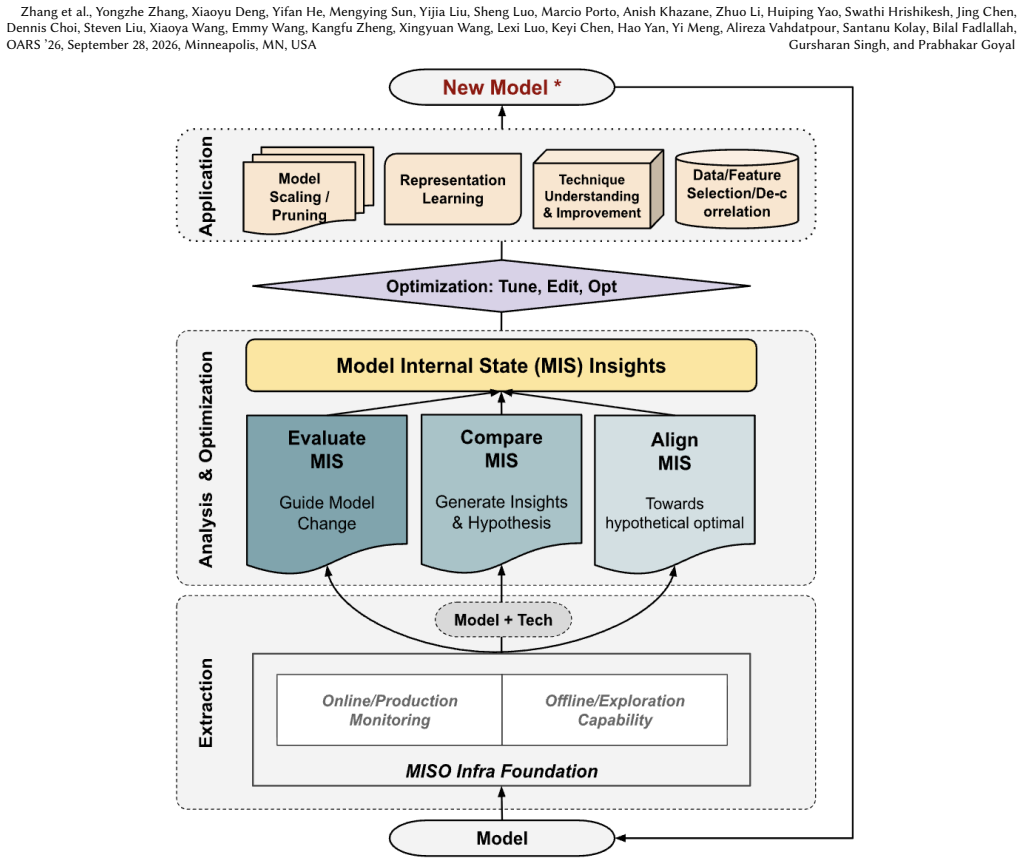
The load-bearing machinery is the three-class MIS aggregation layer, which converts raw internal signals into decision-oriented summaries. Ranking-based primitives compute neuron importance by combining gradient magnitudes with a perturbation score, $I_n=\alpha\frac{1}{|\mathcal{D}|}\sum_{x\in\mathcal{D}}|a_n\cdot\nabla_{a_n}\mathcal{L}(x)|+(1-\alpha)\Delta\mathcal{L}|_{a_n\leftarrow\mathrm{shuffle}(a_n)}$; alignment-based primitives score each normalized layer by how far its pre- and post-normalization distributions deviate from $\mathcal{N}(0,1)$, $\mathrm{Align}(l)=1-\frac{D_{KL}(p_l^{\mathrm{pre}}\|\mathcal{N}(0,1))+D_{KL}(p_l^{\mathrm{post}}\|\mathcal{N}(0,1))}{2}$; and comparison-based primitives contrast MIS across models, layers, and training stages to locate where variants diverge. These primitives feed a budgeted decision loop that validates only the most promising edits, so the central mechanism is the translation of low-level evidence into a handful of inspectable proposals.
What would settle it
Re-run the three optimization tasks on the same workloads with an explicit, shared NE-improvement target for both workflows and record run counts; if expert-driven tuning reaches that target in a comparable number of runs, the 84–94% reduction is an artifact of stopping criteria rather than MIS guidance. A complementary test is to generate the same number of edits at random and measure the NE gain; if random edits match MISO's gains, the internal-state signals are not load-bearing.
Extended reading notes
Core claim
The core discovery is that model internal states can serve as a reliable interface for local ranking-model optimization. MISO extracts MIS from a trained model, aggregates them through ranking-based, alignment-based, and comparison-based primitives, and maps the resulting signals to a small set of candidate actions—selective scaling, pruning, normalization-module replacement, and architectural refinement. Because MIS are re-extracted after each retraining cycle, the workflow adapts as the model and data distribution evolve. The reported case study shows that this closed loop delivers 2.0–2.5 times the relative normalized-entropy improvement of expert-driven tuning across model scales while cutting the number of validation runs by 84–94%.
Load-bearing premise
The claim that 3–12 runs beat 50–92 runs assumes that both workflows use the same, unstated definition of a 'satisfactory configuration'; if the expert-driven target is stricter than MISO's, the run reduction largely measures asymmetric budgets rather than the value of internal-state guidance.
Editorial extensions
If this is right
- If the results hold, local refinement of deployed ranking models can be carried out with 3–12 training runs per improvement cycle instead of 50–92, making repeated optimization economically practical.
- Because MIS are re-extracted after each cycle, MISO provides an adaptive loop that tracks shifts in data distribution and system requirements without manual re-analysis.
- The three primitives are complementary: ranking signals drive selective scaling, alignment signals identify unstable normalization blocks, and comparison signals isolate divergence among nearby variants; the full combination yields the strongest end-to-end recommendations.
- MISO's proposals come with an auditable internal-state rationale, such as under-utilized neurons or misaligned normalization statistics, so even modest metric gains can be justified for deployment.
Reading between the lines
- The same aggregation primitives could plausibly transfer to other modular model families with normalization layers, such as transformer-based rankers, although the paper's evidence is confined to ads ranking models.
- MISO's ranked proposals could serve as warm starts for black-box AutoML, narrowing the search space for broad architecture discovery where the paper concedes MISO is less helpful.
- A direct testable extension is to compare MISO's proposed edits against an equal-budget set of randomly chosen edits; the paper does not report this baseline, and it would isolate the causal contribution of internal-state signals.
- The alignment primitive's assumption that normalized layers should produce standard-normal activations is only a heuristic ranking signal, not a universal quality measure; the paper itself limits it to ranking layers for inspection.
Editorial analysis
A structured set of objections, weighed in public.
Referee Report
Summary. The paper presents MISO, a systems workflow that extracts model internal states (parameters, activations, gradients, normalization statistics) from trained ranking models, aggregates them into ranking, alignment, and comparison signals, and uses the resulting interpretable summaries to propose a small number of candidate architectural edits for validation. The authors evaluate MISO on an ads ranking case study across four model scales and three optimization tasks, reporting that MISO achieves up to 2.5× the relative normalized-entropy (NE) improvement of expert-driven tuning while requiring 84–94% fewer training runs (3–12 MISO runs versus 50–92 expert-driven runs in Table 1). The paper positions MISO as a practical middle ground between manual tuning and black-box AutoML, with an ablation study at the 50x scale showing that the combination of all three MIS primitives gives the strongest recommendations. The manuscript also includes an explicit limitations section stating that the reported results are aggregate operational measurements and should not be interpreted as a fully reproducible benchmark.
Significance. If the empirical claims hold, MISO would be a valuable contribution to the systems side of ranking-model optimization: it offers an interpretable, closed-loop workflow that converts internal signals into actionable edits, and it explicitly targets the repeated local-refinement regime that is common in industrial practice. The paper's strengths include the clear design of three MIS aggregation primitives, the closed-loop adaptive framework, the inclusion of an ablation study at the 50x scale, and an honest acknowledgment that MISO does not replace broad AutoML or cold-start architecture search. However, the central quantitative claims are not yet supported with sufficient rigor: the stopping criterion for 'satisfactory configuration' is undefined, absolute NE improvements and uncertainties are not reported, and the paper's own limitations section undercuts the stability of the claimed multiplicative gains. These issues must be resolved before the headline results can be accepted.
major comments (5)
- [§6.2 and Table 1] The run-count comparison between MISO and expert-driven tuning depends on the phrase 'satisfactory configuration,' which is never defined. Please specify the target objective (e.g., an NE improvement threshold over the starting model), how the expert baseline determines that target, and whether both workflows use the same stopping rule. Without this, the claimed 84–94% run reduction and the 2.0–2.5× NE ratios could reflect asymmetric budgets or stopping thresholds rather than the value of MIS guidance. Additionally, the '±' values in Table 1 (e.g., 50±10, 3±1) are not defined; state whether they are standard deviations, ranges, or something else.
- [§7.1 and Table 1; §9] The headline result reports only relative NE improvement ratios over expert-driven tuning and gives no absolute NE values, standard errors, or confidence intervals. Because Section 9 explicitly states that the results 'should not be interpreted as a fully reproducible benchmark or as a statistical claim about every ranking workload,' the quantitative claims need either supporting measurement detail (absolute NE deltas, number of runs per condition, variance across repetitions) or a more modest framing that does not assert a stable multiplicative gain. As written, the 2.0–2.5× claim is not verifiable from the information provided.
- [§4.2, Eq. (1); §6.1] The neuron-importance score in Eq. (1) uses a balancing hyperparameter α whose value is not reported, and the score is computed on a validation set D that also appears to be used for reporting NE improvements. Please report the α value used in each experiment, provide a sensitivity analysis, and clarify whether the validation set used for selection and perturbation is disjoint from the data used for the final NE measurement. If they are the same, the reported gains may include selection bias; if they are different, state that separation explicitly.
- [§4.2, Eq. (2)] The alignment-based primitive in Eq. (2) measures KL divergence of pre- and post-normalization activations to N(0,1) and uses that as a ranking signal for layer replaceability. This rests on an implicit assumption that the reference distribution should be standard normal, which is not justified for the deployed models' actual normalization layers. Please validate this assumption against the observed normalization statistics, or present the alignment score as a purely heuristic diagnostic without the implied normative claim.
- [§6.2 and §7.1] MISO's run-count metric counts candidate training runs but not the cost of MIS extraction and perturbation-based evaluation, while the abstract and Section 7.1 describe the result as reducing exploration cost by 84–94%. Please add an explicit cost model—or at least a qualitative statement of the magnitude of MISO's overhead—so that the engineering-efficiency claim is not overstated. The current wording in Section 6.2 concedes the overhead but the abstract's 'reduces exploration cost' phrasing does not reflect that nuance.
minor comments (4)
- [§7.1 / Figure 3] The caption of Figure 3 says the left panel shows 'NE improvement relative to black-box scaling,' whereas Table 1 reports MISO improvements relative to expert-driven tuning. Please clarify which baseline is used in each display and keep the terminology consistent.
- [§6.1] The 'black-box scaling' baseline is described only as expanding capacity without MIS guidance; please specify the search procedure and budget for this baseline so the comparison in Figure 3 is interpretable.
- [Eq. (2)] The notation for the KL divergence and the subscripts 'pre' and 'post' is typeset inconsistently in Eq. (2); please fix the formatting and define D_KL explicitly.
- [§9 and Reproducibility] The limitations section is commendably candid, but the statement that results 'should not be interpreted as a fully reproducible benchmark' should be reconciled with the abstract's quantitative claims; consider softening the abstract or moving some numbers to a clearly labeled illustrative case-study section.
Circularity Check
No circular derivation: candidate edits are validated by independent retraining, and no fitted constant or self-citation is load-bearing.
full rationale
Walking the claimed derivation chain, no load-bearing step reduces a result to its own inputs. Eq. (1) defines neuron importance from gradients and perturbations, and Eq. (2) defines an alignment diagnostic; these MIS primitives are used only to generate candidate edits, and every candidate is validated by full retraining and measured NE, which is an external criterion not defined in terms of the MIS scores. Alpha in Eq. (1) is described as a balancing hyperparameter, not fitted to the reported NE outcome. The paper contains no self-citations, no uniqueness theorem imported from the authors' prior work, and no ansatz smuggled in via citation. The main auditability weakness is Section 6.2's protocol: the run-count reduction in Table 1 is measured as 'the number of training runs required to reach a satisfactory configuration,' but 'satisfactory' is never defined for MISO or for expert-driven tuning, so the 84-94% reduction cannot be independently verified and could reflect asymmetric stopping thresholds. That is an evaluation-protocol and reproducibility concern rather than circularity: the paper does not define 'satisfactory' in terms of MISO's own output, and it explicitly concedes in Section 6.2 that it makes no claim internal-state analysis is free, and in Section 9 that the reported results are aggregate operational measurements that should not be interpreted as a fully reproducible benchmark. Under the hard rule requiring an exhibited Eq.-to-Eq. reduction or fitted-parameter-renamed-as-prediction, no circular step is present; score 0.
Assumptions & free parameters
free parameters (2)
- alpha (balancing hyperparameter in neuron importance, Eq. 1) =
not reported
- stopping threshold for 'satisfactory configuration' =
undefined
assumptions (3)
- domain assumption Product of activation magnitude and gradient is a reliable proxy for the value of scaling or pruning a module
- ad hoc to paper Pre- and post-normalization activations should be close to a standard normal, and deviation identifies a replaceable module
- domain assumption Internal states from one trained snapshot remain informative for the effect of structural edits after retraining
Cite this review
Pith. "Pith review of MISO: Model-Internal-State-Guided Optimization for Ranking Models." pith.science (2026). https://pith.science/paper/5IVM4F2G
@misc{pith2026260807035,
  author       = {Pith},
  title        = {Pith review of: MISO: Model-Internal-State-Guided Optimization for Ranking Models},
  year         = {2026},
  howpublished = {\url{https://pith.science/paper/5IVM4F2G}},
  note         = {Machine review of arXiv:2608.07035}
}
read the original abstract
Ranking models are repeatedly refined within established model families, yet the choice of which component to scale, replace, or retire is often guided by expensive trial-and-error. We present Model Internal State Optimization (MISO), a systems workflow that uses model internal states (MIS), including parameters, activations, gradients, and normalization statistics, to prioritize such local optimization decisions. MISO extracts MIS from a trained ranking model, aggregates them into ranking, alignment, and comparison signals, and converts those signals into a small set of interpretable candidate edits. Because MIS are re-extracted after each retraining cycle, MISO naturally supports an adaptive optimization workflow that tracks evolving model behavior as data distributions and system requirements shift over time. In an ads ranking case study, MISO improves normalized entropy while requiring substantially fewer validation runs than expert-driven and black-box scaling workflows, offering a practical middle ground between manual tuning and opaque automated search.
Figures


Reference graph
Works this paper leans on
-
[1]
2016.Deep Neural Networks for YouTube Recommendations
Paul Covington, Jay Adams, and Emre Sargin. 2016.Deep Neural Networks for YouTube Recommendations. InProceedings of the 10th ACM Conference on Recommender Systems. 191–198
work page 2016
-
[2]
2015.Efficient and Robust Automated Machine Learning
Matthias Feurer, Aaron Klein, Katharina Eggensperger, Jost Springenberg, Manuel Blum, and Frank Hutter. 2015.Efficient and Robust Automated Machine Learning. InAdvances in Neural Information Processing Systems, Vol. 28. Curran Associates, Inc
work page 2015
-
[3]
2019.The Lottery Ticket Hypothesis: Find- ing Sparse, Trainable Neural Networks
Jonathan Frankle and Michael Carbin. 2019.The Lottery Ticket Hypothesis: Find- ing Sparse, Trainable Neural Networks. InInternational Conference on Learning Representations
work page 2019
-
[4]
Song Han, Jeff Pool, John Tran, and William J. Dally. 2015.Learning Both Weights and Connections for Efficient Neural Networks. InAdvances in Neural Information Processing Systems 28. 1135–1143
work page 2015
-
[5]
Neural Input Search for Large Scale Recommendation Models
Manas R. Joglekar, Cong Li, Jay K. Adams, Pranav Khaitan, and Quoc V. Le. 2019. Neural Input Search for Large Scale Recommendation Models. arXiv:1907.04471 [cs.LG]. https://arxiv.org/abs/1907.04471
work page Pith review arXiv 2019
-
[6]
2019.DARTS: Differentiable Architecture Search
Hanxiao Liu, Karen Simonyan, and Yiming Yang. 2019.DARTS: Differentiable Architecture Search. InInternational Conference on Learning Representations
work page 2019
-
[7]
Scott M. Lundberg and Su-In Lee. 2017.A Unified Approach to Interpreting Model Predictions. InAdvances in Neural Information Processing Systems 30. 4765–4774
work page 2017
-
[8]
Maxim Naumov, Dheevatsa Mudigere, Hao-Jun Michael Shi, Jianyu Huang, Narayanan Sundaraman, Jongsoo Park, Xiaodong Wang, Udit Gupta, et al. 2019. Deep Learning Recommendation Model for Personalization and Recommendation Systems.arXiv preprint arXiv:1906.00091(2019)
arXiv 2019
Show all 15 references
-
[9]
So, and Quoc V
Esteban Real, Chen Liang, David R. So, and Quoc V. Le. 2020.AutoML-Zero: Evolving Machine Learning Algorithms From Scratch. InProceedings of the 37th International Conference on Machine Learning (ICML’20). JMLR.org
2020
-
[10]
Why Should I Trust You?
Marco Tulio Ribeiro, Sameer Singh, and Carlos Guestrin. 2016.“Why Should I Trust You?”: Explaining the Predictions of Any Classifier. InProceedings of the 22nd ACM SIGKDD International Conference on Knowledge Discovery and Data Mining. 1135–1144
2016
-
[11]
2017.Axiomatic Attribution for Deep Networks
Mukund Sundararajan, Ankur Taly, and Qiqi Yan. 2017.Axiomatic Attribution for Deep Networks. InProceedings of the 34th International Conference on Machine Learning. 3319–3328
2017
-
[12]
2021.DCN V2: Improved Deep & Cross Network and Practical Lessons for Web-Scale Learning to Rank Systems
Ruoxi Wang, Rakesh Shivanna, Derek Cheng, Sagar Jain, Dong Lin, Lichan Hong, and Ed Chi. 2021.DCN V2: Improved Deep & Cross Network and Practical Lessons for Web-Scale Learning to Rank Systems. InProceedings of the Web Conference (WWW). 1785–1797
2021
-
[13]
Morariu, Xintong Han, Mingfei Gao, Ching-Yung Lin, and Larry S
Ruichi Yu, Ang Li, Chun-Fu Chen, Jui-Hsin Lai, Vlad I. Morariu, Xintong Han, Mingfei Gao, Ching-Yung Lin, and Larry S. Davis. 2018.NISP: Pruning Networks Using Neuron Importance Score Propagation. InProceedings of the IEEE Conference on Computer Vision and Pattern Recognition....
2018
-
[14]
2022.DHEN: A Deep and Hierarchical En- semble Network for Large-Scale Click-Through Rate Prediction.arXiv preprint arXiv:2203.11014(2022)
Liu Zhang, Rui Chen, Ruigang Zhao, Huifeng Guo, Ying Li, Zhenhua Zheng, Ruiming Tang, and Xiuqiang He. 2022.DHEN: A Deep and Hierarchical En- semble Network for Large-Scale Click-Through Rate Prediction.arXiv preprint arXiv:2203.11014(2022)
2022 arXiv
-
[15]
2017.Neural Architecture Search with Reinforcement Learning
Barret Zoph and Quoc Le. 2017.Neural Architecture Search with Reinforcement Learning. InInternational Conference on Learning Representations. 7
2017
Reviewed August 10, 2026 · model on record in the stance chip above.
Discussion (0). Continue with ORCID to comment.