REVIEW 3 major objections 6 minor 31 references
HoloTrace: a Location Privacy-Preserving Framework for mmWave MIMO-OFDM Systems
T0 review · 3 major / 6 minor · reviewed 2026-08-04 · deepseek-v4-flash
Pith's one-line read HoloTrace claims that a user can spoof its position to a single base station by perturbing only the pilot signal, with complete spoofing under full channel-gain knowledge and obfuscation without it.
desk verdict Solid oracle-only spoofing math; practical claim outruns the CSI assumption. read the letter →
The pith
A machine-rendered reading of the paper's core claim, the machinery that carries it, and where it could break.
The reading
What carries the argument
The central object is the pilot tensor perturbation, constructed by element-wise (Hadamard) division of a spoofed channel steering tensor by the true channel steering tensor. This division cancels the true geometric factors in the received signal and replaces them with the spoofed ones, so the base station's least-squares estimator is minimized at the fake parameters. In the oracle regime this yields closed-form pilots for AoA, AoD, ToA, and their joint MIMO-OFDM combination; in the blind regime, Kronecker-structured pilots split the manipulation into independent AoA, AoD, and delay factors, enabling approximate spoofing or obfuscation without channel-gain knowledge.
What would settle it
Run the oracle HoloTrace design on a testbed where the UE knows its position and a map but has no instantaneous complex path gains, then have the BS estimate position with a standard multipath estimator at high SNR. If the BS estimate does not systematically land at the chosen fake location—or if the blind design's error is no larger than the no-spoofing error—the central spoofing claim fails under realistic CSI.
Extended reading notes
Core claim
The paper's central claim is that a single pilot perturbation block, inserted at the UE's pilot generator, can reshape the geometric trace of the transmitted waveform so that a single-BS localization procedure based on AoA, AoD, and TDoA estimates a fake position. The spoofing is posed as a unified rank-constrained projection problem, with closed-form pilots in the oracle (CSI-known) regime and blind constructions in the no-CSI regime. Under the oracle assumption the perturbation is exact: the estimator's output matches the theoretical spoofing offset, meaning the BS is fully deceived while the precoder remains unchanged and the link capacity loss is small if the spoofed position is chosen w
Load-bearing premise
The exact complete-spoofing result depends on the user knowing the complex gains (amplitudes and phases) of all propagation paths, which the paper says are rarely available; without that knowledge the blind methods only obfuscate and suffer a path-pairing error.
Editorial extensions
If this is right
- If the oracle claim holds, a UE with accurate self-location and channel-gain knowledge can force a single-BS estimator to report any feasible fake position with error equal to the chosen spoofing offset.
- The spoofing is invisible to the precoder: no beamforming or protocol changes are needed, so it can run on analog-array hardware.
- Link capacity impact is controllable by choosing a spoofing position whose channel slice aligns with the true one; an optimized fake position can keep rate comparable to no-spoofing.
- Blind spoofing, needing no gain knowledge, still moves the estimated position far from the true location, even if it cannot reliably hit a chosen fake position.
- Shift-only spoofing methods fail against difference-based single-anchor localization, since the position estimator is invariant to common delays.
Reading between the lines
- Editorial inference: complete spoofing requires the UE to know instantaneous complex path gains, which the paper itself notes are rarely available; the practical privacy guarantee is therefore obfuscation, not precise location forgery, unless UE-side gain estimation improves.
- Editorial inference: the same pilot-perturbation capability could complicate physical-layer authentication, because a device that can reshape its spatial and delay signature may evade location-based identity checks; the paper notes this dual-use tension but does not develop defences.
- Editorial inference: a direct next step is a hardware testbed with a real analog-array UE and a single BS; if measured position errors track the spoofing offset under oracle conditions, the waveform-level approach transfers to practice.
- Editorial inference: the blind Kronecker pilot's path-pairing problem suggests that decoupled per-dimension estimators or pilot designs preserving angle-delay association could turn current obfuscation into reliable blind spoofing, which the paper lists as future work.
Editorial analysis
A structured set of objections, weighed in public.
Referee Report
Summary. The paper proposes HoloTrace, a UE-side pilot perturbation framework for spoofing the AoA, AoD, and TDoA estimates used by a single BS for mmWave MIMO-OFDM localization. Spoofing is formulated as choosing a pilot tensor so that the noiseless received signal matches a target channel model with attacker-chosen geometric parameters, while leaving the precoder unchanged. The paper gives closed-form 'oracle' constructions under full knowledge of the complex path gains (Props. 1–3), and 'blind' constructions that avoid gain knowledge (Props. 4–6), including an approximate subspace method and a fake-path-injection scheme. Simulations with the FLEX estimator show that the oracle solution matches the desired spoofing offset at high transmit power, the angle-only blind solution approximates it, and the full blind solution obfuscates but fails to reliably spoof due to a pairing problem.
Significance. The oracle derivation is a useful and non-circular construction: the pilot is an explicit pre-image that forces the noiseless received signal onto the spoofed channel manifold, and the target location is chosen independently of the estimator. This is a clean theoretical upper bound and an advance over shift-based approaches such as DAIS, which the paper correctly shows are ineffective for single-anchor difference-based localization. The treatment of asynchronous UEs, analog arrays, and single-BS multipath geometry is valuable. However, the practical significance of the headline claim rests on the availability of exact complex channel gains at the UE, an assumption the paper itself states is rarely met; the blind alternatives do not achieve reliable position spoofing in the paper's own results. The work is therefore best viewed as an oracle-benchmark plus a partial blind-obfuscation design, and the claims should be scaled accordingly.
major comments (3)
- [§III-A, §III-B5, §IV-D4] The paper's 'complete spoofing' result is established only for the oracle solution (O-HT), which requires exact knowledge of the complex path gains α and the geometric parameters ρ. Section III-A explicitly states that these gains are 'rarely available at the UE side.' The constructions in Props. 1–3 divide by the true channel tensor (e.g., Eq. (29)), so any error in α propagates directly into the spoofed pilot and hence into the BS estimate. The robustness test in Sec. IV-D4 perturbs only the UE location (σ_UE), not the channel gains, so it does not address this missing input. To support the practical claim, the authors need either a concrete mechanism for obtaining α with a quantified error model, or a significant reframing of O-HT as an oracle upper bound.
- [§III-C5, §IV-D2, Fig. 6–7] There is a mismatch between the claims for the blind Kronecker solution and its simulated behavior. Proposition 6 states that the blind construction enables independent manipulation of AoA, AoD, and TDoA 'achieving blind, multi-parameter spoofing,' while Sec. IV-D2 reports that B-HT 'cannot reliably spoof' and 'obfuscate but cannot reliably spoof,' with a pairing problem shown in Fig. 7; Fig. 6 omits B-HT entirely because of the large error. The residual bias does not vanish with increasing transmit power. The abstract's phrase 'including scenarios with and without CSI knowledge' therefore overstates what is supported. The authors should either revise the blind design to overcome the pairing issue or substantially qualify the claims about blind spoofing.
- [§III-B, Eqs. (25), (26), (29)] The closed-form pilot constructions allow arbitrary complex pilot entries and impose only a loose total-power constraint through the choice of λ. In practical OFDM/analog-array transmitters, pilot symbols must satisfy per-antenna peak-power or constant-modulus constraints. Since the constructions are pointwise divisions by entries of the true channel tensor (e.g., Eq. (29) divides by A×1 B×2 C×3 D), near-zero entries of the denominator can make the pilot entries arbitrarily large even if the total power is fixed. The paper does not discuss whether the spoofing construction remains feasible under realistic per-antenna constraints. This is load-bearing for the claimed practical deployment and should be addressed, even if only by stating explicit feasibility conditions.
minor comments (6)
- [§I-C] Typo: 'The is organized as follows.' should read 'The paper is organized as follows.'
- [Fig. 3] The caption for Fig. 3b says 'Fig. 3a gives an illustrative example of AoD spoofing'; it should refer to Fig. 3b.
- [§II-A] The definition of F is inconsistent: the text says F=[f0 ... f_{M-1}], but f_s is defined for s=0,...,S-1 and C=F^H A_NT should have S columns. Please correct the index range.
- [Appendix C, §III-C1] In the single-path case, the sentence 'as long as no component of b(θ0) when the corresponding component...' is garbled; the zero-component condition needs to be stated cleanly.
- [§III-C3] The fake-path-injection TDoA result assumes the BS delay estimator selects the two smallest ToAs (or a shortest-path rule). This estimator behavior is not part of the system model in Sec. II and should be stated explicitly as an assumption in the threat model.
- [Abstract and §III] The abstract describes the problem as a 'rank-constrained projection problem,' but no rank constraint appears in Eqs. (13)–(15); the formulation is a feasibility/projection problem. Please align the terminology.
Circularity Check
AoB-HT evaluation retrofits the spoofing target from the method's own output, making its 'spoofing deviation' a self-fulfilling metric; the oracle and blind constructions are otherwise direct and not circular.
-
self definitional
[Sec. IV-D2, Fig. 6 (Performance Metrics vs Transmit Power)]
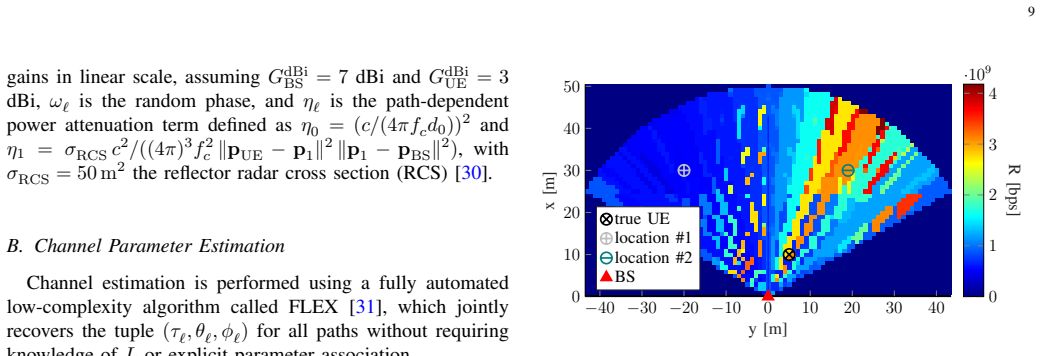
"Location #3 is derived from (8) using the estimated measurements of the AoB-HT solution (see Sec. IV-D3). In Fig. 6b, ... The purple diamond curve, instead, shows the spoofing deviation of AoB-HT with respect to the location #3. ... (iv) Angle-only blind (AoB-HT) offers a more promising spoofing capability than B-HT. ... it better approximates the spoofed location, especially at higher transmit powers."
For the AoB-HT variant, the 'desired spoofed location' (#3) is not chosen a priori; it is computed from the estimator's own output by plugging the AoB-HT estimated measurements into equation (8). The spoofing deviation metric then measures the distance between the estimator output and this retroactively defined target. Since the target is a deterministic function of the output, the reported small deviation is forced by construction. The subsequent claim that AoB-HT 'better approximates the spoofed location' is therefore tautological: the 'spoofed location' has been defined as whatever the AoB-HT estimator produces.
full rationale
The central derivation is constructive rather than circular: Proposition 3 (Eq. 29) explicitly constructs the pilot as the Hadamard quotient of the spoofed and true channel tensors, so the noiseless received signal equals the spoofed channel by design; the BS LS estimator then returns the spoofed parameters. That is a direct pre-image construction, not a fitted-parameter prediction, and the target location is chosen before running the estimator. The blind B-HT result is honestly reported to suffer a path-pairing problem (Sec. IV-D2, Fig. 7), and the oracle's practical limitation — exact complex path gains 'rarely available at the UE side' (Sec. III-A) — is explicitly acknowledged; these are correctness risks, not circularity. Self-citations ([14], [31]) are not load-bearing: the L=1 blind case is re-derived in Appendix C, and FLEX is an independent estimator used in simulation. The one genuine circular step is the AoB-HT 'location #3' metric: the spoofing target is derived from AoB-HT's own estimated measurements via Eq. (8), so the spoofing deviation to that target is forced by construction and cannot support the claim that AoB-HT 'better approximates the spoofed location.' This is a partial, secondary circularity, giving a score of 6.
Assumptions & free parameters
free parameters (3)
- spoofed path gain vector lambda =
arbitrary, not specified
- fake path injection coefficients {lambda_i} =
unspecified complex scalars
- simulation scenario geometry =
p_UE=[10,5], p_spoof#1=[30,-20], #2 optimized by rate, #3 from AoB-HT
assumptions (6)
- domain assumption The mmWave channel is sparse with L paths, single-bounce NLoS, ULA steering vectors, and known 2D geometry (Eq. 1)
- domain assumption The BS estimates channel parameters via LS/ML against the agreed pilot model and localizes via TDoA plus two angles (Eqs. 8-11)
- domain assumption The UE knows its true geometric parameters rho and the environment map (SP positions) for both oracle and blind designs
- domain assumption The UE knows the complex path gains alpha (amplitudes and phases) for the oracle solutions
- ad hoc to paper Spoofed pilots may take arbitrary complex values under only a loose total-power constraint; no constant-modulus or per-antenna peak constraint is enforced
- ad hoc to paper The TDoA estimator selects the two smallest ToAs (or a 'shortest path' rule) among the injected and true delays
Cite this review
Pith. "Pith review of HoloTrace: a Location Privacy-Preserving Framework for mmWave MIMO-OFDM Systems." pith.science (2026). https://pith.science/paper/5IZXNSMV
@misc{pith2026250923444,
  author       = {Pith},
  title        = {Pith review of: HoloTrace: a Location Privacy-Preserving Framework for mmWave MIMO-OFDM Systems},
  year         = {2026},
  howpublished = {\url{https://pith.science/paper/5IZXNSMV}},
  note         = {Machine review of arXiv:2509.23444}
}
read the original abstract
The technological innovation towards 6G cellular networks introduces unprecedented capabilities for user equipment (UE) localization, but it also raises serious concerns about physical layer location privacy. This paper introduces HoloTrace, a signal-level privacy preservation framework that relies on user-side spoofing of localization-relevant features to prevent the extraction of precise location information from the signals received by a base station (BS) in a mmWave MIMO-OFDM system. Spoofing is performed by the user on location parameters such as angle of arrival (AoA), angle of departure (AoD), and time difference of arrival (TDoA). Without requiring any protocol modification nor network-side support, our method strategically perturbs pilot transmissions to prevent a BS from performing non-consensual UE localization. The methodology allows the UE to spoof its position, keeping the precoder unchanged. We formulate spoofing as a unified rank-constrained projection problem, and provide closed-form solutions under varying levels of channel state information (CSI) at the UE, including scenarios with and without CSI knowledge. Simulation results confirm that the proposed approach enables the UE to deceive the BS, inducing significant localization errors, while the impact on link capacity varies depending on the spoofed position. Our findings establish HoloTrace as a practical and robust privacy-preserving solution for future 6G networks.
Figures


Figures from the paper (6 more)


Reference graph
Works this paper leans on
-
[1]
Positioning using wireless networks: Applications, recent progress, and future challenges,
Y . Yanget al., “Positioning using wireless networks: Applications, recent progress, and future challenges,”IEEE Journal on Selected Areas in Communications, vol. 42, no. 9, pp. 2149–2178, 2024
2024
-
[2]
A tutorial on 5G positioning,
L. Italiano, B. Camajori Tedeschini, M. Brambilla, H. Huang, M. Nicoli, and H. Wymeersch, “A tutorial on 5G positioning,”IEEE Communications Surveys & Tutorials, vol. 27, no. 3, pp. 1488–1535, 2025
2025
-
[3]
Positioning and sensing in 6G: Gaps, challenges, and opportunities,
A. Behravanet al., “Positioning and sensing in 6G: Gaps, challenges, and opportunities,”IEEE Vehicular Technology Magazine, vol. 18, no. 1, pp. 40–48, 2022
2022
-
[4]
Location privacy in B5G/6G: Systematization of knowledge,
H. B. Pasandi and F. Parastar, “Location privacy in B5G/6G: Systematization of knowledge,”arXiv preprint arXiv:2406.00359, 2024
arXiv 2024
-
[5]
Cooperative ISAC under spoofing attacks,
U. Ali, N. B. Melazzi, and S. Bartoletti, “Cooperative ISAC under spoofing attacks,”IEEE Wireless Communications Letters, pp. 1–1, 2025
2025
-
[6]
OFDM-based JCAS under attack: The dual threat of spoofing and jamming in WLAN sensing,
H. Can Yildirim, M. Furkan Keskin, H. Wymeersch, and F. Horlin, “OFDM-based JCAS under attack: The dual threat of spoofing and jamming in WLAN sensing,”IEEE Internet of Things Journal, vol. 12, no. 10, pp. 14 511–14 525, 2025
2025
-
[7]
Location-privacy-preserving technique for 5G mmwave devices,
J. J. Checa and S. Tomasin, “Location-privacy-preserving technique for 5G mmwave devices,”IEEE Communications Letters, vol. 24, no. 12, pp. 2692–2695, 2020
2020
-
[8]
Privacy preservation in MIMO-OFDM localization systems: A beamforming approach,
Y . Zhanget al., “Privacy preservation in MIMO-OFDM localization systems: A beamforming approach,”IEEE Wireless Communications Letters, vol. 14, no. 7, pp. 1979–1983, 2025
1979
Show all 31 references
-
[9]
Users are closer than they appear: Protecting user location from WiFi APs,
R. Ayyalasomayajula, A. Arun, W. Sun, and D. Bharadia, “Users are closer than they appear: Protecting user location from WiFi APs,” in Proceedings of the 24th International Workshop on Mobile Computing Systems and Applications. Newport Beach California: ACM, 2023, pp. 124–130
2023
-
[10]
Beamforming and artificial noise for cross-layer location privacy of e-health cellular devices,
S. Tomasin, “Beamforming and artificial noise for cross-layer location privacy of e-health cellular devices,” in2022 IEEE International Conference on Communications Workshops (ICC Workshops). IEEE, 2022, pp. 568–573
2022
-
[11]
Channel state information-free location-privacy enhancement: Fake path injection,
J. Li and U. Mitra, “Channel state information-free location-privacy enhancement: Fake path injection,”IEEE Transactions on Signal Processing, vol. 72, pp. 3745 – 3760, 2024
2024
-
[12]
Delay-angle information spoofing for channel state information- free location-privacy enhancement,
——, “Delay-angle information spoofing for channel state information- free location-privacy enhancement,”arXiv preprint arXiv:2504.14780, 2025
2025
-
[13]
Leveraging angle of arrival estimation against impersonation attacks in physical layer authentication,
T. M. Pham, L. Senigagliesi, M. Baldi, R. F. Schaefer, G. P. Fettweis, and A. Chorti, “Leveraging angle of arrival estimation against impersonation attacks in physical layer authentication,”arXiv preprint arXiv:2503.11508, 2025
2025 arXiv
-
[14]
AoA-based physical layer authentication in analog arrays under impersonation attacks,
M. Srinivasan, L. Senigagliesi, H. Chen, A. Chorti, M. Baldi, and H. Wymeersch, “AoA-based physical layer authentication in analog arrays under impersonation attacks,” in2024 IEEE 25th International Workshop on Signal Processing Advances in Wireless Communications (SPAWC). IEE...
2024
-
[15]
Cooperative impersonation in angle-based physical layer authentication,
A. Pourafzal, H. Chen, M. Srinivasan, Y . Zhang, and H. Wymeersch, “Cooperative impersonation in angle-based physical layer authentication,” inIEEE International Conference on Communications (ICC). IEEE, 2025
2025
-
[16]
Your locations may be lies: Selective-PRS-spoofing attacks and defence on 5G NR positioning systems,
K. Gao, H. Wang, H. Lv, and P. Gao, “Your locations may be lies: Selective-PRS-spoofing attacks and defence on 5G NR positioning systems,” inIEEE INFOCOM 2023 - IEEE Conference on Computer Communications. New York City, NY , USA: IEEE, May 2023, pp. 1–10
2023
-
[17]
Surgical strike on 5G positioning: Selective-PRS-spoofing attacks and its defence,
K. Gao, H. Wang, and H. Lv, “Surgical strike on 5G positioning: Selective-PRS-spoofing attacks and its defence,”IEEE Journal on Selected Areas in Communications, vol. 42, no. 10, pp. 2922–2937, 2024
2024
-
[18]
Tomasin, H
S. Tomasin, H. Fang, and X. Wang,Physical-Layer Authentication for 6G Systems. John Wiley & Sons, Ltd, 2024, ch. 11, pp. 221–237
2024
-
[19]
A comparative study of 3D UE positioning in 5G new radio with a single station,
B. Sun, B. Tan, W. Wang, and E. S. Lohan, “A comparative study of 3D UE positioning in 5G new radio with a single station,”Sensors, vol. 21, no. 4, p. 1178, 2021
2021
-
[20]
Single-anchor two-way localization bounds for 5G mmwave systems,
Z. Abu-Shaban, H. Wymeersch, T. Abhayapala, and G. Seco-Granados, “Single-anchor two-way localization bounds for 5G mmwave systems,” IEEE Transactions on Vehicular Technology, vol. 69, no. 6, pp. 6388– 6400, 2020
2020
-
[21]
Experimental validation of single BS 5G mmWave positioning and mapping for intelligent transport,
Y . Geet al., “Experimental validation of single BS 5G mmWave positioning and mapping for intelligent transport,”IEEE Transactions on Vehicular Technology, vol. 73, no. 11, pp. 16 744–16 757, 2024
2024
-
[22]
Position information from reflecting surfaces,
A. Kakkavas, M. H. Casta ˜neda Garc ´ıa, G. Seco-Granados, H. Wymeersch, R. A. Stirling-Gallacher, and J. A. Nossek, “Position information from reflecting surfaces,”IEEE Wireless Communications Letters, vol. 10, no. 6, pp. 1300–1304, 2021
2021
-
[23]
5G vehicle positioning in tunnels with single anchor TDOA exploiting multipath reflectors,
L. Italiano, M. Brambilla, and M. Nicoli, “5G vehicle positioning in tunnels with single anchor TDOA exploiting multipath reflectors,” in 33rd European Signal Processing Conference (EUSIPCO). Palermo, Italy: IEEE, 2025, pp. 1–5
2025
-
[24]
Beam training and tracking in mmwave communication: A survey,
W. Yi, W. Zhiqing, and F. Zhiyong, “Beam training and tracking in mmwave communication: A survey,”China Communications, vol. 21, no. 6, pp. 1–22, 2024
2024
-
[25]
The integrated sensing and communication revolution for 6G: Vision, techniques, and applications,
N. Gonz ´alez-Prelcicet al., “The integrated sensing and communication revolution for 6G: Vision, techniques, and applications,”Proceedings of the IEEE, vol. 112, no. 7, pp. 676–723, 2024
2024
-
[26]
Joint initial access and localization in millimeter wave vehicular networks: a hybrid model/data driven approach,
Y . Chen, J. Palacios, N. Gonz ´alez-Prelcic, T. Shimizu, and H. Lu, “Joint initial access and localization in millimeter wave vehicular networks: a hybrid model/data driven approach,” in2022 IEEE 12th Sensor Array and Multichannel Signal Processing Workshop (SAM), 2022, pp. 355– 359
2022
-
[27]
Learning to localize with attention: From sparse mmwave channel estimates from a single BS to high accuracy 3D location,
Y . Chen, N. Gonz ´alez-Prelcic, T. Shimizu, and H. Lu, “Learning to localize with attention: From sparse mmwave channel estimates from a single BS to high accuracy 3D location,”arXiv preprint arXiv:2307.00167, 2023
2023 arXiv
-
[28]
Performance bounds for parameter estimation under misspecified models: Fundamental findings and applications,
S. Fortunati, F. Gini, M. S. Greco, and C. D. Richmond, “Performance bounds for parameter estimation under misspecified models: Fundamental findings and applications,”IEEE Signal Processing Magazine, vol. 34, no. 6, pp. 142–157, 2017
2017
-
[29]
Some notes on alternating optimization,
J. C. Bezdek and R. J. Hathaway, “Some notes on alternating optimization,” inAdvances in Soft Computing—AFSS 2002: 2002 AFSS International Conference on Fuzzy Systems Calcutta, India, February 3–6, 2002 Proceedings. Springer, 2002, pp. 288–300
2002
-
[30]
A unified RCS modeling of typical targets for 3GPP ISAC channel standardization and experimental analysis,
Y . Zhanget al., “A unified RCS modeling of typical targets for 3GPP ISAC channel standardization and experimental analysis,”arXiv preprint arXiv:2505.20673, 2025
2025 arXiv
-
[31]
FLEX: Low-complexity 5D beamspace channel estimation for mmWave MIMO-OFDM,
A. Pourafzal, H. Huang, V . Pettersson, M. F. Keskin, and H. Wymeersch, “FLEX: Low-complexity 5D beamspace channel estimation for mmWave MIMO-OFDM,” in33rd European Signal Processing Conference (EUSIPCO). Palermo, Italy: IEEE, 2025, pp. 1–5
2025
Reviewed August 4, 2026 · model on record in the stance chip above.
Discussion (0). Continue with ORCID to comment.