REVIEW 5 major objections 5 minor 61 references
Self-sorting of bidisperse particles in evaporating sessile droplets
T0 review · 5 major / 5 minor · reviewed 2026-08-16 · deepseek-v4-flash
Pith's one-line read In an evaporating ethanol droplet with a moving contact line, thermocapillary Marangoni flow sorts bidisperse particles by size: small particles gather at the apex while large particles surround them.
desk verdict A credible flow-side study that corrects the CCA-mode scaling picture, alongside a plausible but under-validated particle-sorting prediction that needs a serious referee. read the letter →
The pith
A machine-rendered reading of the paper's core claim, the machinery that carries it, and where it could break.
The reading
What carries the argument
The load-bearing object is the temperature-dependent surface tension and its tangential gradient, $\nabla_s\sigma = \sigma_T[\nabla T - (\nabla T\cdot \mathbf{n})\mathbf{n}]$, which produces the Marangoni stress that drives the interface-parallel vortex. In the particle stage, the decisive interactions are the capillary force pinning a particle to the gas-liquid interface and the simplified Cheerios pair force between two adsorbed particles (Eqs. 23 and 24); these keep the particles at the interface where the tangential Marangoni flow can act on them, and the pair attraction is what large particles rely on to surround the small-particle core. The three-way flow competition among receding-contact-line flow, capillary flow, and Marangoni flow is the organizing framework that explains when sorting does and does not occur.
What would settle it
Measure the final deposit and in-drop flow of a 60-degree contact-angle ethanol droplet containing 1.5 and 2.5 micrometer particles on a 50-degree-Celsius substrate evaporating in constant-contact-angle mode: the claim predicts a small-particle core at the apex ringed by large particles whenever the thermocapillary gradient is active, and predicts that suppressing the Marangoni vortex, for instance with a surfactant or a slip-promoting coating, removes the sorting entirely.
Extended reading notes
Core claim
The paper's central discovery is that in constant-contact-angle evaporation with a moving contact line, the direction of the internal flow is decided by a three-way competition: evaporation-driven capillary flow toward the contact line, the receding contact line dragging fluid toward the apex, and thermocapillary Marangoni flow along the interface. For the ethanol droplets studied, the receding-contact-line flow beats the capillary flow at every contact angle considered, so particles are carried from the bulk to the apex in a size-neutral way when Marangoni stress is absent. When Marangoni stress is present, it creates a single vortex whose near-interface branch moves adsorbed particles along the surface; this tangential motion lets small particles slip into gaps and build a compact core at the apex stagnation point, with large particles arranged around that core. The authors identify this Marangoni-driven flow, not wettability or particle density, as the mechanism responsible for the observed self-sorting.
Load-bearing premise
The size-sorting result rests on the simplified surface forces that pin particles to the interface and pull pairs of adsorbed particles together, combined with the no-slip contact-line condition; if real droplets have even modest slip at the contact line, the Marangoni vortex that does the sorting may not form.
Editorial extensions
If this is right
- In constant-contact-angle evaporation without Marangoni stress, size-based particle separation should not occur; suppressing thermocapillary convection is enough to suppress sorting.
- Substrate heating and surface wettability can be used as knobs: turning the thermocapillary vortex on or off should switch between a mixed apex deposit and a small-core/large-shell pattern.
- Particle density is not a controlling parameter for interfacial sorting; the same shell pattern should appear for heavy and neutrally buoyant particles.
- The sorting should persist across contact angles from 60 to 120 degrees as long as the Marangoni flow dominates the receding-contact-line and capillary flows.
- Because Marangoni mixing accelerates evaporation in shallow droplets but slows it in tall ones, the time window for sorting changes with contact angle and heating.
Reading between the lines
- Not claimed in the paper: if the vortex topology is the only requirement, any system generating the same interface-parallel circulation, whether from surfactants, solutal Marangoni stress, or external forcing, should produce the same small-core/large-shell pattern in other solvents.
- Not claimed in the paper: the simplified Cheerios force lumps interface-deformation details into a few parameters, so the sharpness of the core-shell boundary should be sensitive to the particle's contact angle at the interface; a testable prediction is that changing particle hydrophobicity changes how cleanly small and large particles separate.
- Not claimed in the paper: the mechanism suggests a miniature size-classification device, a drying droplet whose Marangoni strength sets the cutoff radius between particles that go to the core and particles that stay in the shell; the cutoff should scale with the ratio of capillary attraction to Marangoni drag.
Signed reviews
Editorial analysis
A structured set of objections, weighed in public.
Referee Report
Summary. The paper presents a two-stage numerical study of bidisperse particle dispersion in an evaporating ethanol sessile droplet on a heated substrate, evaporating in constant-contact-angle (CCA) mode. Stage 1 solves the gas-liquid flow with a VOF method, including heat and vapor transport and thermocapillary Marangoni stress; stage 2 tracks 607 particles (radii 1.5 and 2.5 μm) with a DEM/Lagrangian model including drag, DMT adhesion, a capillary adsorption force, and a simplified Cheerios force. Six first-stage cases vary the contact angle (60°, 90°, 120°) and the presence/absence of Marangoni stress, with silica and neutrally buoyant particles in stage 2. The central claims are: (i) in the absence of Marangoni flow, the receding-contact-line flow dominates and carries both particle sizes toward the apex without size sorting; (ii) with Marangoni flow, a single vortex creates an interface-parallel flow near the apex that produces size-based self-sorting, with small particles forming a core at the apex and large particles surrounding them.
Significance. If the sorting result holds, the paper would support a useful and falsifiable design rule: in CCA-mode evaporation with Marangoni stresses, the thermocapillary flow is the control knob for producing a small-particle-core/large-particle-shell ordered deposit. Strengths of the manuscript: the stage-1 flow solver is validated against an analytical d²-law volume evolution and against the Zhu and Shi experiments at three mesh resolutions; the mesh-independence checks are done for both evaporative volume evolution and the Marangoni-affected velocity/temperature fields; the code and data are openly available with a DOI; and the particle model is not fitted to the sorting outcome, so the sorting claim is a genuine prediction rather than a curve fit. The major weakness is that the sorting prediction rests entirely on the stage-2 particle-interface force model and particle-contact model, neither of which is validated, resolved, or subjected to sensitivity analysis.
major comments (5)
- [Sections 6.2–6.3 and Eqs. (23)–(24)] The central sorting claim (small-particle core, large-particle shell) is produced entirely by the stage-2 force model, yet stage 2 has no validation, no mesh or time-step convergence study, and no sensitivity analysis. The mesh selected in Section 4 resolves the initial contact radius with 24 cells, i.e., approximately 21 μm per cell, while the particle radii are 1.5 and 2.5 μm; the interface position entering r_l in Eq. (23) is therefore known to no better than about one cell, which is several particle diameters. Because the adsorption criterion r_l < R and the capillary/Cheerios forces are sub-grid quantities, the predicted sorting is fragile and needs at least a resolved-interface or sub-grid-interface assessment and a parameter sensitivity study before the Section 7 conclusion can be supported.
- [Section 2.2.1, Eq. (23)] The amplitude f of the capillary adsorption force is never specified, although this force is the mechanism that keeps particles at the interface and thereby enables the sorting pattern. Since the entire small-core/large-shell outcome depends on particles being adsorbed, the value of f (and its relation to the surface free energy of the liquid-particle interface) must be stated and varied.
- [Section 2.2.1, Eq. (14)] Equation (14) defines K_n = 4R*/(3E*), which has units of m³/N, but it is used in Eq. (13) as though the normal force were K_n δ_n^{3/2}, which requires units of N/m^{3/2}. This dimensional inconsistency is a verification concern in exactly the contact-force equations that determine the packing of the sorted core. The formula should be the Hertzian coefficient K_n = (4/3) E* sqrt(R*) (or the paper should otherwise clarify its normalization).
- [Appendix B] Appendix B shows that imposing a 20–50 μm slip length suppresses the Marangoni vortex that is identified (Section 6.3) as the sorting mechanism, and the authors justify the no-slip choice by appealing to experimental evidence that the apex is the coldest region. However, the VOF method itself carries an implicit numerical slip of order one mesh cell (about 21 μm), as the authors note in Section 3.2, so the effective slip of the simulation is not actually zero. Given that the sorting flow is suppressed for slip lengths of 20–50 μm, the paper should demonstrate that the sorting result is robust to the effective numerical slip, or provide a quantitative argument that the implicit slip is below the threshold at which the vortex is suppressed.
- [Section 2.2.1, Eq. (22) and Table 2] The DMT adhesion force uses an uncalibrated work of adhesion Δγ, and the Hertz contact model uses a Young's modulus of 1 MPa (Table 2), about five orders of magnitude below the bulk value for silica. The small-particle core and large-particle shell pattern is described in Section 6.3 as arising from packing in gaps between particles, so the pattern depends precisely on these contact and adhesion parameters. The paper needs a sensitivity analysis with respect to E*, Δγ, and f to establish that the sorting pattern is not an artifact of these choices.
minor comments (5)
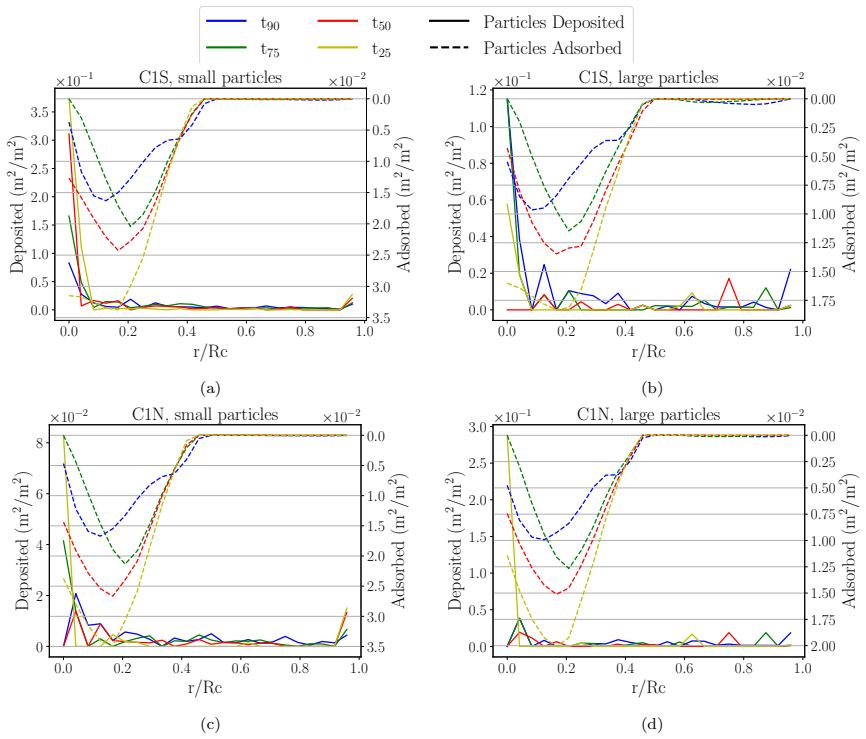
- [Section 6.1, Figures 10–12] The surface-concentration curves of the individual cases are reported without error bars, repeated realizations, or a discussion of statistical sampling fluctuations; since only 607 particles are simulated, the concentration peaks may not be statistically robust and a repetition with different random initial placements should be reported or at least discussed.
- [Table 2] The table lists 'Volume fraction of particles 0.5' while the text in Section 3.1 states that the volume fraction associated with each particle size is 0.1%; this is confusing and should be reconciled (e.g., 0.5% total vs. 0.1% per size).
- [Table 3] The caption of Table 3 states that cases C1–C6 have 'variation in substrate temperature,' but the substrate temperature is fixed at 50 °C for all cases; the caption should instead refer to variation in contact angle and Marangoni stresses.
- [Appendix B, Figure 16] The sub-figure label in the caption of Figure 16 repeats '(d)' for the 50 μm slip case and the figure text 'drops' should read 'droplet'; these should be corrected.
- [Section 2.2.1, Eq. (20)] The drag coefficient correlation in Eq. (20) uses the criterion Re < 1000 versus Re > 1000, but the second branch is typically used for Re > 1000; the 1000 value is a conventional crossover and should be cited or justified, and the use of the Wen–Yu correlation in a dilute one-way-coupled setting should be briefly justified.
Circularity Check
No significant circularity; the small-core/large-shell sorting is an emergent simulation output, not a prescribed or fitted input.
full rationale
The claimed derivation chain is: stage-1 VOF simulation of an evaporating CCA ethanol droplet produces flow and temperature fields; stage-2 Lagrangian DEM simulation then evolves bidisperse particles under drag, contact, adhesion, capillary, and Cheerios forces; the small-core/large-shell surface concentration pattern emerges from that coupled dynamics. None of the target quantities, such as the radial ordering of particle sizes, the agglomeration of small particles at the apex, or the surrounding shell of large particles, is prescribed, fitted, or used to calibrate the model. The capillary force, Cheerios force, DMT adhesion, and Hertz contact are parameterized from material and interface constants given in Tables 1 and 2 and from cited prior work, not from the sorting outcome. The stage-1 flow model is validated externally against the analytical volume evolution and against the Zhu-Shi experiments, with a mesh-independence study in Appendix A; the Appendix B choice of a no-slip contact-line condition is likewise justified by comparison with external experimental temperature observations. Reuse of the authors' previous framework is methodological and not load-bearing for the new claim. Concerns such as the dimensionally inconsistent stiffness expression in Eq. 14, the simplified and unvalidated interface-force closure, the coarse 21-micron mesh relative to the 3-5 micron particles, and the sensitivity to imposed slip lengths are real correctness and robustness risks, but they do not make the sorting result equivalent to its inputs by construction. There is no fitted parameter renamed as a prediction and no self-citation chain that forces the central conclusion.
Assumptions & free parameters
free parameters (4)
- Particle Young's modulus =
1.0 MPa
- Slip length at contact line =
0 (no-slip)
- Surface free energy f in capillary force (Eq. 23) =
not specified
- Cheerios force parameters beta0 and alpha_c (Eq. 24) =
not specified
assumptions (5)
- domain assumption Bond number Bo = 0.049-0.1475 << 1; droplet maintains spherical cap and gravity is neglected (Section 2).
- domain assumption Vapor transport in gas is diffusion-dominated (Pe_v < 1) while heat convection in the liquid is significant (Pe_h > 10) (Section 2).
- domain assumption One-way coupling: particles do not affect the flow because total particle volume fraction is below 1 percent (Section 2).
- ad hoc to paper No-slip boundary condition at the substrate is appropriate despite the Huh-Scriven paradox because the VOF method provides an implicit slip (Section 3.2, Appendix B).
- domain assumption The DMT adhesion and simplified capillary/Cheerios force expressions describe the behavior of 3-5 um particles at the liquid interface (Section 2.2.1).
Cite this review
Pith. "Pith review of Self-sorting of bidisperse particles in evaporating sessile droplets." pith.science (2026). https://pith.science/paper/5KK3YL77
@misc{pith2026250416597,
  author       = {Pith},
  title        = {Pith review of: Self-sorting of bidisperse particles in evaporating sessile droplets},
  year         = {2026},
  howpublished = {\url{https://pith.science/paper/5KK3YL77}},
  note         = {Machine review of arXiv:2504.16597}
}
read the original abstract
This study investigates the dispersion and self-sorting dynamics of bidisperse particles, i.e., a mixture of two distinct particle sizes, during the evaporation of ethanol droplets on a heated substrate, focusing on the influence of surface wettability, Marangoni stresses, and relative particle density. To this end, numerical simulations are carried out using a two-stage numerical approach: the first stage simulates the gas-liquid flow along with the heat and vapor distribution, while the second stage models the particle behavior using Lagrangian particle tracking. The results reveal that for an ethanol droplet evaporating with a constant contact angle in the absence of thermocapillary Marangoni stresses, the flow induced by the receding motion of the contact line supersedes the capillary flow, moving the fluid from the contact line to the apex of the droplet. This flow moves the particles from the bulk of the droplet to the apex of the droplet and suppresses size-based self-sorting of the particles. However, in the presence of Marangoni stresses, a flow along the interface near the apex of the droplet promotes the self-sorting of particles based on their size, whereby smaller particles concentrate near the droplet apex and larger particles form an outer shell around them.
Figures


Figures from the paper (13 more)




Reference graph
Works this paper leans on
-
[1]
A mesh-dependent model for applying dynamic contact angles to VOF simulations
Afkhami, S., Zaleski, S., Bussmann, M., 2009. A mesh-dependent model for applying dynamic contact angles to VOF simulations. Journal of Computational Physics 228, 5370–
work page 2009
-
[2]
The Computer Simulation of Liquids, Vol 42
Allen, M.P., Tildesley, D.J., 1989. The Computer Simulation of Liquids, Vol 42. Oxford University Press
work page 1989
-
[3]
Convective Flows in Evaporating Sessile Droplets
Barmi, M.R., Meinhart, C.D., 2014. Convective Flows in Evaporating Sessile Droplets. The Journal of Physical Chemistry B 118, 2414–2421. doi: 10.1021/jp408241f
-
[4]
Evaporation-induced flow near a contact line: Consequences on coating and contact angle
Berteloot, G., Pham, C.T., Daerr, A., Lequeux, F., Limat, L., 2008. Evaporation-induced flow near a contact line: Consequences on coating and contact angle. EPL (Europhysics Letters) 83, 14003. doi: 10.1209/0295-5075/83/14003. 26 (a) (b) (c) Figure 15: Velocity and temperature plots for the cases including the Marangoni stresses, C4, where θc = 90 ◦, with...
-
[5]
Analysis of an Evaporating Sessile Droplet on a Non-Wetted Surface
Bhardwaj, R., 2018. Analysis of an Evaporating Sessile Droplet on a Non-Wetted Surface. Colloid and Interface Science Communications 24, 49–53. doi: 10.1016/j.colcom.2018. 02.004
-
[6]
Continuum Method for Modeling Surface Tension
Brackbill, J., Kothe, D., Zemach, C., 1992. Continuum Method for Modeling Surface Tension. Journal of Computational Physics 100, 335–354
work page 1992
-
[7]
Blood drop patterns: Formation and applications
Chen, R., Zhang, L., Zang, D., Shen, W., 2016. Blood drop patterns: Formation and applications. Advances in Colloid and Interface Science 231, 1–14. doi: 10.1016/j.cis. 2016.01.008
doi:10.1016/j.cis 2016
-
[8]
Numerical simulations of sessile droplet evaporating on heated substrate
Chen, X., Chen, P.G., Ouazzani, J., LIu, Q., 2017. Numerical simulations of sessile droplet evaporating on heated substrate. The European Physical Journal. Special Topics 226, 1325–1335. doi: 10.1140/epjst/e2016-60203-y
Show all 61 references
-
[9]
Interaction of bi-dispersed particles with contact line in an evaporating colloidal drop
Chhasatia, V.H., Sun, Y., 2011. Interaction of bi-dispersed particles with contact line in an evaporating colloidal drop. Soft Matter 7, 10135. doi: 10.1039/c1sm06393f
2011 doi
-
[10]
A discrete numerical model for granular assemblies
Cundall, P., Strack, O.D.L., 1979. A discrete numerical model for granular assemblies. G´ eotechnique 29, 47–65. doi:http://dx.doi.org/10.1680/geot.1979.29.1.47
1979 doi
-
[11]
Suppression of the Coffee-Ring Effect and Evaporation-Driven Disorder to Order Transition in Colloidal Droplets
Das, S., Dey, A., Reddy, G., Sarma, D.D., 2017. Suppression of the Coffee-Ring Effect and Evaporation-Driven Disorder to Order Transition in Colloidal Droplets. The Journal of Physical Chemistry Letters 8, 4704–4709. doi: 10.1021/acs.jpclett.7b01814
2017 doi
-
[12]
Droplet Evaporation Dynamics on a Superhydrophobic Surface with Negligible Hysteresis
Dash, S., Garimella, S.V., 2013. Droplet Evaporation Dynamics on a Superhydrophobic Surface with Negligible Hysteresis. Langmuir 29, 10785–10795. doi: 10.1021/la402784c
2013 doi
-
[13]
Pattern formation in drying drops
Deegan, R.D., 2000. Pattern formation in drying drops. Physical Review E 61, 475–485. doi:10.1103/PhysRevE.61.475
2000 doi
-
[14]
A unified single-field model framework for Volume-Of-Fluid simulations of interfacial species transfer applied to bubbly flows
Deising, D., Marschall, H., Bothe, D., 2016. A unified single-field model framework for Volume-Of-Fluid simulations of interfacial species transfer applied to bubbly flows. Chem- ical Engineering Science 139, 173–195. doi: 10.1016/j.ces.2015.06.021
2016 doi
-
[15]
Conservative finite-volume framework and pressure-based algorithm for flows of incompressible, ideal-gas and real-gas fluids at all speeds
Denner, F., Evrard, F., van Wachem, B., 2020. Conservative finite-volume framework and pressure-based algorithm for flows of incompressible, ideal-gas and real-gas fluids at all speeds. Journal of Computational Physics 409, 109348. doi: 10.1016/j.jcp.2020.109348
2020
-
[16]
Compressive VOF method with skewness correction to capture sharp interfaces on arbitrary meshes
Denner, F., van Wachem, B., 2014a. Compressive VOF method with skewness correction to capture sharp interfaces on arbitrary meshes. Journal of Computational Physics 279, 127–144. doi: 10.1016/j.jcp.2014.09.002
2014 doi
-
[17]
Fully-coupled balanced-force VOF framework for arbitrary meshes with least-squares curvature evaluation from volume fractions
Denner, F., van Wachem, B., 2014b. Fully-coupled balanced-force VOF framework for arbitrary meshes with least-squares curvature evaluation from volume fractions. Numerical Heat Transfer Part B: Fundamentals 65, 218–255. doi: 10.1080/10407790.2013.849996
-
[18]
Effect of contact deformations on the ad- hesion of particles
Derjaguin, B., Muller, V., Toporov, Y., 1975. Effect of contact deformations on the ad- hesion of particles. Journal of Colloid and Interface Science 53, 314–326. doi: 10.1016/ 0021-9797(75)90018-1
1975
-
[19]
Evaporating pure, binary and ternary droplets: Thermal effects and axial symmetry break- ing
Diddens, C., Tan, H., Lv, P., Versluis, M., Kuerten, J.G.M., Zhang, X., Lohse, D., 2017. Evaporating pure, binary and ternary droplets: Thermal effects and axial symmetry break- ing. Journal of Fluid Mechanics 823, 470–497. doi: 10.1017/jfm.2017.312. 29
2017 doi
-
[20]
Evaporation of pure liquid sessile and spherical suspended drops: A review
Erbil, H.Y., 2012. Evaporation of pure liquid sessile and spherical suspended drops: A review. Advances in Colloid and Interface Science 170, 67–86. doi: 10.1016/j.cis.2011. 12.006
2012 doi
-
[21]
Numerical Analysis of the Dispersion and Deposition of Particles in Evaporating Sessile Droplets
Erdem, A.K., Denner, F., Biancofiore, L., 2024. Numerical Analysis of the Dispersion and Deposition of Particles in Evaporating Sessile Droplets. Langmuir 40, 13428–13445. doi:10.1021/acs.langmuir.4c00680
2024 doi
-
[22]
Evaporation-driven liquid flow in sessile droplets
Gelderblom, H., Diddens, C., Marin, A., 2022. Evaporation-driven liquid flow in sessile droplets. Soft Matter 18, 8535–8553. doi: 10.1039/D2SM00931E
2022 doi
-
[23]
Pinning and Depinning Dynamics of an Evaporating Sessile Droplet Containing Mono- and Bidispersed Colloidal Particles on a Nonheated/Heated Hydrophobic Substrate
Gupta, S., Thombare, M.R., Patil, N.D., 2023. Pinning and Depinning Dynamics of an Evaporating Sessile Droplet Containing Mono- and Bidispersed Colloidal Particles on a Nonheated/Heated Hydrophobic Substrate. Langmuir , acs.langmuir.2c03270doi:10.1021/ acs.langmuir.2c03270
2023
-
[24]
Evaporation of ethanol-water sessile droplet of different compositions at an elevated substrate temper- ature
Gurrala, P., Katre, P., Balusamy, S., Banerjee, S., Sahu, K.C., 2019. Evaporation of ethanol-water sessile droplet of different compositions at an elevated substrate temper- ature. International Journal of Heat and Mass Transfer 145, 118770. doi: 10.1016/j. ijheatmasstransfer....
2019
-
[25]
Volume of fluid method for interfacial reactive mass transfer: Application to stable liquid film
Haroun, Y., Legendre, D., Raynal, L., 2010. Volume of fluid method for interfacial reactive mass transfer: Application to stable liquid film. Chemical Engineering Science 65, 2896– 2909
2010
-
[26]
Evaporation of a Sessile Droplet on a Substrate
Hu, H., Larson, R.G., 2002. Evaporation of a Sessile Droplet on a Substrate. The Journal of Physical Chemistry B 106, 1334–1344. doi: 10.1021/jp0118322
2002 doi
-
[27]
Analysis of the Microfluid Flow in an Evaporating Sessile Droplet
Hu, H., Larson, R.G., 2005. Analysis of the Microfluid Flow in an Evaporating Sessile Droplet. Langmuir 21, 3963–3971. doi: 10.1021/la047528s
2005 doi
-
[28]
Hydrodynamic model of steady movement of a solid/liquid/fluid contact line
Huh, C., Scriven, L., 1971. Hydrodynamic model of steady movement of a solid/liquid/fluid contact line. Journal of Colloid and Interface Science 35, 85–101. doi: 10.1016/ 0021-9797(71)90188-3
1971
-
[29]
Iqbal, R., Matsumoto, A., Carlson, D., Peters, K.T., Funari, R., Sen, A.K., Shen, A.Q.,
-
[30]
Dispersion of particles in a sessile droplet evaporating on a heated substrate
Jain, A.K., Denner, F., van Wachem, B., 2024. Dispersion of particles in a sessile droplet evaporating on a heated substrate. International Journal of Multiphase Flow 180, 104956. doi:10.1016/j.ijmultiphaseflow.2024.104956
2024
-
[31]
Volume tracking of interfaces having surface tension in two and three dimensions
Kothe, D.D.B., Rider, W.J., Mosso, S.S., Brock, J.J., 1996. Volume tracking of interfaces having surface tension in two and three dimensions. AIAA 96-0859 , 25
1996
-
[32]
Transport and deposition patterns in drying sessile droplets
Larson, R.G., 2014. Transport and deposition patterns in drying sessile droplets. AIChE Journal 60, 1538–1571. doi: 10.1002/aic.14338
2014 doi
-
[33]
Simulation of self-assembly in an evaporating droplet of colloidal solution by dissipative particle dynamics
Lebedev-Stepanov, P., Vlasov, K., 2013. Simulation of self-assembly in an evaporating droplet of colloidal solution by dissipative particle dynamics. Colloids and Surfaces A: Physicochemical and Engineering Aspects 432, 132–138. doi: 10.1016/j.colsurfa.2013. 05.012. 30
2013 doi
-
[34]
Adhesive particulate flow: The discrete- element method and its application in energy and environmental engineering
Li, S., Marshall, J.S., Liu, G., Yao, Q., 2011. Adhesive particulate flow: The discrete- element method and its application in energy and environmental engineering. Progress in Energy and Combustion Science 37, 633–668. doi: 10.1016/j.pecs.2011.02.001
2011 doi
-
[35]
A unified single-field Volume-of-Fluid-based formulation for multi-component interfacial transfer with local volume changes
Maes, J., Soulaine, C., 2020. A unified single-field Volume-of-Fluid-based formulation for multi-component interfacial transfer with local volume changes. Journal of Computational Physics 402, 109024. doi: 10.1016/j.jcp.2019.109024
2020
-
[36]
Numerical simulation of species transfer across fluid interfaces in free-surface flows using OpenFOAM
Marschall, H., Hinterberger, K., Sch¨ uler, C., Habla, F., Hinrichsen, O., 2012. Numerical simulation of species transfer across fluid interfaces in free-surface flows using OpenFOAM. Chemical Engineering Science 78, 111–127. doi: 10.1016/j.ces.2012.02.034
2012 doi
-
[37]
Elastic spheres in contact under varying oblique forces
Mindlin, R.D., Deresiewicz, H., 1953. Elastic spheres in contact under varying oblique forces. J. of Appl. Mech. 20, 327–344
1953
-
[38]
Physics of drying complex fluid drop: Flow field, pattern formation, and desiccation cracks
Mondal, R., Lama, H., Sahu, K.C., 2023. Physics of drying complex fluid drop: Flow field, pattern formation, and desiccation cracks. Physics of Fluids 35, 061301. doi: 10.1063/5. 0153682
2023 doi
-
[39]
Evaporation of Nanoparticle Droplets on Smooth Hydrophobic Surfaces: The Inner Coffee Ring Deposits
Nguyen, T.A.H., Hampton, M.A., Nguyen, A.V., 2013. Evaporation of Nanoparticle Droplets on Smooth Hydrophobic Surfaces: The Inner Coffee Ring Deposits. The Journal of Physical Chemistry C 117, 4707–4716. doi: 10.1021/jp3126939
2013 doi
-
[40]
Transients of Marangoni and Stefan advection dynamics during generic sessile droplet evaporation
Paul, A., Dhar, P., 2023. Transients of Marangoni and Stefan advection dynamics during generic sessile droplet evaporation. Physics of Fluids 35, 102022. doi: 10.1063/5.0171215
2023 doi
-
[41]
Stokes flow inside an evaporating liquid line for any contact angle
Petsi, A.J., Burganos, V.N., 2008. Stokes flow inside an evaporating liquid line for any contact angle. Physical Review E 78, 036324. doi: 10.1103/PhysRevE.78.036324
2008 doi
-
[42]
Numerical investigation of evaporation-induced flow around sessile droplets using a sharp-interface algebraic VOF approach
Shang, X., Chen, H., Nguyen, T.B., Tran, T., 2024. Numerical investigation of evaporation-induced flow around sessile droplets using a sharp-interface algebraic VOF approach. International Journal of Heat and Mass Transfer 231, 125849. doi: 10.1016/j. ijheatmasstransfer.2024.125849
2024
-
[43]
Moving Contact Lines: Scales, Regimes, and Dy- namical Transitions
Snoeijer, J.H., Andreotti, B., 2013. Moving Contact Lines: Scales, Regimes, and Dy- namical Transitions. Annual Review of Fluid Mechanics 45, 269–292. doi: 10.1146/ annurev-fluid-011212-140734
2013
-
[44]
Lagrangian numerical simulation of plug flow of cohesionless particles in a horizontal pipe
Tsuji, Y., Tanaka, T., Ishida, T., 1992. Lagrangian numerical simulation of plug flow of cohesionless particles in a horizontal pipe. Powder Technology 71, 239–250
1992
-
[45]
Capillary Forces between Spherical Particles Floating at a Liquid-Liquid Interface
Vassileva, N.D., van den Ende, D., Mugele, F., Mellema, J., 2005. Capillary Forces between Spherical Particles Floating at a Liquid-Liquid Interface. Langmuir 21, 11190–11200. doi:10.1021/la051186o
2005 doi
-
[46]
Cheerios effect
Vella, D., Mahadevan, L., 2005. The “Cheerios effect”. American Journal of Physics 73, 817–825. doi: 10.1119/1.1898523
2005 doi
-
[47]
Pinning and depinning mechanism of the contact line during evaporation of nano-droplets sessile on textured surfaces
Wang, F.C., Wu, H.A., 2013. Pinning and depinning mechanism of the contact line during evaporation of nano-droplets sessile on textured surfaces. Soft Matter 9, 5703. doi: 10. 1039/c3sm50530h
2013
-
[48]
Mechanics of fluidization
Wen, C., Yu, Y., 1966. Mechanics of fluidization. Chem. Eng. Prog. Symp. Ser. 62, 100–111. 31
1966
-
[49]
A Numerical Study Exploring the Effect of Particle Properties on the Fluidization of Adhesive Particles
Wilson, R., Dini, D., van Wachem, B., 2016. A Numerical Study Exploring the Effect of Particle Properties on the Fluidization of Adhesive Particles. AIChE Journal 62, 1467–
2016
-
[50]
Self-pinning of silica suspension droplets on hydrophobic surfaces
Yang, K.C., Wang, C., Hu, T.Y., Lin, H.P., Cho, K.H., Chen, L.J., 2020. Self-pinning of silica suspension droplets on hydrophobic surfaces. Journal of Colloid and Interface Science 579, 212–220. doi: 10.1016/j.jcis.2020.06.059
2020 doi
-
[51]
Experimental studies on formation, spreading and drying of inkjet drop of colloidal suspensions
Yoo, H., Kim, C., 2015. Experimental studies on formation, spreading and drying of inkjet drop of colloidal suspensions. Colloids and Surfaces A: Physicochemical and Engineering Aspects 468, 234–245. doi: 10.1016/j.colsurfa.2014.12.032
2015 doi
-
[52]
Evaporation of a Droplet: From physics to applications
Zang, D., Tarafdar, S., Tarasevich, Y.Y., Dutta Choudhury, M., Dutta, T., 2019. Evaporation of a Droplet: From physics to applications. Physics Reports 804, 1–56. doi:10.1016/j.physrep.2019.01.008
2019 doi
-
[53]
Modeling of interfacial mass transfer based on a single-field formulation and an algebraic VOF method considering non-isothermal systems and large volume changes
Zanutto, C.P., Paladino, E.E., Evrard, F., van Wachem, B., Denner, F., 2022. Modeling of interfacial mass transfer based on a single-field formulation and an algebraic VOF method considering non-isothermal systems and large volume changes. Chemical Engineering Sci- ence 247, 1...
2022
-
[54]
Influence of thermal properties on hydrothermal waves in evaporating sessile droplets
Zhu, J.L., Feng, L., Shi, W.Y., 2021. Influence of thermal properties on hydrothermal waves in evaporating sessile droplets. Physics of Fluids 33, 102107. doi: 10.1063/5.0064888
2021 doi
-
[55]
Longitudinal roll patterns of Marangoni instability in an easily volatile sessile droplet evaporating at constant contact angle mode
Zhu, J.L., Shi, W.Y., 2019. Longitudinal roll patterns of Marangoni instability in an easily volatile sessile droplet evaporating at constant contact angle mode. International Journal of Heat and Mass Transfer 134, 1283–1291. doi: 10.1016/j.ijheatmasstransfer.2019. 02.068
2019 doi
-
[56]
Hydrothermal waves in sessile droplets evaporating at a constant contact angle mode
Zhu, J.L., Shi, W.Y., 2021. Hydrothermal waves in sessile droplets evaporating at a constant contact angle mode. International Journal of Heat and Mass Transfer 172, 121131. doi:10.1016/j.ijheatmasstransfer.2021.121131
2021
-
[57]
Instability patterns of Marangoni flow in evaporating droplets on lyophobic surface
Zhu, J.L., Shi, W.Y., 2023. Instability patterns of Marangoni flow in evaporating droplets on lyophobic surface. International Communications in Heat and Mass Transfer 141, 106598. doi: 10.1016/j.icheatmasstransfer.2022.106598
2023
-
[58]
Monte Carlo simulation of particle size separation in evaporating bi-dispersed colloidal droplets on hydrophilic substrates
Zolotarev, P.A., Kolegov, K.S., 2022. Monte Carlo simulation of particle size separation in evaporating bi-dispersed colloidal droplets on hydrophilic substrates. Physics of Fluids 34, 017107. doi: 10.1063/5.0072083. 32
2022 doi
-
[1477]
doi: 10.1002/aic.15162
-
[2022]
Journal of Colloid and Interface Science 623, 927–937
Evaporation driven smart patterning of microparticles on a rigid-soft composite substrate. Journal of Colloid and Interface Science 623, 927–937. doi: 10.1016/j.jcis. 2022.05.087
2022 doi
-
[5389]
doi: 10.1016/j.jcp.2009.04.027
2009 doi
Reviewed August 16, 2026 · model on record in the stance chip above.
Discussion (0). Continue with ORCID to comment.