REVIEW 3 major objections 5 minor 79 references
PaperBridge: Crafting Research Narratives through Human-AI Co-Exploration
T0 review · 3 major / 5 minor · reviewed 2026-08-06 · deepseek-v4-flash
Pith's one-line read PaperBridge claims that a human-AI co-exploration system, built on four narrative frameworks drawn from 53 public HCI talks, helps researchers organize their own publications into coherent research narratives.
desk verdict A solid UIST-style systems paper with a genuine design-space contribution; the single-arm user study doesn't support the 'demonstrated effectiveness' claim, but the paper is honest about that gap. read the letter →
The pith
A machine-rendered reading of the paper's core claim, the machinery that carries it, and where it could break.
The reading
What carries the argument
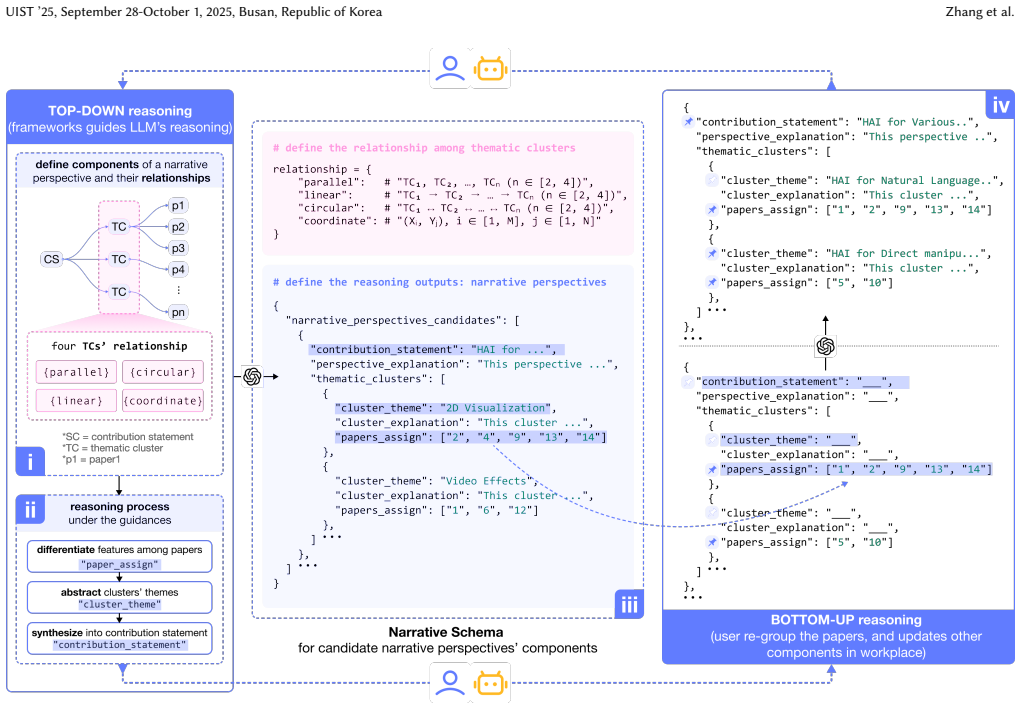
The load-bearing mechanism is the Narrative Schema, a structured JSON representation of a narrative perspective — a contribution statement, thematic clusters, and per-paper assignments — that serves simultaneously as the LLM's output format and as the user's editable workspace. Around this schema, the bi-directional analysis engine runs two prompt chains: a top-down chain that translates each framework's inter-cluster relationships (sequential for linear, orthogonal for coordinate) into instructions and walks the model through distinguishing features, abstracting cluster themes, and synthesizing contribution statements, and a bottom-up chain that regenerates only the components the user has not explicitly locked after manual edits. Before presentation, a ranking module scores candidate perspectives on five equally weighted metrics — statement-cluster alignment, structural consistency, adjusted Rand index against a baseline clustering, paper-cluster similarity, and intra-cluster cohesion — and shows the top four as keyword-form 'sparks' designed to leave interpretive room. The same schema feeds a slide-generation module, so confirmed narratives can be exported as editable presentation decks with framework-matched templates.
What would settle it
A content analysis of a larger, more diverse sample of research talks, for instance 200 talks spanning several computer science subfields and adjacent disciplines, that finds a substantial share of speakers using narrative organizations outside the four frameworks would show the taxonomy is not a representative map. Alternatively, a controlled comparison of PaperBridge against a general-purpose LLM chat interface — a baseline the paper notes was absent — finding no advantage in the number or diversity of alternative narratives produced would undercut the claim that the structured co-exploration workflow adds value.
Extended reading notes
Core claim
The paper's central claim is that exploring alternative research narratives can be scaffolded by a mixed-initiative workflow, and that PaperBridge is a working instance of it. From a content analysis of 53 public HCI job talks and guest seminars, the authors identify four recurring narrative frameworks: parallel (non-overlapping thematic clusters that collectively address one research challenge), linear (clusters forming a progressive development), coordinate (clusters positioned along conceptual dimensions such as user control versus automation), and circular (clusters engaged in iterative feedback loops). The system translates each framework into prompt-level instructions about inter-cluster relationships, so that an LLM can generate candidate narrative perspectives, each consisting of a contribution statement, thematic clusters, and paper assignments, which users then explore either top-down (choose a framework first) or bottom-up (group papers first and let the system synthesize the framing). The user study (N=12) reported a mean System Usability Scale score of 84.38, low workload measures, and strong ratings on inspiration, while also documenting a tension: moderately rated sparks (M=3.18) coexisted with positive overall evaluations, suggesting the system's value lies in prompting reflection rather than in producing final text.
Load-bearing premise
Everything the top-down path offers assumes that the four story structures found in 53 public HCI job talks and guest seminars — parallel, linear, coordinate, and circular — represent how HCI researchers at large actually organize their research narratives, even though the corpus skews toward early-career talks and the paper itself notes the frameworks are not exhaustive.
Editorial extensions
If this is right
- Researchers can turn narrative ideation into a structured search: pick a framework, inspect candidate perspectives, refine them, and export slides, which study participants reported made the task feel less daunting.
- The four narrative frameworks can serve as reusable design patterns or conceptual scaffolds for other academic communication tools, such as grant-writing or portfolio systems.
- Keyword-level suggestions that leave room for interpretation may be more useful than polished generated text when the user is deeply familiar with the material, since participants engaged with sparks they could project their own meaning onto.
- Because participants formed initial trust once they recognized familiar ideas in the system's output, mixed-initiative tools for personal content may need to seed suggestions with recognizable anchors.
- Slide-draft output closes the gap between exploration and deliverables, allowing alternative framings to be carried directly into discussions with advisors or collaborators.
Reading between the lines
- Because the framework corpus consists of 53 HCI job talks and guest seminars, and the paper itself concedes the four frameworks are not exhaustive, a larger corpus spanning other computer science subfields or adjacent disciplines would likely yield additional structures, such as chronological groupings or nested hierarchies — a direct test of the taxonomy's generality.
- The gap between moderate spark ratings and high overall satisfaction suggests the generated perspectives function as prompts for thought rather than as products; a corollary is that a system optimized to produce polished statements could actually be less useful for this task.
- The lock-and-regenerate interaction, in which users fix some narrative components and ask the model to update the rest, generalizes to other LLM-driven editing of structured artifacts, including literature reviews, project plans, or slide decks.
- Because generation relies on titles and abstracts only, researchers with few or topically scattered publications are likely to receive weaker suggestions, as one participant's case in the paper illustrates; feeding in full texts or ongoing-project documents would test how much the input scope limits the approach.
Signed reviews
Editorial analysis
A structured set of objections, weighed in public.
Referee Report
Summary. PaperBridge is a human-AI co-exploration system that helps HCI researchers organize their own publications into alternative research narratives. The design is grounded in a formative study with six early-career HCI researchers and a content analysis of 53 public HCI talks, which yields four narrative frameworks (parallel, linear, coordinate, circular) and a taxonomy of rationale strategies. The system combines top-down framework-guided generation with bottom-up user-driven re-clustering, using a structured JSON 'Narrative Schema' as a shared editable representation. The paper reports a user study with 12 HCI researchers that collected SUS, NASA-TLX, custom Likert-scale questionnaires, spark ratings, and qualitative interviews. The authors claim the study demonstrated usability and effectiveness in facilitating exploration of alternative research narratives, while also reporting moderate mean spark ratings and explicitly acknowledging the lack of a baseline comparison.
Significance. If the effectiveness claim were convincingly supported, PaperBridge would be a useful contribution to academic storytelling support, providing a design space and a mixed-initiative workflow for a task that existing literature tools address only partially. The paper's strengths are its careful empirical grounding in formative interviews and content analysis, its transparent implementation details (including full prompts in the appendix), and its candid discussion of limitations, including the non-exhaustive narrative frameworks and the absence of a baseline condition. The qualitative findings about trust-building, keyword-inspired exploration, and reflection are valuable for future systems. However, the headline claim that the N=12 study demonstrated effectiveness is not yet supported because the evaluation is single-arm and relies on subjective self-report measures; the moderate spark ratings additionally complicate the interpretation. The central contribution is therefore promising but requires either a stronger evaluation design or a more restrained statement of the claim.
major comments (3)
- [Abstract and Section 6.3] The claim that the user study 'demonstrated PaperBridge's usability and effectiveness' is too strong for the evidence presented. The evaluation is a single-arm study with no baseline or comparison condition; participants performed a hypothetical job-talk task using only PaperBridge. Positive SUS (84.38), low NASA-TLX, and favorable questionnaire responses could reflect the generic value of an LLM-based ideation tool, novelty effects, or demand characteristics rather than the specific contributions of PaperBridge's narrative-framework scaffolding and bi-directional workflow. The manuscript itself acknowledges this in Section 7.3 ('our current study did not include a baseline comparison'), but the abstract and Section 6.3 present the effectiveness finding as established. I recommend either adding a controlled comparison against a general-purpose tool such as ChatGPT, or revising the abstract and conclusions to frame the results as 'encouraging preliminary evidence' of effectiveness.
- [Section 6.4.1] The spark ratings are difficult to reconcile with the positive effectiveness narrative. The overall mean spark rating is only 3.18 out of 5 (SD = 1.29), and the difference between 'thought-of' (M = 3.41) and 'not-thought-of' (M = 3.06) sparks is marginal (t(11) = 2.14, p = .056). The paper's explanation—that ratings are affected by the number and coherence of selected papers—is plausible but post-hoc, based on a single illustrative case (P11). Because the sparks are the core mechanism for inspiring alternative narratives, a moderate average rating weakens the claim that PaperBridge effectively facilitated exploration. I recommend a more systematic analysis of spark-rating patterns (e.g., by framework, by participant input size, or by qualitative comments) and a correspondingly nuanced framing of the effectiveness evidence in the abstract.
- [Section 4.2.1] The four narrative frameworks are derived from a corpus of 53 talks with a heavily skewed distribution: parallel appears in 43 talks, linear in 5, coordinate in 4, and circular in 1. The paper acknowledges the taxonomy is not exhaustive (Section 7.3), but the top-down exploration mechanism and the design space are built entirely on these four patterns. The corpus composition (job talks and guest seminars) may overrepresent particular communication contexts and storytelling styles, which could bias the framework design space. I ask the authors to discuss how this skewed distribution and corpus selection affect the generalizability of the frameworks, or to provide additional evidence that the taxonomy covers the space of narrative structures encountered by HCI researchers beyond this corpus.
minor comments (5)
- [Section 5.3.3] The FinalScore equation is presented as FinalScore = 0.2·SCA + 0.2·SC + 0.2·ARI + 0.2·PCS + 0.2·ICC, but the normalization of each metric to [0, 1] is not specified. In particular, the Adjusted Rand Index can be negative; please clarify the normalization procedure.
- [Section 5.3.2] The LLM-based prompt chain is described with specific prompts in the appendix, but the paper does not report temperature settings or the number of generations sampled per request for the 'sparks' generation; including these details would improve reproducibility.
- [Section 6.1.2] The pre-interview is said to establish 'a baseline understanding of participants' organizational thinking,' but this baseline is not used as a comparison in the analysis. Consider renaming it to 'pre-interaction elicitation' to avoid implying a controlled baseline.
- [Section 6.4.1] There is a typo in 'paired-samplest-test'—it should read 'paired-samples t-test.'
- [Section 6.1.2] The questionnaires section lists questions inspired by prior work, but the exact items for the 10-question user experience survey are only shown in Figure 9; please ensure the figure is legible in the final version and that all items are described in the text.
Circularity Check
No significant circularity: the design space comes from an independent content analysis, and the user study evaluates the implemented system without any parameter fitted to the outcome.
full rationale
PaperBridge is a systems paper with no mathematical derivation, so circularity can only arise in the empirical argument. The central design elements (four narrative frameworks, rationale strategies) are grounded in a separate content analysis of 53 public HCI talks (Section 4), not in the user study outcomes; the formative study (Section 3) independently motivates the design considerations. System parameters such as the number of sparks (4) were fixed by a pilot before the main study (Section 6.1), not tuned to the participants' positive ratings. The only effectiveness evidence is a single-arm N=12 study, and Section 7.3 explicitly concedes that no baseline comparison was run; that is a validity or attribution limitation, not a circular reduction, because the outcome measures (SUS, NASA-TLX, spark ratings, interviews) are not defined in terms of the system's internal scoring function. The FinalScore metric (Section 5.3.3) is an internal ranking filter used to choose which sparks to display; no paper claim equates high FinalScore with user-perceived effectiveness, so no fitted-input-called-prediction pattern is present. Self-citations (e.g., [39], [51], [52], [56]) are used as related-work inspiration for editable representations and slide outputs; none is load-bearing, and none is invoked to justify the narrative frameworks or the effectiveness claim. The paper also explicitly acknowledges that the four frameworks are not exhaustive (Section 7.3), so no uniqueness is imported. Consequently, no circular step can be exhibited with the required quote-and-reduction evidence.
Assumptions & free parameters
free parameters (4)
- Number of sparks per framework =
4
- FinalScore weights =
0.2 for each of SCA, SC, ARI, PCS, ICC
- Number of clusters per contribution statement =
3 to 6
- SentenceTransformer embedding model =
all-MiniLM-L6-v2
assumptions (4)
- domain assumption The four narrative frameworks (parallel, linear, coordinate, circular) derived from 53 HCI talks are representative of HCI researchers' narrative organization practices.
- domain assumption Paper titles and abstracts retrieved from Google Scholar are sufficient input for the LLM to generate meaningful narrative clusters and contribution statements.
- domain assumption Aristotle's ethos/pathos/logos taxonomy is an appropriate and useful way to categorize rationale strategies for research narratives.
- ad hoc to paper Self-reported usability metrics (SUS, NASA-TLX) and subjective questionnaires are valid measures of 'effectiveness' for a co-exploration tool.
invented entities (1)
-
Narrative Schema
Cite this review
Pith. "Pith review of PaperBridge: Crafting Research Narratives through Human-AI Co-Exploration." pith.science (2026). https://pith.science/paper/5KS4NG5N
@misc{pith2026250714527,
  author       = {Pith},
  title        = {Pith review of: PaperBridge: Crafting Research Narratives through Human-AI Co-Exploration},
  year         = {2026},
  howpublished = {\url{https://pith.science/paper/5KS4NG5N}},
  note         = {Machine review of arXiv:2507.14527}
}
read the original abstract
Researchers frequently need to synthesize their own publications into coherent narratives that demonstrate their scholarly contributions. To suit diverse communication contexts, exploring alternative ways to organize one's work while maintaining coherence is particularly challenging, especially in interdisciplinary fields like HCI where individual researchers' publications may span diverse domains and methodologies. In this paper, we present PaperBridge, a human-AI co-exploration system informed by a formative study and content analysis. PaperBridge assists researchers in exploring diverse perspectives for organizing their publications into coherent narratives. At its core is a bi-directional analysis engine powered by large language models, supporting iterative exploration through both top-down user intent (e.g., determining organization structure) and bottom-up refinement on narrative components (e.g., thematic paper groupings). Our user study (N=12) demonstrated PaperBridge's usability and effectiveness in facilitating the exploration of alternative research narratives. Our findings also provided empirical insights into how interactive systems can scaffold academic communication tasks.
Figures


Figures from the paper (6 more)



Reference graph
Works this paper leans on
-
[1]
Avril Aitken. 2010. Becoming an academic: Professional identity on the road to tenure. The Journal of Educational Thought (JET)/Revue de la Pensée Éducative (2010), 55–68
work page 2010
-
[2]
Tyler Angert, Miroslav Suzara, Jenny Han, Christopher Pondoc, and Hariharan Subramonyam. 2023. Spellburst: A Node-based Interface for Exploratory Creative Coding with Natural Language Prompts. In Proceedings of the 36th Annual ACM Symposium on User Interface Software and Technology . ACM, 1–22
work page 2023
-
[3]
Aristotle Aristotle et al. 1954. Rhetoric. Vol. 11. Modern Library New York
work page 1954
-
[4]
Benjamin Bach, Euan Freeman, Alfie Abdul-Rahman, Cagatay Turkay, Saiful Khan, Yulei Fan, and Min Chen. 2023. Dashboard Design Patterns. IEEE Transac- tions on Visualization and Computer Graphics 29, 1 (2023), 342–352
work page 2023
-
[5]
Maricela Bravo, José A Reyes-Ortiz, and Isabel Cruz. 2020. Researcher profile ontology for academic environment. In Advances in Computer Vision: Proceedings of the 2019 Computer Vision Conference (CVC), Volume 1 1 . Springer, 799–817
work page 2020
-
[6]
John Brooke. 2013. SUS: a retrospective. Journal of usability studies 8, 2 (2013)
work page 2013
-
[7]
Arthur Câmara, Nirmal Roy, David Maxwell, and Claudia Hauff. 2021. Searching to Learn with Instructional Scaffolding. In Proceedings of the 2021 Conference on Human Information Interaction and Retrieval (Canberra ACT, Australia) (CHIIR ’21). Association for Computing Machinery, New York, NY, USA, 209–218
work page 2021
-
[8]
Tara Capel and Margot Brereton. 2023. What is Human-Centered about Human- Centered AI? A Map of the Research Landscape. In Proceedings of the 2023 CHI Conference on Human Factors in Computing Systems, CHI’23 . ACM, 1–23
work page 2023
Show all 79 references
-
[9]
Joseph Chee Chang, Amy X Zhang, Jonathan Bragg, Andrew Head, Kyle Lo, Doug Downey, and Daniel S Weld. 2023. Citesee: Augmenting citations in scientific papers with persistent and personalized historical context. In Proceedings of the 2023 CHI Conference on Human Factors in Com...
2023
-
[10]
Case, Amanda, and Tianyi Zhang
Wei-Hao Chen, Weixi Tong, Ph.D. Case, Amanda, and Tianyi Zhang. 2025. Dango: A Mixed-Initiative Data Wrangling System using Large Language Model. In Proceedings of the 2025 CHI Conference on Human Factors in Computing Systems (CHI ’25). Association for Computing Machinery, New...
2025
-
[11]
Kiroong Choe, Eunhye Kim, Sangwon Park, and Jinwook Seo. 2024. Fields, Bridges, and Foundations: How Researchers Browse Citation Network Visualiza- tions. In 2024 IEEE Visualization and Visual Analytics (VIS) . IEEE, 146–150
2024
-
[12]
Jean-Peïc Chou, Alexa Fay Siu, Nedim Lipka, Ryan Rossi, Franck Dernoncourt, and Maneesh Agrawala. 2023. Talestream: Supporting story ideation with trope knowledge. In Proceedings of the 36th Annual ACM Symposium on User Interface Software and Technology. 1–12
2023
-
[13]
William Cronon. 1992. A place for stories: Nature, history, and narrative. Journal of American history 78, 4 (1992), 1347–1376
1992
-
[14]
Andres De Los Reyes. 2024. Delivering Academic Job Talks as an Early Career Researcher. In The Early Career Researcher’s Toolbox: Insights into Mentors, Peer Review, and Landing a Faculty Job . Springer, 117–122
2024
-
[15]
Marian Dörk, Nathalie Henry Riche, Gonzalo Ramos, and Susan Dumais. 2012. PivotPaths: Strolling through Faceted Information Spaces. IEEE Transactions on Visualization and Computer Graphics 18, 12 (2012), 2709–2718
2012
-
[16]
Haoxiang Fan, Guanzheng Chen, Xingbo Wang, and Zhenhui Peng. 2024. Lesson- Planner: Assisting Novice Teachers to Prepare Pedagogy-Driven Lesson Plans with Large Language Models. In Proceedings of the 37th Annual ACM Sympo- sium on User Interface Software and Technology (Pittsb...
2024
-
[17]
John Flowerdew and Simon Ho Wang. 2015. Identity in academic discourse. Annual Review of Applied Linguistics 35 (2015), 81–99
2015
-
[18]
Sandra G Hart and Lowell E Staveland. 1988. Development of NASA-TLX (Task Load Index): Results of empirical and theoretical research. In Advances in psy- chology. Vol. 52. Elsevier, 139–183
1988
-
[19]
Devamardeep Hayatpur, Brian Hempel, Richard Lin, and Haijun Xia. 2025. The Shapes of Abstraction in Data Structure Diagrams. In Proceedings of the 2025 CHI Conference on Human Factors in Computing Systems (CHI ’25) . Association for Computing Machinery, New York, NY, USA, Arti...
2025
-
[20]
Jiangen He, Qing Ping, Wen Lou, and Chaomei Chen. 2019. PaperPoles: Facilitat- ing adaptive visual exploration of scientific publications by citation links.Journal of the Association for Information Science and Technology 70, 8 (2019), 843–857
2019
-
[21]
Jeffrey Heer. 2019. Agency plus automation: Designing artificial intelligence into interactive systems. Proceedings of the National Academy of Sciences of the United States of America 116, 6 (2019), 1844–1850
2019
-
[22]
Jeffrey Heer, Matthew Conlen, Vishal Devireddy, Tu Nguyen, and Joshua Horowitz. 2023. Living Papers: A Language Toolkit for Augmented Scholarly Communication. In Proceedings of the 36th Annual ACM Symposium on User Interface Software and Technology. ACM, 1–13
2023
-
[23]
Florian Heimerl, Qi Han, Steffen Koch, and Thomas Ertl. 2016. CiteRivers: Visual Analytics of Citation Patterns. IEEE Transactions on Visualization and Computer Graphics 22, 1 (2016), 190–199
2016
-
[24]
Judith A Holton. 2007. The coding process and its challenges. The Sage handbook of grounded theory 3 (2007), 265–289
2007
-
[25]
Ken Hyland. 2011. The presentation of self in scholarly life: Identity and marginal- ization in academic homepages.English for Specific Purposes 30, 4 (2011), 286–297
2011
-
[26]
Ken Hyland. 2018. Narrative, identity and academic storytelling. ILCEA. Revue de l’Institut des langues et cultures d’Europe, Amérique, Afrique, Asie et Australie 31 (2018)
2018
-
[27]
Hyeonsu Kang, Joseph Chee Chang, Yongsung Kim, and Aniket Kittur. 2022. Threddy: An interactive system for personalized thread-based exploration and organization of scientific literature. In Proceedings of the 35th Annual ACM Sym- posium on User Interface Software and Technolo...
2022
-
[28]
Hyeonsu B Kang, Tongshuang Wu, Joseph Chee Chang, and Aniket Kittur. 2023. Synergi: A mixed-initiative system for scholarly synthesis and sensemaking. In Proceedings of the 36th Annual ACM Symposium on User Interface Software and Technology. 1–19
2023
-
[29]
Takeshi Kurosawa and Yasufumi Takama. 2011. Predicting researchers’ fu- ture activities using visualization system for co-authorship networks. In 2011 IEEE/WIC/ACM International Conferences on Web Intelligence and Intelligent Agent Technology, Vol. 1. IEEE, 332–339
2011
-
[30]
Shahid Latif and Fabian Beck. 2018. VIS Author Profiles: Interactive descriptions of publication records combining text and visualization. IEEE transactions on visualization and computer graphics 25, 1 (2018), 152–161
2018
-
[31]
Machine Learning. 2011. Apolo: Making Sense of Large Network Data by Com- bining. (2011)
2011
-
[32]
Bederson
Bongshin Lee, Mary Czerwinski, George Robertson, and Benjamin B. Bederson
-
[33]
Bongshin Lee, Nathalie Henry Riche, Petra Isenberg, and Sheelagh Carpendale
-
[34]
Yoonjoo Lee, Hyeonsu B Kang, Matt Latzke, Juho Kim, Jonathan Bragg, Joseph Chee Chang, and Pao Siangliulue. 2024. Paperweaver: Enriching topical paper alerts by contextualizing recommended papers with user-collected papers. In Proceedings of the 2024 CHI Conference on Human Fa...
2024
-
[35]
Jiayu Liu, Zhenya Huang, Tong Xiao, Jing Sha, and Jinze Wu. 2024. Socrati- cLM: Exploring Socratic Personalized Teaching with Large Language Models. In NeurIPS. 1–29
2024
-
[36]
Yiren Liu, Si Chen, Haocong Cheng, Mengxia Yu, Xiao Ran, Andrew Mo, Yiliu Tang, and Yun Huang. 2024. How AI Processing Delays Foster Creativity: Explor- ing Research Question Co-Creation with an LLM-based Agent. In Proceedings of the CHI Conference on Human Factors in Computin...
2024
-
[37]
Justin Matejka, Tovi Grossman, and George Fitzmaurice. 2012. Citeology: vi- sualizing paper genealogy. In CHI ’12 Extended Abstracts on Human Factors in Computing Systems (CHI EA ’12) . ACM, 181–190
2012
-
[38]
Andy Nguyen, Yvonne Hong, Belle Dang, and Xiaoshan Huang. 2024. Human- AI collaboration patterns in AI-assisted academic writing. Studies in Higher Education 49, 5 (2024), 847–864
2024
-
[39]
Yang Ouyang, Leixian Shen, Yun Wang, and Quan Li. 2024. NotePlayer: Engaging Computational Notebooks for Dynamic Presentation of Analytical Processes. In Proceedings of the 37th Annual ACM Symposium on User Interface Software and Technology. ACM, 1–20
2024
-
[40]
Cassandra Overney, Belén Saldías, Dimitra Dimitrakopoulou, and Deb Roy. 2024. Sensemate: An accessible and beginner-friendly human-ai platform for qualitative data analysis. In Proceedings of the 29th International Conference on Intelligent User Interfaces. 922–939
2024
-
[41]
Srishti Palani, Aakanksha Naik, Doug Downey, Amy X Zhang, Jonathan Bragg, and Joseph Chee Chang. 2023. Relatedly: Scaffolding literature reviews with existing related work sections. In Proceedings of the 2023 CHI Conference on Human Factors in Computing Systems . 1–20. PaperBr...
2023
-
[42]
Rock Yuren Pang, Hope Schroeder, Kynnedy Simone Smith, Solon Barocas, Ziang Xiao, Emily Tseng, and Danielle Bragg. 2025. Understanding the LLM-ification of CHI: Unpacking the Impact of LLMs at CHI through a Systematic Literature Review. In Proceedings of the 2025 CHI Conferenc...
2025
-
[43]
Antoine Ponsard, Francisco Escalona, and Tamara Munzner. 2016. PaperQuest: A visualization tool to support literature review. In Proceedings of the 2016 CHI Conference Extended Abstracts on Human Factors in Computing Systems . 2264– 2271
2016
-
[44]
Napol Rachatasumrit, Jonathan Bragg, Amy X Zhang, and Daniel S Weld. 2022. Citeread: Integrating localized citation contexts into scientific paper reading. In Proceedings of the 27th International Conference on Intelligent User Interfaces . 707–719
2022
-
[45]
Gabriele Rosenthal. 2006. The narrated life story: On the interrelation between experience, memory and narration. University of Huddersfield
2006
-
[46]
Joshua Schimel. 2012. Writing science: how to write papers that get cited and proposals that get funded . OUP USA
2012
-
[47]
Salomé Schulze. 2014. Finding the academic self: Identity development of aca- demics as doctoral students. Koers: Bulletin for Christian Scholarship= Koers: Bulletin vir Christelike Wetenskap 79, 1 (2014), 1–8
2014
-
[48]
Vidya Setlur, Enamul Hoque, Dae Hyun Kim, and Angel X. Chang. 2020. Sneak pique: Exploring autocompletion as a data discovery scaffold for supporting visual analysis. In Proceedings of the 33rd Annual ACM Symposium on User Interface Software and Technology, UIST’20. ACM, Minne...
2020
-
[49]
Dafna Shahaf, Carlos Guestrin, and Eric Horvitz. 2012. Metro maps of science. In Proceedings of the 18th ACM SIGKDD international conference on Knowledge discovery and data mining . 1122–1130
2012
-
[50]
Kanell, Peter Xu, Omar Khattab, and Mon- ica S
Yijia Shao, Yucheng Jiang, Theodore A. Kanell, Peter Xu, Omar Khattab, and Mon- ica S. Lam. 2024. Assisting in Writing Wikipedia-like Articles From Scratch with Large Language Models. Proceedings of the 2024 Conference of the North Ameri- can Chapter of the Association for Com...
2024
-
[51]
Zekai Shao, Leixian Shen, Haotian Li, Yi Shan, Huamin Qu, Yun Wang, and Siming Chen. 2025. Narrative Player: Reviving Data Narratives with Visuals. IEEE Transactions on Visualization and Computer Graphics (2025), 1–15
2025
-
[52]
Leixian Shen, Haotian Li, Yun Wang, Tianqi Luo, Yuyu Luo, and Huamin Qu
-
[53]
Leixian Shen, Haotian Li, Yun Wang, and Huamin Qu. 2024. From Data to Story: Towards Automatic Animated Data Video Creation with LLM-Based Multi-Agent Systems. In IEEE VIS 2024 Workshop on Data Storytelling in an Era of Generative AI, GEN4DS‘24. IEEE, 20–27
2024
-
[54]
Leixian Shen, Haotian Li, Yun Wang, and Huamin Qu. 2025. Reflecting on Design Paradigms of Animated Data Video Tools. In Proceedings of the 2025 CHI Conference on Human Factors in Computing Systems . ACM, 1–21
2025
-
[55]
Leixian Shen, Haotian Li, Yifang Wang, Xing Xie, and Huamin Qu. 2025. Prompt- ing Generative AI with Interaction-Augmented Instructions. InExtended Abstracts of the CHI Conference on Human Factors in Computing Systems, CHI EA ’25 . ACM, 1–9
2025
-
[56]
Leixian Shen, Yizhi Zhang, Haidong Zhang, and Yun Wang. 2024. Data Player: Automatic Generation of Data Videos with Narration-Animation Interplay. IEEE Transactions on Visualization and Computer Graphics 30, 1 (2024), 109–119
2024
-
[57]
Lei Shi, Hanghang Tong, Jie Tang, and Chuang Lin. 2015. VEGAS: Visual influEnce GrAph Summarization on Citation Networks. IEEE Transactions on Knowledge and Data Engineering 27, 12 (2015), 3417–3431
2015
-
[58]
John Stasko, Jaegul Choo, Yi Han, Mengdie Hu, Hannah Pileggi, Ramik Sadana, and Charles D Stolper. 2013. Citevis: Exploring conference paper citation data visually. Posters of IEEE InfoVis 2 (2013), 2–3
2013
-
[59]
Carola Strobl, Emilie Ailhaud, Kalliopi Benetos, Ann Devitt, Otto Kruse, Antje Proske, and Christian Rapp. 2019. Digital support for academic writing: A review of technologies and pedagogies. Computers & education 131 (2019), 33–48
2019
-
[60]
Hari Subramonyam, Roy Pea, Christopher Pondoc, Maneesh Agrawala, and Colleen Seifert. 2024. Bridging the Gulf of Envisioning: Cognitive Challenges in Prompt Based Interactions with LLMs. InProceedings of the 2024 CHI Conference on Human Factors in Computing Systems (Honolulu, ...
2024
-
[61]
Sangho Suh, Meng Chen, Bryan Min, Toby Jia-Jun Li, and Haijun Xia. 2024. Lumi- nate: Structured generation and exploration of design space with large language models for human-ai co-creation. In Proceedings of the 2024 CHI Conference on Human Factors in Computing Systems . 1–26
2024
-
[62]
Pollock, Ian Arawjo, Rubaiat Habib Kazi, Hariharan Subramonyam, Jingyi Li, Nazmus Saquib, and Arvind Satyanarayan
Sangho Suh, Hai Dang, Ryan Yen, Josh M. Pollock, Ian Arawjo, Rubaiat Habib Kazi, Hariharan Subramonyam, Jingyi Li, Nazmus Saquib, and Arvind Satyanarayan
-
[63]
Nicole Sultanum, Christine Murad, and Daniel Wigdor. 2020. Understanding and supporting academic literature review workflows with litsense. In Proceedings of the 2020 International Conference on Advanced Visual Interfaces . 1–5
2020
-
[64]
Harold Thimbleby. 2004. Supporting diverse HCI research. In Proceedings BCS HCI Conference, Vol. 2. 125–128
2004
-
[65]
Nees Jan Van Eck and Ludo Waltman. 2014. CitNetExplorer: A new software tool for analyzing and visualizing citation networks. Journal of informetrics 8, 4 (2014), 802–823
2014
-
[66]
In Adjunct Proceedings of the 37th Annual ACM Symposium on User Interface Software and Technology (Pittsburgh, PA, USA) (UIST Adjunct ’24)
Dynamic Abstractions: Building the Next Generation of Cognitive Tools and Interfaces. In Adjunct Proceedings of the 37th Annual ACM Symposium on User Interface Software and Technology (Pittsburgh, PA, USA) (UIST Adjunct ’24). Association for Computing Machinery, New York, NY, ...
-
[67]
Yun Wang, Zhitao Hou, Leixian Shen, Tongshuang Wu, Jiaqi Wang, He Huang, Haidong Zhang, and Dongmei Zhang. 2023. Towards Natural Language-Based Vi- sualization Authoring. IEEE Transactions on Visualization and Computer Graphics 29, 1 (2023), 1222 – 1232
2023
-
[68]
Yun Wang, Leixian Shen, Zhengxin You, Xinhuan Shu, Bongshin Lee, John Thomp- son, Haidong Zhang, and Dongmei Zhang. 2024. WonderFlow: Narration-Centric Design of Animated Data Videos. IEEE Transactions on Visualization and Com- puter Graphics (2024), 1–17
2024
-
[69]
Yong Wang, Conglei Shi, Liangyue Li, Hanghang Tong, and Huamin Qu. 2018. Vi- sualizing Research Impact through Citation Data.ACM Transactions on Interactive Intelligent Systems 8, 1 (2018), 1–24
2018
-
[70]
Xingbo Wang, Samantha L Huey, Rui Sheng, Saurabh Mehta, and Fei Wang. 2024. SciDaSynth: Interactive Structured Knowledge Extraction and Synthesis from Scientific Literature with Large Language Model. arXiv preprint arXiv:2404.13765 (2024)
2024
-
[71]
Chang Xiao. 2023. AutoSurveyGPT: GPT-Enhanced Automated Literature Discov- ery. In Adjunct Proceedings of the 36th Annual ACM Symposium on User Interface Software and Technology. ACM, 1–3
2023
-
[72]
Limin Yao, Jie Tang, and Juanzi Li. 2007. A unified approach to researcher profiling. In IEEE/WIC/ACM International Conference on Web Intelligence (WI’07) . IEEE, 359–366
2007
-
[73]
Jian Zhao, Christopher Collins, Fanny Chevalier, and Ravin Balakrishnan. 2013. Interactive Exploration of Implicit and Explicit Relations in Faceted Datasets.IEEE Transactions on Visualization and Computer Graphics 19, 12 (2013), 2080–2089
2013
-
[74]
Meng Qi Yelena Wu, Robert Faris, and Kwan-Liu Ma. 2013. Visual exploration of academic career paths. In Proceedings of the 2013 IEEE/ACM International Conference on Advances in Social Networks Analysis and Mining (ASONAM ’13) . ACM, 779–786
2013
-
[78]
Chengbo Zheng, Yuanhao Zhang, Zeyu Huang, Chuhan Shi, Minrui Xu, and Xiaojuan Ma. 2024. DiscipLink: Unfolding Interdisciplinary Information Seeking Process via Human-AI Co-Exploration. In Proceedings of the 37th Annual ACM Symposium on User Interface Software and Technology . ...
2024
-
[79]
papers_assign
Contribution Statement > Clusters > Papers. Each Paper appears in every Contribution Statement but in exactly one Cluster per Contribution Statement (no overlaps). Together, the Clusters must cover the entire paper set. ## Rules for Linear Framework Within one Contribution Sta...
2025
-
[2005]
In CHI ’05 Extended Abstracts on Human Factors in Computing Systems (CHI EA ’05)
Understanding research trends in conferences using paperLens. In CHI ’05 Extended Abstracts on Human Factors in Computing Systems (CHI EA ’05) . ACM, 1969–1972
1969
-
[2015]
IEEE Computer Graphics and Applications 35, 5 (2015), 84–90
More Than Telling a Story: Transforming Data into Visually Shared Stories. IEEE Computer Graphics and Applications 35, 5 (2015), 84–90
2015
-
[2024]
IEEE Transactions on Visualization and Computer Graphics (2024), 1–14
Data Playwright: Authoring Data Videos With Annotated Narration. IEEE Transactions on Visualization and Computer Graphics (2024), 1–14
2024
Reviewed August 6, 2026 · model on record in the stance chip above.
Discussion (0). Continue with ORCID to comment.