Traffic Load Uniformity in Optical Packet Switched Networks
Pith reviewed 2026-05-25 17:22 UTC · model grok-4.3
The pith
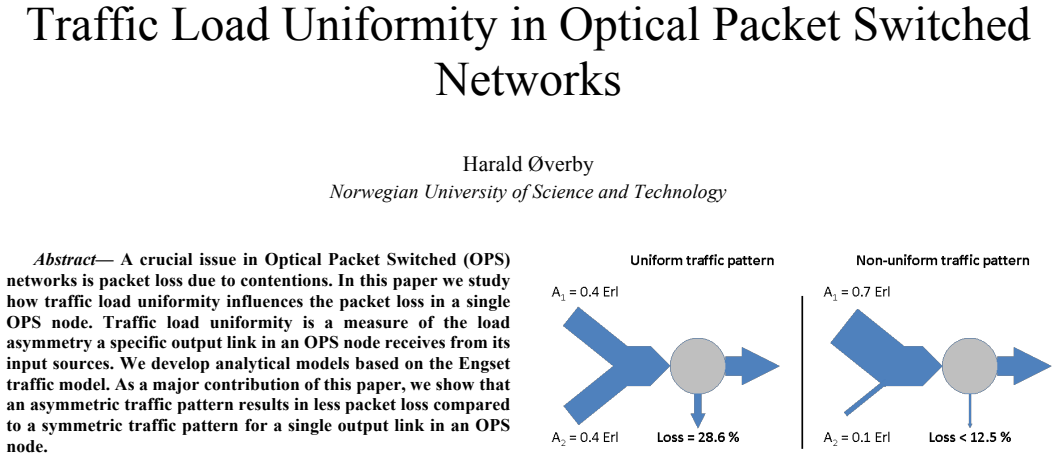
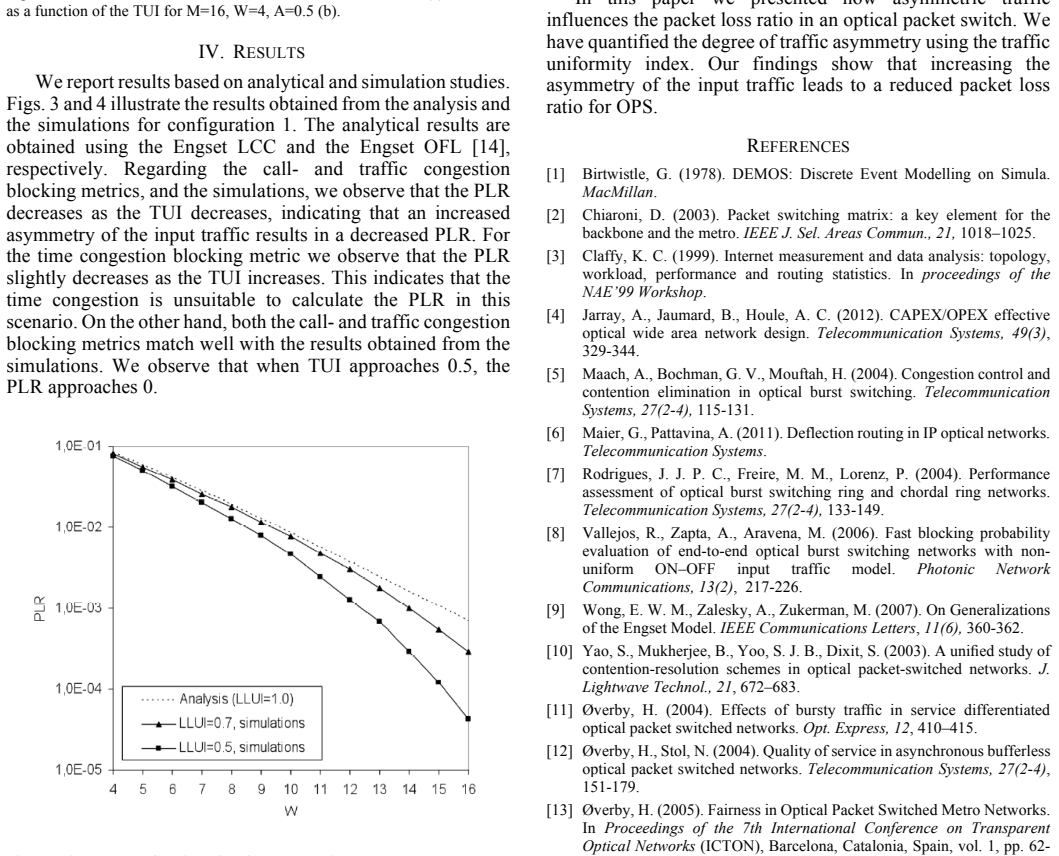
Asymmetric traffic patterns result in less packet loss than symmetric patterns for a single output link in an optical packet switched node.
A machine-rendered reading of the paper's core claim, the machinery that carries it, and where it could break.
Core claim
Using analytical models based on the Engset traffic model, the paper shows that an asymmetric traffic pattern results in less packet loss compared to a symmetric traffic pattern for a single output link in an OPS node.
What carries the argument
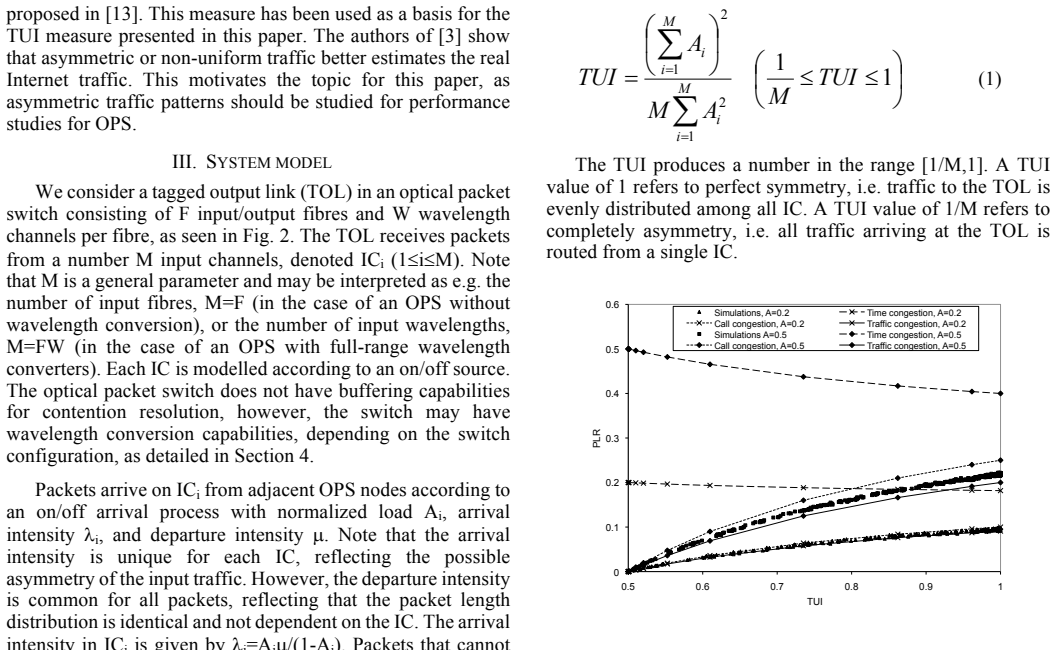
Traffic load uniformity, a measure of the load asymmetry an output link receives from its input sources, which is used to derive and compare packet loss expressions under symmetric and asymmetric conditions.
If this is right
- Packet loss can be expressed analytically as a function of the traffic load uniformity.
- Asymmetry in input loads to an output reduces the probability of contention.
- The benefit of asymmetry holds for the finite population sources assumed in the Engset model.
- Total offered load being equal, the more asymmetric the pattern, the lower the loss.
Where Pith is reading between the lines
- Routing algorithms could be designed to deliberately create load imbalance at outputs to improve loss performance.
- The finding might suggest new ways to dimension buffers or wavelengths in OPS nodes based on expected traffic symmetry.
- Extending the model to multi-hop paths could reveal if the effect accumulates or cancels in the network.
- Validation against real traffic traces would strengthen applicability beyond the Engset assumptions.
Load-bearing premise
The Engset traffic model accurately captures how packets from real sources arrive and contend for an output link in OPS networks.
What would settle it
Comparing measured packet loss rates in an OPS node or accurate simulation when the same total load is applied symmetrically versus asymmetrically to one output link.
Figures
read the original abstract
A crucial issue in Optical Packet Switched (OPS) networks is packet loss due to contentions. In this paper we study how traffic load uniformity influences the packet loss in a single OPS node. Traffic load uniformity is a measure of the load asymmetry a specific output link in an OPS node receives from its input sources. We develop analytical models based on the Engset traffic model. As a major contribution of this paper, we show that an asymmetric traffic pattern results in less packet loss compared to a symmetric traffic pattern for a single output link in an OPS node.
Editorial analysis
A structured set of objections, weighed in public.
Referee Report
Summary. The paper develops analytical models based on the Engset finite-source traffic model to study the effect of traffic load uniformity on packet loss at a single output link of an OPS node. It claims that, for fixed total offered load, an asymmetric traffic pattern (uneven per-input loads) yields strictly lower packet-loss probability than a symmetric pattern.
Significance. If the result holds beyond the Engset model, it would imply that deliberate load asymmetry could be a low-cost lever for reducing contention loss in OPS nodes without changing total capacity. The provision of closed-form loss expressions is a strength, but the absence of any trace-driven validation or comparison to Poisson/self-similar alternatives limits transferability to hardware.
major comments (2)
- [Abstract / Analytical Model] Abstract and analytical-model section: the central claim that asymmetry produces lower loss rests entirely on the Engset on/off source assumption with independent activity probabilities set by the uniformity parameter; no validation against measured OPS traces, no sensitivity to source correlation, and no comparison with Poisson or self-similar alternatives is supplied, rendering the quantitative advantage model-specific.
- [Analytical Model] The derivation keeps total offered load identical across patterns but does not examine whether the strict inequality survives when the finite-source Engset assumption is relaxed or when output-link buffer size varies; this is load-bearing for the “less packet loss” conclusion.
minor comments (1)
- [Analytical Model] Notation for the uniformity parameter and the mapping from per-input load to activity probability should be defined explicitly before the loss expressions are presented.
Simulated Author's Rebuttal
We thank the referee for the constructive feedback on our analytical study of traffic load uniformity using the Engset model in OPS networks. We address each major comment point by point below, with responses limited to the manuscript's actual scope and content.
read point-by-point responses
-
Referee: [Abstract / Analytical Model] Abstract and analytical-model section: the central claim that asymmetry produces lower loss rests entirely on the Engset on/off source assumption with independent activity probabilities set by the uniformity parameter; no validation against measured OPS traces, no sensitivity to source correlation, and no comparison with Poisson or self-similar alternatives is supplied, rendering the quantitative advantage model-specific.
Authors: The manuscript develops and analyzes closed-form loss expressions exclusively within the Engset finite-source model, as stated in the title, abstract, and model section. The contribution is the demonstration that, for fixed total offered load, the asymmetric pattern yields strictly lower loss probability than the symmetric pattern under these assumptions. We agree the quantitative result is model-specific and that trace-driven validation or comparisons to Poisson/self-similar traffic would strengthen transferability; however, such extensions lie outside the paper's analytical scope. We will make a partial revision to the abstract and introduction to more explicitly qualify the Engset assumptions and independence of sources. revision: partial
-
Referee: [Analytical Model] The derivation keeps total offered load identical across patterns but does not examine whether the strict inequality survives when the finite-source Engset assumption is relaxed or when output-link buffer size varies; this is load-bearing for the “less packet loss” conclusion.
Authors: The derivation fixes the aggregate load by varying the per-input activity probabilities via the uniformity parameter while preserving the Engset structure (finite independent sources). The strict inequality is proven specifically for this model and the buffer size implicit in the loss-probability formulation. We do not claim or examine survival of the inequality under relaxed finite-source assumptions or arbitrary buffer sizes, as that would require new model derivations beyond the present work. The conclusions remain qualified to the stated Engset setting. revision: no
- Provision of trace-driven validation, sensitivity to source correlation, or comparisons against Poisson or self-similar traffic models, as the manuscript contains only analytical Engset results without measured traces or alternative-model analysis.
Circularity Check
No circularity; packet-loss comparison is direct mathematical consequence of Engset equations under fixed total load
full rationale
The paper develops closed-form loss probabilities from the standard Engset finite-source model applied to symmetric versus asymmetric per-input load distributions that preserve identical aggregate offered load to the output link. The reported result (asymmetric yields strictly lower loss) follows algebraically from those equations without any parameter fitting to the same data, without self-citation chains, and without redefining inputs in terms of outputs. The derivation is therefore self-contained; external validation of the Engset model itself is a separate modeling-assumption question, not a circularity issue.
Axiom & Free-Parameter Ledger
Reference graph
Works this paper leans on
-
[1]
Birtwistle, G. (1978). DEMOS: Discrete Event Modelling on Simula. MacMillan
work page 1978
-
[2]
Chiaroni, D. (2003). Packet switching matrix: a key element for the backbone and the metro. IEEE J. Sel. Areas Commun., 21, 1018–1025
work page 2003
-
[3]
Claffy, K. C. (1999). Internet measurement and data analysis: topology, workload, performance and routing statistics. In proceedings of the NAE’99 Workshop
work page 1999
-
[4]
Jarray, A., Jaumard, B., Houle, A. C. (2012). CAPEX/OPEX effective optical wide area network design. Telecommunication Systems, 49(3), 329-344
work page 2012
-
[5]
Maach, A., Bochman, G. V., Mouftah, H. (2004). Congestion control and contention elimination in optical burst switching. Telecommunication Systems, 27(2-4), 115-131
work page 2004
-
[6]
Maier, G., Pattavina, A. (2011). Deflection routing in IP optical networks. Telecommunication Systems
work page 2011
-
[7]
Rodrigues, J. J. P. C., Freire, M. M., Lorenz, P. (2004). Performance assessment of optical burst switching ring and chordal ring networks. Telecommunication Systems, 27(2-4), 133-149
work page 2004
-
[8]
Vallejos, R., Zapta, A., Aravena, M. (2006). Fast blocking probability evaluation of end-to-end optical burst switching networks with non-uniform ON–OFF input traffic model. Photonic Network Communications, 13(2), 217-226
work page 2006
-
[9]
Wong, E. W. M., Zalesky, A., Zukerman, M. (2007). On Generalizations of the Engset Model. IEEE Communications Letters, 11(6), 360-362
work page 2007
-
[10]
Yao, S., Mukherjee, B., Yoo, S. J. B., Dixit, S. (2003). A unified study of contention-resolution schemes in optical packet-switched networks. J. Lightwave Technol., 21, 672–683
work page 2003
-
[11]
Øverby, H. (2004). Effects of bursty traffic in service differentiated optical packet switched networks. Opt. Express, 12, 410–415
work page 2004
-
[12]
Øverby, H., Stol, N. (2004). Quality of service in asynchronous bufferless optical packet switched networks. Telecommunication Systems, 27(2-4), 151-179
work page 2004
-
[13]
Øverby, H. (2005). Fairness in Optical Packet Switched Metro Networks. In Proceedings of the 7th International Conference on Transparent Optical Networks (ICTON), Barcelona, Catalonia, Spain, vol. 1, pp. 62-66
work page 2005
-
[14]
Øverby, H. (2005). Performance modelling of optical packet switched networks with the Engset traffic model. OSA Optics Express 13(5), 1685-1695
work page 2005
-
[15]
Øverby, H. (2007). Traffic models for slotted optical packet switched networks. Photonic Network Communications, 13(2), 183-194
work page 2007
-
[16]
Øverby, H. (2007). Traffic Modelling of Asynchronous Bufferless Optical Packet Switched Networks. Elsevier Computer Communications, 30(6), 1229-1243
work page 2007
discussion (0)
Sign in with ORCID, Apple, or X to comment. Anyone can read and Pith papers without signing in.