REVIEW 4 major objections 5 minor 57 references
Importance of User Control in Data-Centric Steering for Healthcare Experts
T0 review · 4 major / 5 minor · reviewed 2026-08-07 · deepseek-v4-flash
Pith's one-line read Healthcare experts who manually steered a diabetes prediction model achieved significantly higher accuracy than those using automated corrections, while trust and understanding held steady.
desk verdict A well-run comparative study with a load-bearing weakness: the accuracy metric is never defined, so manual steering's advantage may reflect overfitting to a visible metric rather than generalizable improvement. read the letter →
The pith
A machine-rendered reading of the paper's core claim, the machinery that carries it, and where it could break.
The reading
What carries the argument
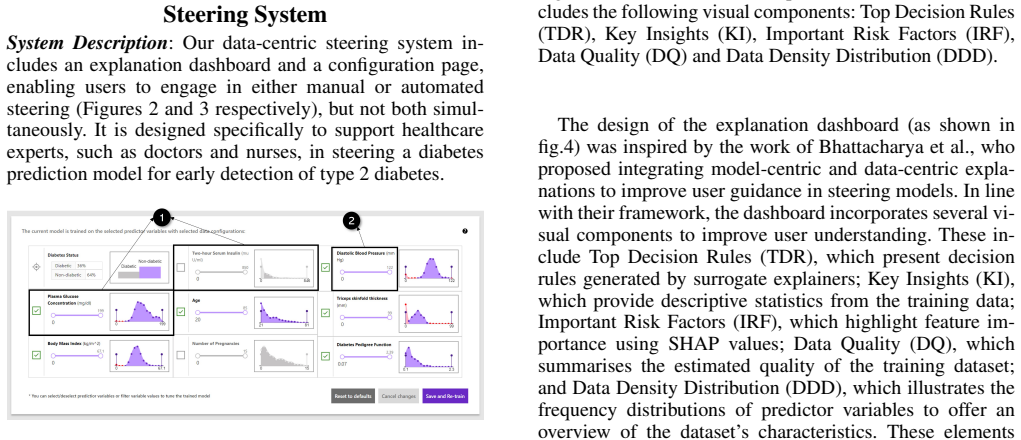
The paper's central object is the steering system with its two interaction modes: manual steering, which gives experts direct controls for feature selection and value-range filtering on the training data, and automated steering, which surfaces detected data issues (class imbalance, outliers, zero values, skewed distributions) with before/after visualizations and lets experts approve corrections with one action. Both modes are supported by a multifaceted explanation dashboard that combines decision rules, key insights, SHAP-based risk factors, a data-quality score, and data-density distributions. This machinery operationalizes the paper's hypothesis: direct control over data, not merely automated suggestions plus consent, is what lets domain experts apply clinical knowledge to improve the model, and the study measures whether that control changes performance, trust, and understanding.
What would settle it
Run the same two steering conditions but evaluate the final models on a held-out test set that participants never see, and constrain both groups to the same number of retraining attempts; if the manual group's accuracy advantage disappears or falls below significance, the reported benefit of user control is an artifact of more search attempts and visible metric feedback rather than a real improvement in model quality.
Extended reading notes
Core claim
The paper's central finding is that manual steering—where healthcare experts directly select predictor variables and filter value ranges in the training data—produced significantly larger gains in prediction accuracy than automated steering, which applies pre-built correction algorithms that experts review and approve with a single action. The manual group achieved higher post-task accuracy (Mann-Whitney U = 1054.0, p < .001), with 84% of participants beating the default model versus 67% in the automated group, and also posted a higher effectiveness score (0.71 vs 0.51, p = .005). The two groups did not differ significantly in changes of perceived trust or perceived understandability, and the manual group showed a significant increase in objective understanding (W = 190.5, p = .019) that the automated group did not. The authors interpret this as evidence that user control over training data improves model outcomes without degrading the human-AI collaboration, and they distill the result into design implications for hybrid steering systems.
Load-bearing premise
The central result depends on the assumption that the manual group's higher accuracy reflects genuine, generalizable improvements to the model rather than a larger search of the configuration space guided by the accuracy score shown after each retraining attempt.
Editorial extensions
If this is right
- If manual steering reliably outperforms automated steering, giving healthcare experts direct data-configuration tools is a practical route to higher-accuracy AI in clinical settings.
- Because perceived trust and understandability did not drop even though manual steering required more effort, increasing user control need not come at the cost of user acceptance.
- The significant gain in objective understanding within the manual group suggests that hands-on data control may sharpen experts' mental models of the AI system, not just improve their immediate task performance.
- A hybrid steering system that lets users switch between manual and automated modes could preserve the accuracy advantage of manual control while keeping the efficiency of automated corrections.
- The proposed design implications—peer approval for changes, rollback and version control, and step-by-step interactive visualizations—are intended to transfer these findings to other high-stakes domains beyond healthcare.
Reading between the lines
- One extension the authors leave open: the manual advantage might shrink or reverse on larger, messier datasets where automated tools can scan far more candidate data issues per minute; this study's small structured dataset and 10-minute window likely favor human pattern recognition on a few visible filters.
- A testable consequence is whether the manual group's higher accuracy persists on a held-out test set rather than the same validation split whose accuracy score was revealed after each retraining; if the advantage vanishes, part of the benefit is metric-feedback overfitting rather than transferable data improvement.
- The objective-understanding gain in the manual group could be studied as a mechanism: direct manipulation may force users to form and test hypotheses about how variables affect predictions, a form of active learning that the one-click approval step in automated steering does not provide.
- The results imply an economic trade-off: manual steering took more clicks, so in time-constrained clinical workflows, a hybrid system should default to automation and offer manual control as an opt-in, with automated checks guarding against user-induced errors.
Editorial analysis
A structured set of objections, weighed in public.
Referee Report
Summary. The paper reports a between-subjects mixed-methods user study with 74 healthcare experts comparing two modes of data-centric steering of a diabetes prediction model: manual steering (direct feature selection and feature filtering) and automated steering (one-click approval of automatically identified data corrections). The central claim is that manual steering yields significantly higher post-steering prediction accuracy (U = 1054.0, p < .001; 84% vs 67% of participants improving over the default model) while perceived trust and understandability remain comparable. The authors use these findings to propose design implications for a hybrid manual-automated steering system. The manuscript includes open-source artifacts, established questionnaires for trust and understanding, and a candid Adverse Impact Statement that acknowledges risks of bias and overfitting.
Significance. If the result holds under a properly specified evaluation protocol, the study provides valuable empirical evidence for a debated question in human-centered AI: whether domain experts benefit from direct control over training data in interactive machine learning. Strengths include the relevant participant population, use of validated trust/understandability instruments, reporting of exact test statistics, open-sourcing of the system, and an unusually transparent Limitations and Adverse Impact Statement. The main empirical claim, however, currently rests on an unspecified accuracy metric and an uncharacterized automated baseline, so the contribution is not yet established. The paper is likely to be of interest to the CHI/HCI community once these load-bearing points are resolved.
major comments (4)
- [Procedure / Post-Steering Model Accuracy] The primary outcome of RQ1 is not defined. The manuscript never states whether the accuracy shown during steering and reported in Figure 6 is training-set accuracy, a fixed validation split, or a held-out test-set accuracy. Because the Procedure instructs participants to 'configure the data multiple times to maximise model accuracy,' and the manual group's controls include feature filtering (Figure 2), participants can search the visible metric, potentially by discarding difficult cases. Without a pre-registered held-out evaluation protocol, the observed manual advantage (U = 1054.0, p < .001) is consistent with overfitting or test-set contamination rather than with generalizable model improvement. The Adverse Impact Statement itself concedes that direct control 'may inadvertently introduce biases or lead to overfitting.' Please report the exact accuracy computation and, if a held-out test was not used, re-run the comparison with a held-out protocol or clearly restrict the claim to the reported metric.
- [Steering System (automated steering condition)] The automated steering condition is not operationalized in sufficient detail to support the intended comparison. The text says automated steering uses 'automated correction algorithms to identify and resolve potential data issues,' but it does not list the algorithms, the data issues targeted, or any validation that these corrections constitute a reasonable automated data-centric baseline. Without this information, the result that manual steering outperforms automated steering could be an artifact of a weak or underspecified automation condition, rather than evidence about automated data-centric steering in general. Please specify the algorithms (e.g., SMOTE/ADASYN, outlier removal, missing-value imputation, feature selection) and how their parameters were chosen.
- [Results RQ2] The claim that manual steering 'maintains trust and system understandability' is supported only by non-significant differences, not by equivalence. With 37 participants per group, these tests have limited power to detect modest differences; the perceived understandability comparison is borderline (U = 263.0, p = .09). To support the 'while maintaining' part of the abstract, the authors should report effect sizes with confidence intervals or perform an equivalence test, and temper the wording to 'no significant difference was detected' unless equivalence is established.
- [Results RQ1] No descriptive statistics for post-steering accuracy are reported. The text gives only U, p, and the proportion of participants who improved. Because the magnitude of the accuracy improvement is not reported, the reader cannot assess whether the statistically significant advantage is practically meaningful. Report group medians/means, IQR/SD, and a rank-biserial or Cliff's delta effect size for the accuracy comparison, as well as for the effectiveness comparison.
minor comments (5)
- [Prediction Model and Dataset] The text contains a typo: 'system uderstandability' should be 'system understandability.'
- [Table 1] The last row of the automated group column appears to read '>10 years: 10' while the row label is '>5 years'; please clarify whether this is intended as a separate category or a typographical error.
- [Figure 6] The figure labels say 'Boxed-violin plot' while the text says 'Boxed-violin plots and box-plots'; please use consistent terminology and ensure the caption defines all plot elements.
- [Data Analysis / Results] Multiple Wilcoxon signed-rank tests and Mann-Whitney U tests are reported without any correction or discussion of multiple testing; a brief note on the exploratory nature of these comparisons would increase transparency.
- [Results RQ2] The text mentions that the automated steering group showed a greater average increase in perceived understandability of approximately 5%, but the underlying means are not reported; please include the pre- and post-task means and standard deviations in the text or in a table.
Circularity Check
No significant circularity: the central claim is an empirical group comparison supported by newly measured outcomes, with self-citations only in design and measurement provenance.
full rationale
This paper is an empirical between-subjects user study, not a derivation. The central claim that manual steering improves prediction accuracy rests on measured post-task accuracy (U = 1054.0, p < .001) and is not defined in terms of the conclusion. The evaluation measure is specified in the Evaluation Measures section: 'We measured the updated prediction model accuracy after participants engaged in the steering process, similar to Bhattacharya et al., to evaluate whether one group achieved better prediction accuracy improvements.' The design is also inspired by prior work by the same authors, but the significant group difference is a new empirical observation from this study's data, not an implication of those citations. The self-citations motivate the system design and measurement choices; they do not supply or force the result. The concern that manual participants might have overfit the visible accuracy metric is a validity and robustness question. The paper itself acknowledges this risk in its Adverse Impact Statement: 'Granting domain experts direct control over training data may inadvertently introduce biases or lead to overfitting.' That is an empirical confound, not circular reasoning: the outcome is not equivalent to an input by construction, and no fitted parameter is renamed as a prediction. Therefore, there are no circular steps and the circularity score is 0.
Assumptions & free parameters
assumptions (4)
- domain assumption Participants recruited from Prolific who self-identify as healthcare experts and report familiarity with diabetes risk factors are sufficiently expert to perform meaningful data-centric steering.
- domain assumption The Pima Indians Diabetes dataset with its known quality issues (class imbalance, zero values, skewed distributions) is a suitable and representative testbed for clinical data-centric steering.
- ad hoc to paper The specific automated correction algorithms implemented in the system fairly represent automated data-centric steering.
- domain assumption Showing participants the model accuracy after each retraining does not induce them to overfit the evaluation set.
Cite this review
Pith. "Pith review of Importance of User Control in Data-Centric Steering for Healthcare Experts." pith.science (2026). https://pith.science/paper/5MLOUE46
@misc{pith2026250618770,
  author       = {Pith},
  title        = {Pith review of: Importance of User Control in Data-Centric Steering for Healthcare Experts},
  year         = {2026},
  howpublished = {\url{https://pith.science/paper/5MLOUE46}},
  note         = {Machine review of arXiv:2506.18770}
}
read the original abstract
As Artificial Intelligence (AI) becomes increasingly integrated into high-stakes domains like healthcare, effective collaboration between healthcare experts and AI systems is critical. Data-centric steering, which involves fine-tuning prediction models by improving training data quality, plays a key role in this process. However, little research has explored how varying levels of user control affect healthcare experts during data-centric steering. We address this gap by examining manual and automated steering approaches through a between-subjects, mixed-methods user study with 74 healthcare experts. Our findings show that manual steering, which grants direct control over training data, significantly improves model performance while maintaining trust and system understandability. Based on these findings, we propose design implications for a hybrid steering system that combines manual and automated approaches to increase user involvement during human-AI collaboration.
Figures


Figures from the paper (4 more)


Reference graph
Works this paper leans on
-
[1]
, " * write output.state after.block = add.period write newline
ENTRY address archivePrefix author booktitle chapter edition editor eid eprint howpublished institution isbn journal key month note number organization pages publisher school series title type volume year label extra.label sort.label short.list INTEGERS output.state before.all mid.sentence after.sentence after.block FUNCTION init.state.consts #0 'before.a...
-
[2]
write newline
" write newline "" before.all 'output.state := FUNCTION n.dashify 't := "" t empty not t #1 #1 substring "-" = t #1 #2 substring "--" = not "--" * t #2 global.max substring 't := t #1 #1 substring "-" = "-" * t #2 global.max substring 't := while if t #1 #1 substring * t #2 global.max substring 't := if while FUNCTION word.in bbl.in capitalize " " * FUNCT...
-
[3]
Ackerman, S.; Farchi, E.; Raz, O.; Zalmanovici, M.; and Dube, P. 2022. Detection of data drift and outliers affecting machine learning model performance over time. arXiv:2012.09258
arXiv 2022
-
[4]
Adadi, A.; and Berrada, M. 2018. Peeking inside the black-box: A survey on Explainable Artificial Intelligence (XAI). IEEE Access, 6: 52138--52160
work page 2018
-
[5]
Anik, A. I.; and Bunt, A. 2021. Data- Centric Explanations : Explaining Training Data of Machine Learning Systems to Promote Transparency . In Proceedings of the 2021 CHI Conference on Human Factors in Computing Systems , 1--13. Yokohama Japan: ACM. ISBN 978-1-4503-8096-6
work page 2021
-
[6]
Baylor, D.; Koc, L.; Koo, C.; Lew, L.; Mewald, C.; Modi, A.; Polyzotis, N.; Ramesh, S.; Roy, S.; Whang, S.; Wicke, M.; Breck, E.; Wilkiewicz, J.; Zhang, X.; Zinkevich, M.; Cheng, H.-T.; Fiedel, N.; Foo, C.; Haque, Z.; and Jain, V. 2017. TFX: A TensorFlow-Based Production-Scale Machine Learning Platform. 1387--1395
work page 2017
-
[7]
Bhatt, U.; Andrus, M.; Weller, A.; and Xiang, A. 2020. Machine Learning Explainability for External Stakeholders. arXiv:2007.05408
arXiv 2020
-
[8]
Bhattacharya, A. 2022. Applied Machine Learning Explainability Techniques. In Applied Machine Learning Explainability Techniques. Birmingham, UK : Packt Publishing. ISBN 978-1803246154
work page 2022
Show all 57 references
-
[9]
Bhattacharya, A.; Ooge, J.; Stiglic, G.; and Verbert, K. 2023. Directive Explanations for Monitoring the Risk of Diabetes Onset: Introducing Directive Data-Centric Explanations and Combinations to Support What-If Explorations. In Proceedings of the 28th International Conferenc...
2023
-
[10]
D.; and Verbert, K
Bhattacharya, A.; Stumpf, S.; Croon, R. D.; and Verbert, K. 2024 a . Explanatory Debiasing: Involving Domain Experts in the Data Generation Process to Mitigate Representation Bias in AI Systems. arXiv:2501.01441
2024 arXiv
-
[11]
Bhattacharya, A.; Stumpf, S.; De Croon, R.; and Verbert, K. 2025. Explanatory Debiasing: Involving Domain Experts in the Data Generation Process to Mitigate Representation Bias in AI Systems. In Proceedings of the 2025 CHI Conference on Human Factors in Computing Systems, CHI ...
2025
-
[12]
Bhattacharya, A.; Stumpf, S.; Gosak, L.; Stiglic, G.; and Verbert, K. 2024 b . EXMOS: Explanatory Model Steering through Multifaceted Explanations and Data Configurations. In Proceedings of the CHI Conference on Human Factors in Computing Systems, CHI '24. New York, NY, USA: A...
2024
-
[13]
Braun, V.; and Clarke, V. 2012. Thematic Analysis. In APA Handbook of Research Methods in Psychology, Vol 2: Research Designs: Quantitative , Qualitative, Neuropsychological, and Biological , APA Handbooks in Psychology , 57--71. Washington, DC, US : American Psychological Ass...
2012
-
[14]
Hello AI
Cai, C. J.; Winter, S.; Steiner, D.; Wilcox, L.; and Terry, M. 2019. "Hello AI": Uncovering the Onboarding Needs of Medical Practitioners for Human-AI Collaborative Decision-Making. Proc. ACM Hum.-Comput. Interact., 3(CSCW)
2019
-
[15]
Cakmak, M.; and Thomaz, A. L. 2011. Mixed-initiative active learning. ICML 2011 Workshop on Combining Learning Strategies to Reduce Label Cost
2011
-
[16]
V.; Bowyer, K
Chawla, N. V.; Bowyer, K. W.; Hall, L. O.; and Kegelmeyer, W. P. 2002. SMOTE : Synthetic Minority Over-sampling Technique. Journal of Artificial Intelligence Research, 16: 321--357
2002
-
[17]
Chen, V.; Bhatt, U.; Heidari, H.; Weller, A.; and Talwalkar, A. 2023. Perspectives on incorporating expert feedback into model updates. Patterns, 4(7): 100780
2023
-
[18]
M.; and Zhu, H
Cheng, H.-F.; Wang, R.; Zhang, Z.; O'Connell, F.; Gray, T.; Harper, F. M.; and Zhu, H. 2019. Explaining Decision-Making Algorithms through UI: Strategies to Help Non-Expert Stakeholders. In Proceedings of the 2019 CHI Conference on Human Factors in Computing Systems, CHI '19, ...
2019
-
[19]
Demšar, J.; Bosnic, Z.; and Kononenko, I. 2019. Visualization of Explanations of Incremental Models. Journal of Intelligent Computing, 10: 121
2019
-
[20]
Feuerriegel, S.; Dolata, M.; and Schwabe, G. 2020. Fair AI. Business & information systems engineering, 62(4): 379--384
2020
-
[21]
FRA. 2019. Data quality and artificial intelligence – mitigating bias and error to protect fundamental rights. In FRA EUROPEAN UNION AGENCY FOR FUNDAMENTAL RIGHTS
2019
-
[22]
A.; Tamang, S.; Yazdany, J.; and Schmajuk, G
Gianfrancesco, M. A.; Tamang, S.; Yazdany, J.; and Schmajuk, G. 2018. Potential Biases in Machine Learning Algorithms Using Electronic Health Record Data . JAMA Internal Medicine, 178(11): 1544--1547
2018
-
[23]
He, H.; Bai, Y.; Garcia, E.; and Li, S. 2008. ADASYN: Adaptive Synthetic Sampling Approach for Imbalanced Learning. 1322 -- 1328
2008
-
[24]
R.; Mueller, S
Hoffman, R. R.; Mueller, S. T.; Klein, G.; and Litman, J. 2019. Metrics for Explainable AI: Challenges and Prospects. arXiv:1812.04608
2019 arXiv
-
[25]
Jian, J.-Y.; Bisantz, A.; and Drury, C. 2000. Foundations for an Empirically Determined Scale of Trust in Automated Systems. International Journal of Cognitive Ergonomics, 4: 53--71
2000
-
[26]
Kazerouni, A.; Zhao, Q.; Xie, J.; Tata, S.; and Najork, M. 2020. Active Learning for Skewed Data Sets. arXiv:2005.11442
2020 arXiv
-
[27]
Ke, G.; Meng, Q.; Finley, T.; Wang, T.; Chen, W.; Ma, W.; Ye, Q.; and Liu, T.-Y. 2017. LightGBM: a highly efficient gradient boosting decision tree. In Proceedings of the 31st International Conference on Neural Information Processing Systems, NIPS'17, 3149–3157. Red Hook, NY, ...
2017
-
[28]
K \"o nig, P. D. 2022. Challenges in enabling user control over algorithm-based services. AI & Soc
2022
-
[29]
Kulesza, T.; Burnett, M.; Wong, W.-K.; and Stumpf, S. 2015. Principles of Explanatory Debugging to Personalize Interactive Machine Learning . In Proceedings of the 20th International Conference on Intelligent User Interfaces , 126--137. Atlanta Georgia USA: ACM. ISBN 978-1-4503-3306-1
2015
-
[30]
Kulesza, T.; Stumpf, S.; Burnett, M.; Wong, W.-K.; Riche, Y.; Moore, T.; Oberst, I.; Shinsel, A.; and McIntosh, K. 2010. Explanatory Debugging : Supporting End - User Debugging of Machine - Learned Programs . In 2010 IEEE Symposium on Visual Languages and Human - Centric Compu...
2010
-
[31]
Lakkaraju, H.; Slack, D.; Chen, Y.; Tan, C.; and Singh, S. 2022. Rethinking Explainability as a Dialogue: A Practitioner's Perspective. arXiv:2202.01875
2022 arXiv
-
[32]
P.; Tang, J.; and Liu, H
Li, J.; Cheng, K.; Wang, S.; Morstatter, F.; Trevino, R. P.; Tang, J.; and Liu, H. 2017. Feature Selection: A Data Perspective. ACM Comput. Surv., 50(6)
2017
-
[33]
V.; and Varshney, K
Liao, Q. V.; and Varshney, K. R. 2022. Human-Centered Explainable AI (XAI): From Algorithms to User Experiences. arXiv:2110.10790
2022 arXiv
-
[34]
V.; Zhang, Y.; Luss, R.; Doshi-Velez, F.; and Dhurandhar, A
Liao, Q. V.; Zhang, Y.; Luss, R.; Doshi-Velez, F.; and Dhurandhar, A. 2022. Connecting Algorithmic Research and Usage Contexts: A Perspective of Contextualized Evaluation for Explainable AI. arXiv:2206.10847
2022 arXiv
-
[35]
Lones, M. A. 2023. How to avoid machine learning pitfalls: a guide for academic researchers. arXiv:2108.02497
2023 arXiv
-
[36]
Lundberg, S.; and Lee, S.-I. 2017. A Unified Approach to Interpreting Model Predictions. arXiv:1705.07874
2017 arXiv
-
[37]
Masís, S. 2023. Interpretable Machine Learning with Python: Build explainable, fair, and robust high-performance models with hands-on, real-world examples. Packt Publishing, 2 edition. ISBN 9781803243627. Second Edition, 606 pages, Published October 31, 2023
2023
-
[38]
G.; Diamos, S.; Diamos, G.; He, L.; Parrish, A.; Kirk, H
Mazumder, M.; Banbury, C.; Yao, X.; Karlaš, B.; Rojas, W. G.; Diamos, S.; Diamos, G.; He, L.; Parrish, A.; Kirk, H. R.; Quaye, J.; Rastogi, C.; Kiela, D.; Jurado, D.; Kanter, D.; Mosquera, R.; Ciro, J.; Aroyo, L.; Acun, B.; Chen, L.; Raje, M. S.; Bartolo, M.; Eyuboglu, S.; Gho...
2023 arXiv
-
[39]
McCrum-Gardner, E. 2008. Which is the correct statistical test to use? British Journal of Oral and Maxillofacial Surgery, 46(1): 38--41
2008
-
[40]
Mehrabi, N.; Morstatter, F.; Saxena, N.; Lerman, K.; and Galstyan, A. 2021. A Survey on Bias and Fairness in Machine Learning. ACM Comput. Surv., 54(6)
2021
-
[41]
Menardi, G.; and Torelli, N. 2012. Training and assessing classification rules with imbalanced data. Data Mining and Knowledge Discovery, 28: 92--122
2012
-
[42]
Miller, T. 2017. Explanation in Artificial Intelligence: Insights from the Social Sciences
2017
-
[43]
Nahar, N.; Zhou, S.; Lewis, G.; and K\" a stner, C. 2022. Collaboration Challenges in Building ML-Enabled Systems: Communication, Documentation, Engineering, and Process. In Proceedings of the 44th International Conference on Software Engineering, ICSE '22, 413–425. New York, ...
2022
-
[44]
Preece, A.; Harborne, D.; Braines, D.; Tomsett, R.; and Chakraborty, S. 2018. Stakeholders in Explainable AI. arXiv:1810.00184
2018 arXiv
-
[45]
Rezwana, J.; and Maher, M. L. 2022. Understanding User Perceptions, Collaborative Experience and User Engagement in Different Human-AI Interaction Designs for Co-Creative Systems. In Proceedings of the 14th Conference on Creativity and Cognition, C&C '22, 38–48. New York, NY, ...
2022
-
[46]
L.; Freire, J.; Ilyas, I
Sadiq, S.; Dasu, T.; Dong, X. L.; Freire, J.; Ilyas, I. F.; Link, S.; Miller, M. J.; Naumann, F.; Zhou, X.; and Srivastava, D. 2018. Data Quality: The Role of Empiricism. SIGMOD Rec., 46(4): 35–43
2018
-
[47]
Settles, B. 2011. Closing the loop: Fast, interactive semi-supervised annotation with queries on features and instances. In Proceedings of the 2011 Conference on Empirical Methods in Natural Language Processing, 1467--1478
2011
-
[48]
W.; Everhart, J
Smith, J. W.; Everhart, J. E.; Dickson, W. C.; Knowler, W. C.; and Johannes, R. S. 1988. Using the ADAP Learning Algorithm to Forecast the Onset of Diabetes Mellitus. In Proceedings of the Annual Symposium on Computer Application in Medical Care, 261--265
1988
-
[49]
Szymanski, M.; Verbert, K.; and Vanden Abeele, V. 2025. Human-Centered Explainable AI. KU Leuven Doctoral Thesis: KU Leuven
2025
-
[50]
Teso, S.; Alkan, O.; Stammer, W.; and Daly, E. 2022. Leveraging Explanations in Interactive Machine Learning : An Overview . ArXiv:2207.14526 [cs]
2022 arXiv
-
[51]
Verbert, K.; Parra, D.; and Brusilovsky, P. 2016. Agents Vs. Users: Visual Recommendation of Research Talks with Multiple Dimension of Relevance. ACM Trans. Interact. Intell. Syst., 6(2)
2016
-
[52]
S.; and Bansal, G
Weld, D. S.; and Bansal, G. 2018. The Challenge of Crafting Intelligible Intelligence. arXiv:1803.04263
2018 arXiv
-
[53]
A.; Buche, C.; and Visser, U
Wondimu, N. A.; Buche, C.; and Visser, U. 2022. Interactive Machine Learning: A State of the Art Review. arXiv:2207.06196
2022 arXiv
-
[54]
P.; Lai, K.-H.; Yang, F.; Jiang, Z.; Zhong, S.; and Hu, X
Zha, D.; Bhat, Z. P.; Lai, K.-H.; Yang, F.; Jiang, Z.; Zhong, S.; and Hu, X. 2023. Data-centric Artificial Intelligence: A Survey. arXiv:2303.10158
2023 arXiv
-
[55]
Zhang, J.; Hsieh, C.-Y.; Yu, Y.; Zhang, C.; and Ratner, A. 2022. A Survey on Programmatic Weak Supervision. arXiv:2202.05433
2022 arXiv
-
[56]
L.; and Carter, S
Zhang, Q.; Lee, M. L.; and Carter, S. 2022. You Complete Me: Human-AI Teams and Complementary Expertise. In Proceedings of the 2022 CHI Conference on Human Factors in Computing Systems, CHI '22. New York, NY, USA: Association for Computing Machinery. ISBN 9781450391573
2022
-
[57]
Zhang, Z. 2016. Missing data imputation: Focusing on single imputation. Annals of translational medicine, 4: 9
2016
Reviewed August 7, 2026 · model on record in the stance chip above.
Discussion (0). Sign in to comment.