REVIEW 2 major objections 40 references
Reviewed by Pith at T0; open to challenge.
T0 means a machine referee read the full paper against a public rubric. The mark states how deep the mechanical check went, never who wrote it. the ladder, T0–T4 →
T0 review · grok-4.3
Gaussian variational inference supplies a linear transformation that speeds up Hamiltonian Monte Carlo, while a variational auto-encoder guides Metropolis-Hastings to cover every mode of multi-modal posteriors.
2026-06-30 02:12 UTC pith:5NILX2DY
load-bearing objection The paper sketches two standard hybrid constructions but supplies no derivations, experiments, or comparisons, leaving the efficiency claims untested. the 2 major comments →
Using Variational Inference to Improve the Efficiency of MCMC Algorithms
The pith
A machine-rendered reading of the paper's core claim, the machinery that carries it, and where it could break.
Core claim
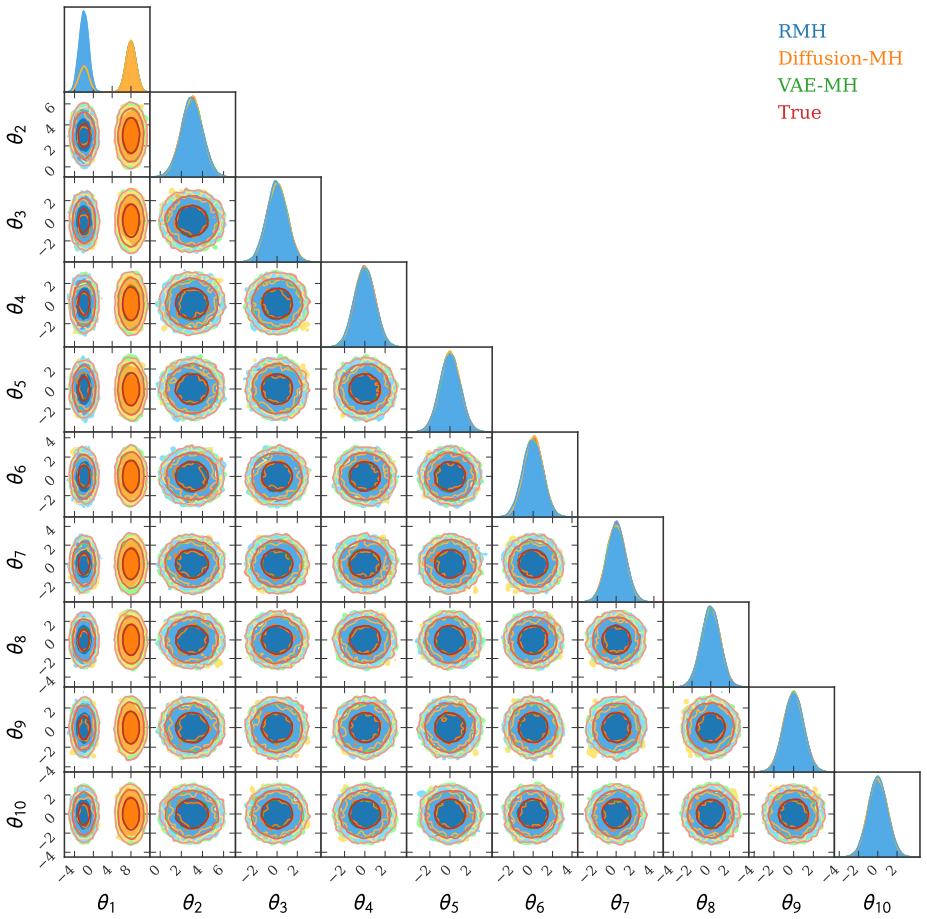
The authors propose two algorithms. The first uses Gaussian variational inference with assorted covariance structures to obtain a linear transformation matrix that preconditions Hamiltonian Monte Carlo. The second trains a variational auto-encoder and inserts its generative model into the Metropolis-Hastings sampler. Both constructions are presented as ways to improve mixing and mode coverage over standard MCMC on complex target distributions.
What carries the argument
The linear transformation matrix derived from Gaussian variational inference (for HMC preconditioning) and the generative model of the variational auto-encoder (for MH proposals).
Load-bearing premise
The variational approximations must stay close enough to the true posterior that the derived transformations and proposals neither bias the sampler nor cause it to miss regions that plain MCMC would reach.
What would settle it
Apply the VAE-MH sampler and plain Metropolis-Hastings to a known multi-modal target such as a mixture of well-separated Gaussians; if the VAE-MH version systematically misses modes that the standard sampler visits, the claim of improved mode coverage is refuted.
If this is right
- Hamiltonian Monte Carlo mixes faster in high-dimensional and complex distributions once preconditioned by the Gaussian variational inference matrix.
- The VAE-MH sampler traverses the full parameter space and locates every mode of multi-modal distributions where standard Metropolis-Hastings may remain trapped.
- The hybrid constructions combine the asymptotic exactness of MCMC with the scalability of variational methods.
- These techniques are intended for settings where the posterior is high-dimensional or exhibits multiple separated modes.
Where Pith is reading between the lines
- The same variational-preconditioning idea could be tested on other MCMC kernels such as Langevin dynamics if an analogous transformation matrix can be extracted.
- When the variational approximation is poor, the transformed HMC might actually mix more slowly than the untransformed version, offering a clear diagnostic for when to fall back to plain MCMC.
- Empirical comparisons on standard benchmark posteriors with known effective sample sizes would quantify the practical reduction in required iterations.
Editorial analysis
A structured set of objections, weighed in public.
Referee Report
Summary. The manuscript proposes two hybrid algorithms combining variational inference and MCMC. The first derives a linear transformation matrix from Gaussian variational inference (with various covariance structures) to precondition Hamiltonian Monte Carlo, with the goal of improving efficiency for high-dimensional and complex targets. The second integrates a variational auto-encoder generative model into the Metropolis-Hastings sampler to produce proposals that better traverse multi-modal distributions and identify all modes.
Significance. If the constructions preserve the invariance properties of the underlying MCMC kernels while delivering measurable efficiency gains, the work could supply practical tools for sampling in settings where plain HMC or MH struggle with geometry or multimodality. The paper correctly identifies the complementary strengths of MCMC (asymptotic exactness) and VI (speed and scalability) and attempts to exploit both.
major comments (2)
- [Abstract] Abstract: the claim that the VAE-MH sampler 'outperforms standard MCMC methods in identifying all modes' is load-bearing for the second contribution, yet the abstract supplies no statement of the conditions under which the VAE proposal leaves the target invariant or guarantees ergodicity; without this, the performance claim cannot be evaluated.
- [Abstract] Abstract: the assertion that the GVI-derived linear transformation 'improves the efficiency of HMC, particularly in high-dimensional and complex target distributions' requires explicit verification that the transformation is constructed from a variational density that does not alter the target measure; the manuscript must show the precise mass-matrix or preconditioner formula and confirm it yields a valid HMC kernel.
Simulated Author's Rebuttal
We thank the referee for their careful review and constructive feedback. We address each major comment below and will revise the abstract to supply the requested theoretical clarifications while preserving the manuscript's core contributions.
read point-by-point responses
-
Referee: [Abstract] Abstract: the claim that the VAE-MH sampler 'outperforms standard MCMC methods in identifying all modes' is load-bearing for the second contribution, yet the abstract supplies no statement of the conditions under which the VAE proposal leaves the target invariant or guarantees ergodicity; without this, the performance claim cannot be evaluated.
Authors: We agree that the abstract should explicitly address invariance and ergodicity. The VAE-MH sampler employs the VAE solely as a proposal mechanism inside the standard Metropolis-Hastings step; the acceptance probability is computed with respect to the target posterior, which guarantees invariance by detailed balance for any proposal distribution. Ergodicity holds under the usual MH conditions (irreducibility and aperiodicity) provided the VAE proposal has positive density on a set of positive target measure, as discussed in Section 3. We will add a concise sentence to the abstract stating these facts and referencing the relevant section. revision: yes
-
Referee: [Abstract] Abstract: the assertion that the GVI-derived linear transformation 'improves the efficiency of HMC, particularly in high-dimensional and complex target distributions' requires explicit verification that the transformation is constructed from a variational density that does not alter the target measure; the manuscript must show the precise mass-matrix or preconditioner formula and confirm it yields a valid HMC kernel.
Authors: We concur that the abstract should state the validity of the preconditioner. The linear transformation is obtained from the GVI mean and covariance; the mass matrix is set to M = Σ^{-1} (or a diagonal approximation thereof). Because any positive-definite mass matrix leaves the target invariant and only rescales the Hamiltonian dynamics, the resulting HMC kernel remains correct. The explicit formula and proof of validity appear in Section 2. We will insert a short clarifying clause in the abstract that references this construction and its measure-preserving property. revision: yes
Circularity Check
No significant circularity detected
full rationale
The paper describes two hybrid constructions: GVI-derived linear transformations for HMC preconditioning and VAE-based proposals inside MH. These are standard measure-preserving combinations in which the variational density is used only to design mass matrices or proposals; the resulting sampler remains invariant to the target posterior by construction of the MH or HMC acceptance step. No equation in the supplied material equates a fitted variational parameter directly to a reported performance metric, no self-citation is invoked as a uniqueness theorem, and no ansatz is smuggled via prior work. The central claims therefore rest on external empirical validation rather than internal definitional reduction.
Axiom & Free-Parameter Ledger
read the original abstract
Bayesian statistics makes inference based on Bayes' theorem, but the posterior distribution of unknown parameters is typically analytically intractable. To estimate the posterior, two widely used numerical approximation methods are Markov Chain Monte Carlo (MCMC) and variational inference (VI). MCMC methods produce asymptotically exact samples but are computationally intensive, while VI methods are faster and more scalable but may lack accuracy. This paper proposes combining MCMC and VI to construct algorithms that leverage the strengths of both. The first proposed algorithm uses Gaussian variational inference (GVI) with various covariance structures to derive a linear transformation matrix for Hamiltonian Monte Carlo (HMC). This method improves the efficiency of HMC, particularly in high-dimensional and complex target distributions. The second algorithm combines a VI-based generative model, the variational auto-encoder (VAE), with the Metropolis-Hastings (MH) sampler. The resulting VAE-MH sampler is efficient and effectively traverses the parameter space, outperforming standard MCMC methods in identifying all modes of multi-modal distributions.
Figures




Reference graph
Works this paper leans on
-
[1]
and Rosenbluth, Marshall N
Metropolis, Nicholas and Rosenbluth, Arianna W. and Rosenbluth, Marshall N. and Teller, Augusta H. and Teller, Edward , journal =. Equation of state calculations by fast computing machines , volume =
-
[2]
Hastings, W. K. , journal =. Monte carlo sampling methods using Markov chains and their applications , volume =
-
[3]
and Rosenthal, Jeffrey S
Roberts, Gareth O. and Rosenthal, Jeffrey S. , journal =. Optimal scaling of discrete approximations to Langevin diffusions , volume =
-
[4]
Optimal tuning of the hybrid Monte Carlo algorithm , volume =
Beskos, Alexandros and Pillai, Natesh and Roberts, Gareth and. Optimal tuning of the hybrid Monte Carlo algorithm , volume =. Bernoulli , number =
-
[5]
and Gilks, W
Gelman, A. and Gilks, W. R. and Roberts, G. O. , journal =. Weak convergence and optimal scaling of random walk metropolis algorithms , volume =
-
[6]
Adaptive proposal distribution for random walk Metropolis algorithm , volume =
Haario, Heikki and Saksman, Eero and Tamminen, Johanna , journal =. Adaptive proposal distribution for random walk Metropolis algorithm , volume =
-
[7]
An adaptive Metropolis algorithm , volume =
Haario, Heikki and Saksman, Eero and Tamminen, Johanna , journal =. An adaptive Metropolis algorithm , volume =
-
[8]
and Lagutin, E
Samsonov, S. and Lagutin, E. and Gabri. Local-global. Advances in Neural Information Processing Systems , pages =
-
[9]
Wormhole Hamiltonian Monte Carlo , year =
Lan, Shiwei and Streets, Jeffrey and Shahbaba, Babak , booktitle =. Wormhole Hamiltonian Monte Carlo , year =
-
[10]
Simulated tempering: A new Monte Carlo scheme , volume =
Marinari, Enzo and Parisi, Giorgio , journal =. Simulated tempering: A new Monte Carlo scheme , volume =
-
[11]
Markov chain Monte Carlo maximum likelihood , year =
Geyer, Charles J , booktitle =. Markov chain Monte Carlo maximum likelihood , year =
-
[12]
Sampling from high-dimensional, multimodal distributions using automatically tuned, tempered hamiltonian monte carlo , year =
Park, Joonha , howpublished =. Sampling from high-dimensional, multimodal distributions using automatically tuned, tempered hamiltonian monte carlo , year =
-
[13]
A repelling--attracting Metropolis algorithm for multimodality , volume =
Tak, Hyungsuk and Meng, Xiao-Li and. A repelling--attracting Metropolis algorithm for multimodality , volume =. Journal of Computational and Graphical Statistics , number =
-
[14]
ICML Workshop on Invertible Neural Networks, Normalizing Flows, and Explicit Likelihood Models , title =
Gabri. ICML Workshop on Invertible Neural Networks, Normalizing Flows, and Explicit Likelihood Models , title =
-
[15]
Computer Physics Communications , pages =
Accelerating Markov chain Monte Carlo sampling with diffusion models , volume =. Computer Physics Communications , pages =
-
[16]
and Kucukelbir, Alp and McAuliffe, Jon D
Blei, David M. and Kucukelbir, Alp and McAuliffe, Jon D. , journal =. Variational inference: A review for statisticians , volume =
-
[17]
Variational inference with normalizing flows , year =
Rezende, Danilo and Mohamed, Shakir , booktitle =. Variational inference with normalizing flows , year =
-
[18]
A practical tutorial on variational Bayes , year =
Tran, Minh-Ngoc and Nguyen, Trung-Ngoc and Dao, Van-Hoa , howpublished =. A practical tutorial on variational Bayes , year =
-
[19]
Ong, Vincent M. H. and Nott, David J. and Smith, Michael S. , journal =. Gaussian variational approximation with a factor covariance structure , volume =
-
[20]
Tan, Linda S. L. and Nott, David J. , journal =. Gaussian variational approximation with sparse precision matrices , volume =
-
[21]
and Welling, Max , booktitle =
Kingma, Diederik P. and Welling, Max , booktitle =. Auto-encoding variational bayes , year =
-
[22]
, booktitle =
Neal, Radford M. , booktitle =
-
[23]
Improving
Lavda, Frantzeska and Gregorov. Improving. Proceedings of the 24th European Conference on Artificial Intelligence , pages =
-
[24]
Approximate inference for deep latent gaussian mixtures , year =
Nalisnick, Eric and Hertel, Lars and Smyth, Padhraic , booktitle =. Approximate inference for deep latent gaussian mixtures , year =
-
[25]
, booktitle =
Ye, Fei and Bors, Adrian G. , booktitle =. Mixtures of variational autoencoders , year =
-
[26]
Hierarchical decompositional mixtures of variational autoencoders , year =
Tan, Ping Liang and Peharz, Robert , booktitle =. Hierarchical decompositional mixtures of variational autoencoders , year =
-
[27]
Student-t variational autoencoder for robust density estimation , year =
Takahashi, Hiroshi and Iwata, Tomoharu and Yamanaka, Yuki and Yamada, Masanori and Yagi, Satoshi , booktitle =. Student-t variational autoencoder for robust density estimation , year =. doi:10.24963/ijcai.2018/374 , pages =
-
[28]
, booktitle =
Thomsen, R. , booktitle =. Multimodal optimization using crowding-based differential evolution , year =
-
[29]
Differential evolution --
Storn, Rainer and Price, Kenneth , journal =. Differential evolution --
-
[30]
Advancements in multimodal differential evolution: A comprehensive review and future perspectives , volume =
Chauhan, Dikshit and. Advancements in multimodal differential evolution: A comprehensive review and future perspectives , volume =. Artificial Intelligence Review , number =
-
[31]
International Conference on Learning Representations , title =
Dinh, Laurent and. International Conference on Learning Representations , title =
-
[32]
Masked autoregressive flow for density estimation , year =
Papamakarios, George and Pavlakou, Theo and Murray, Iain , booktitle =. Masked autoregressive flow for density estimation , year =
-
[33]
Neural spline flows , year =
Durkan, Conor and Bekasov, Artur and Murray, Iain and Papamakarios, George , booktitle =. Neural spline flows , year =
-
[34]
Auxiliary variational
Habib, Raza and Barber, David , booktitle =. Auxiliary variational
-
[35]
Real-parameter evolutionary Monte Carlo with applications to Bayesian mixture models , volume =
Liang, Faming and Wong, Wing Hung , journal =. Real-parameter evolutionary Monte Carlo with applications to Bayesian mixture models , volume =
-
[36]
, journal =
GREEN, PETER J. , journal =. Reversible jump Markov chain Monte Carlo computation and bayesian model determination , volume =
-
[37]
2006 , publisher=
Pattern recognition and machine learning , author=. 2006 , publisher=
2006
-
[38]
Journal of Mathematical Psychology , volume=
A tutorial on Bayesian nonparametric models , author=. Journal of Mathematical Psychology , volume=. 2012 , publisher=
2012
-
[39]
Bayesian Analysis , volume=
Fixed-form variational posterior approximation through stochastic linear regression , author=. Bayesian Analysis , volume=
-
[40]
Journal of the Royal Statistical Society: Series B (Statistical Methodology) , volume=
Riemann manifold Langevin and Hamiltonian Monte Carlo methods , author=. Journal of the Royal Statistical Society: Series B (Statistical Methodology) , volume=
discussion (0)
Sign in with ORCID, Apple, or X to comment. Anyone can read and Pith papers without signing in.