Development of a Programming Based Kinetic Model for Two Stage Composting of Solid Waste
Pith reviewed 2026-06-25 21:49 UTC · model grok-4.3
The pith
A programming-based two-stage kinetic model simplifies analysis of solid waste composting efficiency.
A machine-rendered reading of the paper's core claim, the machinery that carries it, and where it could break.
Core claim
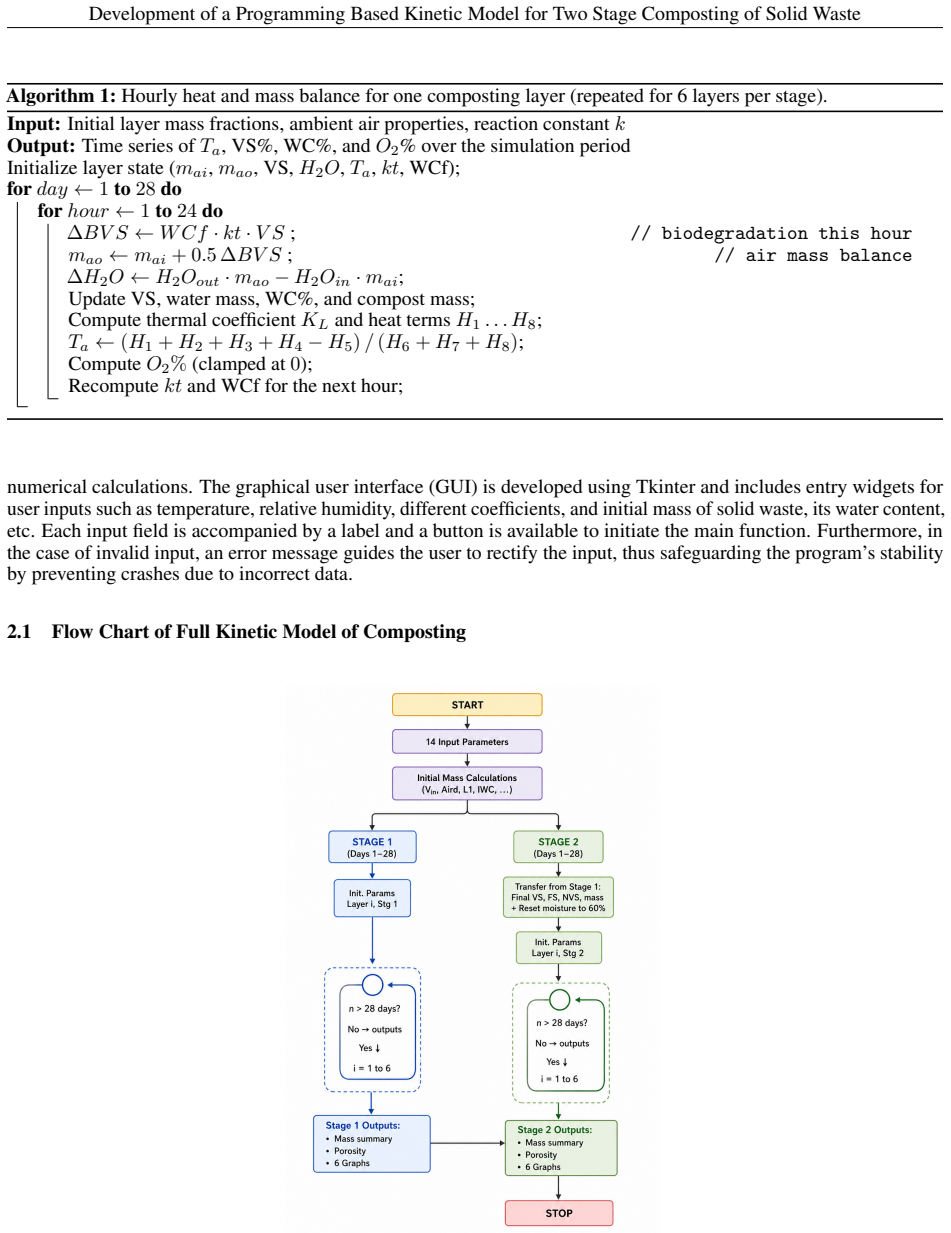
The authors present a two-stage kinetic model coded in a programming environment that separates the composting of solid waste into an initial 28-day decomposition phase and a subsequent degradation phase, allowing simpler calculation of process efficiency under different aeration, moisture, and carbon-to-nitrogen conditions.
What carries the argument
the two-stage kinetic model implemented through programming that tracks decomposition rates across the 28-day split and beyond
If this is right
- The model permits separate efficiency calculations for the first 28 days versus later periods.
- Users can adjust inputs for aeration, moisture, and carbon-to-nitrogen ratio to predict outcomes without solving differential equations by hand.
- The programming implementation supports repeated runs to test different waste mixtures and operating conditions.
- Better process control can reduce greenhouse gas releases from untreated biodegradable waste.
Where Pith is reading between the lines
- The same code structure could be adapted to include real-time sensor data for ongoing adjustments during composting.
- Testing the model on multiple waste streams from different regions would reveal whether the 28-day boundary holds across climates.
- Linking the model to cost calculations for aeration equipment would show practical savings in large-scale facilities.
Load-bearing premise
The chosen split at 28 days together with the programming code accurately captures the real kinetics controlled by aeration, moisture, and carbon-to-nitrogen ratio without further checks against experiments.
What would settle it
Measurements of actual mass loss and temperature profiles from controlled composting bins run for more than 28 days at known aeration, moisture, and C/N levels that deviate from the model's output.
Figures
read the original abstract
As the world is moving toward sustainable development, there is an important need to adopt sustainable waste management solutions of biodegradable solid waste, such as composting, which offers significant advantages over traditional methods like landfilling and incineration by reducing greenhouse gas emissions, enriching soil fertility, and minimizing landfill waste. However, optimizing the composting process governed by factors like aeration, moisture, and carbon-to-nitrogen ratio often relies on complex mathematical models that are difficult to interpret and apply. To overcome this challenge, a user-friendly programming-based two-stage kinetic model has been developed which simplifies composting efficiency analysis, with the first stage covering the initial 28 days of decomposition and the second stage evaluating further degradation, making the process more accessible and actionable for sustainable waste management.
Editorial analysis
A structured set of objections, weighed in public.
Referee Report
Summary. The manuscript claims development of a user-friendly programming-based two-stage kinetic model for composting biodegradable solid waste. The first stage covers the initial 28 days of decomposition and the second stage evaluates further degradation, with the goal of simplifying efficiency analysis under the influences of aeration, moisture, and carbon-to-nitrogen ratio for sustainable waste management applications.
Significance. A correctly formulated, coded, and validated two-stage kinetic model could offer a practical, accessible alternative to complex mathematical models for composting optimization. However, the manuscript provides no equations, code structure, parameter fitting, data, or validation, so no assessment of significance is possible.
major comments (1)
- [Abstract] Abstract: the central claim that a two-stage kinetic model has been developed is unsupported because the text supplies no kinetic equations, rate laws, mass-balance relations, programming implementation details, parameter values, experimental data, error metrics, or validation against prior models. Without these elements the 28-day stage division and incorporation of aeration/moisture/C:N effects cannot be evaluated.
Simulated Author's Rebuttal
We thank the referee for identifying the critical gaps in the presentation of our work. We agree that the submitted manuscript does not contain the required technical details to support the central claim and will revise accordingly.
read point-by-point responses
-
Referee: [Abstract] Abstract: the central claim that a two-stage kinetic model has been developed is unsupported because the text supplies no kinetic equations, rate laws, mass-balance relations, programming implementation details, parameter values, experimental data, error metrics, or validation against prior models. Without these elements the 28-day stage division and incorporation of aeration/moisture/C:N effects cannot be evaluated.
Authors: We agree with this assessment. The submitted version omitted the model equations, code structure, fitted parameters, experimental datasets, error metrics, and validation results. In the revised manuscript we will insert the two-stage kinetic rate laws (first-order for the initial 28-day rapid phase and a modified form for the subsequent slower phase), the explicit mass-balance relations, the Python implementation outline, the parameter values obtained by fitting to our composting trial data, RMSE and R² metrics, and direct comparisons to existing single-stage models. The 28-day breakpoint is defined from the inflection point in cumulative CO₂ evolution curves measured under controlled aeration, moisture, and C:N conditions. revision: yes
Circularity Check
No significant circularity identified
full rationale
The paper abstract and available description claim development of a programming-based two-stage kinetic model with a 28-day breakpoint but supply no equations, rate laws, parameter-fitting procedure, mass-balance relations, or derivation steps. No self-citations, fitted inputs renamed as predictions, or ansatzes are visible. Without any load-bearing mathematical content that could reduce outputs to inputs by construction, the derivation chain is not assessable and exhibits no circularity. This is the expected non-finding when a manuscript presents only a high-level claim without exposing its internal logic.
Axiom & Free-Parameter Ledger
Reference graph
Works this paper leans on
-
[1]
Springer, 2015
Katheem Kiyasudeen, Mahamad Hakimi Ibrahim, Shlrene Quaik, and Sultan Ahmed Ismail.Prospects of organic waste management and the significance of earthworms. Springer, 2015
2015
-
[2]
Harnessing energy from the waste produced in bangladesh: evaluating potential technologies
Khodadad Mostakim, Md Arman Arefin, Mohammad Towhidul Islam, Khaled Mohammad Shifullah, and Md Amirul Islam. Harnessing energy from the waste produced in bangladesh: evaluating potential technologies. Heliyon, 7(10), 2021
2021
-
[3]
Environmental impact of open burning of municipal solid wastes dumps in parts of jos metropolis, nigeria.Journal of Engineering Research and Reports, 12(3):30–43, 2020
RE Daffi, AN Chaimang, and MI Alfa. Environmental impact of open burning of municipal solid wastes dumps in parts of jos metropolis, nigeria.Journal of Engineering Research and Reports, 12(3):30–43, 2020
2020
-
[4]
Simultaneous chemical coagulation and physical treatment of leachate generated from waste landfill in bangladesh.Proceedings of the Waste Safe, pages 25–27, 2017
M Ujjwal, Q Bari, and I Rafizul. Simultaneous chemical coagulation and physical treatment of leachate generated from waste landfill in bangladesh.Proceedings of the Waste Safe, pages 25–27, 2017
2017
-
[5]
Ayesha Siddiqua, John N Hahladakis, and Wadha Ahmed KA Al-Attiya. An overview of the environmental pollution and health effects associated with waste landfilling and open dumping.Environmental Science and Pollution Research, 29(39):58514–58536, 2022
2022
-
[6]
Exploring environmental and meteoro- logical factors influencing greenhouse gas emissions on major urbanized cities in bangladesh.Urban Climate, 60: 102369, 2025
Md Tushar Ali, Quazi Hamidul Bari, and Abu Reza Md Towfiqul Islam. Exploring environmental and meteoro- logical factors influencing greenhouse gas emissions on major urbanized cities in bangladesh.Urban Climate, 60: 102369, 2025
2025
-
[7]
Environmental issues due to open dumping and landfilling
Mohammad I Al-Wabel, Munir Ahmad, Hina Rasheed, Muhammad Imran Rafique, Jahangir Ahmad, and Adel RA Usman. Environmental issues due to open dumping and landfilling. InCircular Economy in Municipal Solid Waste Landfilling: Biomining & Leachate Treatment: Sustainable Solid Waste Management: Waste to Wealth, pages 65–93. Springer, 2022
2022
-
[8]
Production and application of organic waste compost for urban agriculture in emerging cities.International Journal of Agricultural and Biosystems Engineering, 16(4):39–47, 2022
Alemayehu Agizew Woldeamanuel, Mekonnen Maschal Tarekegn, and Raj Mohan Balakrishina. Production and application of organic waste compost for urban agriculture in emerging cities.International Journal of Agricultural and Biosystems Engineering, 16(4):39–47, 2022. 8 Development of a Programming Based Kinetic Model for Two Stage Composting of Solid Waste
2022
-
[9]
Pace and K
M. Pace and K. Farrell-Poe. The composting process. https://extension.usu.edu/agwastemanagement/ files/The_Composting_Process.pdf, 1995. [Accessed 21-06-2026]
1995
-
[10]
A review of the principles of composting: understanding the processes, methods, merits, and demerits.Organic Agriculture, 12(4):547–562, 2022
Ebenezer Ebo Yahans Amuah, Bernard Fei-Baffoe, Lyndon Nii Adjiri Sackey, Nang Biyogue Douti, and Ray- mond Webrah Kazapoe. A review of the principles of composting: understanding the processes, methods, merits, and demerits.Organic Agriculture, 12(4):547–562, 2022
2022
-
[11]
A mathematical model for forced aeration composting: effect of air reuse and initial moisture content
Quazi H Bari. A mathematical model for forced aeration composting: effect of air reuse and initial moisture content. In4th Annual Paper Meet and 1st Civil Engineering Congress, 2011
2011
-
[12]
Kinetic analysis of forced aeration composting-ii
Quazi H Bari and A Koenig. Kinetic analysis of forced aeration composting-ii. application of multilayer analysis for the prediction of biological degradation.Waste Management & Research, 18(4):313–319, 2000
2000
-
[13]
Effect of different modes of aeration on composting of solid waste in a closed system.HKU Theses Online (HKUTO), 1999
Quazi Hamidul Bari. Effect of different modes of aeration on composting of solid waste in a closed system.HKU Theses Online (HKUTO), 1999
1999
-
[14]
A review on mathematical modeling of in-vessel composting process and energy balance.Biomass Conversion and Biorefinery, 12(9):4201–4213, 2022
Muhammad Ajmal, Shi Aiping, Saad Uddin, Muhammad Awais, Muhammad Faheem, Lihua Ye, Khalil Ur Rehman, Muhammad Saif Ullah, and Yefan Shi. A review on mathematical modeling of in-vessel composting process and energy balance.Biomass Conversion and Biorefinery, 12(9):4201–4213, 2022
2022
-
[15]
A review of mathematical models for composting.Waste Management, 113:379–394, 2020
Eric Walling, Anne Trémier, and Céline Vaneeckhaute. A review of mathematical models for composting.Waste Management, 113:379–394, 2020
2020
-
[16]
I¸ sıl Arslan, Ayhan Ünlü, and Murat Topal
E. I¸ sıl Arslan, Ayhan Ünlü, and Murat Topal. Determination of the effect of aeration rate on composting of vegetable–fruit wastes.CLEAN – Soil, Air, Water, 39(11):1014–1021, 2011. doi:https://doi.org/10.1002/clen.201000537. URL https://onlinelibrary.wiley.com/doi/abs/10.1002/ clen.201000537
-
[17]
Quazi H. Bari and Albert Koenig. Application of a simplified mathematical model to estimate the effect of forced aeration on composting in a closed system.Waste Management, 32(11):2037–2045, 2012. ISSN 0956- 053X. doi:https://doi.org/10.1016/j.wasman.2012.01.014. URL https://www.sciencedirect.com/science/ article/pii/S0956053X12000281. Special Thematic Is...
-
[18]
Evaluation of municipal solid waste composting kinetics.Resources, conservation and recycling, 23(4):209–223, 1998
MF Hamoda, HA Abu Qdais, and J Newham. Evaluation of municipal solid waste composting kinetics.Resources, conservation and recycling, 23(4):209–223, 1998
1998
-
[19]
Heena Kauser and Meena Khwairakpam. Organic waste management by two-stage composting process to decrease the time required for vermicomposting.Environmental Technology & Innovation, 25:102193, 2022. ISSN 2352-1864. doi:https://doi.org/10.1016/j.eti.2021.102193. URL https://www.sciencedirect.com/ science/article/pii/S2352186421007860
-
[20]
Dorota Kulikowska and Zygmunt M. Gusiatin. Sewage sludge composting in a two-stage system: Carbon and nitrogen transformations and potential ecological risk assessment.Waste Management, 38:312–320, 2015. ISSN 0956-053X. doi:https://doi.org/10.1016/j.wasman.2014.12.019. URL https://www.sciencedirect.com/ science/article/pii/S0956053X14005960
-
[21]
A review of solid waste composting process-the uk perspective.Dynamic soil, Dynamic plant, 3(Special Issue 1):57–63, 2009
Anurag Garg and Ibtisam E Tothill. A review of solid waste composting process-the uk perspective.Dynamic soil, Dynamic plant, 3(Special Issue 1):57–63, 2009. 9
2009
discussion (0)
Sign in with ORCID, Apple, or X to comment. Anyone can read and Pith papers without signing in.