REVIEW 2 major objections 4 minor 20 references
Accuracy of approximate projection to the semidefinite cone
T0 review · 2 major / 4 minor · reviewed 2026-08-14 · deepseek-v4-flash
Pith's one-line read This paper proves that small spectral gaps do not impair the accuracy of approximate projections onto the positive semidefinite cone, replacing inverse-gap bounds with a computable residual bound.
desk verdict A genuinely gap-independent projection bound with correct proofs, but the introduction's clean √2 statement needs the D≼0 condition and is otherwise false. read the letter →
The pith
A machine-rendered reading of the paper's core claim, the machinery that carries it, and where it could break.
The reading
What carries the argument
The central mechanism is the nonexpansiveness of the metric projection onto the semidefinite cone in the Frobenius norm: $\|\Pi_+(B)-\Pi_+(A)\|_F\le\|B-A\|_F$. The proof constructs an auxiliary matrix $B=\hat V\hat\Lambda\hat V^T+\hat V_\perp\Pi_-(\hat V_\perp^T A\hat V_\perp)\hat V_\perp^T$, chosen so that $\Pi_+(B)=\hat V\hat\Lambda\hat V^T$, and then a unitary congruence rewrites $\|B-A\|_F$ in terms of the residual blocks. Section 3 gives a first-principles derivation that exposes the cancellation responsible for gap-independence: the sine of the angle between $\hat V$ and a positive eigenvector $v_i$ enters with a factor $1/\lambda_i$, and multiplication by the eigenvalue $\lambda_i$ in the projected error cancels it, so no gap denominator survives.
What would settle it
Take a small symmetric matrix $A$ with eigenvalues straddling zero, compute a Rayleigh-Ritz pair $(\hat V,\hat\Lambda=\hat V^T A\hat V)$ with $\hat\Lambda\succeq 0$ and with $\hat V_\perp^T A\hat V_\perp\preceq 0$, and evaluate the ratio $\|\hat V\hat\Lambda\hat V^T-\Pi_+(A)\|_F/\|R\|_F$. The theorem forces this ratio never to exceed $\sqrt{2}$; a single example exceeding $\sqrt{2}$, or a sequence of small-gap examples where the ratio grows as the gap shrinks, would refute the gap-independence claim. For the paper's spectral-norm conjecture, a numerical search for matrices with $\|\hat V\hat\Lambda\hat V^T-\Pi_+(A)\|_2>2\|R\|_2$ would settle the conjectured constant.
Extended reading notes
Core claim
The paper establishes that, for a symmetric or Hermitian matrix $A$ and any orthonormal $\hat V$ with $\hat\Lambda\succeq 0$, $$\|\hat V\hat\Lambda\hat V^T-\Pi_+(A)\|$_F^{2}$\le\|R\|$_F^{2}$+\|\hat V_\perp^T A\hat V\|$_F^{2}$+\|D_+\|$_F^{2}$,$$ where $R=A\hat V-\hat V\hat\Lambda$ and $D_+=\Pi_+(\hat V_\perp^T A\hat V_\perp)$. If the approximate eigenpairs come from the Rayleigh-Ritz process, $\hat\Lambda=\hat V^T A\hat V$, and if the compression of $A$ to the orthogonal complement is negative semidefinite, the bound reduces to $\|\hat V\hat\Lambda\hat V^T-\Pi_+(A)\|_F\le\sqrt{2}\|R\|_F$. The spectral gap is absent from every one of these inequalities. The paper further proves $\|A(V_+V_+^T-\hat V\hat V^T)\|_F\le\sqrt{2}(\|R\|_F+\|D_+\|_F)$ and shows that this alternative measure of projection accuracy differs from the projected-matrix error by at most $\|R\|_F$.
Load-bearing premise
The load-bearing premise is that the approximate eigenpairs are computed with nonnegative Ritz values and that the part of $A$ in the orthogonal complement is non-positive (or nearly so); if that fails the residual alone no longer controls the error, and an extra correction term $\|D_+\|_F$ appears.
Editorial extensions
If this is right
- Any backward-stable symmetric eigensolver yields projection error $O(u)\|A\|_F$ in the Frobenius norm even when $A$ has eigenvalues of tiny magnitude on both sides of zero.
- Inexact projections computed to tolerance $\epsilon$ inside iterative methods such as ADMM carry a guaranteed projection error $O(\epsilon)\|A\|_F$, independent of the spectrum.
- The residual $\|R\|_F$, which is already computed during Rayleigh-Ritz iterations, serves as a certified a posteriori error estimator for the projection, with no need to estimate spectral gaps.
- The negative-eigenpair formulation extends the same guarantee to nearly positive definite matrices, where the projection is best computed from the small negative part rather than the large positive part.
- The two accuracy measures--error of the projected matrix and $\|A(V_+V_+^T-\hat V\hat V^T)\|_F$--differ by at most $\|R\|_F$, so a bound on either transfers to the other.
Reading between the lines
- Beyond the paper: the same two-ingredient proof (nonexpansive cone projection plus an auxiliary matrix isolating the opposite-sign part of $A$) should yield gap-independent bounds for projections onto other closed convex cones with Frobenius-nonexpansive projectors, such as the Lorentz cone; this is a testable extension the paper does not pursue.
- Beyond the paper: the residual-only bound suggests a practical stopping rule for inner eigendecompositions in ADMM and proximal methods--terminate when $\|R\|_F$ falls below a target, with projection error guaranteed by the theorem rather than by gap estimation; the paper supplies the inequality but not the algorithm.
- Beyond the paper: if the spectral-norm conjecture with constant $\delta=2$ is true, gap-independence would extend to the 2-norm, but the paper's own example shows $\Pi_+$ is not nonexpansive in that norm, so a proof would need a different mechanism than the one used here.
Signed reviews
Editorial analysis
A structured set of objections, weighed in public.
Referee Report
Summary. The paper studies the accuracy of approximate projections onto the positive semidefinite cone. Given a symmetric matrix A with positive eigenpairs (V₊, Λ₊) and an approximate projector V̂Λ̂V̂ᵀ with residual R = AV̂ − V̂Λ̂, the authors derive upper bounds on the Frobenius-norm projection error that do not depend on the spectral gap. The main technical results are Theorem 2.1, which bounds the error by the square root of ‖R‖²_F + ‖V̂⊥ᵀAV̂‖²_F + ‖Π₊(V̂⊥ᵀAV̂⊥)‖²_F, and its corollaries, which simplify under the Rayleigh–Ritz relation or when V̂⊥ᵀAV̂⊥ is negative semidefinite, giving the clean √2‖R‖_F bound. Section 3 proves an analogous bound for the alternative measure A(V₊V₊ᵀ − V̂V̂ᵀ), and Section 4 reports numerical experiments supporting the gap-independence.
Significance. If the advertised bounds are valid under the stated hypotheses, the paper provides a practical, computable a posteriori error estimate for approximate semidefinite projections and convincingly demonstrates that small spectral gaps do not inherently compromise accuracy. The proofs are concise and rely on standard tools—nonexpansiveness of convex projections, residual algebra, and elementary norm identities. The sharpness example (Example 2.1) is valuable, and the numerical experiments illustrate the usefulness of the bounds in an ARPACK setting. However, the central advertised inequality (7) is stated without a necessary hypothesis, and Section 3's main theorem omits an assumption used in its proof; these issues require correction.
major comments (2)
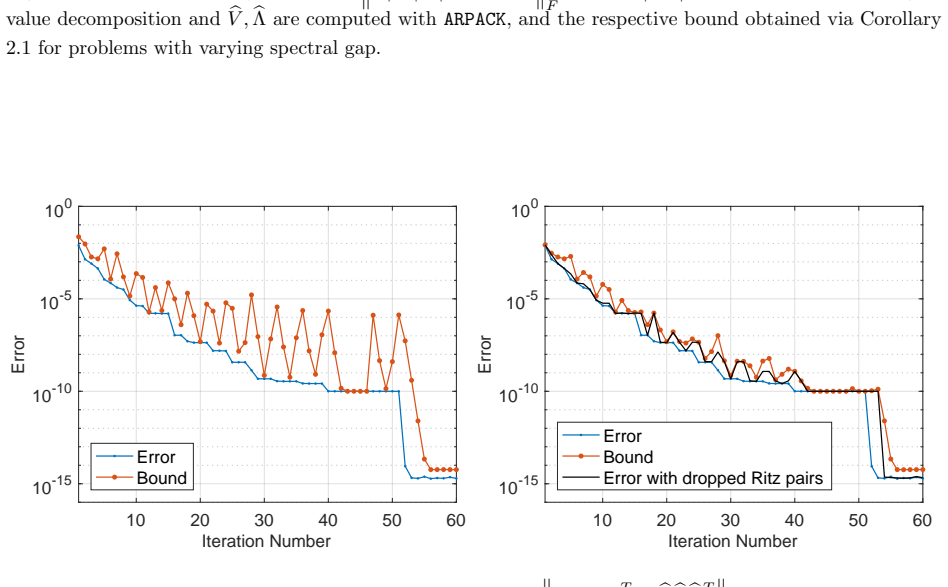
- [Introduction, Eq. (7)] Inequality (7) as stated in the introduction is false. The clean bound ‖V̂Λ̂V̂ᵀ − Π₊(A)‖_F ≤ √2‖R‖_F is only proven in Corollary 2.2 under the additional hypothesis V̂⊥ᵀAV̂⊥ ≼ 0 (i.e., D₊ = 0). Without that condition, Theorem 2.1 and Corollary 2.1 yield the weaker estimate with the extra term ‖D₊‖_F. This is not merely a formal gap: take A = diag(100, −1, −2), V̂ = [0.6, 0.8, 0]ᵀ, and Λ̂ = V̂ᵀAV̂ = 35.36. Here Λ̂ has the same size as Λ₊ and is positive definite, but ‖V̂Λ̂V̂ᵀ − Π₊(A)‖_F ≈ 93.3 while √2‖R‖_F ≈ 68.6, so (7) fails. The introduction should either state (7) with the D≼0 condition explicitly or promote Theorem 2.1/Corollary 2.1 (with the D₊ term) as the main general result.
- [Section 3, Theorem 3.1] The statement of Theorem 3.1 says 'Under the notation and assumptions in Theorem 2.1', but the proof relies crucially on the Rayleigh–Ritz relation Λ̂ = V̂ᵀAV̂, which is not part of Theorem 2.1's assumptions. Indeed, the text immediately before Theorem 3.1 states 'In what follows we assume Λ̂ is obtained by the Rayleigh–Ritz process'. Without this assumption, the bound (23) need not hold, because the residual block structure in (24) and the estimates (25)–(27) use the relation. The theorem statement should include Λ̂ = V̂ᵀAV̂ as a hypothesis.
minor comments (4)
- [Section 2, Eq. (13)] In the proof of Theorem 2.1, the off-diagonal blocks of the matrix in (13) appear to have sign errors relative to the definitions of B and R; the Frobenius norm is insensitive to these sign changes, so the proof remains valid, but the equation should be checked for consistency.
- [Introduction, statement of (7)] The phrase 'which holds when Λ̂ has the same size as Λ₊' after (7) is misleading: the condition for the clean bound is the negative semidefiniteness of V̂⊥ᵀAV̂⊥, not the equality of sizes. The size condition is part of the setup for the cleanest case but is not sufficient.
- [Example 2.1] The ratio reported in Example 2.1 is for squared Frobenius norms; clarifying this would help readers avoid confusion with the unsquared constants in (7) and (16).
- [Section 2.2] The conjecture about the spectral norm would be easier to interpret if the proposed constant δ were tied to a specific family of examples; currently the text only states δ > 1.
Circularity Check
No circularity: the derivation is self-contained and proceeds from residual algebra and the nonexpansiveness of the projection operator.
full rationale
The paper derives gap-independent error bounds for approximate projections onto the semidefinite cone. The main results (Theorem 2.1, Corollaries 2.1–2.3, and Theorem 3.1) follow from residual algebra, the Rayleigh–Ritz relation Λ̂ = V̂ᵀAV̂ when invoked, and the nonexpansiveness of the projection operator in the Frobenius norm, cited to an external textbook [1, Proposition 4.16]. No parameter is fitted to data and then renamed as a prediction; the bounds explicitly express the projection error in terms of the computable residual norm ‖R‖_F and the auxiliary term ‖D₊‖_F. The clean inequality (7) is presented as a special case under stated hypotheses that include V̂⊥ᵀAV̂⊥ ≼ 0 (Corollary 2.2), and the introduction’s phrasing omits that condition, but this is a correctness/statement-precision issue, not circularity. The single self-citation [15] by coauthor Nakatsukasa appears only in a footnote about sharp Ritz vector bounds and is not used to justify the main theorem. The proof of Lemma 2.1 rests on a standard matrix inequality from Horn and Johnson. Overall, the derivation is self-contained: every bound is obtained by explicit algebraic manipulation from the stated assumptions, with no load-bearing self-referential premise.
Assumptions & free parameters
assumptions (4)
- standard math Nonexpansiveness of projection onto a closed convex set in a Hilbert space (Frobenius norm)
- standard math Majorization inequalities for unitarily invariant norms
- standard math Rayleigh-Ritz residual identities
- standard math Eigenvalue interlacing and perturbation bounds for Hermitian matrices
Cite this review
Pith. "Pith review of Accuracy of approximate projection to the semidefinite cone." pith.science (2026). https://pith.science/paper/5OGAEJJE
@misc{pith2026190801606,
  author       = {Pith},
  title        = {Pith review of: Accuracy of approximate projection to the semidefinite cone},
  year         = {2026},
  howpublished = {\url{https://pith.science/paper/5OGAEJJE}},
  note         = {Machine review of arXiv:1908.01606}
}
read the original abstract
When a projection of a symmetric or Hermitian matrix to the positive semidefinite cone is computed approximately (or to working precision on a computer), a natural question is to quantify its accuracy. A straightforward bound invoking standard eigenvalue perturbation theory (e.g. Davis-Kahan and Weyl bounds) suggests that the accuracy would be inversely proportional to the spectral gap, implying it can be poor in the presence of small eigenvalues. This work shows that a small gap is not a concern for projection onto the semidefinite cone, by deriving error bounds that are gap-independent.
Figures

Reference graph
Works this paper leans on
-
[15]
Sharp error bounds for Ritz vectors and approximate singular vectors
Y. Nakatsukasa. Sharp error bounds for Ritz vectors and approximate singular vectors. arXiv 1810.02532, 2018
work page Pith review arXiv 2018
-
[1]
H. Bauschke and P. L. Combettes. Convex Analysis and Monotone Operator Theory in Hilbert Spaces. Springer Publishing Company, Incorporated, 1st edition, 2011
work page 2011
-
[2]
S. Boyd, N. Parikh, E. Chu, B. Peleato, and J. Eckstein. Distributed Optimization and Statistical Learning via the Alternating Direction Method of Multipliers. Found. Trends Mach. Learn., 3(1):1–122, 2011
work page 2011
-
[3]
C. Davis and W. Kahan. The Rotation of Eigenvectors by a Perturbation. III. SIAM J. Numer. Anal. , 7(1):1–46, 1970
work page 1970
- [4]
-
[5]
I. S. Duff, A. M. Erisman, and J. K. Reid. Direct Methods for Sparse Matrices. Oxford University Press, 2017
work page 2017
-
[6]
J. Eckstein and D. P. Bertsekas. On the Douglas—Rachford splitting method and the proximal point algorithm for maximal monotone operators. Mathematical Programming, 55(1):293–318, 1992
work page 1992
- [7]
Show all 20 references
-
[8]
Garstka, M
M. Garstka, M. Cannon, and P. J. Goulart. COSMO: A conic operator splitting method for convex conic problems. arXiv 1901.10887, 2019
1901 arXiv
-
[9]
G. H. Golub and C. F. Van Loan. Matrix Computations. Johns Hopkins Studies in the Mathematical Sciences. Johns Hopkins University Press, 4th edition, 2013
2013
-
[10]
N. Higham. Matrix nearness problems and applications. Applications of Matrix Theory, 1989
1989
-
[11]
Higham, N
N. Higham, N. Strabic, and V. Sego. Restoring definiteness via shrinking, with an application to correlation matrices with a fixed block. SIAM Review, 58(2):245–263, 2016
2016
-
[12]
N. J. Higham. Computing the nearest correlation matrix-a problem from finance. IMA Journal of Numerical Analysis , 22(3):329–343, July 2002. 17
2002
-
[13]
R. A. Horn and C. R. Johnson. Matrix Analysis . Cambridge University Press, New York, NY, USA, 2nd edition, 2012
2012
-
[14]
Lehoucq, D
R. Lehoucq, D. Sorensen, and C. Yang. ARPACK Users’ Guide. Society for Industrial and Applied Mathematics, 1998
1998
-
[16]
B. N. Parlett. The Symmetric Eigenvalue Problem . Prentice-Hall, Inc., Upper Saddle River, NJ, USA, 1998
1998
-
[17]
Qi and D
H. Qi and D. Sun. A Quadratically Convergent Newton Method for Computing the Nearest Correlation Matrix. SIAM J. Matrix Anal. Appl. , 28(2):360–385, June 2006
2006
-
[18]
Y. Saad. Numerical Methods for Large Eigenvalue Problems . Society for Industrial and Applied Mathematics, 2011
2011
-
[19]
Vandenberghe and S
L. Vandenberghe and S. Boyd. Semidefinite Programming. SIAM Review, 38(1):49–95, 1996
1996
-
[20]
Xiong, V
J. Xiong, V. Zolotov, and L. He. Robust extraction of spatial correlation. IEEE Trans- actions on Computer-Aided Design of Integrated Circuits and Systems , 26(4):619–631, April 2007. 18
2007
Reviewed August 14, 2026 · model on record in the stance chip above.
Discussion (0). Continue with ORCID to comment.