REVIEW 3 major objections 4 minor 36 references
Extremely high-aspect-ratio ultrafast Bessel beam generation and stealth dicing of multi-millimeter thick glass
T0 review · 3 major / 4 minor · reviewed 2026-08-14 · deepseek-v4-flash
Pith's one-line read A focus-free three-axicon shaper sustains a subwavelength Bessel core for over 8 mm and uses it to stealth-dice glass up to 1 cm thick.
desk verdict Compact Bessel shaper with 8 mm zone and 1-cm glass dicing is real, but the Joule-level extrapolation is quantitatively implausible for 50 fs pulses. read the letter →
The pith
A machine-rendered reading of the paper's core claim, the machinery that carries it, and where it could break.
The reading
What carries the argument
The load-bearing component is the three-axicon beam shaper: a negative and a positive 10-degree axicon convert the input Gaussian beam into a thick collimated annulus, and a third 45-degree axicon refracts that annulus into a conical wavefront, forming a Bessel beam at a controlled working distance. The cone angle follows from the last axicon's wedge angle and refractive index, $\theta = \arcsin\bigl(n\sin(\beta - \arcsin(\sin\beta/n))\bigr)$, and the Bessel-zone length is $L_B = w_0(1+\tan\beta\tan\gamma)/\tan\theta$. Because there is no relay telescope, the Bessel field is never Fourier-transformed into a high-intensity annulus on an intermediate optic, so the system stays compact (about 15 cm) and is claimed to tolerate pulse energies up to the joule level.
What would settle it
Send pulses of several hundred millijoules through the shaper and check whether the axicons survive and the measured Bessel profile stays a single 740-nm core over 8 mm; if the optics damage or the profile distorts, the high-energy claim fails.
Extended reading notes
Core claim
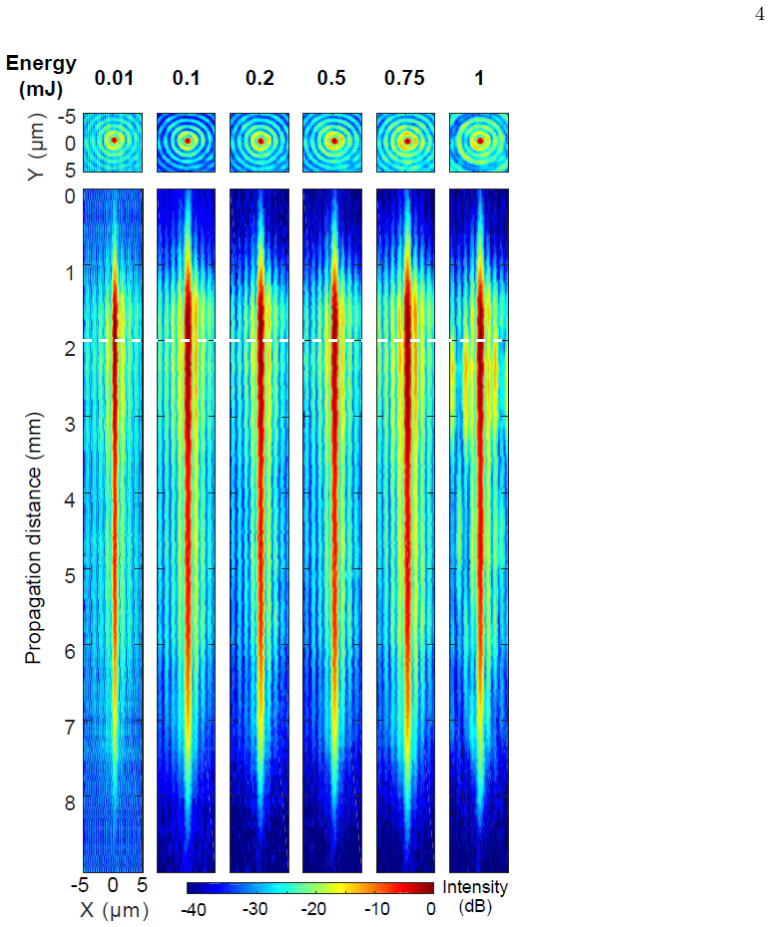
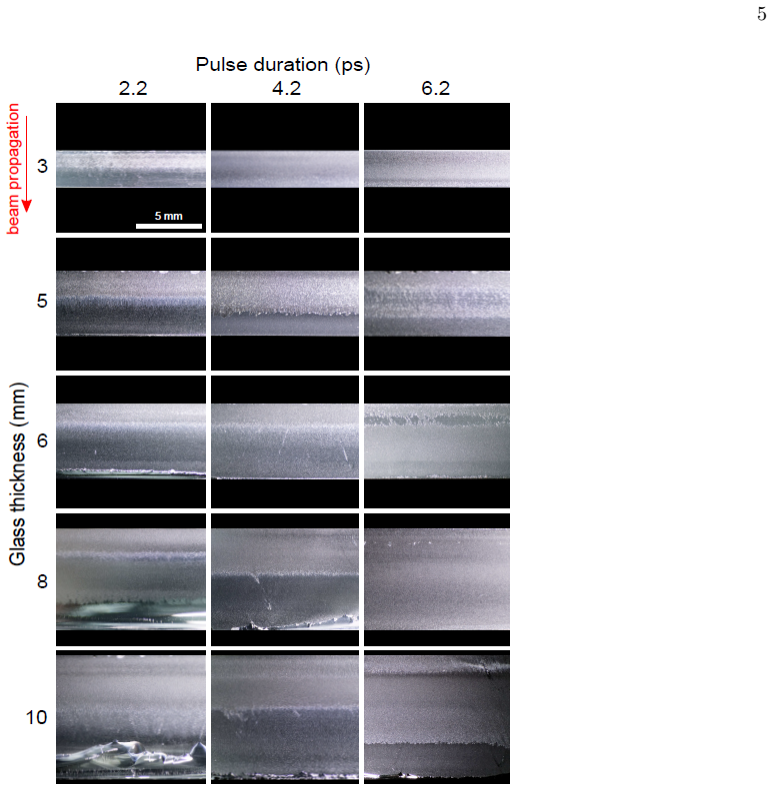
The central discovery is that a three-axicon arrangement with no intermediate focus produces a high-angle Bessel beam ($\theta = 23.3^\circ$) whose central core has a FWHM diameter of 740 nm and remains essentially unchanged over an 8 mm propagation distance in air. The Bessel-zone length is set by the input waist and the axicon angles, the working distance by the spacing between the first two axicons, and the cone angle only by the last axicon. With this beam, the authors show that single-pass laser processing followed by mechanical bending cleaves soda-lime glass slabs from 3 to 10 mm thick; at 6.2 ps pulse duration, the cleaved-edge roughness is in the 1.00 to 1.25 µm range, comparable to ground glass. The shaper was operated at input energies up to 5 mJ, and the argument that it can scale to much higher energies rests on the absence of any intermediate focus, which avoids the high-intensity spots and damage risks of relay-imaging designs.
Load-bearing premise
The joule-level scaling claim depends on the assumption that spreading the pulse over a few square centimeters of axicon surface prevents optical damage and nonlinear distortion at energies far above the 5 mJ actually tested.
Editorial extensions
If this is right
- Stealth dicing can be extended from sub-millimeter glass to slabs of 1 cm thickness in a single pass, reducing or eliminating mechanical post-processing of thick glass.
- Picosecond pulse durations around 6 ps give chip-free cleaving with roughness close to ground glass, while 50 fs pulses do not produce cleavable modifications, making pulse duration a key processing parameter.
- Because the Bessel-zone length and working distance are set by separate geometric parameters, the same shaper can be adjusted for different material thicknesses without redesigning the optics.
- The authors expect the same design to shape pulse energies near a joule, reaching intensities around $10^{18}\,\mathrm{W\,cm^{-2}}$ in a non-diffracting channel, which would matter for high-intensity and plasma applications.
Reading between the lines
- If joule-level operation is confirmed, the same no-focus design should also tolerate high average power, since thermal lensing is reduced when energy is spread uniformly over large axicon surfaces; the paper argues this but does not measure it.
- The linear scaling of Bessel-zone length with input waist suggests that the demonstrated 8 mm zone is not an upper limit; larger input beams could produce even longer zones and potentially dice thicker stacks, though that extrapolation is untested.
- Because rear-surface chipping at short pulse durations is attributed to decreasing local fluence along the beam, a two-pass strategy with different focal depths could improve edge quality on 10 mm glass; this is a testable extension the paper does not explore.
Signed reviews
Editorial analysis
A structured set of objections, weighed in public.
Referee Report
Summary. The paper reports a three-axicon beam shaper that generates a high-cone-angle Bessel beam (θ = 23.3°) with a 740 nm FWHM central spot over a propagation length of roughly 8 mm in air. The authors derive parameter-free geometric-optics formulas for the cone angle, Bessel-zone length, and working distance, and show experimental fluence maps from 12 µJ to 1 mJ that agree with the model. They claim that the absence of intermediate focusing allows shaping of pulse energies up to the Joule level, and they demonstrate proof-of-principle stealth dicing of soda-lime glass up to 10 mm thick using 2.5 mJ pulses of 2.2–6.2 ps duration.
Significance. If the results hold, the shaper is a compact and promising tool for generating extremely long, high-angle Bessel beams, and the 10-mm glass-dicing demonstration is a useful proof of principle. The strengths of the paper are the parameter-free geometric-optics model, the direct comparisons with measured Bessel length and cone angle (predicted 9.7 mm versus observed about 8 mm; θ = 23.3°), and the absence of fitted free parameters in the core characterization. The dicing result, with roughness close to that of ground glass, is also a concrete and reproducible application. The main weakness is the unsupported and quantitatively implausible extrapolation to Joule-level pulse energies; this claim is load-bearing in the abstract and conclusion, while the demonstrated low-energy regime is credible.
major comments (3)
- [Experimental characterization and conclusion] The Joule-level capability claim (abstract; 'We remark that...' in the characterization section; conclusion) rests only on a static-fluence damage-threshold argument and neglects nonlinear propagation through the transmissive optics, particularly the 17.8-mm-thick fused-silica third axicon. For 1 J, 50 fs pulses with the stated 23.3° cone angle and w0 = 4 mm, the annulus area is roughly 2.5 cm², giving a peak intensity of about 8×10¹² W/cm² in the axicon. With n₂ ≈ 2.7×10⁻²⁰ m²/W for fused silica, the accumulated nonlinear phase is B = (2π/λ)n₂IL ≈ 300 rad, far above the B ≲ 1 limit for undistorted propagation. Self-phase modulation and self-focusing of this magnitude would severely distort the beam and likely damage the optic before the intended Bessel beam is formed. At the largest characterized energy, 1 mJ, B ≈ 0.3 rad, and even at the uncharacterized 5 mJ input, B ≈ 1.5 rad is already non-negligible. The authors should remove or substantially temper the Joule-level claim, restrict it explicitly to stretched pulses with a quantitative B-integral estimate, or support it with high-energy experiments and a nonlinear propagation analysis.
- [Experimental characterization] The statement that the aspect ratio is 'two orders of magnitude higher than previously achieved with telescopic arrangements for the same cone angle of 23.3°' is unsupported by the manuscript: no baseline value or reference is given, and no error bars accompany the quoted 740 nm FWHM spot diameter or the approximately 8 mm Bessel-zone length. Since the >10,000:1 aspect ratio and its improvement over prior work are central to the paper's novelty, the authors should either provide the comparison value with a proper citation or restrict the claim to the directly measured quantities with stated uncertainties.
- [Stealth dicing] The 10-mm dicing demonstration is presented as a headline result, but its quality metrics are not fully quantified: for the 10 mm samples the authors report chipping over 'some 100 µm' and a similar deviation from flatness, but they do not report the number of successful cleaves, the statistics behind the 'repeated 3 times' statement, or the uncertainty on the roughness range [1.00–1.25] µm. A statement of the success criterion (e.g., what counts as a cleave, how chipping was measured) and the number of independent attempts would make the proof-of-principle claim reproducible and better support the comparison with ground-glass roughness.
minor comments (4)
- [Experimental characterization] The sentence 'We experimentally characterize the Bessel beam distribution up to 1 mJ in air and show it is constant' is imprecise; the measured quantity is the invariance of the transverse fluence profile with pulse energy, not a time-independent beam.
- [References] There are small typographical errors in the reference list: 'J. Opt. Sco.' should be 'J. Opt. Soc.' in Refs. [25] and [33], and the author name in Ref. [34] appears garbled. Please proofread the reference metadata.
- [Experimental characterization] The claim that the Bessel beam is 'homogeneous' over its about 8 mm range should be accompanied by the criterion used to define the zone (e.g., peak-intensity variation or central-lobe FWHM along z) and the corresponding uncertainty, since the measured length is compared with a 9.7 mm prediction.
- [Conclusion] The sentence linking the shaper to 'high average power' conflates average power with pulse energy; the demonstrated average power is 2.5 W (2.5 mJ at 1 kHz), which is not high relative to industrial systems. Please separate the average-power and pulse-energy claims.
Circularity Check
No significant circularity: the Bessel beam angle and length are parameter-free geometric-optics predictions checked against measured images, and the dicing demonstration is a direct experiment.
full rationale
The derivation chain is self-contained. The Bessel cone angle θ is computed from the third axicon's wedge angle and refractive index via Eq. (1), and the Bessel zone length LB is computed from the input waist, angles, and index via Eq. (2); neither quantity is fitted to the measured intensity maps. The measured ~8 mm homogeneous zone is compared with the predicted LB = 9.7 mm, which is an independent check, not an input. The central-spot diameter and the >10 000:1 aspect ratio are direct imaging measurements, and the stealth-dicing results are a physical demonstration. Self-citations (e.g., [5], [25], [35], [36]) are used for background, parameter choice, or comparison, but none supplies the central prediction or defines the measured Bessel length; no uniqueness theorem or ansatz is imported from the authors' prior work. The Joule-level extrapolation is an arguable physical-risk concern, for instance regarding B-integral accumulation in the 17.8 mm fused-silica axicon, but that is a correctness and support issue, not circularity: the paper does not define the experimentally characterized Bessel beam in terms of the extrapolated energy handling.
Assumptions & free parameters
assumptions (4)
- domain assumption Geometric optics ray tracing accurately describes the transformation by the axicon pair and the third axicon.
- domain assumption The manufactured axicons are of sufficient quality to produce a single undistorted Bessel hotspot.
- ad hoc to paper Typical optical damage thresholds (several J/cm squared) and beam spread over cm squared areas imply Joule-level survivability.
- domain assumption The 5 micrometer spacing between pulses (5 mm/s at 1 kHz) is near-optimal for cleaving.
Cite this review
Pith. "Pith review of Extremely high-aspect-ratio ultrafast Bessel beam generation and stealth dicing of multi-millimeter thick glass." pith.science (2026). https://pith.science/paper/5OR4SVHR
@misc{pith2026190807196,
  author       = {Pith},
  title        = {Pith review of: Extremely high-aspect-ratio ultrafast Bessel beam generation and stealth dicing of multi-millimeter thick glass},
  year         = {2026},
  howpublished = {\url{https://pith.science/paper/5OR4SVHR}},
  note         = {Machine review of arXiv:1908.07196}
}
read the original abstract
We report on the development of an ultrafast beam shaper capable of generating Bessel beams of high cone angle that maintain a high-intensity hot spot with subwavelength diameter over a propagation distance in excess of 8~mm. This generates a high-intensity focal region with extremely high aspect ratio exceeding 10~000:1. The absence of intermediate focusing in the shaper allows for shaping very high energies, up to Joule levels. We demonstrate proof of principle application of the Bessel beam shaper for stealth dicing of thick glass, up to 1~cm. We expect this high energy Bessel beam shaper will have applications in several areas of high intensity laser physics.
Figures

Reference graph
Works this paper leans on
-
[1]
K. Mishchik, R. Beuton, O. D. Caulier, S. Skupin, B. Chimier, G. Duchateau, B. Chassagne, R. Kling, C. H¨ onninger, E. Mottay, and J. Lopez, Opt. Express 25, 33271 (2017)
work page 2017
-
[2]
J. Dudutis, R. Stonys, G. Raˇ ciukaitis, and P. Geˇ cys, Procedia CIRP74, 333 (2018)
work page 2018
-
[3]
L. Ye, W. Perrie, O. J. Allegre, Y. Jin, Z. Kuang, P. J. Scully, E. Fearon, D. Eckford, S. P. Edwardson, and G. Dearden, Laser Phys. 23, 126004 (2013)
work page 2013
-
[4]
M. Mikutis, T. Kudrius, G. ˇSlekys, D. Paipulas, and S. Juodkazis, Opt. Mater. Express 3, 1862 (2013)
work page 2013
-
[5]
M. K. Bhuyan, F. Courvoisier, P. A. Lacourt, M. Jacquot, R. Salut, L. Furfaro, and J. M. Dudley, Appl. Phys. Lett. 97, 081102 (2010)
work page 2010
-
[6]
L. Rapp, R. Meyer, R. Giust, L. Furfaro, M. Jacquot, P. A. Lacourt, J. M. Dudley, and F. Courvoisier, Sci. Rep. 6, 34286 (2016)
work page 2016
- [7]
-
[8]
P. Polesana, M. Franco, A. Couairon, D. Faccio, and P. D. Trapani, Phys. Rev. A 77, 043814 (2008)
work page 2008
Show all 36 references
-
[9]
Courvoisier, R
F. Courvoisier, R. Stoian, and A. Couairon, Opt. & Las. Tech. 80, 125 (2016)
2016
-
[10]
Stoian, M
R. Stoian, M. K. Bhuyan, G. Zhang, G. Cheng, R. Meyer, and F. Courvoisier, Adv. Opt. Tech. 7, 165 (2018)
2018
-
[11]
Ahmed, M
F. Ahmed, M. S. Ahsan, M. S. Lee, and M. B. G. Jun, Appl. Phys. A 114, 1161 (2013)
2013
-
[12]
M. K. Bhuyan, O. Jedrkiewicz, V. Sabonis, M. Mikutis, S. Recchia, A. Aprea, M. Bollani, and P. D. Trapani, Appl. Phys. A 120, 443 (2015)
2015
-
[13]
Mishchik, C
K. Mishchik, C. J. Leger, O. D. Caulier, S. Skupin, B. Chimier, C. H¨ onninger, R. Kling, G. Duchateau, and J. Lopez, J. Laser Micro/Nanoeng. 11, 66 (2016)
2016
-
[14]
L. Rapp, R. Meyer, L. Furfaro, C. Billet, R. Giust, and F. Courvoisier, Opt. Express 25, 9312 (2017)
2017
-
[15]
Klewitz, S
S. Klewitz, S. Sogomonian, M. Woerner, and S. Herminghaus, Opt. Commun. 154, 186 (1998)
1998
-
[16]
Dubietis, P
A. Dubietis, P. Polesana, G. Valiulis, A. Stabinis, P. D. Trapani, and A. Piskarskas, Opt. Express 15, 4168 (2007)
2007
-
[17]
Nesrallah, G
M. Nesrallah, G. Vampa, G. Bart, P. B. Corkum, C. R. McDonald, and T. Brabec, Optica 5, 271 (2018)
2018
-
[18]
L. V. Dao, K. B. Dinh, and P. Hannaford, Appl. Phys. Lett 95, 131114 (2009)
2009
-
[19]
Hafizi, E
B. Hafizi, E. Esarey, and P. Sprangle, Phys. Rev. E 55, 3539 (1997)
1997
-
[20]
Kumar, A
S. Kumar, A. Parola, P. D. Trapani, and O. Jedrkiewicz, Appl. Phys. B 123, 185 (2017)
2017
-
[21]
Alexeev, K
I. Alexeev, K. Y. Kim, and H. M. Milchberg, Phys. Rev. Lett. 88, 073901 (2002)
2002
-
[22]
Zamboni-Rached, K
M. Zamboni-Rached, K. N´ obrega, H. Hern´ andez-Figueroa, and E. Recami, Opt. Commun.226, 15 (2003)
2003
-
[23]
Clerici, D
M. Clerici, D. Faccio, A. Lotti, E. Rubino, O. Jedrkiewicz, J. Biegert, and P. D. Trapani, Opt. Express 16, 19807 (2008)
2008
-
[24]
Bowlan, H
P. Bowlan, H. Valtna-Lukner, M. L˜ ohmus, P. Piksarv, P. Saari, and R. Trebino, Opt. Lett. 34, 2276 (2009)
2009
-
[25]
Froehly, M
L. Froehly, M. Jacquot, P. A. Lacourt, J. M. Dudley, and F. Courvoisier, J. Opt. Sco. Am. A 31, 790 (2014)
2014
-
[26]
Turnbull, P
D. Turnbull, P. Franke, J. Katz, J. Palastro, I. Begishev, R. Boni, J. Bromage, A. Milder, J. Shaw, and D. Froula, Phys. Rev. Lett. 120, 225001 (2018)
2018
-
[27]
M. K. Bhuyan, F. Courvoisier, P.-A. Lacourt, M. Jacquot, L. Furfaro, M. J. Withford, and J. M. Dudley, Opt. Express 18, 566 (2010)
2010
-
[28]
Mitra, M
S. Mitra, M. Chanal, R. Clady, A. Mouskeftaras, and D. Grojo, Appl. Opt. 54, 7358 (2015)
2015
-
[29]
Polesana, A
P. Polesana, A. Couairon, D. Faccio, A. Parola, M. A. Porras, A. Dubietis, A. Piskarskas, and P. D. Trapani, Phys. Rev. Lett. 99, 223902 (2007)
2007
-
[30]
Boucher, J
P. Boucher, J. D. Hoyo, C. Billet, O. Pinel, G. Labroille, and F. Courvoisier, Appl. Opt. 57, 6725 (2018)
2018
-
[31]
Jarutis, R
V. Jarutis, R. Passkauskas, and A. Stabinis, Opt. Commun. 184, 105 (2000). 7
2000
-
[32]
Chebbi, S
B. Chebbi, S. Minko, N. Al-Akwaa, and I. Golub, Opt. Commun. 283, 1678 (2010)
2010
-
[33]
Weber, D
N. Weber, D. Spether, A. Seifert, and H. Zappe, J. Opt. Sco. Am. A 29, 808 (2012)
2012
-
[34]
Bergner, M
K. Bergner, M. M¨ uller, R. Klas, J. Limpert, S. Nolte, and A. T¨ unnerman, Appl. Opt. 57, 5941 (2018)
2018
-
[35]
Meyer, R
R. Meyer, R. Giust, M. Jacquot, J. M. Dudley, and F. Courvoisier, Appl. Phys. Lett. 111, 231108 (2017)
2017
-
[36]
Lamperti, V
M. Lamperti, V. Jukna, O. Jedrkiewicz, P. D. Trapani, R. Stoian, T. E. Itina, C. Xie, F. Courvoisier, and A. Couairon, APL Photonics 3, 120805 (2018)
2018
Reviewed August 14, 2026 · model on record in the stance chip above.
Discussion (0). Continue with ORCID to comment.