REVIEW 3 major objections 5 minor 61 references
Hyperparametric solitons in nondegenerate optical parametric oscillators
T0 review · 3 major / 5 minor · reviewed 2026-08-06 · deepseek-v4-flash
Pith's one-line read New soliton family forms when parametric oscillation turns bistable
desk verdict Credible first demonstration of nondegenerate-OPO soliton combs, but the defining OPO-2 background rests on unmeasured signal/idler losses. read the letter →
The pith
A machine-rendered reading of the paper's core claim, the machinery that carries it, and where it could break.
The reading
What carries the argument
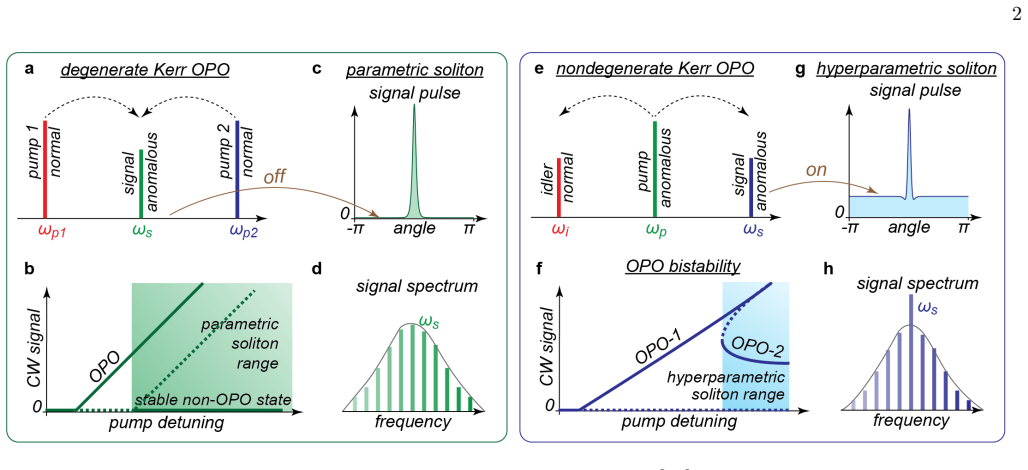
The central object is the bistable OPO loop formed by the $|\mu|=253$ signal-idler mode pair, computed from the three-mode reduction of the coupled-mode equations and encoded as the OPO-1 and OPO-2 branches. The mechanism is the fold in the signal power vs. pump detuning curve that appears when the pump is over-coupled (high pump loss) and signal losses are small enough that the four-wave mixing drive $a_0^2 a_{-\mu}^*$ is strong. In the envelope description, the signal equation with quasi-CW pump and idler reduces to a generalized Lugiato-Lefever equation in which the parametric driving term replaces the external pump, so the soliton is generated by the OPO-2 background rather than by the laser directly.
What would settle it
A direct measurement of the intrinsic quality factors of the modes near 242 THz and 141 THz, for example by probing them with a second weak laser or by analysing the cold-cavity transmission over that range, would settle it: if the actual signal loss exceeds the Table I value by a factor of two or more, the predicted OPO bistability and the observed soliton steps should vanish.
Extended reading notes
Core claim
The discovery is that a nondegenerate Kerr microresonator OPO can support a soliton whose existence relies on bistability between two distinct parametric oscillation states, not on coexistence of an OPO state with a non-oscillating state. For the first signal-idler pair that bifurcates above threshold, the upper branch (OPO-1) is modulationally unstable and the lower branch (OPO-2) is stable over a window of negative pump detuning. The signal envelope then obeys a generalized Lugiato-Lefever equation in which the four-wave mixing product $a_0^2 a_{-\mu}^*$ acts as an effective pump; because the OPO-2 background remains excited at the soliton tails, the bright signal soliton sits on a finite monochromatic background. The pump and idler components stay quasi-CW, and experiment and simulation agree on a three-colour comb with a single repetition rate close to the signal mode's free spectral range.
Load-bearing premise
The computed loss rates for the signal and idler modes, which come from simulation rather than direct measurement, are accurate enough that the OPO bistability loop and the stable lower branch are real.
Editorial extensions
If this is right
- Hyperparametric solitons should be reproducible in any nondegenerate Kerr microresonator OPO whose first bifurcating signal-idler pair is bistable with a stable lower branch.
- The three combs (pump, signal, idler) are repetition-rate locked to the signal free spectral range, so their small spacing differences are pulled to one value.
- Because the signal frequency is set by phase matching rather than by half the pump frequency, soliton combs can be placed at widely tunable spectral locations.
- Multisoliton states, soliton crystals, quasi-crystals, and breathers follow from the same mechanism, with the idler and pump backgrounds remaining quasi-CW as soliton number changes.
Reading between the lines
- A similar bistability-based soliton mechanism could be sought in $\chi^{(2)}$ microresonator OPOs with nondegenerate downconversion, where the phase-matching bandwidth offers even broader tunability.
- The design rule that emerges is that the signal mode's quality factor should be made as high as possible relative to the pump, which suggests that the soliton window can be widened by further improving signal mode Q.
- The generalized Lugiato-Lefever form implies that other pattern-formation phenomena, such as dark solitons or Turing rolls, may exist on the OPO-2 background and would be distinguishable by their characteristic comb spectra.
- If the loss of the idler mode were reduced, the idler might also localize into a pulse, creating a genuinely three-component bright soliton rather than a two-component one with quasi-CW idler.
Editorial analysis
A structured set of objections, weighed in public.
Referee Report
Summary. The paper reports an experimental and numerical study of a new soliton regime in a silicon-nitride microresonator nondegenerate optical parametric oscillator. The device is pumped at roughly 191.4 THz with a relatively low-Q C-band resonance; the signal is generated near 242.0 THz (O-band) and the idler near 140.8 THz (beyond 2 um). The central claim is that the signal field forms a bright soliton sitting on a finite, parametrically generated background (the OPO-2 branch of a bistable OPO loop), while the pump and idler remain quasi-CW, and that all three combs share a common repetition rate. The authors coin the term hyperparametric soliton for this state. They support the claim with measured soliton steps, three-band comb spectra, RF spectra, multisoliton states, and a coupled-mode simulation that reproduces the qualitative spectral features. The paper also presents a generalized Lugiato-Lefever interpretation of the signal equation with an effective pump provided by the quasi-CW idler and pump fields.
Significance. If the interpretation is correct, the paper opens a new direction for microresonator frequency combs: it demonstrates soliton generation in a nondegenerate OPO with large spectral separation between pump, signal, and idler, thereby allowing O-band and mid-infrared comb generation from a C-band pump while retaining the tunability that distinguishes nondegenerate from degenerate OPOs. The experimental evidence is substantial for a proof-of-principle study: clear soliton steps, three-color spectra with a common repetition rate, and multisoliton crystals and breathers are shown. The numerical model is not a circular fit; it uses independently simulated or measured device parameters and reproduces the observed spectra. The main weakness is that the central physical mechanism, namely the existence and stability of the OPO-2 background on which the soliton rests, depends on signal and idler loss values that are simulated rather than measured, and the experimental diagnostics do not directly distinguish a finite background from a strong CW line coexisting with a zero-background soliton.
major comments (3)
- [Methods, Table I, Eqs. (4)-(6), Fig. 4a] The existence of the OPO-2 branch and the soliton window is controlled by the balance between parametric gain and the losses of the signal and idler modes. Table I lists kappa_253/kappa_0 = 0.2709 and kappa_-253/kappa_0 = 0.3607, but these values are from Lumerical simulation, not from direct measurement; the Methods explicitly states that 'Uncertainties in the parameter selection for numerical modelling come from the absence of experimental data on the loss values in the proximity of the signal and idler fields.' Since modest changes in these loss rates can shift the parametric threshold and the negative-detuning fold in Fig. 4a, the conclusion that OPO-2 exists and supports the observed states is not yet firmly established. Please provide a sensitivity analysis over plausible ranges of the signal and idler losses, or better, direct quality-factor measurements near 242 THz and 141 THz.
- [Fig. 3d, Fig. 4e, Discussion] The main experimental signature invoked for the finite OPO-2 background is the dominance of the central signal and idler modes in the combs. This is consistent with the proposed background but does not rule out an alternative scenario in which a strong CW parametric line coexists with a zero-background soliton comb; the two would produce similar optical spectra. A discriminating measurement would be useful, for example the power dependence of the central line relative to the comb teeth across the soliton step, or a coherent measurement of the central line's linewidth and phase relationship. Without such a test, the 'soliton on a finite background' interpretation rests on the numerical model rather than on direct experimental evidence. Please either add such a measurement or clearly state that the background identification is inferred from simulation.
- [Introduction and Discussion] The claim that the observed solitons 'have not been theoretically predicted' is too categorical. References [41,42] already report theoretical bright solitons in nondegenerate OPOs, and Eq. (8b) is itself presented as a generalized Lugiato-Lefever equation with a quasi-CW effective pump. The genuinely new element is the soliton resting on the stable OPO-2 branch of a bistable OPO rather than on a zero background. Please revise the novelty statement to focus on that distinction and to acknowledge the earlier theoretical work more carefully.
minor comments (5)
- [Methods, Eq. (3)] The sentence 'While numerically solving Eq. (3), we divided them by kappa_0/2' has an unclear antecedent; please specify which quantities are normalized and how the normalization is applied.
- [Fig. 5b] The RF spectra would be more convincing if the resolution bandwidth and video bandwidth were reported, and if the linewidths of the RF peaks were quantified to support the classification of states as stable versus breathers.
- [Fig. 3e] The statement that the repetition rate is 199.5 GHz and 'nearest to' the linear signal repetition rate of 199.75 GHz should include the measurement uncertainty; without it, the 0.25 GHz difference may or may not be significant given the OSA resolution.
- [Data and code availability] The instructions to 'inquire with' the corresponding authors are less transparent than a public repository; consider depositing the simulation code and processed data in a permanent archive.
- [Author affiliation] In the author affiliation list, 'TW11 0L W' contains a stray space; it should presumably read 'TW11 0LW'.
Circularity Check
No significant circularity: the hyperparametric-soliton derivation is a forward coupled-mode simulation with independently simulated parameters, and the OPO-2 background is a post-hoc consistency check rather than an input.
full rationale
The central claim is that a nondegenerate Kerr OPO produces a signal bright soliton on a finite OPO-2 background, with pump and idler quasi-CW. The derivation chain starts from the standard coupled-mode equations, Eq. (3), with resonator frequencies, Q-factors and coupling rates obtained from Lumerical simulations and pump-region measurements, not from fits to the soliton spectra. The 'generalised Lugiato-Lefever' identification of Eq. (8b) is explicitly interpretive: the effective driving term A_p^2 A_i^* is approximated by the OPO-2 state a_0^2 a_{-\mu'}^*, and the matching of soliton tails to OPO-2 values in Fig. 4e is an a posteriori consistency check, not a fitted constraint. The Methods limitation statement, 'Uncertainties in the parameter selection for numerical modelling come from the absence of experimental data on the loss values in the proximity of the signal and idler fields,' is a genuine parametric-accuracy risk that could affect the existence of OPO-2, but it does not make the model circular; the affected linewidths are simulated inputs, and the observed spectra are reproduced by forward modelling rather than by tuning those parameters to the target state. Self-citations are present (e.g. Ref. [61] for the coupled-mode form, Ref. [41] as a contrast for the novelty claim), but none is used as a load-bearing uniqueness theorem or as a substitute for derivation; the equations are standard and the novelty assertion is a literature claim, not a circularly derived result. No step reduces by construction to its own input, so the circularity score is 0.
Assumptions & free parameters
free parameters (2)
- Signal/idler linewidth ratios kappa_mu/kappa_0 (Table I) =
kappa_253/kappa_0 = 0.2709; kappa_-253/kappa_0 = 0.3607
- Phase-matching offsets Delta_f_mu/kappa_0 (Table I) =
e.g., Delta_f_253/kappa_0 = 2.683; Delta_f_-253/kappa_0 = -1.686
assumptions (5)
- domain assumption Coupled-mode equations Eq. (3) represent Kerr microresonator dynamics for the TM00 mode family.
- domain assumption Q_load values for signal and idler frequencies follow the Lumerical simulation (Fig. 2d) and Table I linewidth ratios.
- domain assumption OPO-1 is modulationally unstable and OPO-2 stable over the soliton existence interval.
- domain assumption Pump and idler are quasi-CW in the soliton regime, so d_theta(A_p^2 A_i^*) is approximately zero and Delta_s is quasi-constant.
- domain assumption Truncation of the envelope model at second-order dispersion is sufficient for the hyperparametric soliton regime.
invented entities (1)
-
Hyperparametric soliton (newly named soliton class)
independent evidence
Cite this review
Pith. "Pith review of Hyperparametric solitons in nondegenerate optical parametric oscillators." pith.science (2026). https://pith.science/paper/5PEGIESS
@misc{pith2026250703626,
  author       = {Pith},
  title        = {Pith review of: Hyperparametric solitons in nondegenerate optical parametric oscillators},
  year         = {2026},
  howpublished = {\url{https://pith.science/paper/5PEGIESS}},
  note         = {Machine review of arXiv:2507.03626}
}
abstract
Dissipative solitons and their associated low-noise, chip-scale frequency combs hold great potential for applications in optical communications, spectroscopy, precision time-keeping, and beyond. These applications drive interest in shifting soliton spectra to frequency bands far detuned from the telecom's C-band pump sources. Recent demonstrations have utilized second-harmonic generation and degenerate optical parametric oscillators (OPOs) to shift soliton combs away from the primary pump. However, these approaches lack the tunability offered by nondegenerate OPOs. This work presents a proof-of-principle demonstration of solitons in a silicon-nitride microresonator-based nondegenerate OPO system with engineered dispersion and optimized coupling rates. By pumping a relatively low-Q resonance in the C-band, we excite a signal soliton comb centred around a far-detuned, high-Q O-band resonance. This process also generates repetition-rate-locked combs at the pump and idler frequencies, with the latter occurring at a wavelength beyond 2$\mu$m. We demonstrate that the solitons supported by this platform are distinct from other families of dissipative solitons and call them - hyperparametric solitons. They emerge when the narrow-band signal mode, phase-matched under negative pump detuning, reaches sufficient power to drive bistability in the parametric signal. We investigate the properties of hyperparametric solitons, including their parametrically generated background and multisoliton states, both experimentally and through theoretical modelling.
Figures


Figures from the paper (2 more)


Reference graph
Works this paper leans on
-
[1]
A. Pasquazi, et al. Micro-combs: A novel generation of optical sources, Physics Reports729, 1 (2018)
work page 2018
-
[2]
S.A. Diddams, K. Vahala, and T. Udem, Optical fre- quency combs: Coherently uniting the electromagnetic spectrum, Science369, eaay3676 (2020)
work page 2020
-
[3]
L. Chang, S.T. Liu, and J.E. Bowers, Integrated optical frequency comb technologies, Nature Photonics16, 95 (2022)
work page 2022
-
[4]
T. J. Kippenberg, A. L. Gaeta, M. Lipson, and M.L. Gorodetsky, Dissipative Kerr solitons in optical mi- croresonators, Science361, 567 (2018)
work page 2018
-
[5]
Stably accessing octave-spanning microres- onator frequency combs in the soliton regime,
Q. Li, et al. “Stably accessing octave-spanning microres- onator frequency combs in the soliton regime,” Optica4, 193–203 (2017)
work page 2017
-
[6]
M.H.P. Pfeiffer, et al. ”Octave-spanning dissipative Kerr soliton frequency combs in Si3N4 microresonators,” Op- tica4, 684 (2017)
work page 2017
-
[7]
Y. Song, Y. Hu, X. Zhu, K. Yang, and M. Lonˇ car, Octave- spanning Kerr soliton frequency combs in dispersion- and dissipation-engineered lithium niobate microresonators, Light: Science & Applications13, 225 (2024)
work page 2024
- [8]
Show all 61 references
-
[9]
Moille, E
G. Moille, E. F. Perez, J. R. Stone, A. Rao, X. Lu, T. S. Rahman, Y. K. Chembo, and K. Srinivasan, Ultra- broadband kerr microcomb through soliton spectral translation, Nature Communications12, 7275 (2021)
2021
-
[10]
Moille, G., Shandilya, P., Niang, A. et al. Versatile opti- cal frequency division with Kerr-induced synchronization at tunable microcomb synthetic dispersive waves. Nat. Photon.19, 36 (2025)
2025
-
[11]
Zhang, T
S. Zhang, T. Bi, G. N. Ghalanos, N. P. Moroney, L. Del Bino, and P. Del’Haye, Dark-bright soliton bound states in a microresonator, Physical Review Letters128, 033901 (2022)
2022
-
[12]
P., Lucas, E., Zang, J
Yu, S. P., Lucas, E., Zang, J. & Papp, S. B. A contin- uum of bright and dark-pulse states in a photonic-crystal resonator. Nat. Commun.13, 3134 (2022)
2022
-
[13]
Q.-F. Yang, X. Yi, K. Y. Yang, and K. Vahala, Stokes 11 solitons in optical microcavities, Nature Physics 13, 53 (2017)
2017
-
[14]
T. Tan, Z. Yuan, H. Zhang, G. Yan, S. Zhou, N. An, B. Peng, G. Soavi, Y. Rao, and B. Yao, Multispecies and individual gas molecule detection using stokes solitons in a graphene over-modal microresonator, Nature commu- nications12, 6716 (2021)
2021
-
[15]
He, et al
Y. He, et al. ”Self-starting bi-chromatic LiNbO3 soliton microcomb,” Optica6, 1138 (2019)
2019
-
[16]
Lu, J., Puzyrev, D.N., Pankratov, V.V. et al. Two- colour dissipative solitons and breathers in microres- onator second-harmonic generation. Nat Commun14, 2798 (2023)
2023
-
[17]
Kerr-nonlinearity optical parametric oscillation in an ultrahigh-Q toroid microcavity
Kippenberg, T.J., Spillane, S.M., and Vahala, K.J. Kerr-nonlinearity optical parametric oscillation in an ultrahigh-Q toroid microcavity. Phys. Rev. Lett.93, 083904 (2004)
2004
-
[18]
J.S. Levy, A. Gondarenko, M.A. Foster, A.C. Turner- Foster, A.L. Gaeta, and M. Lipson, CMOS-compatible multiple-wavelength oscillator for on-chip optical inter- connects, Nature Photonics4, 37 (2010)
2010
-
[19]
Razzari, D
L. Razzari, D. Duchesne, M. Ferrera, R. Morandotti, S. Chu, B.E. Little, and D.J. Moss, CMOS-compatible inte- grated optical hyper-parametric oscillator, Nature Pho- tonics4, 41 (2010)
2010
-
[20]
N. L. B. Sayson, T. Bi, V. Ng, H. Pham, L. S. Trainor, H. G. Schwefel, S. Coen, M. Erkintalo, and S. G. Murdoch, Octave-spanning tunable parametric oscillation in crys- talline kerr microresonators, Nature Photonics13, 701 (2019)
2019
-
[21]
Fujii, S
S. Fujii, S. Tanaka, M. Fuchida, H. Amano, Y. Hayama, R. Suzuki, Y. Kakinuma, and T. Tanabe, Octavewide phase-matched four-wave mixing in dispersion engi- neered crystalline microresonators, Optics letters44, 3146 (2019)
2019
-
[22]
E. F. Perez, G. Moille, X. Lu, J. Stone, F. Zhou, and K. Srinivasan, High-performance kerr microresonator opti- cal parametric oscillator on a silicon chip, Nature Com- munications14, 242 (2023)
2023
-
[23]
Kippenberg, Voltage-tunable optical parametric oscilla- tor with an alternating dispersion dimer integrated on a chip, Optica10, 1582 (2023)
Dmitry Pidgayko, Aleksandr Tusnin, Johann Riemens- berger, Anton Stroganov,3 Alexey Tikan, and Tobias J. Kippenberg, Voltage-tunable optical parametric oscilla- tor with an alternating dispersion dimer integrated on a chip, Optica10, 1582 (2023)
2023
-
[24]
Westly, Ashutosh Rao, Su-Peng Yu, Travis C
Xiyuan Lu, Gregory Moille, Anshuman Singh, Qing Li, Daron A. Westly, Ashutosh Rao, Su-Peng Yu, Travis C. Briles, Scott B. Papp, and Kartik Srinivasan, ”Milliwatt- threshold visible–telecom optical parametric oscillation using silicon nanophotonics,” Optica6, 1535 (2019)
2019
-
[25]
Y. Tang, Z. Gong, X. Liu, and H. X. Tang, Widely sepa- rated optical Kerr parametric oscillation in AlN micror- ings, Optics Letters45, 1124 (2020)
2020
-
[26]
Jang, Xingchen Ji, Yoshitomo Okawachi, Michal Lipson, and Alexander L
Yun Zhao, Jae K. Jang, Xingchen Ji, Yoshitomo Okawachi, Michal Lipson, and Alexander L. Gaeta, ”Large regenerative parametric amplification on chip at ultra-low pump powers,” Optica10, 819 (2023)
2023
-
[27]
Andrekson, Ultra-broadband optical amplification using nonlinear in- tegrated waveguides, Nature640, 918 (2025)
Ping Zhao, Vijay Shekhawat, Marcello Girardi, Zonglong He, Victor Torres-Company, and Peter A. Andrekson, Ultra-broadband optical amplification using nonlinear in- tegrated waveguides, Nature640, 918 (2025)
2025
-
[28]
Demonstration of chip-based coupled degenerate optical parametric oscilla- tors for realizing a nanophotonic spin-glass,
Y. Okawachi, M. Yu, J. K. Jang, X. Ji, Y. Zhao, B. Y. Kim, M. Lipson, and A. L. Gaeta, “Demonstration of chip-based coupled degenerate optical parametric oscilla- tors for realizing a nanophotonic spin-glass,” Nat. Com- mun.11, 4119 (2020)
2020
-
[29]
Octave-spanning tunable infrared parametric oscillators in nanophotonics,
L. Ledezma, A. Roy, L. Costa, R. Sekine, R. Gray, Q. Guo, R. Nehra, R. M. Briggs, and A. Marandi, “Octave-spanning tunable infrared parametric oscillators in nanophotonics,” Sci. Adv.9, eadf9711 (2023)
2023
-
[30]
Hwang, Hubert S
Alexander Y. Hwang, Hubert S. Stokowski, Taewon Park, Marc Jankowski, Timothy P. McKenna, Carsten Lan- grock, Jatadhari Mishra, Vahid Ansari, Martin M. Fejer, and Amir H. Safavi-Naeini, ”Mid-infrared spectroscopy with a broadly tunable thin-film lithium niobate optical paramet...
2023
-
[31]
A. W. Bruch, X. Liu, Z. Gong, J. B. Surya, M. Li, C.-L. Zou, and H. X. Tang, Pockels soliton microcomb, Nature Photonics15, 21 (2021)
2021
-
[32]
Moille, M
G. Moille, M. Leonhardt, D. Paligora, N. Englebert, F. Leo, J. Fatome, K. Srinivasan, and M. Erkintalo, Para- metrically driven pure-Kerr temporal solitons in a chip- integrated microcavity, Nature Photonics18, 617 (2024)
2024
-
[33]
Englebert, F
N. Englebert, F. De Lucia, P. Parra-Rivas, C. M. Arab´ı, P.-J. Sazio, S.-P. Gorza, and F. Leo, Parametrically driven kerr cavity solitons, Nature Photonics15, 857 (2021)
2021
-
[34]
Localized structures in optical parametric oscillation,
S. Longhi, “Localized structures in optical parametric oscillation,” Phys. Scripta56, 611 (1997)
1997
-
[35]
Localized structures in degenerate optical parametric oscillators,
K. Staliunas and V. J. Sanchez-Morcillo, “Localized structures in degenerate optical parametric oscillators,” Opt. Commun.139, 306 (1997)
1997
-
[36]
Lett.23, 1514 (1998)
Stefano Trillo and Marc Haelterman, ”Excitation and bistability of self-trapped signal beams in optical para- metric oscillators,” Opt. Lett.23, 1514 (1998)
1998
-
[37]
Interaction of cav- ity solitons in degenerate optical parametric oscillators,
D.V. Skryabin and W. J. Firth, “Interaction of cav- ity solitons in degenerate optical parametric oscillators,” Opt. Lett.24, 1056 (1999)
1999
-
[38]
J. W. Miles, Parametrically excited solitary waves, J. Fluid Mech.148, 451 (1984)
1984
-
[39]
Fauve and O
S. Fauve and O. Thual, Solitary waves generated by sub- critical instabilities in dissipative systems, Phys. Rev. Lett.64, 282 (1990)
1990
-
[40]
I. V. Barashenkov, M. M. Bogdan and V. I. Korobov, Stability Diagram of the Phase-Locked Solitons in the Parametrically Driven, Damped Nonlinear Schr¨ odinger Equation, Europhysics Letters15, 113 (1991)
1991
-
[41]
Skryabin, A.R
D.V. Skryabin, A.R. Champneys, and W.J. Firth, Fre- quency Selection by Soliton Excitation in Nondegenerate Intracavity Down-conversion, Phys. Rev. Lett.84, 463 (2000)
2000
-
[42]
de Valc´ arcel, E
G.J. de Valc´ arcel, E. Rold´ an, and K. Staliunas, Cavity solitons in nondegenerate optical parametric oscillation, Optics Communications181, 207 (2000)
2000
-
[43]
A. B. Matsko, Hyperparametric frequency noise eater, Physical Review A99, 023843 (2019)
2019
-
[44]
Kippenberg, ”Efficient mass manufacturing of high-density, ultra-low-loss Si3N4 photonic integrated circuits,” Optica11, 1397 (2024)
Xinru Ji, Rui Ning Wang, Yang Liu, Johann Riemens- berger, Zheru Qiu, and Tobias J. Kippenberg, ”Efficient mass manufacturing of high-density, ultra-low-loss Si3N4 photonic integrated circuits,” Optica11, 1397 (2024)
2024
-
[45]
Moille, Q
G. Moille, Q. Li, T. C. Briles, S.-P. Yu, T. Drake, X. Lu, A. Rao, D. Westly, S. B. Papp, and K. Srinivasan, Broadband resonator-waveguide coupling for efficient ex- traction of octave-spanning microcombs, Optics Letters 44, 4737 (2019)
2019
-
[46]
A. B. Matsko, A. A. Savchenkov, S.-W. Huang, and L. Maleki, Clustered frequency comb, Optics Letters41, 5102 (2016)
2016
-
[47]
N. L. B. Sayson, H. Pham, K. E. Webb, V. Ng, L. S. 12 Trainor, H. G. Schwefel, S. Coen, M. Erkintalo, and S. G. Murdoch, Origins of clustered frequency combs in kerr microresonators, Optics Letters43, 4180 (2018)
2018
-
[48]
Zhang, et al
S. Zhang, et al. Sub-milliwatt-level microresonator soli- tons with extended access range using an auxiliary laser, Optica6, 206 (2019)
2019
-
[49]
Yu, M., Jang, J., Okawachi, Y. et al. Breather soli- ton dynamics in microresonators. Nat Commun8, 14569 (2017)
2017
-
[50]
Breather solitons in AlN microres- onators
Afridi, A.A., et al. Breather solitons in AlN microres- onators. Opt. Continuum1, 42 (2022)
2022
-
[51]
Cole, D.C., Lamb, E.S., Del’Haye, P. et al. Soliton crys- tals in Kerr resonators. Nature Photon11, 671 (2017)
2017
-
[52]
Karpov, M., Pfeiffer, M.H.P., Guo, H. et al. Dynamics of soliton crystals in optical microresonators. Nat. Phys. 15, 1071 (2019)
2019
-
[53]
Topological soli- ton metacrystals
Fan, Z., Puzyrev, D.N., Skryabin, D.V. Topological soli- ton metacrystals. Commun Phys5, 248 (2022)
2022
-
[54]
Englebert, R.M
N. Englebert, R.M. Gray, L. Ledezma, and A. Marandi, ”Topological Soliton Formation in a Nanophotonic Op- tical Parametric Oscillator,” in CLEO 2024, Technical Digest Series (Optica Publishing Group, 2024), paper FW4M.6
2024
-
[55]
Mittal, S., Moille, G., Srinivasan, K. et al. Topologi- cal frequency combs and nested temporal solitons. Nat. Phys.17, 1169 (2021)
2021
-
[56]
Flower et al, Observation of topological frequency combs, Science384, 1356 (2024)
Christopher J. Flower et al, Observation of topological frequency combs, Science384, 1356 (2024)
2024
-
[57]
Malik, A. et al. Widely tunable, heterogeneously inte- grated quantum-dot O-band lasers on silicon, Photon. Res.8, 1551 (2020)
2020
-
[58]
Chembo, Y.K. & Yu, N. Modal expansion approach to optical-frequency-comb generation with monolithic whispering-gallery-mode resonators. Phys. Rev. A82, 033801 (2010)
2010
-
[59]
Herr, T. et al. Temporal solitons in optical microres- onators. Nat. Photonics8, 145 (2014)
2014
-
[60]
Guo, X. et al. Efficient Generation of a Near-visible Fre- quency Comb via Cherenkov-like Radiation from a Kerr Microcomb, Phys. Rev. Appl.10, 014012 (2018)
2018
-
[61]
Hierarchy of coupled mode and envelope models for bi-directional microresonators with Kerr non- linearity
Skryabin, D.V. Hierarchy of coupled mode and envelope models for bi-directional microresonators with Kerr non- linearity. OSA Continuum3, 1364 (2020). Acknowledgements This work was supported by a joint project between Research Ireland (SFI Grant No. 23/EPSRC/3920) and the UK ...
2020
Reviewed August 6, 2026 · model on record in the stance chip above.
Discussion (0). Continue with ORCID to comment.