REVIEW 3 major objections 5 minor 9 references
Richtmyer-Meshkov mixing layer growth from localized perturbations
T0 review · 3 major / 5 minor · reviewed 2026-08-14 · deepseek-v4-flash
Pith's one-line read The Richtmyer–Meshkov mixing layer from a localized perturbation patch is controlled by a persistent boundary vortex pair, not by uniform turbulent spreading.
desk verdict A clean, honest LES study of a genuinely new RM test case (localized perturbation patches) with a plausible edge-vortex mechanism; caveats are single-realization statistics and withheld RANS evidence. read the letter →
The pith
A machine-rendered reading of the paper's core claim, the machinery that carries it, and where it could break.
The reading
What carries the argument
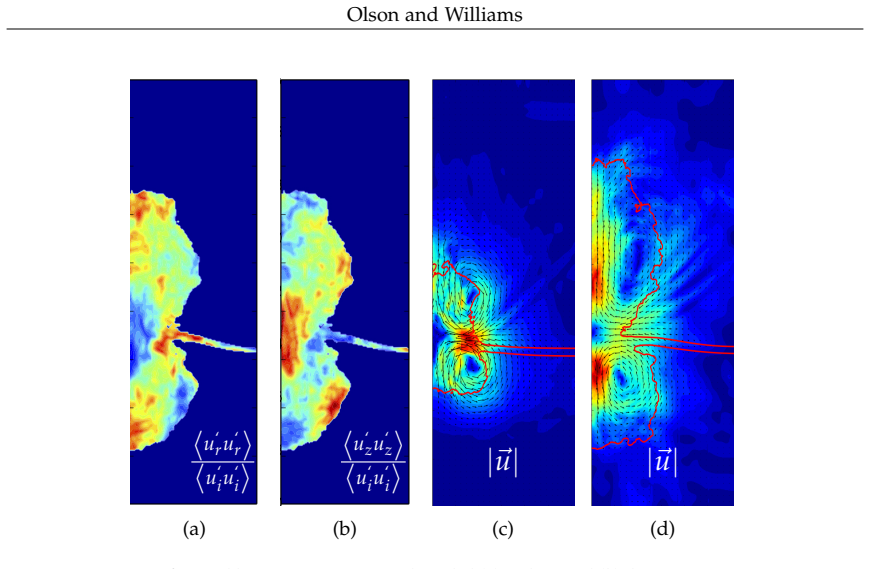
The mechanism is carried by the boundary vortex pair, two counter-rotating coherent vortices that form at the lateral edge of the perturbation patch and persist through late time. The patch is created by a mask function $w(y,z)=\frac12(1-\tanh((r-r_0)/\delta_w))$, with $r$ measuring distance from the patch center line or center point; the mask confines the interface perturbation $S(y,z)$ to a strip or a disk and gives that region a sharp edge. Once the instability transitions to turbulence, the edge generates a large-scale mean circulation, and the mean velocity field shows that this vortex pair is what entrains pure fluid into the mixing packets along the interface and suppresses lateral spreading. The statistical picture is obtained by planar averaging over two symmetric patch shapes, which turns the three-dimensional flow into a two-dimensional mean flow in which the vortex pair is visible.
What would settle it
A shock-tube experiment with a localized patch of initial roughness, fielded with particle-image velocimetry across the patch edge, would settle the claim: if no persistent counter-rotating vortex pair appears and the mixing width grows at a rate comparable to the height, the mechanism is wrong. In computation, a finite-Reynolds-number LES or a longer run beyond $\tau=6$ that shows relaxation to self-similar lateral spreading would likewise refute the claim of persistent suppression.
Extended reading notes
Core claim
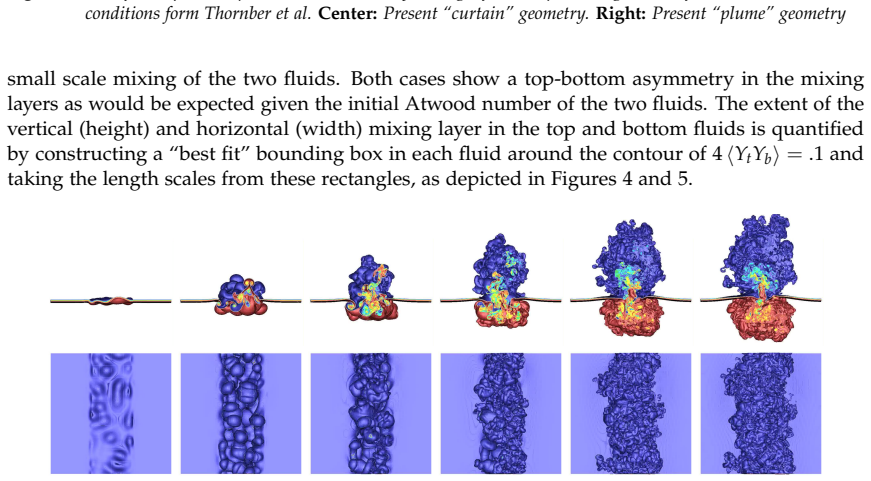
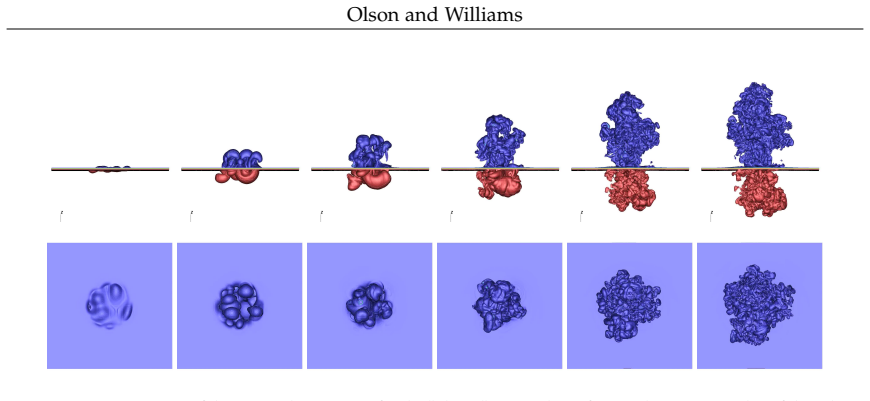
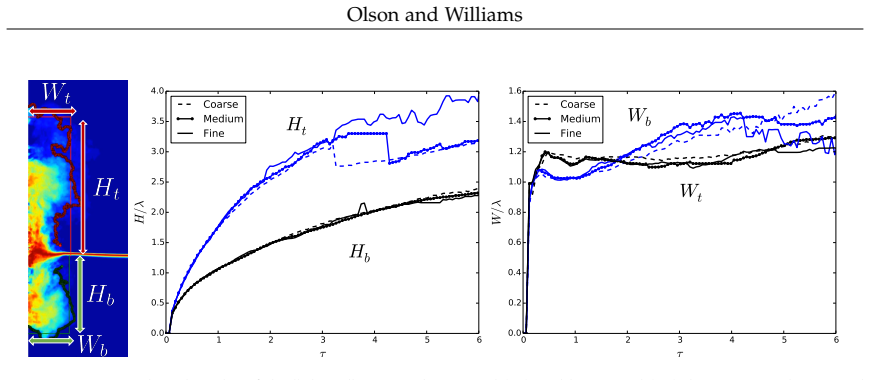
The paper's central claim is that the growth of a Richtmyer–Meshkov mixing layer from spatially localized perturbations has a different mechanism from the classic case of uniform perturbations. In both the 'curtain' (strip) and 'plume' (disk) configurations, coherent packets of mixed fluid detach from the surface, and entrainment into them is supplied by a laminar inflow from the surrounding smooth regions. That inflow is organized by a pair of counter-rotating vortices that appears at the boundary of the initial perturbation patch during transition and survives to the end of the calculation at $\tau = 6$. The vertical mixing heights continue to grow, but the lateral width grows very little, giving a mixing layer with a growing aspect ratio and persistent anisotropy of the Reynolds stresses. The authors further report that this mean-flow vortex pair is absent in preliminary RANS calculations, which consequently under-predict the vertical length scale and over-predict the horizontal one by about a factor of two.
Load-bearing premise
The simulations assume an infinite-Reynolds-number fluid with no viscosity, conductivity, or diffusivity; if a real fluid's molecular transport damps the boundary vortex pair, the predicted suppression of lateral spreading could weaken or disappear.
Editorial extensions
If this is right
- The vertical height of the localized mixing layer follows the usual power-law growth of uniform RM mixing, but the lateral width remains almost constant, so the layer's aspect ratio increases with time rather than relaxing to homogeneity.
- The vortex pair that appears during transition persists to late time and is the dominant entrainment mechanism; turbulent fluctuations modulate, but do not erase, this large-scale mean circulation.
- Because the mean flow is genuinely two-dimensional, a RANS closure that models only turbulent transport and does not resolve the vortex pair mispredicts the mixing layer: under-predicting vertical growth and over-predicting horizontal growth by about a factor of two.
- The same mechanism should appear for any isolated roughness feature on an inertial-confinement-fusion capsule, so defect-driven mixing plumes cannot be represented by a model calibrated on statistically uniform interfaces.
Reading between the lines
- The ratio of the patch boundary length to its area likely controls the entrainment rate: if the vortex pair is generated at the edge, a fixed-area patch with a longer perimeter should entrain fluid faster, a testable prediction the paper does not make.
- The authors state that self-similarity has not been reached by $\tau=6$; if a longer calculation eventually shows the vortex pair decaying and lateral growth resuming, the proposed 'persistent' suppression would have a finite lifetime set by the patch size and the circulation of the pair.
- The vortex-pair mechanism resembles the starting vortex of a finite-span body: the edges of a localized perturbed region inject net circulation into the mean flow, so an initially localized mixing patch behaves more like a coherent jet or plume than like a slice of homogeneous turbulence.
- For engineering models, the practical consequence is that a mean-flow-aware treatment may be required rather than tuning the turbulent diffusivity, because the missing object is the coherent vortex pair itself.
Signed reviews
Editorial analysis
A structured set of objections, weighed in public.
Referee Report
Summary. The manuscript studies Richtmyer-Meshkov mixing from spatially localized initial perturbations, motivated by manufactured features in inertial confinement fusion capsules. Two configurations are considered: a strip-like "curtain" and a circular "plume" patch, obtained by applying a smooth mask to the narrowband multimode initial conditions of the Thornber et al. collaboration. Implicit LES calculations at three resolutions are run to nondimensional time τ = 6. The paper reports that the vertical mixing height grows quasi-power-law while the lateral width grows very little, producing a mixing layer with a growing aspect ratio. The authors interpret two-dimensional averages of the perturbed flow as showing a persistent vortex pair at the patch boundary that entrains pure fluid and suppresses lateral spreading. They claim this indicates that localized RM mixing is governed by a mechanism distinct from the homogeneous-multimode case, and they note that preliminary RANS calculations fail to reproduce the two-dimensional mean flow.
Significance. If the central claim is robust, the paper identifies a genuinely different mixing mechanism relevant to ICF applications and to engineering RANS closure: the mean flow itself is multidimensional, and entrainment is controlled by coherent vortex pairs rather than by the usual self-similar turbulent mixing layer dynamics. The study has clear strengths: it builds on well-established initial conditions, performs a three-resolution study with mixing-height scatter below 3% for τ < 3, examines two distinct patch geometries, and reports quantitative bounding-box metrics in addition to qualitative visualizations. The main significance, however, is conditional on the robustness of the vortex-pair mechanism to the random-phase realization and on a quantitative demonstration that the vortex pair actually controls the lateral spreading. As presented, the evidence is visual and single-realization, so the claimed generality to ICF-like perturbations is not yet established.
major comments (3)
- [Section IV, Eq. (2), Fig. 6] The central mechanistic claim rests on a single random-phase realization per geometry. The two symmetric masks provide an azimuthal or spanwise average within that one realization but do not provide an ensemble over independent realizations of S(y,z). Since the patch radius r0 = 2π/6 is not very much larger than the perturbation length scale and the domain is finite, the persistent vortex pair visible in Fig. 6(c,d) could be a realization-dependent feature, such as a net dipole moment from the particular random phases, rather than a generic edge effect. Without at least one additional phase realization or an explicit convergence test of the mean-flow structure, the abstract's claim that localized RM growth has "a rather different mechanism" is not supported.
- [Section IV, Fig. 6] The causal link between the vortex pair and the suppressed lateral spreading is asserted from visual correspondence rather than quantified. The manuscript provides no measurement of the vortex pair's circulation, no entrainment flux across the mixing-layer boundary, and no diagnostic connecting the vortex strength to the time evolution of the lateral mixing width W. Since the growing aspect ratio is the key observable supporting the mechanism claim, a quantitative measure of entrainment or circulation is needed to distinguish the proposed mechanism from other possible explanations.
- [Section V] The RANS comparison is not independently checkable. The text states that preliminary K-L RANS studies fail to capture the two-dimensional mean flow and under-predict and over-predict the vertical and horizontal mixing scales "by a factor of two," but no model configuration, equations, or results are shown. Because the abstract and conclusions use this comparison to support the claim that existing engineering models may be challenged, the supporting data should be included or the claim should be explicitly marked as a qualitative expectation rather than a demonstrated result.
minor comments (5)
- [Section IV, Fig. 6] The sentence "Figure 6(c) and 6(b) show contours of the mean velocity magnitude with velocity vectors and the mixing layer edge drawn in black and red, respectively" appears to mis-reference the panels; the corresponding contours are in panels (c) and (d).
- [Section IV] The description of the averaging operation as "xr-planar averages via a binning operation" is unclear; please specify the exact averaging coordinates for the curtain and plume cases.
- [Section IV] There is a typographical error in the phrase "a vortex pair which which forms early on."
- [Reference [1]] The Richtmyer reference should be Commun. Pure Appl. Math. 13, 297-319 (1960).
- [Section IV] The notation "τ = ˙W/λ0t" should be parenthesized as τ = ( ˙W/λ0 ) t to avoid ambiguity.
Circularity Check
No significant circularity: the vortex-pair mechanism is a simulation outcome, not a refit or a self-cited premise.
full rationale
The paper makes no fitted-input-as-prediction move: no parameter is calibrated to the data used to infer the vortex-pair entrainment mechanism. The initial perturbation field S(y,z) is taken from the prior Thornber et al. collaboration, and the new mask w(y,z) is prescribed, but the central claim—that localized perturbations grow with a persistent vortex pair at the patch boundary and suppressed lateral spreading—is read from the LES output rather than defined by those inputs. The self-citations to [6] (Ares numerics) and [8] (initial conditions) are not load-bearing for the new mechanism: neither prior reference contains the localized-patch result. The causal statement that entrainment is 'controlled by the propagation of vortex pairs' is a qualitative inference from mean-flow contours in the same simulation, which is an interpretive step, not an equation-level reduction of a predicted quantity to an input. Concerns about a single random-phase realization, the inviscid idealization, and the withheld preliminary RANS results are legitimate correctness and robustness questions, but they are not circularity: the paper does not assert that the vortex pair follows from the mask by construction, and no resulting quantity is shown to equal a fitted or self-cited value. The derivation chain is therefore self-contained with respect to the circularity criteria.
Assumptions & free parameters
assumptions (3)
- domain assumption The Ares LES solver accurately represents the small-scale turbulence at the given grid resolutions.
- domain assumption The infinite Reynolds number limit, with no physical transport, is appropriate for the late-time mixing dynamics.
- domain assumption The initial perturbation spectrum from Thornber et al. (2017) is a representative baseline for RM mixing layers.
Cite this review
Pith. "Pith review of Richtmyer-Meshkov mixing layer growth from localized perturbations." pith.science (2026). https://pith.science/paper/5PT62LGF
@misc{pith2026190802864,
  author       = {Pith},
  title        = {Pith review of: Richtmyer-Meshkov mixing layer growth from localized perturbations},
  year         = {2026},
  howpublished = {\url{https://pith.science/paper/5PT62LGF}},
  note         = {Machine review of arXiv:1908.02864}
}
read the original abstract
We study the growth of Richtmyer-Meshkov mixing layers from an initial surface with spatially localized perturbations. We use two symmetric forms of the initial patch, which allow simulation data to be averaged to generate a two-dimensional statistical representation of the three dimensional turbulent flow. We find that as the mixing layer grows, the turbulent structures tend to form into discrete packets separated from the surface, with material entrainment into them dominated by a laminar entrainment flow inward from the surrounding regions where the surface was originally smooth. The entrainment appears to be controlled by the propagation of vortex pairs which appear at the boundary of the region of initial perturbations. This suggests that the growth of RM mixing from isolated features, as may be found in manufactured Inertial Confinement Fusion capsules, has a rather different mechanism than the growth of an RM mixing layer when the perturbations are uniform. This may be a challenge for some existing engineering models.
Figures

Figures from the paper (3 more)

Reference graph
Works this paper leans on
-
[1]
Richtmyer (1960) Taylor instability in shock acceleration of compressible fluids Commun
R. Richtmyer (1960) Taylor instability in shock acceleration of compressible fluids Commun. Pure Appl. Math 8, 297-319
work page 1960
-
[2]
Meshkov (1969) Instability of the interface of two gases accelerated by a shock wave
E. Meshkov (1969) Instability of the interface of two gases accelerated by a shock wave. Sov. Fluid Dyn. 4 , 101-108
work page 1969
-
[3]
Zhou (2017) Rayleigh-Taylor and Richtmyer-Meshkov instability induced flow, turbulence, and mixing
Y. Zhou (2017) Rayleigh-Taylor and Richtmyer-Meshkov instability induced flow, turbulence, and mixing. I. Physics Reports 720-722, 1-136
work page 2017
-
[4]
Zhou (2017) Rayleigh-Taylor and Richtmyer-Meshkov instability induced flow, turbulence, and mixing
Y. Zhou (2017) Rayleigh-Taylor and Richtmyer-Meshkov instability induced flow, turbulence, and mixing. II. Physics Reports 723-725, 1-160 5 Olson and Williams ⟨u‘ru‘r⟩ ⟨u‘ iu‘ i⟩ (a) ⟨u‘zu‘z⟩ ⟨u‘ iu‘ i⟩ (b) |⃗u| (c) |⃗u| (d) Figure 6: Contours of Reynolds stress anisotropy in the radial (a) and vertical (b) directions at τ = 6. Anisotropy follows the local...
work page 2017
-
[5]
C. R. Weber, et. al (2017) Improving ICF implosion performance with alternative capsule supports Physics of Plasmas 24, 056302
work page 2017
-
[6]
B. J. Olson and J. A. Greenough (2014) Large eddy simulation requirements for the Richtmyer- Meshkov instability Physics of Fluids 26, 044103
work page 2014
- [7]
-
[8]
B. Thornber, J. Griffond, O. Poujade, N. Attal, H. Varshochi, P . Bigdelou, P . Ramaprabhu, B. Olson, J. Greenough, Y. Zhou, O. Schilling, K. A. Garside, R. J. R. Williams, C. A. Batha, P . A. Kuchugov, M. E. Ladonkina, V . F. Tishkin, N. V . Zmitrenko, V . B. Rozanov, and D. L. Youngs (2017) Late-time growth rate, mixing, and anisotropy in the multimode ...
work page 2017
Show all 9 references
-
[9]
B. E. Morgan and J. A. Greenough (2016) Large-eddy and unsteady RANS simulations of a shock-accelerated heavy gas cylinder Shock Waves 26:355-383 6
2016
Reviewed August 14, 2026 · model on record in the stance chip above.
Discussion (0). Continue with ORCID to comment.