Evolving edge weights via local entropy flow and cohesion flow on graphs
Pith reviewed 2026-06-26 02:54 UTC · model grok-4.3
The pith
Local entropy and cohesion flows evolve edge weights on graphs with global existence and uniqueness of solutions.
A machine-rendered reading of the paper's core claim, the machinery that carries it, and where it could break.
Core claim
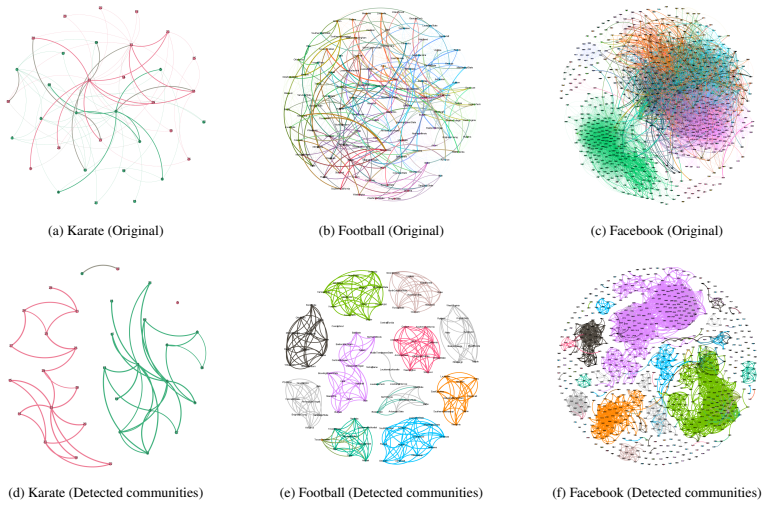
By introducing local entropy and cohesion on graphs, the authors define the local entropy flow and the cohesion flow as evolution equations for edge weights. They establish global existence and uniqueness of solutions for both flows and study their long-term asymptotic behaviors, including the case in which the limit tends to positive infinity. The flows are applied to fundamental network analysis tasks including community detection and node classification, with empirical results competitive with established Ricci flows on graphs.
What carries the argument
The local entropy flow and cohesion flow, which are parabolic-type evolution equations for edge weights driven by the newly defined local entropy and cohesion quantities.
If this is right
- Both flows admit global unique solutions whose asymptotic behavior can be tracked, including divergence to positive infinity.
- Sequential application of the cohesion flow followed by the local entropy flow improves performance on community detection and node classification.
- The resulting weighted graphs achieve accuracy competitive with Ollivier Ricci flow and Lin-Lu-Yau Ricci flow on benchmark tasks.
- The flows are computationally efficient and reduce overall cost relative to the comparison methods.
Where Pith is reading between the lines
- The two flows together may offer a practical discrete substitute for continuous curvature flows when only graph data is available.
- The asymptotic analysis could be used to predict when the evolved weights stabilize into community structure without additional clustering steps.
- Extending the same quantities to directed or weighted multi-graphs might preserve the global existence result.
Load-bearing premise
The local entropy and cohesion quantities are well-defined and sufficiently regular on the graphs so that the resulting flows admit global smooth solutions.
What would settle it
A concrete graph on which either the local entropy flow or the cohesion flow develops a singularity or loses uniqueness in finite time would disprove the global existence and uniqueness claim.
Figures
read the original abstract
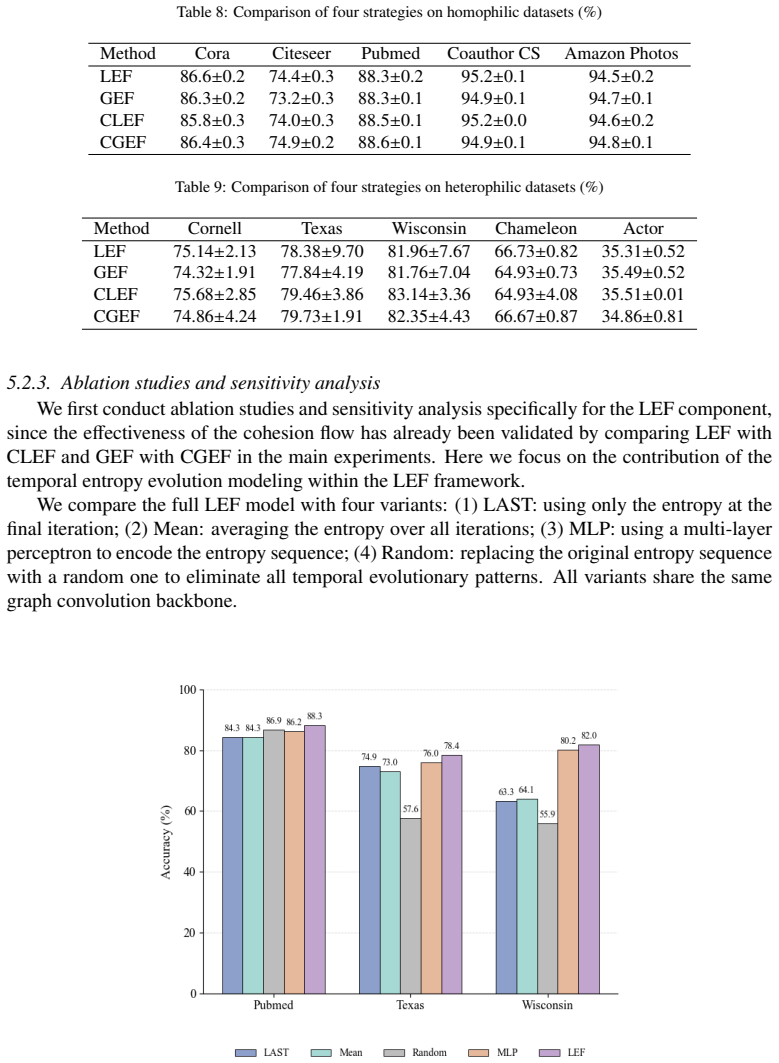
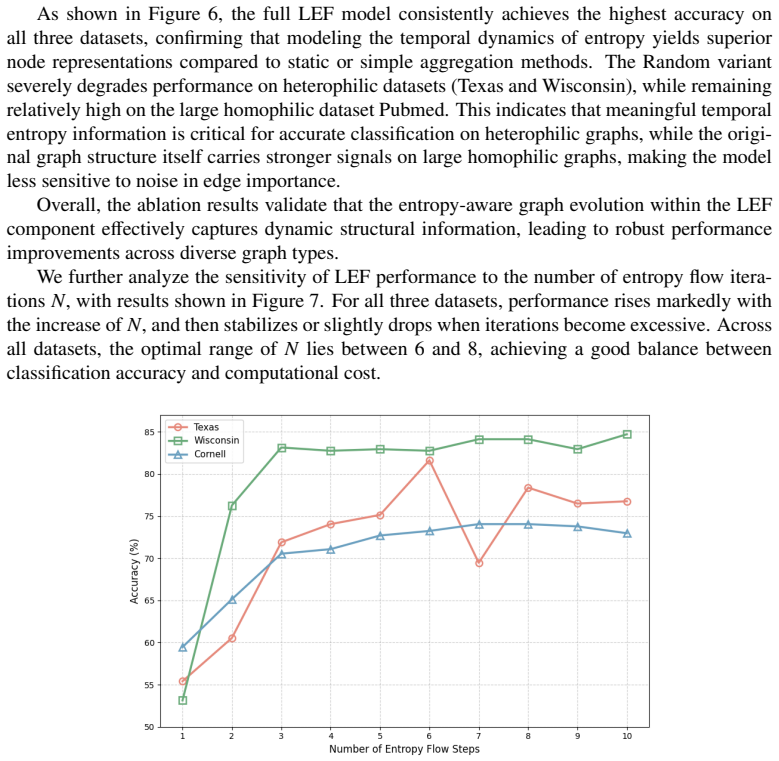
In this paper, we first propose two different quantities on graphs, namely local entropy and cohesion, then design two corresponding flows for edge weights: the local entropy flow and the cohesion flow. We establish the global existence and uniqueness of solutions for both flows and investigate their asymptotic behaviors, including the case that the limit goes to positive infinity. Moreover, they can be applied to fundamental network analysis tasks, including community detection and node classification. Empirical evaluations demonstrate that our method achieves performance competitive with Ollivier Ricci flow and Lin-Lu-Yau Ricci flow on benchmark network analysis tasks. In experimental scenarios, we first apply the cohesion flow to evolve the edge weights of the graph, and then apply the local entropy flow to further update the resulting weighted graph. Both flows are computationally efficient, leading to a significant reduction in overall computational cost and improved scalability.
Editorial analysis
A structured set of objections, weighed in public.
Referee Report
Summary. The manuscript introduces local entropy and cohesion quantities on graphs and the associated local entropy flow and cohesion flow on edge weights. It claims to prove global existence and uniqueness of solutions to both flows, to analyze their long-time asymptotics (including cases where the limit is positive infinity), and to apply the evolved weights to community detection and node classification, reporting performance competitive with Ollivier-Ricci and Lin-Lu-Yau Ricci flows. The method is applied sequentially (cohesion flow followed by local entropy flow) and is asserted to be computationally efficient.
Significance. If the global-existence statements are supported by explicit a priori bounds that rule out finite-time singularities while preserving positivity, the work would supply new, explicitly constructible dynamical systems on weighted graphs with potential advantages in scalability over curvature-based flows. The empirical competitiveness on standard benchmarks would then constitute a concrete, falsifiable contribution to network-analysis methodology.
major comments (2)
- [Abstract] Abstract and the global-existence statements: on a finite graph both flows reduce to autonomous ODE systems on the vector of edge weights. Local existence follows from Picard-Lindelöf, but the claimed global smooth solutions for arbitrary positive initial data require uniform a priori control preventing loss of positivity or ||w(t)|| → ∞ in finite time. The explicit mention of asymptotic regimes “including the case that the limit goes to positive infinity” indicates that unbounded solutions are contemplated; without a maximum principle, Lyapunov functional, or comparison argument that supplies the necessary bounds, the global-existence claim is not secured by standard ODE theory alone.
- [Applications section] The sequential application (cohesion flow followed by local entropy flow) is presented as the practical algorithm, yet the interaction between the two flows and the precise stopping criteria or termination conditions are not shown to preserve the global-existence guarantees established for each flow separately.
minor comments (2)
- Notation for the local entropy and cohesion functionals should be introduced with explicit formulas before the flows are defined; the current presentation leaves their precise dependence on the edge weights and vertex degrees implicit.
- The experimental section should include a brief description of the benchmark graphs, the precise community-detection and node-classification pipelines that use the evolved weights, and the number of independent runs used to report performance statistics.
Simulated Author's Rebuttal
We thank the referee for the thorough review and insightful comments on the global-existence claims and the sequential application of the flows. Below we address each major comment directly, indicating where revisions will be made to strengthen the presentation.
read point-by-point responses
-
Referee: [Abstract] Abstract and the global-existence statements: on a finite graph both flows reduce to autonomous ODE systems on the vector of edge weights. Local existence follows from Picard-Lindelöf, but the claimed global smooth solutions for arbitrary positive initial data require uniform a priori control preventing loss of positivity or ||w(t)|| → ∞ in finite time. The explicit mention of asymptotic regimes “including the case that the limit goes to positive infinity” indicates that unbounded solutions are contemplated; without a maximum principle, Lyapunov functional, or comparison argument that supplies the necessary bounds, the global-existence claim is not secured by standard ODE theory alone.
Authors: We agree that standard ODE theory on finite-dimensional systems requires explicit a priori bounds to guarantee global existence. In the manuscript (Theorems 3.3 and 4.2), global existence is established by exhibiting a strictly decreasing Lyapunov functional for each flow that yields uniform upper and lower bounds on all edge weights for every finite time interval, thereby ruling out both loss of positivity and finite-time blow-up. The asymptotic regimes in which weights tend to +∞ are analyzed only in the long-time limit t o∞; the Lyapunov control prevents any singularity at finite t. We will add a brief paragraph in the abstract and introduction explicitly referencing these Lyapunov estimates to make the argument self-contained. revision: partial
-
Referee: [Applications section] The sequential application (cohesion flow followed by local entropy flow) is presented as the practical algorithm, yet the interaction between the two flows and the precise stopping criteria or termination conditions are not shown to preserve the global-existence guarantees established for each flow separately.
Authors: The referee correctly notes that the composition of the two flows requires justification. Because each flow separately admits a unique global solution for any positive initial data, and because the output of the cohesion flow at any finite time (or at its equilibrium) remains strictly positive, it furnishes admissible initial data for the local-entropy flow; global existence for the second flow then follows directly from the already-proven result. The manuscript currently runs each flow for a fixed, finite number of iterations chosen empirically. We will revise the applications section to state this explicitly, to note that any finite-time truncation preserves positivity, and to add a short remark that the sequential procedure therefore inherits the global-existence guarantees of the individual flows. revision: yes
Circularity Check
No circularity: definitions and existence proofs are independent of the claimed results.
full rationale
The paper introduces local entropy and cohesion as new quantities on graphs, defines the corresponding parabolic flows on edge weights, and states that global existence/uniqueness and asymptotics are established by mathematical analysis. No equations or steps reduce a claimed prediction or uniqueness result to a fitted parameter or self-citation by construction. Empirical comparisons to Ollivier and Lin-Lu-Yau flows are external benchmarks. The derivation chain is self-contained against standard ODE/PDE theory on finite graphs and does not rely on renaming known results or smuggling ansatzes via self-citation.
Axiom & Free-Parameter Ledger
Reference graph
Works this paper leans on
-
[1]
U. Alon, E. Yahav, On the bottleneck of graph neural networks and its practical implica- tions, in: International Conference on Learning Representations, 2021
2021
-
[2]
Anand, G
K. Anand, G. Bianconi, Entropy measures for networks: Toward an information theory of complex topologies, Phys. Rev. E 80 (4) (2009) 045102
2009
-
[3]
S. Bai, B. Hua, Y . Lin, S. Liu, On the Ricci flow on trees, arXiv: 2509.22140, 2025
arXiv 2025
-
[4]
S. Bai, A. Huang, L. Lu, S. T. Yau, On the sum of Ricci-curvatures for weighted graphs, Pure Appl. Math. Q. 17 (2021) 1599-1617
2021
-
[5]
S. Bai, R. Li, S. Liu, X. Lai, Ricci flow on weighted digraphs with balancing factor, arXiv:2509.19989, 2025
arXiv 2025
-
[6]
S. Bai, Y . Lin, L. Lu, Z. Wang, S. Yau, Ollivier Ricci-flow on weighted graphs, Amer. J. Math. 146 (2024) 1723-1747
2024
-
[7]
S. Bai, S. Liu, X. Lai, The weighted Forman and Lin-Lu-Yau Ricci flow on graphs, arXiv:2601.02673, 2026
arXiv 2026
-
[8]
Bauer, J
F. Bauer, J. Jost, S. P. Liu, Ollivier-Ricci curvature and the spectrum of the normalized graph Laplace operator. Math. Res. Lett. 19 (2012) 1185-1205
2012
-
[9]
Bhowmick, B
S. Bhowmick, B. Seah, Clustering and summarizing protein-protein interaction networks: a survey, IEEE Trans. Knowl. Data Eng. 28 (2015) 638-658
2015
-
[10]
Chien, J
E. Chien, J. Peng, P. Li, O. Milenkovic, Adaptive universal generalized pagerank graph neural network, in: Int. Conf. Learning Representations (ICLR), 2021
2021
-
[11]
B. Chow, F. Luo, Combinatorial Ricci flows on surfaces, J. Differential Geometry 63 (2008) 97-129
2008
-
[12]
Clauset, M
A. Clauset, M. Newman, C. Moore, Finding community structure in very large networks, Phys. Rev. E 70 (2004) 066111. 26
2004
-
[13]
Cordasco, L
G. Cordasco, L. Gargano, Community detection via semi-synchronous label propagation algorithms, 2010 IEEE International Workshop on: Business Applications of Social Net- work Analysis (BASNA), 1-8
2010
-
[14]
T. M. Cover, J. A. Thomas, Elements of Information Theory, Wiley, 2nd edn., 2005
2005
-
[15]
Craven, D
M. Craven, D. DiPasquo, D. Freitag, A. McCallum, T. Mitchell, K. Nigam, S. Slattery, Learning to extract symbolic knowledge from the World Wide Web, in: Proceedings of the Fifteenth National/Tenth Conference on Artificial Intelligence/Innovative Applications of Artificial Intelligence, AAAI’98/IAAI’98, pp. 509-516, 1998
1998
-
[16]
Danon, A
L. Danon, A. Díaz-Guilera, J. Duch, A. Arenas, Comparing community structure identifi- cation, J. Stat. Mech. Theory Exp. (2005) P09008
2005
-
[17]
Dehmer, Information processing in complex networks: Graph entropy and information functionals, Appl
M. Dehmer, Information processing in complex networks: Graph entropy and information functionals, Appl. Math. Comput. 201 (2012) 82-94
2012
-
[18]
Fortunato, Community detection in graphs, Phys
S. Fortunato, Community detection in graphs, Phys. Rep. 486 (2010) 75-174
2010
-
[19]
Gasteiger, A
J. Gasteiger, A. Bojchevski, S. Günnemann, Predict then propagate: Graph neural networks meet personalized PageRank, in: Int. Conf. Learning Representations (ICLR), 2019
2019
-
[20]
Gasteiger, S
J. Gasteiger, S. Weißenberger, S. Günnemann, Diffusion improves graph learning, in: Pro- ceedings of the 33rd International Conference on Neural Information Processing Systems, pp. 13366-13378, Red Hook, NY , USA, 2019
2019
-
[21]
Girvan, M
M. Girvan, M. E. J. Newman, Community structure in social and biological networks, Proc. Natl. Acad. Sci. 99 (2002) 7821-7826
2002
-
[22]
Hamilton, Three-manifolds with positive ricci curvature, J
R. Hamilton, Three-manifolds with positive ricci curvature, J. Differ. Geom. 17 (1982) 255-306
1982
-
[23]
W. L. Hamilton, R. Ying, J. Leskovec, Inductive representation learning on large graphs, in: Proc. 31st Int. Conf. Neural Inf. Process. Syst. (NeurIPS), pp. 1025-1035, 2017
2017
-
[24]
Hubert, P
L. Hubert, P. Arabie, Comparing partitions, J. Classif. 2 (1985) 193-218
1985
-
[25]
Jeffreys, Theory of Probability, Oxford University Press, 1998
H. Jeffreys, Theory of Probability, Oxford University Press, 1998
1998
-
[26]
J. Jost, S. P. Liu, Ollivier’s Ricci Curvature, Local Clustering and Curvature-Dimension Inequalities on Graphs. Discrete Comput. Geom. 51 (2014) 300-322
2014
-
[27]
T. N. Kipf, M. Welling, Semi-supervised classification with graph convolutional networks, in: Int. Conf. Learning Representations (ICLR), 2017
2017
-
[28]
Kullback, R
S. Kullback, R. A. Leibler, On information and sufficiency, Ann. Math. Statist. 22 (1951) 79-86
1951
-
[29]
X. Lai, S. Bai, Y . Lin, Normalized discrete Ricci flow used in community detection, Phys. A 597 (2022) 127251
2022
-
[30]
Leskovec, SNAP datasets: Stanford large network dataset collection,http://snap
J. Leskovec, SNAP datasets: Stanford large network dataset collection,http://snap. stanford.edu/data, 2014
2014
-
[31]
R. Li, F. Münch, The convergence and uniqueness of a discrete-time nonlinear Markov chain, J. Funct. Anal. 290 (2026) 111367
2026
-
[32]
Y . Lin, S. Liu, The Ricci flow with prescribed curvature on graphs, arXiv:2603.10479, 2026
Pith/arXiv arXiv 2026
-
[33]
Y . Lin, L. Lu, S. T. Yau, Ricci curvature of graphs, Tohoku Math. J. 63 (2011) 605-627
2011
-
[34]
J. Ma, Y . Yang, A modified Ricci flow on arbitrary weighted graph, J. Geom. Anal. 35 (2025) 332
2025
-
[35]
J. Ma, Y . Yang, Evolution of weights on a connected finite graph, arXiv:2411.06393, 2024
arXiv 2024
-
[36]
J. Ma, Y . Yang, Piecewise-linear Ricci curvature flows on weighted graphs, arXiv:2505.15395, 2025
arXiv 2025
-
[37]
J. Ma, Y . Yang, J. Zhao, L. Zhao, Geometric evolution graph convolutional networks: En- 27 hancing graph representation learning via Ricci flow, arXiv:2603.26178, 2026
Pith/arXiv arXiv 2026
-
[38]
McAuley, C
J. McAuley, C. Targett, Q. Shi, A. van den Hengel, Image-based recommendations on styles and substitutes, in: Proceedings of the 38th International ACM SIGIR Conference on Research and Development in Information Retrieval, SIGIR’15, pp. 43-52, 2015
2015
-
[39]
Monti, D
F. Monti, D. Boscaini, J. Masci, E. Rodola, J. Svoboda, M.M. Bronstein, Geometric deep learning on graphs and manifolds using mixture model CNNs, in: Proc. IEEE Conf. Com- put. Vis. Pattern Recognit. (CVPR), pp. 5115-5124, 2017
2017
-
[40]
Newman, Modularity and community structure in networks, Proc
M. Newman, Modularity and community structure in networks, Proc. Natl. Acad. Sci. 103 (2006) 8577-8582
2006
-
[41]
Newman,Networks, Oxford Univ
M. Newman,Networks, Oxford Univ. Press (2018)
2018
-
[42]
C. C. Ni, Y . Y . Lin, F. Luo, J. Gao, Community detection on networks with Ricci flow, Sci. Rep. 9 (2019) 9984
2019
-
[43]
Ollivier, Ricci curvature of metric spaces, C
Y . Ollivier, Ricci curvature of metric spaces, C. R. Math. 345 (2007) 643-646
2007
-
[44]
Ollivier, Ricci curvature of markov chains on metric spaces, J
Y . Ollivier, Ricci curvature of markov chains on metric spaces, J. Funct. Anal. 256 (2009) 810-864
2009
-
[45]
Perelman, The entropy formula for the Ricci flow and its geometric applications, arXiv:0211159, 2002
G. Perelman, The entropy formula for the Ricci flow and its geometric applications, arXiv:0211159, 2002
2002
-
[46]
Reichardt, S
J. Reichardt, S. Bornholdt, Statistical mechanics of community detection, Phys. Rev. E 74 (2006) 016110
2006
-
[47]
Rozemberczki, C
B. Rozemberczki, C. Allen, R. Sarkar, Multi-scale attributed node embedding, J. Complex Networks 9(2) (2021) cnab014
2021
-
[48]
P. Sen, G. Namata, M. Bilgic, L. Getoor, B. Gallagher, T. Eliassi-Rad, Collective classifi- cation in network data, AI Magazine, 29(3) (2008) 93-106
2008
-
[49]
Sengupta, N
P. Sengupta, N. Azarhooshang, R. Albert, B. DaGupta, Finding influential cores via nor- malized Ricci flows in directed and undirected hypergraphs with applications, Phys. Rev. E 111 (2025) 044316
2025
-
[50]
C. E. Shannon, A mathematical theory of communication, Bell System Tech. J. 27 (1948) 379-423
1948
-
[51]
D. Shi, Y . Guo, Z. Shao, J. Gao, How curvature enhances the adaptation power of framelet GCNs, arXiv:2307.09768, 2023
arXiv 2023
-
[52]
J. Tang, J. Sun, C. Wang, Z. Yang, Social influence analysis in large-scale networks, in: Proc. 15th ACM SIGKDD Int. Conf. Knowledge Discovery and Data Mining (KDD’09), New York, NY , USA, 2009, pp. 807-816
2009
-
[53]
Tauro, C
S. Tauro, C. Palmer, G. Siganos, M. Faloutsos, A simple conceptual model for the internet topology, GLOBE COM’01 IEEE Global Telecommun. Conf. 3 (2001) 1667-1671
2001
-
[54]
Y . Tian, J. Ma, Y . Yang, L. Zhao, Community detection of undirected hypergraphs by Ricci flow, Phys. Rev. E 112 (2025) 044311
2025
-
[55]
Topping, F
J. Topping, F. DiGiovanni, B. P. Chamberlain, X. Dong, M. M. Bronstein, Understanding over-squashing and bottlenecks on graphs, in: Int. Conf. Learning Representations (ICLR), 2022
2022
-
[56]
Veli ˇckovi´c, G
P. Veli ˇckovi´c, G. Cucurull, A. Casanova, A. Romero, P. Liò, Y . Bengio, Graph attention networks, in: Int. Conf. Learning Representations (ICLR), 2018
2018
-
[57]
Weber, J
M. Weber, J. Jost, E. Saucan, Forman-Ricci flow for change detection in large dynamic data sets, Axioms 5 (2016) 26
2016
-
[58]
Weber, E
M. Weber, E. Saucan, J. Jost, Characterizing complex networks with Forman-Ricci curva- ture and associated geometric flows, J. Complex Networks 5 (2017) 527-550
2017
-
[59]
K. Xu, C. Li, Y . Tian, T. Sonobe, K. Kawarabayashi, S. Jegelka, Representation learning on 28 graphs with jumping knowledge networks, in: Proc. Int. Conf. Machine Learning (ICML), PMLR, pp. 5453-5462, 2018
2018
-
[60]
Z. Ye, K. S. Liu, T. Ma, J. Gao, C. Chen, Curvature graph network, in: Int. Conf. Learn. Represent. (ICLR), 2020
2020
-
[61]
Zachary, An information flow model for conflict and fission in small groups, J
W. Zachary, An information flow model for conflict and fission in small groups, J. Anthro- pol. Res. 33 (1977) 452-473
1977
-
[62]
Zheng, B
X. Zheng, B. Zhou, J. Gao, Y . Wang, P. Lió, M. Li, G. Montufar, How framelets enhance graph neural networks, in: Int. Conf. Mach. Learn. (ICML), PMLR, pp. 12761-12771, 2021
2021
-
[63]
J. Zhao, J. Ma, Y . Yang, L. Zhao, Core detection via Ricci curvature flows on weighted graphs, Physica A 692 (2026) 131525
2026
-
[64]
J. Zhao, J. Ma, Y . Yang, L. Zhao, Finding core subgraphs of directed graphs via discrete Ricci curvature flow, arXiv:2512.07899, 2025
arXiv 2025
-
[65]
J. Zhao, J. Ma, Y . Yang, L. Zhao, An efficient entropy flow on weighted graphs: theory and applications, arXiv:2604.08144, 2026. 29
Pith/arXiv arXiv 2026
discussion (0)
Sign in with ORCID, Apple, or X to comment. Anyone can read and Pith papers without signing in.