Observation of enhanced optical spin Hall effect in a vertical hyperbolic metamaterial
Pith reviewed 2026-05-25 16:39 UTC · model grok-4.3
The pith
A vertical hyperbolic metamaterial produces optical spin Hall shifts thousands of times larger than its horizontal counterpart under identical conditions.
A machine-rendered reading of the paper's core claim, the machinery that carries it, and where it could break.
Core claim
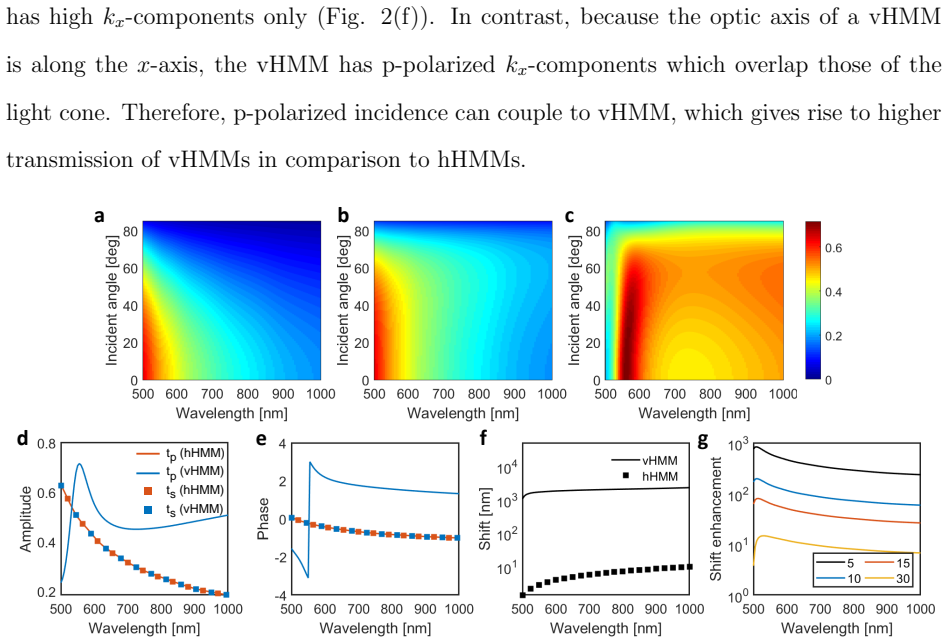
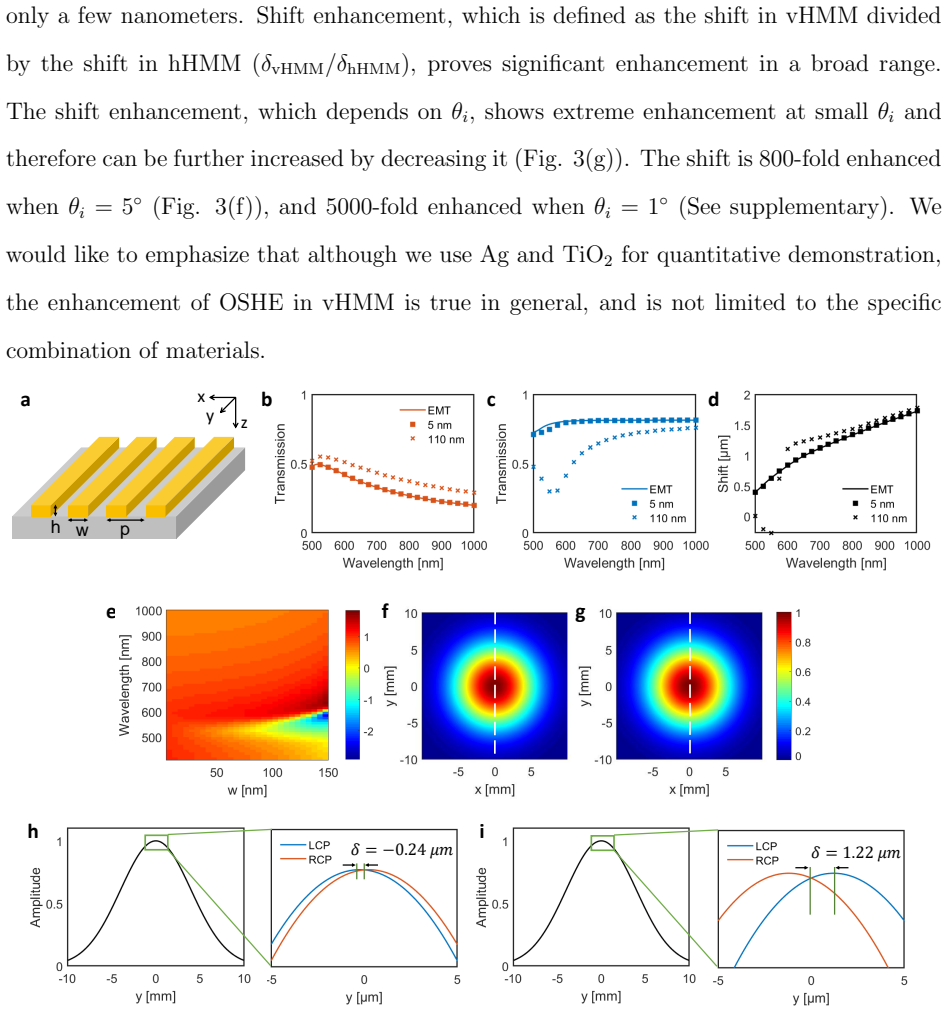
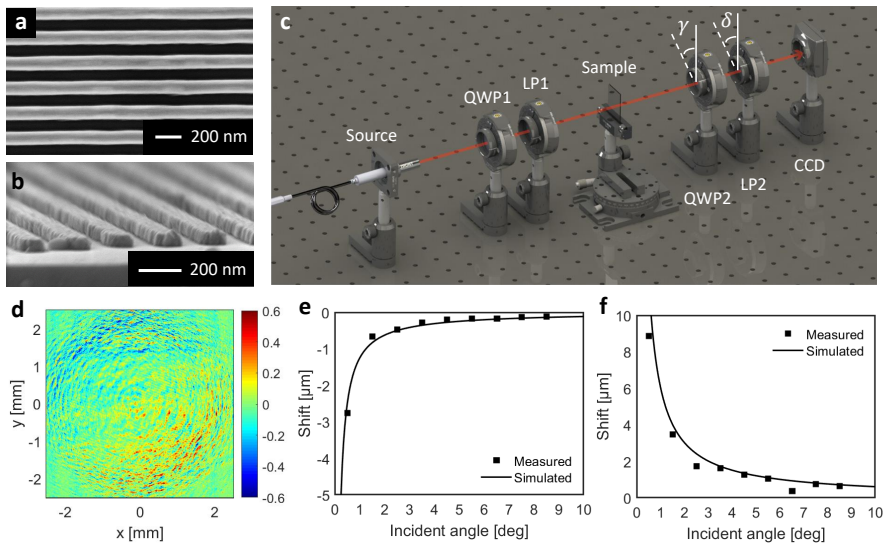
Under the same material combinations and total thickness, the vertical hyperbolic metamaterial enhances the optical spin Hall effect shift by more than 800-fold at 5 degree incidence and 5000-fold at 1 degree incidence relative to the horizontal multilayer, with experimental confirmation on a fabricated gold nano-grating matching the simulations.
What carries the argument
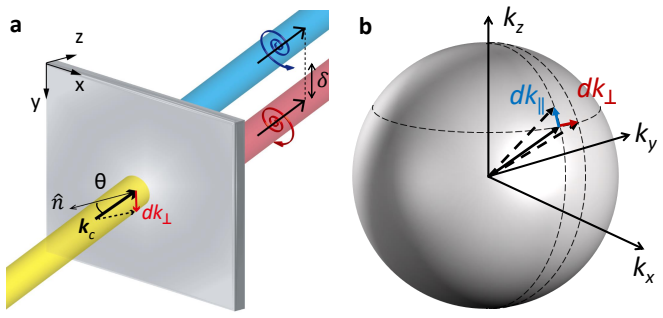
The vertical nano-grating geometry that preserves the hyperbolic dispersion relation while permitting large transverse wavevector components.
If this is right
- Helicity-dependent beam control becomes feasible in filters, sensors, switches, and beam splitters without the transmission penalty of thick horizontal stacks.
- The same total thickness and materials can now be used for devices that require both large shift and usable output intensity.
- Large-area fabrication via nanoimprint lithography is compatible with the vertical geometry, supporting scalable production.
Where Pith is reading between the lines
- The approach may extend to other wave phenomena in hyperbolic media that benefit from access to high transverse wavevectors.
- Combining the grating with tunable or active layers could produce electrically switchable versions of the enhanced shift.
- At incidence angles below 1 degree, further scaling of the enhancement might appear, provided beam quality and alignment limits are managed.
Load-bearing premise
The vertical nano-grating preserves the hyperbolic dispersion of the horizontal multilayer while allowing the large transverse wavevector components needed for the enhanced shift.
What would settle it
A direct side-by-side measurement showing the helicity-dependent shift in the vertical grating is not at least several hundred times larger than in an equivalent-thickness horizontal stack at the same small angle would falsify the enhancement claim.
Figures
read the original abstract
Hyperbolic metamaterials, horizontally stacked metal and dielectric multilayer, have recently been studied as a platform to observe optical spin Hall effect. However, the large optical spin Hall effect in the horizontal hyperbolic metamaterials accompanies extremely low transmission, which obstructs its practical applications. Reducing the sample thickness to augment the transmission causes diminishment of the shift. In this letter, we demonstrate that a vertical hyperbolic metamaterial can enhance the shift by several orders of magnitude in comparison to the shift of its horizontal counterpart. Under the same conditions of material combinations and total thickness, the shift enhancement, which is incident angle-dependent, can be higher than 800-fold when the incident angle is 5 degree, and 5000-fold when the incident angle is 1 degree. As a proof of concept, we fabricate a large-scale gold nano-grating by nanoimprint lithography and measure the helicity-dependent shift by Stokes polarimetry setup, which agrees well with the simulated result. The gigantic optical spin Hall effect in a vertical hyperbolic metamaterial will enable helicity-dependent control of optical devices including filters, sensors, switches and beam splitters.
Editorial analysis
A structured set of objections, weighed in public.
Referee Report
Summary. The paper claims that a vertical hyperbolic metamaterial realized as a gold nano-grating enhances the optical spin Hall effect transverse shift by >800-fold at 5° incidence and >5000-fold at 1° incidence relative to a horizontal multilayer of identical total thickness and material fill fraction. The enhancement is angle-dependent, arises from the same material stack, and is supported by numerical simulations together with experimental Stokes polarimetry on a nanoimprint-fabricated sample that shows agreement with the simulated result. The work addresses the low-transmission limitation of conventional horizontal HMMs while preserving large shifts.
Significance. If the reported enhancement is not an artifact of mismatched dispersion relations between the two geometries, the result would provide a practical route to helicity-dependent beam control with usable transmission. The experimental demonstration on a large-area fabricated sample and the direct comparison under fixed material parameters are strengths that could be cited if the central mechanism is confirmed.
major comments (2)
- [Abstract / geometry comparison] Abstract and the geometry-comparison section: the headline enhancement factors (800-fold at 5°, 5000-fold at 1°) are obtained by subtracting the transverse shift computed for the vertical grating from that computed for the horizontal multilayer under identical total thickness and fill fraction. This comparison presupposes that the effective permittivity tensor (and therefore the isofrequency contour that determines dφ/dk_y) remains unchanged when the multilayer is rotated from horizontal to vertical. The vertical nano-grating periodicity introduces additional Bragg scattering for TM modes; no explicit check is shown that the phase gradient remains identical at the small angles where the fold-increase is largest.
- [Experimental section / simulation method] The experimental validation uses Stokes polarimetry on the fabricated vertical grating and reports agreement with simulation, but the simulation method for the vertical case (full-wave vs. effective-medium) is not stated in sufficient detail to confirm that the same dispersion relation used for the horizontal reference is recovered. If the vertical simulation already incorporates the grating-induced modification, the enhancement claim must be re-derived with a consistent dispersion model for both geometries.
minor comments (2)
- [Abstract] The abstract states that the enhancement 'can be higher than 800-fold' and '5000-fold'; the precise definition of the reference shift (horizontal multilayer at the same angle and polarization) should be repeated in the main text with an equation or table entry.
- [Figures] Figure captions and axis labels for the Stokes-parameter maps should explicitly note the incident angle and wavelength used for the 800× and 5000× cases.
Simulated Author's Rebuttal
We thank the referee for the detailed review and valuable comments on our work. We address each major comment below and will revise the manuscript accordingly to provide the requested clarifications and verifications.
read point-by-point responses
-
Referee: [Abstract / geometry comparison] Abstract and the geometry-comparison section: the headline enhancement factors (800-fold at 5°, 5000-fold at 1°) are obtained by subtracting the transverse shift computed for the vertical grating from that computed for the horizontal multilayer under identical total thickness and fill fraction. This comparison presupposes that the effective permittivity tensor (and therefore the isofrequency contour that determines dφ/dk_y) remains unchanged when the multilayer is rotated from horizontal to vertical. The vertical nano-grating periodicity introduces additional Bragg scattering for TM modes; no explicit check is shown that the phase gradient remains identical at the small angles where the fold-increase is largest.
Authors: The headline enhancement is calculated under the effective medium approximation using the same permittivity tensor for both geometries, which is valid when the grating period is subwavelength. This isolates the effect of the hyperbolic dispersion orientation. We will include in the revision an explicit comparison of the phase gradient dφ/dk_y obtained from effective-medium theory and from full-wave simulations of the vertical structure at small angles to confirm the approximation holds. revision: yes
-
Referee: [Experimental section / simulation method] The experimental validation uses Stokes polarimetry on the fabricated vertical grating and reports agreement with simulation, but the simulation method for the vertical case (full-wave vs. effective-medium) is not stated in sufficient detail to confirm that the same dispersion relation used for the horizontal reference is recovered. If the vertical simulation already incorporates the grating-induced modification, the enhancement claim must be re-derived with a consistent dispersion model for both geometries.
Authors: The enhancement comparison employs the effective-medium model consistently for both vertical and horizontal configurations to maintain identical dispersion relations. Full-wave simulations are employed solely for modeling the actual fabricated sample and matching the experimental Stokes measurements. We will revise the text to clearly specify the methods used for each part of the study and add a note confirming consistency of the dispersion at the angles of interest. revision: yes
Circularity Check
No significant circularity; enhancement claim rests on simulation and measurement comparison rather than definitional reduction.
full rationale
The paper's central result is an observed and simulated enhancement of the optical spin Hall shift in a vertical nano-grating geometry relative to a horizontal multilayer of identical total thickness and fill fraction. This comparison is performed by direct numerical computation of the transverse shift (via the phase gradient dφ/dk_y) and by Stokes polarimetry measurement; neither quantity is obtained by fitting a parameter to the target data and then relabeling it as a prediction, nor is the enhancement ratio inserted by definition into the governing equations. No self-citation chain is invoked to establish uniqueness of the effective-medium tensor or to forbid alternative dispersion models. The derivation therefore remains self-contained against external benchmarks (full-wave simulation and experiment) and does not reduce to its inputs by construction.
Axiom & Free-Parameter Ledger
axioms (1)
- standard math Maxwell's equations govern the electromagnetic response of the layered structure.
Lean theorems connected to this paper
-
IndisputableMonolith/Cost/FunctionalEquation.leanwashburn_uniqueness_aczel unclear?
unclearRelation between the paper passage and the cited Recognition theorem.
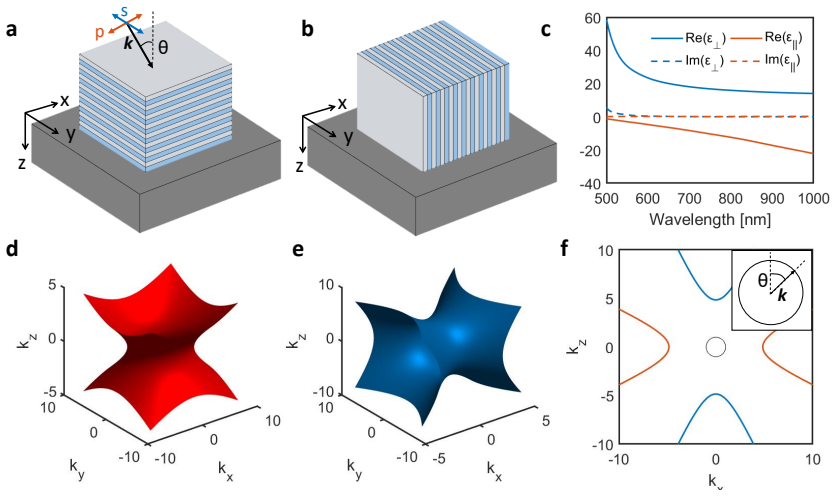
The permittivity of a multilayer-based hyperbolic metamaterial is ε∥=fεm+(1−f)εd, ε⊥=εmεd/((1−f)εm+fεd); εhHMM=diag(ε∥,ε∥,ε⊥), εvHMM=diag(ε⊥,ε∥,ε∥). Shift δ±H=±cotθi/k1 Re(1−ts/tp).
-
IndisputableMonolith/Foundation/AlexanderDuality.leanalexander_duality_circle_linking unclear?
unclearRelation between the paper passage and the cited Recognition theorem.
Equi-frequency contours of hHMM and vHMM at 600 nm; type-II hyperbolic dispersion.
What do these tags mean?
- matches
- The paper's claim is directly supported by a theorem in the formal canon.
- supports
- The theorem supports part of the paper's argument, but the paper may add assumptions or extra steps.
- extends
- The paper goes beyond the formal theorem; the theorem is a base layer rather than the whole result.
- uses
- The paper appears to rely on the theorem as machinery.
- contradicts
- The paper's claim conflicts with a theorem or certificate in the canon.
- unclear
- Pith found a possible connection, but the passage is too broad, indirect, or ambiguous to say the theorem truly supports the claim.
Reference graph
Works this paper leans on
-
[1]
Jacob, Z.; Alekseyev, L. V.; Narimanov, E. Optical Hyperlens: Far-field imaging beyond the diffraction limit. Opt. Express 2006, 14, 8247--8256
work page 2006
-
[2]
Spherical hyperlens for two-dimensional sub-diffractional imaging at visible frequencies
Rho, J.; Ye, Z.; Xiong, Y.; Yin, X.; Liu, Z.; Choi, H.; Bartal, G.; Zhang, X. Spherical hyperlens for two-dimensional sub-diffractional imaging at visible frequencies. Nat. Commun. 2010, 1, 143
work page 2010
-
[3]
D.; Kim, M.; So, S.; Choi, H.-J.; Mun, J.; Nguyen, D
Lee, D.; Kim, Y. D.; Kim, M.; So, S.; Choi, H.-J.; Mun, J.; Nguyen, D. M.; Badloe, T.; Ok, J. G.; Kim, K.; Lee, H.; Rho, J. Realization of Wafer-Scale Hyperlens Device for Sub-diffractional Biomolecular Imaging. ACS Photonics 2018, 5, 2549--2554
work page 2018
-
[4]
Byun, M.; Lee, D.; Kim, M.; Kim, Y.; Kim, K.; Ok, J. G.; Rho, J.; Lee, H. Demonstration of nanoimprinted hyperlens array for high-throughput sub-diffraction imaging. Sci. rep. 2017, 7, 46314
work page 2017
-
[5]
V.; Boltasseva, A.; Narimanov, E
Jacob, Z.; Kim, J.-Y.; Naik, G. V.; Boltasseva, A.; Narimanov, E. E.; Shalaev, V. M. Engineering photonic density of states using metamaterials. Appl. Phys. B 2010, 100, 215--218
work page 2010
-
[6]
Yang, X.; Yao, J.; Rho, J.; Yin, X.; Zhang, X. Experimental realization of three-dimensional indefinite cavities at the nanoscale with anomalous scaling laws. Nat. Photonics 2012, 6, 450
work page 2012
-
[7]
Spin Hall Effect Enhancement of Transmitted Light Through an Anisotropic Metamaterial Slab
Tang, T.; Zhang, Y.; Li, J.; Luo, L. Spin Hall Effect Enhancement of Transmitted Light Through an Anisotropic Metamaterial Slab. IEEE Photon. J. 2017, 9, 1--10
work page 2017
-
[8]
Enhanced spin Hall effect of tunneling light in hyperbolic metamaterial waveguide
Tang, T.; Li, C.; Luo, L. Enhanced spin Hall effect of tunneling light in hyperbolic metamaterial waveguide. Sci. rep. 2016, 6, 30762
work page 2016
-
[9]
Takayama, O.; Sukham, J.; Malureanu, R.; Lavrinenko, A. V.; Puentes, G. Photonic spin Hall effect in hyperbolic metamaterials at visible wavelengths. Opt. Lett. 2018, 43, 4602--4605
work page 2018
-
[10]
Sun, J.; Shalaev, M. I.; Litchinitser, N. M. Experimental demonstration of a non-resonant hyperlens in the visible spectral range. Nat. Commun. 2015, 6, 7201
work page 2015
-
[11]
Onoda, M.; Murakami, S.; Nagaosa, N. Hall Effect of Light. Phys. Rev. Lett. 2004, 93, 083901
work page 2004
-
[12]
Bliokh, K. Y.; Bliokh, Y. P. Conservation of Angular Momentum, Transverse Shift, and Spin Hall Effect in Reflection and Refraction of an Electromagnetic Wave Packet. Phys. Rev. Lett. 2006, 96, 073903
work page 2006
-
[13]
Photonic Spin Hall Effect at Metasurfaces
Yin, X.; Ye, Z.; Rho, J.; Wang, Y.; Zhang, X. Photonic Spin Hall Effect at Metasurfaces. Science 2013, 339, 1405--1407
work page 2013
-
[14]
Bliokh, K. Y.; Aiello, A. Goos Hänchen and Imbert Fedorov beam shifts: an overview. Journal of Optics 2013, 15, 014001
work page 2013
-
[15]
Observation of the Spin Hall Effect of Light via Weak Measurements
Hosten, O.; Kwiat, P. Observation of the Spin Hall Effect of Light via Weak Measurements. Science 2008, 319, 787--790
work page 2008
-
[16]
Experimental observation of the spin Hall effect of light on a nanometal film via weak measurements
Zhou, X.; Xiao, Z.; Luo, H.; Wen, S. Experimental observation of the spin Hall effect of light on a nanometal film via weak measurements. Phys. Rev. A 2012, 85, 043809
work page 2012
-
[17]
Enhanced spin Hall effect of transmitted light through a thin epsilon-near-zero slab
Zhu, W.; She, W. Enhanced spin Hall effect of transmitted light through a thin epsilon-near-zero slab. Opt. Lett. 2015, 40, 2961--2964
work page 2015
-
[18]
Photonic spin Hall effect on the surface of anisotropic two-dimensional atomic crystals
Zhang, W.; Wu, W.; Chen, S.; Zhang, J.; Ling, X.; Shu, W.; Luo, H.; Wen, S. Photonic spin Hall effect on the surface of anisotropic two-dimensional atomic crystals. Photon. Res. 2018, 6, 511--516
work page 2018
-
[19]
Observation of spin Hall effect in photon tunneling via weak measurements
Zhou, X.; Ling, X.; Zhang, Z.; Luo, H.; Wen, S. Observation of spin Hall effect in photon tunneling via weak measurements. Sci. rep. 2014, 4, 7388
work page 2014
-
[20]
Notes on crystal optics of superlattices
Agranovich, V.; Kravtsov, V. Notes on crystal optics of superlattices. Solid State Commun. 1985, 55, 85 -- 90
work page 1985
-
[21]
Fan, X.; Wang, G. P.; Lee, J. C. W.; Chan, C. T. All-Angle Broadband Negative Refraction of Metal Waveguide Arrays in the Visible Range: Theoretical Analysis and Numerical Demonstration. Phys. Rev. Lett. 2006, 97, 073901
work page 2006
-
[22]
Metasurfaces for manipulating surface plasmons
Liu, Y.; Zhang, X. Metasurfaces for manipulating surface plasmons. Appl. Phys. Lett. 2013, 103, 141101
work page 2013
-
[23]
High, A. A.; Devlin, R. C.; Dibos, A.; Polking, M.; Wild, D. S.; Perczel, J.; de Leon, N. P.; Lukin, M. D.; Park, H. Visible-frequency hyperbolic metasurface. Nature 2015, 522, 192
work page 2015
-
[24]
Bliokh, K. Y.; Samlan, C. T.; Prajapati, C.; Puentes, G.; Viswanathan, N. K.; Nori, F. Spin-Hall effect and circular birefringence of a uniaxial crystal plate. Optica 2016, 3, 1039--1047 mcitethebibliography main.tex0000664000000000000000000010202013504311627011221 0ustar rootroot [journal=apchd5,manuscript=letter] achemso [version=3] mhchem * [1] #1 [1] ...
discussion (0)
Sign in with ORCID, Apple, or X to comment. Anyone can read and Pith papers without signing in.