Implementation and Verification of Toroidal Resistive Wall Boundary Conditions in the PIXIE3D MHD code using a Boundary Integral Method
Pith reviewed 2026-06-28 03:13 UTC · model grok-4.3
The pith
The PIXIE3D MHD code implements thin-wall resistive boundary conditions for axisymmetric toroidal geometries via a boundary integral method and verifies second-order accuracy with analytic test cases.
A machine-rendered reading of the paper's core claim, the machinery that carries it, and where it could break.
Core claim
The thin-wall resistive wall boundary conditions, implemented through a boundary integral method in PIXIE3D, achieve second-order accuracy in axisymmetric toroidal geometries, as established by a complete suite of analytic verification examples for both 2D and 3D plasmas, together with extensions that incorporate an exterior perfectly conducting wall and current-carrying coils exterior to the plasma mesh.
What carries the argument
Boundary integral method that solves Laplace's equation for the magnetic scalar potential in the vacuum region, using specialized quadrature rules for singular and hypersingular integrands derived from the Green's function.
If this is right
- The boundary treatment enables accurate modeling of plasma-wall interactions without reducing the overall spatial accuracy of the MHD simulation.
- The same verification suite confirms correctness for both axisymmetric equilibria and non-axisymmetric perturbations in toroidal geometry.
- The outer-wall and coil extensions allow the boundary condition to account for additional conducting structures and external currents without altering the core plasma mesh.
- The implementation supports direct simulation of vertical displacement events in realistic tokamak geometries such as ITER.
Where Pith is reading between the lines
- If the quadrature rules remain stable under mesh refinement, the method could be adapted to non-axisymmetric wall shapes by replacing the toroidal Green's function with a more general 3D kernel.
- Second-order boundary accuracy may tighten the error budget in long-time stability calculations that couple the plasma to the wall.
- Direct comparison of simulated VDE trajectories against experimental data from existing tokamaks would test whether the thin-wall approximation itself is the dominant modeling uncertainty.
Load-bearing premise
The specialized quadrature rules for the singular and hypersingular integrands are correctly derived from existing literature and accurately implemented without introducing order reduction or instability in toroidal geometry.
What would settle it
Compute the numerical solution for one of the provided analytic test cases on successively refined meshes and check whether the observed convergence rate in the error norms falls below second order.
Figures
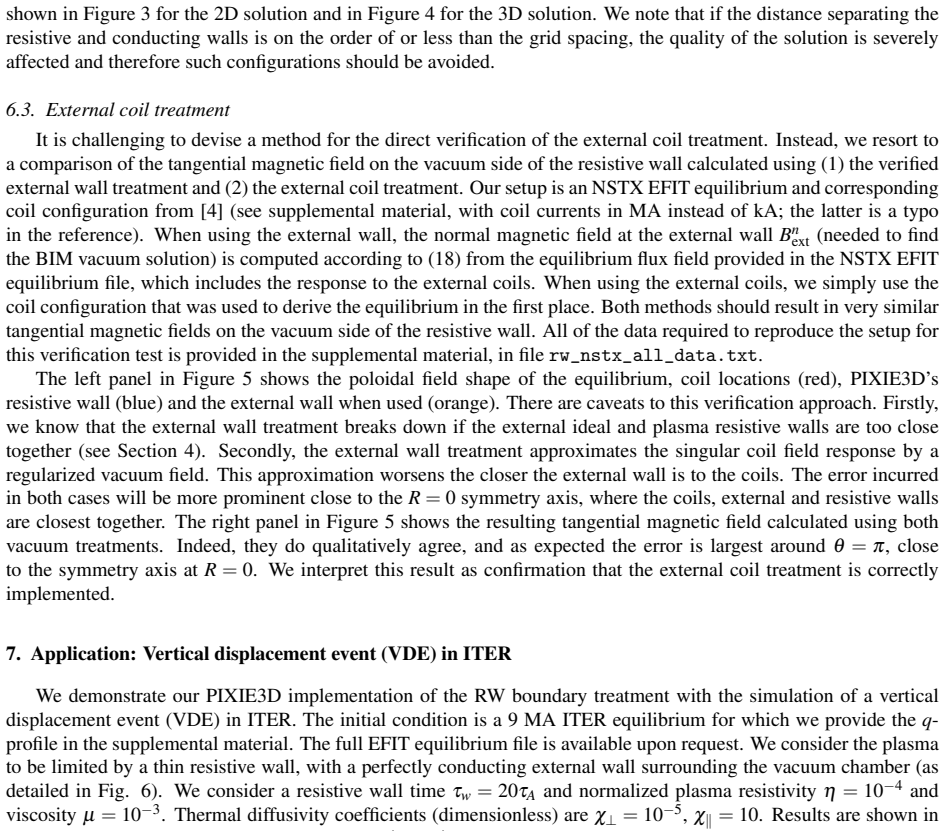
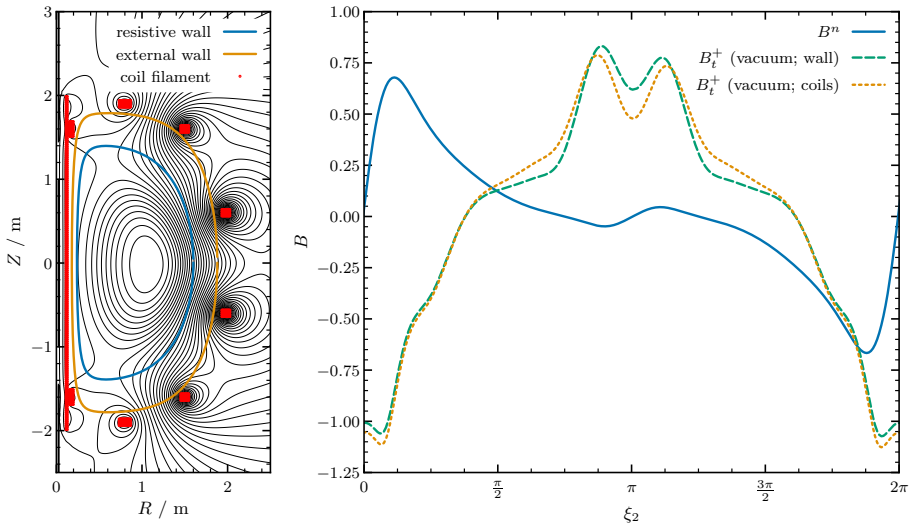
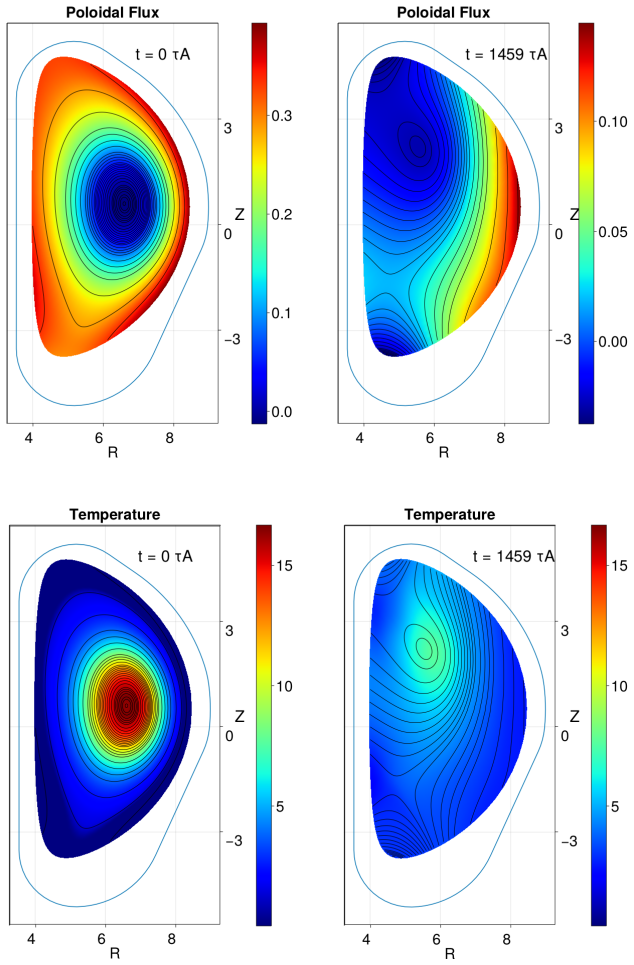
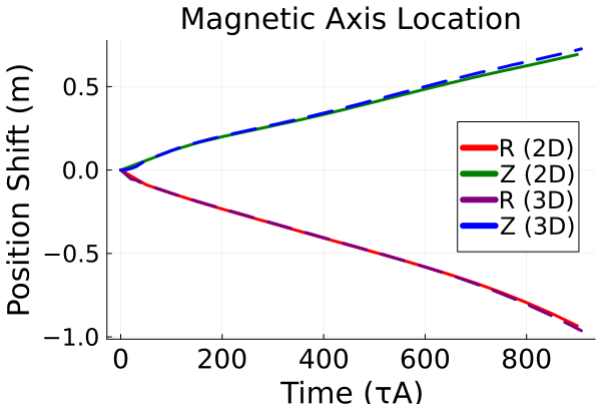
read the original abstract
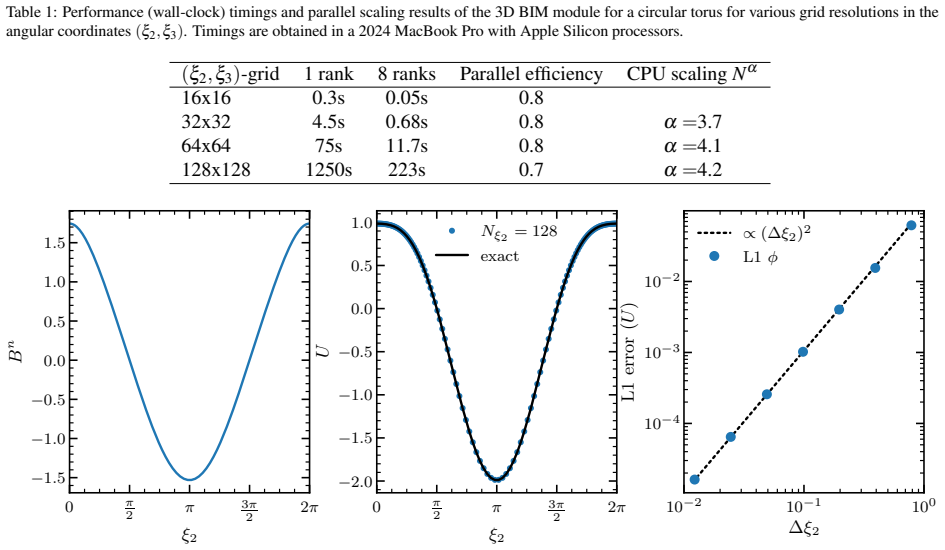
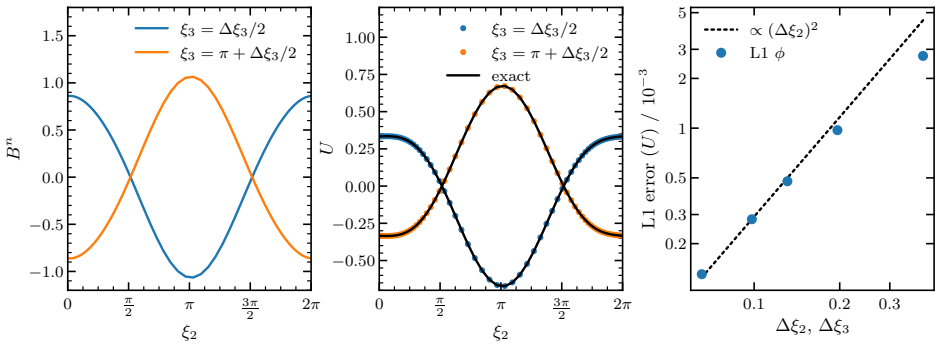
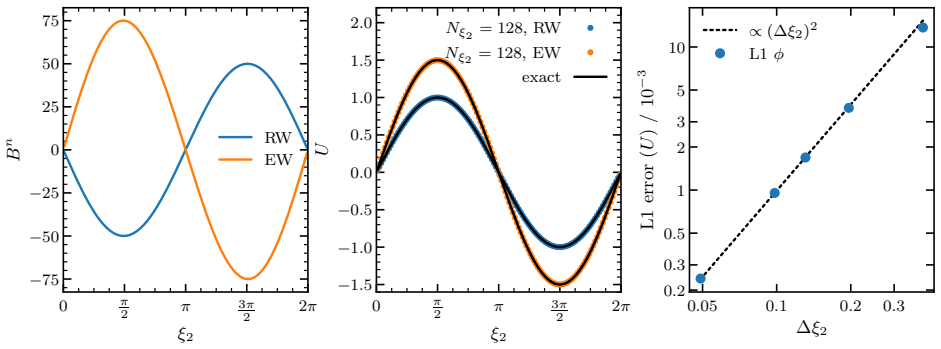
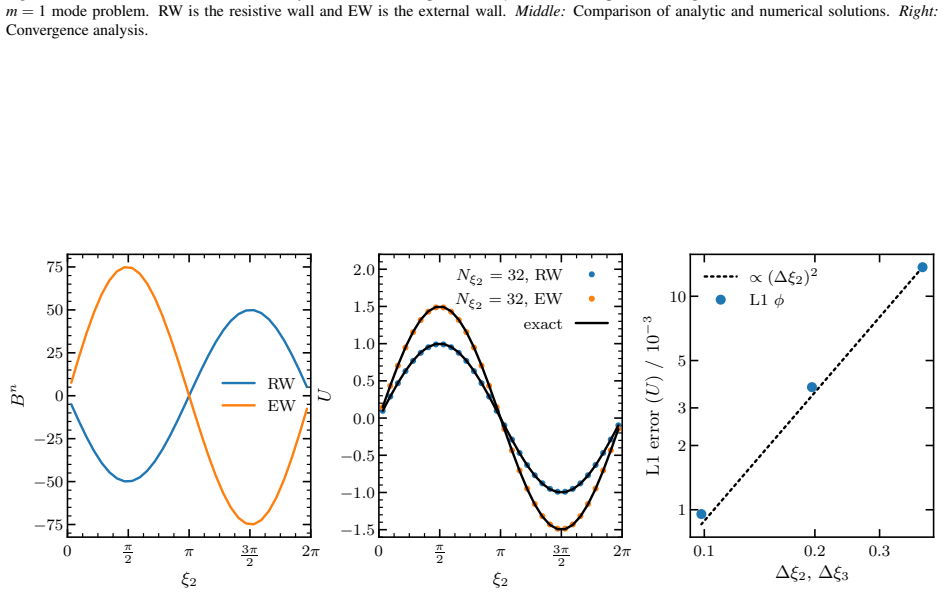
We present the complete formulation of resistive wall boundary conditions in axisymmetric toroidal geometries as implemented in the PIXIE3D extended magnetohydrodynamics (MHD) code, along with a complete suite of analytical verification examples that demonstrate correctness in the implementation. The formulation centers around a thin wall approximation and a Boundary Integral Method to solve for the magnetic scalar potential in the immediately surrounding vacuum. This requires specialized quadrature rules derived from existing literature to handle the numerical integration of singular and hypersingular integrands (the Green's function of Laplace's equation and its derivatives), for which we provide the nodes and weights. Further, we describe an extension to the formalism to include the effect of a perfectly conducting second, outer wall exterior to the resistive (plasma-facing) wall and separated by vacuum, and exterior to the computational plasma mesh proper. Lastly, we describe an extension to include the effect of current-carrying coils also defined exterior to the plasma mesh in the resistive wall boundary condition treatment. For most aspects of the method, we present self-contained verification examples using analytic solutions in axisymmetric toroidal geometries (with both 2D and 3D plasmas) and show it to be accurate to second order. We demonstrate the algorithm with a vertical displacement event (VDE) using the ITER tokamak geometry.
Editorial analysis
A structured set of objections, weighed in public.
Referee Report
Summary. The manuscript presents the complete formulation and implementation of thin-wall resistive wall boundary conditions in axisymmetric toroidal geometries within the PIXIE3D extended MHD code. The approach uses a boundary integral method to solve for the magnetic scalar potential in the surrounding vacuum region, incorporates specialized quadrature rules for singular and hypersingular integrands derived from the Green's function of Laplace's equation, and extends the formalism to include an outer perfectly conducting wall and exterior current-carrying coils. Verification is performed via self-contained analytic solutions in both 2D and 3D axisymmetric toroidal cases, demonstrating second-order accuracy, with an additional demonstration on a vertical displacement event using ITER geometry.
Significance. If the reported second-order accuracy holds, the work supplies a verified, self-contained numerical capability for modeling resistive-wall effects in tokamak-relevant geometries. This is directly relevant to extended MHD studies of plasma stability, including vertical displacement events. The reliance on external analytic solutions for verification (rather than internal fitting) and the provision of explicit quadrature nodes/weights are positive features that support reproducibility.
minor comments (3)
- The abstract states that accuracy to second order is shown 'for most aspects of the method'; the manuscript should explicitly identify which components (e.g., outer-wall or coil extensions) were not subjected to the same analytic verification suite.
- In the description of the quadrature rules, the manuscript should state the precise source references for the singular/hypersingular integration formulas and confirm that the supplied nodes/weights were cross-checked against those references for the toroidal metric.
- Figure captions and axis labels in the verification sections should include the specific error norm (e.g., L2 or L∞) and the observed convergence rate for each test case to allow direct comparison with the claimed second-order accuracy.
Simulated Author's Rebuttal
We thank the referee for the positive summary, significance assessment, and recommendation of minor revision. No specific major comments appear in the report, so we have no individual points requiring rebuttal or revision at this stage. We will incorporate any minor editorial or formatting suggestions during the revision process.
Circularity Check
No significant circularity; verification relies on external analytic solutions
full rationale
The paper presents a numerical implementation of resistive wall boundary conditions via boundary integral method, with the central claim being second-order accuracy verified against independent analytic solutions in toroidal geometries. The formulation is self-contained, quadrature rules are explicitly taken from existing literature (not self-derived or fitted), and verification examples use external analytic benchmarks rather than internal data fits or self-referential equations. No load-bearing step reduces to a self-citation chain, fitted parameter renamed as prediction, or ansatz smuggled via prior work by the same authors. The derivation chain is independent of its own outputs.
Axiom & Free-Parameter Ledger
axioms (2)
- standard math The vacuum region exterior to the plasma satisfies Laplace's equation for the magnetic scalar potential.
- domain assumption The thin-wall approximation is valid for the resistive wall.
Reference graph
Works this paper leans on
-
[1]
Gruber, K
O. Gruber, K. Lackner, G. Pautasso, U. Seidel, B. Streibl, Vertical displacement events and halo currents, Plasma physics and controlled fusion 35 (SB) (1993) B191
1993
-
[2]
Igochine, Physics of resistive wall modes, Nuclear Fusion 52 (7) (2012) 074010
V . Igochine, Physics of resistive wall modes, Nuclear Fusion 52 (7) (2012) 074010
2012
-
[3]
A. Marx, H. Lütjens, Free-boundary simulations with the XTOR-2F code, Plasma Physics and Controlled Fusion 59 (6) (2017) 064009, publisher: IOP Publishing.doi:10.1088/1361-6587/aa6d1f. URLhttps://dx.doi.org/10.1088/1361-6587/aa6d1f
-
[4]
Krebs, F
I. Krebs, F. Artola, C. Sovinec, S. Jardin, K. Bunkers, M. Hoelzl, N. Ferraro, Axisymmetric simulations of vertical displacement events in tokamaks: A benchmark of M3D-C1, NIMROD, and JORE, Physics of Plasmas 27 (2) (2020)
2020
-
[5]
L. Chacón, A non-staggered, conservative,∇·b=0, finite-volume scheme for 3d implicit extended mag- netohydrodynamics in curvilinear geometries, Computer Physics Communications 163 (3) (2004) 143–171. doi:https://doi.org/10.1016/j.cpc.2004.08.005. URLhttps://www.sciencedirect.com/science/article/pii/S0010465504004369
-
[6]
L. Chacón, An optimal, parallel, fully implicit Newton–Krylov solver for three-dimensional viscoresistive magnetohydrodynamicsa), Physics of Plasmas 15 (5) (2008) 056103.arXiv:https://pubs.aip.org/ aip/pop/article-pdf/doi/10.1063/1.2838244/14079118/056103\_1\_online.pdf,doi:10.1063/ 1.2838244. URLhttps://doi.org/10.1063/1.2838244
-
[7]
L. Chacón, A scalable multidimensional fully implicit solver for hall magnetohydrodynamics, Journal of Com- putational Physics 526 (2025) 113789.doi:https://doi.org/10.1016/j.jcp.2025.113789. URLhttps://www.sciencedirect.com/science/article/pii/S0021999125000725
-
[8]
Hamilton, L
J. Hamilton, L. Chacón, G. Keramidas, X.-Z. Tang, Aligning thermal and current quenches with a high density low-z injection, Nuclear Fusion 65 (11) (2025) 116014
2025
-
[9]
Schnack, S
D. Schnack, S. Ortolani, Computational modelling of the effect of a resistive shell on the rfx reversed field pinch experiment, Nuclear fusion 30 (2) (1990) 277
1990
-
[10]
M. S. Chance, Vacuum calculations in azimuthally symmetric geometry, Physics of Plasmas 4 (6) (1997) 2161– 2180.doi:10.1063/1.872380. URLhttps://doi.org/10.1063/1.872380
-
[11]
W. S. Hall, The Boundary Element Method, V ol. 27 of Solid Mechanics and Its Applications, Springer Nether- lands, Dordrecht, 1994.doi:10.1007/978-94-011-0784-6. URLhttp://link.springer.com/10.1007/978-94-011-0784-6 25
-
[12]
M. S. Chance, A. D. Turnbull, P. B. Snyder, Calculation of the vacuum Green’s function valid even for high toroidal mode numbers in tokamaks, Journal of Computational Physics 221 (1) (2007) 330–348.doi:10. 1016/j.jcp.2006.06.025. URLhttps://www.sciencedirect.com/science/article/pii/S0021999106002920
2007
-
[13]
V . D. Pustovitov, N. V . Chukashev, General Approach to the Evolving Plasma Equilibria with a Resistive Wall in Tokamaks, Mathematics 11 (8) (2023) 1885, number: 8 Publisher: Multidisciplinary Digital Publishing Institute. doi:10.3390/math11081885. URLhttps://www.mdpi.com/2227-7390/11/8/1885
-
[14]
Pletzer, H
A. Pletzer, H. R. Strauss, An efficient method for solving elliptic boundary element problems with application to the tokamak vacuum problem, Computer Physics Communications 182 (10) (2011) 2077–2083.doi:10. 1016/j.cpc.2011.05.001. URLhttps://www.sciencedirect.com/science/article/pii/S0010465511001548
2011
-
[15]
Pletzer, I
A. Pletzer, I. Szczesniak, GRIN: A flexible program to compute Green’s function integrals in two dimensions, http://svn.code.sf.net/p/grinsoft/code, [Online; accessed 12-12-2025] (2001)
2025
-
[16]
W. Park, E. V . Belova, G. Y . Fu, X. Z. Tang, H. R. Strauss, L. E. Sugiyama, Plasma simulation studies using multilevel physics models, Physics of Plasmas 6 (5) (1999) 1796–1803.doi:10.1063/1.873437. URLhttps://doi.org/10.1063/1.873437
-
[17]
H. R. Strauss, B. E. Chapman, N. C. Hurst, MST resistive wall tearing mode simulations, Plasma Physics and Controlled Fusion 65 (8) (2023) 084002, publisher: IOP Publishing.doi:10.1088/1361-6587/acdff8. URLhttps://dx.doi.org/10.1088/1361-6587/acdff8
-
[18]
C. R. Sovinec, A. H. Glasser, T. A. Gianakon, D. C. Barnes, R. A. Nebel, S. E. Kruger, D. D. Schnack, S. J. Plimpton, A. Tarditi, M. S. Chu, Nonlinear magnetohydrodynamics simulation using high-order finite elements, Journal of Computational Physics 195 (1) (2004) 355–386.doi:10.1016/j.jcp.2003.10.004. URLhttps://www.sciencedirect.com/science/article/pii/...
-
[19]
Becerra, RESISTIVE W ALL AND ERROR FIELD STUDIES USING THE EXTENDED MHD CODE NIMROD, Ph.D
A. Becerra, RESISTIVE W ALL AND ERROR FIELD STUDIES USING THE EXTENDED MHD CODE NIMROD, Ph.D. thesis, University of Wisconsin - Madison (2016). URLhttps://cptc.wisc.edu/wp-content/uploads/sites/327/2017/09/UW-CPTC_17-2.pdf
2016
-
[20]
URLhttps://pubs.aip.org/adv/article/13/9/095111/2910703/Nonlinear-verification-of-the-resistive-wall
Spinicci, L., Bonfiglio, D., Chacón, L., Cappello, S., Veranda, M., Nonlinear verification of the resistive-wall boundary modules in the SPECYL and PIXIE3D magneto-hydrodynamic codes for fusion plasmas, AIP Advances 13 (9) (2023) 095111.doi:10.1063/5.0161029. URLhttps://pubs.aip.org/adv/article/13/9/095111/2910703/Nonlinear-verification-of-the-resistive-wall
-
[21]
N. M. Ferraro, S. C. Jardin, L. L. Lao, M. S. Shephard, F. Zhang, Multi-region approach to free-boundary three-dimensional tokamak equilibria and resistive wall instabilities, Physics of Plasmas 23 (5) (2016) 056114. doi:10.1063/1.4948722. URLhttps://doi.org/10.1063/1.4948722
-
[22]
Y . Liu, R. Albanese, A. Portone, G. Rubinacci, F. Villone, An analytical demonstration of coupling schemes between magnetohydrodynamic codes and eddy current codes, Physics of Plasmas 15 (7) (2008) 072516. doi:10.1063/1.2959129. URLhttps://pubs.aip.org/pop/article/15/7/072516/985682/An-analytical-demonstration-of-coupling-schemes
-
[23]
B\'ezier Surfaces and Finite Elements for
O. Czarny, G. Huysmans, Bézier surfaces and finite elements for MHD simulations, Journal of Computational Physics 227 (16) (2008) 7423–7445.doi:10.1016/j.jcp.2008.04.001. URLhttps://www.sciencedirect.com/science/article/pii/S0021999108002118
-
[24]
Linear MHD stability studies with the STARWALL code
P. Merkel, E. Strumberger, Linear MHD stability studies with the STARW ALL code, arXiv:1508.04911 [physics] (Aug. 2015).doi:10.48550/arXiv.1508.04911. URLhttp://arxiv.org/abs/1508.04911 26
work page internal anchor Pith review Pith/arXiv arXiv doi:10.48550/arxiv.1508.04911 2015
-
[25]
Chacón, J
L. Chacón, J. Hamilton, N. Krasheninnikova, A robust fourth-order finite-difference discretization for the strongly anisotropic transport equation in magnetized plasmas, Computer Physics Communications (2025) 109646
2025
-
[26]
Bonfiglio, L
D. Bonfiglio, L. Chacón, S. Cappello, Nonlinear three-dimensional verification of the specyl and pixie3d mag- netohydrodynamics codes for fusion plasmas, Physics of Plasmas 17 (8) (2010)
2010
-
[27]
Balay, W
S. Balay, W. D. Gropp, L. C. McInnes, B. F. Smith, Efficient management of parallelism in object oriented numerical software libraries, in: E. Arge, A. M. Bruaset, H. P. Langtangen (Eds.), Modern Software Tools in Scientific Computing, Birkhäuser Press, 1997, pp. 163–202
1997
-
[28]
Balay, S
S. Balay, S. Abhyankar, M. F. Adams, S. Benson, J. Brown, P. Brune, K. Buschelman, E. Constantinescu, L. Dalcin, A. Dener, V . Eijkhout, J. Faibussowitsch, W. D. Gropp, V . Hapla, T. Isaac, P. Jolivet, D. Karpeev, D. Kaushik, M. G. Knepley, F. Kong, S. Kruger, D. A. May, L. C. McInnes, R. T. Mills, L. Mitchell, T. Munson, J. E. Roman, K. Rupp, P. Sanan, J...
2023
-
[29]
Poulson, B
J. Poulson, B. Marker, J. R. Hammond, N. A. Romero, R. van de Geijn, Elemental: A new framework for distributed memory dense matrix computations, ACM Transactions on Mathematical Software 39 (2) (2013)
2013
-
[30]
Lebedev, R
N. Lebedev, R. Silverman, Special Functions and Their Applications, Dover Books on Mathematics, Dover Publications, 1972. URLhttps://books.google.com/books?id=po-6Yxz851MC
1972
-
[31]
S. Kuyucak, M. Hoyles, S.-H. Chung, Analytical Solutions of Poisson’s Equation for Realistic Geometrical Shapes of Membrane Ion Channels, Biophysical Journal 74 (1) (1998) 22–36.doi:10.1016/S0006-3495(98) 77763-X. URLhttps://linkinghub.elsevier.com/retrieve/pii/S000634959877763X
-
[32]
T. Fukushima, Precise and fast computation of complete elliptic integrals by piecewise minimax rational function approximation, Journal of Computational and Applied Mathematics 282 (2015) 71–76.doi:10.1016/j.cam. 2014.12.038. URLhttps://www.sciencedirect.com/science/article/pii/S0377042715000023
-
[33]
T. Fukushima, ZONAL TOROIDAL HARMONIC EXPANSIONS OF EXTERNAL GRA VITATIONAL FIELDS FOR RING-LIKE OBJECTS, The Astronomical Journal 152 (2) (2016) 35, publisher: The Ameri- can Astronomical Society.doi:10.3847/0004-6256/152/2/35. URLhttps://dx.doi.org/10.3847/0004-6256/152/2/35
-
[34]
M. Carley, Numerical Quadratures for Singular and Hypersingular Integrals in Boundary Element Methods, SIAM Journal on Scientific Computing 29 (3) (2007) 1207–1216.doi:10.1137/060666093. URLhttp://epubs.siam.org/doi/10.1137/060666093
-
[35]
J. Bremer, Z. Gimbutas, V . Rokhlin, A nonlinear optimization procedure for generalized gaussian quadra- tures, SIAM Journal on Scientific Computing 32 (4) (2010) 1761–1788.arXiv:https://doi.org/10.1137/ 080737046,doi:10.1137/080737046. URLhttps://doi.org/10.1137/080737046
-
[36]
P. Kolm, V . Rokhlin, Numerical quadratures for singular and hypersingular integrals, Computers & Mathematics with Applications 41 (3-4) (2001) 327–352.doi:10.1016/S0898-1221(00)00277-7. URLhttps://linkinghub.elsevier.com/retrieve/pii/S0898122100002777 27
discussion (0)
Sign in with ORCID, Apple, or X to comment. Anyone can read and Pith papers without signing in.