REVIEW 3 major objections 6 minor 109 references
A candidate for True Type-2 AGN without hidden central BLRs Identified by central Tidal Disruption Event
T0 review · 3 major / 6 minor · reviewed 2026-08-07 · deepseek-v4-flash
Pith's one-line read A tidal disruption event in a narrow-line AGN identifies it as a true Type-2 AGN with no hidden broad-line region.
desk verdict A clever single-object paper proposing TDE flares as a probe of unobscured Type-2 nuclei; the case is plausible but the SN alternative is not properly excluded. read the letter →
The pith
A machine-rendered reading of the paper's core claim, the machinery that carries it, and where it could break.
The reading
What carries the argument
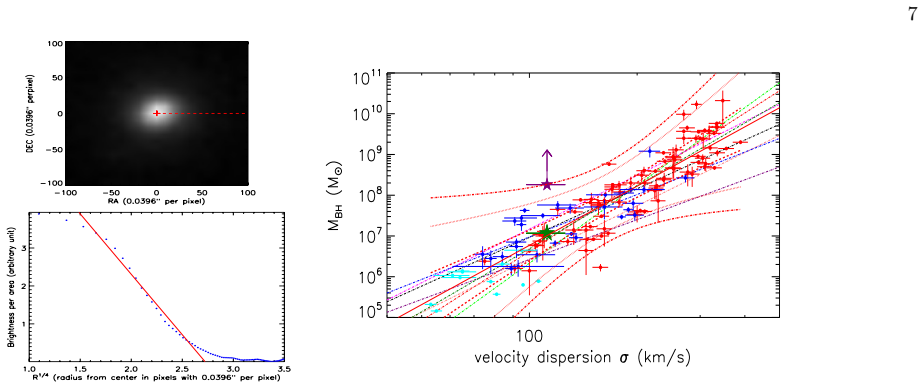
The mechanism that carries the argument is the tidal disruption event as a geometric line-of-sight probe. A TDE flare is produced by stellar debris falling onto the central supermassive black hole, with the emitting region extending out to roughly $R_{\rm out}\sim 7.6$-$16.6$ light-days; seeing such a flare in the CSS, PTF, PanSTARRS, and ZTF light curves tells us the nucleus is unobscured. The argument then couples this geometric fact with spectroscopic modeling: simple stellar population templates plus an AGN power-law continuum are subtracted from the archival spectrum, and the residual line spectrum is fit with narrow components plus blue-shifted wings. An alternative fit including a broad H$\alpha$ component is rejected by an F-test at better than 6-$\sigma$ confidence, and the broad-component virial mass is inconsistent with the $M_{\rm BH}$-$\sigma_*$ mass. The TDE model also independently gives a black-hole mass consistent with the $M_{\rm BH}$-$\sigma_*$ estimate, tying the two strands together.
What would settle it
Fit supernova light-curve templates to the CSS, PTF, and PanSTARRS photometry: if a supernova model matches the flare at least as well as the TDE model, the central-origin argument fails. Alternatively, a new spectrum taken during a future bright state that shows broad Balmer emission would directly refute the no-BLR claim; likewise, an X-ray spectrum showing a large column density would contradict the unobscured-nucleus inference.
Extended reading notes
Core claim
The central claim is that SDSS J2334 is a genuine candidate for a true Type-2 AGN, meaning it has no central broad-line region at all, rather than having one hidden by an obscuring torus. The argument combines two independent facts: a tidal disruption event is detected in optical light curves, proving that radiation from within about 20 light-days of the black hole reaches us unobscured; and a high-quality spectrum taken before the flare contains narrow emission lines but no broad Balmer components, with the virial black-hole mass implied by any assumed broad component disagreeing with the $M_{\rm BH}$-$\sigma_*$ expected mass by more than 6 $\sigma$. The TDE fit gives a black-hole mass of about $1.17\times10^7\,M_\odot$ and a disrupted main-sequence star of about $4.7\,M_\odot$. The authors conclude that the absence of broad lines is intrinsic, making SDSS J2334 a TT2AGN candidate and suggesting that detecting TDE flares in Type-2 AGN is a viable identification method.
Load-bearing premise
The load-bearing premise is that the 2009-2013 optical flare is a tidal disruption event at the galaxy's central black hole rather than a supernova or other transient, because only a central origin proves the nucleus is unobscured.
Editorial extensions
If this is right
- If SDSS J2334 is a TT2AGN, then some Type-2 AGN classified by the unified model as obscured are actually unobscured objects without broad-line regions.
- Detecting a TDE-like flare in a spectroscopically normal Type-2 AGN becomes a practical screening method: any Type-2 AGN showing a central flare is a candidate TT2AGN.
- The absence of broad lines is not an artifact of a low signal-to-noise spectrum, because the virial-mass and M-sigma comparison rules out a hidden broad component at high confidence.
- Future multi-epoch spectroscopy of SDSS J2334 can test the no-BLR interpretation by searching for virialized variability of any broad component.
- The method can be applied to archival long-term light curves of other narrow-line AGN to build a sample of TT2AGN candidates.
Reading between the lines
- Beyond the paper, this method could be applied in reverse: cross-match archival light curves of all spectroscopically classified Type-2 AGN for TDE-shaped flares, then follow up candidates spectroscopically to map how often a missing BLR tracks an unobscured line of sight.
- As an extension, an X-ray observation measuring the line-of-sight column density would independently test the unobscured-nucleus geometry: a low $N_{\rm H}$ would confirm the TDE-based inference, while a high $N_{\rm H}$ would challenge it.
- A further testable consequence: if true Type-2 AGN are common, virial black-hole mass estimates for this population are systematically biased, and the discrepancy between virial and M-sigma masses could be used as a selection criterion to find more TT2AGN candidates in large spectroscopic surveys.
Editorial analysis
A structured set of objections, weighed in public.
Referee Report
Summary. The paper proposes SDSS J233454.07+145712.9 as a candidate True Type-2 AGN (TT2AGN), i.e., an AGN whose central BLR is genuinely absent rather than hidden by dust. The argument has two pillars. First, using CSS, PTF, PanSTARRS, and ZTF light curves, the authors fit the 2009-2013 optical outburst with a tidal disruption event (TDE) model and derive a black hole mass of about 1.17e7 Msun, concluding that the central region within roughly 20 light-days is directly visible. Second, from an SDSS spectrum taken before the outburst, they argue that the AGN is genuine (BPT diagrams, power-law continuum, SED fit), that no broad Balmer lines are present (line-profile fitting and an F-test, supported by RCSED2), and that a virial mass from an assumed broad Halpha component would be inconsistent with the M-sigma relation at >6 sigma. The paper concludes that combining TDE variability with narrow-line-only spectroscopy is a new method for identifying TT2AGN candidates.
Significance. If the identification is correct, SDSS J2334 would be a rare and important object: a spectroscopically Type-2 AGN in which the absence of a BLR is inferred from an unobscured direct view of the central engine, rather than from a null detection that might be caused by dust. The paper has real strengths: it assembles a 20-year multi-survey optical data set, uses public TDE fitting codes (TDEFIT/MOSFIT), checks the TDE black hole mass against the independent M-sigma relation, cross-validates the spectroscopic decomposition against RCSED2, and explicitly acknowledges that multi-epoch spectroscopy is needed to confirm the result. The proposal to use TDE flares as line-of-sight probes in Type-2 AGN is methodologically interesting and potentially fruitful. However, the central claim is conditional on the outburst being a true nuclear TDE, and that key premise is not secured against alternative transient interpretations.
major comments (3)
- [Section 4.3] The dismissal of supernovae is a non-sequitur and is load-bearing for the whole TT2AGN claim. The text states that 'after considering the AGN-like spectroscopic features ... the model on supernovae should be disfavored,' but an AGN host galaxy can also host a supernova, and the pre-flare AGN classification does not exclude a nuclear or host-galaxy SN. No supernova light-curve model (SN Ia, IIn, or SLSN-I) is fitted or compared with the CSS/PTF/PanSTARRS data, even though SNe IIn and SLSNe can produce long-lived, slowly declining light curves with bumps. If the flare is a supernova, it provides no evidence that the central BLR region is unobscured, and the object could be an ordinary torus-obscured Type-2 AGN with a host SN. The authors should either fit representative SN models to the multiband light curves or provide quantitative constraints (e.g., color evolution, spectral classification, star-formation rate limits) that rule them out.
- [Section 3, Points 1 and 3 (Eqs. 5-6)] There is an internal contradiction in the no-BLR argument. Point 1 assumes E(B-V)=2.2, derived from the broad Halpha/Hbeta flux ratio, to argue that the broad Balmer lines are 'seriously' obscured and that the inferred virial black hole mass (1.8e8 Msun) should be considered a lower limit. Point 3 then compares the observed broad Halpha luminosity, without any extinction correction, with the luminosity expected from the unobscured continuum luminosity at 5100 A and concludes that 'there were few effects of obscurations.' If the broad component were reddened by E(B-V)=2.2, its observed luminosity would be suppressed by a large factor and would need to be corrected before the comparison in Eq. (6); if the broad Halpha luminosity is used as observed, the E(B-V)=2.2 assumption in Point 1 is unjustified. The authors need to state explicitly which extinction law and which assumption are being used in each step and reconcile the two statements.
- [Section 2] The TDE fit is presented as the key evidence that the central region is in the line of sight, but the quantitative quality of the fit is not shown for the bands that are not used in the primary fit. The best-fit TDE parameters are obtained from the CSS V-band light curve and then applied to the PTF and PanSTARRS bands with only the host magnitudes as free parameters, yet no chi-square values, residuals, or confidence bands are reported for those additional bands. In addition, the rebrightening bump about 900 days after peak is explicitly not modeled; the paper only notes that it falls within the confidence interval. Given that the TDE identification is the foundation of the unobscured-sightline claim, the authors should report fit statistics for all bands and discuss whether the bump is consistent with the model or hints at an additional component, such as a supernova.
minor comments (6)
- [Section 4 heading] The heading 'DISSCUSSION' should be corrected to 'DISCUSSION'.
- [Abstract] The phrase 'the to detect TDE expected flares' is ungrammatical; it should read something like 'that detecting TDE-expected flares in normal Type-2 AGN...'.
- [Section 5] In the concluding paragraph, 'SDSS J2234' is a typo for 'SDSS J2334'.
- [Section 4.1] The text 'In the left panel of Figure 3, the variation of WISE color (W1-W2) over time is displayed' appears to refer to the left panel of Figure 6, not Figure 3, whose left panels show the photometric image and surface brightness profile.
- [Table 1 notes] The table notes refer to '[N ii]λ5007Å', which appears to be a typo; the [N ii] line discussed is λ6583 Å.
- [Section 3] The F-test is used to compare models that are not obviously nested (e.g., the model with blue-shifted wings versus the model with an additional broad Gaussian component). A brief justification of nestedness or the use of an information criterion such as AIC/BIC would make the '6 sigma' preference claim more robust.
Circularity Check
No significant circularity: the TDE fit, M-sigma comparison, and spectral analysis are independent and empirically anchored.
full rationale
The paper's central claim—that SDSS J2334 is a candidate TT2AGN—rests on three independent lines of evidence. First, the TDE interpretation is obtained by fitting a public theoretical TDE model (MOSFIT/TDEFIT) to CSS, PTF, and PanSTARRS light curves; the fitted BH mass and stellar mass are free parameters, not derived from the TT2AGN hypothesis. Second, the disfavoring of broad Balmer emission is based on a comparison between a virial mass estimate (using the external R-L relation and the second moment of an assumed broad H-alpha component) and an M-sigma expected mass (using an external scaling relation calibrated on quiescent galaxies, RM AGN, and TDEs); this is an independent external benchmark, not an input to the fit. Third, the absence of hidden BLRs is supported by the measured narrow-line spectrum and F-test comparisons between models with and without broad components, which do not presuppose the conclusion. The 'expected broad H-alpha luminosity' check is a cross-consistency test, not a fitted quantity. The only mild concern is that several methodological citations are to the authors' own prior work (e.g., Y. Gu et al. 2024; X.-G. Zhang 2024), but these are procedural references to a standard public code and do not carry a load-bearing uniqueness or existence theorem. The 20-light-day size estimate is a derived consequence of the fitted BH mass, not a prediction forced by the input. The dismissal of supernova alternatives in Section 4.3 is logically weak (an AGN host can host a supernova), but that is a correctness risk, not circular reasoning. The derivation chain is therefore self-contained against external data and benchmarks, and no step reduces to its own input by construction.
Assumptions & free parameters
free parameters (10)
- TDE black hole mass MBH =
log(M_BH6)=1.07±0.24, about 11.7e6 Msun
- TDE stellar mass M* =
log(M*/Msun)=0.65±0.21, about 4.7 Msun
- Impact parameter beta =
log(beta)=0.28±0.07
- Viscous time Tv =
log(Tv)=-1.10±0.28
- Energy conversion efficiency eta =
log(eta)=-1.08±0.32
- Photosphere normalization R0 =
log(R0)=-0.36±0.12
- Photosphere power-law index lp =
log(lp)=-0.78±0.54
- Host galaxy magnitude in CSS V band mag0 =
17.26±0.02 mag
- Host galaxy magnitudes in PTF and PanSTARRS bands =
not quoted individually
- Reddening E(B-V) of assumed broad lines =
about 2.2 mag
assumptions (8)
- domain assumption The public TDE models (TDEFIT/MOSFIT) with viscous-delayed accretion and a blackbody photosphere describe the observed optical flare.
- domain assumption Main-sequence mass-radius relation of Tout et al. (1996) is valid for the disrupted star.
- domain assumption The MBH-sigma relation applies to SDSS J2334.
- domain assumption The Bentz et al. R-L relation gives the BLR radius from continuum luminosity.
- domain assumption SSP subtraction with 39 templates plus a power-law continuum correctly separates host galaxy and AGN emission in the SDSS spectrum.
- domain assumption The observed optical flare originates at the central black hole (TDE or central AGN flare), not in a supernova.
- standard math BPT diagram classification using Kewley et al. and Kauffmann et al. dividing lines identifies the ionization source as an AGN.
- domain assumption The 2001 SDSS spectrum predates the flare and is therefore not contaminated by TDE emission.
Cite this review
Pith. "Pith review of A candidate for True Type-2 AGN without hidden central BLRs Identified by central Tidal Disruption Event." pith.science (2026). https://pith.science/paper/5RGAVSFU
@misc{pith2026250520821,
  author       = {Pith},
  title        = {Pith review of: A candidate for True Type-2 AGN without hidden central BLRs Identified by central Tidal Disruption Event},
  year         = {2026},
  howpublished = {\url{https://pith.science/paper/5RGAVSFU}},
  note         = {Machine review of arXiv:2505.20821}
}
abstract
In this manuscript, through applications of TDE (tidal disruption event) expected variability properties, a potential candidate for True type-2 AGN without hidden central broad line regions (=TT2AGN) is reported in the SDSS J233454.07+145712.9 (=SDSS J2334). Through analyzing the 20-years optical light curves of SDSS J2334 from different Sky Survey projects, a TDE is preferred with a $4.7{\rm M_\odot}$ main-sequence star tidally disrupted by the central BH with mass $11.7\times 10^6{\rm M_\odot}$, indicating that central region within distance about 20 light-days to central BH in SDSS J2334 is directly in the line-of-sight. Moreover, AGN activities in SDSS J2334 can be confirmed through applications of BPT diagrams. Meanwhile, comparing virial BH mass determined through assumed broad Balmer emission components and M-sigma expected BH mass by well measured stellar velocity dispersion through stellar absorption features, optical broad emission lines in SDSS J2334 are disfavored with confidence level higher than 6$\sigma$. Therefore, combining the unique properties of the TDE and the spectroscopic results with only narrow emission lines, SDSS J2334 can be well identified as a potential candidate for a TT2AGN. The results indicate the to detect TDE expected flares in normal Type-2 AGN classified by spectroscopic results should be a new practicable method for identifying
Figures


Figures from the paper (3 more)


Reference graph
Works this paper leans on
-
[1]
2020, ApJS, 249, 3, doi: 10.3847/1538-4365/ab929e
Ahumada, R., Allende Prieto, C., Almeida, A., et al. 2020, ApJS, 249, 3, doi: 10.3847/1538-4365/ab929e
-
[2]
1993, ARA&A, 31, 473, doi: 10.1146/annurev.aa.31.090193.002353 13
Antonucci, R. 1993, ARA&A, 31, 473, doi: 10.1146/annurev.aa.31.090193.002353 13
arXiv 1993
-
[3]
A panchromatic review of thermal and nonthermal active galactic nuclei
Antonucci, R. 2012, Astronomical and Astrophysical Transactions, 27, 557, doi: 10.48550/arXiv.1210.2716
work page Pith review arXiv doi:10.48550/arxiv.1210.2716 2012
-
[4]
Anumarlapudi, A., Dobie, D., Kaplan, D. L., et al. 2024, ApJ, 974, 241, doi: 10.3847/1538-4357/ad64d3
-
[5]
Assef, R. J., Prieto, J. L., Stern, D., et al. 2018, ApJ, 866, 26, doi: 10.3847/1538-4357/aaddf7
-
[6]
F., Dickey, C., Geha, M., & Reines, A
Baldassare, V. F., Dickey, C., Geha, M., & Reines, A. E. 2020, ApJL, 898, L3, doi: 10.3847/2041-8213/aba0c1
-
[7]
Barth, A. J., Voevodkin, A., Carson, D. J., & Woźniak, P. 2014, AJ, 147, 12, doi: 10.1088/0004-6256/147/1/12
-
[8]
Batiste, M., Bentz, M. C., Raimundo, S. I., Vestergaard, M., & Onken, C. A. 2017, ApJL, 838, L10, doi: 10.3847/2041-8213/aa6571
Show all 109 references
-
[9]
C., Kulkarni, S
Bellm, E. C., Kulkarni, S. R., Graham, M. J., et al. 2019, PASP, 131, 018002, doi: 10.1088/1538-3873/aaecbe
2019 doi
-
[10]
N., Treu, T., Ding, X., et al
Bennert, V. N., Treu, T., Ding, X., et al. 2021, ApJ, 921, 36, doi: 10.3847/1538-4357/ac151a
2021 doi
-
[11]
C., Denney, K
Bentz, M. C., Denney, K. D., Grier, C. J., et al. 2013, ApJ, 767, 149, doi: 10.1088/0004-637X/767/2/149
2013 doi
-
[12]
2012, MNRAS, 426, 3225, doi: 10.1111/j.1365-2966.2012.21959.x
Bianchi, S., Panessa, F., Barcons, X., et al. 2012, MNRAS, 426, 3225, doi: 10.1111/j.1365-2966.2012.21959.x
2012
-
[13]
2019, MNRAS, 488, L1, doi: 10.1093/mnrasl/slz080
Bianchi, S., Antonucci, R., Capetti, A., et al. 2019, MNRAS, 488, L1, doi: 10.1093/mnrasl/slz080
2019 doi
-
[14]
2019, A&A, 622, A103, doi: 10.1051/0004-6361/201834156
Boquien, M., Burgarella, D., Roehlly, Y., et al. 2019, A&A, 622, A103, doi: 10.1051/0004-6361/201834156
2019 doi
-
[15]
2008, MNRAS, 390, 1241, doi: 10.1111/j.1365-2966.2008.13841.x
Brightman, M., & Nandra, K. 2008, MNRAS, 390, 1241, doi: 10.1111/j.1365-2966.2008.13841.x
2008
-
[16]
S., Holoien, T
Brown, J. S., Holoien, T. W. S., Auchettl, K., et al. 2017, MNRAS, 466, 4904, doi: 10.1093/mnras/stx033
2017 doi
-
[17]
2003, MNRAS, 344, 1000, doi: 10.1046/j.1365-8711.2003.06897.x Bruzual A., G., & Charlot, S
Bruzual, G., & Charlot, S. 2003, MNRAS, 344, 1000, doi: 10.1046/j.1365-8711.2003.06897.x Bruzual A., G., & Charlot, S. 1993, ApJ, 405, 538, doi: 10.1086/172385
2003
-
[19]
N., Kennea, J
Burrows, D. N., Kennea, J. A., Ghisellini, G., et al. 2011, Nature, 476, 421, doi: 10.1038/nature10374
2011 doi
-
[20]
2010, ApJ, 724, 855, doi: 10.1088/0004-637X/724/2/855
Cao, X. 2010, ApJ, 724, 855, doi: 10.1088/0004-637X/724/2/855
2010 doi
-
[21]
2017, MNRAS, 466, 798, doi: 10.1093/mnras/stw3020
Cappellari, M. 2017, MNRAS, 466, 798, doi: 10.1093/mnras/stw3020
2017 doi
-
[22]
2013, MNRAS, 432, 1709, doi: 10.1093/mnras/stt562
Cappellari, M., Scott, N., Alatalo, K., et al. 2013, MNRAS, 432, 1709, doi: 10.1093/mnras/stt562
2013 doi
-
[23]
V., Katkov, I
Chilingarian, I. V., Katkov, I. Y., Zolotukhin, I. Y., et al. 2018, ApJ, 863, 1, doi: 10.3847/1538-4357/aad184
2018 doi
-
[24]
V., Zolotukhin, I
Chilingarian, I. V., Zolotukhin, I. Y., Katkov, I. Y., et al. 2017, ApJS, 228, 14, doi: 10.3847/1538-4365/228/2/14 Cid Fernandes, R., Mateus, A., Sodré, L., Stasińska, G., &
2017 doi
-
[25]
Gomes, J. M. 2005, MNRAS, 358, 363, doi: 10.1111/j.1365-2966.2005.08752.x Cid Fernandes, R., Stasińska, G., Mateus, A., & Vale Asari, N. 2011, MNRAS, 413, 1687, doi: 10.1111/j.1365-2966.2011.18244.x
2005
-
[26]
A., & Sutherland, R
Dopita, M. A., & Sutherland, R. S. 1996, ApJS, 102, 161, doi: 10.1086/192255
1996 doi
-
[27]
J., Djorgovski, S
Drake, A. J., Djorgovski, S. G., Graham, M. J., et al. 2019, MNRAS, 482, 98, doi: 10.1093/mnras/sty2673
2019 doi
-
[28]
J., Djorgovski, S
Drake, A. J., Djorgovski, S. G., Mahabal, A., et al. 2009, ApJ, 696, 870, doi: 10.1088/0004-637X/696/1/870
2009 doi
-
[29]
2012, ApJL, 747, L33, doi: 10.1088/2041-8205/747/2/L33
Elitzur, M. 2012, ApJL, 747, L33, doi: 10.1088/2041-8205/747/2/L33
2012 doi
-
[30]
Elitzur, M., & Ho, L. C. 2009, ApJL, 701, L91, doi: 10.1088/0004-637X/701/2/L91
2009 doi
-
[31]
2016, MNRAS, 459, 585, doi: 10.1093/mnras/stw657
Elitzur, M., & Netzer, H. 2016, MNRAS, 459, 585, doi: 10.1093/mnras/stw657
2016 doi
-
[32]
2000, ApJL, 539, L9, doi: 10.1086/312838
Ferrarese, L., & Merritt, D. 2000, ApJL, 539, L9, doi: 10.1086/312838
2000 doi
-
[33]
W., Lang, D., & Goodman, J
Foreman-Mackey, D., Hogg, D. W., Lang, D., & Goodman, J. 2013, PASP, 125, 306, doi: 10.1086/670067
2013 doi
-
[34]
2000, ApJL, 539, L13, doi: 10.1086/312840
Gebhardt, K., Bender, R., Bower, G., et al. 2000, ApJL, 539, L13, doi: 10.1086/312840
2000 doi
-
[35]
2021, ARA&A, 59, 21, doi: 10.1146/annurev-astro-111720-030029
Gezari, S. 2021, ARA&A, 59, 21, doi: 10.1146/annurev-astro-111720-030029
2021 doi
-
[36]
C., Milliard, B., et al
Gezari, S., Martin, D. C., Milliard, B., et al. 2006, ApJL, 653, L25, doi: 10.1086/509918
2006 doi
-
[37]
2012, Nature, 485, 217, doi: 10.1038/nature10990
Gezari, S., Chornock, R., Rest, A., et al. 2012, Nature, 485, 217, doi: 10.1038/nature10990
2012 doi
-
[38]
A., Boyce, M
Gordon, Y. A., Boyce, M. M., O’Dea, C. P., et al. 2021, ApJS, 255, 30, doi: 10.3847/1538-4365/ac05c0
2021 doi
-
[39]
J., Djorgovski, S
Graham, M. J., Djorgovski, S. G., Drake, A. J., et al. 2017, MNRAS, 470, 4112, doi: 10.1093/mnras/stx1456
2017 doi
- [40]
- [41]
-
[42]
E., Ho, L
Greene, J. E., Ho, L. C., & Barth, A. J. 2008, ApJ, 688, 159, doi: 10.1086/592078
2008 doi
-
[43]
A., Chilingarian, I
Grishin, K. A., Chilingarian, I. V., Combes, F., et al. 2025, arXiv e-prints, arXiv:2502.13202, doi: 10.48550/arXiv.2502.13202
2025 doi
-
[44]
2024, MNRAS, doi: 10.1093/mnras/stae2816
Gu, Y., Zhang, X.-G., Chen, X.-Q., Yang, X., & Liang, E.-W. 2024, MNRAS, doi: 10.1093/mnras/stae2816
2024 doi
-
[45]
2014, ApJ, 783, 23, doi: 10.1088/0004-637X/783/1/23
Guillochon, J., Manukian, H., & Ramirez-Ruiz, E. 2014, ApJ, 783, 23, doi: 10.1088/0004-637X/783/1/23
2014 doi
-
[46]
A., et al
Guillochon, J., Nicholl, M., Villar, V. A., et al. 2018, ApJS, 236, 6, doi: 10.3847/1538-4365/aab761 14
2018 doi
-
[47]
2013, ApJ, 767, 25, doi: 10.1088/0004-637X/767/1/25
Guillochon, J., & Ramirez-Ruiz, E. 2013, ApJ, 767, 25, doi: 10.1088/0004-637X/767/1/25
2013 doi
-
[48]
2025, ApJ, 979, 235, doi: 10.3847/1538-4357/ada274
Guo, H., Sun, J., Li, S., et al. 2025, ApJ, 979, 235, doi: 10.3847/1538-4357/ada274
2025 doi
-
[49]
L., McConnell, D., Thomson, A
Hale, C. L., McConnell, D., Thomson, A. J. M., et al. 2021, PASA, 38, e058, doi: 10.1017/pasa.2021.47
2021 doi
-
[50]
2023, ApJ, 942, 9, doi: 10.3847/1538-4357/aca283
Hammerstein, E., van Velzen, S., Gezari, S., et al. 2023, ApJ, 942, 9, doi: 10.3847/1538-4357/aca283
2023 doi
-
[51]
Hawkins, M. R. S. 2004, A&A, 424, 519, doi: 10.1051/0004-6361:20041127
2004 doi
- [52]
-
[53]
C., Kim, M., & Terashima, Y
Ho, L. C., Kim, M., & Terashima, Y. 2012, ApJL, 759, L16, doi: 10.1088/2041-8205/759/1/L16
2012 doi
-
[54]
2011, ApJL, 734, L16, doi: 10.1088/2041-8205/734/1/L16
Huang, X.-X., Wang, J.-X., Tan, Y., Yang, H., & Huang, Y.-F. 2011, ApJL, 734, L16, doi: 10.1088/2041-8205/734/1/L16
2011 doi
-
[55]
2015, ApJ, 803, 57, doi: 10.1088/0004-637X/803/2/57
Ichikawa, K., Packham, C., Ramos Almeida, C., et al. 2015, ApJ, 803, 57, doi: 10.1088/0004-637X/803/2/57
2015 doi
-
[56]
2017, Nature Astronomy, 1, 865, doi: 10.1038/s41550-017-0290-2
Kankare, E., Kotak, R., Mattila, S., et al. 2017, Nature Astronomy, 1, 865, doi: 10.1038/s41550-017-0290-2
2017 doi
-
[57]
M., Tremonti, C., et al
Kauffmann, G., Heckman, T. M., Tremonti, C., et al. 2003, MNRAS, 346, 1055, doi: 10.1111/j.1365-2966.2003.07154.x
2003
-
[58]
J., Dopita, M
Kewley, L. J., Dopita, M. A., Sutherland, R. S., Heisler, C. A., & Trevena, J. 2001, ApJ, 556, 121, doi: 10.1086/321545
2001 doi
-
[59]
J., Groves, B., Kauffmann, G., & Heckman, T
Kewley, L. J., Groves, B., Kauffmann, G., & Heckman, T. 2006, MNRAS, 372, 961, doi: 10.1111/j.1365-2966.2006.10859.x
2006
-
[60]
Kormendy, J., & Ho, L. C. 2013, ARA&A, 51, 511, doi: 10.1146/annurev-astro-082708-101811
2013 doi
-
[61]
A., Chandler, C
Lacy, M., Baum, S. A., Chandler, C. J., et al. 2020, PASP, 132, 035001, doi: 10.1088/1538-3873/ab63eb
2020 doi
-
[62]
M., Kulkarni, S
Law, N. M., Kulkarni, S. R., Dekany, R. G., et al. 2009, PASP, 121, 1395, doi: 10.1086/648598
2009 doi
-
[63]
Y., et al
Li, Y., Yuan, W., Zhou, H. Y., et al. 2015, AJ, 149, 75, doi: 10.1088/0004-6256/149/2/75
2015 doi
-
[64]
2011, MNRAS, 410, 166, doi: 10.1111/j.1365-2966.2010.17432.x
Lintott, C., Schawinski, K., Bamford, S., et al. 2011, MNRAS, 410, 166, doi: 10.1111/j.1365-2966.2010.17432.x
2011
-
[65]
2022, ApJ, 925, 67, doi: 10.3847/1538-4357/ac33a9
Liu, X.-L., Dou, L.-M., Chen, J.-H., & Shen, R.-F. 2022, ApJ, 925, 67, doi: 10.3847/1538-4357/ac33a9
2022 doi
-
[66]
M., et al
Mainzer, A., Bauer, J., Cutri, R. M., et al. 2014, ApJ, 792, 30, doi: 10.1088/0004-637X/792/1/30
2014 doi
- [67]
-
[68]
2018, Science, 361, 482, doi: 10.1126/science.aao4669
Mattila, S., Pérez-Torres, M., Efstathiou, A., et al. 2018, Science, 361, 482, doi: 10.1126/science.aao4669
2018 doi
-
[69]
L., Lenc, E., et al
McConnell, D., Hale, C. L., Lenc, E., et al. 2020, PASA, 37, e048, doi: 10.1017/pasa.2020.41
2020 doi
-
[70]
J., & Ma, C.-P
McConnell, N. J., & Ma, C.-P. 2013, ApJ, 764, 184, doi: 10.1088/0004-637X/764/2/184
2013 doi
-
[71]
2015, MNRAS, 452, 69, doi: 10.1093/mnras/stv1095
Merloni, A., Dwelly, T., Salvato, M., et al. 2015, MNRAS, 452, 69, doi: 10.1093/mnras/stv1095
2015 doi
-
[72]
2019, ApJ, 872, 151, doi: 10.3847/1538-4357/ab010f
Mockler, B., Guillochon, J., & Ramirez-Ruiz, E. 2019, ApJ, 872, 151, doi: 10.3847/1538-4357/ab010f
2019 doi
-
[73]
S., Murayama, T., et al
Nagao, T., Kawabata, K. S., Murayama, T., et al. 2004, AJ, 128, 2066, doi: 10.1086/424936
2004 doi
-
[74]
2015, ARA&A, 53, 365, doi: 10.1146/annurev-astro-082214-122302
Netzer, H. 2015, ARA&A, 53, 365, doi: 10.1146/annurev-astro-082214-122302
2015 doi
-
[75]
2009, A&A, 507, 1793, doi: 10.1051/0004-6361/200912497
Noll, S., Burgarella, D., Giovannoli, E., et al. 2009, A&A, 507, 1793, doi: 10.1051/0004-6361/200912497
2009 doi
-
[76]
M., Ferrarese, L., Gilbert, K
Peterson, B. M., Ferrarese, L., Gilbert, K. M., et al. 2004, ApJ, 613, 682, doi: 10.1086/423269
2004 doi
-
[77]
Pons, E., & Watson, M. G. 2016, A&A, 594, A72, doi: 10.1051/0004-6361/201629194
2016 doi
-
[78]
Rees, M. J. 1988, Nature, 333, 523, doi: 10.1038/333523a0
1988 doi
-
[79]
E., Greene, J
Reines, A. E., Greene, J. E., & Geha, M. 2013, ApJ, 775, 116, doi: 10.1088/0004-637X/775/2/116 Savić, D., Goosmann, R., Popović, L. Č., Marin, F., &
2013 doi
-
[80]
Afanasiev, V. L. 2018, A&A, 614, A120, doi: 10.1051/0004-6361/201732220
2018 doi
-
[81]
Savorgnan, G. A. D., & Graham, A. W. 2015, MNRAS, 446, 2330, doi: 10.1093/mnras/stu2259
2015 doi
-
[82]
2021, MNRAS, 508, 3820, doi: 10.1093/mnras/stab2843
Sazonov, S., Gilfanov, M., Medvedev, P., et al. 2021, MNRAS, 508, 3820, doi: 10.1093/mnras/stab2843
2021 doi
-
[83]
T., Strauss, M
Shen, Y., Richards, G. T., Strauss, M. A., et al. 2011, ApJS, 194, 45, doi: 10.1088/0067-0049/194/2/45
2011 doi
-
[84]
E., & Quataert, E
Strubbe, L. E., & Quataert, E. 2009, MNRAS, 400, 2070, doi: 10.1111/j.1365-2966.2009.15599.x
2009
-
[85]
2024, A&A, 692, A262, doi: 10.1051/0004-6361/202452380
Sun, L., Jiang, N., Dou, L., et al. 2024, A&A, 692, A262, doi: 10.1051/0004-6361/202452380
2024 doi
-
[86]
A., Pols, O
Tout, C. A., Pols, O. R., Eggleton, P. P., & Han, Z. 1996, MNRAS, 281, 257, doi: 10.1093/mnras/281.1.257
1996 doi
-
[87]
L., et al
Trakhtenbrot, B., Arcavi, I., MacLeod, C. L., et al. 2019, ApJ, 883, 94, doi: 10.3847/1538-4357/ab39e4
2019 doi
-
[88]
Tran, H. D. 2001, ApJL, 554, L19, doi: 10.1086/320926
2001 doi
-
[89]
Tran, H. D. 2003, ApJ, 583, 632, doi: 10.1086/345473
2003 doi
-
[90]
M., & Padovani, P
Urry, C. M., & Padovani, P. 1995, PASP, 107, 803, doi: 10.1086/133630 Valencia-S., M., Zuther, J., Eckart, A., et al. 2012, A&A, 544, A129, doi: 10.1051/0004-6361/201219226 van Velzen, S., Anderson, G. E., Stone, N. C., et al. 2016, Science, 351, 62, doi: 10.1126/science.aad11...
1995 doi
-
[91]
W., & Hill, G
Veilleux, S., Goodrich, R. W., & Hill, G. J. 1997, ApJ, 477, 631, doi: 10.1086/303735 15
1997 doi
-
[92]
2002, ApJ, 571, 733, doi: 10.1086/340045
Vestergaard, M. 2002, ApJ, 571, 733, doi: 10.1086/340045
2002 doi
-
[93]
R., et al
Wevers, T., Guolo, M., Pasham, D. R., et al. 2024, ApJ, 963, 75, doi: 10.3847/1538-4357/ad1878
2024 doi
-
[94]
C., Vanden Berk, D
Wilhite, B. C., Vanden Berk, D. E., Kron, R. G., et al. 2005, ApJ, 633, 638, doi: 10.1086/430821
2005 doi
-
[95]
2013, ApJ, 772, 49, doi: 10.1088/0004-637X/772/1/49
Woo, J.-H., Schulze, A., Park, D., et al. 2013, ApJ, 772, 49, doi: 10.1088/0004-637X/772/1/49
2013 doi
-
[96]
Woo, J.-H., Yoon, Y., Park, S., Park, D., & Kim, S. C. 2015, ApJ, 801, 38, doi: 10.1088/0004-637X/801/1/38
2015 doi
-
[97]
L., Eisenhardt, P
Wright, E. L., Eisenhardt, P. R. M., Mainzer, A. K., et al. 2010, AJ, 140, 1868, doi: 10.1088/0004-6256/140/6/1868
2010 doi
- [98]
-
[99]
2023, ApJL, 955, L6, doi: 10.3847/2041-8213/acf216
Yao, Y., Ravi, V., Gezari, S., et al. 2023, ApJL, 955, L6, doi: 10.3847/2041-8213/acf216
2023 doi
-
[100]
W., Connolly, A
Yip, C. W., Connolly, A. J., Vanden Berk, D. E., et al. 2009, AJ, 137, 5120, doi: 10.1088/0004-6256/137/6/5120
2009 doi
-
[101]
L., Schmidt, G
Zakamska, N. L., Schmidt, G. D., Smith, P. S., et al. 2005, AJ, 129, 1212, doi: 10.1086/427543
2005 doi
-
[102]
2021, ApJ, 909, 16, doi: 10.3847/1538-4357/abdb35
Zhang, X. 2021, ApJ, 909, 16, doi: 10.3847/1538-4357/abdb35
2021 doi
- [103]
- [104]
-
[105]
2021, ApJ, 922, 248, doi: 10.3847/1538-4357/ac23c8
Zhang, X., YingFei, Z., PeiZhen, C., et al. 2021, ApJ, 922, 248, doi: 10.3847/1538-4357/ac23c8
2021 doi
-
[106]
2022, ApJ, 937, 105, doi: 10.3847/1538-4357/ac903d
Zhang, X., & Zhao, S. 2022, ApJ, 937, 105, doi: 10.3847/1538-4357/ac903d
2022 doi
-
[107]
2014, MNRAS, 438, 557, doi: 10.1093/mnras/stt2226
Zhang, X.-G. 2014, MNRAS, 438, 557, doi: 10.1093/mnras/stt2226
2014 doi
-
[108]
2022, MNRAS, 516, L66, doi: 10.1093/mnrasl/slac092
Zhang, X.-G. 2022, MNRAS, 516, L66, doi: 10.1093/mnrasl/slac092
2022 doi
-
[109]
2024, MNRAS, 534, L23, doi: 10.1093/mnrasl/slae072
Zhang, X.-G. 2024, MNRAS, 534, L23, doi: 10.1093/mnrasl/slae072
2024 doi
-
[110]
Q., Liu, F
Zhou, Z. Q., Liu, F. K., Komossa, S., et al. 2021, ApJ, 907, 77, doi: 10.3847/1538-4357/abcccb
2021 doi
Reviewed August 7, 2026 · model on record in the stance chip above.
Discussion (0). Sign in to comment.