Nautilus: A Verifiable Hierarchical Federated Learning Framework for Vehicular-Edge-Cloud Systems
Pith reviewed 2026-06-26 07:21 UTC · model grok-4.3
The pith
Nautilus combines resource-aware scheduling with zero-knowledge proofs to verify fair task allocation and reduce communication in vehicular federated learning.
A machine-rendered reading of the paper's core claim, the machinery that carries it, and where it could break.
Core claim
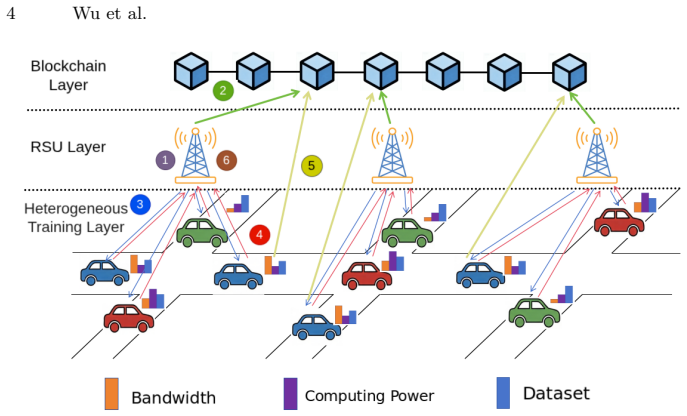
Nautilus shows that a multi-dimensional resource-aware scheduler can dynamically set per-vehicle compression ratios and task sizes from bandwidth, latency, and compute measurements, while a zero-knowledge proof mechanism verifies both the fairness of those allocations and the faithful execution of compression instructions, thereby cutting communication overhead, speeding convergence, and preserving both privacy and system integrity in hierarchical vehicular-edge-cloud settings.
What carries the argument
The multi-dimensional resource-aware scheduling algorithm that sets compression ratios and training tasks from vehicle bandwidth, latency, and computing power, together with the zero-knowledge proof mechanism that verifies scheduling fairness and client compliance.
If this is right
- Total bits exchanged during training rounds decrease because compression ratios are matched to each vehicle's actual capacity.
- Global model accuracy improves faster because slower or weaker vehicles are not forced into oversized tasks that delay the round.
- Any external auditor can confirm that no vehicle was unfairly assigned an easy or hard workload without learning the vehicle's private resource measurements.
- Client devices can prove they applied the exact compression ratio the scheduler requested without revealing their local dataset or gradients.
Where Pith is reading between the lines
- The same proof technique could be reused to verify other dynamic decisions, such as which vehicles are chosen for the next round or how model updates are aggregated.
- If the scheduling algorithm were made public, external observers could check that it was followed even when the vehicles themselves are not trusted.
- The framework's structure suggests it could be adapted to other mobile or IoT settings where devices differ sharply in power and network quality.
Load-bearing premise
The zero-knowledge proofs and the scheduling decisions can be generated and checked with low enough overhead to remain practical when vehicles move at highway speeds and experience frequent changes in connectivity.
What would settle it
A trace from real vehicles showing that the extra messages and compute time spent on zero-knowledge proofs exceed the communication savings achieved by the adaptive compression schedule under measured heterogeneity levels.
Figures
read the original abstract
Federated Learning (FL) enables privacy-preserving collaborative learning for Internet of Vehicles (IoV) scenarios, but extreme heterogeneity of vehicular-edge-cloud resources severely limits system efficiency. Dynamic scheduling strategies mitigate this issue but introduce new trust concerns: verifying fair scheduling decisions and faithful client execution of compression instructions without privacy leakage remains an open challenge. We propose Nautilus, a verifiable efficient federated learning framework. First, a multi-dimensional resource-aware scheduling algorithm dynamically allocates compression ratios and training tasks based on vehicle bandwidth, latency and computing power, improving training efficiency. Second, a Zero-Knowledge Proof (ZKP) mechanism ensures scheduling fairness and execution compliance while preserving privacy. Experiments show the framework reduces communication overhead and accelerates convergence with guaranteed system integrity.
Editorial analysis
A structured set of objections, weighed in public.
Referee Report
Summary. The manuscript proposes Nautilus, a verifiable hierarchical federated learning framework for vehicular-edge-cloud systems. It features a multi-dimensional resource-aware scheduling algorithm that dynamically allocates compression ratios and training tasks based on vehicle bandwidth, latency, and computing power. Additionally, it incorporates a Zero-Knowledge Proof (ZKP) mechanism to verify scheduling fairness and execution compliance while preserving privacy. The authors report that experiments demonstrate reduced communication overhead, accelerated convergence, and guaranteed system integrity.
Significance. If the experimental claims hold after accounting for any ZKP overhead under the described vehicular heterogeneity, the work would address a relevant gap at the intersection of dynamic scheduling and verifiable privacy in FL for IoV. The integration of resource-aware allocation with ZKP for fairness verification is a coherent direction. However, the absence of methods, baselines, or overhead measurements prevents evaluation of whether the net efficiency gains are realized.
major comments (1)
- [Abstract] Abstract: The central claims that experiments show reduced communication overhead, accelerated convergence, and guaranteed integrity rest on unspecified experimental outcomes. No methods, baselines, datasets, hardware platforms, quantitative metrics (e.g., percentage overhead reduction or round counts), or error bars are supplied. This is load-bearing because the net benefit of the ZKP mechanism under extreme heterogeneity cannot be assessed without these details.
Simulated Author's Rebuttal
We thank the referee for the detailed review and constructive comments on our manuscript. We address the concern regarding the abstract below and will incorporate revisions to strengthen the presentation of experimental claims.
read point-by-point responses
-
Referee: [Abstract] Abstract: The central claims that experiments show reduced communication overhead, accelerated convergence, and guaranteed integrity rest on unspecified experimental outcomes. No methods, baselines, datasets, hardware platforms, quantitative metrics (e.g., percentage overhead reduction or round counts), or error bars are supplied. This is load-bearing because the net benefit of the ZKP mechanism under extreme heterogeneity cannot be assessed without these details.
Authors: We agree that the abstract, as currently written, provides only a high-level summary of the experimental outcomes without quantitative specifics. The full manuscript contains a dedicated Experiments section (Section 5) that details the methods, baselines (including FedAvg and other hierarchical FL variants), datasets (vehicular trace-based and standard benchmarks like CIFAR-10 adapted for IoV), hardware platforms, quantitative metrics with percentage reductions, round counts, and error bars from multiple runs. However, these details are not reflected in the abstract. We will revise the abstract to include key quantitative results (e.g., communication overhead reduction percentages and convergence speedups) to make the claims self-contained and allow assessment of ZKP overhead under heterogeneity. revision: yes
Circularity Check
No circularity; claims rest on experimental results without derivations or self-referential reductions.
full rationale
The paper describes a scheduling algorithm and ZKP mechanism whose benefits are asserted via experiments, with no equations, fitted parameters, self-citations, or derivation chains present in the provided text. The central claims do not reduce to inputs by construction; they are empirical assertions about overhead and convergence that stand or fall on the (unshown) experimental data rather than any definitional or citation-based loop.
Axiom & Free-Parameter Ledger
Reference graph
Works this paper leans on
-
[1]
In: Artificial intelligence and statistics, pp
McMahan, B., Moore, E., Ramage, D., Hampson, S., y Arcas, B.A.: Communication-efficient learning of deep networks from decentralized data. In: Artificial intelligence and statistics, pp. 1273–1282. PMLR (2017)
2017
-
[2]
In: ICC 2019-2019 IEEE international conference on communications (ICC), pp
Nishio, T., Yonetani, R.: Client selection for federated learning with heterogeneous resources in mobile edge. In: ICC 2019-2019 IEEE international conference on communications (ICC), pp. 1–7. IEEE (2019)
2019
-
[3]
In: NeurIPS (2019)
Lin, J., Du, M., Liu, J.: Free-rider attacks on model aggregation in federated learn- ing. In: NeurIPS (2019)
2019
-
[4]
IEEE Communications Surveys & Tutorials22(3), 2031–2063 (2020)
Lim, W.Y., Luong, N.C., Hoang, D.T., Jiao, Y., Liang, Y.C., Yang, Q., Niyato, D., Miao, C.: Federated learning in mobile edge networks: A comprehensive survey. IEEE Communications Surveys & Tutorials22(3), 2031–2063 (2020)
2031
-
[5]
IEEE Internet of Things Journal7(7), 5986–5994 (2019)
Mills, J., Hu, J., Min, G.: Communication-efficient federated learning for wireless edge intelligence in iot. IEEE Internet of Things Journal7(7), 5986–5994 (2019)
2019
-
[6]
Li, T., Sahu, A.K., Zaheer, M., et al.: Fedprox: Federated optimization for hetero- geneous networks (2020)
2020
-
[7]
Vogels, T., Shankar, S.P., McMahan, B., et al.: Powersgd: Practical low-rank gra- dient compression for distributed optimization (2021)
2021
-
[8]
IEEE Journal on Selected Areas in Com- munications39(11), 3267–3281 (2021)
Shlezinger, N., Chen, M., Eldar, Y.C., et al.: Federated learning with gradient sparsification: Convergence and privacy. IEEE Journal on Selected Areas in Com- munications39(11), 3267–3281 (2021)
2021
-
[9]
IEEE Transactions on Information Forensics and Security (2023)
Xu, G., Li, H., Liu, S.: Verifynet: Secure and verifiable federated learning. IEEE Transactions on Information Forensics and Security (2023)
2023
-
[10]
In: IEEE INFOCOM (2024)
Zhang, X., Wang, Y.: Zkp-fl: Zero-knowledge proof for verifiable federated learning. In: IEEE INFOCOM (2024)
2024
-
[11]
IEEE Transactions on Big Data11(2), 447–460 (2025)
Wang, P., Dong, N., Sun, J., Knottenbelt, W., Guo, Y.:zkFL: Zero-knowledge proof-based gradient aggregation for federated learning. IEEE Transactions on Big Data11(2), 447–460 (2025). DOI 10.1109/TBDATA.2024.3403370 14 Wu et al
-
[12]
Li, Y., Hu, J., Zhou, Y., et al.: Verifiable federated learning with zero-knowledge proofs (2023)
2023
-
[13]
Lu, Y., Dong, H., Cao, Z., et al.: Chainfl: Blockchain for federated learning (2020)
2020
-
[14]
IEEE Communications Surveys & Tutorials25(1), 95–124 (2022)
Zheng, T., et al.: Blockchain-based federated learning: A comprehensive survey. IEEE Communications Surveys & Tutorials25(1), 95–124 (2022)
2022
-
[15]
IEEE Transactions on Parallel and Distributed Systems33(2), 396–408 (2022)
Shi, W., Zhou, S., Miao, L., Li, Z.: Tifl: A tier-based federated learning system. IEEE Transactions on Parallel and Distributed Systems33(2), 396–408 (2022)
2022
-
[16]
IEEE Journal of Selected Topics in Signal Processing16(3), 557–570 (2022)
Shi, W., Ling, Q., Wu, G., et al.: Fedadapt: Adaptive aggregation for heterogeneous federated learning. IEEE Journal of Selected Topics in Signal Processing16(3), 557–570 (2022)
2022
-
[17]
IEEE Transactions on Signal Processing69, 3345–3360 (2021)
Wang, J., Liang, C., Chen, G., Lin, J.: Fednova: Reducing communication complex- ity in federated learning. IEEE Transactions on Signal Processing69, 3345–3360 (2021)
2021
discussion (0)
Sign in with ORCID, Apple, or X to comment. Anyone can read and Pith papers without signing in.