REVIEW 4 major objections 6 minor 43 references
Instance-Based Transfer Learning with Similarity-Aware Subject Selection for Cross-Subject SSVEP-Based BCIs
T0 review · 4 major / 6 minor · reviewed 2026-08-07 · deepseek-v4-flash
Pith's one-line read A transfer-learning framework that treats each source subject's task-related component as a weighted instance, and filters out dissimilar sources before transfer, is reported to beat the standard TRCA method on three SSVEP datasets and to…
desk verdict Solid SSVEP transfer-learning paper: iTRCA is a credible improvement over TRCA, but the SS-iTRCA gains rest on a selection threshold tuned on the evaluation set. read the letter →
The pith
A machine-rendered reading of the paper's core claim, the machinery that carries it, and where it could break.
The reading
What carries the argument
The load-bearing object is the task-related component (TRC), a one-channel summary of a subject's SSVEP response made by applying a TRCA spatial filter to that subject's averaged template. The argument rides on two operations built from it. First, CCA between the concatenated source TRCs and the target's own template produces a common latent space, so each source subject is assigned a real-valued weight (the corresponding entry of $\hat{w}_i^{GS}$) instead of the equal weight implicit in grand averaging. Second, the same TRC is reused as a similarity metric: the normalized correlation $\tilde{c}_i^n = |c_i^n|/\max_n |c_i^n|$ decides which sources enter the transfer. A trigger parameter $\gamma$ governs whether selection happens at all, and the threshold $c_{lb}$ makes the framework a continuous bridge: at $c_{lb}=0$ every source is used (iTRCA), and at $c_{lb}=1$ no source is used, so the model collapses to the target-only TRCA baseline.
What would settle it
Replicate the threshold sweep on a held-out target population: for each target, compute TRC similarities to all source subjects and evaluate SS-iTRCA accuracy for every $c_{lb}$ between 0 and 1. The claim predicts a peak at an intermediate threshold (the paper reports one near 0.8 on Benchmark); if the peak is absent, or if accuracy is highest when no source subject is excluded, or if the excluded low-similarity subjects would have improved accuracy, then TRC similarity is not a reliable guide to which source subjects transfer well.
Extended reading notes
Core claim
The central claim is that cross-subject SSVEP recognition improves when each source subject's response is represented by a single task-related component and those components are treated as weighted instances rather than as equally contributing subjects. iTRCA concatenates source TRCs into a source template $Y_i^S$, runs CCA against the target subject's individual template $\bar{X}_i^{Ta}$ to get a source weight vector $\hat{w}_i^{GS}$ and a target spatial filter $\hat{w}_i^{GT}$, and forms a subject-general feature $\rho_{1,i}$ by correlating the spatially filtered test trial with the weighted source template; a subject-specific TRCA feature $\rho_{2,i}$ preserves the target's own response. The features are fused as $\rho_i = \mathrm{sign}(\rho_{1,i})\rho_{1,i}^2 + \mathrm{sign}(\rho_{2,i})\rho_{2,i}^2$ and combined across filter-bank sub-bands. SS-iTRCA pre-selects source subjects by the normalized TRC similarity $\tilde{c}_i^n$, dropping sources that look unlike the target. The paper reports that this consistently outperforms TRCA on Benchmark, BETA, and a self-collected dataset, and also outperforms TransRCA, DGTF, and CSSFT, with the largest gains when the target has only two calibration blocks.
Load-bearing premise
The load-bearing premise is that a single task-related component per stimulus adequately summarizes a subject's SSVEP response and that the correlation between that component and the target's own template is a reliable guide to which source subjects will help, because both the transfer and the selection rule are built on that correlation.
Editorial extensions
If this is right
- With only two target calibration blocks, SS-iTRCA raises recognition accuracy over TRCA by 11.32 percentage points on Benchmark, 9.08 on BETA, and 21.19 on the self-collected dataset, so a new user can be calibrated with far fewer trials.
- Because the subject-general and subject-specific features are fused in a single correlation score, the method fits into the same filter-bank processing pipeline as TRCA, so the practical change is a preprocessing and scoring step rather than a new classifier.
- The TRC-based similarity score reuses computations already performed for iTRCA, which is why selecting subjects adds little cost; the paper reports substantially lower training time than accuracy-based CSSFT with comparable inference time to TransRCA.
- Feature distributions from the transfer framework are more compact and better separated than TRCA's on all three datasets, with higher CHI values, which is the internal reason given for the accuracy gains.
- The framework degenerates gracefully: with no similar source subjects it becomes plain TRCA, and with all source subjects passing the threshold it becomes iTRCA, so it never forces transfer when the data argue against it.
Reading between the lines
- Editorial inference: Because the paper's threshold sweep on Benchmark shows accuracy rising as $c_{lb}$ increases to about 0.8 and then declining, the selection rule introduces a new hyperparameter; a practical deployment would need a principled way to set it per target subject, or part of the calibration saving is eaten by threshold tuning.
- Editorial inference: The near-zero benefit of selection on the 11-subject self-collected dataset suggests the similarity filter matters mainly when the source pool is large and heterogeneous; a testable prediction is that the gain grows with source-pool size and shrinks or reverses when the pool is small.
- Editorial inference: Because the method's selection metric is computed before transfer, the same TRC-similarity score could be tested as a generic source-quality index for other SSVEP transfer pipelines, not only for iTRCA's feature construction.
- Editorial inference: The self-collected dataset uses different stimulus frequencies and only 12 targets; if the shared latent space is encoding-specific, the transfer benefit may change with stimulus design, which could be checked by running the same framework on a code-modulated or high-frequency SSVEP dataset.
Editorial analysis
A structured set of objections, weighed in public.
Referee Report
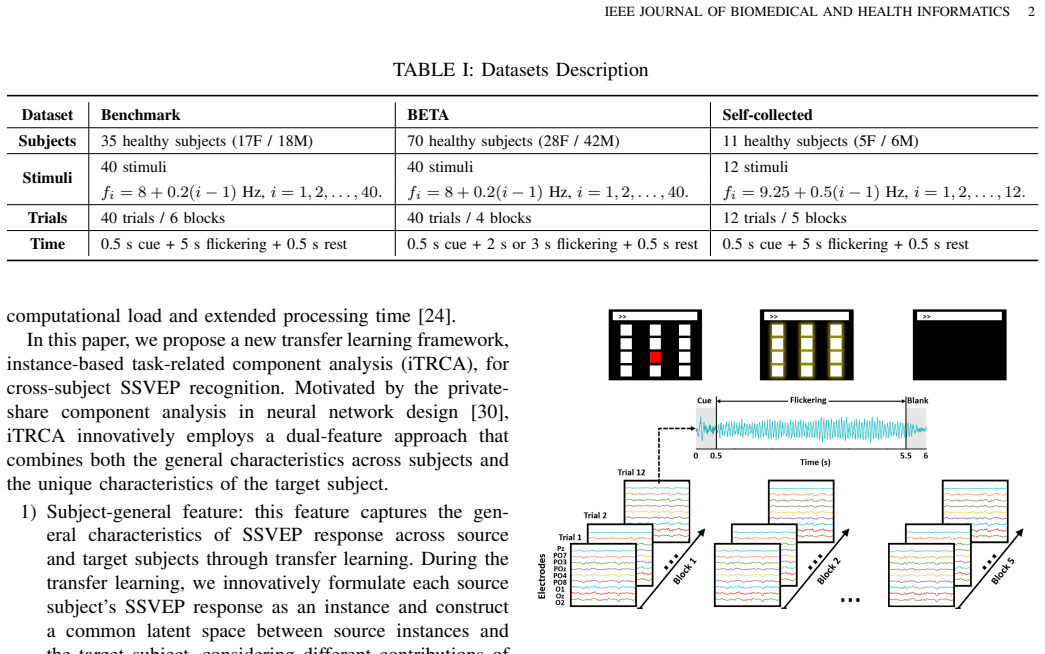
Summary. The paper proposes iTRCA, an SSVEP transfer-learning method that combines a subject-general feature—obtained by CCA between the target subject's template and a stack of source subjects' task-related components—with a target-specific TRCA feature in a filter-bank correlation score. A subject-selection extension, SS-iTRCA, filters source subjects by the normalized correlation between target and source TRCs. The method is evaluated with leave-one-subject-out and leave-one-block-out cross-validation on the Benchmark, BETA, and a self-collected dataset, with comparisons to TRCA and to TransRCA, DGTF, and CSSFT. The central empirical claim is that iTRCA and SS-iTRCA outperform TRCA, with the largest gains when the target has few calibration blocks, e.g., Table II deltas of 11.32, 9.08, and 21.19 percentage points at Ntb=2.
Significance. If the results are unbiased, the contribution is practically relevant: it offers a simple, training-efficient way to reduce SSVEP calibration data, and the similarity-based subject selection is far cheaper than accuracy-based methods such as CSSFT. The TRCA and CCA machinery is standard, and the nested LOSO/LOBO protocol is correctly applied so that test trials do not enter training. The main weaknesses are the selection of the c_lb threshold on the Benchmark evaluation set, the Benchmark-only state-of-the-art comparison, and the failure of SS-iTRCA to improve over iTRCA on the self-collected dataset; these weaken the strength of the conclusion as currently worded. No code is provided, so reproducibility is limited.
major comments (4)
- [Section III.A, III.C, Eq. (19)] The subject-selection hyperparameters γ=0.5 and c_lb=0.9 are fixed for all reported evaluations without a nested validation loop, and the only sensitivity analysis (Fig. 8a, Benchmark) shows SS-iTRCA accuracy peaking at c_lb=0.8 and declining at 0.9. Because all SS-iTRCA results in Figs. 4–6 and Table II use c_lb=0.9, the headline SS-iTRCA-vs-iTRCA gains, including Table II deltas of 11.32, 9.08, and 21.19 percentage points at Ntb=2, are not unbiased estimates of the benefit of subject selection. Please either introduce an inner validation loop that selects γ and c_lb from training data only, or report the main results across a range of c_lb values on all three datasets and demonstrate that the chosen value is not evaluation-set-dependent.
- [Section III.D and V] The comparison with existing transfer learning methods TransRCA, DGTF, and CSSFT appears only on the Benchmark dataset (Fig. 9). The conclusion's statement that SS-iTRCA 'shows superior results compared to the existing transfer learning methods' is therefore broader than the evidence supports. Please either run the comparison on BETA and the self-collected dataset, or qualify the conclusion to Benchmark. In addition, the statistical test in Fig. 9a is described only as a paired t-test between iTRCA and TransRCA; please specify all pairwise comparisons and any multiple-comparison correction.
- [Section IV.C and V] The conclusion states that SS-iTRCA 'further enhances the performance of iTRCA', but the self-collected dataset consistently shows no statistically significant difference between SS-iTRCA and iTRCA (Figs. 4c, 5c, 6c), a point acknowledged in Section IV.C. Since this negative result is part of the paper's own evidence, the conclusion should be restricted to the public datasets or supported by an explicit cross-dataset analysis; as written, it overstates the benefit of the selection module.
- [Section II.D, Eq. (16)] The trigger rule in Eq. (16) is not justified: when all c_n_i ≤ γ, all source subjects are used even though this is precisely the situation where the source pool is least similar to the target; the stated preference for more data may conflict with the goal of avoiding negative transfer. The value γ=0.5 is fixed without a sensitivity analysis, and Fig. 8c shows that for some target subjects the entire source pool is used. Please provide an ablation of the trigger (e.g., always select, never trigger, varied γ) or a justification based on data, since this rule materially changes which source subjects enter the transfer.
minor comments (6)
- [Table II] The text says the gap among SS-iTRCA, iTRCA, and TRCA is organized in Table II, but the table lists only TRCA and SS-iTRCA; an iTRCA column would make the table consistent with the text.
- [Eq. (17)] Using |c_n_i| to define similarity groups source subjects with large-magnitude negative correlations together with positively correlated subjects; the authors should justify why negative TRC correlation should count as similarity.
- [Section II.C, Eq. (13)] The number of sub-bands is fixed to N_m=3 without sensitivity analysis; since filter-bank settings affect SSVEP feature quality, a brief analysis or citation justifying this choice is needed.
- [Fig. 4] The asterisks for significance are not tied to specific pairs or to a multiple-comparison procedure; please clarify which comparisons are tested and how the repeated-measures ANOVAs were followed up.
- [Eq. (22)] Eq. (22) and its surrounding text should state explicitly that the selection time T = d + 0.5 s (gaze shifting plus data length) rather than only 'including' these components.
- [Data availability] There is no data or code availability statement; releasing the self-collected dataset and MATLAB code would substantially aid reproducibility.
Circularity Check
No significant circularity: the transfer pipeline is fitted only on source data and target calibration blocks, with test blocks held out.
full rationale
The iTRCA/SS-iTRCA derivation does not reduce to its own inputs. Source TRCs (Eqs. 6-7) come from source-subject data; the shared latent space (Eq. 9) is fitted by CCA between source TRCs and the target subject's calibration template; test-trial features (Eqs. 10-11) are evaluated on held-out blocks through leave-one-block-out cross-validation, so no test trial or test label enters the parameter fit. The subject-selection criterion (Eq. 15) also uses only calibration TRCs and affects which source subjects enter the same training-time CCA; this is standard training-data selection, not a fitted prediction renamed as an outcome. The paper's same-group citations, e.g., [26] for contribution scoring and [21] as a baseline, are contextual and not load-bearing, and no uniqueness theorem is imported from the authors' prior work. The limitations stated by the authors themselves, notably that SS-iTRCA does not significantly outperform iTRCA on the self-collected dataset (Section IV-C) and that the subject-selection threshold is sensitive (Fig. 8a), are evaluation-robustness concerns rather than equation-level circularity. Because the central comparisons are measured on independent public datasets with a held-out block per target subject, the core derivation and evaluation are self-contained and externally falsifiable.
Assumptions & free parameters
free parameters (3)
- c_lb (similarity lower boundary) =
0.9
- gamma (selection trigger) =
0.5
- N_m (number of sub-bands) =
3
assumptions (4)
- domain assumption A single TRC per source subject and stimulus is a sufficient instance representation for transfer (Eq. 7).
- domain assumption The CCA in Eq. (9) between source TRCs and the target template extracts a common latent space that improves test-trial recognition.
- domain assumption Pearson correlation between target and source TRCs (Eq. 15) is a valid measure of transferability for subject selection.
- ad hoc to paper The fusion rule in Eq. (12), sign-weighted sum of squared correlations, is an appropriate feature combination.
Cite this review
Pith. "Pith review of Instance-Based Transfer Learning with Similarity-Aware Subject Selection for Cross-Subject SSVEP-Based BCIs." pith.science (2026). https://pith.science/paper/5RVEBKQX
@misc{pith2026250610933,
  author       = {Pith},
  title        = {Pith review of: Instance-Based Transfer Learning with Similarity-Aware Subject Selection for Cross-Subject SSVEP-Based BCIs},
  year         = {2026},
  howpublished = {\url{https://pith.science/paper/5RVEBKQX}},
  note         = {Machine review of arXiv:2506.10933}
}
read the original abstract
Steady-state visual evoked potential (SSVEP)-based brain-computer interfaces (BCIs) can achieve high recognition accuracy with sufficient training data. Transfer learning presents a promising solution to alleviate data requirements for the target subject by leveraging data from source subjects; however, effectively addressing individual variability among both target and source subjects remains a challenge. This paper proposes a novel transfer learning framework, termed instance-based task-related component analysis (iTRCA), which leverages knowledge from source subjects while considering their individual contributions. iTRCA extracts two types of features: (1) the subject-general feature, capturing shared information between source and target subjects in a common latent space, and (2) the subject-specific feature, preserving the unique characteristics of the target subject. To mitigate negative transfer, we further design an enhanced framework, subject selection-based iTRCA (SS-iTRCA), which integrates a similarity-based subject selection strategy to identify appropriate source subjects for transfer based on their task-related components (TRCs). Comparative evaluations on the Benchmark, BETA, and a self-collected dataset demonstrate the effectiveness of the proposed iTRCA and SS-iTRCA frameworks. This study provides a potential solution for developing high-performance SSVEP-based BCIs with reduced target subject data.
Figures


Figures from the paper (5 more)


Reference graph
Works this paper leans on
-
[1]
Brain-computer interfaces for communication and control,
J. R. Wolpaw, N. Birbaumer, D. J. McFarland, G. Pfurtscheller, and T. M. Vaughan, “Brain-computer interfaces for communication and control,”Clin. Neurophysiol., vol. 113, no. 6, pp. 767–791, Jun. 2002, doi:10.1016/S1388-2457(02)00057-3
-
[2]
EEG-controlled wall-crawling cleaning robot using SSVEP- based brain-computer interface,
L. Shao, L. Zhang, A. N. Belkacem, Y . Zhang, X. Chen, J. Li, and H. Liu, “EEG-controlled wall-crawling cleaning robot using SSVEP- based brain-computer interface,”J. Healthc. Eng., vol. 2020, no. 1, p. 6968713, Jun. 2020, doi:10.1155/2020/6968713
-
[3]
Combination of high- frequency ssvep-based bci and computer vision for controlling a robotic arm,
X. Chen, B. Zhao, Y . Wang, and X. Gao, “Combination of high- frequency ssvep-based bci and computer vision for controlling a robotic arm,”J. Neural Eng., vol. 16, no. 2, p. 026012, Feb. 2019, doi:10.1088/1741-2552/aaf594
-
[4]
Mind controlled drone: An innovative multiclass SSVEP based brain computer interface,
A. Chiuzbaian, J. Jakobsen, and S. Puthusserypady, “Mind controlled drone: An innovative multiclass SSVEP based brain computer interface,” inProc. 7th Int. Winter Conf. Brain-Comput. Interface (BCI), Gangwon, South Korea, 2019, pp. 1–5, doi:10.1109/IWW-BCI.2019.8737327
-
[5]
Brain-controlled adaptive lower limb exoskeleton for rehabilitation of post-stroke paralyzed,
P. G. Vinoj, S. Jacob, V . G. Menon, S. Rajesh, and M. R. Khosravi, “Brain-controlled adaptive lower limb exoskeleton for rehabilitation of post-stroke paralyzed,”IEEE Access, vol. 7, pp. 132 628–132 648, Jun. 2019, doi:10.1109/ACCESS.2019.2921375
arXiv 2019
-
[6]
X. Zhao, Y . Chu, J. Han, and Z. Zhang, “SSVEP-based brain-computer interface controlled functional electrical stimulation system for upper extremity rehabilitation,”IEEE Trans. Syst., Man, Cybern.: Syst., vol. 46, no. 7, pp. 947–956, May 2016, doi:10.1109/TSMC.2016.2523762
-
[7]
An embedded lightweight SSVEP-BCI electric wheelchair with hybrid stimulator,
R. Na, C. Hu, Y . Sun, S. Wang, S. Zhang, M. Han, W. Yin, J. Zhang, X. Chen, and D. Zheng, “An embedded lightweight SSVEP-BCI electric wheelchair with hybrid stimulator,”Digit. Signal Process., vol. 116, p. 103101, Sep. 2021, doi:10.1016/j.dsp.2021.103101
arXiv 2021
-
[8]
Con- trol of an electrical prosthesis with an SSVEP-based BCI,
A. M ¨uller-Putz, R. Scherer, G. Pfurtscheller, and R. Rupp, “Con- trol of an electrical prosthesis with an SSVEP-based BCI,”IEEE Trans. Biomed. Eng., vol. 55, no. 1, pp. 361–364, Dec. 2007, doi:10.1109/TBME.2007.897815
arXiv 2007
Show all 43 references
-
[9]
Towards a hybrid BCI gaming paradigm based on motor imagery and SSVEP,
Z. Wang, Y . Yu, M. Xu, Y . Liu, E. Yin, and Z. Zhou, “Towards a hybrid BCI gaming paradigm based on motor imagery and SSVEP,” Int. J. Hum.–Comput. Interact., vol. 35, no. 3, pp. 197–205, Mar. 2018, doi:10.1080/10447318.2018.1445068
2018
-
[10]
VEP-based brain- computer interfaces: time, frequency, and code modulations [research frontier],
G. Bin, X. Gao, Y . Wang, B. Hong, and S. Gao, “VEP-based brain- computer interfaces: time, frequency, and code modulations [research frontier],”IEEE Comput. Intell. Mag., vol. 4, no. 4, pp. 22–26, Oct. 2009, doi:10.1109/MCI.2009.934562
2009
-
[11]
Facilitating applications of SSVEP-BCI by effective cross-subject knowledge transfer,
H. Li, G. Xu, C. Du, Z. Li, C. Han, P. Tian, B. Li, and S. Zhang, “Facilitating applications of SSVEP-BCI by effective cross-subject knowledge transfer,”Expert Syst. Appl., vol. 249, p. 123492, Sep. 2024, doi:10.1016/j.eswa.2024.123492
2024
-
[12]
A prac- tical VEP-based brain-computer interface,
Y . Wang, R. Wang, X. Gao, B. Hong, and S. Gao, “A prac- tical VEP-based brain-computer interface,”IEEE Trans. Neural Syst. Rehabil. Eng., vol. 14, no. 2, pp. 234–240, Jun. 2006, doi:10.1109/TNSRE.2006.875576
2006
-
[13]
Frequency recognition based on canonical correlation analysis for SSVEP-based BCIs,
Z. Lin, C. Zhang, W. Wu, and X. Gao, “Frequency recognition based on canonical correlation analysis for SSVEP-based BCIs,”IEEE Trans. Biomed. Eng., vol. 53, no. 12, pp. 2610–2614, Dec. 2006, doi:10.1109/TBME.2006.886577
2006
-
[14]
Multiway canonical correlation analysis for frequency compo- nents recognition in SSVEP-based BCIs,
Y . Zhang, G. Zhou, Q. Zhao, A. Onishi, J. Jin, X. Wang, and A. Ci- chocki, “Multiway canonical correlation analysis for frequency compo- nents recognition in SSVEP-based BCIs,” inProc. ICONIP, Shanghai, China, 2011, pp. 287–295, doi:10.1007/978-3-642-24955-6 35
2011 doi
-
[15]
A high-speed BCI based on code modulation VEP,
G. Bin, X. Gao, Y . Wang, Y . Li, B. Hong, and S. Gao, “A high-speed BCI based on code modulation VEP,”J. Neural Eng., vol. 8, no. 2, p. 025015, Mar. 2011, doi:10.1088/1741-2560/8/2/025015
2011 doi
-
[16]
Frequency recognition in SSVEP-based BCI using multiset canonical correlation analysis,
Y . Zhang, G. Zhou, J. Jin, X. Wang, and A. Cichocki, “Frequency recognition in SSVEP-based BCI using multiset canonical correlation analysis,”Int. J. Neural Syst., vol. 24, no. 4, p. 1450013, Jun. 2014, doi:10.1142/S0129065714500129
2014 doi
-
[17]
L1- regularized multiway canonical correlation analysis for SSVEP-based BCI,
Y . Zhang, G. Zhou, J. Jin, M. Wang, X. Wang, and A. Cichocki, “L1- regularized multiway canonical correlation analysis for SSVEP-based BCI,”IEEE Trans. Neural Syst. Rehabil. Eng., vol. 21, no. 6, pp. 887– 896, Oct. 2013, doi:10.1109/TNSRE.2013.2279680
2013
-
[18]
Correlated component analysis for enhancing the performance of SSVEP-based brain-computer interface,
Y . Zhang, D. Guo, F. Li, E. Yin, Y . Zhang, P. Li, Q. Zhao, T. Tanaka, D. Yao, and P. Xu, “Correlated component analysis for enhancing the performance of SSVEP-based brain-computer interface,”IEEE Trans. Neural Syst. Rehabil. Eng., vol. 26, no. 5, pp. 948–956, Apr. 2018, doi:...
2018
-
[19]
Enhancing detection of SSVEPs for a high-speed brain speller using task-related component analysis,
M. Nakanishi, Y . Wang, X. Chen, Y .-T. Wang, X. Gao, and T.-P. Jung, “Enhancing detection of SSVEPs for a high-speed brain speller using task-related component analysis,”IEEE Trans. Biomed. Eng., vol. 65, no. 1, pp. 104–112, Apr. 2017, doi:10.1109/TBME.2017.2694818
2017
-
[20]
Cross-subject assistance: Inter-and intra-subject maximal correlation for enhancing the performance of SSVEP-based BCIs,
H. Wang, Y . Sun, F. Wang, L. Cao, W. Zhou, Z. Wang, and S. Chen, “Cross-subject assistance: Inter-and intra-subject maximal correlation for enhancing the performance of SSVEP-based BCIs,”IEEE Trans. Neural Syst. Rehabil. Eng., vol. 29, pp. 517–526, Feb. 2021, doi:10.1109/TNSR...
2021
-
[21]
Cross-subject transfer method based on domain generaliza- tion for facilitating calibration of SSVEP-based BCIs,
J. Huang, Z. Q. Zhang, B. Xiong, Q. Wang, B. Wan, F. Li, and P. Yang, “Cross-subject transfer method based on domain generaliza- tion for facilitating calibration of SSVEP-based BCIs,”IEEE Trans. Neural Syst. Rehabil. Eng., vol. 31, pp. 3307–3319, Aug. 2023, doi:10.1109/TNSRE....
2023
-
[22]
A cross-subject SSVEP-BCI based on task related component anal- IEEE JOURNAL OF BIOMEDICAL AND HEALTH INFORMATICS 11 ysis,
W. Liu, Y . Ke, P. Liu, J. Du, L. Kong, S. Liu, X. An, and D. Ming, “A cross-subject SSVEP-BCI based on task related component anal- IEEE JOURNAL OF BIOMEDICAL AND HEALTH INFORMATICS 11 ysis,” inProc. 41st EMBC, Berlin, Germany, 2019, pp. 3022–3025, doi:10.1109/EMBC.2019.8857064
2019
-
[23]
Cross domain correlation maximization for enhancing the target recognition of SSVEP-based brain-computer interfaces,
W. Lan, R. Wang, Y . He, Y . Zong, Y . Leng, K. Iramina, W. Zheng, and S. Ge, “Cross domain correlation maximization for enhancing the target recognition of SSVEP-based brain-computer interfaces,”IEEE Trans. Neural Syst. Rehabil. Eng., vol. 31, pp. 3545–3555, Aug. 2023, doi:10...
2023
-
[24]
A canonical correlation analysis-based transfer learning framework for enhancing the perfor- mance of SSVEP-based BCIs,
Q. Wei, Y . Zhang, Y . Wang, and X. Gao, “A canonical correlation analysis-based transfer learning framework for enhancing the perfor- mance of SSVEP-based BCIs,”IEEE Trans. Neural Syst. Rehabil. Eng., vol. 31, pp. 2809–2821, Jun. 2023, doi:10.1109/TNSRE.2023.3288397
2023
-
[25]
Cross-subject spatial filter transfer method for SSVEP-EEG feature recognition,
W. Yan, Y . Wu, C. Du, and G. Xu, “Cross-subject spatial filter transfer method for SSVEP-EEG feature recognition,”J. Neural Eng., vol. 19, no. 3, p. 036008, May 2022, doi:10.1088/1741-2552/ac6b57
2022 doi
-
[26]
Cross-subject transfer learning for boosting recognition performance in SSVEP-based BCIs,
Y . Zhang, S. Q. Xie, C. Shi, J. Li, and Z. Q. Zhang, “Cross-subject transfer learning for boosting recognition performance in SSVEP-based BCIs,”IEEE Trans. Neural Syst. Rehabil. Eng., vol. 31, pp. 1574–1583, Mar. 2023, doi:10.1109/TNSRE.2023.3250953
2023
-
[27]
A survey on transfer learning,
S. J. Pan and Q. Yang, “A survey on transfer learning,”IEEE Trans. Knowl. Data Eng., vol. 22, no. 10, pp. 1345–1359, Oct. 2009, doi:10.1109/TKDE.2009.191
2009 doi
-
[28]
To transfer or not to transfer,
M. T. Rosenstein, Z. Marx, L. P. Kaelbling, and T. G. Dietterich, “To transfer or not to transfer,” inNIPS 2005 workshop on transfer learning, vol. 898, no. 3, 2005, p. 4
2005
-
[29]
A survey of transfer learn- ing,
K. Weiss, T. M. Khoshgoftaar, and D. Wang, “A survey of transfer learn- ing,”J. Big Data, vol. 3, no. 9, pp. 1–40, May 2016, doi:10.1186/s40537- 016-0043-6
2016 doi
- [30]
-
[31]
A benchmark dataset for SSVEP-based brain–computer interfaces,
Y . Wang, X. Chen, X. Gao, and S. Gao, “A benchmark dataset for SSVEP-based brain–computer interfaces,”IEEE Trans. Neural Syst. Rehabil. Eng., vol. 25, no. 10, pp. 1746–1752, Nov. 2016, doi:10.1109/TNSRE.2016.2627556
2016
-
[32]
BETA: A large benchmark database toward SSVEP-BCI application,
B. Liu, X. Huang, Y . Wang, X. Chen, and X. Gao, “BETA: A large benchmark database toward SSVEP-BCI application,”Front. Neurosci., vol. 14, p. 627, Jun. 2020, doi:10.3389/fnins.2020.00627
2020
-
[33]
Multivariate synchroniza- tion index for frequency recognition of SSVEP-based brain–computer interface,
Y . Zhang, P. Xu, K. Cheng, and D. Yao, “Multivariate synchroniza- tion index for frequency recognition of SSVEP-based brain–computer interface,”J. Neurosci. Methods, vol. 221, pp. 32–40, Jan. 2014, doi:10.1016/j.jneumeth.2013.07.018
2014 doi
-
[34]
Instance weighting methods,
J. Wang and Y . Chen, “Instance weighting methods,” inIntroduction to transfer learning: algorithms and practice. Singapore: Springer Nature, 2023, pp. 67–77
2023
-
[35]
Group task-related component analysis (gTRCA): A multi- variate method for inter-trial reproducibility and inter-subject similarity maximization for EEG data analysis,
H. Tanaka, “Group task-related component analysis (gTRCA): A multi- variate method for inter-trial reproducibility and inter-subject similarity maximization for EEG data analysis,”Sci. Rep., vol. 10, no. 1, p. 84, Jan. 2020, doi:10.1038/s41598-019-56962-2
2020 doi
-
[36]
Hermitian matrices, Symmetric matri- ces, and Congruences,
R. A. Horn and C. R. Johnson, “Hermitian matrices, Symmetric matri- ces, and Congruences,” inMatrix analysis, 2nd ed. New York, USA: Cambridge Univ. Press, 2012, pp. 234–239
2012
-
[37]
Canonical Correlation Analysis,
K. V . Mardia, J. T. Kent, and C. C. Taylor, “Canonical Correlation Analysis,” inMultivariate analysis, 2nd ed. West Sussex, UK: John Wiley & Sons, 2024, pp. 281–293
2024
-
[38]
High- speed spelling with a noninvasive brain–computer interface,
X. Chen, Y . Wang, M. Nakanishi, X. Gao, T.-P. Jung, and S. Gao, “High- speed spelling with a noninvasive brain–computer interface,”Proc. Natl. Acad. Sci. U.S.A., vol. 112, no. 44, pp. E6058–E6067, Oct. 2015, doi:10.1073/pnas.1508080112
2015 doi
-
[39]
Filter bank canonical correlation analysis for implementing a high-speed SSVEP-based brain– computer interface,
X. Chen, Y . Wang, S. Gao, T.-P. Jung, and X. Gao, “Filter bank canonical correlation analysis for implementing a high-speed SSVEP-based brain– computer interface,”J. Neural Eng., vol. 12, no. 4, p. 046008, Jun. 2015, doi:10.1088/1741-2560/12/4/046008
2015 doi
-
[40]
Visualizing data using t-SNE,
L. Van der Maaten and G. Hinton, “Visualizing data using t-SNE,” J. Mach. Learn. Res., vol. 9, pp. 2579–2605, Nov. 2008, [Online]. Available:https://www.jmlr.org/papers/v9/vandermaaten08a.html
2008
-
[41]
A dendrite method for cluster analysis,
T. Cali ´nski and J. Harabasz, “A dendrite method for cluster analysis,” Commun. Stat. Theory Methods, vol. 3, no. 1, pp. 1–27, Jun. 2007, doi:10.1080/03610927408827101
2007 doi
-
[42]
A review on transfer learning in EEG signal analysis,
Z. Wan, R. Yang, M. Huang, N. Zeng, and X. Liu, “A review on transfer learning in EEG signal analysis,”Neurocomputing, vol. 421, pp. 1–14, Jan. 2021, doi:10.1016/j.neucom.2020.09.017
2021 doi
-
[43]
Cross-subject transfer learning improves the practicality of real-world applications of brain-computer interfaces,
K.-J. Chiang, C.-S. Wei, M. Nakanishi, and T.-P. Jung, “Cross-subject transfer learning improves the practicality of real-world applications of brain-computer interfaces,” in2019 9th International IEEE/EMBS Conference on Neural Engineering (NER). IEEE, 2019, pp. 424–427
2019
Reviewed August 7, 2026 · model on record in the stance chip above.
Discussion (0). Continue with ORCID to comment.