REVIEW 3 major objections 3 minor 52 references
The Impact of Informal Mentorship in Academic Collaborations
T0 review · 3 major / 3 minor · reviewed 2026-08-14 · deepseek-v4-flash
Pith's one-line read Informal mentorship quality causally raises a junior scientist's later citation impact, by up to 36 percent, and the size depends on mentor count, mentor age, and the genders of both partners.
desk verdict The paper's own supplementary tables show the mentorship effect running the wrong way, so the headline causal claim is not supported as written; fixable but not acceptable. read the letter →
The pith
A machine-rendered reading of the paper's core claim, the machinery that carries it, and where it could break.
The reading
What carries the argument
The engine of the analysis is a pair of matched comparisons built with coarsened exact matching (CEM), a method that selects control proteges who resemble treated proteges on the number of mentors, first mentored-paper year, discipline, gender, affiliation rank, post-mentorship active years, and average mentor age. The treatment is 'big-shot experience'—the average annual citations, up to the first mentorship publication, of all a protege's informal mentors—or, in the secondary analysis, 'hub experience,' the average collaborator-network degree of those mentors. The outcome is 'c5,' the citations a protege's own post-mentorship papers (written without mentors) accumulate five years after publication. CEM is what lets the authors call the big-shot effect causal rather than merely correlational: it is the device that attempts to rule out differences in who gets high-impact mentors.
What would settle it
A concrete check: re-run the matched comparison but add each protege's own citation count—or publication record—before the mentorship period as an additional exact-matching variable or regression control inside the matched sample. If the big-shot effect shrinks toward zero or reverses sign, the causal claim fails, because the apparent effect would then be explained by pre-existing differences among proteges rather than by the mentorship itself.
Extended reading notes
Core claim
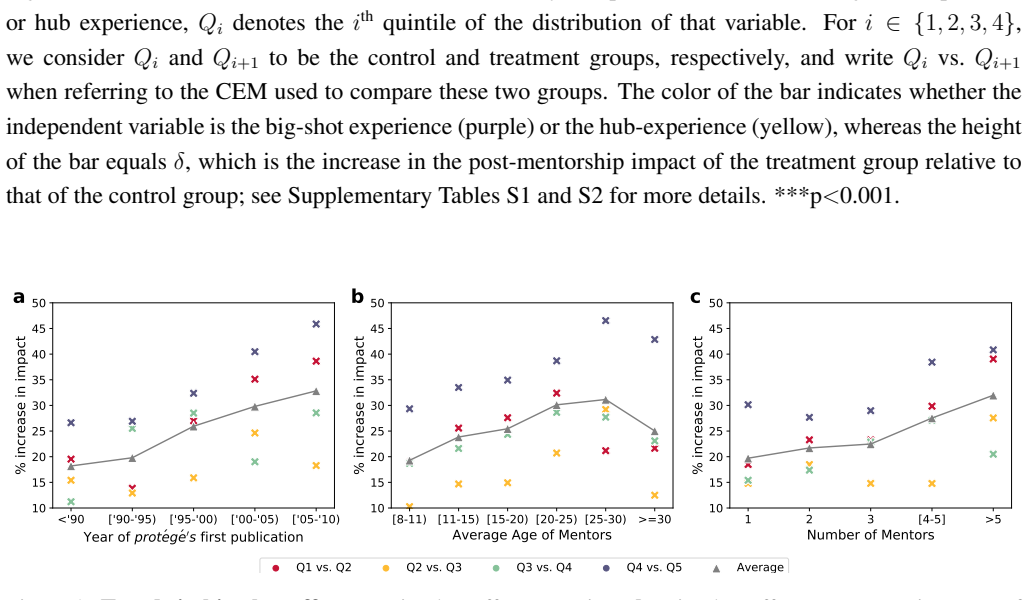
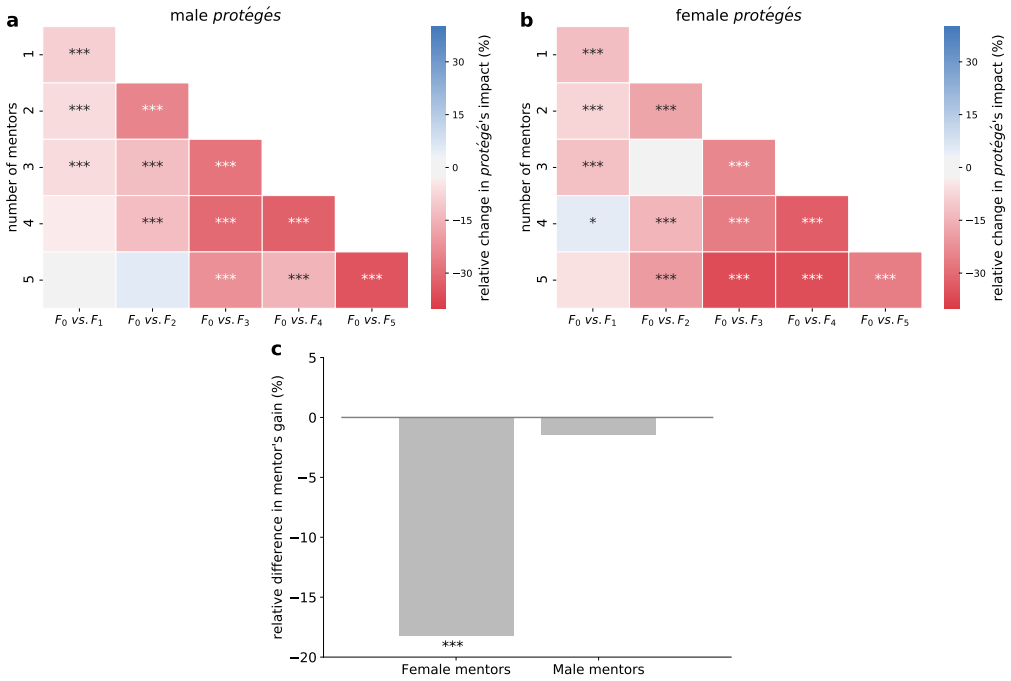
The paper's central claim is that mentorship quality has a causal effect on the scientific impact of the papers a protege writes after the mentorship period ends. The strongest quantified form is the 'big-shot effect': moving a protege from one quintile of mentor prior-impact to the next increases post-mentorship impact by up to 36 percent, whereas the corresponding 'hub effect' from mentors' network centrality never exceeds 7 percent. The effect persists across disciplines, university ranks, and protege gender; it grows with the number of mentors and roughly doubles in recent decades, and it rises with mentors' academic age until around 30 years of experience, then declines. On gender, the paper claims that increasing the proportion of female mentors among a protege's informal mentors decreases the protege's later impact (by up to 35 percent in the matched comparisons), and that female mentors gain on average 18 percent fewer citations from mentoring female than male proteges, while male mentors' gains are unaffected. The paper reads these results as evidence that policies pushing female-female mentorships, however effective at retaining women in science, may reduce the later impact of the women who stay, and that opposite-gender mentorships should be encouraged instead.
Load-bearing premise
The estimate assumes that after matching on the listed covariates, proteges with high-impact mentors and proteges with lower-impact mentors differ only in their mentorship quality—that is, there is no unmeasured difference in the protege's own ability, prior publication record, or selection into high-status mentors that drives both who mentors them and their later impact.
Editorial extensions
If this is right
- If mentorship quality is causal, then the impact of a young scientist's later independent work can be raised by changing who they collaborate with early, not just by changing their own effort or resources.
- Because the big-shot effect grows with the number of mentors and is strongest with more than five mentors, supporting early-career scientists in building a broad set of senior collaborators is a plausible route to higher impact.
- The peak at roughly 30 years of mentor experience means that the most productive informal mentoring may come from mid-to-late-career scientists, not the very newest or the most senior.
- The gender results imply that policies designed to retain women by pairing them with female mentors may need to weigh a trade-off: retention gains against a measured reduction in later citation impact for those who stay, and against lower citation gains for female mentors themselves.
- Because the hub effect is small relative to the big-shot effect, a mentor's standing in the collaboration network matters less than their demonstrated citation impact—so mentorship policy should prioritize research eminence over connectedness.
Reading between the lines
- Beyond the paper: a test restricting to same-subfield mentorships would discriminate knowledge transfer from a pure status halo, since the paper does not separate these channels.
- Beyond the paper: adding each protege's own pre-mentorship citation trajectory as a matching variable would likely shrink the 36 percent figure, because the paper's match does not include prior output.
- Beyond the paper: the gender findings imply that informal mentorship networks are a resource distributed unequally by gender, so opposite-gender mentorship policies could work only if enough high-impact male mentors are available and willing.
- Beyond the paper: on the mentor side, the lower gain female mentors experience from female proteges could be driven by audience citation bias rather than mentorship quality, a channel the paper does not distinguish.
Signed reviews
Editorial analysis
A structured set of objections, weighed in public.
Referee Report
Summary. The paper investigates whether informal mentorship by senior coauthors affects junior scientists' later independent impact. Using Microsoft Academic Graph data, the authors define protégé-mentor pairs, measure mentorship quality by mentors' prior citation impact ("big-shot experience") and prior collaboration degree ("hub experience"), and use coarsened exact matching between adjacent quintiles of these measures to estimate effects on the protégé's average five-year citation impact after mentorship. The paper reports positive causal effects (up to 36% for high-status mentors), increasing with mentor count and with mentor age up to a threshold, and analyzes gender composition effects on both protégé outcomes and mentors' citation gains.
Significance. The research question is important, and the dataset is unusually large. I credit the authors for making their matching definitions and supplementary tables explicit; this transparency is what exposes the internal inconsistency discussed below. Nevertheless, the paper's primary evidence contradicts its headline claim: in the main matched comparison, higher mentorship-quality groups have lower post-mentorship impact than controls. Since this reversal affects the abstract, Results, and the policy-related gender conclusions, the significance of the claimed causal effect cannot be credited as presented.
major comments (3)
- [Supplementary Table S3] The definition of δ in Supplementary Note 3 is δ = 100·(imp(T′) − imp(C′))/imp(C′), with C = Qi and T = Qi+1. For Q1 vs Q2, the table reports imp(C′) = 14.86 and imp(T′) = 11.66, which gives δ = −21.5%, not +27.4%. The same reversal occurs in every row: Q2 vs Q3 gives −14.1% (reported +16.4%), Q3 vs Q4 gives −17.7% (reported +21.5%), and Q4 vs Q5 gives −26.2% (reported +35.5%). The reported positive values are those that would be obtained from 100·(imp(C′) − imp(T′))/imp(T′), i.e., both the sign and the denominator are inverted. This is not a local typo: it reverses the direction of the headline causal effect.
- [Supplementary Tables S4–S10] The same pattern is systematic rather than isolated. In Table S4 (hub effect), each higher-quintile matched group has lower mean post-mentorship impact than the lower-quintile group (e.g., 18.61 vs 19.83 for Q1 vs Q2, reported as +6.6% instead of −6.2%), and the same inversion recurs in the large majority of stratified rows in Tables S5–S10 for time periods, mentor-age bins, mentor-count bins, university-rank bins, gender, and discipline. Some individual rows, such as Geology Q2 vs Q3 in Table S10, do report negative δ correctly, which shows that the issue is not a uniformly applied alternative convention. Because the matched control group consistently outperforms the treatment group, the abstract's central claim that higher mentorship quality increases post-mentorship impact is not supported by the paper's own evidence; the observed matched association is negative.
- [Results: Causal identification] Even if the sign issue were corrected, the causal claim rests on an unconfoundedness assumption that is asserted rather than supported. The matching variables listed where CEM is introduced (number of mentors, first mentored-paper year, discipline, gender, affiliation rank, post-mentorship active years, average mentor age, and the other mentorship-quality measure) do not include the protégé's own prior productivity or prior citation impact, and no sensitivity analysis or placebo test is provided. Because both the treatment (mentors' prior citation impact) and the outcome (protégé's post-mentorship citation impact) are citation-based measures, selection of higher-ability protégés into mentors with higher citation impact is a concrete alternative explanation that the current design does not rule out.
minor comments (3)
- [Supplementary Table S7] The rows for two mentors and three mentors are numerically identical, which appears to be a copy-paste error and should be corrected.
- [Figure 1 caption] The caption says to see Supplementary Tables S1 and S2 for details, but the actual CEM result tables for the big-shot and hub effects are Supplementary Tables S3 and S4.
- [Reference [20]] Reference [20] credits Fortunato et al. with the title "Hot streaks in artistic, cultural, and scientific careers"; the correct title of that review article is "Science of science". The hot streaks paper is already reference [17].
Circularity Check
No circularity found: the treatment and outcome are independently measured citation aggregates, and the causal claim rests on CEM comparisons rather than on definitional identity or a self-citation chain.
full rationale
The paper's central claim is empirical: mentorship quality, measured by mentors' average annual citations before mentorship ('big-shot experience') or average collaboration degree ('hub experience'), is compared against the protege's later citation impact on papers written without those mentors (c5). These constructs are not defined in terms of one another; the outcome excludes co-authored mentor papers, while the treatment is computed from mentor histories prior to the collaboration. No parameter is fitted to the outcome and then renamed as a prediction; the reported delta is a direct relative difference between matched group means using the formula in Supplementary Note 3. The CEM design is standard and the confounding controls are listed explicitly. The only self-citation is to the authors' own prior work [18] for the scientist-discipline classification method; this is a methodological input, not a uniqueness theorem or an argument that forces the causal conclusion, so it is not load-bearing in the circularity sense. A separate concern, visible in Supplementary Tables S3-S10, is that the printed imp(C') and imp(T') values are everywhere inconsistent with the printed positive delta values, which would imply a sign-reversal or reporting error. That is an internal-consistency or correctness problem, not a circularity: even if the arithmetic were wrong, the treatment and outcome would still be independently defined. No reduction of the paper's derivation to its own inputs was found, so the circularity score is 0.
Assumptions & free parameters
free parameters (4)
- junior_career_threshold =
7 years
- c5_measurement_window =
5 years
- publication_gap_threshold =
5 years
- gender_confidence_threshold =
95 percent
assumptions (6)
- domain assumption Microsoft Academic Graph accurately records authors, affiliations, publication dates, and citations.
- domain assumption Citation count five years after publication is a valid measure of scientific impact.
- domain assumption Coauthorship between a junior and a senior scientist at the same US institution constitutes informal mentorship.
- domain assumption Academic age, measured as years since first publication, accurately reflects career stage.
- domain assumption Coarsened exact matching on the listed observed confounders identifies average causal effects.
- domain assumption Gender inferred from first names via genderize.io is accurate for the retained sample.
Cite this review
Pith. "Pith review of The Impact of Informal Mentorship in Academic Collaborations." pith.science (2026). https://pith.science/paper/5S3IVHYL
@misc{pith2026190803813,
  author       = {Pith},
  title        = {Pith review of: The Impact of Informal Mentorship in Academic Collaborations},
  year         = {2026},
  howpublished = {\url{https://pith.science/paper/5S3IVHYL}},
  note         = {Machine review of arXiv:1908.03813}
}
read the original abstract
Inspired by the numerous benefits of mentorship in academia, we study "informal mentorship" in scientific collaborations, whereby a junior scientist is supported by multiple senior collaborators, without them necessarily having any formal supervisory roles. To this end, we analyze 2.5 million unique pairs of mentor-prot\'eg\'es spanning 9 disciplines and over a century of research, and we show that mentorship quality has a causal effect on the scientific impact of the papers written by the prot\'eg\'e post mentorship. This effect increases with the number of mentors, and persists over time, across disciplines and university ranks. The effect also increases with the academic age of the mentors until they reach 30 years of experience, after which it starts to decrease. Furthermore, we study how the gender of both the mentors and their prot\'eg\'e affect not only the impact of the prot\'eg\'e post mentorship, but also the citation gain of the mentors during the mentorship experience with their prot\'eg\'e. We find that increasing the proportion of female mentors decreases the impact of the prot\'eg\'e, while also compromising the gain of female mentors. While current policies that have been encouraging junior females to be mentored by senior females have been instrumental in retaining women in science, our findings suggest that the impact of women who remain in academia may increase by encouraging opposite-gender mentorships instead.
Figures

Reference graph
Works this paper leans on
-
[1]
Kram, K. E. Mentoring at work: Developmental relationships in organizational life (University Press of America, Lanham, MD, England, 1988). 5
work page 1988
-
[2]
Allen, T. D., Eby, L. T., Poteet, M. L. & Lentz, E. Career benefits associated with mentoring for prot´eg´e: a meta-analysis. Journal of Applied Psychology 89, 127–136 (2004)
work page 2004
-
[3]
Scandura, T. A. Mentorship and career mobility: An empirical investigation. Journal of Organiza- tional Behavior 13, 169–174 (1992)
work page 1992
-
[4]
Singh, V ., Bains, D. & Vinnicombe, S. Informal mentoring as an organisational resource.Long Range Planning 35, 389–405 (2002)
work page 2002
-
[5]
Kram, C. T. K. E. The efficacy of mentoring – the benefits for mentees, mentors, and organizations. In Passmore, J., Peterson, D. B., & Freire, T. (eds.)The Wiley-Blackwell Handbook of the Psychology of Coaching and Mentoring, First Edition , chap. 12, 217–242 (John Wiley & Sons, Ltd, 2013)
work page 2013
-
[6]
Kanter, R. M. Men and Women of the Corporation (Basic Books, New York, 1977)
work page 1977
-
[7]
Levine, A. & Nidiffer, J. Beating the Odds: How the Poor Get into College (Jossey-Bass, San Francisco, 1996)
work page 1996
-
[8]
Stephens, N. M., Hamedani, M. G. & Destin, M. Closing the social-class achievement gap: A difference-education intervention improves first-generation students’ academic performance and all students’ college transition. Psychological Science 25, 943–953 (2014)
work page 2014
Show all 52 references
-
[9]
& Piacentinic, M
Gaule, P. & Piacentinic, M. An advisor like me? advisor gender and post-graduate careers in science. Research Policy 47, 805–813 (2018)
2018
-
[10]
Higgins, M. C. & Kram, K. E. Reconceptualizing mentoring at work: A developmental network perspective. The Academy of Management Review 26, 264–288 (2001)
2001
-
[11]
Higgins, M. C. & Thomas, D. A. Constellations and career: Toward understanding the effects of multiple developmental relationships. Organizational Behavior 22, 223–247 (2001)
2001
-
[12]
Wuchty, S., Jones, B. F. & Uzzi, B. The increasing dominance of teams in production of knowledge. Science 316, 1036–1039 (2007)
2007
-
[13]
Guimer `a, R., Uzzi, B., Spiro, J., Lu ´ıs & Amaral, A. N. Team assembly mechanisms determine collaboration network structure and team performance. Science 308, 697–702 (2005)
2005
-
[14]
Sekara, V . et al. The chaperone effect in scientific publishing. Proceedings of the National Academy of Sciences 115, 12603–12607 (2018)
2018
-
[15]
E., Allesina, S
Acuna, D. E., Allesina, S. & Kording, K. P. Predicting scientific success. Nature 489, 201–202 (2012)
2012
-
[16]
R., Robinson-Garcia, N., Murray, D
Sugimoto, C. R., Robinson-Garcia, N., Murray, D. S., Yegros-Yegros, A. & Lariviere, R. C. V . Sci- entists have most impact when they’re free to move.Nature 550, 29–31 (2017). 6
2017
-
[17]
Liu, L. et al. Hot streaks in artistic, cultural, and scientific careers. Nature 559, 396–399 (2018)
2018
-
[18]
K., Rahwan, T
AlShebli, B. K., Rahwan, T. & Woon, L. W. The preeminence of ethnic diversity in scientific collab- oration. Nature Communications 9, 5163 (2018)
2018
-
[19]
& Jones, B
Uzzi, B., Mukherjee, S., Stringer, M. & Jones, B. Atypical combinations and scientific impact. Science 342, 468–472 (2013)
2013
-
[20]
Fortunato, S. et al. Hot streaks in artistic, cultural, and scientific careers. Science 359 (2018)
2018
-
[21]
Hirshman, B. R. et al. Impact of medical academic genealogy on publication patterns: An analysis of the literature for surgical resection in brain tumor patients. Annals of Neurology 79, 169–177 (2016)
2016
-
[22]
Johnson, W. B. Student-faculty mentorship outcomes. In Allen, T. D. & Eby, L. T. (eds.) The Blackwell handbook of mentoring: A multiple perspectives approach , chap. 12, 189–210 (Blackwell Publishing, Malden, 2007)
2007
-
[23]
& Sugimoto, C
Larivi `ere, V ., Ni, C., Gingras, Y ., Cronin, B. & Sugimoto, C. R. Bibliometrics: global gender dispar- ities in science. Nature 504, 211–213 (2013)
2013
-
[24]
M., Brown, E
Handley, I. M., Brown, E. R., Moss-Racusin, C. A. & Smith, J. L. Quality of evidence revealing subtle gender biases in science is in the eye of the beholder. PNAS 112, 13201–13206 (2015)
2015
-
[25]
Nielsen, M. W. et al. Opinion: Gender diversity leads to better science. Proceedings of the National Academy of Sciences 114, 1740–1742 (2017)
2017
-
[26]
Berenbaum, M. R. Speaking of gender bias. PNAS 116, 8086–8088 (2019)
2019
-
[27]
Reskin, B. F. Academic sponsorship and scientists’ careers. Sociology of Education 52, 129–146 (1979)
1979
-
[28]
The effects of mentoring on academic careers over time: Testing performance and political perspectives
Kirchmeyer, C. The effects of mentoring on academic careers over time: Testing performance and political perspectives. Human Relations 58, 637–660 (2005)
2005
-
[29]
L., Green, S
Paglis, L. L., Green, S. G. & Bauer, T. N. Does adviser mentoring add value? a longitudinal study of mentoring and doctoral student outcomes. Research in Higher Education 47, 451–476 (2006)
2006
-
[30]
D., Ottino, J
Malmgren, R. D., Ottino, J. M. & Amaral, L. A. N. The role of mentorship in prot ´eg´e performance. Nature 465, 622–626 (2010)
2010
-
[31]
H., Zhang, Y ., Pani, J
Chariker, J. H., Zhang, Y ., Pani, J. R. & Rouchka, E. C. Identification of successful mentoring com- munities using network-based analysis of mentormentee relationships across nobel laureates. Scien- tometrics 111, 1733–1749 (2017). 7
2017
-
[32]
Rossi, L., Freire, I. L. & Mena-Chalco, J. P. Genealogical index: A metric to analyze advisoradvisee relationships. Journal of Informetrics 11, 564–582 (2017)
2017
-
[33]
F., Achakulvisut, T., Acuna, D
Lin `eard, J. F., Achakulvisut, T., Acuna, D. E. & David, S. V . Intellectual synthesis in mentorship determines success in academic careers. Nature Communications 9, 1733–1749 (2018)
2018
-
[34]
Liu, J. et al. Understanding the advisor-advisee relationship via scholarly data analysis. Scientomet- rics 116, 161–180 (2018)
2018
-
[35]
D., Currie, J
Blau, F. D., Currie, J. M., Croson, R. T. A. & Ginther, D. K. Can mentoring help female assis- tant professors? interim results from a randomized trial. American Economic Review 100, 348–354 (2010)
2010
-
[36]
Sinha, A. et al. An overview of microsoft academic service (mas) and applications. In Proceedings of the 24th international conference on world wide web , 243–246 (ACM, 2015)
2015
-
[37]
M., King, G
Iacus, S. M., King, G. & Porro, G. Causal inference without balance checking: coarsened exact matching. Political Analysis 20, 1–24 (2012)
2012
-
[38]
& Woolley, A
Bear, J. & Woolley, A. The role of gender in team collaboration and performance. Interdisciplinary Science Reviews 36 (2011)
2011
-
[39]
Gender prediction methods based on first names with genderizer
Wais, K. Gender prediction methods based on first names with genderizer. R Journal 8 (2016)
2016
-
[40]
genderize.io
Academic ranking of world universities. http://www.shanghairanking.com/ARWU2018.html (2018). 8 Methods The data used for this study was obtained in October 2015 from the Microsoft Academic Graph (MAG) dataset [36]. This data set includes records of scientific publications speci...
2018 arXiv
-
[41]
The data points are divided into 10 bins based on percentile cutoffs as follows: <4.0; 4.0-7.1; 7.2-10.5; 10.6-14.2; 14.3-18.4; 18.5-23.3, 23.4-29.5; 29.6-38.2; 38.3-54.2;>54.2
Big-Shot experience (IV): This is computed for any given prot´eg´e by first computing the average annual number of citations of each mentor up to the year of their first publication with the prot ´eg´e, and then averaging these numbers over all mentors. The data points are divid...
-
[42]
Note that this network changes over time
Hub experience (IV): This is computed for any given prot ´eg´e as the average degree of the mentors prior to mentorship, where the degree of each such mentor is measured in the network of scientific collaborations, i.e., the network where every node represents a scientist and a...
-
[43]
Number of mentors (C) : The total number of mentors that the prot ´eg´e has, which is divided into 5 bins based on quintile cutoffs as follows: 1; 2; 3; 4-5;>5
-
[44]
This is divided into 10 bins based on percentile cutoffs as follows: 4 <1987; 1987-1992; 1993-1996; 1997-1998; 1999-2001; 2002-2003; 2004-2005; 2006- 2007; 2008-2009;≥ 2010
Year of the prot´eg´e’s first publication (C): The year in which the prot´eg´e published their first mentored paper. This is divided into 10 bins based on percentile cutoffs as follows: 4 <1987; 1987-1992; 1993-1996; 1997-1998; 1999-2001; 2002-2003; 2004-2005; 2006- 2007; 2008-2...
1987
-
[45]
Gender of the prot ´eg´e (C): The data points in our study are divided into 2 bins: male and female. Following (1),the gender of prot´eg´es and mentors is identified using a state- of-the art gender classifier (2), and drop all mentor-prot´eg´e pairs where the gender of the prot...
-
[46]
The data points in our study are divided into the following bins: 1; 2; 3
University rank (C): The rank1 of the affiliation of the prot ´eg´e on their first mentored publication. The data points in our study are divided into the following bins: 1; 2; 3; . . . ; 99; 100; 101-150; 151-200; 201-300; 301-400; 401-500;>500
-
[47]
Average academic age of mentors (C): This is computed for any given prot ´eg´e by first computing the academic age 2 of each mentor in the year of their first publication with the prot´eg´e, and then averaging these numbers over all the mentors. The data points are divided into ...
-
[48]
Academic Ranking of World Universities
The number of years post mentorship (C) : Since our dataset was obtained in October 2015, we are only able to calculate c5—the number of citations accumulated five years post publication—for papers published before 2011. Thus, given a prot ´eg´e whose first paper was published i...
2015
-
[49]
Scientific discipline (C) : The prot ´eg´es are classified into disciplines using the method proposed by ( 1). This method classifies any given scientist, si, based on the keywords that are specified in the publications of si, which are themselves classified by Microsoft Academic G...
1911
-
[50]
K., Rahwan, T
AlShebli, B. K., Rahwan, T. & Woon, L. W. The preeminence of ethnic diversity in scientific collaboration. Nature Communications 9, 5163 (2018)
2018
-
[51]
Gender prediction methods based on first names with genderizer
Wais, K. Gender prediction methods based on first names with genderizer. The R Journal 8, 17–37 (2016)
2016
-
[52]
M., King, G
Iacus, S. M., King, G. & Porro, G. Causal inference without balance checking: Coarsened exact matching. Political analysis 20, 1–24 (2012). 16
2012
Reviewed August 14, 2026 · model on record in the stance chip above.
Discussion (0). Continue with ORCID to comment.