REVIEW 4 major objections 6 minor 33 references
Synchronous oscillations locked on classical energy levels by two cooperating drives
T0 review · 4 major / 6 minor · reviewed 2026-08-14 · deepseek-v4-flash
Pith's one-line read Two equally strong, properly detuned drives can lock a classical mechanical oscillator onto discrete, noise-robust energy levels.
desk verdict A novel numerical observation of discrete mechanical energy levels in a doubly driven optomechanical system, but the evidence is almost entirely computational and the higher-level claims need independent reproduction and an analytic anchor. read the letter →
The pith
A machine-rendered reading of the paper's core claim, the machinery that carries it, and where it could break.
The reading
What carries the argument
The central object is the pair of cooperating drives on the optomechanical system described by Eq. (1): a cooling field detuned by $\omega_m$ from the cavity and a resonant field, with equal amplitudes $E_1=E_2$. What carries the argument is the nonlinear coupling $\tfrac{\sqrt{2}}{4}gX_m(X_c^2+P_c^2)$ between the cavity field quadratures and the mechanical displacement. Under matched frequencies this nonlinearity turns the resonant drive's intensity into a staircase response of the mechanical amplitude, while the cooling field lowers the resulting levels and locks their phases; the single-mode approximation $X_m(t)=A\sin(\omega_m t)+d$ (Eq. C1) then lets the discrete $A_n$ be read off the stabilized trajectories and connects each level to the average energy $\langle E_m\rangle^{(n)}\approx \tfrac{1}{2}A_n^2$.
What would settle it
Take the parameters of Fig. 1B ($\omega_m=50\kappa$, $g/\sqrt{2}=10^{-5}\kappa$, $\gamma_m=10^{-5}\kappa$) and sweep $E$ continuously through the claimed threshold $E\approx 5\times 10^5\kappa$ up to $E\approx 10^8\kappa$, using two independent high-precision integrators with step sizes differing by, say, a factor of two. If the stabilized time-averaged mechanical energy $\langle E_m\rangle$ is not constant over finite intervals but instead varies continuously, or if the set of stabilized values depends on the integrator's step size rather than converging to the tabulated levels $A_n$, then the discrete energy levels are numerical artifacts. The same check can be performed experimentally by measuring $\langle E_m\rangle$ versus drive amplitude in a high-finesse cavity with the two matched drives.
Extended reading notes
Core claim
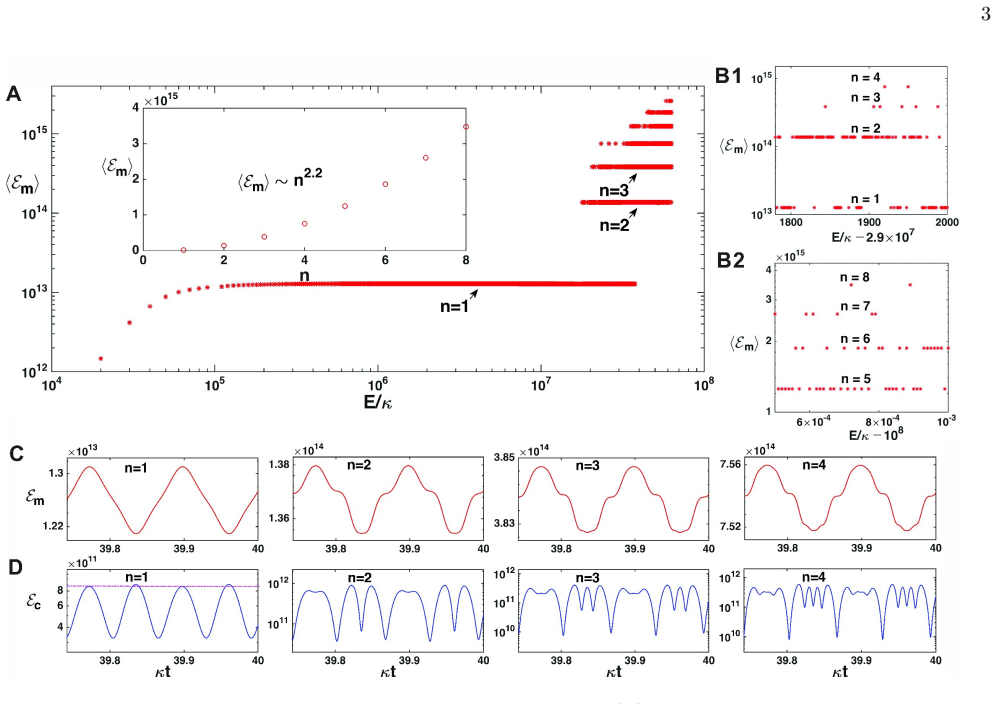
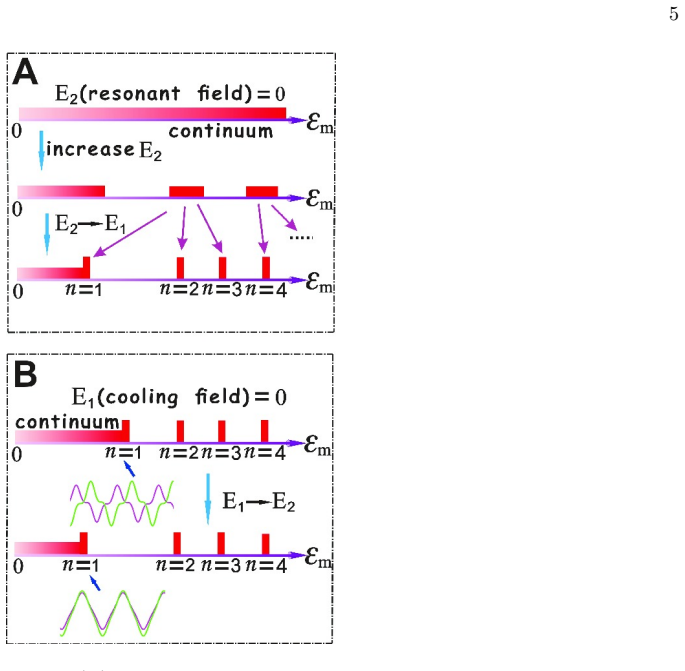
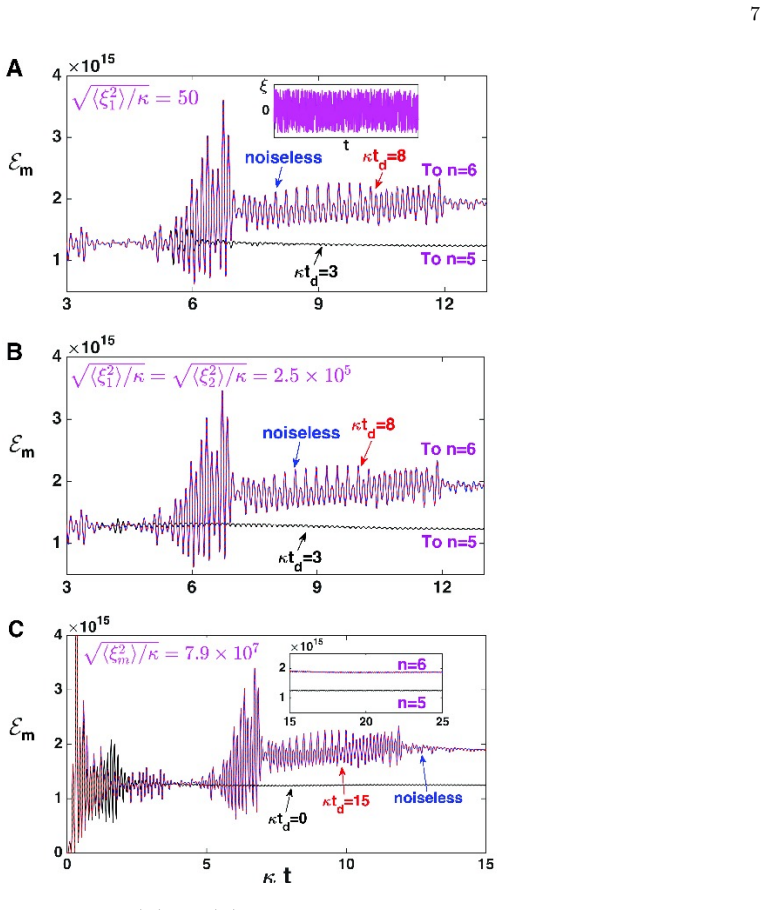
Under the frequency-matching condition $\Delta_1=\omega_m$ and $\Delta_2=0$ with equal drive amplitudes $E_1=E_2=E$, the mechanical displacement approaches a single-frequency locked oscillation $X_m(t)=A\sin(\omega_m t+\varphi)+d$. The amplitude $A$ takes one of a discrete set of values $A_n$ rather than growing continuously with $E$; the time-averaged mechanical energy therefore sits on levels $\langle E_m\rangle^{(n)}\approx \tfrac{1}{2}A_n^2$, with the empirical power law $\langle E_m\rangle^{(n)}\sim n^{2.2}$. The cavity field develops a characteristic oscillation pattern whose number of peaks in half a period identifies the mechanical level, and all frequency components of the two oscillators are phase-synchronized ($n{:}m$ synchronization). The resonant drive alone creates the discrete amplitude response through nonlinear saturation; adding the equal cooling drive lowers the levels and synchronizes phases across different $E$. The level ultimately reached depends sensitively on initial conditions (a difference of $10^{-18}$ in initial energy can change the final level), but the final locked state is immune to noise applied after stabilization. The paper's claim is that this discrete-level structure is a genuine property of the underlying differential equations, validated by accepting only numerical results that survive refinement of precision.
Load-bearing premise
The whole phenomenon rests on the numerical solutions of Eq. (1) faithfully representing the dynamics; for levels $n\ge 4$ the paper reports that changing computation precision can switch which level is reached, so if the discrete plateaus are artifacts of the solver rather than true properties of the equations, the central claim fails.
Editorial extensions
If this is right
- If the claim is right, a large classical object can have discrete, noise-robust energy levels, so quantization-like behavior can be mimicked by classical nonlinear dynamics without invoking quantum mechanics.
- The mechanical energy level can be read out directly from the cavity field's oscillation pattern (peak count in a half period), giving a practical non-invasive level indicator.
- Because the final level is highly sensitive to perturbations during the transient but immune to them after stabilization, the system could act as a sensor for small early disturbances or tiny differences in initial conditions.
- The strict condition $\Delta_1=\omega_m$ with $\Delta_2=0$ turns the two-drive setup into a way to measure the mechanical frequency precisely: energy-level locking occurs only at exact matching.
- The first energy level is predicted at effective cooling intensity $J\approx 0.1$, within reach of current optomechanical systems, so the phenomenon should be testable now.
Reading between the lines
- Inference: The irregular, nearly random pattern of which level is selected as the drive amplitude changes suggests that basin boundaries between neighboring levels are complicated, possibly fractal; if so, this two-drive system could serve as a deterministic yet unpredictable level selector, a candidate physical source of random bits.
- Inference: The same mechanism may generalize beyond optomechanics to any two nonlinearly coupled oscillators with one resonant and one cooling-like drive; a direct test would be to look for amplitude plateaus in driven micromechanical or optoelectronic oscillator experiments.
- Inference: The empirical power law $\langle E_m\rangle^{(n)}\sim n^{2.2}$ is close to quadratic; if higher levels tighten toward $n^2$, the classical level spacings would mimic a harmonic oscillator, a connection the paper does not make.
- Inference: The robustness of stabilized levels suggests a possible control protocol: apply a short pulse during the transient to select a desired level, then let the system settle; the paper's square-pulse tests hint at this but do not demonstrate deterministic level selection.
Signed reviews
Editorial analysis
A structured set of objections, weighed in public.
Referee Report
Summary. The manuscript reports numerical evidence that a classical optomechanical oscillator driven by two equal-amplitude fields, one red-detuned by the mechanical frequency and one resonant, can synchronize onto a discrete set of stabilized oscillatory states whose time-averaged mechanical energy ⟨Em⟩ takes discrete values resembling energy levels. The central claim is that the amplitude and phase of the mechanical motion become locked to one of several discrete levels, that the levels are robust to noise after stabilization, and that the transition between levels is sensitive to initial conditions and drive amplitude. The paper presents simulations of Eq. (1), a single-mode approximation for the locked motion, a comparison with linearized cavity dynamics in Appendix C, and numerical robustness checks under drive and thermal noise in Section VII.
Significance. If the central claim is correct, the paper reports a genuinely striking classical analogue of discrete energy levels, with potential implications for nonlinear dynamics, synchronization, and precision measurement. The manuscript gives credit for a number of careful numerical checks: the single-mode approximation is compared against the full nonlinear dynamics in Fig. C1, the noise robustness of the stabilized levels is demonstrated in Fig. 5, and the dependence on the two drives is explored systematically in Appendices C and D. However, the significance is conditional because the existence of the discrete levels, especially for n≥4, is established only by numerical integration of the ordinary differential equations, with no independent verification that the plateaus are true invariant attractors of Eq. (1). The paper also contains no analytic derivation of the level positions or of the claimed power law, so the result currently rests on numerical observation.
major comments (4)
- [Appendix B] The admitted precision dependence for the higher energy levels is a load-bearing gap. Appendix B states that for n≥4, a different computation precision will lead to a different energy level being reached, and the authors reinterpret this as sensitivity to initial conditions caused by different iteration step sizes. That interpretation is plausible only if the set of candidate levels is independently known to consist of stable limit cycles of Eq. (1). The paper provides no Floquet stability analysis, no basin-of-attraction computation, and no convergence study demonstrating that the level values are invariant under changes of integrator, tolerance, and integration horizon. Since the abstract extrapolates the phenomenon to "whatever drive intensity beyond a threshold," the n≥4 levels are not yet established as properties of the differential equations rather than of a particular numerical solver.
- [Appendix C] The linearized validation in Appendix C is partly circular. Table C1 reads the amplitudes An and displacements dn from the contours of the same numerical simulations that the linearized Eq. (C2) is meant to validate, and the agreement in Fig. C1 then confirms the single-mode ansatz but not the existence or discreteness of the levels. To substantiate the central claim, the candidate amplitudes should be obtained independently, for example by solving the algebraic conditions for a periodic orbit of the full system or by continuing the n=1 branch in drive amplitude and checking for bifurcations. Without such an independent determination, the plateaus in ⟨Em⟩ could be an artifact of the way the simulations are initialized and integrated.
- [Section III] The power law ⟨Em⟩(n)∼n^2.2 is presented without derivation, uncertainty estimate, or a statement of the fitted range. With only five levels, irregular horizontal spacing, and overlapping levels as shown in Figs. 2B1 and 2B2, the exponent is not a quantitatively supported claim. Please provide the fit residuals, the dependence of the exponent on system parameters, or an analytic derivation; otherwise the claim should be explicitly labeled as an empirical observation over the computed range.
- [Section VI] The claim that the sensitivity to initial conditions "has nothing to do with chaos" is supported only by the observation that final differences appear bounded in two example trajectories. A bounded difference over a finite integration time does not exclude transient chaos or a weak positive Lyapunov exponent, especially in a regime where the manuscript itself reports extreme sensitivity to precision. A quantitative Lyapunov-exponent calculation or a return-map analysis of the stabilized motion is needed to make the non-chaos claim persuasive.
minor comments (6)
- [Abstract] The abstract contains typographical errors: "continues values" should be "continuous values," and "against intuition" would read more naturally as "contrary to intuition."
- [Fig. 4 caption] The caption contains a typo: "different enenrgy level" should be "different energy level."
- [Section III] In the sentence "after magnifying the scales on the horizontal axis as in Figs. B1 and B2," the references should be to Figs. 2B1 and 2B2 in the main text.
- [Appendix D] The reference to "Fig. S2" in the caption of Fig. D2 appears to be a leftover from a supplementary file and should refer to Fig. D2 or another figure in the paper.
- [Appendix C] The formal time-ordered exponential expansion in Eq. (C3) is not used in the comparison; the text says the linearized equations are integrated numerically. The expansion could be removed or its purpose clarified to avoid confusion.
- [General] The manuscript would benefit from a description of the numerical integration method, tolerances, and convergence criteria, as well as a statement on code or data availability, to make the numerical results reproducible.
Circularity Check
Minor circularity: the phase-locking claim is built into the single-mode ansatz; the central energy-level observation is otherwise numerical and self-contained.
-
self definitional
[Appendix C, Eq. (C1); Section III (Properties of Energy Levels)]
"The approximation means that the stabilized oscillations for the oscillator having its amplitudes locked on the energy levels can take the form Xm(t) = An sin(ωmt) +dn (C1) by choosing the phase to be zero."
The main text concludes that 'by the single-mode approximation the phase φn in Eq. (3) for each level is identical.' But Eq. (C1) sets the phase to zero by an arbitrary choice of time origin, which can be made independently for every trajectory. Under this parametrization every oscillation has the same zero phase, so the claimed phase synchronization among levels and drive amplitudes is built into the ansatz rather than derived from Eq. (1) or independently measured. The phase-locking part of the claimed phenomenon therefore reduces to a convention.
full rationale
The paper's central claim—discrete plateaus of the time-averaged mechanical energy in Eq. (1)—is a numerical observation obtained by direct integration, not a derivation that assumes the conclusion. The relation ⟨Em⟩≈½An² is algebraic once the single-mode ansatz is adopted, and An is read from the same simulations; this is a parametrization, not an inference from the conclusion. The n^2.2 scaling is an empirical fit, not a prediction. Appendix C's comparison of linearized cavity quadratures with full simulations is a self-consistency check: An and dn are inputs taken from the nonlinear run, so agreement cannot independently establish the existence of the levels, though it does not force the output. The one genuinely circular move is the phase-synchronization statement: the single-mode ansatz sets the phase to zero by choosing the time origin, and the paper then asserts that the phase is identical by that same approximation; any oscillation can be written that way with a per-trajectory time shift, so the assertion is true by construction rather than by dynamics. Appendix B's admission that different numerical precisions reach different levels for n≥4 is a numerical-validity concern, not a circularity. No load-bearing self-citation appears; ref. [26] is used only to set the scale of the effective cooling intensity.
Assumptions & free parameters
free parameters (1)
- power law exponent for level energies =
2.2
assumptions (3)
- domain assumption The classical optomechanical equations of motion (Eq. 1) accurately model the experimental setup of Fig. 1A, including the two coherent drives and the mechanical oscillator.
- ad hoc to paper The stabilized mechanical motion is well approximated by a single-frequency sinusoid plus a constant displacement (Eq. C1).
- domain assumption Numerical integration with sufficient precision yields physically meaningful stabilized states, including for levels n≥4 where results depend on computation precision.
Cite this review
Pith. "Pith review of Synchronous oscillations locked on classical energy levels by two cooperating drives." pith.science (2026). https://pith.science/paper/5U6OZEFN
@misc{pith2026190805231,
  author       = {Pith},
  title        = {Pith review of: Synchronous oscillations locked on classical energy levels by two cooperating drives},
  year         = {2026},
  howpublished = {\url{https://pith.science/paper/5U6OZEFN}},
  note         = {Machine review of arXiv:1908.05231}
}
read the original abstract
It is intuitively imagined that the energy of a classical object always takes continues values and can hardly be confined to discrete ones like the energy levels of microscopic systems. Here, we demonstrate that such classical energy levels against intuition can be created through a previously unknown synchronization process for nonlinearly coupled macroscopic oscillators driven by two equally strong fields. Given the properly matched frequencies of the two drive fields, the amplitude and phase of an oscillator will be frozen on one of a series of determined trajectories like energy levels, and the phenomenon exists for whatever drive intensity beyond a threshold. Interestingly, the oscillator's motion can be highly sensitive to its initial condition but, unlike the aperiodicity in chaotic motion, it will nonetheless end up on such fixed energy levels. Upon reaching the stability, however, the oscillations on the energy levels are robust against noisy perturbation.
Figures

Figures from the paper (2 more)

Reference graph
Works this paper leans on
-
[1]
S. H. Strogatz and I. Stewart, Coupled Oscillators and Biological Synchronization. Sci. Am. 269, 102 (1993)
work page 1993
-
[2]
A. Pikovsky, M. Rosenblum, and J. Kurths, Synchronization: A universal concept in nonlinear sciences (Cambridge University Press, 2001)
work page 2001
-
[3]
R. V. Jensen, Synchronization of driven nonlinear oscillators. Am. J. Phys. 70, 607 (2002)
work page 2002
-
[4]
A. Balanov, N. Janson, D. Postnov, and O. Sosnovtseva, Synchronization: From simple to complex (Springer-Verlag, 2009)
work page 2009
-
[5]
Huygens, Horologium Oscillatorium (F
C. Huygens, Horologium Oscillatorium (F. Muguet, Paris, 1673)
-
[6]
J. Buck and E. Buck, Mechanism of Rhythmic Synchronous Flashing of Fire flies. Science 159, 1319-1327 (1968)
work page 1968
-
[7]
L. Goldberg, H. F. Taylor, and J. F. Weller, Injection locking of coupled-stripe diode laser arrays. Appl. Phys. Lett. 46, 236 (1985)
work page 1985
-
[8]
S. Shapiro, Josephson Currents in Superconducting Tunneling: The Effect of Microwaves and Other Observations. Phys. Rev. Lett. 11, 80 (1963)
work page 1963
Show all 33 references
-
[9]
A. K. Jain, K. K. Likharev, J. E. Lukens, and J. E. Sauvageau, Mutual phase-locking in Josephson junction arrays. Phys. Reports, 109, 309-426 (1984)
1984
-
[10]
Aspelmeyer, T
M. Aspelmeyer, T. J. Kippenberg, and F. Marquardt, Cavity optomechanics. Rev. Mod. Phys. 86, 1391-1452 (2014)
2014
-
[11]
G. S. Agarwal and S. Huang, Electromagnetically induced transparency in mechanical effects of light. Phys. Rev. A 81, 041803(R) (2010)
2010
-
[12]
Weis et al., Optomechanically Induced Transparency
S. Weis et al., Optomechanically Induced Transparency. Science 330, 1520-1523 (2010)
2010
-
[13]
A. H. Safavi-Naeini et al., Electromagnetically induced transparency and slow light with optomechanics. Nature 472, 69-73 (2011)
2011
-
[14]
J. Ma, C. You, L. Si, H. Xiong, J. Li, X. Yang, and Y. Wu, Formation and manipulation of optomechanical chaos via a bichromatic driving. Phys. Rev. A 90, 043839 (2014)
2014
-
[15]
Monifi et al., Optomechanically induced stochastic resonance and chaos transfer between optical fields
F. Monifi et al., Optomechanically induced stochastic resonance and chaos transfer between optical fields. Nat. Photonics 10, 399 (2016)
2016
-
[16]
Kronwald, F
A. Kronwald, F. Marquardt, and A. A. Clerk, Arbitrarily large steady-state bosonic squeezing via dissipation. Phys. Rev. A 88, 063833 (2013)
2013
-
[17]
Gammaitoni, P
L. Gammaitoni, P. H¨ anggi, P. Jung, and F. Marchesoni, Stochastic resonance. Rev. Mod. Phys. 70, 223 (1998)
1998
-
[18]
Lindner, J
B. Lindner, J. Garcia-Ojalvo, A. Neiman, and L. Schimansky-Geier, Effects of noise in excitable systems. Phys. Rep. 392, 321 (2004)
2004
-
[19]
Kuramoto, Chemical Oscillations, Waves, and Turbulence (Springer-Verlag, Berlin, 1984)
Y. Kuramoto, Chemical Oscillations, Waves, and Turbulence (Springer-Verlag, Berlin, 1984)
1984
-
[20]
L. M. Pecora and T. L. Carroll, Synchronization in chaotic systems. Phys. Rev. Lett. 64, 821 (1990)
1990
-
[21]
M. G. Rosenblum, A. S. Pikovsky, and J. Kurths, Phase Synchronization of Chaotic Oscillators. Phys. Rev. Lett. 76, 1804 (1996)
1996
-
[22]
J. M. Gonz´ alez-Miranda, Synchronization and Control of Chaos. An introduction for scientists and engineers (Imperial College Press, 2004)
2004
-
[23]
T. E. Lee and H. R. Sadeghpour, Quantum Synchronization of Quantum van der Pol Oscillators with Trapped Ions. Phys. Rev. Lett. 111, 234101 (2013)
2013
-
[24]
Walter, A
S. Walter, A. Nunnenkamp, and C. Bruder, Quantum Synchronization of a Driven Self-Sustained Oscillator. Phys. Rev. Lett. 112, 094102 (2014)
2014
-
[25]
Roulet and C
A. Roulet and C. Bruder, Synchronizing the Smallest Possible System. Phys. Rev. Lett. 121, 053601 (2018)
2018
-
[26]
B. He, L. Yang, Q. Lin, and M. Xiao, Radiation Pressure Cooling as a Quantum Dynamical Process. Phys. Rev. Lett. 118, 233604 (2017)
2017
-
[27]
Horsthemke and R
W. Horsthemke and R. Lefever, Noise-Induced Transitions (Springer-Verlag, Berlin, Heidelberg, 2006)
2006
-
[28]
Carmon, H
T. Carmon, H. Rokhsari, L. Yang, T. J. Kippenberg, and K. J. Vahala, Temporal Behavior of Radiation-Pressure-Induced Vibrations of an Optical Microcavity Phonon Mode. Phys. Rev. Lett. 94, 223902 (2005). 14
2005
-
[29]
Rokhsari, T
H. Rokhsari, T. Kippenberg, T. Carmon, and K. Vahala, Radiation-pressure-driven micro-mechanical oscillator. Opt. Express 13, 5293 (2005)
2005
-
[30]
T. J. Kippenberg, H. Rokhsari, T. Carmon, A. Scherer, and K. J. Vahala, Analysis of Radiation-Pressure Induced Me- chanical Oscillation of an Optical Microcavity. Phys. Rev. Lett. 95, 033901 (2005)
2005
-
[31]
Marquardt, J
F. Marquardt, J. G. E. Harris, and S. M. Girvin, Dynamical Multistability Induced by Radiation Pressure in High-Finesse Micromechanical Optical Cavities. Phys. Rev. Lett. 96, 103901 (2006)
2006
-
[32]
Carmon, M
T. Carmon, M. C. Cross, and K. J. Vahala, Chaotic Quivering of Micron-Scaled On-Chip Resonators Excited by Centrifugal Optical Pressure. Phys. Rev. Lett. 98, 167203 (2007)
2007
-
[33]
A. G. Krause, J. T. Hill, M. Ludwig, A. H. Safavi-Naeini, J. Chan, F. Marquardt, and O. Painter, Nonlinear radiation pressure dynamics in an optomechanical crystal. Phys. Rev. Lett. 115, 233601 (2015)
2015
Reviewed August 14, 2026 · model on record in the stance chip above.
Discussion (0). Continue with ORCID to comment.