REVIEW 1 major objections 4 minor 68 references
Scaling properties of the Tan's contact: embedding pairs and correlation effect in the Tonks limit
T0 review · 1 major / 4 minor · reviewed 2026-08-14 · deepseek-v4-flash
Pith's one-line read In the strongly interacting regime, every N-particle contact ratio collapses onto the two-boson curve.
desk verdict Useful, mostly solid paper with a real high-temperature inconsistency in the advertised explicit formula; the canonical scaling collapse for N≤5 is credible. read the letter →
The pith
A machine-rendered reading of the paper's core claim, the machinery that carries it, and where it could break.
The reading
What carries the argument
The mechanism is a chain of exact reductions. The canonical contact is obtained from Tan's sweep relation, $C_N^c = -(m^2/\pi\hbar^4)\partial F/\partial g^{-1}$, equivalently $C_N^c = (g m^2/\pi\hbar^4)\langle H_{\mathrm{int}}\rangle$. For two bosons the relative spectrum comes from the implicit equation $\Gamma(-\nu/2)/\Gamma(-\nu/2+1/2) = -\sqrt{2}\,|a_{1\mathrm D}|/a_{\mathrm{ho}}$, giving the exact curve $C_2^c(z,\tau)$ and its Tonks-Girardeau limit. For $N$ bosons at infinite repulsion the contact is written through the fermionic two-body density matrix, $C_N^c(\infty,T) = (2/\pi)\int dx\,F(x)$, and for finite interactions the authors use quantum Monte Carlo on a discretized Hubbard model. The identity that carries the claim is $f_N(z>1,\tau)\simeq f_2(z>1,\tau)$, and the conjectured $N$-dependent factor $s(N)=N^{5/2}-N^{3/4}(1+e^{-2/\tau})$ is what makes the Tonks-Girardeau data for different $N$ collapse onto a single curve.
What would settle it
Evaluate the exact fermionic density-matrix expression for the canonical Tonks-Girardeau contact, Eq. (7), for $N=6$ and $N=7$ over a range of $\tau$; if $C_N^c(\infty,\tau)/h_2(\infty,\tau)$ departs from $s(N)$ or gains a visible $\tau$ dependence, Eq. (23) is wrong. A second check is to compute $f_N(z=2.5,\tau)$ for $N=6$ by quantum Monte Carlo and ask whether it still lies on the $N=2$ curve.
Extended reading notes
Core claim
The central claim is the scaling law $f_N(z>1,\tau) \simeq f_2(z>1,\tau)$, where $f_N = C_N^c(z,\tau)/C_N^c(\infty,\tau)$ is the canonical contact rescaled by its value at infinite repulsion, $z = a_{\mathrm{ho}}/(|a_{1\mathrm D}|\sqrt{N})$ is the rescaled interaction, and $\tau=T/T_F$ the rescaled temperature. Equivalently, all the non-trivial particle-number dependence of the contact is embedded in the Tonks-Girardeau contact $C_N^c(\infty,\tau)$. For that quantity the paper conjectures $C_N^c(\infty,\tau) = h_2(\infty,\tau)\,[N^{5/2}-N^{3/4}(1+e^{-2/\tau})]$, with $h_2$ fixed by the exact two-boson formula; Monte Carlo data for $N=2$ to $5$ collapse on this curve within about $5\%$ at $z=1$ and $1\%$ at $z=2.5$. The same collapse is shown to fail in the grand-canonical ensemble at intermediate temperatures, so the universal form is specific to fixed particle number.
Load-bearing premise
The load-bearing premise is the conjectured formula for the Tonks-Girardeau contact, $C_N^c(\infty,\tau)=h_2(\infty,\tau)(N^{5/2}-N^{3/4}(1+e^{-2/\tau}))$, whose exponents come from a zero-temperature fit and large-temperature pair counting, whose exponential crossover is put in by hand, and which is verified only for $N=2$ to $5$.
Editorial extensions
If this is right
- For every $N\ge 2$ and every temperature in the regime $z>1$, the canonical contact is $C_N^c(z,\tau)=f_2(z,\tau)\,C_N^c(\infty,\tau)$, so no separate $N$-body calculation is required once the two-boson curve and the Tonks-Girardeau contact are known.
- The conjectured formula $C_N^c(\infty,\tau)=h_2(\infty,\tau)(N^{5/2}-N^{3/4}(1+e^{-2/\tau}))$ supplies an explicit bridge from few-atom samples to the thermodynamic limit, where $N^{5/2}$ scaling is recovered.
- At high temperature the formula reduces to the pair-counting result $N(N-1)/2$ times the two-boson contact, while at low temperature it carries the correlation-induced $N^{5/2}-N^{3/4}$ dependence.
- The universal collapse does not survive in the grand-canonical ensemble at intermediate temperatures, so fixed-$N$ (canonical) experiments are required to observe it.
- The authors note that an analogous universal ratio follows from recent results for the homogeneous gas, suggesting the scaling extends beyond harmonic traps.
Reading between the lines
- I would expect the $3/4$ exponent to be a fingerprint of the harmonic confinement, so a box-trapped version of this construction should show a different finite-$N$ factor; checking the homogeneous analogue cited in the paper would settle that.
- The factor $1+e^{-2/\tau}$ is an interpolation between the low- and high-temperature limits; deriving it from the fermionic density-matrix sums might extend the collapse to weaker interactions ($z\le 1$) or to multi-component mixtures.
- A practical experimental test is to measure the momentum-tail coefficient in a few-atom 1D tube for two or three particle numbers at fixed $z$ and $\tau$, and compare the ratio $C_N/C_N(\infty)$ with the two-boson ratio.
Signed reviews
Editorial analysis
A structured set of objections, weighed in public.
Referee Report
Summary. The paper studies the canonical Tan's contact of N repulsive Lieb-Liniger bosons in a one-dimensional harmonic trap at finite temperature, with a focus on small N. The authors compute the contact exactly for two bosons at arbitrary interaction and for N bosons in the Tonks-Girardeau (TG) limit, and use quantum Monte Carlo simulations for intermediate interactions. Their central claim is that in the strongly interacting regime (z > 1) the ratio f_N(z, τ) = C_N(g(z), T(τ))/C_N(∞, T(τ)) is approximately independent of N, so that all nontrivial particle-number dependence is carried by the TG contact. To make this explicit they conjecture an analytic N-dependence for the TG contact, Eq. (23), with an interpolating factor s(N) that bridges the zero-temperature N^{3/4} correction and the high-temperature pair-counting behavior. The paper also compares canonical and grand-canonical contacts and shows that the proposed scaling fails in the grand-canonical ensemble at intermediate interactions.
Significance. If the central universality claim were established, it would be a practically useful result: the canonical contact for a trapped Lieb-Liniger gas in the strong-coupling regime could be obtained from the exactly computable two-boson curve and the N-body TG contact. The paper has genuine strengths: the two-boson calculation and the TG contact evaluation are clean, the QMC data appear to have small errors, and the comparison between canonical and grand-canonical ensembles is informative. The proposed scaling relation is interesting and plausible. However, the main quantitative formula for the TG contact, Eq. (23), is internally inconsistent with the paper's own high-temperature limit, and the central universality claim is tested only in a narrow parameter window. These issues currently prevent the paper from supporting the advertised "any N, any T" conclusion.
major comments (1)
- [Sec. III.C, Eq. (23)] The central scaling hypothesis (25) is tested only for N ≤ 5, z = 1 and 2.5, and rescaled temperatures roughly in the range 0.1 ≲ τ ≲ 1 in Figs. 4(d) and 5(d). The abstract and introduction state "we show" and "for any number of particles and temperature," which overstates the evidence. Since Eq. (25) is presented as a conjecture, the language should be qualified throughout, and the conclusion should clearly delimit the tested regime. A direct test at larger N or wider τ, even for the TG contact where exact results are available, would materially strengthen the claim.
minor comments (4)
- [Sec. III.C, Eq. (24) and Fig. 3] The dashed line in Fig. 3 is labeled as the high-temperature limit h_2(∞, τ ≫ 1), but the plotted object appears to be h_N(∞, τ ≫ 1) of Eq. (20), which is not the τ → ∞ limit of h_2(∞, τ) as defined in Eq. (24). This labeling should be corrected to avoid confusion, especially given the issue raised in the first major comment.
- [Sec. II.B and Sec. III.C] There are several typos: "g is ininite" should be "g is infinite," and "can de derived" should be "can be derived." These should be corrected.
- [Figs. 4 and 5] The horizontal axes of Figs. 4 and 5 are labeled only "0.1 1"; the tick labels and the intended τ range should be made explicit so the reader can see exactly which temperatures are covered.
- [References] Reference [3] (Yang and Yang) appears to have an incorrect journal and volume: the standard citation is J. Math. Phys. 10, 1115 (1969). Please verify all bibliographic entries.
Circularity Check
No significant circularity: the universal scaling law (Eq. 25) is tested against independent exact two-body and exact Tonks-Girardeau inputs, and Eq. (23) is explicitly labeled a conjecture rather than a prediction derived from its own inputs.
full rationale
The central scaling claim is Eq. (25), f_N(z>1,τ)=C_N(g,T)/C_N(∞,T)≃f_2(z>1,τ). The denominator C_N(∞,T) is computed exactly from the fermionic two-body density matrix (Eqs. 7-9), the numerator is independent QMC data obtained from Eq. (3), and f_2 is the exact two-boson contact from Eq. (5). Figures 4(d) and 5(d) therefore compare three independent inputs, so the observed collapse is not forced by any definition. Equation (23) is explicitly presented as a conjecture for the N-dependence of the Tonks-Girardeau contact, and although h_2 is defined as C_2/s(2), making the N=2 case an identity, the N=3 to 5 verification against exact Eq. (7) is a genuine consistency check; the later QMC test of Eq. (25) uses the exact C_N(∞) in the denominator, not the conjectured s(N). The self-citations ([37], [45], [46]) provide motivation and analytic ingredients, but the main result is benchmarked internally against exact two-body and TG data, so no load-bearing circular step is present. The apparent high-temperature limit issue in Eq. (23), which does not reduce to the pair-counting result Eq. (19), and the restriction of tests to N≤5, τ≤5 are correctness and extrapolation risks rather than circularity.
Assumptions & free parameters
free parameters (2)
- Zero-temperature correlation exponent eta =
3/4
- Crossover coefficient in s(N) =
2 (in exp(-2/tau))
assumptions (6)
- domain assumption Tan's sweep relation (Eq. 2) gives the contact from the free energy derivative in the canonical ensemble.
- domain assumption The two-body energy spectrum satisfies the implicit relation f(nu) = -sqrt(2)|a1D|/aho (Eq. 4).
- domain assumption In the Tonks-Girardeau limit the contact can be computed from the fermionic two-body density matrix (Eqs. 7-9).
- domain assumption Stochastic Green function QMC on the discretized Hubbard model (Delta = 0.1) gives exact canonical averages within quoted errors.
- ad hoc to paper The scaling ansatz f_N(z > 1, tau) approx f_2(z > 1, tau) holds for all N and temperatures (Eq. 25).
- ad hoc to paper The interpolating form s(N) = N^{5/2} - N^{3/4}(1 + exp(-2/tau)) reproduces the exact TG contact at all temperatures (Eq. 23).
Cite this review
Pith. "Pith review of Scaling properties of the Tan's contact: embedding pairs and correlation effect in the Tonks limit." pith.science (2026). https://pith.science/paper/5U75O4K2
@misc{pith2026190808714,
  author       = {Pith},
  title        = {Pith review of: Scaling properties of the Tan's contact: embedding pairs and correlation effect in the Tonks limit},
  year         = {2026},
  howpublished = {\url{https://pith.science/paper/5U75O4K2}},
  note         = {Machine review of arXiv:1908.08714}
}
read the original abstract
We study the Tan's contact of a one dimensional quantum gas of N repulsive identical bosons confined in a harmonic trap at finite temperature. This canonical ensemble framework corresponds to the experimental conditions, the number of particles being fixed for each experimental sequence. We show that, in the strongly interacting regime, the contact rescaled by the contact at the Tonks-Girardeau limit is an universal function of two parameters, the rescaled interaction strength and temperature. This means that all pair and correlation effects in the Tan's contact are embedded in the Tan's contact in the Tonks-Girardeau limit.
Figures

Figures from the paper (3 more)

Reference graph
Works this paper leans on
-
[37]
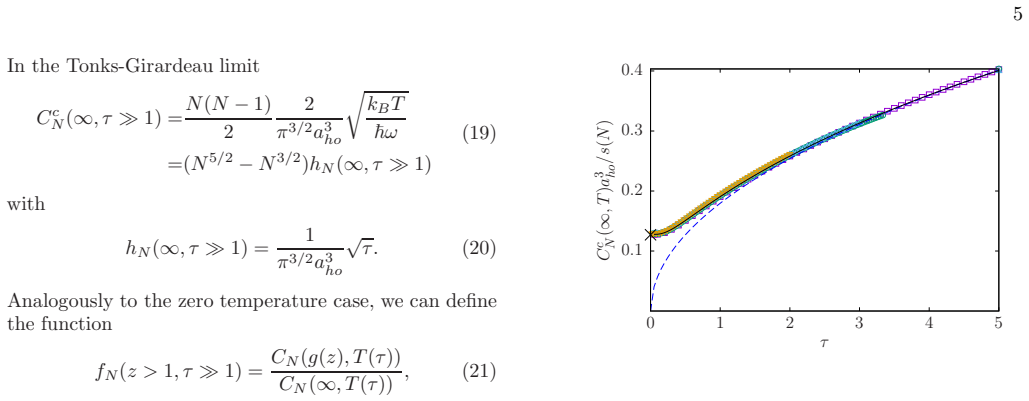
that CN (g(z), 0) ∼N 5/2 −γN η (15) where γ ≃ 1 and η = 3/4 in the Tonks-Girardeau limit, and where they are slowly varying in the strongly inter- acting regime z >1. B. Large temperature scaling In the large temperature limit, T ≫TF , quantum cor- relations are negligible and the contact for N bosons in the canonical ensemble is simply given by the two-p...
-
[1]
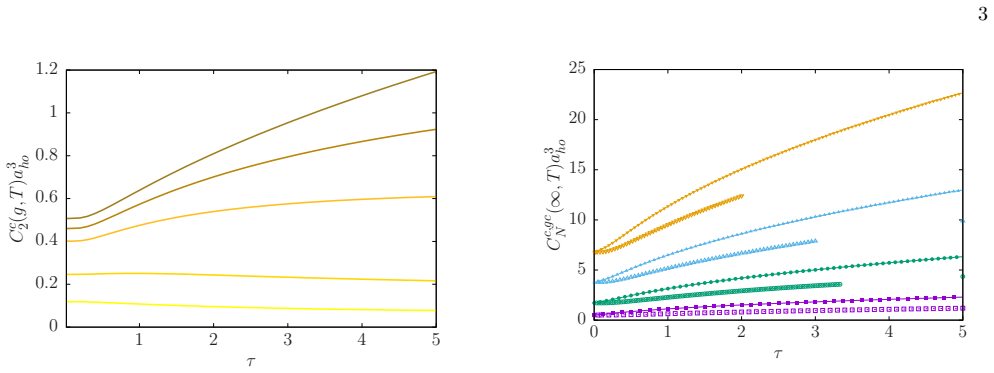
2 1 2 3 4 5 Cc 2(g, T )a3 ho τ FIG. 1: Canonical Tan’s contact C c 2(g, T ) as a function of τ = T /T F [Eq.(5)] for different values of the interaction strength z = aho/ (|a1D| √ N ). From bottom to top: z = 0 . 5, 1, 2.5, 5, and 1000. The curve for z = 1000 is indiscernable from the contact evaluated in the Tonks limit by means of Eq. (6). and ψ ( − νj 2...
-
[2]
[45]. More precisely, it can be shown that Cc N (∞,T ) = 2 π ∫ +∞ −∞ dxF (x) (7) where we have defined F (x) = lim x′,x′′→x ρ2F (x′,x ;x′′,x ) |x −x′||x −x′′|. (8) 0 5 10 15 20 25 0 1 2 3 4 5 Cc,gc N (∞, T )a3 ho τ FIG. 2: Canonical (empty symbols) [Eq. (7)] and grand- canonical contact (full symbols) [46] as a function of τ for N = 2 (violet squares), N =...
- [3]
-
[4]
This approximation ( A2) becomes more precise at large values of n
are given by νn ≃ 2 π acot(2 √ 2n + 1g−1ℏωaho) + 2n, (A2) with n ≥ 0. This approximation ( A2) becomes more precise at large values of n. Thus ( A1) reads Cc 2 = 4Z −1 r π2a3 ho ∑ n e−βℏ ωνn √ 2n + 1 1 + 4(2n + 1)(ℏωahog−1)2. (A3) 9 By replacing in the exponential νn with its value in the Tonks-Girardeau limit, νn = 2n + 1, and exploiting that ∫ ∞ 0 √x 1 ...
-
[5]
4 0 1 2 3 4 5 Cc N (∞, T )a3 ho/s (N ) τ FIG. 3: Canonical contact in the Tonks-Girardeau limit CN (∞, T ), Eq. (7), as a function of τ, scaled by the fac- tor s(N ) = N 5/ 2 − N 3/ 4(1+exp(− 2/τ )), see Eq. (23). Vio- let squares: N = 2, green circles: N = 3, light-blue up- triangles: N = 4 and orange down-triangles: N = 5. The blue dashed line correspon...
-
[7]
1 1 (b) C c N (z, τ )a3 ho/ (N 5/ 2−N 3/ 2) τ
-
[9]
that simplify in the grand-canonical case. C. The finite interaction strength regime In the finite interaction strength scenario for N > 2, we rely on quantum Monte Carlo simulations to obtain exact results. Starting from Eq. ( 1), we discretize the Hamiltonian using a finite difference method and rewrite it using second quantization, ending with the followin...
Show all 68 references
-
[10]
4: Panels (a), (b) and (c): C c N (z, τ )a3 ho as a function of τ, for the case z = 1, rescaled by N 5/ 2 − N 3/ 4 (a), N 5/ 2 − N 3/ 2 (b), and s(N ) (c)
1 1 (d) C c N (z, τ )/C c N (∞, τ ) τ FIG. 4: Panels (a), (b) and (c): C c N (z, τ )a3 ho as a function of τ, for the case z = 1, rescaled by N 5/ 2 − N 3/ 4 (a), N 5/ 2 − N 3/ 2 (b), and s(N ) (c). Panel (d): fN (z = 1 , τ ) as a function of τ. The points (violet squares: N =...
-
[11]
1 1 (a) C c N (z, τ )a3 ho/ (N 5/ 2 − N 3/ 4) τ
-
[12]
1 1 (b) C c N (z, τ )a3 ho/ (N 5/ 2 − N 3/ 2) τ
-
[13]
1 1 (c) C c N (z, τ )a3 ho/s (N ) τ
-
[14]
5: Panels (a), (b) and (c): C c N (z, τ )a3 ho as a function of τ, for the case z = 2
1 1 (d) C c N (z, τ )/C c N (∞, τ ) τ FIG. 5: Panels (a), (b) and (c): C c N (z, τ )a3 ho as a function of τ, for the case z = 2. 5, rescaled by N 5/ 2 − N 3/ 4 (a), N 5/ 2 − N 3/ 2 (b), and s(N ) (c). Panel (d): fN (z = 2 . 5, τ ) as a function of τ. The points (violet square...
-
[15]
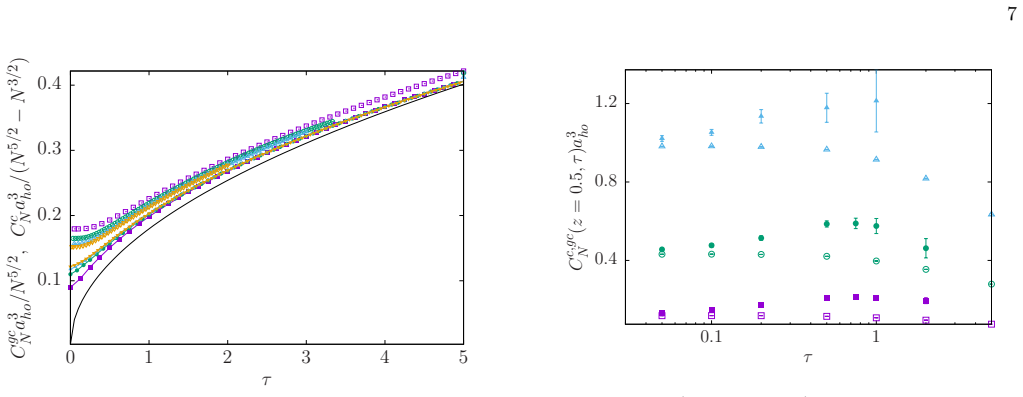
4 0 1 2 3 4 5 Cgc N a3 ho/N 5/2, C c N a3 ho/ (N 5/2 − N 3/2) τ FIG. 6: Canonical (empty symbols) and grand-canonical contact (full symbols) as a function of τ for N = 2 (vi- olet squares), N = 3 (green circles), N = 4 (light-blue up-triangles), and N = 5 (orange down-triangle...
-
[16]
5, τ )a3 ho τ FIG
1 1 Cc,gc N (z = 0. 5, τ )a3 ho τ FIG. 7: Canonical (empty symbols) and grand-canonical con- tact (full symbols) as a function of τ for N = 2 (violet squares), N = 3 (green circles), N = 4 (light-blue up- triangles) bosons. All points correspond to QMC data eval- uated in the ...
-
[17]
Giamarchi, Quantum Physics in One Dimension (Clarendon Press, Oxford, 2003)
T. Giamarchi, Quantum Physics in One Dimension (Clarendon Press, Oxford, 2003)
2003
-
[18]
8: C gc N (z = 1 , τ )/C gc N (∞, τ ) as a function of τ
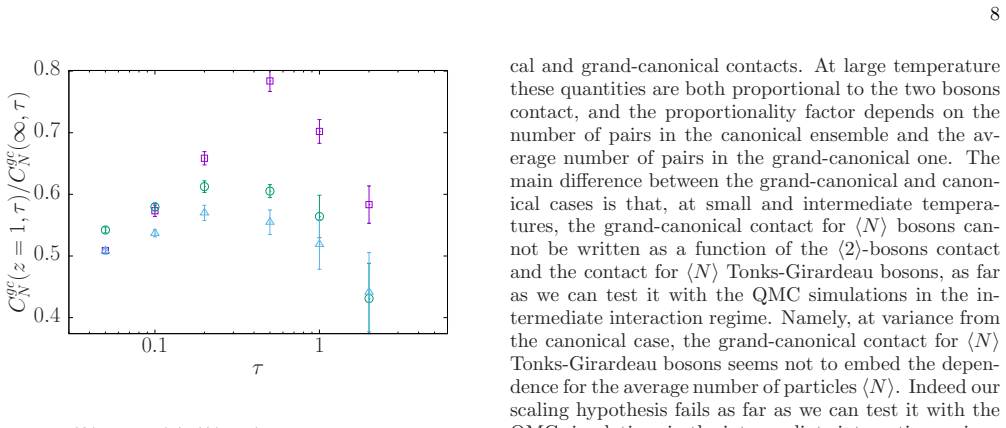
1 1 C gc N (z = 1, τ )/C gc N (∞, τ ) τ FIG. 8: C gc N (z = 1 , τ )/C gc N (∞, τ ) as a function of τ. The points (violet squares: N = 2, green circles: N = 3, light- blue up-triangles: N = 4) correspond to the QMC data. scaling hypothesis in the grand canonical ensemble at la...
-
[19]
Pitaevskii, Sov
L. Pitaevskii, Sov. Phys. JEPT 13, 451 (1961)
1961
-
[20]
Lieb and W
E. Lieb and W. Liniger, Phys. Rev. 130, 1605 (1963)
1963
-
[21]
J. B. McGuire, J. Math. Phys. (NY) 5, 622 (1964)
1964
-
[22]
holds even in the grand-canonical ensem- ble, one may wonder if the generalized scaling hypothe- sis (
-
[23]
Lieb, Phys
E. Lieb, Phys. Rev. 130, 1616 (1963)
1963
-
[24]
C. N. Yang, Phys. Rev. Lett. 19, 1312 (1967)
1967
-
[25]
is still valid in this ensemble. In Fig. 8 we plot the quantity Cgc N (z,τ )/C gc N (∞,τ ) for the case z = 1 and N = 2, 3 and 4 and τ ≤ 2, Cgc N (z,τ ) having been cal- culated by means of QMC simulations and Cgc N (∞,τ ) by means of Eqs. (8)-(9) in [46]. We observe that, for...
-
[26]
Gaudin, Physics Letters A 24, 55 (1967)
M. Gaudin, Physics Letters A 24, 55 (1967)
1967
-
[27]
Sutherland, Phys
B. Sutherland, Phys. Rev. Lett. 20, 98 (1968)
1968
-
[28]
C. K. Lai and C. N. Yang, Phys. Rev. A 3, 393 (1971)
1971
-
[29]
J. B. McGuire, J. Math. Phys. (NY) 6, 432 (1965)
1965
-
[30]
Luther and V
A. Luther and V. J. Emery, Phys. Rev. Lett. 33, 589 (1974)
1974
-
[31]
J. N. Fuchs, A. Recati, and W. Zwerger, Phys. Rev. Lett. 93, 090408 (2004)
2004
-
[32]
Busch, B.-G
T. Busch, B.-G. Englert, K. Rz¸ a˙ zewski, and M. Wilkens, Found. Phys. 28, 549 (1998)
1998
-
[33]
Aharony, O
A. Aharony, O. Entin-Wohlman, and Y. Imry, Phys. Rev. B 61, 5452 (2000)
2000
-
[34]
Abad and J
J. Abad and J. G. Esteve, Few-Body Systems 37, 107 (2005)
2005
-
[35]
Olshanii and V
M. Olshanii and V. Dunjko, Phys. Rev. Lett. 91, 090401 (2003)
2003
-
[36]
Yao et al
H. Yao et al. , Phys. Rev. Lett. 121, 220402 (2018)
2018
-
[38]
Gross, Il Nuovo Cimento 20, 454 (1961)
E. Gross, Il Nuovo Cimento 20, 454 (1961)
1961
-
[39]
Tan, Ann
S. Tan, Ann. Phys. (N.Y.) 323, 2971 (2008)
2008
-
[40]
Tan, Ann
S. Tan, Ann. Phys. (N.Y.) 323, 2987 (2008)
2008
-
[41]
Tan, Ann
S. Tan, Ann. Phys. (N.Y.) 323, 2952 (2008)
2008
-
[42]
J. T. Stewart, J. P. Gaebler, T. E. Drake, and D. S. Jin, Phys. Rev. Lett. 104, 235301 (2010)
2010
-
[43]
Y. Sagi, T. E. Drake, R. Paudel, and D. S. Jin, Phys. Rev. Lett. 109, 220402 (2012)
2012
-
[44]
Chang et al
R. Chang et al. , Phys. Rev. Lett. 117, 235303 (2016)
2016
-
[45]
R. J. Wild et al. , Phys. Rev. Lett. 108, 145305 (2012)
2012
-
[46]
Yan et al
Z. Yan et al. , Phys. Rev. Lett. 122, 093401 (2019)
2019
-
[47]
Hoinka et al
S. Hoinka et al. , Phys. Rev. Lett. 110, 055305 (2013)
2013
-
[48]
Laurent et al
S. Laurent et al. , Phys. Rev. Lett. 118, 103403 (2017)
2017
-
[49]
Decamp et al
J. Decamp et al. , Physical Review A 94, 053614 (2016)
2016
-
[50]
Decamp et al
J. Decamp et al. , New Journal of Physics 19, 125001 (2017)
2017
-
[51]
Minguzzi, P
A. Minguzzi, P. Vignolo, and M. Tosi, Phys. Lett. A 294, 222 (2002)
2002
-
[52]
Grining et al
T. Grining et al. , Phys. Rev. A 92, 061601 (2015)
2015
-
[53]
Matveeva and G
N. Matveeva and G. Astrakharchik, New Journal of Physics 18, 065009 (2016)
2016
-
[54]
O. I. Pˆ at ¸u and A. Kl¨ umper, Phys. Rev. A 93, 033616 (2016)
2016
-
[55]
Xu and M
W. Xu and M. Rigol, Phys. Rev. A 92, 063623 (2015)
2015
-
[56]
Rizzi, C
M. Rizzi, C. Miniatura, A. Minguzzi, and P. Vignolo, Phys. Rev. A 98, 043607 (2018)
2018
-
[57]
Moritz, T
H. Moritz, T. St¨ oferle, M. K¨ ohl, and T. Esslinger, Phys. Rev. Lett. 91, 250402 (2003)
2003
-
[58]
Pagano et al
G. Pagano et al. , Nature Physics 10, 198201 (2014)
2014
-
[59]
Salces-Carcoba et al
F. Salces-Carcoba et al. , New Journal of Physics 20, 113032 (2018)
2018
-
[60]
Olshanii, Phys
M. Olshanii, Phys. Rev. Lett. 81, 938 (1998)
1998
-
[61]
Valiente, European Phys
M. Valiente, European Phys. Lett. 98, 10010 (2012)
2012
-
[62]
Gradshteyn and I
I. Gradshteyn and I. Ryzhik, Table of Integrals, Series, and Products (Elsevier, Amsterdam, 1996)
1996
-
[63]
Pitaevskii and S
L. Pitaevskii and S. Stringari, Bose-Einstein Condensa- tion and Superfluidity (Oxford University Press, Oxford, 2016)
2016
-
[64]
B. Y. Fang, P. Vignolo, C. Miniatura, and A. Minguzzi, Phys. Rev. A 79, 023623 (2009)
2009
-
[65]
Vignolo and A
P. Vignolo and A. Minguzzi, Phys. Rev. Lett. 110, 020403 (2013)
2013
-
[66]
V. G. Rousseau, Phys. Rev. E 77, 056705 (2008)
2008
-
[67]
V. G. Rousseau, Phys. Rev. E 78, 056707 (2008)
2008
-
[68]
G. D. Rosi, P. Massignan, M. Lewenstein, and G. As- trakharchik, arXiv:1905.07391 (2019)
2019 arXiv
-
[69]
Z¨ urnet al
G. Z¨ urnet al. , Phys. Rev. Lett. 108, 075303 (2012)
2012
-
[70]
A. N. Wenz et al. , Science 342, 457 (2013)
2013
Reviewed August 14, 2026 · model on record in the stance chip above.
Discussion (0). Continue with ORCID to comment.