REVIEW 4 major objections 4 minor 38 references
Iterative Hard Thresholding for Low CP-rank Tensor Models
T0 review · 4 major / 4 minor · reviewed 2026-08-14 · deepseek-v4-flash
Pith's one-line read This paper proves that tensor iterative hard thresholding recovers low CP-rank tensors from few noisy linear measurements, under a tensor RIP with a bounded-factor thresholding oracle, converging linearly down to a noise floor.
desk verdict Extends TIHT to CP-rank with a clever approximator, but the proof has a load-bearing gap over factor norms and the sample complexity is exponential. read the letter →
The pith
A machine-rendered reading of the paper's core claim, the machinery that carries it, and where it could break.
The reading
What carries the argument
The central object is the set $\mathcal{S}_{r,R}$ of normalized tensors of CP-rank $r$ whose CP factor vectors all have Euclidean norm at most $R$; the tensor restricted isometry property (TRIP) is restricted to this set. The mechanism carrying the proof is the thresholding oracle imported from a relative-error tensor approximation result: given a tensor that has a rank-$r$ approximation with bounded factors, it returns a rank-$r$ tensor whose squared error is at most $(1+\epsilon)$ times the best rank-$r$ error plus $2^{-n\alpha}$. The contraction argument combines this oracle with the TRIP, using the per-iteration bound $\|W_j-X\|_F^2 \le 2^{-n\alpha}$ to keep every difference inside the TRIP's domain. This is what lets the proof run without the assumption that the hard thresholding operator is a near-best projection.
What would settle it
Run TIHT with Gaussian measurements on a CP-rank $r$ tensor, and at each iteration compute the largest Euclidean norm among the CP factor vectors returned by the thresholding subroutine. If any iterate's factors exceed $2^{n\alpha}$ while the induction claims they stay bounded, the premise of Corollary 2.3--and with it Theorem 2.4--is violated.
Extended reading notes
Core claim
The paper's central claim is that a CP-rank analogue of tensor iterative hard thresholding is provably robust without assuming the thresholding step is a near-best projection. For a target $X \in \mathcal{S}_{r,2^{n\alpha}}$ (unit-norm, CP-rank $r$, factor vectors bounded by $2^{n\alpha}$) and a measurement operator $A$ satisfying the TRIP with $\delta_{3r} \le \tfrac12 2^{-n\alpha}$, the iterates of (2.2)--(2.3) satisfy $$\|X_{j+1}-X\|_F \le (2\delta_{3r})^j \|X_0-X\|_F + \frac{2\sqrt{1+\delta_{3r}}}{1-2\delta_{3r}}\|z\|_2 + \frac{(1+\epsilon)$2^{{-0.5n\alpha}}$}{1-2\delta_{3r}}.$$ The thresholding oracle comes from a recent relative-error low CP-rank approximation algorithm, so each update is efficient and returns a rank-$r$ tensor; the price is that the TRIP is needed for rank $3r$ rather than $r$. The companion result shows Gaussian measurement maps satisfy this TRIP with high probability when $m \ge C\delta^{-2}\max\{\log(\varepsilon^{-1}), r\log(d r R^d)\sum_{i=1}^d n_i\}$, so the recovery guarantee applies to a concrete, implementable measurement model.
Load-bearing premise
The argument needs the thresholding routine to return a low-CP-rank tensor whose factor vectors are never larger than $2^{n\alpha}$; the approximation theorem it cites promises accuracy, not that size bound.
Editorial extensions
If this is right
- Low CP-rank tensors can be recovered from Gaussian measurements with error decaying at the linear rate $(2\delta_{3r})^j$, matching the behavior of IHT for sparse vectors and low-rank matrices.
- The guarantee is robust to noise: after roughly $\lceil \log_{1/(2\delta)}(\|X_0-X\|_F/\|z\|_2)\rceil$ iterations, the error is bounded by $\|z\|_2$ plus the $2^{-0.5n\alpha}$ approximation floor.
- The hard-to-verify per-iteration projection assumption in prior tensor IHT results is replaced by an explicit efficient CP approximation routine, removing a major obstacle to applying the theory.
- Gaussian measurement operators satisfy the CP-TRIP with high probability when $m\ge C\delta^{-2}\max\{\log(\varepsilon^{-1}), r\log(d r R^d)\sum_i n_i\}$, giving a concrete measurement budget for the recovery guarantee.
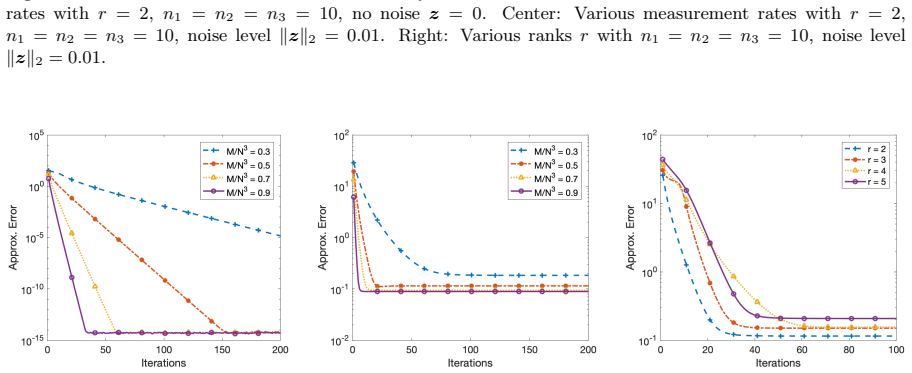
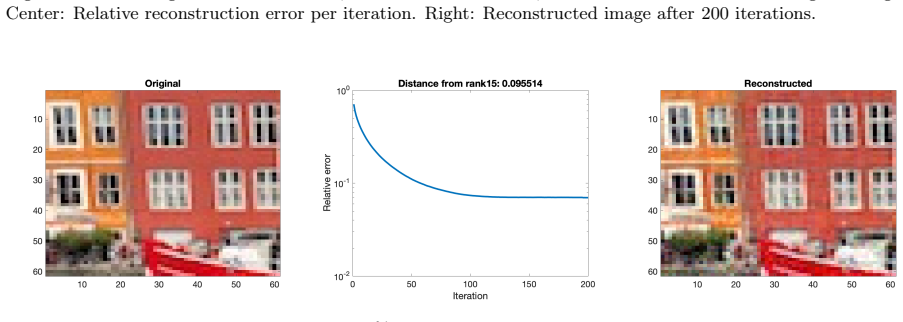
- Numerical experiments on synthetic tensors, color images, and grayscale video reach the predicted noise floor, indicating the theoretical guarantees are reflected in practice.
Reading between the lines
- If the bounded-factor guarantee for the thresholding output can be established or enforced, the same proof template would likely transfer to other low-rank tensor formats such as Tucker, tensor-train, and hierarchical Tucker, yielding analogous CP-style guarantees.
- The $2^{n\alpha}$ scale suggests an accuracy--cost tradeoff: larger $\alpha$ weakens the TRIP requirement and improves noise tolerance but worsens the sample complexity and approximation cost; optimizing this tradeoff is a natural next step.
- A direct experiment tracking the CP factor norms of the iterates would reveal whether the bounded-factor premise is actually necessary in practice or merely an artifact of the proof technique.
- The covering-number argument for Gaussian maps could be adapted to sub-Gaussian or structured measurement ensembles, potentially giving sample complexity bounds for tensor completion-type settings.
Signed reviews
Editorial analysis
A structured set of objections, weighed in public.
Referee Report
Summary. The paper extends the Tensor Iterative Hard Thresholding (TIHT) method of Rauhut, Schneider, and Stojanac to tensors of low CP-rank. The authors replace the exact CP-rank projection (which is NP-hard) with the relative-error CP approximation algorithm of Song, Woodruff, and Zhong. Under a CP-rank version of the tensor Restricted Isometry Property (TRIP) with bounded factor norms, they claim linear convergence of the iterates to within a noise level and an approximation error term (Theorem 2.4). They also prove that Gaussian measurement operators satisfy the required TRIP with high probability (Theorem 2.5) and present numerical experiments on synthetic and real data. The central claims, if correct, would be a useful extension of existing low-rank tensor recovery guarantees.
Significance. The paper addresses a meaningful problem: extending iterative hard thresholding to CP-rank tensors while avoiding the computationally intractable exact CP projection. The use of the Song-Woodruff-Zhong relative-error approximator is a creative way to avoid assumption (1.3) from prior work. However, the proof of the main theorem has several load-bearing gaps. Most importantly, the assertion that the approximation subroutine returns a tensor with bounded CP factors is not justified by the cited theorem, and without that bound the induction in Theorem 2.4 collapses. The sample complexity result also appears to miss a term in log(1/δ), and the proof of Theorem 2.4 contains invalid algebra. These issues prevent the theoretical claims from being established. The numerical experiments are promising but do not compensate for the gaps in the analysis.
major comments (4)
- [Section 2, Corollary 2.3] Corollary 2.3 asserts that the output X_{j+1} of the approximation subroutine has CP factors bounded by 2^{nα}, but the only external guarantee invoked, Theorem 2.2, does not provide such a bound. Theorem 2.2's hypothesis requires the existence of a bounded-factor rank-r approximant, and its conclusion is an approximation error bound only. The proof of Theorem 2.4 applies the TRIP to X_{j+1}-X, which requires both X and X_{j+1} to have factor norms bounded by the same R. Without a proof that H_r(W_j) returns bounded factors, the induction cannot be continued, and the argument fails at the step 'Using the fact that rank(X_{j+1}-X)≤2r<3r, we invoke TRIP.' This is a load-bearing gap.
- [Section 2.1, Theorem 2.5 and Corollary 2.7] The sample complexity bound in (2.6), m ≥ Cδ^{-2}·max{log(ε^{-1}), r log(drR^d)∑ n_i}, omits the factor log(1/δ) that appears when the net resolution is chosen proportional to δ. The covering number from Lemma 2.6 gives log N(S_{r,R},ε) ≤ r(∑ n_i) log(3drR^d/ε), so with ε = cδ the required m is of order δ^{-2} r(∑ n_i) log(drR^d/δ). The stated bound, with the max structure, does not include the multiplying factor r(∑ n_i) on the log(1/δ) term. Moreover, ε is not defined in the theorem statement, making the bound non-specifiable. In addition, Corollary 2.7 applies Theorem 2.5 with R = 1/2 2^{-nα}, while Theorem 2.4 and Corollary 2.3 require the TRIP on sets with factor bound R = 2^{nα}; these values are inconsistent.
- [Theorem 2.4 proof, derivation of Eq. (2.5)] The splitting argument with parameters β and γ is mathematically invalid. With β+γ=1, the first displayed inequality becomes 0 ≤ ..., and summing the three displayed inequalities produces the original quadratic inequality, not a linear one. The function f(β)=1-β+√β is not bounded above by 1 on [0,1] (for example, f(1/4)=1.25), so the claim that it can be dropped is false. Consequently, the linear recursion (2.4) does not follow from the preceding inequalities. A correct derivation would need a different argument, such as an absorbing inequality.
- [Theorem 2.4 proof, use of TRIP on A_Q] The proof bounds ‖I - A_Q^* A_Q‖ by δ_{3r} by referring to the proof of Theorem 1 in [31]. However, A_Q is the restriction of A to a subspace spanned by X_j, X_{j+1}, and X. To apply the TRIP with constant δ_{3r} there, one needs the TRIP to hold for all elements of that subspace, not just for X_{j+1}-X. A general linear combination of three CP-rank-r tensors with bounded factors need not lie in S_{3r,R}; its factor norms can grow. The argument in [31] for Tucker rank does not transfer to the CP setting without additional justification. This step requires a dedicated proof.
minor comments (4)
- [Algorithm 1] The loop is written as 'for j = 0, 2, ..., T−1', which appears to be a typo for 'for j = 0, 1, ..., T−1'.
- [Theorem 2.4] The statement claims that recovery error on the order of the upper bound of the noise, 2^{-nα}, is achieved. Since the noise is bounded by 2^{-nα}/(2‖A‖_{2→2}), this claim is only correct up to a factor of ‖A‖_{2→2}; please clarify the normalization.
- [Section 2.1] In Corollary 2.7, the displayed formula for m is missing a closing parenthesis and the expression 'log(ε^{-1}' is incomplete. Also, the notation for the max should be cleaned up.
- [Throughout] There are several typographical errors, such as 'lead to' for 'led to' and inconsistent use of ε vs. ϵ. A careful proofreading pass is recommended.
Circularity Check
No circularity: the recovery theorem is derived from external TRIP and approximation guarantees; the bounded-factor gap in Corollary 2.3 is a correctness risk, not a circular step.
full rationale
The paper's central derivation chain is not circular. The recovery result Theorem 2.4 is built on two external, independently stated ingredients: the CP-rank TRIP (Definition 2.1) and the Song-Woodruff-Zhong relative-error CP approximation algorithm (Theorem 2.2, cited from [32]). Neither ingredient is defined in terms of the target recovery error, and neither is a renamed version of the paper's own conclusion. The TIHT iteration (2.2)-(2.3) feeds the gradient step W_j into the external approximator H_r, and the proof then combines TRIP with Corollary 2.3's approximation bound and the claimed bounded-factor property. No parameter is fitted to data and then called a prediction; the constants 2^{nα} and 2^{-0.5nα} are explicit assumption parameters, not fitted values. The proof of Theorem 2.5 that Gaussian maps satisfy the TRIP is an independent covering-number and concentration argument. The one serious defect in the paper is Corollary 2.3: it asserts that the output X_{j+1} has CP factors bounded by 2^{nα}, but the quoted Theorem 2.2 only guarantees the stated Frobenius approximation error and says nothing about factor norms of the output. That is a missing proof step and a potential break in the induction, but it is not circularity: the unsupported claim is not equivalent to an input by construction, and it is not obtained by fitting or by self-citation. Likewise, the use of [31] as a proof template is not load-bearing self-citation; the authors re-derive the inequalities with their own Corollary 2.3. Overall, the paper's derivation has independent mathematical content and no circular reduction, so the circularity score is 0.
Assumptions & free parameters
free parameters (2)
- α
- ε
assumptions (4)
- domain assumption Signals of interest belong to S_{r,R}: unit Frobenius norm CP-rank r tensors with all CP factor norms bounded by R.
- ad hoc to paper The approximator in Theorem 2.2 outputs a rank-r tensor with CP factors bounded by 2^{nα}.
- ad hoc to paper The measurement operator A satisfies the CP-TRIP with constant δ_{3r} < 2^{-nα}/2.
- standard math Standard covering-number and sub-Gaussian concentration arguments from [31] extend to the set S_{r,R}.
Cite this review
Pith. "Pith review of Iterative Hard Thresholding for Low CP-rank Tensor Models." pith.science (2026). https://pith.science/paper/5UHPVZ4G
@misc{pith2026190808479,
  author       = {Pith},
  title        = {Pith review of: Iterative Hard Thresholding for Low CP-rank Tensor Models},
  year         = {2026},
  howpublished = {\url{https://pith.science/paper/5UHPVZ4G}},
  note         = {Machine review of arXiv:1908.08479}
}
read the original abstract
Recovery of low-rank matrices from a small number of linear measurements is now well-known to be possible under various model assumptions on the measurements. Such results demonstrate robustness and are backed with provable theoretical guarantees. However, extensions to tensor recovery have only recently began to be studied and developed, despite an abundance of practical tensor applications. Recently, a tensor variant of the Iterative Hard Thresholding method was proposed and theoretical results were obtained that guarantee exact recovery of tensors with low Tucker rank. In this paper, we utilize the same tensor version of the Restricted Isometry Property (RIP) to extend these results for tensors with low CANDECOMP/PARAFAC (CP) rank. In doing so, we leverage recent results on efficient approximations of CP decompositions that remove the need for challenging assumptions in prior works. We complement our theoretical findings with empirical results that showcase the potential of the approach.
Figures


Figures from the paper (2 more)

Reference graph
Works this paper leans on
-
[32]
Relative error tensor low rank approximation,
Z. Song, D. P. Woodruff, and P. Zhong, “Relative error tensor low rank approximation,” inPro- ceedings of the Thirtieth Annual ACM-SIAM Symposium on Discrete Algorithms, pp. 2772–2789, Society for Industrial and Applied Mathematics, 2019
work page 2019
-
[31]
Low rank tensor recovery via iterative hard threshold- ing,
H. Rauhut, R. Schneider, and Ž. Stojanac, “Low rank tensor recovery via iterative hard threshold- ing,”Linear Algebra and its Applications, vol. 523, pp. 220–262, 2017
work page 2017
-
[1]
A mathematical introduction to compressive sensing,
S. Foucart and H. Rauhut, “A mathematical introduction to compressive sensing,”Applied and Numerical Harmonic Analysis, 2013
work page 2013
-
[2]
Y. C. Eldar and G. Kutyniok,Compressed sensing: theory and applications. Cambridge University Press, 2012
work page 2012
-
[3]
Compressive multiplexing of correlated signals,
A. Ahmed and J. Romberg, “Compressive multiplexing of correlated signals,”IEEE Transactions on Information Theory, vol. 61, no. 1, pp. 479–498, 2014
work page 2014
-
[4]
Hyperspectral image restoration using low-rank matrix recovery,
H. Zhang, W. He, L. Zhang, H. Shen, and Q. Yuan, “Hyperspectral image restoration using low-rank matrix recovery,”IEEE Transactions on Geoscience and Remote Sensing, vol. 52, no. 8, pp. 4729– 4743, 2013
work page 2013
-
[5]
Quantum state tomography via compressed sensing,
D. Gross, Y.-K. Liu, S. T. Flammia, S. Becker, and J. Eisert, “Quantum state tomography via compressed sensing,”Physical review letters, vol. 105, no. 15, p. 150401, 2010
work page 2010
-
[6]
Robust principal component analysis?,
E. J. Candès, X. Li, Y. Ma, and J. Wright, “Robust principal component analysis?,”Journal of the ACM (JACM), vol. 58, no. 3, p. 11, 2011
work page 2011
Show all 38 references
-
[7]
Lambertian reflectance and linear subspaces,
R. Basri and D. W. Jacobs, “Lambertian reflectance and linear subspaces,”IEEE Transactions on Pattern Analysis & Machine Intelligence, no. 2, pp. 218–233, 2003
2003
-
[8]
Exact matrix completion via convex optimization,
E. J. Candès and B. Recht, “Exact matrix completion via convex optimization,”Foundations of Computational mathematics, vol. 9, no. 6, pp. 717–772, 2009
2009
-
[9]
Uniqueness conditions for low-rank matrix recovery,
Y. Eldar, D. Needell, and Y. Plan, “Uniqueness conditions for low-rank matrix recovery,”Applied and Computational Harmonic Analysis, vol. 33, no. 2, pp. 309–314, 2012
2012
-
[10]
Guaranteed minimum-rank solutions of linear matrix equa- tions via nuclear norm minimization,
B. Recht, M. Fazel, and P. A. Parrilo, “Guaranteed minimum-rank solutions of linear matrix equa- tions via nuclear norm minimization,”SIAM review, vol. 52, no. 3, pp. 471–501, 2010
2010
-
[11]
Tight oracle bounds for low-rank matrix recovery from a mininal number of noisy random measurements,
E. Candes and Y. Plan, “Tight oracle bounds for low-rank matrix recovery from a mininal number of noisy random measurements,”IEEE Trans. Inform. Theory, vol. 57, no. 4, pp. 2342–2359, 2011. 12
2011
-
[12]
Iterative hard thresholding for compressed sensing,
T. Blumensath and M. E. Davies, “Iterative hard thresholding for compressed sensing,”Appl. Com- put. Harmon. A., vol. 27, no. 3, pp. 265–274, 2009
2009
-
[13]
Normalized iterative hard thresholding: Guaranteed stability and performance,
T. Blumensath and M. E. Davies, “Normalized iterative hard thresholding: Guaranteed stability and performance,”IEEE Journal of selected topics in signal processing, vol. 4, no. 2, pp. 298–309, 2010
2010
-
[14]
Normalized iterative hard thresholding for matrix completion,
J. Tanner and K. Wei, “Normalized iterative hard thresholding for matrix completion,”SIAM Jour- nal on Scientific Computing, vol. 35, no. 5, pp. S104–S125, 2013
2013
-
[15]
Decoding by linear programming,
E. J. Candès and T. Tao, “Decoding by linear programming,”IEEE T. Inform. Theory, vol. 51, pp. 4203–4215, 2005
2005
-
[16]
Tensor completion for estimating missing values in visual data,
J. Liu, P. Musialski, P. Wonka, and J. Ye, “Tensor completion for estimating missing values in visual data,”IEEE transactions on pattern analysis and machine intelligence, vol. 35, no. 1, pp. 208–220, 2012
2012
-
[17]
Efficient tensor completion for color image and video recovery: Low-rank tensor train,
J. A. Bengua, H. N. Phien, H. D. Tuan, and M. N. Do, “Efficient tensor completion for color image and video recovery: Low-rank tensor train,”IEEE Transactions on Image Processing, vol. 26, no. 5, pp. 2466–2479, 2017
2017
-
[18]
Multilinear multitask learn- ing,
B. Romera-Paredes, H. Aung, N. Bianchi-Berthouze, and M. Pontil, “Multilinear multitask learn- ing,” inInternational Conference on Machine Learning, pp. 1444–1452, 2013
2013
-
[19]
Multilinear independent components analysis,
M. A. O. Vasilescu and D. Terzopoulos, “Multilinear independent components analysis,” in2005 IEEE Computer Society Conference on Computer Vision and Pattern Recognition (CVPR’05), vol. 1, pp. 547–553, IEEE, 2005
2005
-
[20]
The multiconfiguration time-dependent hartree (mctdh) method: a highly efficient algorithm for propagating wavepackets,
M. H. Beck, A. Jäckle, G. A. Worth, and H.-D. Meyer, “The multiconfiguration time-dependent hartree (mctdh) method: a highly efficient algorithm for propagating wavepackets,”Physics reports, vol. 324, no. 1, pp. 1–105, 2000
2000
-
[21]
Lubich,From quantum to classical molecular dynamics: reduced models and numerical analysis
C. Lubich,From quantum to classical molecular dynamics: reduced models and numerical analysis. European Mathematical Society, 2008
2008
-
[22]
Some mathematical notes on three-mode factor analysis,
L. R. Tucker, “Some mathematical notes on three-mode factor analysis,”Psychometrika, vol. 31, no. 3, pp. 279–311, 1966
1966
-
[23]
A multilinear singular value decomposition,
L. De Lathauwer, B. De Moor, and J. Vandewalle, “A multilinear singular value decomposition,” SIAM journal on Matrix Analysis and Applications, vol. 21, no. 4, pp. 1253–1278, 2000
2000
-
[24]
Analysis of individual differences in multidimensional scaling via an n-way generalization of âĂIJeckart-youngâĂİ decomposition,
J. D. Carroll and J.-J. Chang, “Analysis of individual differences in multidimensional scaling via an n-way generalization of âĂIJeckart-youngâĂİ decomposition,”Psychometrika, vol. 35, no. 3, pp. 283–319, 1970
1970
-
[25]
Foundations of the parafac procedure: Models and conditions for an
R. A. Harshman et al., “Foundations of the parafac procedure: Models and conditions for an" explanatory" multimodal factor analysis,” 1970
1970
-
[26]
Factorization strategies for third-order tensors,
M. E. Kilmer and C. D. Martin, “Factorization strategies for third-order tensors,”Linear Algebra and its Applications, vol. 435, no. 3, pp. 641–658, 2011
2011
-
[27]
Novel methods for multilinear data completion and de-noising based on tensor-svd,
Z. Zhang, G. Ely, S. Aeron, N. Hao, and M. Kilmer, “Novel methods for multilinear data completion and de-noising based on tensor-svd,” inProceedings of the IEEE conference on computer vision and pattern recognition, pp. 3842–3849, 2014
2014
-
[28]
Tensor decompositions and applications,
T. G. Kolda and B. W. Bader, “Tensor decompositions and applications,”SIAM review, vol. 51, no. 3, pp. 455–500, 2009. 13
2009
-
[29]
Tensor decompositions for learninglatentvariablemodels,
A. Anandkumar, R. Ge, D. Hsu, S. M. Kakade, and M. Telgarsky, “Tensor decompositions for learninglatentvariablemodels,” The Journal of Machine Learning Research, vol.15, no.1, pp.2773– 2832, 2014
2014
-
[30]
Most tensor problems are np-hard,
C. J. Hillar and L.-H. Lim, “Most tensor problems are np-hard,”Journal of the ACM (JACM), vol. 60, no. 6, p. 45, 2013
2013
-
[33]
Uniqueness of tensor decompositions with applications to polynomial identifiability,
A. Bhaskara, M. Charikar, and A. Vijayaraghavan, “Uniqueness of tensor decompositions with applications to polynomial identifiability,” inConference on Learning Theory, pp. 742–778, 2014
2014
-
[34]
C. A. Rogers,Packing and covering. No. 54, University Press, 1964
1964
-
[35]
Introduction to the non-asymptotic analysis of random matrices,
R. Vershynin, “Introduction to the non-asymptotic analysis of random matrices,”arXiv preprint arXiv:1011.3027, 2010
2010 arXiv
-
[36]
Tensorlab 3.0 – numerical optimization strategies for large-scale constrained and coupled matrix/tensor factorization,
N. Vervliet, O. Debals, and L. De Lathauwer, “Tensorlab 3.0 – numerical optimization strategies for large-scale constrained and coupled matrix/tensor factorization,” inAsilomar Conference on Signals, Systems and Computers, pp. 1733–1738, IEEE, 2016
2016
-
[37]
Linear convergence of stochastic iterative greedy algorithms with sparse constraints,
N. Nguyen, D. Needell, and T. Woolf, “Linear convergence of stochastic iterative greedy algorithms with sparse constraints,”IEEE Transactions on Information Theory, vol. 63, no. 11, pp. 6869–6895, 2017
2017
-
[38]
Greedy low-rank approximation in tucker format of solutions of tensor linear systems,
I. Georgieva and C. Hofreither, “Greedy low-rank approximation in tucker format of solutions of tensor linear systems,”Journal of Computational and Applied Mathematics, vol. 358, pp. 206–220, 2019. 14
2019
Reviewed August 14, 2026 · model on record in the stance chip above.
Discussion (0). Continue with ORCID to comment.