Compositional Separation of Control Flow and Data Flow
Pith reviewed 2026-05-24 07:04 UTC · model grok-4.3
The pith
A category-theoretic model separates data flow and control flow as independent dimensions in high-level computation.
A machine-rendered reading of the paper's core claim, the machinery that carries it, and where it could break.
Core claim
The paper's central claim is the introduction of a novel MHC that explicitly separates data flow and control flow as distinct dimensions while providing modularity through category-theoretic operations for building composites that inherit the same properties as their parts.
What carries the argument
The novel MHC rooted in category theory, which supplies operations for compositionally constructing sequential, parallel, branching or iterative composites while keeping data and control flows orthogonal.
If this is right
- Orthogonal reasoning about data flow and control flow supports optimisation, maintainability and verification.
- Composites can be constructed sequentially, in parallel, with branching or iteratively.
- Any composite maintains the separation of concerns and modularity of its constituents.
- The model can represent high-level computations in software engineering and artificial intelligence.
Where Pith is reading between the lines
- This approach might allow independent verification of data and control aspects in complex programs.
- Applications could extend to distributed computing where flows need clear separation.
- Testing the model on a branching algorithm would show if orthogonality holds without hidden dependencies.
Load-bearing premise
The category-theoretic constructions can be defined so that data flow and control flow remain orthogonal in every composite without loss of expressiveness or introduction of hidden dependencies between the two dimensions.
What would settle it
A specific high-level computation that requires either mixing the two flows or introducing dependencies when composed using the model's operations.
Figures
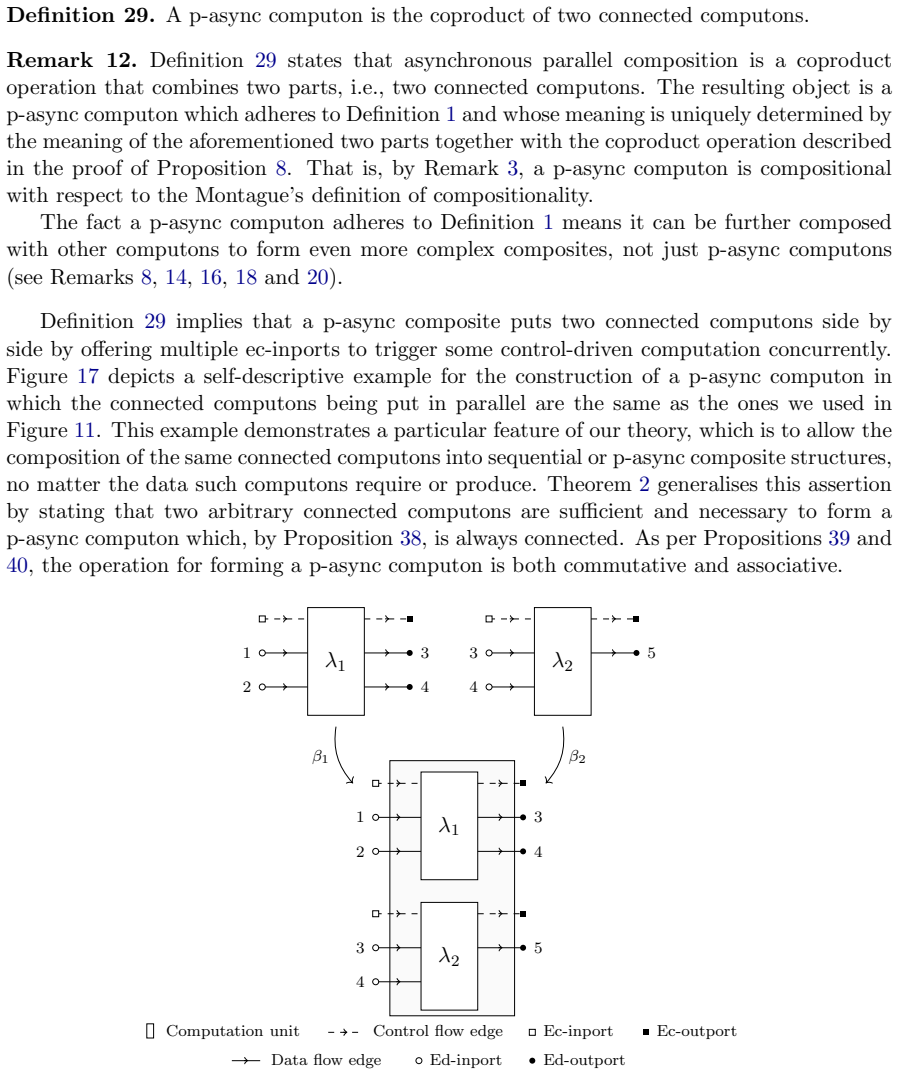
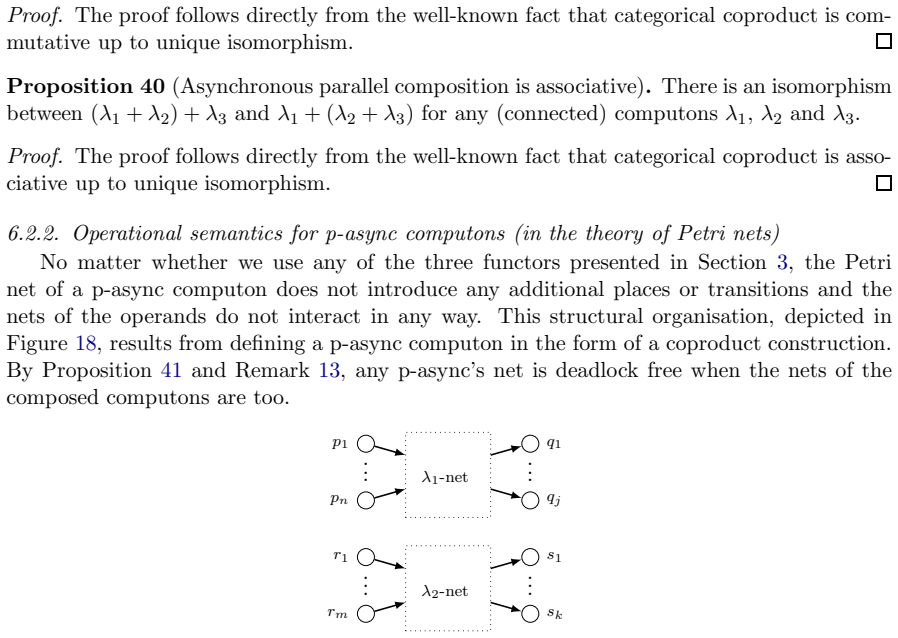
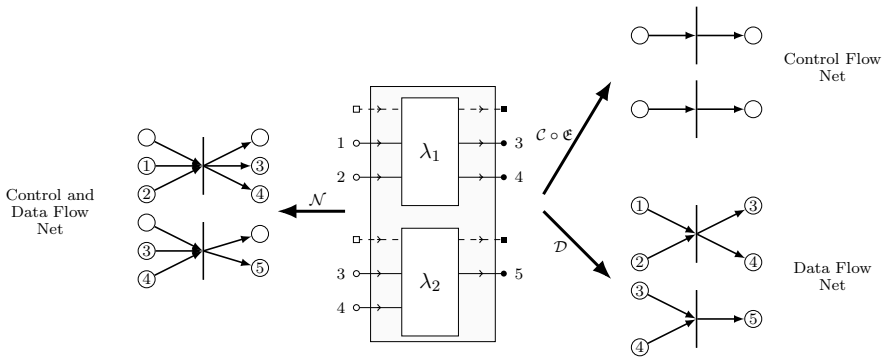
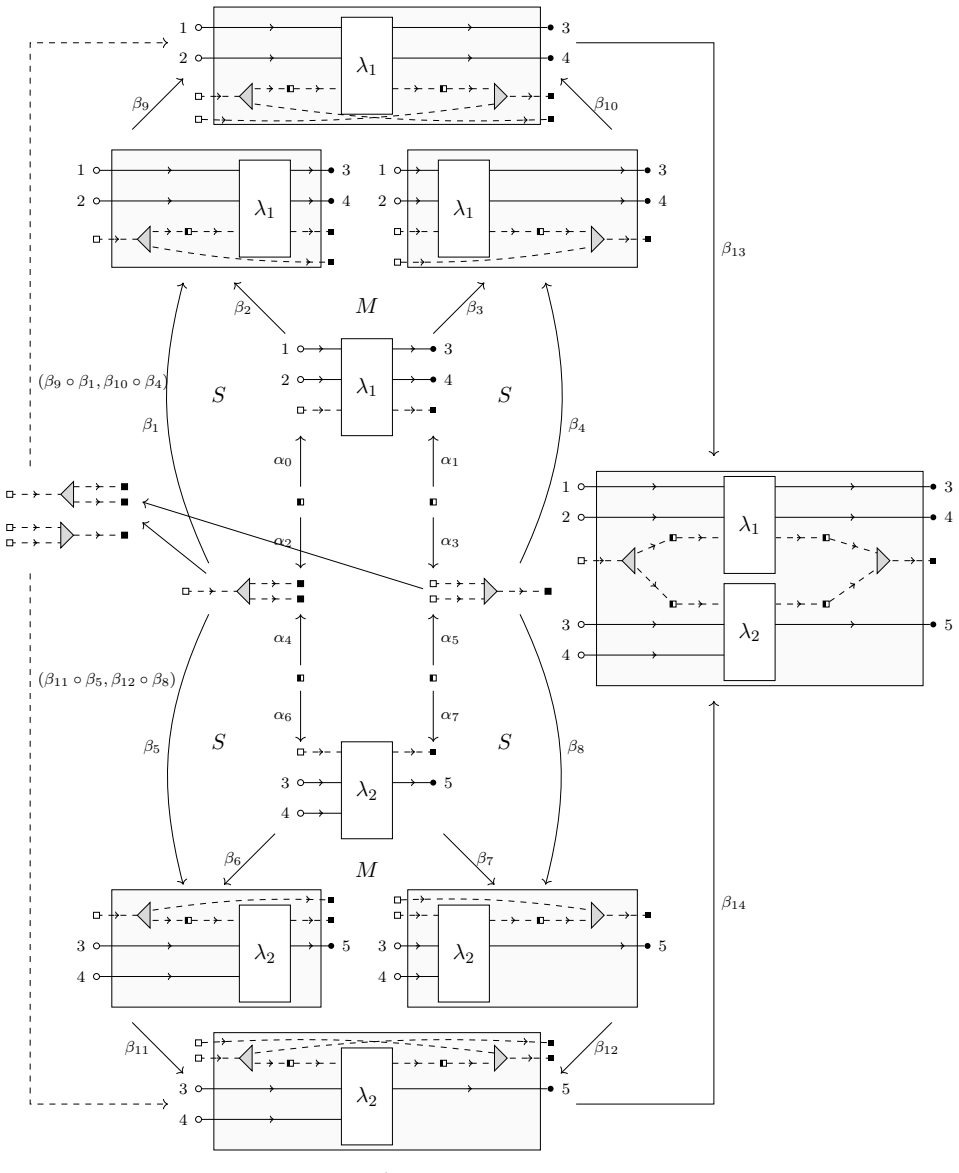
read the original abstract
Every Model of High-Level Computation (MHC) has an underlying composition mechanism for combining simple computing devices into more complex ones. Composition can be done by (explicitly or implicitly) defining control flow, data flow or any combination thereof. Control flow specifies the order in which individual computations are activated, whereas data flow defines how data is exchanged among them. Unfortunately, traditional MHCs either mix data and control or only consider one dimension explicitly, which makes it difficult to reason about data flow and control flow separately. Reasoning about these dimensions orthogonally is a crucial desideratum for optimisation, maintainability and verification purposes. In this paper, we introduce a novel MHC that explicitly treats data flow and control flow as separate dimensions, while providing modularity. As the model is rooted in category theory, it provides category-theoretic operations for compositionally constructing sequential, parallel, branching or iterative composites. Compositionality entails that a composite exhibits the same properties as its respective constituents, including separation of concerns and modularity. We conclude the paper by demonstrating how our proposal can be used to model high-level computations in two different application domains: software engineering and artificial intelligence.
Editorial analysis
A structured set of objections, weighed in public.
Referee Report
Summary. The paper introduces a novel Model of High-Level Computation (MHC) rooted in category theory that explicitly separates data flow and control flow as orthogonal dimensions. It supplies category-theoretic operations to construct sequential, parallel, branching, and iterative composites compositionally, with the property that composites inherit separation of concerns and modularity from their constituents. The model is illustrated on examples from software engineering and artificial intelligence.
Significance. A category-theoretic MHC that rigorously separates the two dimensions while guaranteeing compositionality would supply a formal toolkit for modular reasoning, verification, and optimization that existing MHCs lack. The explicit treatment of both dimensions as first-class and orthogonal could enable reusable proofs about each dimension independently.
major comments (1)
- [Abstract / §3 (model definition)] The central claim (abstract, paragraph on the novel MHC) that the category-theoretic operations preserve strict orthogonality of data flow and control flow in every composite, including iterative ones, without hidden dependencies or loss of expressiveness, is load-bearing. The manuscript must supply the concrete objects, morphisms, and functors of the underlying category together with the definitions of the four composition operations and a proof (or at least a sketch) that each operation preserves the separation; without these the claim cannot be verified.
minor comments (2)
- [Abstract] Notation for the two dimensions (data vs. control) should be introduced once with a consistent symbol or subscript and then used uniformly; the abstract alternates between prose descriptions and implicit references.
- [§5] The two application-domain examples would benefit from a small table contrasting how the same composite is expressed in the new MHC versus a conventional one (e.g., data-flow graph or control-flow graph).
Simulated Author's Rebuttal
Thank you for the opportunity to respond to the referee's report. We are grateful for the positive assessment of the significance of our work and for the constructive major comment. We address it below.
read point-by-point responses
-
Referee: [Abstract / §3 (model definition)] The central claim (abstract, paragraph on the novel MHC) that the category-theoretic operations preserve strict orthogonality of data flow and control flow in every composite, including iterative ones, without hidden dependencies or loss of expressiveness, is load-bearing. The manuscript must supply the concrete objects, morphisms, and functors of the underlying category together with the definitions of the four composition operations and a proof (or at least a sketch) that each operation preserves the separation; without these the claim cannot be verified.
Authors: We agree that the central claim requires explicit support in the form of concrete definitions and a preservation argument. Upon review, while §3 introduces the model at a high level using category-theoretic language, it does not provide the full details requested. In the revised manuscript, we will augment §3 with: (1) the explicit definition of the underlying category (objects as pairs of data and control structures, morphisms accordingly), (2) formal definitions of the four operations (sequential as composition in the product category, parallel as tensor product, branching using coproducts, iterative using fixed-point constructions or coalgebras), and (3) a proof sketch demonstrating that each operation preserves the orthogonality by showing that data-flow morphisms commute with control-flow morphisms independently. This will substantiate the claim without altering the core contribution. revision: yes
Circularity Check
No circularity; model defined via standard category theory without reductions to inputs or self-citations
full rationale
The abstract presents the MHC as rooted in category theory, with compositionality (a standard property) entailing separation of concerns. No equations, fitted parameters, or self-citations appear that would make any claim equivalent to its inputs by construction. The derivation is self-contained against external category-theoretic benchmarks, with no load-bearing steps that reduce to prior author work or definitional circularity.
Axiom & Free-Parameter Ledger
axioms (1)
- standard math Category theory supplies operations that preserve separation of concerns under composition
Lean theorems connected to this paper
-
IndisputableMonolith/Cost/FunctionalEquation.leanwashburn_uniqueness_aczel unclear?
unclearRelation between the paper passage and the cited Recognition theorem.
a computon λ is a functor Comp→Set ... c to a surjective function λ(c):λ(P)↠λ(Σ) ... zero reserved for control ports
-
IndisputableMonolith/Foundation/AlexanderDuality.leanalexander_duality_circle_linking unclear?
unclearRelation between the paper passage and the cited Recognition theorem.
pushout ... λ1 +λ0 λ2 ... coproduct λ1 + λ2 ... functor C: SetComp→SetGr for CFG
What do these tags mean?
- matches
- The paper's claim is directly supported by a theorem in the formal canon.
- supports
- The theorem supports part of the paper's argument, but the paper may add assumptions or extra steps.
- extends
- The paper goes beyond the formal theorem; the theorem is a base layer rather than the whole result.
- uses
- The paper appears to rely on the theorem as machinery.
- contradicts
- The paper's claim conflicts with a theorem or certificate in the canon.
- unclear
- Pith found a possible connection, but the passage is too broad, indirect, or ambiguous to say the theorem truly supports the claim.
Reference graph
Works this paper leans on
-
[1]
Stavros Tripakis, Christos Stergiou, Chris Shaver, and Edward A. Lee. A modular formal semantics for Ptolemy. Mathematical Structures in Computer Science , 23(4):834–881, 2013
work page 2013
-
[2]
Models of High-Level Computation
Damian Arellanes. Models of High-Level Computation. Te chnical Report arXiv:2402.02602, arXiv, 2024
-
[3]
Composition of Interacting Computations
Farhad Arbab. Composition of Interacting Computations . In Dina Goldin, Scott A. Smolka, and Peter Wegner, editors, Interactive Computation: The New Paradigm , pages 277–321. Springer, Berlin, Heidelberg, 2006
work page 2006
-
[4]
An Introduction to Component-based Software De- velopment
Kung-Kiu Lau and Simone Di Cola. An Introduction to Component-based Software De- velopment. World Scientific, Singapore, 1st edition, 2017
work page 2017
-
[5]
W. M. P. Van der Aalst. The application of Petri-nets to wo rkflow management. Journal of Circuits, Systems and Computers , 8(1):21–66, 1998. ISSN 0218-1266
work page 1998
-
[6]
The Box Algebra=Petri Nets+Process Expressions
Eike Best, Raymond Devillers, and Maciej Koutny. The Box Algebra=Petri Nets+Process Expressions. Information and Computation , 178(1):44–100, 2002
work page 2002
-
[7]
Evaluating IoT servi ce composition mechanisms for the scalability of IoT systems
Damian Arellanes and Kung-Kiu Lau. Evaluating IoT servi ce composition mechanisms for the scalability of IoT systems. Future Generation Computer Systems , 108:827–848, 2020
work page 2020
-
[8]
Reo: a channel-based coordination model f or component composition
Farhad Arbab. Reo: a channel-based coordination model f or component composition. Mathematical Structures in Computer Science , 14(3):329–366, 2004
work page 2004
-
[9]
Programming for humans: a new paradigm fo r domain-specific languages
Robin Message. Programming for humans: a new paradigm fo r domain-specific languages. Technical Report UCAM-CL-TR-843, University of Cambridge , 2013
work page 2013
-
[10]
Mauricio Varea, Bashir M. Al-Hashimi, Luis A. Cort´ es, Petru Eles, and Zebo Peng. Dual Flow Nets: Modeling the control/data-flow relation in e mbedded systems. ACM Transactions on Embedded Computing Systems , 5(1):54–81, 2006
work page 2006
-
[11]
Model Checking: Back and Forth between Hardware and Software
Edmund Clarke, Anubhav Gupta, Himanshu Jain, and Helmu t Veith. Model Checking: Back and Forth between Hardware and Software. In Bertrand Me yer and Jim Wood- cock, editors, Verified Software: Theories, Tools, Experiments: First IFIP TC 2 /WG 2.3 Conference, VSTTE 2005, Zurich, Switzerland, October 10-13, 2 005, Revised Selected Papers and Discussions , Le...
work page 2005
-
[12]
Decentralized Data Flows for the Functional Scalability of Service-Oriented IoT System s
Damian Arellanes, Kung-Kiu Lau, and Rizos Sakellariou . Decentralized Data Flows for the Functional Scalability of Service-Oriented IoT System s. The Computer Journal , 66 (6):1477–1506, 2023
work page 2023
-
[13]
Wim Vanderbauwhede. Separation of Data flow and Control flow in Reconfigurable Multi-core SoCs using the Gannet Service-based Architectu re. In Second NASA/ESA Conference on Adaptive Hardware and Systems (AHS 2007) , pages 326–333, August 2007
work page 2007
-
[14]
Correctness-by- Construction: An Overview of the CorC Ecosystem
Tabea Bordis, Tobias Runge, Alexander Kittelmann, and Ina Schaefer. Correctness-by- Construction: An Overview of the CorC Ecosystem. ACM SIGAda Letters , 42(2):75–78, 2023
work page 2023
-
[15]
Analysis and Classi fication of Service Interactions for the Scalability of the Internet of Things
Damian Arellanes and Kung-Kiu Lau. Analysis and Classi fication of Service Interactions for the Scalability of the Internet of Things. In IEEE ICIOT , pages 80–87, 2018. 86
work page 2018
-
[16]
Algebraic Service C omposition for User-Centric IoT Applications
Damian Arellanes and Kung-Kiu Lau. Algebraic Service C omposition for User-Centric IoT Applications. In Dimitrios Georgakopoulos and Liang-J ie Zhang, editors, Internet of Things – ICIOT 2018 , volume 10972 of Lecture Notes in Computer Science , pages 56–69. Springer International Publishing, Cham, 2018
work page 2018
-
[17]
Robert W. Sebesta. Concepts of Programming Languages . Pearson, NY, 12th edition edition, February 2018
work page 2018
-
[18]
G. Kahn. Natural semantics. In Franz J. Brandenburg, Gu y Vidal-Naquet, and Martin Wirsing, editors, 4th Annual Symposium on Theoretical Aspects of Computer Scien ce, pages 22–39, Berlin, Heidelberg, 1987. Springer
work page 1987
-
[19]
The origins of structural operationa l semantics
Gordon D Plotkin. The origins of structural operationa l semantics. The Journal of Logic and Algebraic Programming, 60-61:3–15, 2004
work page 2004
-
[20]
P. Merlin and D. Farber. Recoverability of Communicati on Protocols - Implications of a Theoretical Study. IEEE Transactions on Communications , 24(9):1036–1043, 1976
work page 1976
-
[21]
Damian Arellanes. Composition Machines: Programming Self-organising Software Mod- els for the Emergence of Sequential Program Spaces. In Theoretical Aspects of Software Engineering, pages 19–37. Springer, 2024
work page 2024
- [22]
-
[23]
David I. Spivak. Database queries and constraints via l ifting problems. Mathematical Structures in Computer Science , 24(6):1–55, 2014
work page 2014
-
[24]
Theo M. V. Janssen and Barbara H. Partee. Compositional ity. In Johan van Benthem and Alice ter Meulen, editors, Handbook of Logic and Language , pages 417–473. North- Holland, Amsterdam, 1997
work page 1997
-
[25]
Algebraic approach to single-pushout g raph transformation
Michael L¨ owe. Algebraic approach to single-pushout g raph transformation. Theoretical Computer Science , 109(1):181–224, 1993
work page 1993
-
[26]
A Taste of Categorical P etri Nets
Claudia Ermel and Alfio Martini. A Taste of Categorical P etri Nets. Technical Report 96-9, TU Berlin, 1996
work page 1996
-
[27]
Compositional se- mantics for open Petri nets based on deterministic processe s
Paolo Baldan, Andrea Corradini, Hartmut Ehrig, and Rei ko Heckel. Compositional se- mantics for open Petri nets based on deterministic processe s. Mathematical Structures in Computer Science , 15(1):1–35, 2005
work page 2005
-
[28]
Baez, Fabrizio Genovese, Jade Master, and Micha el Shulman
John C. Baez, Fabrizio Genovese, Jade Master, and Micha el Shulman. Categories of Nets. In 36th Annual ACM/IEEE Symposium on Logic in Computer Science (LICS) , pages 1–13, 2021
work page 2021
-
[29]
Petri nets based on Lawvere theories
Jade Master. Petri nets based on Lawvere theories. Mathematical Structures in Computer Science, 30(7):833–864, 2020
work page 2020
-
[30]
Compositionality as We See It, Everywhere A round Us
Bob Coecke. Compositionality as We See It, Everywhere A round Us. In Arkady Plot- nitsky and Emmanuel Haven, editors, The Quantum-Like Revolution , pages 247–267. Springer International Publishing, Cham, 2023
work page 2023
-
[31]
Business Process Model And Notation (BPMN), 2011
OMG . Business Process Model And Notation (BPMN), 2011. URL https://www.omg. org/spec/BPMN/2.0/
work page 2011
-
[32]
Wesley M. Johnston, J. R. Paul Hanna, and Richard J. Mill ar. Advances in Dataflow Programming Languages. ACM Computing Surveys , 36(1):1–34, 2004. 87
work page 2004
-
[33]
Double-pushout graph transformation revisited
Annegret Habel, J¨ urgen M¨ uller, and Detlef Plump. Double-pushout graph transformation revisited. Mathematical Structures in Computer Science , 11(5):637–688, 2001
work page 2001
-
[34]
Modelling and analysis using GROOVE
Amir Hossein Ghamarian, Maarten de Mol, Arend Rensink, Eduardo Zambon, and Maria Zimakova. Modelling and analysis using GROOVE. International Journal on Software Tools for Technology Transfer, 14(1):15–40, 2012
work page 2012
-
[35]
Amazon Web Services . A WS Step Functions, 2023. URL https://aws.amazon.com/ step-functions/
work page 2023
-
[36]
Using A WS Step Functions State Mach ines to Handle Workflow- Driven A WS CodePipeline Actions, 2017
Marcilio Mendonca. Using A WS Step Functions State Mach ines to Handle Workflow- Driven A WS CodePipeline Actions, 2017. URL https://aws.amazon.com/blogs/ devops/using-aws-step-functions-state-machines-to-h andle-workflow- driven-aws-codepipeline-actions/
work page 2017
-
[37]
Sepp Hochreiter and J¨ urgen Schmidhuber. Long Short-T erm Memory. Neural Computa- tion, 9(8):1735–1780, 1997
work page 1997
-
[38]
ProCom — the Progress Component Model Reference Manual
Tomas Bures, Jan Carlson, Ivica Crnkovic, Severine Sen tilles, and Aneta Vulgarakis. ProCom — the Progress Component Model Reference Manual. 200 8
-
[39]
The Rubus component model for resou rce constrained real- time systems
Kaj Hanninen, Jukka Maki-Turja, Mikael Nolin, Mats Lin dberg, John Lundback, and Kurt-Lennart Lundback. The Rubus component model for resou rce constrained real- time systems. In 2008 International Symposium on Industrial Embedded Systems , pages 177–183, June 2008
work page 2008
-
[40]
SCA DE 6: A formal language for embedded critical software development (invited paper)
Jean-Louis Cola¸ co, Bruno Pagano, and Marc Pouzet. SCA DE 6: A formal language for embedded critical software development (invited paper). I n 2017 International Sympo- sium on Theoretical Aspects of Software Engineering (TASE) , pages 1–11, September 2017
work page 2017
-
[41]
The Esterel synchr onous programming language: design, semantics, implementation
G´ erard Berry and Georges Gonthier. The Esterel synchr onous programming language: design, semantics, implementation. Science of Computer Programming , 19(2):87–152, 1992
work page 1992
-
[42]
N. Halbwachs, P. Caspi, P. Raymond, and D. Pilaud. The sy nchronous data flow pro- gramming language LUSTRE. Proceedings of the IEEE , 79(9):1305–1320, 1991
work page 1991
-
[43]
A c omponent model that is both control-driven and data-driven
Kung-Kiu Lau, Lily Safie, Petr Stepan, and Cuong Tran. A c omponent model that is both control-driven and data-driven. In Proceedings of the 14th international ACM Sigsoft symposium on Component based software engineering , CBSE ’11, pages 41–50, New York, NY, USA, 2011. Association for Computing Machiner y
work page 2011
-
[44]
Design pattern solutions as explicit entities in component-based software development
Petr ˇStˇ ep´ an. Design pattern solutions as explicit entities in component-based software development. In Proceedings of the 16th international workshop on Component -oriented programming, pages 9–16, New York, NY, USA, 2011. Association for Comput ing Ma- chinery
work page 2011
-
[45]
Exogenous Connecto rs for Hierarchical Service Composition
Damian Arellanes and Kung-Kiu Lau. Exogenous Connecto rs for Hierarchical Service Composition. In International Conference on Service-Oriented Computing and A pplica- tions (SOCA) , pages 125–132. IEEE, 2017
work page 2017
-
[46]
W. M. P. Van der Aalst, K. M. Van Hee, A. H. M. Ter Hofstede, N. Sidorova, H. M. W. Verbeek, M. Voorhoeve, and M. T. Wynn. Soundness of workflow n ets: classification, decidability, and analysis. Formal Aspects of Computing , 23(3):333–363, 2011
work page 2011
-
[47]
Resource workflow nets: an appro ach to workflow modelling and analysis
Oana Otilia Prisecaru. Resource workflow nets: an appro ach to workflow modelling and analysis. Enterprise Information Systems , 2(2):101–120, 2008. 88
work page 2008
-
[48]
Functor: A hi gher-level co-operating program model
M Ohba, Y Tanitsu, N Takimoto, and H Kadota. Functor: A hi gher-level co-operating program model. Annual Review in Automatic Programming , 11:21–28, 1981
work page 1981
-
[49]
Zebo Peng and K. Kuchcinski. Automated transformation of algorithms into register- transfer level implementations. IEEE Transactions on Computer-Aided Design of Inte- grated Circuits and Systems , 13(2):150–166, 1994
work page 1994
- [50]
-
[51]
John C. Baez and Jade Master. Open Petri nets. Mathematical Structures in Computer Science, 30(3):314–341, 2020
work page 2020
-
[52]
Does My Service Have Partners? In Kurt Jen sen and Wil M
Karsten Wolf. Does My Service Have Partners? In Kurt Jen sen and Wil M. P. van der Aalst, editors, Transactions on Petri Nets and Other Models of Concurrency II: S pecial Issue on Concurrency in Process-Aware Information Systems , Lecture Notes in Computer Science, pages 152–171. Springer, Berlin, Heidelberg, 200 9
-
[53]
Modu- lar encoding of synchronous and asynchronous interactions using open Petri nets
Paolo Baldan, Filippo Bonchi, Fabio Gadducci, and Giac oma Valentina Monreale. Modu- lar encoding of synchronous and asynchronous interactions using open Petri nets. Science of Computer Programming , 109:96–124, 2015
work page 2015
-
[54]
Connector algebras for C/E and P/T nets’ interactions
Roberto Bruni, Hernan Melgratti, Ugo Montanari, and Pa wel Sobocinski. Connector algebras for C/E and P/T nets’ interactions. Logical Methods in Computer Science , Volume 9, Issue 3, 2013
work page 2013
-
[55]
A compositional partial order semanti cs for Petri net components
Ekkart Kindler. A compositional partial order semanti cs for Petri net components. In Pierre Az´ ema and Gianfranco Balbo, editors,Application and Theory of Petri Nets 1997 , Lecture Notes in Computer Science, pages 235–252, Berlin, H eidelberg, 1997. Springer
work page 1997
-
[56]
Whole-grain Petri Nets and Processes
Joachim Kock. Whole-grain Petri Nets and Processes. Journal of the ACM , 70(1):1–58, 2022
work page 2022
-
[57]
Categ orical Data Structures for Technical Computing
Evan Patterson, Owen Lynch, and James Fairbanks. Categ orical Data Structures for Technical Computing. Compositionality, 4:5, 2022
work page 2022
-
[58]
Introducing String Diagrams: The Art of Category Theory
Ralf Hinze and Dan Marsden. Introducing String Diagrams: The Art of Category Theory . Cambridge University Press, Cambridge, 2023
work page 2023
-
[59]
Gheorghe P˘ aun. Computing with Membranes. Journal of Computer and System Sciences , 61(1):108–143, 2000
work page 2000
-
[60]
A Formal Support to Business and Architectural Desi gn for Service-Oriented Systems
Roberto Bruni, Howard Foster, Alberto Lluch Lafuente, Ugo Montanari, and Emilio Tuosto. A Formal Support to Business and Architectural Desi gn for Service-Oriented Systems. In Martin Wirsing and Matthias H¨ olzl, editors, Rigorous Software Engineering for Service-Oriented Systems: Results of the SENSORIA Proje ct on Software Engineering for Service-Orient...
work page 2011
-
[61]
The FRACTAL component model and its support in Java
Eric Bruneton, Thierry Coupaye, Matthieu Leclercq, Vi vien Qu´ ema, and Jean-Bernard Stefani. The FRACTAL component model and its support in Java . Software: Practice and Experience, 36(11-12):1257–1284, 2006
work page 2006
-
[62]
The Space and Motion of Communicating Agents
Robin Milner. The Space and Motion of Communicating Agents . Cambridge University Press, 1st edition, 2009
work page 2009
-
[63]
B. Fong. The algebra of open and interconnected systems . PhD Thesis, University of Oxford, 2016. 89
work page 2016
discussion (0)
Sign in with ORCID, Apple, or X to comment. Anyone can read and Pith papers without signing in.