REVIEW 2 major objections
Electrostatic Clutch-Based Mechanical Multiplexer with Increased Force Capability
T0 review · 2 major / 0 minor · reviewed 2026-05-23 · grok-4.3
Pith's one-line read Electrostatic capstan clutches let one motor drive a four-DoF robotic hand to 212 N output forces.
desk verdict Electrostatic capstan clutch enables one-motor SISO/SIMO tendon multiplexing at high force on a 4-DoF hand, but the 212 N claims rest on unshown clutch transmission data. read the letter →
The pith
A machine-rendered reading of the paper's core claim, the machinery that carries it, and where it could break.
The reading
What carries the argument
The electrostatic capstan clutch, which engages a capstan surface via electrostatic attraction to transmit tendon forces in a multiplexed transmission.
What would settle it
Direct measurement showing clutch slippage, measurable wear, or force output dropping below 212 N under repeated SISO and SIMO cycling on the hand would falsify the performance claim.
Extended reading notes
Core claim
The paper establishes that an electrostatic capstan clutch-based transmission enables both SISO and SIMO mechanical multiplexing at high force levels, as shown by a single motor producing up to 212 N output forces, 4.09 times greater vertical grip strength, and 111.2 N horizontal carrying capacity on a four-DoF tendon-driven robotic hand.
Load-bearing premise
The electrostatic clutches transmit the reported high forces reliably without slippage, wear, or added control overhead that would reduce net output.
Editorial extensions
If this is right
- A single motor can control four joints either sequentially or simultaneously while still delivering peak tendon forces of 212 N.
- Vertical grip strength rises by a measured factor of 4.09 compared with non-multiplexed baselines.
- Horizontal carrying capacity reaches 111.2 N, exceeding prior five-fingered tendon-driven hands.
- The same motor can switch between SISO and SIMO modes without hardware changes.
- Actuator count for multi-DoF tendon-driven systems can be reduced while preserving high force output.
Reading between the lines
- Fewer motors could lower overall system mass and power draw in wearable or mobile robots that use similar tendon routing.
- The multiplexing approach may extend to other cable-driven mechanisms such as exoskeletons or legged robots if clutch scaling holds.
- Reliability under thousands of cycles at peak load remains an open question beyond the reported demonstrations.
Signed reviews
Editorial analysis
A structured set of objections, weighed in public.
Referee Report
Summary. The manuscript presents an electrostatic capstan clutch-based mechanical multiplexer for reducing actuator count in multi-DoF robotic systems. It enables both SISO and SIMO control from a single motor and demonstrates the approach on a four-DoF tendon-driven robotic hand, reporting output forces up to 212 N, a 4.09-fold increase in vertical grip strength, and a horizontal carrying capacity of 111.2 N (claimed highest among five-fingered tendon-driven hands).
Significance. If the experimental results hold after verification of the transmission assumptions, the work would be significant for high-force multi-DoF actuation with reduced motor count, addressing a practical constraint in tendon-driven robotics and potentially enabling more compact high-performance manipulators.
major comments (2)
- [Abstract] Abstract: The headline results (212 N output force, 4.09× grip increase, 111.2 N carrying capacity) require the electrostatic clutches to transmit full motor torque without slippage, creep, or degradation in both SISO and SIMO modes. No clutch-level force-slip curves, voltage thresholds, engagement/disengagement timing data, or endurance cycling results at 212 N tendon tension are referenced, leaving the core force-multiplication claim dependent on an unverified transmission assumption.
- [Abstract] Abstract / Results: No measurement protocol, error bars, baseline comparisons to non-multiplexed actuation, or details on multiplexing implementation (e.g., how simultaneous vs. sequential control was achieved without control overhead) are supplied. This prevents verification of the data-to-claim link for the reported performance numbers.
Simulated Author's Rebuttal
We thank the referee for the constructive review and for highlighting the need for stronger verification of the clutch transmission and experimental details. We address each major comment below and will incorporate the requested data and clarifications in the revised manuscript.
read point-by-point responses
-
Referee: [Abstract] Abstract: The headline results (212 N output force, 4.09× grip increase, 111.2 N carrying capacity) require the electrostatic clutches to transmit full motor torque without slippage, creep, or degradation in both SISO and SIMO modes. No clutch-level force-slip curves, voltage thresholds, engagement/disengagement timing data, or endurance cycling results at 212 N tendon tension are referenced, leaving the core force-multiplication claim dependent on an unverified transmission assumption.
Authors: We agree that clutch-level characterization data are essential to substantiate the headline force claims. The current manuscript focuses on system-level results; in revision we will add force-slip curves, voltage thresholds, engagement/disengagement timing, and endurance cycling results at 212 N tendon tension for both SISO and SIMO operation. These additions will directly verify transmission without slippage, creep, or degradation. revision: yes
-
Referee: [Abstract] Abstract / Results: No measurement protocol, error bars, baseline comparisons to non-multiplexed actuation, or details on multiplexing implementation (e.g., how simultaneous vs. sequential control was achieved without control overhead) are supplied. This prevents verification of the data-to-claim link for the reported performance numbers.
Authors: We acknowledge that explicit protocols and comparisons strengthen the results. In the revision we will supply the full measurement protocol with error bars, baseline comparisons to non-multiplexed actuation, and expanded details on the multiplexing implementation, including how simultaneous versus sequential control is realized and any control overhead. These changes will clarify the link between data and claims. revision: yes
Circularity Check
No significant circularity: experimental hardware demonstration with no derivations
full rationale
The paper is a hardware demonstration of an electrostatic capstan clutch multiplexer on a tendon-driven robotic hand. It reports measured performance metrics (212 N output force, 4.09× grip increase, 111.2 N carrying capacity) from physical testing rather than any mathematical derivation, model fitting, or prediction step. No equations, fitted parameters, self-citations of uniqueness theorems, or ansatzes appear in the provided text. The central claims rest on experimental outcomes that are externally falsifiable via replication of the hardware, satisfying the criteria for a self-contained result with no reduction to inputs by construction.
Assumptions & free parameters
Cite this review
Pith. "Pith review of Electrostatic Clutch-Based Mechanical Multiplexer with Increased Force Capability." pith.science (2026). https://pith.science/paper/5VDK5FXO
@misc{pith2026250108469,
  author       = {Pith},
  title        = {Pith review of: Electrostatic Clutch-Based Mechanical Multiplexer with Increased Force Capability},
  year         = {2026},
  howpublished = {\url{https://pith.science/paper/5VDK5FXO}},
  note         = {Machine review of arXiv:2501.08469}
}
read the original abstract
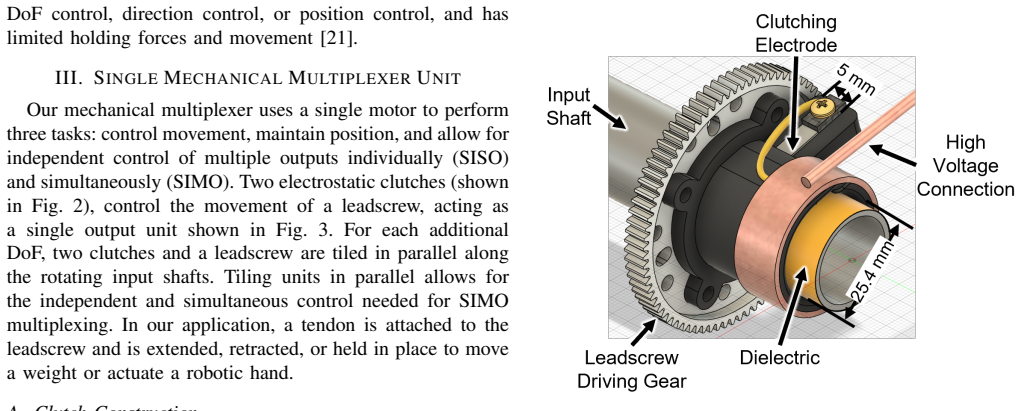
As robotic systems become increasingly articulated, conventional actuation still dedicates one motor to each degree of freedom (DoF). Mechanical multiplexers address this limitation by allowing a single motor to control multiple outputs through clutches, reducing the number of required motors. However, previous multiplexers have relied on bulky mechanical clutch designs, limiting their development. This study presents an electrostatic capstan clutch-based transmission architecture that enables high-force mechanical multiplexing with independent, simultaneous, and fully actuated control of multiple outputs from a single motor. Our transmission implements four fully-actuated linear outputs, achieving individual output forces of up to 212 N and output speeds of up to 69.5 mm/s. We demonstrate our transmission on a commercial tendon-driven hand, where sequentially allocating system-wide torque capacity to individual outputs increased vertical grip strength by 4.09x and raised horizontal carrying capacity to 111.2 N, the highest reported among five-fingered tendon-driven robotic hands. These results demonstrate that electrostatic clutch-based mechanical multiplexing enables high-force, independent, simultaneous, and fully actuated control while overcoming the limitations of previous mechanical multiplexers.
Figures


Figures from the paper (6 more)


Reviewed May 23, 2026 · model on record in the stance chip above.
Discussion (0). Continue with ORCID to comment.