REVIEW 2 major objections 4 minor 68 references
An approximate factorization method for inverse acoustic scattering with phaseless total-field data
T0 review · 2 major / 4 minor · reviewed 2026-08-14 · deepseek-v4-flash
Pith's one-line read The location and shape of an acoustic scatterer can be recovered from intensity-only measurements through an approximate factorization method.
desk verdict A credible first factorization-type method for phaseless acoustic data, with a proven operator asymptotics and an honestly admitted spectral-inheritance gap that keeps the full inversion guarantee heuristic. read the letter →
The pith
A machine-rendered reading of the paper's core claim, the machinery that carries it, and where it could break.
The reading
What carries the argument
The load-bearing object is the modified phaseless total-field operator $\widetilde N_R^{PW} = e^{-i(kR+\pi/4)} B_{1/2}^* N_R^{PW} B_{1/2}$, where $N_R^{PW}$ is the integral operator with kernel $|u(R\hat x,d)|^2 - 1$ on the measurement circle, and $B_{1/2}$, $B_{1/2}^*$ are the Fourier-multiplier operators $(1+m^2)^{-1/4}$ that renormalize the Sobolev scales so that everything acts on $L^2(\mathbb S^1)$. The identity carrying the argument is the operator-norm proximity of the symmetrized absolute value $(\widetilde N_R^{PW})_\# = |\operatorname{Re}(\widetilde N_R^{PW})| + |\operatorname{Im}(\widetilde N_R^{PW})|$ to $(1/\sqrt{8k\pi R})\widetilde F_\#$, obtained by estimating the residual scattered-field terms with oscillatory-integral bounds. The paper then feeds the factorization of $\widetilde F = B_{1/2}^* F B_{1/2}$ through a range identity, yielding the exact criterion $z\in D \iff B_{1/2}^*\varphi_z \in R(\widetilde F_\#^{1/2})$, and uses that criterion to define the indicator function from the eigensystem of $(\widetilde N_{L,M})_\#$.
What would settle it
For a sound-soft disk with known radius, compute the discretized matrix $(\widetilde N_{L,M})_\#$ from forward data and compare its first several eigenvectors with those of $(1/\sqrt{8k\pi R})\widetilde F_\#$ as $R$ increases. If the angle between the dominant eigenspaces does not tend to zero, or if the indicator $W_{L,M}^{PW}(z)$ stops being large inside and small outside the disk, the spectral-inheritance step on which the method depends is false.
Extended reading notes
Core claim
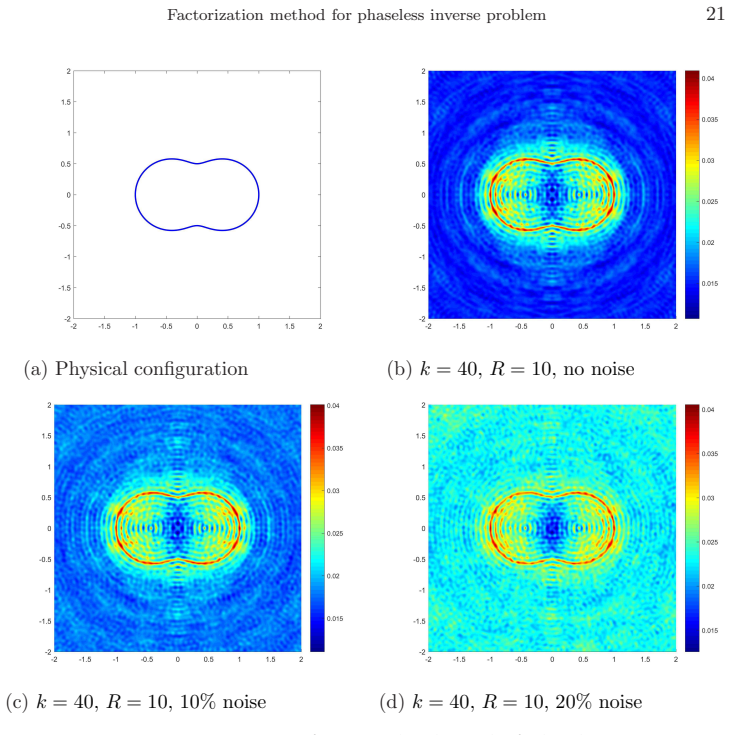
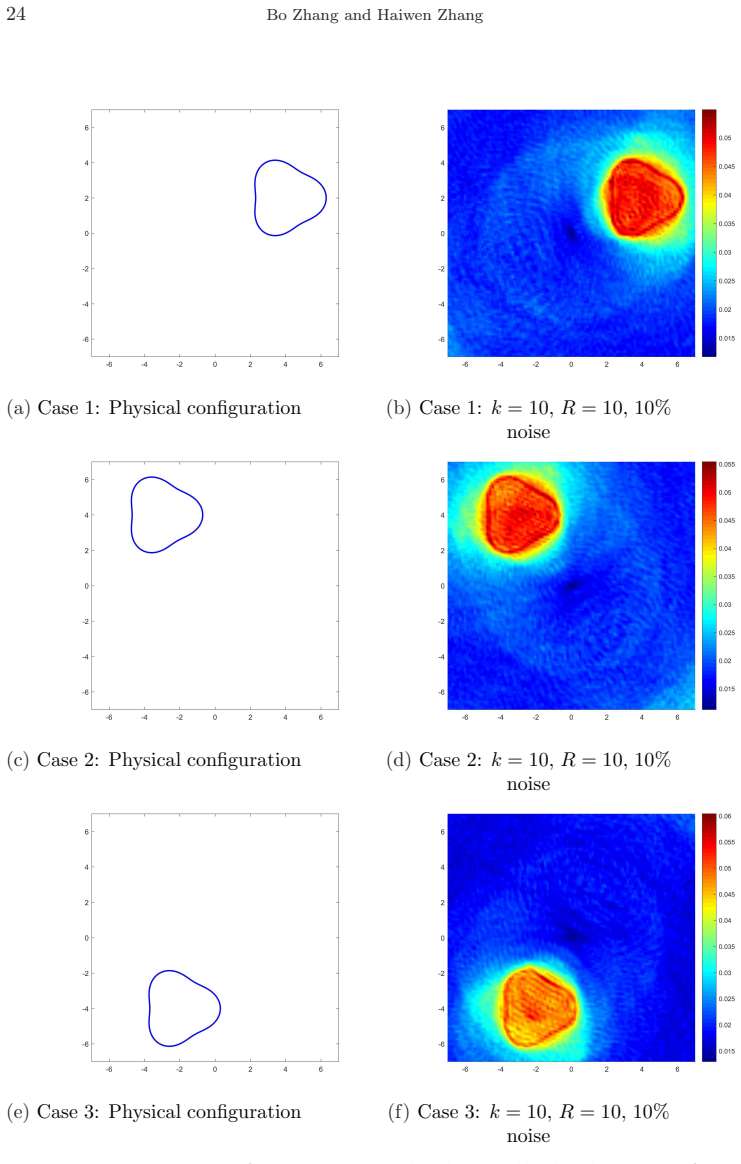
The central claim is that the symmetrized phaseless total-field operator $(\widetilde N_R^{PW})_\# := |\operatorname{Re}(\widetilde N_R^{PW})| + |\operatorname{Im}(\widetilde N_R^{PW})|$ has the asymptotic expansion $(\widetilde N_R^{PW})_\# = (1/\sqrt{8k\pi R})\widetilde F_\# + O(R^{-\alpha})$ in $L(L^2(\mathbb S^1))$ for every $\alpha\in(1/2,1)$, where $\widetilde F_\#$ is the symmetrized modified far-field operator. For $\widetilde F_\#$ the paper proves an exact range characterization: $z\in D$ if and only if $B_{1/2}^*\varphi_z$ lies in the range of $\widetilde F_\#^{1/2}$, where $\varphi_z(\hat x)=e^{-ik\hat x\cdot z}$ and $B_{1/2}^*$ is the adjoint of the Sobolev renormalization operator $B_{1/2}$. Consequently, the paper asserts that the eigensystem of $(\widetilde N_R^{PW})_\#$ approximately reconstructs both the location and the shape of $D$ when $R$ is sufficiently large, and it presents this as the first factorization-type inversion method for phaseless scattering data. Numerical experiments with peanut, kite, rounded square, rounded triangle, and two-component obstacles are used to support the claim.
Load-bearing premise
The load-bearing premise is that two operators close in operator norm have spectral systems close enough for the finite-dimensional indicator built from the measured-data operator to inherit the exact range characterization proved for the far-field operator; the paper states in Remark 5.3 that it cannot yet prove this inheritance.
Editorial extensions
If this is right
- The same algorithm runs unchanged for sound-soft, sound-hard, impedance, and penetrable scatterers, because the boundary condition never enters the construction of the indicator.
- Once the measurement radius $R$ and truncation $M$ are large enough, the indicator $W_{L,M}^{PW}(z)$ should be large inside the obstacle and small outside it, matching the exact far-field characterization.
- Larger measurement radii improve the reconstruction in the paper's numerical study of an impedance obstacle with $R=4,8,12$, consistent with the $O(R^{-\alpha})$ approximation error.
- The method tolerates additive noise: the paper's examples with 10% and 20% noise still locate the scatterers.
- The reconstruction is non-iterative and requires only one eigensystem computation of the discretized symmetrized matrix $(\widetilde N_{L,M})_\#$.
Reading between the lines
- The paper leaves open whether operator-norm proximity transfers to the spectral systems; if eigenvectors are unstable, the indicator could fail for scatterers with clustered eigenvalues, so a numerical eigenvalue-stability study would be a direct test of the method's core heuristic.
- Plotting $W_{L,M}^{PW}(z) - W(z)$ at fixed points inside and outside a known scatterer as $R$ grows would quantify the actual convergence rate and expose whether the $O(R^{-\alpha})$ bound is sharp in practice.
- The symmetrization $|\operatorname{Re}(\cdot)| + |\operatorname{Im}(\cdot)|$ is a transferable device: it could be applied to other phaseless inverse problems, such as electromagnetic scattering or near-field measurements with point sources, whenever the underlying far-field operator admits a range-identity factorization.
- The paper gives no $k$-dependent constants in the error bound (Remark 3.8), so the practical resolution limits at high frequency remain unknown; deriving such constants would require a wavenumber-explicit analysis of the far-field pattern.
Signed reviews
Editorial analysis
A structured set of objections, weighed in public.
Referee Report
Summary. The paper considers the inverse acoustic scattering problem at fixed frequency with phaseless total-field data |u(x,d)| on a circle ∂B_R surrounding the unknown scatterer. It introduces the phaseless total-field operator N_R^PW in (3.1) and proves, in Theorem 3.7, that N_R^PW minus (e^{iπ/4} e^{ikR}/√(8kπR)) times the far-field operator F is O(1/R) in the H^{1/2}(S^1)→H^{-1/2}(S^1) operator norm. After multiplying by the Sobolev weight operators B_{1/2}, B*_{1/2}, it obtains the L2→L2 estimate in Theorem 4.2 for the modified operators. The paper then invokes the factorization results of [31,32] to characterize D via the range of (tilde F#)^{1/2} (Theorem 4.7) and defines the indicator W_M^PW from the eigensystem of the positive part (tilde N_{R,M})# of the truncated modified phaseless operator. The algorithm is tested numerically for sound-soft, sound-hard, impedance, and penetrable media with up to 20% noise.
Significance. If the inversion claim were fully established, this would be a useful first factorization-type method for phaseless data, adding to the small set of non-iterative phaseless reconstruction algorithms. The rigorous asymptotic analysis of N_R^PW—the oscillatory-integral estimates in Lemmas 3.2–3.4 and the interpolation argument in Theorem 3.7—is a solid contribution, as is the combination of these estimates with the independently established factorization and range-identity results of [31,32] to justify the approximate factorization structure. The numerical study is reasonably broad (five obstacle types, noise levels, varying R). The central limitation is that the step from operator-norm approximation to the eigensystem-based indicator is explicitly unproved (Remark 5.3), so the reconstruction guarantee currently rests on a heuristic; this limits the significance to a conditional result.
major comments (2)
- [§5, Remark 5.3] The sentence 'we are currently not able to give a rigorous theoretical analysis on the property of the indicator function W_M^PW(z)' identifies the exact load-bearing step of the paper. The exact range characterization (4.11)–(4.12) is proved only for the modified far-field operator tilde F#, while the algorithm replaces tilde F# by (tilde N_{R,M})# without a theorem showing that the weighted eigenseries in (5.8) inherits the divergence property of W(z). Since the abstract and Section 1 claim that the method 'reconstructs' the scatterer, this missing justification is a central gap; the numerical examples illustrate but do not prove the claimed inheritance.
- [§5, Eq. (5.8) and Remark 5.3] Operator-norm convergence in (4.13) and (5.2) does not control the indicator (5.8). The summands |(B*_{1/2,M}φ_z, ψ_j)|^2/λ_j involve reciprocals of eigenvalues λ_j that tend to 0 for a compact operator, and the eigenvectors of a compact operator are not stable under small norm perturbations unless spectral gaps are controlled. The tail of the series is precisely what distinguishes z∈D from z∉D through divergence of W(z), and the O(R^{-α}) bound gives no estimate for that tail. A rigorous or at least a regularized version of the indicator, for example with an eigenvalue cutoff depending on R, would be needed to make the reconstruction claim load-bearing.
minor comments (4)
- [§3, Lemma 3.1] The proof of Lemma 3.1 is only a reference to [17] and well-posedness; for reproducibility, please spell out why the C^1 bound (3.4) and the decay (3.5) hold uniformly in d for both obstacle and medium scattering.
- [§4, Eq. (4.3)] The phase factor e^{-i(kR+π/4)} in the definition of tilde N_R^PW is introduced without explanation; a brief remark that it cancels the phase appearing in Theorem 3.7 would improve readability.
- [§5, Algorithm 5.1] Step (5) instructs the user to locate sampling points where W takes 'a large value' but gives no threshold or quantitative stopping rule; a reproducible criterion or a statement that the indicator is used only relatively would help.
- [§6, Table 6.1] The parametrization table lists centers (c1,c2) symbolically, but the actual center values are not given for Examples 1, 2, 3, and 5; please include them for reproducibility.
Circularity Check
No circularity found: the phaseless total-field operator is derived from data, its asymptotic link to the far-field operator is proved inside the paper, and the factorization and range identity are imported from independent references.
full rationale
The derivation chain is self-contained at the points that matter for circularity. The operator N_PW_R is defined directly from the measured data by (3.1), and Theorem 3.7 derives the asymptotic relation to the far-field operator F by expanding |u|^2 - 1 and applying oscillatory-integral estimates; the phase factor e^{-i(kR+pi/4)} in (4.3) is an analytic normalization rather than a fitted parameter. The operator-norm bound (4.13) in Remark 4.8 is a standard perturbation estimate for |Re A| + |Im A|, and it is not what supplies the range characterization. Theorem 4.7's range identity is anchored in Kirsch-Grinberg [31] and Kirsch-Liu [32], which are independent of the authors; the self-citations [22,58,59] are contextual references to earlier approximate-factorization work and are not load-bearing. The paper explicitly disclaims a proof that the finite-dimensional indicator W_PW_M inherits the range test (Remark 5.3: "we are currently not able to give a rigorous theoretical analysis on the property of the indicator function W_PW_M(z)"), but that is an admitted correctness and completeness gap, not a circular reduction: the indicator is not defined in terms of the reconstruction target, and no fitted parameter is renamed as a prediction. Therefore no circular step can be exhibited.
Assumptions & free parameters
assumptions (9)
- standard math Standard well-posedness and far-field asymptotic expansion of the scattered field, with uniform C^1 bound on the far-field pattern and remainder O(|x|^{-3/2}) (Lemma 3.1).
- standard math Reciprocity relation u_\infty(\hat x,d) = u_\infty(-d,-\hat x) for the far-field pattern.
- standard math Van der Corput-type oscillatory integral bound (Lemma 3.2, from [14]).
- standard math Factorizations of the far-field operator \tilde F for sound-soft, impedance, and inhomogeneous medium scatterers (Lemmas 4.4-4.6, from [31]).
- standard math Modified range identity of Kirsch and Liu [32, Theorem 1.1].
- domain assumption Spectral assumptions: k^2 is not a Dirichlet, impedance, or interior transmission eigenvalue in D.
- domain assumption For the medium case, the contrast m = n-1 satisfies Re[m] \geq c > 0 or Re[m] \leq -c < 0 pointwise.
- domain assumption The scatterer D is strictly contained in the measurement circle B_R and R is sufficiently large.
- ad hoc to paper Operator-norm closeness in (4.13) is sufficient for the finite-dimensional eigensystem indicator W_M^PW(z) to approximate the range test of \tilde F_#.
Cite this review
Pith. "Pith review of An approximate factorization method for inverse acoustic scattering with phaseless total-field data." pith.science (2026). https://pith.science/paper/5VPI5UUS
@misc{pith2026190803786,
  author       = {Pith},
  title        = {Pith review of: An approximate factorization method for inverse acoustic scattering with phaseless total-field data},
  year         = {2026},
  howpublished = {\url{https://pith.science/paper/5VPI5UUS}},
  note         = {Machine review of arXiv:1908.03786}
}
abstract
This paper is concerned with the inverse acoustic scattering problem with phaseless total-field data at a fixed frequency. An approximate factorization method is developed to numerically reconstruct both the location and shape of the unknown scatterer from the phaseless total-field data generated by incident plane waves at a fixed frequency and measured on the circle $\partial B_R$ with a sufficiently large radius $R$. The theoretical analysis of our method is based on the asymptotic property in the operator norm from $H^{1/2}(\mathbb{S}^1)$ to $H^{-1/2}(\mathbb{S}^1)$ of the phaseless total-field operator defined in terms of the phaseless total-field data measured on $\partial B_R$ with large enough $R$, where $H^s(\mathbb{S}^1)$ is a Sobolev space on the unit circle $\mathbb{S}^1$ for real number $s$, together with the factorization of a modified far-field operator. The asymptotic property of the phaseless total-field operator is also established in this paper with the theory of oscillatory integrals. The unknown scatterer can be either an impenetrable obstacle of sound-soft, sound-hard or impedance type or an inhomogeneous medium with a compact support, and the proposed inversion algorithm does not need to know the boundary condition of the unknown obstacle in advance. Numerical examples are also carried out to demonstrate the effectiveness of our inversion method. To the best of our knowledge, it is the first attempt to develop a factorization type method for inverse scattering problems with phaseless data.
Figures


Figures from the paper (3 more)


Reference graph
Works this paper leans on
-
[1]
A.D. Agaltsov, T. Hohage and R.G. Novikov, An iterative a pproach to monochromatic phaseless inverse scattering, Inverse Problems 35 (2018), 024001
work page 2018
- [2]
- [3]
-
[4]
T. Arens and N. Grinberg, A complete factorization metho d for scattering by periodic surfaces, Computing 75 (2005), 111–132
work page 2005
-
[5]
G. Bao, P. Li and J. Lv, Numerical solution of an inverse di ffraction grating problem from phaseless data, J. Opt. Soc. Am. A 30 (2013), 293–299. Factorization method for phaseless inverse problem 23 (a) Physical configuration (b) k = 10, R = 4, 10% noise (c) k = 10, R = 8, 10% noise (d) k = 10, R = 12, 10% noise Fig. 6.3 . Reconstruction of a kite-shaped,...
work page 2013
- [6]
-
[7]
Y. Boukari and H. Haddar, The factorization method appli ed to cracks with impedance bound- ary conditions, Inverse Probl. Imaging 7 (2013), 1123–1138
work page 2013
-
[8]
F. Cakoni and D. Colton, A Qualitative Approach to Inverse Scattering Theory , Springer, Berlin, 2014
work page 2014
Show all 68 references
-
[9]
Cand` es, X
E.J. Cand` es, X. Li and M. Soltanolkotabi, Phase retriev al via Wirtinger flow: theory and algorithms, IEEE Trans. Inform. Theory 61 (2015), 1985–2007
2015
-
[10]
Chandler-Wilde and P
S.N. Chandler-Wilde and P. Monk, W ave-number-explici t bounds in time-harmonic scattering, SIAM J. Math. Anal. 39 (2008), 1428–1455
2008
-
[11]
Chen, Computational Methods for Electromagnetic Inverse Scatte ring, Wiley, New York, 2018
X. Chen, Computational Methods for Electromagnetic Inverse Scatte ring, Wiley, New York, 2018
2018
-
[12]
Z. Chen, S. Fang and G. Huang, A direct imaging method for the half-space inverse scattering problems with phaseless data, Inverse Problems Imaging 11 (2017), 901–916
2017
-
[13]
Chen and G
Z. Chen and G. Huang, A direct imaging method for electro magnetic scattering data without phase information, SIAM J. Imaging Sci. 9 (2016), 1273–1297
2016
-
[14]
Chen and G
Z. Chen and G. Huang, Phaseless imaging by reverse time m igration: acoustic waves, Numer. Math. Theory Methods Appl. 10 (2017), 1–21
2017
-
[15]
Colton and R
D. Colton and R. Kress, Integral Equation Methods in Scattering Theory , Wiley, New York, 1983
1983
-
[16]
Colton and R
D. Colton and R. Kress, Inverse scattering, in: Handbook of Mathematical Methods in Imaging (O. Scherzer, ed.), Springer, New York, 2011, pp. 551–598. 24 Bo Zhang and Haiwen Zhang (a) Case 1: Physical configuration (b) Case 1: k = 10, R = 10, 10% noise (c) Case 2: Physical confi...
2011
-
[17]
Colton and R
D. Colton and R. Kress, Inverse Acoustic and Electromagnetic Scattering Theory (3rd Ed.), Springer, New York, 2013
2013
-
[18]
H. Dong, J. Lai and P. Li, Inverse obstacle scattering fo r elastic waves with phased or phaseless far-field data, SIAM J. Imaging Sciences 12 (2019), 809–838
2019
-
[19]
H. Dong, D. Zhang and Y. Guo, A reference ball based itera tive algorithm for imaging acoustic obstacle from phaseless far-field data, Inverse Probl. Imaging 13 (2019), 177–195
2019
-
[20]
Griesmaier, An asymptotic factorization method for inverse electromagnetic scattering in layered media, SIAM J
R. Griesmaier, An asymptotic factorization method for inverse electromagnetic scattering in layered media, SIAM J. Appl. Math. 68 (2008), 1378–1403
2008
-
[21]
Griesmaier and M
R. Griesmaier and M. Hanke, An asymptotic factorizatio n method for inverse electromagnetic scattering in layered media II: A numerical study, Contemp. Math. 494 (2009), 61–79
2009
-
[22]
G. Hu, J. Yang, B. Zhang and H. Zhang, Near-field imaging o f scattering obstacles with the factorization method, Inverse Problems 30 (2014), 095005
2014
-
[23]
Ivanyshyn, Shape reconstruction of acoustic obstac les from the modulus of the far field pattern, Inverse Probl
O. Ivanyshyn, Shape reconstruction of acoustic obstac les from the modulus of the far field pattern, Inverse Probl. Imaging 1 (2007), 609–622
2007
-
[24]
Ivanyshyn and R
O. Ivanyshyn and R. Kress, Identification of sound-soft 3D obstacles from phaseless data, Inverse Probl. Imaging 4 (2010), 131–149
2010
-
[25]
Ivanyshyn and R
O. Ivanyshyn and R. Kress, Inverse scattering for surfa ce impedance from phase-less far field data, J. Comput. Phys. 230 (2011), 3443–3452
2011
-
[26]
X. Ji, X. Liu and B. Zhang, Inverse acoustic scattering w ith phaseless far field data: Uniqueness, phase retrieval, and direct sampling methods, SIAM J. Imaging Sci. 12 (2019), 1163–1189
2019
-
[27]
X. Ji, X. Liu and B. Zhang, Phaseless inverse source scat tering problem: Phase retrieval, uniqueness and direct sampling methods, J. Comput. Phys.: X 1 (2019), 100003. 26 Bo Zhang and Haiwen Zhang
2019
-
[28]
X. Ji, X. Liu and B. Zhang, Target reconstruction with a r eference point scatterer using phase- less far field patterns, SIAM J. Imaging Sci. 12 (2019), 372–391
2019
-
[29]
Kirsch, Characterization of the shape of a scatterin g obstacle using the spectral data of the far field operator, Inverse Problems 14 (1998), 1489–1512
A. Kirsch, Characterization of the shape of a scatterin g obstacle using the spectral data of the far field operator, Inverse Problems 14 (1998), 1489–1512
1998
-
[30]
Kirsch, An Introduction to the Mathematical Theory of Inverse Probl ems (2nd Ed.), Springer, New York, 2011
A. Kirsch, An Introduction to the Mathematical Theory of Inverse Probl ems (2nd Ed.), Springer, New York, 2011
2011
-
[31]
Kirsch and N
A. Kirsch and N. Grinberg, The Factorization Method for Inverse Problems , Oxford Univ. Press, Oxford, 2008
2008
-
[32]
Kirsch and X
A. Kirsch and X. Liu, A modification of the factorization method for the classical acoustic inverse scattering problems, Inverse Problems 30 (2014), 035013
2014
-
[33]
Klibanov, Phaseless inverse scattering problems in three dimensions, SIAM J
M.V. Klibanov, Phaseless inverse scattering problems in three dimensions, SIAM J. Appl. Math. 74 (2014), 392–410
2014
-
[34]
Klibanov, A phaseless inverse scattering problem for the 3-D Helmholtz equation, Inverse Probl
M.V. Klibanov, A phaseless inverse scattering problem for the 3-D Helmholtz equation, Inverse Probl. Imaging 11 (2017), 263–276
2017
-
[35]
Klibanov, N.A
M.V. Klibanov, N.A. Koshev, D.-L. Nguyen, L.H. Nguyen, A. Brettin and V.N. Astratov, A nu- merical method to solve a phaseless coefficient inverse probl em from a single measurement of experimental data, SIAM J. Imaging Sci. 11 (2018), 2339–2367
2018
-
[36]
Klibanov, D.-L
M.V. Klibanov, D.-L. Nguyen and L.H. Nguyen, A coefficien t inverse problem with a single measurement of phaseless scattering data, SIAM J. Appl. Math. 79 (2019), 1–27
2019
-
[37]
Klibanov, L.H
M.V. Klibanov, L.H. Nguyen and K. Pan, Nanostructures i maging via numerical solution of a 3-D inverse scattering problem without the phase informati on, Appl. Numer. Math. 110 (2016), 190–203
2016
-
[38]
Klibanov and V.G
M.V. Klibanov and V.G. Romanov, Reconstruction proced ures for two inverse scattering prob- lems without the phase information, SIAM J. Appl. Math. 76 (2016), 178–196
2016
-
[39]
Kress, Linear Integral Equations (3rd Ed.), Springer, New York, 2014
R. Kress, Linear Integral Equations (3rd Ed.), Springer, New York, 2014
2014
-
[40]
Kress and W
R. Kress and W. Rundell, Inverse obstacle scattering wi th modulus of the far field pattern as data, in: Inverse Problems in Medical Imaging and Nondestructive Tes ting (Oberwolfach, 1996), Springer, Vienna, 1997, pp. 75–92
1996
-
[41]
Lechleiter, Factorization Methods for Photonics and Rough Surfaces , PhD thesis, Univ
A. Lechleiter, Factorization Methods for Photonics and Rough Surfaces , PhD thesis, Univ. Karlsruhe (TH), Germany, 2008
2008
-
[42]
Li and H
J. Li and H. Liu, Recovering a polyhedral obstacle by a fe w backscattering measurements, J. Differ. Equations 259 (2015), 2101–2120
2015
-
[43]
J. Li, H. Liu and Y. W ang, Recovering an electromagnetic obstacle by a few phaseless backscat- tering measurements, Inverse Problems 33 (2017), 035011
2017
-
[44]
L. Li, H. Zheng and F. Li, Two-dimensional contrast sour ce inversion method with phaseless data: TM case, IEEE Trans. Geosci. Remote Sens. 47 (2009), 1719–1736
2009
-
[45]
Liu and B
X. Liu and B. Zhang, Unique determination of a sound-sof t ball by the modulus of a single far field datum, J. Math. Anal. Appl. 365 (2010), 619–624
2010
-
[46]
Majda, High frequency asymptotics for the scatterin g matrix and the inverse problem of acoustical scattering, Comm
A. Majda, High frequency asymptotics for the scatterin g matrix and the inverse problem of acoustical scattering, Comm. Pure Appl. Math. 29 (1976), 261–291
1976
-
[47]
Maleki and A.J
M.H. Maleki and A.J. Devaney, Phase-retrieval and inte nsity-only reconstruction algorithms for optical diffraction tomography, J. Opt. Soc. Am. A 10 (1993), 1086–1092
1993
-
[48]
Maretzke and T
S. Maretzke and T. Hohage, Stability estimates for line arized near-field phase retrieval in X-ray phase contrast imaging, SIAM J. Appl. Math. 77 (2017), 384–408
2017
-
[49]
McLean, Strongly Elliptic Systems and Boundary Integral Equations , Cambridge Univ
W. McLean, Strongly Elliptic Systems and Boundary Integral Equations , Cambridge Univ. Press, Cambridge, 2000
2000
-
[50]
Moiola and E.A
A. Moiola and E.A. Spence, Acoustic transmission probl ems: wavenumber-explicit bounds and resonance-free regions, Math. Models Methods Appl. Sci. 29 (2019), 317–354
2019
-
[51]
Moscoso, A
M. Moscoso, A. Novikov and G. Papanicolaou, Coherent im aging without phases, SIAM J. Imaging Sci. 9 (2016), 1689–1707
2016
-
[52]
Moscoso, A
M. Moscoso, A. Novikov, G. Papanicolaou and C. Tsogka, M ultifrequency interferometric imag- ing with intensity-only measurements, SIAM J. Imaging Sci. 10 (2017), 1005–1032
2017
-
[53]
Novikov, M
A. Novikov, M. Moscoso and G. Papanicolaou, Illuminati on strategies for intensity-only imag- ing, SIAM J. Imaging Sci. 8 (2015), 1547–1573
2015
-
[54]
Novikov, Formulas for phase recovering from phase less scattering data at fixed frequency, Bull
R.G. Novikov, Formulas for phase recovering from phase less scattering data at fixed frequency, Bull. Sci. Math. 139 (2015), 923–936
2015
-
[55]
Novikov, Explicit formulas and global uniqueness for phaseless inverse scattering in mul- tidimensions, J
R.G. Novikov, Explicit formulas and global uniqueness for phaseless inverse scattering in mul- tidimensions, J. Geom. Anal. 26 (2016), 346–359
2016
-
[56]
L. Pan, Y. Zhong, X. Chen and S.P. Yeo, Subspace-based op timization method for inverse scattering problems utilizing phaseless data, IEEE Trans. Geosci. Remote Sens. 49 (2011), 981–987
2011
-
[57]
Potthast, A survey on sampling and probe methods for i nverse problems, Inverse Problems Factorization method for phaseless inverse problem 27 22 (2006), R1–R47
R. Potthast, A survey on sampling and probe methods for i nverse problems, Inverse Problems Factorization method for phaseless inverse problem 27 22 (2006), R1–R47
2006
-
[58]
F. Qu, J. Yang and B. Zhang, An approximate factorizatio n method for inverse medium scat- tering with unknown buried objects, Inverse Problems 33 (2017), 035007
2017
-
[59]
Qu and H
F. Qu and H. Zhang, Locating a complex inhomogeneous med ium with an approximate factor- ization method, Inverse Problems 35 (2019), 045001
2019
-
[60]
Romanov and M
V.G. Romanov and M. Yamamoto, Phaseless inverse proble ms with interference waves, J. Inverse Ill-Posed Probl. 26 (2018), 681–688
2018
-
[61]
Spence, W avenumber-explicit bounds in time-harm onic acoustic scattering, SIAM J
E.A. Spence, W avenumber-explicit bounds in time-harm onic acoustic scattering, SIAM J. Math. Anal. 46 (2014), 2987–3024
2014
-
[62]
X. Xu, B. Zhang and H. Zhang, Uniqueness in inverse scatt ering problems with phaseless far-field data at a fixed frequency, SIAM J. Appl. Math. 78 (2018), 1737–1753
2018
-
[63]
X. Xu, B. Zhang and H. Zhang, Uniqueness in inverse scatt ering problems with phaseless far-field data at a fixed frequency. II, SIAM J. Appl. Math. 78 (2018), 3024–3039
2018
-
[64]
Zhang and H
B. Zhang and H. Zhang, Imaging of locally rough surfaces from intensity-only far-field or near- field data, Inverse Problems 33 (2017), 055001
2017
-
[65]
Zhang and H
B. Zhang and H. Zhang, Recovering scattering obstacles by multi-frequency phaseless far-field data, J. Comput. Phys. 345 (2017), 58–73
2017
-
[66]
Zhang and H
B. Zhang and H. Zhang, Fast imaging of scattering obstac les from phaseless far-field measure- ments at a fixed frequency, Inverse Problems 34 (2018), 104005
2018
-
[67]
Zhang and Y
D. Zhang and Y. Guo, Uniqueness results on phaseless inv erse acoustic scattering with a refer- ence ball, Inverse Problems 34 (2018), 085002
2018
-
[68]
Zhang, Y
D. Zhang, Y. Guo, J. Li and H. Liu, Retrieval of acoustic s ources from multi-frequency phaseless data, Inverse Problems 34 (2018), 094001
2018
Reviewed August 14, 2026 · model on record in the stance chip above.
Discussion (0). Continue with ORCID to comment.