REVIEW 3 major objections 6 minor 62 references
Resolving SLX 1744-299 and SLX 1744-300 in the hard X-ray band: implications for their ultracompact nature
T0 review · 3 major / 6 minor · reviewed 2026-08-02 · deepseek-v4-flash
Pith's one-line read The first hard X-ray resolution of the pair SLX 1744−299/300 shows both in the low-luminosity hard state and caps one orbital period at ~90 minutes, strengthening its ultracompact candidacy.
desk verdict Solid NuSTAR resolution of two GC LMXBs; the observational core is new and careful, but the DIM-based P_orb limits need the curve choice stated and systematics propagated. read the letter →
The pith
A machine-rendered reading of the paper's core claim, the machinery that carries it, and where it could break.
The reading
What carries the argument
The argument runs on two pieces of machinery. Spectrally, the paper models both sources with nthComp, a thermal Comptonisation continuum (seed photons from the neutron-star surface/boundary layer), yielding photon index Γ≈2.3 and coronal temperatures kTe≈38 keV (SLX 1744−299) and ≈9 keV (SLX 1744−300); the timing side uses Leahy-normalised power spectra and dead-time-corrected fractional rms, giving ~21–23% for both. Dynamically, the paper converts distance upper limits (7.2±1.4 kpc, 10.3±0.8 kpc) into luminosity upper limits, assumes LX = 0.1 c^2 Mdot, and compares Mdot with the disc instability model's critical mass-transfer rates (for non-irradiated C/O and irradiated mixed-composition di
What would settle it
A direct measurement of either system's orbital period—through coherent pulsations, eclipse/dip timing, or optical spectroscopy of the counterpart—would settle the ultracompact claim. Alternatively, observing a photospheric-radius-expansion burst would pin down the distance: for SLX 1744−300, a distance below ~6.5 kpc would push its inferred mass-transfer rate above the DIM stability line at P_orb <80 min and remove it from the ultracompact regime by this argument.
Extended reading notes
Core claim
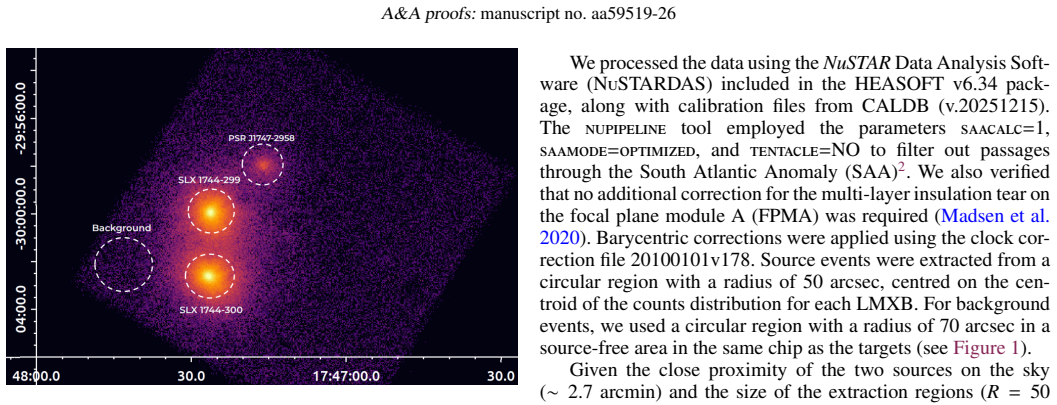
The central claim is that a single 79-ks NuSTAR stare (ObsID 30401036002) resolves SLX 1744−299 and SLX 1744−300 individually in the 3–78 keV band for the first time, allowing separate hard X-ray characterisation. Both sources are described by an absorbed thermal Comptonisation model with no statistically required soft thermal or Fe-line components, and both show fractional rms variability of 21–23%, i.e., the low-luminosity hard state. Their fluxes are (1.77±0.01) and (2.02±0.01) ×10^-10 erg/cm2/s in 3–78 keV—SLX 1744−300 slightly brighter, reversing the historical order. The paper then converts the corresponding luminosity upper limits into mass-accretion-rate upper limits and compares the
Load-bearing premise
The orbital-period limits rest on assuming that each source's observed X-ray luminosity directly yields its mass-transfer rate via L_X = 0.1 c^2 Mdot, that the transfer rate equals the accretion rate, and that the disc-instability-model stability curves for these disc compositions apply; if any of these fails—or the burst-distance upper limits are wrong—the inferred P_orb caps move.
Editorial extensions
If this is right
- If the P_orb caps hold, SLX 1744−299 becomes a strong ultracompact-binary candidate, and its previously observed intermediate-duration bursts fit the hydrogen-poor donor expected in such systems.
- The two sources' persistent, hard-state behaviour at ~10^36 erg/s shows that faint Galactic Centre X-ray sources can hide short-period binaries; future high-angular-resolution hard X-ray surveys could uncover more such pairs.
- The observed flux-ratio reversal relative to earlier 0.5–10 keV measurements (SLX 1744−300 now brighter) implies long-term variability in one or both systems, which must be accounted for in any multi-epoch study of the pair.
- The burst recurrence-time upper limit of ~5 h for SLX 1744−300 favours mixed H/He burning and, combined with the persistent-flux estimate from the alpha parameter, independently supports the luminosity derived from spectral fits.
Reading between the lines
- Inference: The same DIM logic applied to other persistent, faint, unresolved Galactic Centre LMXBs could yield a statistical sample of candidate ultracompact binaries without needing orbital-period measurements, provided hard X-ray imaging can separate crowded fields.
- Inference: If SLX 1744−299 proves to be ultracompact, the pair would constitute two very close compact binaries in the same field; because ultracompact binaries are expected gravitational-wave sources at millihertz frequencies, the pair offers a testbed for Galactic population models ahead of space-based gravitational-wave detectors.
- Inference: The paper's cap on P_orb for SLX 1744−300 is sensitive to the distance: if the true distance is below ~6.5 kpc, the source would fall outside the ultracompact regime by this method, so a single photospheric-radius-expansion burst would discriminate between the two interpretations.
Signed reviews
Editorial analysis
A structured set of objections, weighed in public.
Referee Report
Summary. The paper analyzes a NuSTAR archival observation (ObsID 30401036002) of the close pair SLX 1744−299 and SLX 1744−300, claiming the first spatial resolution of the two sources above 10 keV. The authors find both in the hard state (fractional rms ~21–23%, photon index Γ≈2.3, thermal Comptonisation spectra), with SLX 1744−300 slightly brighter (flux ratio ~1.15 in 3–78 keV). SLX 1744−299 shows a gradual flux decline and spectral hardening; SLX 1744−300 remains steady and exhibits two short Type-I bursts attributed to mixed H/He burning. Combining distance upper limits with the disc instability model, the authors derive P_orb≲90 min for SLX 1744−299 and P_orb≲105–155 min for SLX 1744−300, concluding that SLX 1744−299 is a compelling ultracompact X-ray binary (UCXB) candidate.
Significance. The observational analysis is careful and largely convincing: the authors quantify cross-contamination via King-profile simulations (0.76–0.99%), apply dead-time corrections, use simulation-based Fe-line significance tests, and report MCMC parameter uncertainties. The resolved hard X-ray fluxes, hard-state classification, and burst properties are valuable additions to the sparse literature on these two persistent LMXBs. If the orbital-period constraints hold, the paper strengthens the UCXB candidacy of SLX 1744−299. However, the DIM-based section is the least robust link and needs substantial revision before the conclusions can be considered reliable. The constraining power is testable: future optical/IR or X-ray timing could directly measure the orbital periods.
major comments (3)
- [§5.3, Fig. 5] The central P_orb limits are derived by comparing Ṁ_acc≲1.9×10^−10 M☉/yr and ≲4.5×10^−10 M☉/yr with "the critical stability thresholds predicted by the DIM", but the text does not state which of the four curves in Fig. 5 (non-irradiated C/O, irradiated mixed-composition, irradiated solar-composition, irradiated pure-helium) was used. These curves differ substantially; for SLX 1744−299 the choice can shift the inferred limit from below 80 min to above 90 min, which directly affects the claim that this is a compelling UCXB candidate. Please specify the adopted curve(s), justify the composition and irradiation assumptions for each donor, and propagate the attendant systematic uncertainty into the quoted limits.
- [§5.3] The conversion L_X = η c^2 Ṁ_acc with η=0.1 is used without discussion of its assumptions. The quoted L_X values are 3–78 keV, not bolometric; a bolometric correction and a plausible range of radiative efficiency (e.g., 0.1–0.2) would change Ṁ by factors of order unity, and the DIM intersection can shift accordingly. The paper should present the P_orb limits as a function of these assumptions, or explicitly justify why the limits are robust to them.
- [§5.3 and Abstract] The abstract and conclusion quote P_orb≲105–155 min for SLX 1744−300, while §5.3 quotes P_orb≲155 min; these numbers must be harmonized. More importantly, the text itself states that the SLX 1744−300 constraint is "compatible with a short-period LMXB, including a UCXB". Given the ambiguity highlighted in the first major comment, the same caveat applies to the SLX 1744−299 limit. The "compelling" wording should be softened unless the DIM-curve selection and its systematics are fully quantified.
minor comments (6)
- [Abstract, §5.3, §6] The P_orb values for SLX 1744−300 are inconsistent: Abstract and Conclusion say 105–155 min, while §5.3 says ≲155 min.
- [§2.2] The text says "over 105 spectral simulations"; this should read "10^5" (the superscript has been lost).
- [Fig. 5] The caption lists the curve labels but does not give the corresponding literature references; add Menou et al. (2002) and Lasota et al. (2008) with a note on the irradiation treatment.
- [Table 1] The notation "norm bb -<3.3" and "-<1.4" is unclear; state explicitly that these are 90% upper limits and give the units.
- [§4.2] The model name "QDPbursmodel" should be written as "bursmodel" (a QDP model) with the appropriate reference, to avoid confusion.
- [§2.2] The sentence describing the Fe-line significance test should specify whether the 10^5 simulated spectra used the best-fit continuum parameters or a posterior distribution; this affects the reported false-positive rate.
Circularity Check
No significant circularity: the central results are direct NuSTAR measurements, and the P_orb limits are an external DIM model inference, not a refit of the same data.
full rationale
The paper's derivation chain is linear and data-driven: (1) extract NuSTAR spectra/light curves; (2) fit absorbed thermal Comptonisation models; (3) convert measured 3–78 keV fluxes to luminosities using literature distance upper limits (Chelovekov et al. 2017); (4) convert L_X to Mdot via L_X = eta c^2 Mdot with eta = 0.1; (5) read P_orb limits from DIM stability curves (Menou et al. 2002, Lasota et al. 2008). None of these steps defines its output in terms of the conclusion, and no parameter is fitted to a quantity that is later presented as a prediction. The flux ratio (~1.15), fractional rms (~21–23%), and hard-state spectral parameters are direct measurements/characterisations of the NuSTAR data. The P_orb constraints are model-dependent inferences from an external disc-instability model; even if the specific DIM curve used in Fig. 5 is not stated explicitly, that is a reproducibility/robustness issue, not a circular reduction. The paper's own statement that the SLX 1744−300 constraint is 'compatible with a short-period LMXB, including a UCXB' shows the inference is not forced. The self-citations present (e.g., Muñoz-Darias et al. 2014 for hard-state rms reference values; Armas Padilla et al. 2023 for the UCXB catalog; Borghese et al. 2026 for a comparative NuSTAR sample) are contextual or empirical benchmarks, and the central claim does not reduce to them. The derivation is therefore self-contained with respect to circularity, and the correct finding is no significant circularity.
Assumptions & free parameters
free parameters (3)
- η (radiative efficiency) =
0.1
- N_H for each source =
3.3e22 cm^-2 (SLX 1744-299), 3.7e22 cm^-2 (SLX 1744-300)
- Distance upper limits =
7.2 ± 1.4 kpc (299), 10.3 ± 0.8 kpc (300)
assumptions (3)
- domain assumption The disc instability model (DIM) stability curves from Menou et al. (2002) and Lasota et al. (2008) correctly predict the stable-vs-transient boundary for LMXB discs.
- domain assumption The X-ray luminosity traces the mass accretion rate through L_X = η c^2 Ṁ_acc with η=0.1 and Ṁ_transfer ≈ Ṁ_acc.
- domain assumption The type-I bursts from SLX 1744−300 are due to mixed H/He burning.
Cite this review
Pith. "Pith review of Resolving SLX 1744-299 and SLX 1744-300 in the hard X-ray band: implications for their ultracompact nature." pith.science (2026). https://pith.science/paper/5VXAR6VU
@misc{pith2026260611133,
  author       = {Pith},
  title        = {Pith review of: Resolving SLX 1744-299 and SLX 1744-300 in the hard X-ray band: implications for their ultracompact nature},
  year         = {2026},
  howpublished = {\url{https://pith.science/paper/5VXAR6VU}},
  note         = {Machine review of arXiv:2606.11133}
}
abstract
Persistent, low-luminosity low-mass X-ray binaries (LMXBs) offer a unique opportunity to study accretion in this poorly understood regime, as well as to unveil new members of the ultracompact X-ray binary (UCXB) family, characterised by orbital periods ($P_{\rm orb}$) shorter than $\sim 80$ min. We report on a NuSTAR archival observation that, for the first time above 10 keV, spatially resolves the Galactic Centre pair SLX 1744$-$299 and SLX 1744$-$300. We find SLX 1744$-$300 to be slightly brighter, with a flux ratio of $\sim 1.15$, increasing to $\sim 1.3$ when extrapolated to 0.5$-$10 keV. Both the timing (root-mean-square variability) and spectral properties (well described in both cases by a thermal Comptonisation model) indicate that the systems were in the hard state. The two sources, however, display markedly different behaviour throughout the observation. SLX 1744$-$299 shows a gradual flux decline consistent with a decrease in the mass-accretion rate, whereas SLX 1744$-$300 remains steady but exhibits two short-recurrence Type-I X-ray bursts indicative of mixed H/He burning. Combining our results with previously reported upper limits on the distance, we derive low persistent X-ray luminosities of $L_{\rm X}\lesssim 1.1\times10^{36}$ erg s$^{-1}$ and $L_{\rm X}\lesssim 2.6\times10^{36}$ erg s$^{-1}$ (3$-$78 keV) for SLX 1744$-$299 and SLX 1744$-$300, respectively. The corresponding mass-accretion rates, when compared with the critical values from the disc instability model, favour $P_{\rm orb}\lesssim 90$ min and $P_{\rm orb}\lesssim 105-155$ min. Although both limits are formally compatible with the UCXB regime, the case of SLX 1744$-$299 appears significantly more compelling, also considering the previously reported intermediate-duration burst.
Figures


Figures from the paper (2 more)


Reference graph
Works this paper leans on
-
[1]
2020, MNRAS, 494, 2509
Alizai, K., Chenevez, J., Brandt, S., & Lund, N. 2020, MNRAS, 494, 2509
2020
-
[2]
L., Linares, M., Homan, J., & Chakrabarty, D
Allen, J. L., Linares, M., Homan, J., & Chakrabarty, D. 2015, ApJ, 801, 10
2015
-
[3]
2023, Living Reviews in Relativity, 26, 2 Armas Padilla, M., Corral-Santana, J
Amaro-Seoane, P., Andrews, J., Arca Sedda, M., et al. 2023, Living Reviews in Relativity, 26, 2 Armas Padilla, M., Corral-Santana, J. M., Borghese, A., et al. 2023, A&A, 677, A186 Armas Padilla, M., Degenaar, N., & Wijnands, R. 2013a, MNRAS, 434, 1586 Armas Padilla, M., Ponti, G., De Marco, B., Muñoz-Darias, T., & Haberl, F. 2018, MNRAS, 473, 3789 Armas P...
2023
-
[4]
M., Sivakoff, G
Arnason, R. M., Sivakoff, G. R., Heinke, C. O., Cohn, H. N., & Lugger, P. M. 2015, ApJ, 807, 52
2015
-
[5]
Arnaud, K. A. 1996, in Astronomical Society of the Pacific Conference Series, V ol. 101, Astronomical Data Analysis Software and Systems V , ed. G. H. Jacoby & J. Barnes, 17
1996
-
[6]
2018, HENDRICS: High ENergy Data Reduction Interface from the Command Shell, Astrophysics Source Code Library, record ascl:1805.019
Bachetti, M. 2018, HENDRICS: High ENergy Data Reduction Interface from the Command Shell, Astrophysics Source Code Library, record ascl:1805.019
2018
-
[7]
& Huppenkothen, D
Bachetti, M. & Huppenkothen, D. 2018, ApJ, 853, L21
2018
-
[8]
& Degenaar, N
Bahramian, A. & Degenaar, N. 2023, in Handbook of X-ray and Gamma-ray Astrophysics. Edited by Cosimo Bambi and Andrea Santangelo, 120
2023
Show all 62 references
-
[9]
O., Tudor, V ., et al
Bahramian, A., Heinke, C. O., Tudor, V ., et al. 2017, MNRAS, 467, 2199
2017
-
[10]
2024, A&A, 688, A214
Ballhausen, R., Thalhammer, P., Pradhan, P., et al. 2024, A&A, 688, A214
2024
-
[11]
Blackburn, J. K. 1995, in Astronomical Society of the Pacific Conference Se- ries, V ol. 77, Astronomical Data Analysis Software and Systems IV , ed. R. A
1995
-
[12]
2026, arXiv e-prints, arXiv:2604.13187
Borghese, A., Armas Padilla, M., & Muñoz-Darias, T. 2026, arXiv e-prints, arXiv:2604.13187
2026 arXiv
-
[13]
J., Gilfanov, M., & Sunyaev, R
Burke, M. J., Gilfanov, M., & Sunyaev, R. 2017, MNRAS, 466, 194
2017
-
[14]
V ., Grebenev, S
Chelovekov, I. V ., Grebenev, S. A., Mereminskiy, I. A., & Prosvetov, A. V . 2017, Astronomy Letters, 43, 781
2017
-
[15]
M., Han, Z., & Chen, X
Chen, H.-L., Tauris, T. M., Han, Z., & Chen, X. 2021, MNRAS, 503, 3540
2021
-
[16]
P., & Dubus, G
Coriat, M., Fender, R. P., & Dubus, G. 2012, MNRAS, 424, 1991
2012
-
[17]
2004, Nuclear Physics B Proceedings Supplements, 132, 435
Cumming, A. 2004, Nuclear Physics B Proceedings Supplements, 132, 435
2004
-
[18]
Degenaar, N., Koljonen, K. I. I., Chakrabarty, D., et al. 2016, MNRAS, 456, 4256
2016
-
[19]
M., Chakrabarty, D., et al
Degenaar, N., Miller, J. M., Chakrabarty, D., et al. 2015, MNRAS, 451, L85
2015
-
[20]
Degenaar, N., Wijnands, R., & Miller, J. M. 2013, ApJ, 767, L31
2013
-
[21]
M., Grinberg, V ., Fürst, F., et al
Diez, C. M., Grinberg, V ., Fürst, F., et al. 2023, A&A, 674, A147
2023
-
[22]
2007, A&A Rev., 15, 1
Done, C., Gierli´nski, M., & Kubota, A. 2007, A&A Rev., 15, 1
2007
-
[23]
2024, arXiv e-prints, arXiv:2401.11931
Fortin, F., Kalsi, A., García, F., & Chaty, S. 2024, arXiv e-prints, arXiv:2401.11931
2024 arXiv
-
[24]
K., Muno, M
Galloway, D. K., Muno, M. P., Hartman, J. M., Psaltis, D., & Chakrabarty, D. 2008, ApJS, 179, 360
2008
-
[25]
& Weare, J
Goodman, J. & Weare, J. 2010, Communications in Applied Mathematics and Computational Science, 5, 65
2010
-
[26]
P., et al
Grefenstette, B., Brightman, M., Earnshaw, H. P., et al. 2022, arXiv e-prints, arXiv:2206.04058
2022 arXiv
-
[27]
A., Craig, W
Harrison, F. A., Craig, W. W., Christensen, F. E., et al. 2013, ApJ, 770, 103
2013
-
[28]
L., et al
Huppenkothen, D., Bachetti, M., Stevens, A. L., et al. 2019, ApJ, 881, 39 in’t Zand, J. J. M., Galloway, D. K., & Ballantyne, D. R. 2011, A&A, 525, A111 in’t Zand, J. J. M., Jonker, P. G., & Markwardt, C. B. 2007, A&A, 465, 953
2019
-
[29]
E., Middleditch, J., et al
Kawai, N., Fenimore, E. E., Middleditch, J., et al. 1988, ApJ, 330, 130
1988
-
[30]
E., An, H., Barrière, N., et al
Koglin, J. E., An, H., Barrière, N., et al. 2011, in Society of Photo-Optical Instru- mentation Engineers (SPIE) Conference Series, V ol. 8147, Society of Photo- Optical Instrumentation Engineers (SPIE) Conference Series, ed. S. L. O’Dell & G. Pareschi, 81470J Article number, ...
2011
-
[31]
1998, PASJ, 50, 667 La Monaca, F., Di Marco, A., Poutanen, J., et al
Kubota, A., Tanaka, Y ., Makishima, K., et al. 1998, PASJ, 50, 667 La Monaca, F., Di Marco, A., Poutanen, J., et al. 2024, ApJ, 960, L11
1998
-
[32]
2001, New A Rev., 45, 449
Lasota, J.-P. 2001, New A Rev., 45, 449
2001
-
[33]
P., Dubus, G., & Kruk, K
Lasota, J. P., Dubus, G., & Kruk, K. 2008, A&A, 486, 523
2008
-
[34]
Lewin, W. H. G., van Paradijs, J., & Taam, R. E. 1993, Space Sci. Rev., 62, 223
1993
-
[35]
A., & Homan, J
Lin, D., Remillard, R. A., & Homan, J. 2007, ApJ, 667, 1073
2007
-
[36]
M., Miller, J
Ludlam, R. M., Miller, J. M., Bachetti, M., et al. 2017, ApJ, 836, 140
2017
-
[37]
K., Forster, K., Grefenstette, B., Harrison, F
Madsen, K. K., Forster, K., Grefenstette, B., Harrison, F. A., & Miyasaka, H. 2022, Journal of Astronomical Telescopes, Instruments, and Systems, 8, 034003
2022
-
[38]
K., Grefenstette, B
Madsen, K. K., Grefenstette, B. W., Pike, S., et al. 2020, arXiv e-prints, arXiv:2005.00569
2020 arXiv
-
[39]
K., Harrison, F
Madsen, K. K., Harrison, F. A., Markwardt, C. B., et al. 2015, ApJS, 220, 8
2015
-
[40]
1986, ApJ, 308, 635
Makishima, K., Maejima, Y ., Mitsuda, K., et al. 1986, ApJ, 308, 635
1986
-
[41]
2017, A&A, 603, A39
Matranga, M., Papitto, A., Di Salvo, T., et al. 2017, A&A, 603, A39
2017
-
[42]
2002, ApJ, 564, L81
Menou, K., Perna, R., & Hernquist, L. 2002, ApJ, 564, L81
2002
-
[43]
1984, PASJ, 36, 741
Mitsuda, K., Inoue, H., Koyama, K., et al. 1984, PASJ, 36, 741
1984
-
[44]
G., Sakano, M., & Tsuboi, Y
Mori, H., Maeda, Y ., Pavlov, G. G., Sakano, M., & Tsuboi, Y . 2005, Advances in Space Research, 35, 1137 Muñoz-Darias, T., Fender, R. P., Motta, S. E., & Belloni, T. M. 2014, MNRAS, 443, 3270 Muñoz-Darias, T., Motta, S., & Belloni, T. M. 2011, MNRAS, 410, 679
2005
-
[45]
2018, arXiv e-prints, arXiv:1807.01060
Nelemans, G. 2018, arXiv e-prints, arXiv:1807.01060
2018 arXiv
-
[46]
& Jonker, P
Nelemans, G. & Jonker, P. G. 2010, New A Rev., 54, 87
2010
-
[47]
& Sienkiewicz, R
Paczynski, B. & Sienkiewicz, R. 1981, ApJ, 248, L27
1981
-
[48]
2021, A&A, 650, A42
Pavlinsky, M., Tkachenko, A., Levin, V ., et al. 2021, A&A, 650, A42
2021
-
[49]
N., Grebenev, S
Pavlinsky, M. N., Grebenev, S. A., & Sunyaev, R. A. 1994, ApJ, 425, 110
1994
-
[50]
C., & Webbink, R
Rappaport, S., Joss, P. C., & Webbink, R. F. 1982, ApJ, 254, 616
1982
-
[51]
K., Foster, A
Skinner, G. K., Foster, A. J., Willmore, A. P., & Eyles, C. J. 1990, MNRAS, 243, 72
1990
-
[52]
K., Willmore, A
Skinner, G. K., Willmore, A. P., Eyles, C. J., Bertram, D., & Church, M. J. 1987, Nature, 330, 544
1987
-
[53]
2021, MNRAS, 507, 330
Stoop, M., van den Eijnden, J., Degenaar, N., et al. 2021, MNRAS, 507, 330
2021
-
[54]
Tauris, T. M. 2018, Phys. Rev. Lett., 121, 131105 van den Eijnden, J., Degenaar, N., Pinto, C., et al. 2018, MNRAS, 475, 2027 van Haaften, L. M., Nelemans, G., V oss, R., et al. 2013, A&A, 552, A69
2018
-
[55]
& van den Heuvel, E
Verbunt, F. & van den Heuvel, E. P. J. 1995, in X-ray Binaries, 457–494
1995
-
[56]
A., Ferland, G
Verner, D. A., Ferland, G. J., Korista, K. T., & Yakovlev, D. G. 1996, ApJ, 465, 487
1996
-
[57]
2015, MNRAS, 454, 1371
Wijnands, R., Degenaar, N., Armas Padilla, M., et al. 2015, MNRAS, 454, 1371
2015
-
[58]
2000, ApJ, 542, 914
Wilms, J., Allen, A., & McCray, R. 2000, ApJ, 542, 914
2000
-
[59]
2024, A&A, 686, A95
Zalot, N., Sokolova-Lapa, E., Stierhof, J., et al. 2024, A&A, 686, A95
2024
-
[60]
1995, ApJ, 439, 849
Zampieri, L., Turolla, R., Zane, S., & Treves, A. 1995, ApJ, 439, 849
1995
-
[61]
A., Johnson, W
Zdziarski, A. A., Johnson, W. N., & Magdziarz, P. 1996, MNRAS, 283, 193
1996
-
[62]
2012, Research in Astronomy and Astro- physics, 12, 1526 ˙Zycki, P
Zhu, C.-H., Lü, G.-L., & Wang, Z.-J. 2012, Research in Astronomy and Astro- physics, 12, 1526 ˙Zycki, P. T., Done, C., & Smith, D. A. 1999, MNRAS, 309, 561 Article number, page 10 of 10
2012
Reviewed August 2, 2026 · model on record in the stance chip above.
Discussion (0). Continue with ORCID to comment.