REVIEW 4 major objections 5 minor 56 references
A Robust Billboard-based Free-viewpoint Video Synthesizing Algorithm for Sports Scenes
T0 review · 4 major / 5 minor · reviewed 2026-08-14 · deepseek-v4-flash
Pith's one-line read Back-projecting a raw space-carving model onto camera planes lets five wide-baseline cameras render occluded players in free-viewpoint sports video.
desk verdict A clean, incremental billboard-based free-viewpoint pipeline with a parameter-free occlusion check, but the 'high-fidelity, robust' claim is only shown on hand-picked frames and the connected-components failure mode for close players is acknowledged but never characterized. read the letter →
The pith
A machine-rendered reading of the paper's core claim, the machinery that carries it, and where it could break.
The reading
What carries the argument
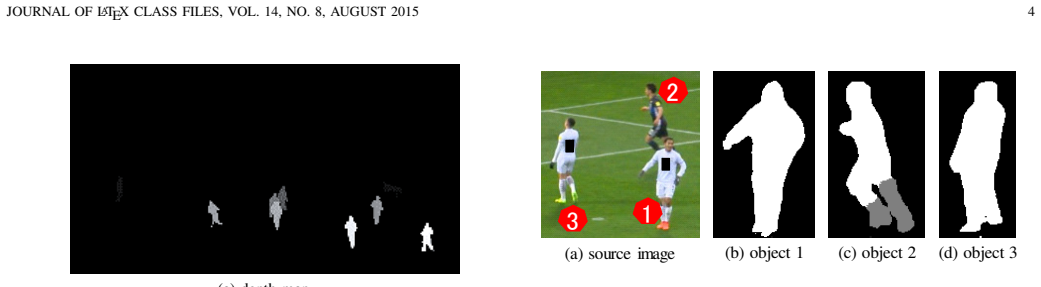
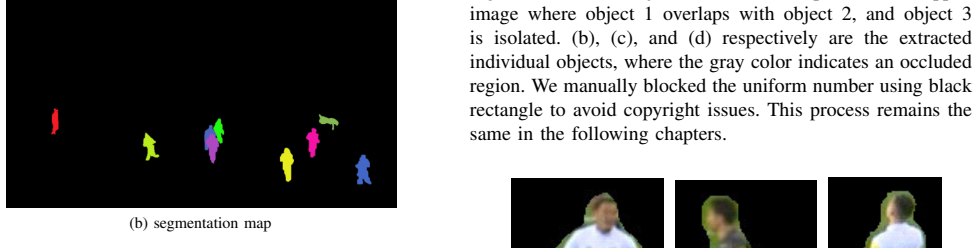
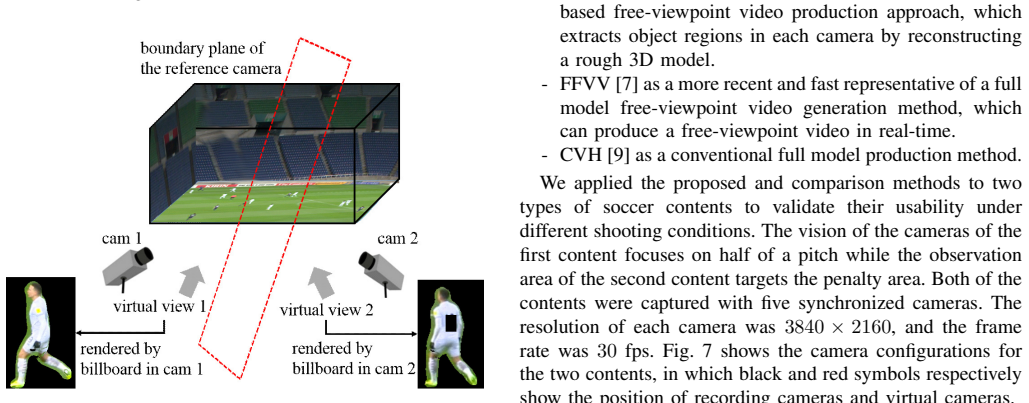
The central object is the volumetric visual hull obtained directly from space carving—a voxel approximation of the scene from silhouettes without any optimization. The carrying mechanism is the back-projection of the hull's mesh triangles onto each camera plane: each triangle knows its object label and depth, so the projection simultaneously generates a depth map, a per-pixel segmentation map, and a visibility test (projected label equals stored segmentation label vs. differs). This turns an imprecise 3D model into precise 2D evidence, which is what lets the method segment objects and detect occlusions with no user-tuned parameters.
What would settle it
Run the pipeline on a multi-frame sequence in which two players are in sustained physical contact, then inspect the label map: if the volumetric hull's connected components merge into one component for those frames, the method outputs a single billboard for both players, and the per-player occlusion map disappears—the failure the paper itself describes in its discussion.
Extended reading notes
Core claim
The central discovery is that a raw volumetric visual hull, though too inaccurate to render, is a reliable oracle for per-object segmentation and occlusion when projected onto each camera plane. The projection of each mesh triangle carries both a depth value and the object label of its connected component, so a single pass assigns every pixel a depth and an object identity. A pixel's visibility is decided by comparing the label of the projected polygon with the label stored in the 2D segmentation map: equal means visible, different means occluded by another object. This comparison is free of thresholds and, the paper argues, robust against self-occlusion. With that information the method builds a separate billboard for every object in every camera, fills occluded regions from neighboring cameras, and places each billboard at the 3D barycenter of its crude model, producing the stereo placement needed for a free-viewpoint walk-through in a virtual stadium.
Load-bearing premise
The method assumes that connected-components labeling on the voxel hull produces one coherent, separated blob per player; when players touch or grapple, the hull merges them into a single component and the per-player segmentation and occlusion detection collapse.
Editorial extensions
If this is right
- With only five wide-baseline cameras, the method can synthesize free-viewpoint soccer video with natural surface textures, including for players hidden behind another player.
- Occlusion detection requires no parameters, so the method transfers across scenes without per-sequence tuning of a visibility threshold.
- Because each object's billboard is placed using the barycenter of its raw 3D model, the flat billboards still provide a coherent stereo layout in the virtual stadium.
- The method is positioned for team sports with many visible players per camera (soccer, rugby, basketball), where multiple billboards give the 3D effect; it is not intended for one-on-one or grappling scenarios.
Reading between the lines
- The same label-consistency test could be reused to fuse textures from several cameras instead of only the nearest one, which the paper does not explore; doing so might further soften the artifacts visible when the reference camera views a player at a grazing angle.
- A straightforward stress test is to erode or dilate the raw hull and measure how much the occlusion boundaries shift; that would quantify how sensitive the method is to silhouette accuracy, a number the paper does not report.
- The back-projection oracle could generalize to other image-based rendering pipelines that hold a coarse proxy model, such as depth-image-based rendering or light-field interpolation, where per-pixel object labels would improve depth disambiguation.
Signed reviews
Editorial analysis
A structured set of objections, weighed in public.
Referee Report
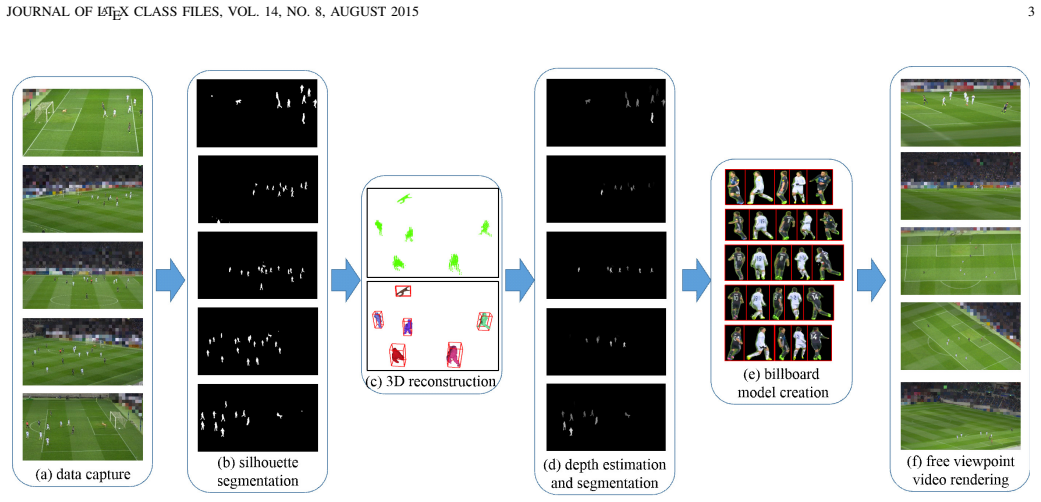
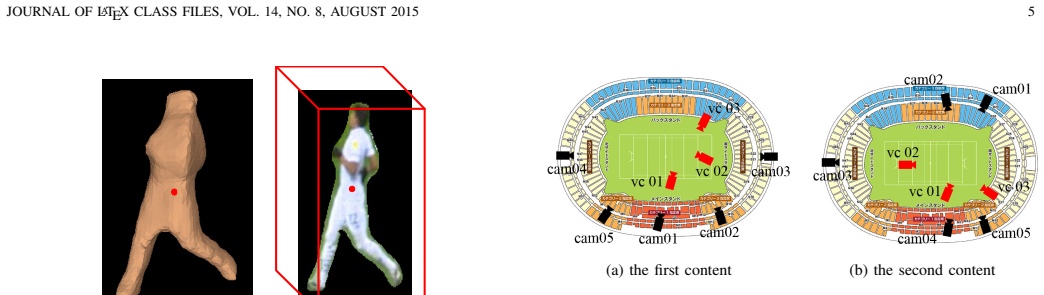
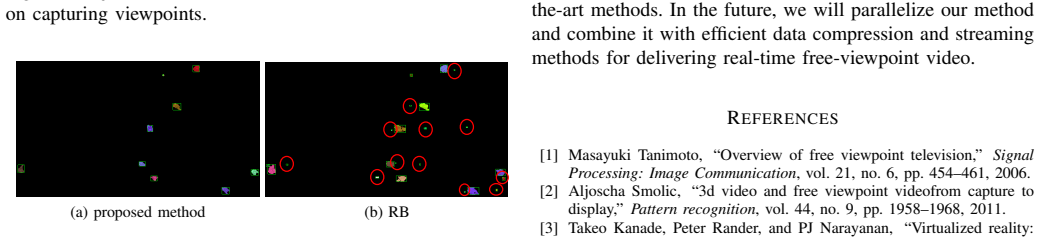
Summary. This paper presents a billboard-based free-viewpoint video synthesis algorithm for sports scenes captured by a small number of wide-baseline cameras. The method (1) reconstructs a raw volumetric visual hull from silhouettes via space carving, (2) segments the hull into objects using connected-components labeling, (3) projects the resulting mesh models back onto each camera plane to build depth and 2D segmentation maps, and (4) creates per-object billboard models whose visible regions are textured from the reference camera and whose occluded regions are filled from neighboring cameras. The billboard locations in the virtual stadium are set from each object's 3D barycenter. Experiments on two soccer sequences with five cameras are presented, comparing against three baselines: the authors' earlier RB method, a full-model method FFVV, and CVH. The central claims are robustness under sparse wide-baseline capture and the ability to reproduce occluded object appearances without parameter-dependent occlusion detection.
Significance. If demonstrated rigorously, the proposed approach would be a practical contribution to low-cost free-viewpoint sports video, since it aims to work with only five wide-baseline cameras and to handle occlusion, which is a known weakness of billboard-based rendering. The conceptual idea of using the back-projected raw visual hull for object segmentation and visibility classification is coherent and internally consistent. The paper also includes comparative results against relevant baselines, which is useful. However, the evidence is almost entirely qualitative, and the core failure mode of connected-components segmentation under player proximity is acknowledged in the Discussion but never quantitatively characterized. The strength of the contribution therefore rests on subjective image comparisons on a small number of selected frames, which is currently insufficient to support the abstract's claims of 'robust' and 'high-fidelity' behavior.
major comments (4)
- [Section III-B, Eq. (3)] The noise-filter equation appears to be inverted. As written, it sets Vt to OFF when Tmin < N(Vt) < Tmax, meaning an object is removed precisely when its voxel count lies between the two thresholds. Since the experiments use Tmin=3e4 and Tmax=3e5 (Section IV), a typical player with a voxel count in that range would be discarded, while very small noise and very large merged regions would be kept. This is the opposite of the described intention ('remove such noisy regions'). If this is a typographical error, the equation must be corrected; as presented, the formal definition of the noise filter is wrong and the experimental results cannot be reproduced from the description.
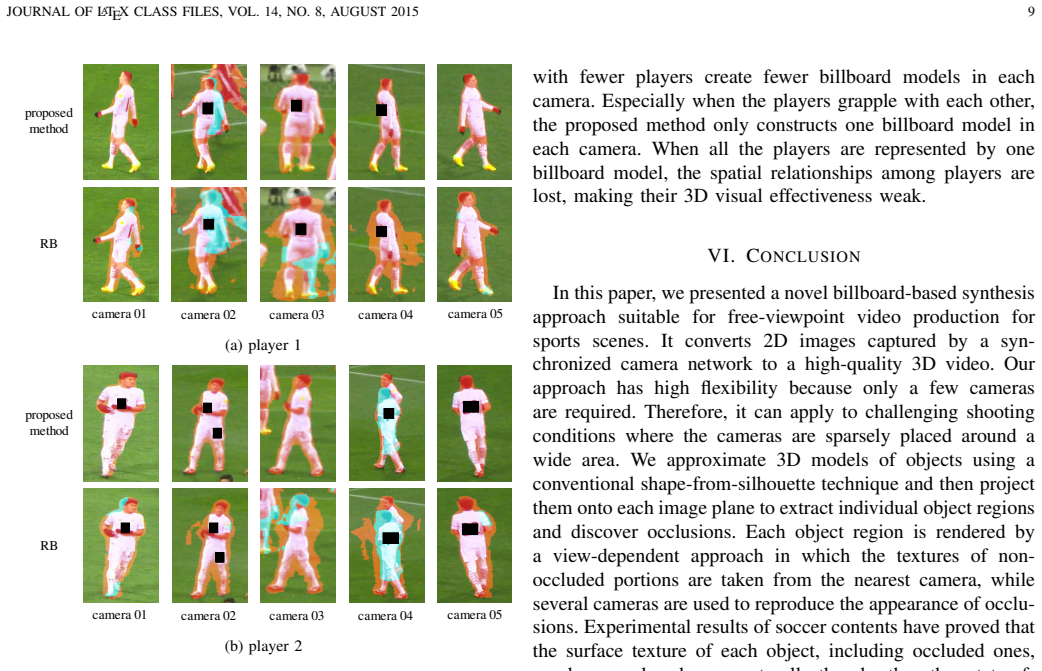
- [Section III-B and Section V (Discussion)] The central assumption that each player yields a separate connected component in the volumetric visual hull is not validated anywhere in the paper. The authors acknowledge in the Discussion that 'when the players grapple with each other, the proposed method only constructs one billboard model in each camera' and that 'spatial relationships among players are lost.' No experiment measures how close two players can become before their visual hulls merge, how often such proximity occurs in the test sequences, or how the method behaves as the number of cameras decreases. Since the noise filter in Eq. (3) only thresholds total voxel count, it cannot split a merged component, so the claimed robustness to occlusions is unverified in exactly the proximity regime that is common in soccer. This limitation should be stated as a qualification of the title and abstract claims, or addressed with a dedicated experiment.
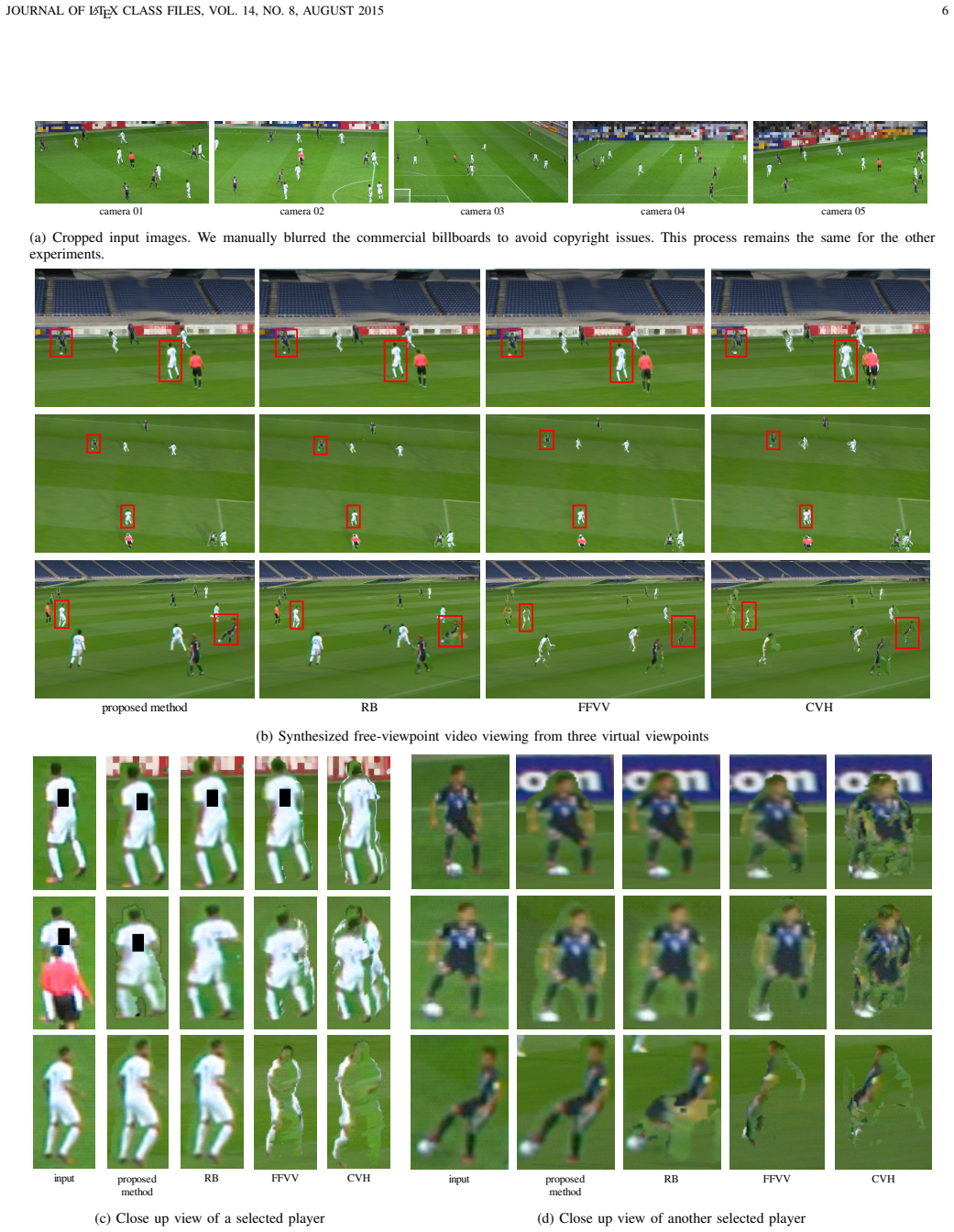
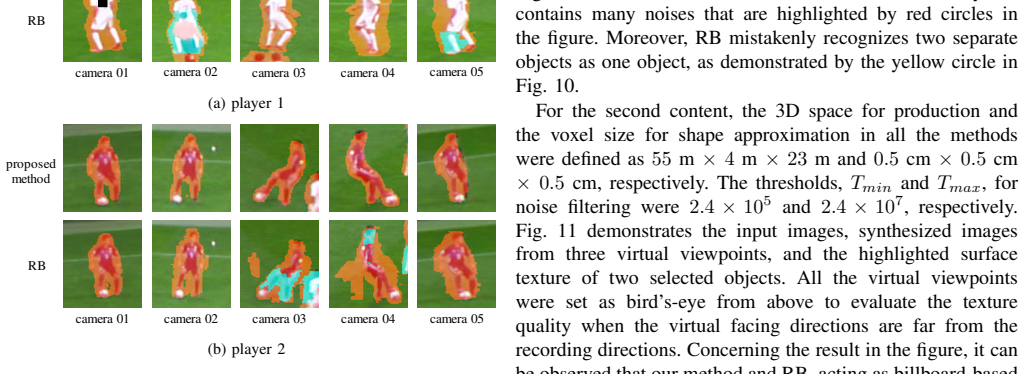
- [Section IV] The experimental evaluation is entirely qualitative. Figures 8 through 13 show selected frames, cropped regions, and manually chosen virtual viewpoints, but there is no quantitative metric to support the claims of 'high-fidelity' and 'more naturally' reproduced textures. For a paper asserting a robust algorithm, the absence of any error measure (e.g., segmentation accuracy, visibility classification accuracy, PSNR/SSIM on novel views) or a user study is a significant gap. At minimum, the authors should report a quantitative comparison on a set of frames or viewpoints, even if limited, and should state the number of frames evaluated and how the displayed examples were selected.
- [Section III-B and Section IV] The method is not parameter-free, contrary to the impression given in the Introduction ('occlusion ... detected ... without the involvement of parameters'). The thresholds Tmin and Tmax, the voxel size, and the reconstruction volume are all hand-set, and the two experiments use different values (1 cm voxels for the first content, 0.5 cm for the second). No sensitivity analysis is provided, so it is unclear how much the results depend on these choices. The authors should either provide a sensitivity study or clearly scope the claims to the specific parameter settings investigated.
minor comments (5)
- [Section III-E] The text says 'Euler distance', which should be 'Euclidean distance'.
- [Abstract and Section I] There is a tense inconsistency: 'we proposed an algorithm' appears in the abstract and Introduction, whereas the rest of the paper uses the present tense. Use 'we propose' consistently.
- [Section III-B, Eq. (2)] Equation (2) is typeset awkwardly with slashes inside the braces; writing the four moments as separate equations would improve readability.
- [Section III-D.3] The spelling 'barycentre' is used in some places and 'barycenter' in others; please unify the spelling.
- [References] Reference [7] is cited as 'accepted' without a publication year. If it has appeared in a proceedings or journal, the full citation should be provided.
Circularity Check
No circularity: the pipeline is a constructive algorithm whose outputs (segmentation and occlusion labels) are derived from 3D projection geometry, not from fitted constants or self-cited uniqueness results.
full rationale
This paper is a constructive system paper rather than a mathematical derivation, so the circularity tests apply only to the claimed derivation chain. Reading the pipeline from Section III: silhouettes are extracted by background subtraction, a volumetric visual hull is built by space carving, connected components labeling assigns object identifiers, mesh models are projected back to each camera plane to produce a depth map and a 2D segmentation map, and occlusion is judged by comparing the label of each projecting polygon with the label stored in the segmentation map. This is a standard z-buffer-style visibility test: both labels come from the same 3D model, but the comparison is a geometric consistency check, not a definitional equivalence that pre-commits the claimed result. No output quantity is fitted to a subset of data and then renamed as a prediction. The thresholds Tmin and Tmax in Eq. (3) are manually justified size filters for removing noisy voxel components, not parameters fitted to the rendered output or to the occlusion labels. The self-citations ([5] as the RB baseline, [7] as a comparison method, [43] for camera calibration, [54] for silhouette extraction, and [55] for connected components labeling) are used as standard components or comparison baselines; none of them supplies a load-bearing uniqueness theorem or an unverified premise on which the central claim exclusively rests. The Discussion's concession that grappling players merge into a single billboard is a genuine robustness limitation of the connected-components assumption, but it is a correctness and scope caveat, not a circular step. Since no reduction of the claimed result to its inputs was exhibited, the circularity score is 0.
Assumptions & free parameters
free parameters (3)
- Noise filtering thresholds Tmin and Tmax =
Content 1: 3e4 and 3e5; Content 2: 2.4e5 and 2.4e7
- Silhouette segmentation threshold =
not specified
- Voxel size and reconstruction volume =
1 cm for content 1; 0.5 cm for content 2; volumes stated per sequence
assumptions (4)
- domain assumption Camera calibration by [43] is sufficiently accurate for back-projection.
- domain assumption Background subtraction reliably separates all moving objects from the field.
- domain assumption Connected components labeling of the visual hull yields one component per player in most frames.
- domain assumption The visual hull from five cameras, though too coarse for direct rendering, is accurate enough for per-object segmentation and occlusion detection.
Cite this review
Pith. "Pith review of A Robust Billboard-based Free-viewpoint Video Synthesizing Algorithm for Sports Scenes." pith.science (2026). https://pith.science/paper/5WFQ65RS
@misc{pith2026190802446,
  author       = {Pith},
  title        = {Pith review of: A Robust Billboard-based Free-viewpoint Video Synthesizing Algorithm for Sports Scenes},
  year         = {2026},
  howpublished = {\url{https://pith.science/paper/5WFQ65RS}},
  note         = {Machine review of arXiv:1908.02446}
}
read the original abstract
We present a billboard-based free-viewpoint video synthesizing algorithm for sports scenes that can robustly reconstruct and render a high-fidelity billboard model for each object, including an occluded one, in each camera. Its contributions are (1) applicable to a challenging shooting condition where a high precision 3D model cannot be built because a small number of cameras featuring wide-baseline are equipped; (2) capable of reproducing appearances of occlusions, that is one of the most significant issues for billboard-based approaches due to the ineffective detection of overlaps. To achieve contributions above, the proposed method does not attempt to find a high-quality 3D model but utilizes a raw 3D model that is obtained directly from space carving. Although the model is insufficiently accurate for producing an impressive visual effect, precise objects segmentation and occlusions detection can be performed by back-projecting it onto each camera plane. The billboard model of each object in each camera is rendered according to whether it is occluded or not, and its location in the virtual stadium is determined considering the location of its 3D model. We synthesized free-viewpoint videos of two soccer sequences recorded by five cameras with the proposed and state-of-art methods to demonstrate its performance.
Figures
Figures from the paper (9 more)



Reference graph
Works this paper leans on
-
[1]
Overview of free viewpoint television,
Masayuki Tanimoto, “Overview of free viewpoint television,” Signal Processing: Image Communication , vol. 21, no. 6, pp. 454–461, 2006
work page 2006
-
[2]
3d video and free viewpoint videofrom capture to display,
Aljoscha Smolic, “3d video and free viewpoint videofrom capture to display,” Pattern recognition, vol. 44, no. 9, pp. 1958–1968, 2011
work page 1958
-
[3]
Virtualized reality: Constructing virtual worlds from real scenes,
Takeo Kanade, Peter Rander, and PJ Narayanan, “Virtualized reality: Constructing virtual worlds from real scenes,” IEEE multimedia, vol. 4, no. 1, pp. 34–47, 1997
work page 1997
-
[4]
Generation, visualization, and editing of 3d video,
T. Matsuyama and T. Takai, “Generation, visualization, and editing of 3d video,” in Proceedings. First International Symposium on 3D Data Processing Visualization and Transmission , June 2002, pp. 234–245
work page 2002
-
[5]
Hiroshi Sankoh, Sei Naito, Keisuke Nonaka, Houari Sabirin, and Jun Chen, “Robust billboard-based, free-viewpoint video synthesis algorithm to overcome occlusions under challenging outdoor sport scenes,” in Proceedings of the 26th ACM International Conference on Multimedia . 2018, MM ’18, pp. 1724–1732, ACM
work page 2018
-
[6]
Fast plane-based free-viewpoint synthesis for real-time live streaming,
Keisuke Nonaka, Ryosuke Watanabe, Jun Chen, Houari Sabirin, and Sei Naito, “Fast plane-based free-viewpoint synthesis for real-time live streaming,” in 2018 IEEE Visual Communications and Image Processing (VCIP). IEEE, 2018, pp. 1–4
work page 2018
-
[7]
A fast free-viewpoint video synthesis algorithm for sports scenes,
Jun Chen, Ryosuke Watanabe, Keisuke Nonaka, Tomoaki Konno, Hi- roshi Sankoh, and Sei Naito, “A fast free-viewpoint video synthesis algorithm for sports scenes,” in2019 IEEE/RSJ International Conference on Intelligent Robots and Systems . IEEE, 2019, (accepted)
work page 2019
-
[8]
Model-based free-viewpoint video: Acquisition, rendering, and encoding,
Christian Theobalt, Gernot Ziegler, Marcus Magnor, and Hans-Peter Seidel, “Model-based free-viewpoint video: Acquisition, rendering, and encoding,” in Proceedings of Picture Coding Symposium, San Francisco, USA, 2004, pp. 1–6
work page 2004
Show all 56 references
-
[9]
Dual-mode deformable models for free-viewpoint video of sports events,
J. Kilner, J. Starck, A. Hilton, and O. Grau, “Dual-mode deformable models for free-viewpoint video of sports events,” in Sixth International Conference on 3-D Digital Imaging and Modeling (3DIM 2007) , 2007, pp. 177–184
2007
-
[10]
A point-cloud-based multiview stereo algorithm for free-viewpoint video,
Yebin Liu, Qionghai Dai, and Wenli Xu, “A point-cloud-based multiview stereo algorithm for free-viewpoint video,” IEEE transactions on visualization and computer graphics , vol. 16, no. 3, pp. 407–418, 2010. JOURNAL OF LATEX CLASS FILES, VOL. 14, NO. 8, AUGUST 2015 10
2010
-
[11]
High-quality streamable free-viewpoint video,
Alvaro Collet, Ming Chuang, Pat Sweeney, Don Gillett, Dennis Evseev, David Calabrese, Hugues Hoppe, Adam Kirk, and Steve Sullivan, “High-quality streamable free-viewpoint video,” ACM Transactions on Graphics (ToG), vol. 34, no. 4, pp. 69, 2015
2015
-
[12]
Intel True View,
“Intel True View,” https://www.intel.com/content/www/us/en/sports/ technology/true-view.html?wapkw=true+view/
-
[13]
Articulated billboards for video- based rendering,
Marcel Germann, Alexander Hornung, Richard Keiser, Remo Ziegler, Stephan W ¨urmlin, and Markus Gross, “Articulated billboards for video- based rendering,” in Computer Graphics F orum. Wiley Online Library, 2010, vol. 29, pp. 585–594
2010
-
[14]
Virtual viewpoint replay for a soccer match by view interpolation from multiple cameras,
Naho Inamoto and Hideo Saito, “Virtual viewpoint replay for a soccer match by view interpolation from multiple cameras,” IEEE Transactions on Multimedia , vol. 9, no. 6, pp. 1155–1166, 2007
2007
-
[15]
Toward real-time delivery of immersive sports content,
Houari Sabirin, Qiang Yao, Keisuke Nonaka, Hiroshi Sankoh, and Sei Naito, “Toward real-time delivery of immersive sports content,” IEEE MultiMedia, vol. 25, no. 2, pp. 61–70, 2018
2018
-
[16]
Novel-view synthesis of outdoor sport events using an adaptive view-dependent geometry,
Marcel Germann, Tiberiu Popa, Richard Keiser, Remo Ziegler, and Markus Gross, “Novel-view synthesis of outdoor sport events using an adaptive view-dependent geometry,” in Computer Graphics F orum. Wiley Online Library, 2012, vol. 31, pp. 325–333
2012
-
[17]
Mask r-cnn,
Kaiming He, Georgia Gkioxari, Piotr Doll ´ar, and Ross Girshick, “Mask r-cnn,” in Computer Vision (ICCV), 2017 IEEE International Conference on. IEEE, 2017, pp. 2980–2988
2017
-
[18]
Convolutional pose machines,
Shih-En Wei, Varun Ramakrishna, Takeo Kanade, and Yaser Sheikh, “Convolutional pose machines,” in Proceedings of the IEEE Conference on Computer Vision and Pattern Recognition , 2016, pp. 4724–4732
2016
-
[19]
Soccer on your tabletop,
Konstantinos Rematas, Ira Kemelmacher-Shlizerman, Brian Curless, and Steve Seitz, “Soccer on your tabletop,” in Proceedings of the IEEE Conference on Computer Vision and Pattern Recognition , 2018, pp. 4738–4747
2018
-
[20]
Semantically coherent co- segmentation and reconstruction of dynamic scenes,
Armin Mustafa and Adrian Hilton, “Semantically coherent co- segmentation and reconstruction of dynamic scenes,” in Proceedings of the IEEE Conference on Computer Vision and Pattern Recognition , 2017, pp. 422–431
2017
-
[21]
The visual hull concept for silhouette-based image understanding,
Aldo Laurentini, “The visual hull concept for silhouette-based image understanding,” IEEE Transactions on pattern analysis and machine intelligence, vol. 16, no. 2, pp. 150–162, 1994
1994
-
[22]
A real time system for robust 3d voxel reconstruction of human motions,
German KM Cheung, Takeo Kanade, J-Y Bouguet, and Mark Holler, “A real time system for robust 3d voxel reconstruction of human motions,” in Computer Vision and Pattern Recognition, 2000. Proceedings. IEEE Conference on. IEEE, 2000, vol. 2, pp. 714–720
2000
-
[23]
Efficient visual hull computation for real-time 3d reconstruction using cuda,
Alexander Ladikos, Selim Benhimane, and Nassir Navab, “Efficient visual hull computation for real-time 3d reconstruction using cuda,” in Computer Vision and Pattern Recognition Workshops, 2008. CVPRW’08. IEEE Computer Society Conference on . IEEE, 2008, pp. 1–8
2008
-
[24]
Marching cubes: A high res- olution 3d surface construction algorithm,
William E Lorensen and Harvey E Cline, “Marching cubes: A high res- olution 3d surface construction algorithm,” in ACM siggraph computer graphics. ACM, 1987, vol. 21, pp. 163–169
1987
-
[25]
A survey of the marching cubes algorithm,
Timothy S Newman and Hong Yi, “A survey of the marching cubes algorithm,” Computers & Graphics , vol. 30, no. 5, pp. 854–879, 2006
2006
-
[26]
Complex 3d shape recovery using a dual-space approach,
Chen Liang and K-YK Wong, “Complex 3d shape recovery using a dual-space approach,” in Computer Vision and Pattern Recognition,
-
[27]
Efficient polyhedral mod- eling from silhouettes,
Jean-S ´ebastien Franco and Edmond Boyer, “Efficient polyhedral mod- eling from silhouettes,” IEEE Transactions on Pattern Analysis and Machine Intelligence, vol. 31, no. 3, pp. 414–427, 2009
2009
-
[28]
Image-based photo hulls,
Greg Slabaugh, Ron Schafer, and Mat Hans, “Image-based photo hulls,” in Proceedings. First International Symposium on 3D Data Processing Visualization and Transmission . IEEE, 2002, pp. 704–862
2002
-
[29]
Photo hull regularized stereo,
Shufei Fan and Frank P Ferrie, “Photo hull regularized stereo,” Image and Vision Computing , vol. 28, no. 4, pp. 724–730, 2010
2010
-
[30]
Image-based photo hulls,
Gregory G Slabaugh, Ronald W Schafer, et al., “Image-based photo hulls,” Dec. 13 2005, US Patent 6,975,756
2005
-
[31]
Carved visual hulls for image- based modeling,
Yasutaka Furukawa and Jean Ponce, “Carved visual hulls for image- based modeling,” International Journal of Computer Vision , vol. 81, no. 1, pp. 53–67, 2009
2009
-
[32]
Multi-view dynamic shape refinement using local temporal integration,
V . Leroy, J. Franco, and E. Boyer, “Multi-view dynamic shape refinement using local temporal integration,” in 2017 IEEE International Conference on Computer Vision (ICCV) , Oct 2017, pp. 3113–3122
2017
-
[33]
Surface capture for performance- based animation,
Jonathan Starck and Adrian Hilton, “Surface capture for performance- based animation,” IEEE computer graphics and applications , vol. 27, no. 3, 2007
2007
-
[34]
Model-based outdoor performance capture,
Nadia Robertini, Dan Casas, Helge Rhodin, Hans-Peter Seidel, and Christian Theobalt, “Model-based outdoor performance capture,” in 2016 F ourth International Conference on 3D Vision (3DV) . IEEE, 2016, pp. 166–175
2016
-
[35]
Mosh: Motion and shape capture from sparse markers,
Matthew Loper, Naureen Mahmood, and Michael J Black, “Mosh: Motion and shape capture from sparse markers,” ACM Transactions on Graphics (TOG) , vol. 33, no. 6, pp. 220, 2014
2014
-
[36]
Virtual view specification and synthesis for free viewpoint television,
Wenfeng Li, Jin Zhou, Baoxin Li, and M Ibrahim Sezan, “Virtual view specification and synthesis for free viewpoint television,” IEEE Transactions on Circuits and Systems for Video Technology , vol. 19, no. 4, pp. 533–546, 2009
2009
-
[37]
Wide- baseline foreground object interpolation using silhouette shape prior,
C. Verleysen, T. Maugey, P. Frossard, and C. De Vleeschouwer, “Wide- baseline foreground object interpolation using silhouette shape prior,” IEEE Transactions on Image Processing , vol. 26, no. 11, pp. 5477– 5490, Nov 2017
2017
-
[38]
Correspondence and depth-image based rendering a hybrid approach for free-viewpoint video,
Christian Lipski, Felix Klose, and Marcus Magnor, “Correspondence and depth-image based rendering a hybrid approach for free-viewpoint video,” IEEE Transactions on Circuits and Systems for Video Technol- ogy, vol. 24, no. 6, pp. 942–951, 2014
2014
-
[39]
A practical implementation of free viewpoint video system for soccer games,
Tomoyuki Tezuka Mehrdad Panahpour Tehrani Keita Takahashi Toshi- aki Fujii Ryo Suenaga, Kazuyoshi Suzuki, “A practical implementation of free viewpoint video system for soccer games,” 2015
2015
-
[40]
Billboard deformation via 3d voxel by using optimization for free- viewpoint system,
K. Nonaka, Q. Yao, H. Sabirin, J. Chen, H. Sankoh, and S. Naito, “Billboard deformation via 3d voxel by using optimization for free- viewpoint system,” in 2017 25th European Signal Processing Confer- ence (EUSIPCO) , Aug 2017, pp. 1500–1504
2017
-
[41]
Optimal billboard deformation via 3d voxel for free-viewpoint system,
Keisuke Nonaka, Houari Sabirin, Jun Chen, Hiroshi Sankoh, and Sei Naito, “Optimal billboard deformation via 3d voxel for free-viewpoint system,” IEICE TRANSACTIONS on Information and Systems , vol. 101, no. 9, pp. 2381–2391, 2018
2018
-
[42]
Fast camera self-calibration for synthesizing free viewpoint soccer video,
Qiang Yao, Akira Kubota, Kaoru Kawakita, Keisuke Nonaka, Hiroshi Sankoh, and Sei Naito, “Fast camera self-calibration for synthesizing free viewpoint soccer video,” in 2017 IEEE International Conference on Acoustics, Speech and Signal Processing (ICASSP) . IEEE, 2017, pp. 1612–1616
2017
-
[43]
Automatic camera self-calibration for immersive navigation of free viewpoint sports video,
Qiang Yao, Hiroshi Sankoh, Keisuke Nonaka, and Sei Naito, “Automatic camera self-calibration for immersive navigation of free viewpoint sports video,” in 2016 IEEE 18th International Workshop on Multimedia Signal Processing (MMSP). IEEE, 2016, pp. 1–6
2016
-
[44]
Robust camera calibration for sport videos using court models,
Dirk Farin, Susanne Krabbe, Wolfgang Effelsberg, et al., “Robust camera calibration for sport videos using court models,” inStorage and Retrieval Methods and Applications for Multimedia 2004 . International Society for Optics and Photonics, 2003, vol. 5307, pp. 80–92
2004
-
[45]
Robust moving camera calibration for synthesizing free viewpoint soccer video,
Qiang Yao, Keisuke Nonaka, Hiroshi Sankoh, and Sei Naito, “Robust moving camera calibration for synthesizing free viewpoint soccer video,” in 2016 IEEE International Conference on Image Processing (ICIP) . IEEE, 2016, pp. 1185–1189
2016
-
[46]
Fully convolu- tional networks for semantic segmentation,
Jonathan Long, Evan Shelhamer, and Trevor Darrell, “Fully convolu- tional networks for semantic segmentation,” in Proceedings of the IEEE conference on computer vision and pattern recognition , 2015, pp. 3431– 3440
2015
-
[47]
Rethinking atrous convolution for semantic image segmenta- tion,
Liang-Chieh Chen, George Papandreou, Florian Schroff, and Hartwig Adam, “Rethinking atrous convolution for semantic image segmenta- tion,” arXiv preprint arXiv:1706.05587 , 2017
2017 arXiv
-
[48]
Deep ordinal regression network for monocular depth estimation,
Huan Fu, Mingming Gong, Chaohui Wang, Kayhan Batmanghelich, and Dacheng Tao, “Deep ordinal regression network for monocular depth estimation,” in Proceedings of the IEEE Conference on Computer Vision and Pattern Recognition , 2018, pp. 2002–2011
2018
-
[49]
Monocular depth estimation using multi-scale continuous crfs as se- quential deep networks,
Dan Xu, Elisa Ricci, Wanli Ouyang, Xiaogang Wang, and Nicu Sebe, “Monocular depth estimation using multi-scale continuous crfs as se- quential deep networks,” IEEE transactions on pattern analysis and machine intelligence, 2018
2018
-
[50]
Monocular depth estimation: A survey,
Amlaan Bhoi, “Monocular depth estimation: A survey,” arXiv preprint arXiv:1901.09402, 2019
1901 arXiv
-
[51]
Coarse-to-fine volumetric prediction for single-image 3d human pose,
Georgios Pavlakos, Xiaowei Zhou, Konstantinos G. Derpanis, and Kostas Daniilidis, “Coarse-to-fine volumetric prediction for single-image 3d human pose,” 2017 IEEE Conference on Computer Vision and Pattern Recognition (CVPR) , Jul 2017
2017
-
[52]
Lifting from the deep: Convolutional 3d pose estimation from a single image,
Denis Tome, Chris Russell, and Lourdes Agapito, “Lifting from the deep: Convolutional 3d pose estimation from a single image,” 2017 IEEE Conference on Computer Vision and Pattern Recognition (CVPR) , Jul 2017
2017
-
[53]
Towards 3d human pose estimation in the wild: A weakly- supervised approach,
Xingyi Zhou, Qixing Huang, Xiao Sun, Xiangyang Xue, and Yichen Wei, “Towards 3d human pose estimation in the wild: A weakly- supervised approach,” 2017 IEEE International Conference on Com- puter Vision (ICCV) , Oct 2017
2017
-
[54]
Accurate silhouette extraction of multiple moving objects for free viewpoint sports video synthesis,
Qiang Yao, Hiroshi Sankoh, Houari Sabirin, and Sei Naito, “Accurate silhouette extraction of multiple moving objects for free viewpoint sports video synthesis,” in 2015 IEEE 17th International Workshop on Multimedia Signal Processing (MMSP) . IEEE, 2015, pp. 1–6. JOURNAL OF LA...
2015
-
[55]
Efficient parallel connected component labeling with a coarse-to-fine strategy,
Jun Chen, Keisuke Nonaka, Hiroshi Sankoh, Ryosuke Watanabe, Houari Sabirin, and Sei Naito, “Efficient parallel connected component labeling with a coarse-to-fine strategy,” IEEE Access , vol. 6, pp. 55731–55740, 2018
2018
-
[2005]
IEEE Computer Society Conference on
CVPR 2005. IEEE Computer Society Conference on . IEEE, 2005, vol. 2, pp. 878–884
2005
Reviewed August 14, 2026 · model on record in the stance chip above.
Discussion (0). Continue with ORCID to comment.