REVIEW 3 major objections 4 minor 44 references
Quantum Mott semimetal in a one-dimensional Hubbard model
T0 review · 3 major / 4 minor · reviewed 2026-08-01 · deepseek-v4-flash
Pith's one-line read A one-dimensional spinful Hubbard model with one orbital per unit cell has a quantum Mott semimetal as its ground state — gapless spinful Dirac fermions at k=0 coexisting with a neutral spin mode, protected by inversion and particle-hole sy
desk verdict Solid ED/DMRG evidence for a c≈3 gapless phase at the flat-band particle-hole-symmetric point, but the 'phase' label needs a stability check away from t=0. read the letter →
The pith
A machine-rendered reading of the paper's core claim, the machinery that carries it, and where it could break.
The reading
What carries the argument
The central object is the projected f-orbital operator on the active flat band, whose momentum-space form factor g_{k_*}(k) is controlled by a single scale k_*; this nonlocal operator encodes the orbital character and sets the interaction range to 1/k_*. The argument is carried by the emergent composite fermion ψ at k=0: because inversion acts as c_{k}→c_{-k} and ψ_{k}→−ψ_{-k}, the hybridization between c and ψ must vanish linearly at k=0 (giving kσ_y), while particle-hole symmetry forbids the mass term mτ_z, so the Dirac point is protected. The ancilla wavefunction — two auxiliary fermions per site projected into a spin singlet, with the ancilla on the bond and carrying inverted parity — pr
What would settle it
Start from the C1S2 ground state at t=0 and add an arbitrarily small hopping that preserves both inversion and particle-hole symmetry (for example, a next-nearest-neighbor hopping t_A≠0 with t_B adjusted so the band remains flat, or a PH-symmetric nearest-neighbor interaction), then measure the single-electron gap in iDMRG as a function of the perturbation strength. If the gap opens linearly for any nonzero perturbation, the phase exists only at a measure-zero point and is not a symmetry-protected phase.
Extended reading notes
Core claim
The paper claims that the ground state of the projected one-orbital Hubbard model, at t=0 (flat band, particle-hole symmetric) and with antiferromagnetic exchange J_A above a critical value, is a gapless C1S2 Mott semimetal. The state contains a spinful Dirac crossing at k=0 for each spin, protected by inversion symmetry (which forces the emergent fermion ψ to have opposite parity to the electron c, making the hybridization linear in k) and by particle-hole symmetry (which forbids the Dirac mass term mτ_z). Coexisting with this itinerant sector is a gapless neutral spin mode from the local moments, giving central charge c≈3. The authors support this with exact diagonalization and density-mat
Load-bearing premise
The quantum Mott semimetal is established at the exactly flat, particle-hole-symmetric point t=0, and the paper itself notes that the model with only U_A and J_A is fine-tuned; if infinitesimal symmetry-preserving perturbations of the Hamiltonian generically open a gap or destabilize the C1S2 state, the central claim that the model hosts a protected quantum Mott semimetal phase fails.
Editorial extensions
If this is right
- If the C1S2 Mott semimetal is genuine, Mott semimetal physics does not require topological bands, concentrated Berry curvature, or a Wannier obstruction — a momentum-dependent form factor plus inversion and particle-hole symmetries suffice.
- The phase is a 1D laboratory for fractionalized Fermi liquid (FL*) physics emerging from a single electronic band: a composite fermion ψ that carries the electron's charge but opposite parity, hybridizing with the bare electron to form a protected Dirac node.
- The P=1/2 Mott insulator and its continuous transition to the P=0 Mott insulator at a Luttinger-liquid critical point provide a concrete route to a many-body polarization jump of 1/2, with boundary Friedel oscillations as a signature.
- The ancilla wavefunction and the identification of ψ as a density trion or spin polaron predict specific composite spectral features (missing spectral weight near k=0 in the upper Hubbard band) that can be probed in photoemission-like measurements or cold-atom quantum simulations.
Reading between the lines
- The C1S2 phase is demonstrated only at the exactly flat, particle-hole-symmetric point, and the paper itself states that the model is fine-tuned in that the k=0 mode decouples; a natural next step, not performed here, is a systematic study of infinitesimal symmetry-preserving perturbations to see whether a gap opens and whether the phase has a finite basin of attraction.
- Because the Dirac point sits at a single momentum k=0 in one dimension, the 'semimetal' is a zero-dimensional node; comparing the numerically extracted exponents (e.g., spin correlation decay r^{-α} and pairing exponent α=1+1/K_c) against the bosonized C1S2 theory would test whether the phase is indeed the claimed SU(2)_1 × C1S1 theory or a different gapless state.
- The claim that this 1D model 'captures essential aspects of TBG physics' suggests a testable extension: tuning the form factor g_{k_*} in the same chain interpolates between flat-band-like and topologically nontrivial limits, which could clarify which features of twisted bilayer graphene are generic to strong correlations rather than specific to its band geometry.
- If the ancilla framework is correct, the emergent ψ fermion should leave fingerprints in bipartite entanglement spectra — a chiral two-band structure with the same central charge c≈3 — which can be computed from the variational wavefunction and checked against iDMRG.
Editorial analysis
A structured set of objections, weighed in public.
Referee Report
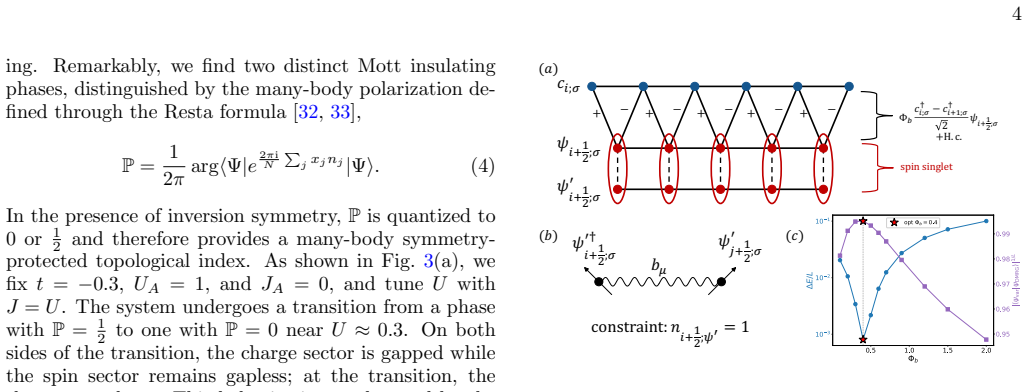
Summary. The paper studies a 1D spinful Hubbard model obtained by projecting a two-orbital model onto a flat band. At the flat-band, particle-hole-symmetric point t=0, and with antiferromagnetic exchange J_A above a critical value, it claims a quantum Mott semimetal* ground state (C1S2) with central charge c≈3, consisting of a spinful Dirac fermion at k=0 and a gapless neutral spin mode. Evidence is from ED Hubbard bands touching at k=0, iDMRG finite-entanglement scaling c≈3, power-law spin correlations, and extrapolated zero single-electron and pair gaps. For t≠0 (PH breaking), the paper finds two Mott insulators distinguished by many-body polarization P=1/2 and P=0, with a continuous transition through a Luttinger liquid. An ancilla wavefunction with two auxiliary fermions is proposed and shown to have high per-site overlap with DMRG for the P=1/2 insulator.
Significance. If the central claim holds, this is the first unbiased numerical demonstration of a zero-temperature quantum Mott semimetal in a one-orbital 1D model, going beyond thermal Mott semimetals and providing a concrete toy model for the heavy-fermion/composite-fermion picture proposed for TBG. The strength of the paper is the combination of ED and iDMRG with explicit analytic spin-wave, bosonization, and RG analyses; the ancilla wavefunction achieves ~0.995 per-site overlap with DMRG, which is a nontrivial variational achievement. The C1S2 assignment from c≈3 and gapless spin/pair/electron channels is internally consistent. However, the significance of the result as a robust phase, rather than a fine-tuned critical point, is not fully established.
major comments (3)
- [§Quantum Mott semimetal* phase and Appendix D] The k*=0.5 point is one of the two representative C1S2 examples, with U=0 (main text: 'two example points ... J_A=4/3, U=1/15, k*=∞ and J_A=0.5, U=0, k*=0.5'). Since g_{k*}(0)=0 in Eq. (3), the k=0 electron does not enter U_A or J_A. Appendix D admits that 'the model with only the U_A and J_A term is fine tuned in the sense that the k=0 mode simply decouples.' At U=0, the k=0 c-mode is therefore completely noninteracting and dispersionless. The measured c≈3 in Fig. 2(c) for k*=0.5 may then be the trivial sum of a free spinful flat-band mode (c=2) and a Heisenberg spin chain (c=1), rather than a genuine Mott semimetal with an emergent hybridized fermion. Please provide a k*=0.5 (or similar) example with U>0, or demonstrate explicitly that the k=0 mode acquires a finite velocity and finite overlap with the composite ψ operators despite the vanishing of g_{k*}(0).
- [Abstract and §Symmetric Mott insulators / Appendix G] The load-bearing assertion is that the C1S2 state is a 'phase' protected by inversion and particle-hole symmetry. The microscopic model has t=0 exactly; Fig. 3(d) shows that t=0.08 gaps the Dirac point, and t is the only single-particle kinetic term. Thus C1S2 occupies a measure-zero set in the bare parameter space unless it is stable to all PH-preserving perturbations. The RG analysis in Appendix G (Eqs. G16-G34) is performed for the ancilla effective theory, not for the microscopic Hamiltonian Eq. (2), and no connection is made between the microscopic couplings (U_A, J_A, U, J) and the effective couplings (K_c, g_{J,⊥}, g_N) needed for stability. The sentence in the main text that C1S2 'appears to be stable within the numerical precision we can reach for the parameter studied' does not address PH-preserving perturbations outside the studied line. To support the 'phase' claim, please ad
- [End Matter, Eq. (11)] The microscopic identification of the emergent ψ fermion is left incomplete. The density trion and spin polaron operators in Eq. (11) contain the combination (c_i - c_{i+1}), whose Fourier transform is ∝ sin(k/2); the same is true of [f_{A,i+1/2}, H_int] used in Eq. (10). At the Dirac point k=0 these explicit operators have vanishing single-particle overlap. The paper states that A_0=0 but does not give a concrete microscopic operator with nonzero ψ_0 overlap. If the composite ψ_0 has zero weight in all low-energy operators, the two-band effective description (Eq. (8)) is not microscopically justified. Please compute the overlap of the candidate ψ operators with the actual low-energy excitations (e.g., via DMRG/ED spectral weights) or provide the missing k=0 construction.
minor comments (4)
- [General] Typos: 'demosntrated' in Conclusion, 'descandants' in the ancilla section, 'Diffrent' in Appendix C, 'Definiton' in Appendix D, 'sturcture factor' in Appendix G.
- [Ancilla wavefunction section] The benchmark of the ancilla wavefunction is referred to in the text as 'Fig. 3(d)', but the actual overlap/energy panel is Fig. 4(c); Fig. 3(d) is the spectral function for t=0.08. Please correct the cross-reference.
- [Eq. (2) and Fig. 2] It would be helpful to state explicitly in the C1S2 section which couplings (U, J) are non-zero in the two example points; the main text gives U=1/15, J=0 for k*=∞ and U=0, J=0 for k*=0.5, but the figure caption for Fig. 2(c) lists U=1/15 without distinguishing the two cases. A table of parameters would remove ambiguity.
- [Fig. 2(c)] The central charge extraction uses 'the last-four-point fit' of S vs ln ξ. Please provide the fitting window, the number of points, and an estimate of the statistical/finite-χ error, as the c≈3 value is a cornerstone of the C1S2 assignment.
Circularity Check
No significant circularity: the C1S2 identification rests on direct ED/DMRG evidence, and the ancilla/ψ effective theory is an interpretive model introduced after the numerics.
full rationale
The paper's central claim—a C1S2 quantum Mott semimetal ground state at the flat-band, particle-hole-symmetric point—is supported by direct numerical evidence rather than by an assumed input: finite-entanglement scaling gives c≈3 (Fig. 2c), single-electron and pair gaps extrapolate to zero (Fig. 8a,b), the spin correlator decays as r^{-1} (Fig. 2c), and ED shows Hubbard bands touching at k=0 (Fig. 2b). These observations do not presuppose the ancilla or ψ effective theory. The emergent fermion ψ and the low-energy Hamiltonian H_charge are introduced after the numerics as an interpretation of the observed two-component Dirac structure; they are not used to derive the ground-state phase. The single variational parameter Φ_b in the ancilla wavefunction is fitted to maximize overlap with DMRG, but this is presented as an accurate variational description, not as a prediction of the phase. Prior self-citations ([22], [37]) provide a framework and analogy, but the present numerical phase identification is independent of them, and no uniqueness theorem is invoked. The fine-tuning/robustness question at t=0 is a physical correctness concern, not a circularity issue. Overall, the derivation chain is self-contained with respect to its numerical benchmarks.
Assumptions & free parameters
free parameters (4)
- k_* =
∞ (large-k* limit) and 0.5
- J_A =
4/3 (k*=∞) and 0.5 (k*=0.5)
- Φ_b (ancilla variational parameter) =
0.4 (optimal)
- µ_ψ (ancilla chemical potential) =
chosen so ⟨n_ψ⟩=1 per site
assumptions (5)
- domain assumption The two-orbital Hamiltonian can be projected onto the perfectly flat lower band because U_A is much smaller than the band gap.
- domain assumption At t_A=0 and Δ=γ²/(2t_B)-t_B the lower band is exactly flat, giving t=0 in the effective model and exact particle-hole symmetry.
- standard math Inversion, particle-hole, and time-reversal act on c and ψ as specified, forcing the k τ_y hybridization and forbidding mτ_z and k τ_x.
- ad hoc to paper The low-energy Hilbert space can be represented by physical electrons c, ancilla fermion ψ, and spinon ψ' with a local singlet projection.
- domain assumption The gapless spin sector is described by the SU(2)_1 CFT (1D Heisenberg chain).
invented entities (2)
-
ψ ancilla fermion (composite fermion)
-
ψ' ancilla fermion (spinon)
Cite this review
Pith. "Pith review of Quantum Mott semimetal in a one-dimensional Hubbard model." pith.science (2026). https://pith.science/paper/5YZMT54B
@misc{pith2026260719465,
  author       = {Pith},
  title        = {Pith review of: Quantum Mott semimetal in a one-dimensional Hubbard model},
  year         = {2026},
  howpublished = {\url{https://pith.science/paper/5YZMT54B}},
  note         = {Machine review of arXiv:2607.19465}
}
abstract
Mott physics in topological bands has recently attracted considerable attention, particularly in the context of twisted bilayer graphene (TBG). However, the essential ingredients for stabilizing this physics remain unclear. Here, we demonstrate a quantum Mott semimetal phase as the ground state within a one-dimensional spinful Hubbard model featuring only one orbital per unit cell, protected by inversion and particle-hole symmetries. We start from a two-orbital model where a localized $f$ orbital on the A sublattice hybridizes with a delocalized $c$ orbital on the B sublattice. Projecting the $f$-orbital Hubbard $U$ onto the active flat band yields a lattice model with Wannier orbitals centered on the B sublattice. Similar to TBG, a momentum-space scale $k_*$ emerges, setting the interaction range in the projected model to $1/k_*$. While the ground state is ferromagnetic with only the Hubbard $U$, introducing an inter-site antiferromagnetic spin coupling $J$ stabilizes a Mott semimetal$^*$ phase with a central charge $c=3$. Using exact diagonalization (ED) and density matrix renormalization group (DMRG) methods, we show that this phase hosts a spinful Dirac fermion coexisting with a neutral spin mode -- analogous to the fractionalized Fermi liquid (FL$^*$) phase in higher dimensions. Furthermore, breaking particle-hole (PH) symmetry via dispersion transforms the Mott semimetal into a Mott insulator, which is separated from a distinct Mott insulating phase by a continuous transition with a polarization jump of $1/2$. Our work provides the first unbiased evidence of a Mott semimetal ground state and demonstrates that this 1D model captures some essential aspects of TBG physics, despite lacking a Wannier obstruction.
Figures


Figures from the paper (6 more)


Reference graph
Works this paper leans on
-
[1]
E. Y. Andrei, D. K. Efetov, P. Jarillo-Herrero, A. H. MacDonald, K. F. Mak, T. Senthil, E. Tutuc, A. Yazdani, and A. F. Young, The marvels of moir´ e materials, Nat. Rev. Mater.6, 201 (2021)
2021
-
[2]
K. F. Mak and J. Shan, Semiconductor moir´ e materials, Nat. Nanotechnol.17, 686 (2022)
2022
-
[3]
Balents, C
L. Balents, C. R. Dean, D. K. Efetov, and A. F. Young, Superconductivity and strong correlations in moir´ e flat bands, Nat. Phys.16, 725 (2020)
2020
-
[4]
Y. Cao, V. Fatemi, A. Demir, S. Fang, S. L. Tomarken, 6 J. Y. Luo, J. D. Sanchez-Yamagishi, K. Watanabe, T. Taniguchi, E. Kaxiras, R. C. Ashoori, and P. Jarillo- Herrero, Correlated insulator behaviour at half-filling in magic-angle graphene superlattices, Nature556, 80 (2018)
2018
-
[5]
Rozen, J
A. Rozen, J. M. Park, U. Zondiner, Y. Cao,et al., En- tropic evidence for a Pomeranchuk effect in magic-angle graphene, Nature592, 214 (2021)
2021
-
[6]
Saito, F
Y. Saito, F. Yang, J. Ge, X. Liu,et al., Isospin Pomer- anchuk effect in twisted bilayer graphene, Nature592, 220 (2021)
2021
-
[7]
D. Wong, K. P. Nuckolls, M. Oh, B. Lian, Y. Xie, S. Jeon, K. Watanabe, T. Taniguchi, B. A. Bernevig, and A. Yaz- dani, Cascade of electronic transitions in magic-angle twisted bilayer graphene, Nature582, 198 (2020)
2020
-
[8]
Zondiner, A
U. Zondiner, A. Rozen, D. Rodan-Legrain, Y. Cao, R. Queiroz, T. Taniguchi, K. Watanabe, Y. Oreg, F. von Oppen, A. Stern, E. Berg, P. Jarillo-Herrero, and S. Ilani, Cascade of phase transitions and dirac revivals in magic- angle graphene, Nature582, 203 (2020)
2020
Show all 44 references
-
[9]
A. L. Sharpe, E. J. Fox, A. W. Barnard, J. Finney,et al., Emergent ferromagnetism near three-quarters filling in twisted bilayer graphene, Science365, 605 (2019)
2019
-
[10]
Serlin, C
M. Serlin, C. L. Tschirhart, H. Polshyn,et al., Intrinsic quantized anomalous Hall effect in a moir´ e heterostruc- ture, Science367, 900 (2020)
2020
-
[11]
Bultinck, E
N. Bultinck, E. Khalaf, S. Liu, S. Chatterjee, A. Vish- wanath, and M. P. Zaletel, Ground state and hidden symmetry of magic-angle graphene at even integer fill- ing, Phys. Rev. X10, 031034 (2020)
2020
-
[12]
Y. H. Kwan, G. Wagner, T. Soejima, M. P. Zaletel, S. H. Simon, S. A. Parameswaran, and N. Bultinck, Kekul´ e spi- ral order at all nonzero integer fillings in twisted bilayer graphene, Phys. Rev. X11, 041063 (2021)
2021
-
[13]
D. E. Parker, T. Soejima, J. Hauschild, M. P. Zaletel, and N. Bultinck, Strain-induced quantum phase transitions in magic-angle graphene, Phys. Rev. Lett.127, 027601 (2021)
2021
-
[14]
Wagner, Y
G. Wagner, Y. H. Kwan, N. Bultinck, S. H. Simon, and S. A. Parameswaran, Global phase diagram of the normal state of twisted bilayer graphene, Phys. Rev. Lett.128, 156401 (2022)
2022
-
[15]
Bultinck, S
N. Bultinck, S. Chatterjee, and M. P. Zaletel, Mecha- nism for anomalous hall ferromagnetism in twisted bi- layer graphene, Phys. Rev. Lett.124, 166601 (2020)
2020
-
[16]
Zhang, D
Y.-H. Zhang, D. Mao, and T. Senthil, Twisted bilayer graphene aligned with hexagonal boron nitride: Anoma- lous hall effect and a lattice model, Phys. Rev. Res.1, 033126 (2019)
2019
-
[17]
Y. Xie, A. T. Pierce, J. M. Park, D. E. Parker, E. Khalaf, P. Ledwith, Y. Cao, S. H. Lee, S. Chen, P. R. Forrester, K. Watanabe, T. Taniguchi, A. Vishwanath, P. Jarillo- Herrero, and A. Yacoby, Fractional chern insulators in magic-angle twisted bilayer graphene, Nature600, 439 (2021)
2021
-
[18]
Zhang, D
Y.-H. Zhang, D. Mao, Y. Cao, P. Jarillo-Herrero, and T. Senthil, Nearly flat Chern bands in moir´ e superlat- tices, Phys. Rev. B99, 075127 (2019)
2019
-
[19]
Repellin, Z
C. Repellin, Z. Dong, Y.-H. Zhang, and T. Senthil, Ferro- magnetism in narrow bands of moir´ e superlattices, Phys. Rev. Lett.124, 187601 (2020)
2020
-
[20]
P. J. Ledwith, J. Dong, A. Vishwanath, and E. Kha- laf, Nonlocal moments and mott semimetal in the chern bands of twisted bilayer graphene, Phys. Rev. X15, 021087 (2025)
2025
-
[21]
Hu, Z.-D
H. Hu, Z.-D. Song, and B. A. Bernevig, Projected and solvable topological heavy fermion model of twisted bi- layer graphene (2025), arXiv:2502.14039 [cond-mat.str- el]
2025
-
[22]
J.-Y. Zhao, B. Zhou, and Y.-H. Zhang, Topological Mott localization and pseudogap metal in twisted bilayer graphene, Phys. Rev. B112, 085107 (2025)
2025
-
[23]
P. J. Ledwith, A. Vishwanath, and E. Khalaf, Exotic car- riers from concentrated topology: Dirac trions as the origin of the missing spectral weight in twisted bilayer graphene, arXiv preprint arXiv:2505.08779 (2025)
2025 arXiv
-
[24]
J.-Y. Zhao, B. Zhou, and Y.-H. Zhang, Mixed-valence mott insulator and composite excitation in twisted bi- layer graphene, Phys. Rev. B112, 235144 (2025)
2025
-
[25]
Vituri and E
Y. Vituri and E. Berg, Controlled loop expan- sion for the topological heavy fermion model (2026), arXiv:2604.14278 [cond-mat.str-el]
2026 arXiv
-
[26]
N. Wei, F. von Oppen, and L. I. Glazman, Lifetime and spectral function of topological heavy fermions (2026), arXiv:2604.14369 [cond-mat.str-el]
2026 arXiv
-
[27]
P. A. Nosov, E. Khalaf, and P. Ledwith, Controlled ex- pansion for correlated electrons with concentrated kine- matics (2026), arXiv:2605.20171 [cond-mat.str-el]
2026 arXiv
-
[28]
Zhou and Y.-H
B. Zhou and Y.-H. Zhang, Symmetric topological mott insulator and mott semimetal, arXiv preprint arXiv:2601.02485 (2026)
2026
-
[29]
W.-P. Su, J. Schrieffer, and A. Heeger, Soliton excitations in polyacetylene, Physical Review B22, 2099 (1980)
-
[30]
Senthil, S
T. Senthil, S. Sachdev, and M. Vojta, Fractionalized fermi liquids, Phys. Rev. Lett.90, 216403 (2003)
2003
-
[31]
Rende, A
R. Rende, A. Nikolaenko, L. L. Viteritti, S. Sachdev, and Y.-H. Zhang, Transformer neural-network quan- tum states for lattice models of spins and fermions: Application to the ancilla layer model, arXiv preprint arXiv:2603.02316 (2026)
2026
-
[32]
Resta, Quantum-mechanical position operator in ex- tended systems, Phys
R. Resta, Quantum-mechanical position operator in ex- tended systems, Phys. Rev. Lett.80, 1800 (1998)
1998
-
[33]
Tada and M
Y. Tada and M. Oshikawa, Many-body multipole index and bulk-boundary correspondence, Phys. Rev. B108, 235150 (2023)
2023
-
[34]
E. G. Dalla Torre, E. Berg, and E. Altman, Hidden order in 1d bose insulators, Phys. Rev. Lett.97, 260401 (2006)
2006
-
[35]
Barbiero, A
L. Barbiero, A. Montorsi, and M. Roncaglia, How hid- den orders generate gaps in one-dimensional fermionic systems, Phys. Rev. B88, 035109 (2013)
2013
-
[36]
Montorsi, F
A. Montorsi, F. Dolcini, R. C. Iotti, and F. Rossi, Symmetry-protected topological phases of one- dimensional interacting fermions with spin-charge separation, Phys. Rev. B95, 245108 (2017)
2017
-
[37]
Zhou, H.-K
B. Zhou, H.-K. Jin, and Y.-H. Zhang, Variational wave- function for a mott insulator at finiteuusing ancilla qubits, Phys. Rev. B112, 115159 (2025)
2025
-
[38]
Zhang and S
Y.-H. Zhang and S. Sachdev, From the pseudogap metal to the Fermi liquid using ancilla qubits, Phys. Rev. Res. 2, 023172 (2020)
2020
-
[39]
Hubbard, Electron correlations in narrow energy bands, Proceedings of the Royal Society of London
J. Hubbard, Electron correlations in narrow energy bands, Proceedings of the Royal Society of London. A. Mathematical and Physical Sciences276, 238 (1963). End Matter 7 (𝑏) (𝑐) (𝑑)(𝑎) FIG. 5. Wannier representation of the lower band. We chooset A = 0, tB =−1, γ= 1 in the calcu...
1963
-
[40]
The spectral function for is shown in Fig
Definiton of spectral function Here we provide the details of calculating the spectral functionA(k, ω), which is defined as: A(k, ω) = X σ 1 Z X ⟨m|∈Ne+1 X |n⟩∈Ne e− En T ⟨m|c† k;σ|n⟩δ(ω−(E m −E n)) + 1 Z X ⟨m|∈Ne−1 X |n⟩∈Ne e− En T ⟨m|c−k;¯σ|n⟩δ(ω−(E n −E m)) ! , (D2) whereZi...
-
[41]
Analytical calculation of spectral function Here we provide the analytical derivation of the single-particle spectral function discussed in the main text. At t= 0, the projected effective Hamiltonian can be written as Heff = X i UA 2 ˜nA;i+ 1 2 −1 2 + U 2 (ni −1) 2 + X i JA 2 ...
-
[42]
(G4) The shifts are defined modulo the compactification periods
Symmetries and allowed perturbations The symmetry transformations of the fields are: I:ϕ c(x)→ −ϕc(−x) + π 2 , θ c(x)→θ c,s(−x), ϕs → −ϕs(−x), θ s(x)→θ s(−x), C:ϕ c,s(x)→ −ϕc,s(x), θ c,s(x)→θ c,s(x), T:ϕ c(x)→ϕ c(x), θ c(x)→ −θc(x)− π 2 , ϕs(x)→ −ϕs(x), θ s(x)→θ s(x) + π 2 . (...
-
[43]
Momentum-shell integration After integrating outθ ν and settingy ν =v ντwherev ν is charge/spin velocity. The Euclidean action is S= X ν 1 2πKν Z d2r(∇ϕ ν)2.(G8) Splitϕ ν =ϕ ν,< +ϕ ν,> with ϕ< :|q|<Λe −dℓ, ϕ > : Λe−dℓ <|q|<Λ,Λ =α −1.(G9) The fast-mode fluctuations can be calcu...
-
[44]
Coupling to the neutral spin mode If we consider the coupling to the neutral spin modeψ ′, the most general coupling is HJ =J cSc ·S ψ′ +J ψSψ ·S ψ′.(G18) We bosonize the spin field ofψ ′, the details are given in Table. III. Terms containing (−1) iN ′ oscillate and average to...
Reviewed August 1, 2026 · model on record in the stance chip above.
Discussion (0). Sign in to comment.