REVIEW 4 major objections 4 minor 42 references
Laser Wakefield Acceleration Driven by a Discrete Flying Focus
T0 review · 4 major / 4 minor · reviewed 2026-08-15 · deepseek-v4-flash
Pith's one-line read A discrete flying focus can keep an electron beam locked in the accelerating phase of a plasma wave for 50 dephasing lengths, removing the main cap on single-stage energy gain.
desk verdict The discrete flying focus with a derived delay law is a genuine step forward; the 41 GeV result is plausible but rests on a quasistatic simulation whose own validation leaves the nonlinear rear-sheath physics unverified. read the letter →
The pith
A machine-rendered reading of the paper's core claim, the machinery that carries it, and where it could break.
The reading
What carries the argument
The central object is the discrete flying focus: a train of $N$ collinear Gaussian laser pulses, each with its own focal point $f_j$ and delay $\Delta_j$ (Eqs. 7\textendash 10). The delays are fixed by Eq. (10) so that every pulse reaches focus at the same value of $\xi = z - ct$, even though each pulse individually propagates at the subluminal group velocity $v_g$. As each pulse slips backward in $\xi$, its successor comes into focus at that same $\xi$, so the peak of the combined envelope\textemdash and with it the wake's accelerating phase\textemdash advances at $c$. In the linear regime each pulse only drives the wake over a Rayleigh range, requiring $N \approx L_D/z_R$ pulses; in the nonlinear regime self-guiding lets each pulse drive the wake over a pump-depletion length, so $N \approx L_D/L_{pd}$ is enough. The pulse train also provides independent knobs per pulse (spot size, duration, focal point, delay, polarization) that the simulations use to keep the injected beam ahead of the oscillating rear sheath.
What would settle it
Run the Figure 4 configuration end to end in a fully electromagnetic particle-in-cell code that resolves self-injection, trapped redshifted light, and direct laser acceleration, and check whether a 50-pC beam still reaches 41 GeV with normalized slice emittance at 4 $\mu$m.
Extended reading notes
Core claim
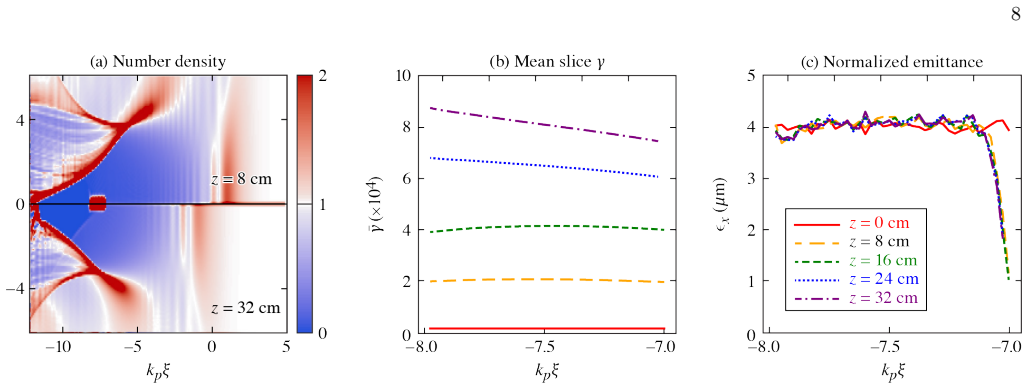
The central claim is that the dephasing that normally caps energy gain in a laser wakefield accelerator can be eliminated by discretizing the flying focus into $N$ collinear pulses. Each pulse $j$ is assigned a focal point $f_j$ and a delay $\Delta_j$ satisfying $\Delta_j = (v_g/c)\xi_0 + (1 - v_g/c)f_j$, where $v_g$ is the plasma's group velocity; this makes every pulse's focus land at the same value of $\xi = z - ct$. The wake driven by the train therefore has phase velocity $v_w = c$, and an electron with $v_z \approx c$ stays locked to the same accelerating phase for as long as the train lasts. The paper's load-bearing simulation result is that with $a_0 = 4$, $N = 80$, and 150 J of total pulse energy, a 50-pC beam injected at 1 GeV reaches an average energy of 41 GeV after 32 cm, corresponding to 50 dephasing lengths, with normalized slice emittance unchanged from its initial 4 $\mu$m and a slice energy spread of about 0.1 percent. The paper presents this as roughly three times the energy gain a conventional pulse could deliver in a stage of the same length, and as a route to reducing the number of stages needed for TeV-scale energies.
Load-bearing premise
The headline result depends on the quasistatic particle-in-cell code being trustworthy over 50 dephasing lengths, yet the paper's own comparison with a fully electromagnetic code shows agreement only within the first plasma period, shows that self-injection (dark current) is not captured, and does not model direct laser acceleration of the beam by redshifted trapped light.
Editorial extensions
If this is right
- Adding pulses extends the acceleration distance without lowering the plasma density, so single-stage energy gain scales linearly with $N$; this is the direct consequence of Eq. (14) and the reason a discrete flying focus reduces the number of stages required for a target energy.
- In the nonlinear regime the number of pulses needed scales with the pump-depletion length rather than the Rayleigh range, so a discrete flying focus with only tens of pulses can drive a wake over tens of dephasing lengths.
- For a fixed stage length, the energy-gain advantage over a conventional pulse grows roughly as $L^{1/3}$ and with density (Eq. 15), putting a premium on higher-density operation at the cost of lower loadable charge.
- The injected beam must be placed ahead of the rear sheath, and the paper shows that tailoring the first two delays and adding a small slippage correction to all later delays is sufficient to keep the beam from being swept over by the sheath.
- The 1.3% energy-transfer efficiency of the demonstration case is not a ceiling: the paper estimates that a fully blown-out wave loaded with a trapezoidal beam could hold about 400 pC and raise the efficiency to roughly 10%.
Reading between the lines
- Editorial inference: the same delay-tuning equation can be generalized to produce wakes with phase velocities deliberately above or below $c$, which would let a single experimental setup explore muon-acceleration wakes or wave-breaking suppression without changing the laser hardware.
- Editorial inference: the pre-ionization energy (roughly 2600 J for the 41-GeV case) exceeds the pulse energy itself, so the practical viability of the concept may hinge on using the discrete flying focus to ionize the gas in flight or coupling into a pre-formed plasma; this is a testable extension the authors leave open.
- Editorial inference: the claim that trapped redshifted light does not grow emittance is supported only by a phenomenological-model calculation in the paper, so a straightforward extension is to run the full 32-cm case in a code that models direct laser acceleration and check whether emittance growth stays below the 4-$\mu$m baseline.
- Editorial inference: if the phase-locking holds, a useful diagnostic for an experiment would be to image the wake position versus propagation distance and verify that the accelerating phase moves at $c$ to within roughly $1/(k_p L)$; this would test the central mechanism before investing in a full beam run.
Signed reviews
Editorial analysis
A structured set of objections, weighed in public.
Referee Report
Summary. The paper introduces a discrete flying focus (DFF) for laser wakefield acceleration: a train of collinear laser pulses with staggered focal points and delays such that each pulse comes into focus at the same value of the comoving coordinate ξ, producing a plasma wave whose accelerating phase advances at c despite the subluminal group velocity of each pulse. The delay law (Eq. 10) is derived from linear dispersion and the paraxial approximation, extending the ASTRL formalism. The authors present QPAD simulations in the linear regime (a0=0.1) confirming vw=c over 20-25 dephasing lengths, and in the nonlinear regime (a0=4) a beam-loaded simulation in which a 48-50 pC, 1 GeV beam is accelerated to an average energy of 41 GeV over 32 cm (50 dephasing lengths) with preserved slice emittance. The paper also discusses experimental implementation and efficiency.
Significance. The DFF concept is a clever and potentially impactful extension of flying-focus techniques; if validated, it could reduce the number of stages needed for a TeV collider. The analytic derivation of the delay law is transparent and the linear-regime simulations provide a clean proof of principle. The paper is also commendable for including a detailed code-validation appendix that honestly identifies the limitations of QPAD. However, the central quantitative claim (41 GeV over 50 Ld) rests on a simulation tool whose nonlinear-regime accuracy is precisely the point in question, so the significance is currently contingent on additional validation.
major comments (4)
- [Sec. III C and Appendix C] The headline result (41 GeV, 50 Ld, N=80, beam-loaded) is produced entirely with QPAD, but Appendix C states that in the nonlinear regime QPAD deviates from OSIRIS after the first plasma period, cannot model self-injection, and does not model direct laser acceleration. The text in Sec. III B asserts that these deviations do not affect the accelerating field in the first period, but no comparison is shown for the actual beam-loaded configuration. Without a reduced-scale full-PIC benchmark (or a systematic convergence study) of the Fig. 4 setup, the quantitative claim is not established.
- [Sec. III C] The tailored delay law includes an empirical slippage correction S=1.25e-5, and a uniform-delay run loses most of the beam. Since S compensates for nonlinear rear-sheath evolution, which Appendix C identifies as the physics where QPAD is least reliable, the robust phase-locking may be a simulation artifact. The authors should provide a physical derivation of S or a sensitivity scan showing that the final energy and emittance are stable over a range of S.
- [Appendix C] The direct-laser-acceleration (DLA) estimate is performed for a beam with a 65-nm spot and 40-nm emittance over 5 Ld, whereas the Fig. 4 beam has a 650-nm spot, 4-µm emittance, and is simulated over 50 Ld. The resonance argument is suggestive, but it does not quantify the cumulative emittance growth for the headline beam. The DLA neglect is therefore not adequately supported for the configuration on which the main claim rests.
- [Appendix C] The OSIRIS benchmark shows a 0.35-nC self-injected bunch in the DFF wake. The paper argues that self-injection is causally disconnected from the external beam, but the self-injected bunch loads the wake and can alter the accelerating structure; moreover QPAD runs in mode-0 only, which cannot capture symmetry-breaking effects. A full-PIC simulation that includes the externally injected beam is needed to demonstrate that the 41 GeV result survives the omitted physics.
minor comments (4)
- [Abstract and Sec. III C] The abstract reports '40 GeV' and '50-pC', while Sec. III C reports '41 GeV' and '48-pC'. Please make these numbers consistent throughout.
- [Appendix C] The sentence 'Self-injection cannot be not modeled within the quasistatic approximation' contains a double negative; it should read 'cannot be modeled'.
- [Fig. 4 caption] The caption states '50 pC' but the text in Sec. III C states '48-pC'. Please align the caption with the text.
- [Table I] The table lists L = 16 cm for the simulations in Figs. 2 and 3, while Sec. III C uses L = 32 cm. A footnote or separate row would clarify that the table does not apply to Fig. 4.
Circularity Check
No circularity: Eq. (10) is derived from group-velocity kinematics, and the tailored nonlinear simulations are openly benchmarked rather than fitted to the claimed output.
full rationale
The central analytic step, Eq. (10), is an algebraic consequence of requiring every pulse to focus at the same ξ value; it is not defined in terms of the target phase velocity or the final beam energy. The linear-regime simulations (Figs. 2 and 3c) confirm vw=c with no fitted parameters, providing an independent check of the dephasing-free mechanism. In the nonlinear beam-loaded case (Sec. III C), the paper explicitly states that the delays were tailored: the first two pulses were shifted by 2k_p^-1 and 1k_p^-1, and all subsequent pulses used S=1.25e-5, with the paper reporting that without this tailoring most of the beam was lost. This is an openly disclosed design choice rather than a parameter fitted to the 41 GeV result; the energy gain is a simulation outcome conditional on that design, not a quantity made equal to an input by construction. The QPAD code is self-cited, but Appendix C benchmarks it against the fully electromagnetic, independent OSIRIS code, so the simulation tool is not supported solely by self-citation. The acknowledged limitations of QPAD in the nonlinear regime (deviation after the first plasma period, no self-injection, no direct laser acceleration) are correctness risks explicitly stated in the manuscript; they are not instances of the derivation reducing to its own inputs. The direct-laser-acceleration negligibility argument is based on a physical resonance-condition estimate (kβ << kL) plus a separate phenomenological-model check, not on fitting the headline emittance. I find no step in the claimed derivation chain that is circular.
Assumptions & free parameters
free parameters (4)
- Slippage correction S in the tailored delay law =
1.25e-5
- Delays of first two pulses =
shifted by 2 kp^-1 and 1 kp^-1 relative to Eq. 10
- Simulation length L=50Ld=32 cm =
16-32 cm
- Per-pulse amplitude a0j in the linear-regime example =
0.024 for N=250, with overall a0=0.1
assumptions (5)
- domain assumption Paraxial approximation and dropping of the three higher-order terms in Eq. (3).
- domain assumption Linear superposition of individual pulse envelopes (Eq. 7) is valid, including when pulses overlap.
- domain assumption The wakefield in the nonlinear regime is described by the quasistatic, ponderomotive-guiding-center, mode-0 (cylindrically symmetric) approximation in QPAD.
- ad hoc to paper The delay law Eq. (10) using the linear group velocity is a valid starting point for the nonlinear regime, and the empirical correction S accounts for all relevant slippage.
- standard math Standard relativistic laser-plasma scaling laws (Eqs. 12-15) from Refs. 4, 23, 25 apply to the DFF parameter choices.
invented entities (2)
-
Discrete flying focus (DFF) pulse train
-
Tailored delay correction S (1.25e-5)
Cite this review
Pith. "Pith review of Laser Wakefield Acceleration Driven by a Discrete Flying Focus." pith.science (2026). https://pith.science/paper/5Z3E6DNM
@misc{pith2026250619824,
  author       = {Pith},
  title        = {Pith review of: Laser Wakefield Acceleration Driven by a Discrete Flying Focus},
  year         = {2026},
  howpublished = {\url{https://pith.science/paper/5Z3E6DNM}},
  note         = {Machine review of arXiv:2506.19824}
}
read the original abstract
Laser wakefield acceleration (LWFA) may enable the next generation of TeV-scale lepton colliders. Reaching such energies will likely require multiple LWFA stages to overcome limitations on the energy gain achievable in a single stage. The use of stages, however, introduces challenges such as alignment, adiabatic matching between stages, and a lower average accelerating gradient. Here, we propose a discrete flying focus that can deliver higher energy gain in a single stage, thereby reducing the number of stages required for a target energy. A sequence of laser pulses with staggered focal points and delays drives a plasma wave in which an electron beam experiences a near-constant accelerating gradient over distances beyond those attainable with a conventional pulse. Simulations demonstrate that a discrete flying focus with a total energy of 150 J can transfer 40 GeV per electron to a 50-pC beam in a single 30-cm stage, corresponding to 50 dephasing lengths.
Figures


Figures from the paper (2 more)

Reference graph
Works this paper leans on
-
[1]
Because the transverse components of the vector potential evolve in- dependently, it is sufficient to consider the evolution of a single component: a(t,z, x⊥) = a(t,z, x⊥)ˆϵ where ˆϵ is a polarization unit vector. Substituting Eq. (2) into Eq. (1) and transforming to the coordinates (ζ,s )≡ (z−vgt,z ), where vg = c2k0/ω0 ≈ 1− 1 2(ω0/ωp)2 c is the linear g...
-
[2]
C. B. Schroeder, E. Esarey, C. Geddes, C. Benedetti, and W. P. Leemans, Physics considerations for laser- plasma linear colliders, Physical Review Special Top- ics—Accelerators and Beams 13, 101301 (2010)
work page 2010
-
[3]
T. Tajima and J. M. Dawson, Laser electron accelerator, Physical review letters 43, 267 (1979)
work page 1979
- [4]
-
[5]
C. Schroeder, F. Albert, C. Benedetti, J. Bromage, D. Bruhwiler, S. Bulanov, E. Campbell, N. Cook, B. Cros, M. Downer, et al. , Linear colliders based on laser-plasma accelerators, Journal of Instrumentation 18 (06), T06001
-
[6]
S. Steinke, J. Van Tilborg, C. Benedetti, C. Geddes, C. Schroeder, J. Daniels, K. Swanson, A. Gonsalves, K. Nakamura, N. Matlis, et al. , Multistage coupling of independent laser-plasma accelerators, Nature 530, 190 (2016)
work page 2016
-
[7]
T. Mehrling, J. Grebenyuk, F. Tsung, K. Floettmann, and J. Osterhoff, Transverse emittance growth in staged laser-wakefield acceleration, Physical Review Special Topics—Accelerators and Beams 15, 111303 (2012)
work page 2012
-
[8]
Debus, R
A. Debus, R. Pausch, A. Huebl, K. Steiniger, R. Widera, T. E. Cowan, U. Schramm, and M. Bussmann, Cir- cumventing the dephasing and depletion limits of laser- wakefield acceleration, Physical Review X 9, 031044 (2019)
2019
Show all 42 references
-
[9]
Y. Zhao, W. An, X. Xu, F. Li, L. Hildebrand, M. J. Hogan, V. Yakimenko, C. Joshi, and W. B. Mori, Emit- tance preservation through density ramp matching sec- tions in a plasma wakefield accelerator, Physical Review Accelerators and Beams 23, 011302 (2020). 12
2020
-
[10]
Caizergues, S
C. Caizergues, S. Smartsev, V. Malka, and C. Thaury, Phase-locked laser-wakefield electron acceleration, Na- ture Photonics 14, 475 (2020)
2020
-
[11]
Palastro, J
J. Palastro, J. Shaw, P. Franke, D. Ramsey, T. Simpson, and D. Froula, Dephasingless laser wakefield acceleration, Physical review letters 124, 134802 (2020)
2020
-
[12]
Nutting, N
T. Nutting, N. Ernst, A. G. Thomas, and K. Krushel- nick, Transversely pumped laser driven particle acceler- ator, arXiv preprint arXiv:2501.11825 (2025)
2025 arXiv
-
[13]
K. G. Miller, J. R. Pierce, M. V. Ambat, J. L. Shaw, K. Weichman, W. B. Mori, D. H. Froula, and J. P. Palas- tro, Dephasingless laser wakefield acceleration in the bub- ble regime, Scientific Reports 13, 21306 (2023)
2023
-
[14]
D. H. Froula, D. Turnbull, A. S. Davies, T. J. Kessler, D. Haberberger, J. P. Palastro, S.-W. Bahk, I. A. Begi- shev, R. Boni, S. Bucht, et al., Spatiotemporal control of laser intensity, Nature photonics 12, 262 (2018)
2018
-
[15]
Liberman, A
A. Liberman, A. Golovanov, S. Smartsev, S. Tata, I. A. Andriyash, S. Benracassa, E. Y. Levine, E. Kroupp, and V. Malka, First direct observation of a wakefield gen- erated with structured light (2025), arXiv:2503.01516 [physics.acc-ph]
2025
-
[16]
J. J. Pigeon, P. Franke, M. L. P. Chong, J. Katz, R. Boni, C. Dorrer, J. P. Palastro, and D. H. Froula, Ultrabroad- band flying-focus using an axiparabola-echelon pair, Opt. Express 32, 576 (2024)
2024
-
[17]
S. W. Jolly, O. Gobert, A. Jeandet, and F. Qu´ er´ e, Con- trolling the velocity of a femtosecond laser pulse using refractive lenses, Opt. Express 28, 4888 (2020)
2020
-
[18]
J. L. Shaw, M. V. Ambat, K. G. Miller, R. Boni, I. La- Belle, W. B. Mori, J. J. Pigeon, A. Rigatti, I. Settle, L. Mack, J. P. Palastro, and D. H. Froula, Path to a single-stage, 100-gev electron beam via a flying-focus- driven laser-plasma accelerator (2025), arXiv:2505.00157 ...
2025 arXiv
-
[19]
Zuegel, A
J. Zuegel, A. Aprahamian, E. Zurek, F. Dollar, and A. D. Piazza, Research Infrastructure: Midscale RI-1 (M1:DP): OMEGA-EP-Pumped Optical Parametric Amplifier Line (EP-OPAL) Facility Design, https://www.nsf.gov/ awardsearch/showAward?AWD_ID=2329970 (2024), award Number: 2329970...
2024
-
[20]
F. Li, W. An, V. K. Decyk, X. Xu, M. J. Hogan, and W. B. Mori, A quasi-static particle-in-cell algorithm based on an azimuthal fourier decomposition for highly efficient simulations of plasma-based acceleration: Qpad, Computer Physics Communications 261, 107784 (2021)
2021
-
[21]
J. R. Pierce, J. P. Palastro, F. Li, B. Malaca, D. Ram- sey, J. Vieira, K. Weichman, and W. B. Mori, Arbitrar- ily structured laser pulses, Physical Review Research 5, 013085 (2023)
2023
-
[22]
Gorbunov and V
L. Gorbunov and V. Kirsanov, Excitation of plasma waves by an electromagnetic wave packet, Zh. Eksp. Teor. Fiz 93, 509 (1987)
1987
-
[23]
F. Li, W. An, F. S. Tsung, V. K. Decyk, and W. B. Mori, Integrating a ponderomotive guiding center algo- rithm into a quasi-static particle-in-cell code based on az- imuthal mode decomposition, Journal of Computational Physics 470, 111599 (2022)
2022
-
[24]
Katsouleas, Physical mechanisms in the plasma wake- field accelerator, Phys
T. Katsouleas, Physical mechanisms in the plasma wake- field accelerator, Phys. Rev. A 33, 2056 (1986)
1986
-
[25]
W. Lu, M. Tzoufras, C. Joshi, F. Tsung, W. Mori, J. Vieira, R. Fonseca, and L. Silva, Generating multi- gev electron bunches using single stage laser wakefield acceleration¡? format?¿ in a 3d nonlinear regime, Physi- cal Review Special Topics—Accelerators and Beams 10, 061301 (2007)
2007
-
[26]
T. N. Dalichaouch, X. L. Xu, A. Tableman, F. Li, F. S. Tsung, and W. B. Mori, A multi-sheath model for highly nonlinear plasma wakefields, Physics of Plasmas 28, 063103 (2021)
2021
-
[27]
Remarkable agreement between the electron densities and the electric field envelopes of the laser pulses is ev- ident in Fig
using identical laser pulse and plasma parameters. Remarkable agreement between the electron densities and the electric field envelopes of the laser pulses is ev- ident in Fig. 5. The physical parameters correspond to the nonlinear ( a0 = 4) cases presented in Table I, but wit...
-
[28]
Tzoufras, W
M. Tzoufras, W. Lu, F. S. Tsung, C. Huang, W. B. Mori, T. Katsouleas, J. Vieira, R. Fonseca, and L. O. Silva, Beam loading in the nonlinear regime of plasma-based acceleration, Physical review letters 101, 145002 (2008)
2008
-
[29]
R. A. Fonseca, L. O. Silva, F. S. Tsung, V. K. Decyk, W. Lu, C. Ren, W. B. Mori, S. Deng, S. Lee, T. Kat- souleas, and J. C. Adam, OSIRIS: A three-dimensional, fully relativistic particle in cell code for modeling plasma based accelerators, in Lecture Notes in Computer Science...
2002
-
[30]
Khachatryan, A
A. Khachatryan, A. Irman, F. Van Goor, and K.-J. Boller, Femtosecond electron-bunch dynamics in laser wakefields and vacuum, Physical Review Special Top- ics—Accelerators and Beams 10, 121301 (2007)
2007
-
[31]
Q. Su, J. Larson, T. N. Dalichaouch, F. Li, W. An, L. Hildebrand, Y. Zhao, V. Decyk, P. Alves, S. M. Wild, et al. , Optimization of transformer ratio and beam load- ing in a plasma wakefield accelerator with a structure- exploiting algorithm, Physics of Plasmas 30 (2023)
2023
-
[32]
B. S. Nunes, S. P. d. Santos, R. P. Nunes, C. Bont ¸oiu, M. Alva-S´ anchez, R. E. Samad, N. D. Vieira Jr, G. Xia, J. Resta-L´ opez, and A. Bonatto, Bayesian optimiza- tion of laser wakefield acceleration in the self-modulated regime (sm-lwfa) aiming to produce molybdenum-99 vi...
2024 arXiv
-
[33]
P.-F. Geng, M. Chen, and Z.-M. Sheng, Efficient muon acceleration in laser wakefields driven by single or com- bined laser pulses, Physics of Plasmas 31 (2024)
2024
-
[34]
J. P. Palastro, B. Malaca, J. Vieira, D. Ramsey, T. T. Simpson, P. Franke, J. L. Shaw, and D. H. Froula, Laser- plasma acceleration beyond wave breaking, Physics of Plasmas 28, 013109 (2021)
2021
-
[35]
Vieira and J
J. Vieira and J. Mendon¸ ca, Nonlinear laser driven donut wakefields for positron and electron acceleration, Physi- cal Review Letters 112, 215001 (2014)
2014
-
[36]
Rainville, M
A. Rainville, M. Whittlesey, C. Pasquale, Y. Jing, M. Chen, S. Chen, H. Pei, J. Ruppe, T. Zhou, Q. Du, Z. Zhang, G. Chang, F. X. K¨ artner, and A. Gal- vanauskas, Near-complete extraction of maximum stored energy from large-core fibers using coherent pulse stack- ing amplifica...
2024
-
[37]
Mora and T
P. Mora and T. M. Antonsen, Jr, Kinetic modeling of in- tense, short laser pulses propagating in tenuous plasmas, Physics of Plasmas 4, 217 (1997)
1997
-
[38]
Morshed, T
S. Morshed, T. M. Antonsen, and J. P. Palastro, Ef- ficient simulation of electron trapping in laser and plasma wakefield acceleration, Physics of Plasmas 17, 10.1063/1.3432685 (2010)
2010 doi
-
[39]
Pukhov, Z.-M
A. Pukhov, Z.-M. Sheng, and J. M. ter Vehn, Particle acceleration in relativistic laser channels, Physics of Plas- mas 6, 2847 (1999), this is the main paper that derives 13 the betatron motion equation
1999
-
[40]
K. G. Miller, J. P. Palastro, J. L. Shaw, F. Li, F. S. Tsung, V. K. Decyk, C. Joshi, and W. B. Mori, Accurate simulation of direct laser acceleration in a laser wakefield accelerator, Physics of Plasmas 30 (2023)
2023
-
[41]
Davidson, A
A. Davidson, A. Tableman, W. An, F. Tsung, W. Lu, J. Vieira, R. Fonseca, L. Silva, and W. Mori, Implemen- tation of a hybrid particle code with a PIC description in r–z and a gridless description in ϕ into OSIRIS, Journal of Computational Physics 281, 1063 (2015)
2015
-
[42]
F. Li, K. G. Miller, X. Xu, F. S. Tsung, V. K. De- cyk, W. An, R. A. Fonseca, and W. B. Mori, A new field solver for modeling of relativistic particle-laser in- teractions using the particle-in-cell algorithm, Computer Physics Communications 258, 107580 (2021)
2021
Reviewed August 15, 2026 · model on record in the stance chip above.
Discussion (0). Continue with ORCID to comment.