REVIEW 4 major objections 4 minor 14 references
Synergy between Art and Science: Collaboration at the South Pole
T0 review · 4 major / 4 minor · reviewed 2026-08-14 · deepseek-v4-flash
Pith's one-line read A collaboration between an artist and a physicist turns a cubic-kilometre particle detector at the South Pole into a musical instrument, and the authors claim the resulting sonification lets listeners hear the direction, path, and energy…
desk verdict An honest art-science project report with a useful, reproducible sonification mapping; its analytic claims about audibility are asserted, not demonstrated. read the letter →
The pith
A machine-rendered reading of the paper's core claim, the machinery that carries it, and where it could break.
The reading
What carries the argument
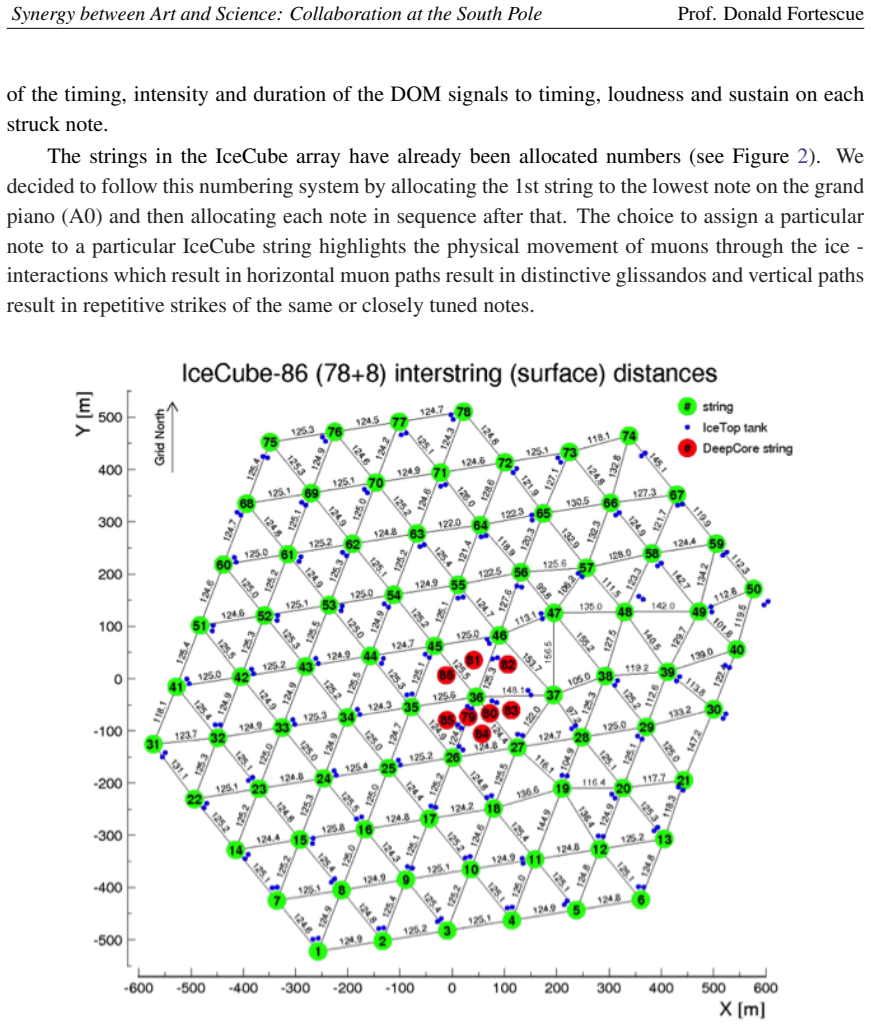
The central mechanism is the mapping of the detector's 86 instrumented vertical strings onto piano keys in string-number order, with photon hits on the individual optical modules transduced into struck notes via MIDI. Horizontal muon tracks produce glissandos across spatially separated strings; vertical tracks produce repeated near-identical notes; the rate of recorded photons controls tempo, modeling stochastic energy loss. This mapping is what turns a spatial particle event into an audible contour.
What would settle it
Play the sonified muon events to listeners who have no prior knowledge of the underlying data and ask them to report the incoming direction of each muon and to distinguish horizontal from vertical tracks; if their accuracy is no better than chance, the claimed analytical value of the sonification is not supported. A concrete version would present a set of events with known muon direction and ask listeners to sort them by direction, directly testing the paper's assertion that direction is audible in tone changes.
Extended reading notes
Core claim
The paper's central claim is that a data-transduction algorithm can map the 86 vertical sensor strings of the South Pole neutrino detector to 86 of the 88 piano keys, convert recorded photon hits on the detector's optical modules to MIDI note events, and select one muon event per hour from the direction of the sun to synchronize with a 24-hour time-lapse. Within the resulting sound work, the authors claim, listeners can hear the incoming direction of muons as shifts in tone, the muon path across the array as glissandos or repeated notes, and stochastic energy loss as tempo variation. The paper presents sonification as a form of 'listening as,' analogous to the 'drawing as' concept in scientific visualization, and argues that it could be more intuitively informative to scientists than animated 2D renderings.
Load-bearing premise
The load-bearing premise is that human hearing naturally resolves three-dimensional structure, so listening to neutrino interactions could be more intuitively informative to scientists than looking at animated renderings on a two-dimensional screen.
Editorial extensions
If this is right
- Scientists could use sonification as a complement to visual event displays, picking out muon direction, track geometry, and energy-loss patterns by ear.
- A non-specialist audience can grasp the layout of the detector through the familiar piano layout, making the instrument's 86 vertical strings tangible in sound.
- The same Python-to-MIDI transduction path can be re-applied to other particle detectors, letting future observatories render their events in sound with minimal new tooling.
- Pairing the audio with a synchronized time-lapse places the particle data in a shared physical frame with Earth's rotation and atmospheric motion, supporting embodied engagement with the data.
- If 'listening as' is theory-laden representation, then sonification should be treated as a scientific representation method, with its own conventions, distortions, and affordances, rather than only an artistic by-product.
Reading between the lines
- A controlled listening study—sorting sonified muon events by incoming direction or track type—would turn the paper's central claim into a quantitative result; the paper itself reports no such test.
- The current mapping encodes string identity as pitch, so horizontal tracks are easy to hear as glissandos, but depth along a string may be encoded less directly; alternative mappings could make depth or energy explicit.
- Because the sonification pipeline is general, the same approach could be applied to real-time data streams, potentially giving analysts an 'auditory alarm' for unusual event topologies.
- The underlying premise—that three-dimensional listening is more intuitive than 2D viewing—could be tested in other high-dimensional data domains, such as particle showers or seismic arrays.
Signed reviews
Editorial analysis
A structured set of objections, weighed in public.
Referee Report
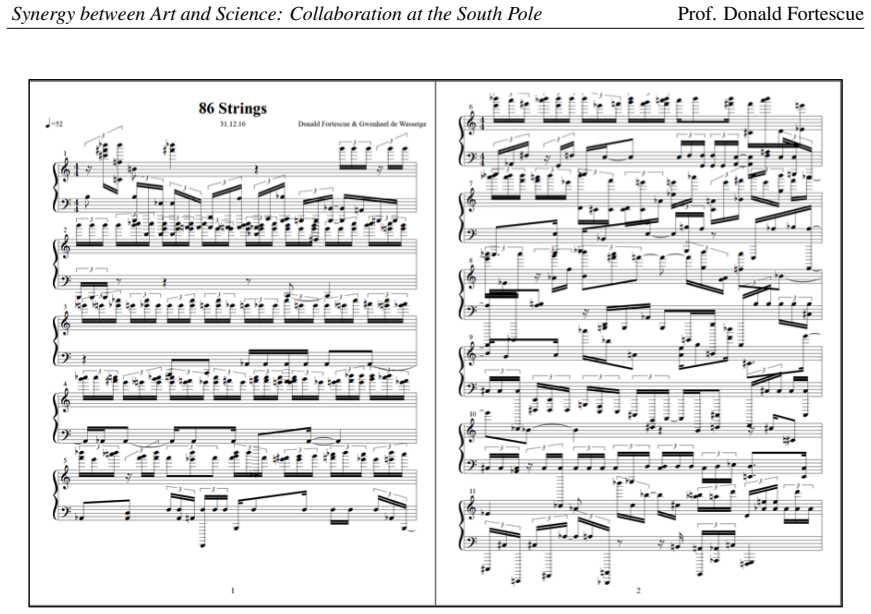
Summary. The paper reports on an art-science collaboration between artist Donald Fortescue and IceCube physicist Gwenhaël de Wasseige, resulting in the audiovisual work Axis Mundi and the sonification 86 Strings #1. The authors describe how atmospheric muon events detected by the IceCube array are transduced into sound by mapping the 86 detector strings to piano keys, with hit timing, intensity, and duration mapped to note timing, loudness, and sustain. Events from the direction of the Sun are sampled hourly and slowed down by orders of magnitude. The paper claims that this sonification allows audiences to physically engage with Earth's rotation, atmospheric motion, and muon passage, and that listeners can hear distinct characteristics of muons, such as incoming direction, path, and stochastic energy loss. The text also discusses the objective, rule-based approach to art making and the lasting value of the collaboration.
Significance. If the audibility claims are taken at face value, the work provides a novel and engaging public-outreach tool and a potential alternative data-exploration method for high-energy physics. The paper is transparent about its design choices and provides a link to the resulting video, which is valuable for reproducibility and for other art-science projects. Its main scientific significance, however, rests on the unverified assertion that the sonification preserves physical information in an auditorily decodable way. The paper offers no listening experiment, no classification test, and no comparison with existing 2D visualizations. As it stands, the documented contribution is primarily artistic and outreach-oriented; the scientific-usefulness claim is promising but not demonstrated.
major comments (4)
- [Section 3.2] The central claim that 'it is possible within 86 Strings #1 to hear certain distinct characteristics of the muons passing through the ice' is an empirical perceptual assertion that is not supported by any evidence in the manuscript. There is no listening test, no classification experiment, no comparison with Steamshovel visualizations, and no control for the authors' familiarity with the data. Before this claim can be accepted, the authors should either present a small perceptual study (e.g., listeners identifying direction or energy-loss features from sonified events) or explicitly reframe the statement as a hypothesis or hope rather than an established result.
- [Section 2.2] The described mapping assigns the string index to the piano pitch, but the 60 DOMs on each string are not mapped to distinct audible parameters. Therefore two hits at different depths on the same string produce the same pitch, so vertical trajectory information is not directly represented. The later claim in Section 3.2 that the muon path 'can be reconstructed through the variation of tone within the event' is not supported by this mapping: a vertical muon would produce repeated or closely spaced notes, not a variation of tone. The authors need to clarify which audible cue (e.g., timing sequence, loudness envelope, or an additional mapping parameter) is intended to encode the depth information.
- [Section 2.2] The claim that horizontal muon paths produce 'distinctive glissandos' assumes that the string numbering corresponds to a monotonic spatial ordering of the detector strings. The paper refers to Figure 2 but does not demonstrate that consecutive string numbers correspond to neighboring strings or to a geometrically ordered arrangement. Without this information, a horizontal muon crossing adjacent physical strings could be mapped to non-adjacent pitches, which would not sound like a glissando. The manuscript should document the string-numbering geometry or qualify the claim accordingly.
- [Section 3.2] The statement that 'We readily discern sound as occurring in three dimensions' is an overgeneralization that is not established for the specific sonification presented here. Human spatial hearing does provide directional cues, but that is not equivalent to the ability to recover multidimensional data structures from an arbitrary pitch-mapping sonification. Since the paper's stated scientific motivation is that listening to neutrino interactions 'could be more intuitively informative to scientists than looking at animated renderings on a 2D screen,' this premise is load-bearing. A concrete test, such as a source-localization or parameter-recovery task using the sonified audio, would be needed to support this claim.
minor comments (4)
- [Section 2.2] There is a typographical duplication: 'transduction of data into into audible sound' should read 'transduction of data into audible sound.'
- [Section 3] 'has bought awareness' should be 'has brought awareness.'
- [Abstract] The phrase 'the Dr. Gwenhael de Wasseige' is awkward; it should be 'Dr. Gwenhaël de Wasseige' without the definite article.
- [Section 2.1] The text says 'c.1 million cubic meters' after describing the array as a cubic kilometer; for consistency, this should be expressed as approximately one cubic kilometer or 10^9 cubic meters.
Circularity Check
No circularity found: the paper's sonification mapping is a transparent design choice, and the perceptual claims, though empirically unsupported, are not circular.
full rationale
The paper does not derive a quantitative result from first principles; it describes a sonification design and reports qualitative perceptual expectations. The mapping from IceCube string indices to piano pitches in Section 2.2 is an explicit authorial choice, not a parameter fitted to data, so sonic features such as glissandos for horizontal tracks and repeated notes for vertical tracks are direct consequences of that stated mapping rather than disguised inputs. The Section 3.2 claim that a listener can hear muon direction, path, and stochastic energy loss is an untested empirical hypothesis about auditory perception and information recoverability; it may be unsupported or overstrong, but an unsupported empirical claim is not circular reasoning, and it could in principle be tested by external listening experiments. Citations to IceCube collaboration papers and to Vertesi supply detector background and an analogy, respectively, and are not load-bearing steps in a derivation that reduces to its own assumptions. No self-definitional step, fitted-value-renamed-as-prediction, self-citation chain, or author-imported uniqueness theorem is present. The honest finding is no significant circularity.
Assumptions & free parameters
free parameters (4)
- Piano key mapping =
string i to the i-th note ascending from A0
- Event sampling rate =
one muon event per hour (24 events)
- Sun-direction event selection =
only events from the direction of the sun
- Time stretch factor =
each microsecond event stretched to 10-20 seconds
assumptions (3)
- domain assumption IceCube DOMs detect Cherenkov photons from muons and neutrinos, and these detections can be represented as event data.
- domain assumption MIDI can represent note timing, loudness, and duration, and Python MIDI libraries exist.
- domain assumption Human listeners can perceive three-dimensional spatial structure in sound.
Cite this review
Pith. "Pith review of Synergy between Art and Science: Collaboration at the South Pole." pith.science (2026). https://pith.science/paper/5ZHRZYAK
@misc{pith2026190808812,
  author       = {Pith},
  title        = {Pith review of: Synergy between Art and Science: Collaboration at the South Pole},
  year         = {2026},
  howpublished = {\url{https://pith.science/paper/5ZHRZYAK}},
  note         = {Machine review of arXiv:1908.08812}
}
read the original abstract
We present the result of a cross-disciplinary collaboration between Prof. Donald Fortescue of the California College of the Arts in San Francisco and the Dr. Gwenhael de Wasseige of the IceCube Collaboration. The work presented was initiated during Fortescue's US National Science Foundation funded Antarctic Artists and Writers Fellowship at the South Pole in the austral summer of 2016/17. One outcome of this collaboration is the video work Axis Mundi - a timelapse movie captured during 24 hours at the South Pole, combined with a simultaneous sampling of IceCube data transduced into sound. Axis Mundi captures the rotation of the Earth in space, the transient motions of the atmosphere, and the passage of subatomic particles through the polar ice, to provide a means for us to physically engage with these phenomena. We detail how both the timelapse and the transduction of atmospheric muon data have been realized and discuss the benefits of such a collaboration.
Figures

Figures from the paper (1 more)

Reference graph
Works this paper leans on
-
[1]
IceCube Collaboration, M. G. Aartsen et al. JINST 12 (2017), P03012
work page 2017
-
[2]
IceCube Collaboration, M. G. Aartsen et al. Science 342 (2013) 1242856
work page 2013
-
[3]
IceCube Collaboration, M. G. Aartsen et al. , Phys.\ Rev.\ Lett.\ 117 (2016), 071801
work page 2016
-
[4]
IceCube Collaboration, M. G. Aartsen et al. , Eur.\ Phys.\ J.\ C 77 (2017), 146
work page 2017
-
[5]
IceCube Collaboration, M. G. Aartsen et al. , ApJ, 872, (2019), 133
work page 2019
-
[6]
Sol LeWitt, `Paragraphs on Conceptual Art', Artforum, 5/10, Summer 1967
work page 1967
-
[7]
Lynch and Steve Woolgar (Harvard: The MIT Press, 2014), 19
Janet Vertesi, `Drawing as: Distinctions and Disambiguation in Digital Images of Mars,' in Representation in Scientific Practice Revisited (Inside Technology), edited by Catelijne Coopmans, Janet Vertesi, Michael E. Lynch and Steve Woolgar (Harvard: The MIT Press, 2014), 19
work page 2014
-
[8]
Vertesi, `Drawing as,' 18
Show all 14 references
-
[9]
Adri\`an-Martinez et al
KM3NeT Collaboration, S. Adri\`an-Martinez et al. , Journal of Physics G: Nuclear and Particle Physics, 43 (2016), 8
2016
-
[10]
IceCube-Gen2 Collaboration, PoS(ICRC2017)1052 (2018)
2018
-
[11]
IceCube Collaboration, PoS(ICRC2019)xyz (these proceedings)
-
[12]
IceCube Collaboration, M. G. Aartsen et al. , JINST 12 (2017) P03012
2017
-
[13]
Waxman and J
E. Waxman and J. N. Bahcall, Phys. Rev. D59 (1999) 023002
1999
-
[14]
write newline
" write newline "" before.all 'output.state := FUNCTION blank.sep after.quote 'output.state := FUNCTION fin.entry output.state after.quoted.block = 'skip 'add.period if write newline FUNCTION new.block output.state before.all = 'skip output.state after.quote = after.quoted.blo...
Reviewed August 14, 2026 · model on record in the stance chip above.
Discussion (0). Continue with ORCID to comment.