REVIEW 3 major objections 5 minor 1 cited by
The Willmore Energy Landscape of Spheres and Avoidable Singularities of the Willmore Flow
T0 review · 3 major / 5 minor · reviewed 2026-08-06 · deepseek-v4-flash
Pith's one-line read Every immersed 2-sphere with Willmore energy at most $12\pi$ admits an energy-decreasing regular homotopy to either a round sphere or a surface in the model family $J$.
desk verdict Genuine progress on the Willmore landscape below 12π, but the main theorem as stated fails for round spheres and the lower-bound half leans on a same-author companion preprint. read the letter →
The pith
A machine-rendered reading of the paper's core claim, the machinery that carries it, and where it could break.
The reading
What carries the argument
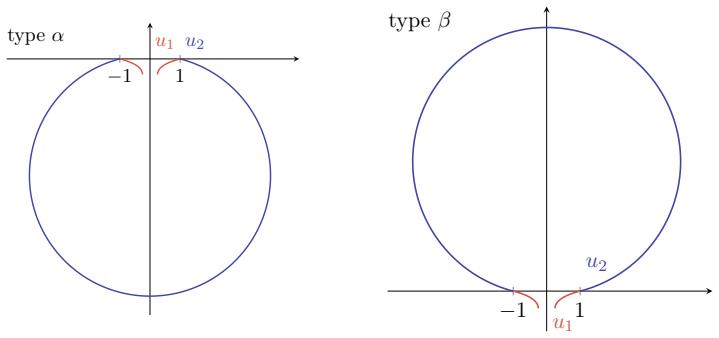
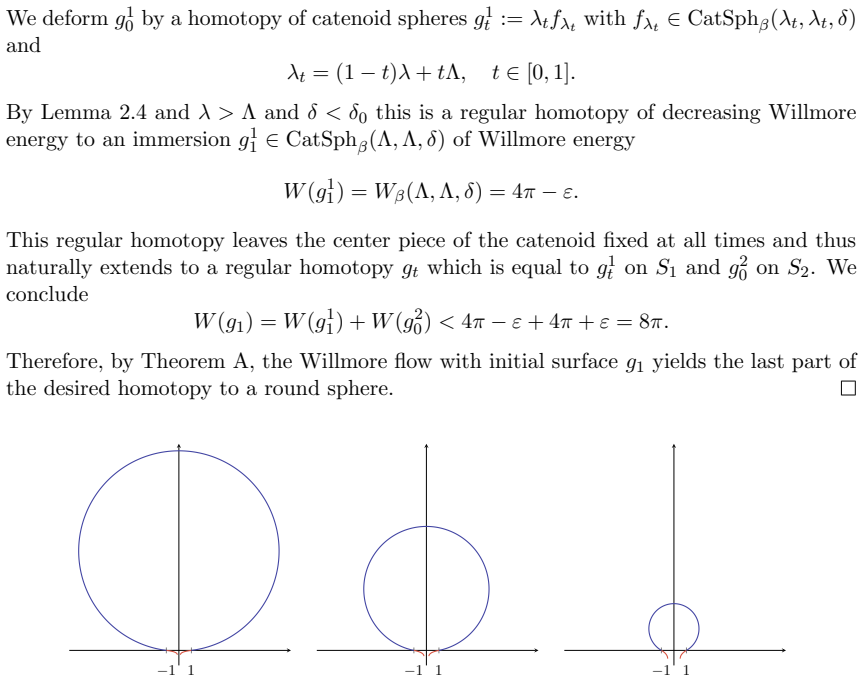
The argument is carried by a gluing construction around the catenoid blow-up predicted by the blow-up classification for the Willmore flow below $16\pi$: when $W(f_0)\le 12\pi$, the only possible blow-up at a singularity is a catenoid. The authors cut the surface along the catenoid neck, replace each side by a flat disk, and use the theorem that Willmore flow below $8\pi$ converges to a round sphere. The two flowing hemispheres are glued back to the catenoid at every time, producing catenoid spheres of two types, $\alpha$ and $\beta$; type $\beta$ can be shrunk to lower the energy below $8\pi$ and then flowed to a round sphere, while type $\alpha$ gives exactly the model family $J$. The companion invariant $F$ for triple-point-free immersed spheres is the topological tool that separates the four classes: it is constant along triple-point-free regular homotopies and takes values $e_{\pm 1}$ on round spheres and $e_{\pm 3}$ on $J$.
What would settle it
Find a triple-point-free immersed sphere $f:S^2\to\mathbb{R}^3$ with $W(f)\le 12\pi$ whose invariant $F(f)$ takes a value outside $\{e_{-3},e_{-1},e_1,e_3\}$; Proposition 1.9 would then be false. Alternatively, construct a regular homotopy below $12\pi$ from some $j\in J$ to a round sphere, which would contradict Theorem D and collapse Theorem 1.4.
Extended reading notes
Core claim
The central claim, Theorem 1.2, is that energy below $12\pi$ forces a very specific global shape: every smooth immersed sphere with $W(f)\le 12\pi$ admits a regular homotopy $H$ with $H_0=f$, $W(H_t)<W(f)$ for every positive time, and $H_1$ either a round sphere or an element of $J$. Theorem 1.4 then says that for $\omega\in(8\pi,12\pi]$ the sublevel set $I(\omega)$ contains exactly four regular homotopy classes: two containing the round spheres of opposite orientation and two containing the model surfaces $\pm j$, whose infimum energy is $8\pi$ but not attained. Proposition 1.6 characterizes unavoidable singularities: a flow starting at $f_0$ with $W(f_0)\le 12\pi$ develops an unavoidable singularity exactly when $f_0\in J$. Proposition 1.9 extends the Li–Yau inequality at $12\pi$: a triple-point-free immersion with invariant $F(f)$ outside $\{e_{\pm 1},e_{\pm 3}\}$ must have $W(f)>12\pi$.
Load-bearing premise
The entire classification depends on the companion paper's invariant and on Theorem D asserting that every regular homotopy from a model surface $j\in J$ to an embedded sphere must pass through at least one triple point; if that theorem were false, the four-class count and the 'unavoidable singularities exactly $J$' statement would both collapse.
Editorial extensions
If this is right
- For every $\omega\in(8\pi,12\pi]$, the sublevel set $I(\omega)$ splits into exactly four regular homotopy classes, so the energy landscape below $12\pi$ is known at the level of regular homotopy classes.
- If a smooth immersion with energy at most $12\pi$ fails to converge to a round sphere under the Willmore flow, then the initial surface can be deformed, without energy increase, to a model surface in $J$; the singularity is unavoidable precisely for initial data in $J$.
- The Li–Yau inequality is extended at the $12\pi$ threshold: a triple-point-free immersed sphere with invariant outside $\{e_{-3},e_{-1},e_1,e_3\}$ has Willmore energy greater than $12\pi$, so the new invariant $F$ controls the complexity of such surfaces.
- For any initial surface with $W\le 12\pi$ that admits a triple-point-free regular homotopy to a round sphere, there is also an energy-nonincreasing such homotopy; this is the low-energy version of the statement needed for an optimal sphere eversion.
- Below $16\pi$, if no Enneper-type blow-up occurs, the same gluing method deforms the surface without energy increase to a round sphere or to an $\alpha$-connected catenoid or trinoid model, giving a partial landscape description up to $16\pi$.
Reading between the lines
- If the companion invariant were replaced by a quadruple-point-free analogue, the same strategy would likely prove the $16\pi$ conjecture once an explicit sphere eversion through a halfway model is shown to be free of quadruple points; the paper explicitly raises this as Question 1.12.
- The four-class structure suggests a genuine topological phase change at $12\pi$: numerical experiments could test whether energy-decreasing paths from random low-energy immersions land on round spheres or on the $J$-model family, and whether the infimum $8\pi$ is approached by catenoid-sphere gluings.
- The cut-and-glue procedure described as a possible Willmore flow with surgery is a testable algorithmic construction: implementing it at a catenoid blow-up and checking whether the resulting flow converges to one or two round spheres would provide a concrete dynamical realization of the classification.
- For spheres of revolution, Proposition 1.10's lower bound $W(f)>4\pi(|\tau|+1/2)$ is sharp only in the limit; constructing explicit near-equality examples by gluing round spheres with catenoid necks would clarify how close the inequality is to being attained.
Editorial analysis
A structured set of objections, weighed in public.
Referee Report
Summary. The paper studies the sublevel sets I(omega) of the Willmore energy on the space of smooth immersions of S^2 into R^3. The main theorem (Theorem 1.2) asserts that every such immersion with energy at most 12 pi admits a regular homotopy of strictly decreasing energy whose terminal surface is either a round sphere or one of the model surfaces in the family J. Combining this with an invariant for triple-point-free immersed spheres imported from the companion preprint [Sei25], the paper derives a four-class description of I(omega) for omega in (8 pi, 12 pi], a classification of unavoidable singularities of the Willmore flow (Proposition 1.6), an extension of the Li-Yau inequality at 12 pi (Proposition 1.9), consequences for sphere eversions, and a partial classification below 16 pi. The constructive upper-bound part is carried out by gluing catenoid pieces to round spheres with explicit energy estimates, using the Lamm-Nguyen blow-up classification [LN15] and the Kuwert-Schaetzle convergence theorem [KS04].
Significance. If the results are correct, the paper gives a complete description of the regular homotopy classes of the Willmore energy landscape below 12 pi and identifies exactly which initial surfaces of energy at most 12 pi lead to unavoidable singularities. This would be a substantial advance in the global analysis of the Willmore functional. The paper's strength is its explicit gluing construction: the energy bookkeeping in Proposition 2.7, the estimates in Lemma 2.4, and the detailed computations in Lemma A.1 give a concrete, checkable pathway from a catenoid blow-up to either a round sphere or a surface in J. The upper-bound direction is internally plausible. However, the lower-bound direction and the classification of unavoidable singularities rest on Theorem D, the invariant values F(+-e)=e_{+-1}, F(j)=e_{+-3}, and a generic-triple-point persistence assertion, all imported from the same-author companion preprint [Sei25] without proof or summary in the present manuscript. In addition, the main theorem as stated is false for round initial data because the required strict energy decrease is impossible when W(f)=4 pi. These points make the paper conditional rather than self-contained.
major comments (3)
- [Section 1.3, Theorem 1.2] Theorem 1.2 is false as stated for round initial data. If f is a round sphere, then W(f)=4 pi and every immersed sphere has Willmore energy at least 4 pi, with equality only for round spheres; hence no regular homotopy H with H_0=f can satisfy W(H_t)<W(f) for all t in (0,1]. The proof in Section 2.3 also implicitly assumes omega = W(f0)-W(f_{s0}) > 0, which fails for round f0. The theorem should be restricted to non-round initial data, or the strict inequality should be weakened in a way that is still sufficient for the later applications. Since the round spheres are already the endpoints e and -e in the classification, this is a fixable statement error, but it is load-bearing because Theorem 1.2 is cited as the main theorem.
- [Section 1.3, Theorem 1.4; Section 1.4, Proposition 1.6; Section 1.5, Proposition 1.9] The lower-bound half of the paper's central classification is not proved in this manuscript. The assertion that j in J is not regularly homotopic to e or -e inside I(omega), the 'only if' direction of Proposition 1.6, and Proposition 1.9 all depend on Theorem D ([Sei25, Theorem 1.7]), on the invariant values F(+-e)=e_{+-1} and F(j)=e_{+-3} ([Sei25, Example 5.2]), and on the claim that regular homotopies from J to embedded spheres have generic triple points. None of these results is stated in sufficient detail or proved here, and [Sei25] is a same-author companion preprint. If any of these imported results fails, the 'at least four classes' part of Theorem 1.4 collapses, and the characterization of unavoidable singularities is unsupported. The paper should either include proofs or sufficiently detailed statements of the imported results, or the main conclusions should be explicitly conditioned on the companion preprint.
- [Appendix A, Corollary 1.3] The proof of Corollary 1.3 uses a 'generic triple-point persistence' assertion that is stronger than the quoted Theorem D. Theorem D only says that every regular homotopy joining some j in J to an embedded sphere has triple points; Corollary 1.3 needs the existence of a time at which the triple point is generic, so that all immersions in a C^infinity neighborhood also have triple points. This genericity statement is asserted to follow from [Sei25], but it is not formulated precisely nor proved. Since the strict inequality W(H_t)>12 pi is needed to separate the J-classes from the round classes in I(12 pi), this missing formulation is a load-bearing gap.
minor comments (5)
- [Abstract and Section 1.3] The abstract says a homotopy whose Willmore energy 'does not exceed' that of the initial surface, while Theorem 1.2 states the stronger strict inequality W(H_t)<W(f) for all t in (0,1]. These formulations should be reconciled, especially in light of the round-sphere issue raised above.
- [Section 2.2, Definition 2.3] The definition says W_alpha(lambda,R,delta) is 'the Willmore energy of some catenoid sphere' in CatSph_alpha. Since the set CatSph_alpha may contain different parametrizations, it would be clearer to define W_alpha and W_beta as the energy of the specific rotationally symmetric gluing constructed in the preceding paragraph, and to note that this value is independent of the chosen parametrization.
- [Section 2.2, proof of Lemma 2.4] In the proof of Lemma 2.4(i), the constant delta_0 is set to 2 pi / C, but the statement requires delta_0 in (0,1/2). The definition should be delta_0 = min(1/2, 2 pi / C) to make the stated range valid.
- [Section 2.3, Step 5.2 of Proposition 2.7] The text says that by translation and rotation of F_t one can ensure F_t(p)=0 and T_p F_t = R^2 x {0} for all t, but it does not explicitly justify that these ambient motions can be chosen continuously in t. This is likely true, but a sentence explaining the continuity would remove ambiguity.
- [Section 2.4, Remark 2.11] There is a typo: 'The discussion aboe' should read 'The discussion above'.
Circularity Check
The gluing construction behind Theorem 1.2 is self-contained, but the exact four-class classification, the unavoidable-singularity characterization, and Proposition 1.9 import their lower-bound content from the same-author companion preprint [Sei25].
-
self citation load bearing
[Section 1.3, Theorem D and proof of Theorem 1.4; Appendix A, proof of Corollary 1.3.]
"Theorem D. ([Sei25, Theorem 1.7]). Every regular homotopy joining some j ∈ J to an embedded sphere has triple points. ... By Corollary 1.3, it is also not regularly homotopic to e or −e in I(ω). This proves the statement."
The lower-bound half of the main classification (I(ω) has at least four classes) is not proved in this manuscript. Corollary 1.3 obtains the needed strict inequality W > 12π by quoting [Sei25]: 'since [Sei25] implies that there must be an immersion Ht with a generic triple point'. Theorem 1.4 then uses Corollary 1.3 to conclude that j is not homotopic to ±e inside I(ω). No proof, statement of assumptions, or independent verification of [Sei25] is provided here. If Theorem D fails, j could be connected to an embedded sphere with energy at most 12π, the four-class count collapses, and Proposition 1.6's 'only if' direction loses its justification.
-
self citation load bearing
[Section 2.3, Lemma 2.8.]
"Now, for given f ∈ I(ω) ∩ J we apply Proposition 2.7 for δ and λ = R > λ1 to obtain a regular homotopy to some i ∈ Imm(S2,R3) with hemispheres i|Si ∈ CatSphα(λ,λ,δ). Type β cannot occur by Theorem D."
This step excludes the β-attachment solely by importing Theorem D from the same-author preprint [Sei25]. The exclusion is load-bearing for Lemma 2.8, which is exactly the statement used in Theorem 1.4 to organize all f ∈ I(ω) ∩ J into the two classes J±. The paper's own construction shows that a β-type catenoid sphere can be deformed to a round sphere with energy below 8π; without Theorem D that alternative would merge classes and the four-class theorem would not follow. The paper does not establish Theorem D or its independence from the present results.
1 more flagged steps
-
self citation load bearing
[Section 1.5, proof of Proposition 1.9.]
"Suppose W(f) ≤ 12π. In [Sei25, Example 5.2] it is computed F(±e) = e±1 and F(j) = e±3 for all j ∈ J. Then, Theorem 1.2 provides a regular homotopy without triple points to round spheres e, −e or some j ∈ J. The invariant is constant along regular homotopies without triple points [Sei25, Theorem 1.3] and thus F(f) ∈ {e−3, e−1, e1, e3}."
The claimed extension of the Li-Yau inequality at 12π is obtained by combining Theorem 1.2 with the invariant F, whose constancy, computed values, and membership criterion are all quoted from [Sei25]. The present paper neither defines F nor proves the quoted facts. Since Proposition 1.9 is presented as a consequence of the landscape classification, its content reduces to the same companion preprint: if the [Sei25] values or constancy fail, the claimed lower bound W > 12π for all other triple-point-free immersions is unsupported.
full rationale
The constructive core of the paper, Theorem 1.2, is not circular: its proof in Section 2.3 is a genuine gluing argument using Proposition 2.7, Lemma 2.4, the external classification of blow-ups by Lamm-Nguyen [LN15], and Kuwert-Schatzle's convergence theorem [KS04]. No equation in the proof is set equal to its own input by construction, no fitted parameter is relabeled as a prediction, and the energy controls are explicit. The main concern is the lower-bound direction of the classification. The four-class statement, the unavoidable-singularity characterization, Proposition 1.9, and the strict version of Corollary 1.3 all depend essentially on Theorem D and the F-invariant facts imported from [Sei25], a companion preprint by the second author that is cited but neither proved nor summarized here. This is load-bearing self-citation rather than an independent derivation. If [Sei25] is later verified externally, the circularity score should drop to 0-2; absent such verification, the paper's central classification rests in part on a same-author citation.
Assumptions & free parameters
free parameters (1)
- Auxiliary proof constants Λ, δ0, λ1, ρ, ω, ε
assumptions (9)
- standard math Theorem A (Kuwert-Schätzle [KS04]): the Willmore flow with W(f0) ≤ 8π exists globally and converges to a round sphere.
- domain assumption Theorem E (Lamm-Nguyen [LN15, Thm 1.6]): for W(f0) < 16π the blow-up is a catenoid, trinoid, or Enneper surface; for W(f0) ≤ 12π only the catenoid case appears.
- domain assumption Theorem D (Seidel [Sei25, Thm 1.7]): every regular homotopy from j ∈ J to an embedded sphere has triple points; invariance and values F(±e) = e_{±1}, F(j) = e_{±3} ([Sei25, Thm 1.3, Ex. 5.2]).
- standard math Theorem B (Max-Banchoff [MB81]): every sphere eversion has a quadruple point; every regular homotopy from f to −f has a quadruple point.
- standard math Li-Yau inequality [LY82]: an immersion with an n-tuple point has W ≥ 4πn.
- standard math Bryant classification [Bry84]: Willmore spheres appear only at levels 4πk; below 16π the only smooth Willmore spheres are the round spheres.
- standard math Langer compactness [Lan85, Thm 2.4] and short-time existence of the Willmore flow [KS12].
- standard math Kusner [Kus87, Thm A] on density at infinity of complete minimal surfaces.
- standard math Smale [Sma58, Sma59]: immersions of S² in R³ form one regular homotopy class; orientation-preserving diffeomorphisms of S² are homotopic.
invented entities (3)
-
Family J of model surfaces (Definition 1.1)
independent evidence
-
Catenoid spheres CatSph_α and CatSph_β (Definition 2.3)
independent evidence
-
Triple-point-free invariant F (from [Sei25])
independent evidence
Cite this review
Pith. "Pith review of The Willmore Energy Landscape of Spheres and Avoidable Singularities of the Willmore Flow." pith.science (2026). https://pith.science/paper/63CX2TVP
@misc{pith2026250623359,
  author       = {Pith},
  title        = {Pith review of: The Willmore Energy Landscape of Spheres and Avoidable Singularities of the Willmore Flow},
  year         = {2026},
  howpublished = {\url{https://pith.science/paper/63CX2TVP}},
  note         = {Machine review of arXiv:2506.23359}
}
abstract
We study the sublevel sets of the Willmore energy on the space of smoothly immersed $ 2 $-spheres in Euclidean $ 3 $-space. We show that the subset of immersions with energy at most $ 12\pi $ consists of four regular homotopy classes. Moreover, we show that in certain regular homotopy classes, all singularities of the Willmore flow are avoidable, that is, the initial surface admits a regular homotopy to a round sphere whose Willmore energy does not exceed that of the initial surface. This yields a classification of initial surfaces with energy at most $ 12\pi $ that lead to unavoidable singularities. As a further consequence, we obtain an extension of the Li-Yau inequality at $ 12\pi $ for a large class of immersed spheres without triple points. To prove these results, we glue together different instances of the Willmore flow and employ an invariant for triple-point-free immersed spheres.
Figures


Figures from the paper (8 more)





Forward citations
Cited by 1 Pith paper
-
An Invariant for Triple-Point-Free Immersed Spheres
The paper defines an invariant whose image is completely described, showing infinitely many regular homotopy classes of triple-point-free immersed spheres.
Reference graph
Works this paper leans on
-
[1]
The `Holiverse': holistic eversion of the 2-sphere in $\R^3$
Iain R. Aitchison. The ` H oliverse': holistic eversion of the 2-sphere in R ^3 , 2010. arXiv:1008.0916 https://arxiv.org/abs/1008.0916
work page Pith review arXiv 2010
-
[2]
An algebraic halfway model for the eversion of the sphere
Fran c ois Ap \' e ry. An algebraic halfway model for the eversion of the sphere. Tohoku Math. J. (2) , 44(1):103--150, 1992. With an appendix by Bernard Morin
work page 1992
-
[3]
Analytic sphere eversion using ruled surfaces
Adam Bednorz and Witold Bednorz. Analytic sphere eversion using ruled surfaces. Differential Geom. Appl. , 64:59--79, 2019
work page 2019
-
[4]
Existence of minimizing W illmore surfaces of prescribed genus
Matthias Bauer and Ernst Kuwert. Existence of minimizing W illmore surfaces of prescribed genus. Int. Math. Res. Not. , (10):553--576, 2003
work page 2003
-
[5]
Mario Botsch, Leif Kobbelt, Mark Pauly, Pierre Alliez, and Bruno Levy. Polygon Mesh Processing . A K Peters/CRC Press, October 2010
work page 2010
-
[6]
A singular example for the W illmore flow
Simon Blatt. A singular example for the W illmore flow. Analysis (Munich) , 29(4):407--430, 2009
work page 2009
-
[7]
Energy quantization for W illmore surfaces and applications
Yann Bernard and Tristan Rivi\`ere. Energy quantization for W illmore surfaces and applications. Ann. of Math. (2) , 180(1):87--136, 2014
work page 2014
-
[8]
Immersions with bounded second fundamental form
Patrick Breuning. Immersions with bounded second fundamental form. J. Geom. Anal. , 25(2):1344--1386, 2015
work page 2015
Show all 67 references
-
[9]
Robert L. Bryant. A duality theorem for W illmore surfaces. J. Differential Geom. , 20(1):23--53, 1984
1984
-
[10]
Bubble tree of branched conformal immersions and applications to the W illmore functional
Jingyi Chen and Yuxiang Li. Bubble tree of branched conformal immersions and applications to the W illmore functional. Amer. J. Math. , 136(4):1107--1154, 2014
2014
-
[11]
do Carmo
Manfredo P. do Carmo. Differential geometry of curves and surfaces . Prentice-Hall, Inc., Englewood Cliffs, NJ, 1976. Translated from the Portuguese
1976
-
[12]
D imension reduction for W illmore flows of tori: fixed conformal class and analysis of singularities, 2025
Anna Dall'Acqua, Marius Müller, Fabian Rupp, and Manuel Schlierf. D imension reduction for W illmore flows of tori: fixed conformal class and analysis of singularities, 2025. arXiv:2502.12606 https://arxiv.org/abs/2502.12606
2025 arXiv
-
[13]
uller, Reiner Sch\
Anna Dall'Acqua, Marius M\"uller, Reiner Sch\"atzle, and Adrian Spener. The W illmore flow of tori of revolution. Anal. PDE , 17(9):3079--3124, 2024
2024
-
[14]
Francis and Bernard Morin
George K. Francis and Bernard Morin. Arnold S hapiro's eversion of the sphere. Math. Intelligencer , 2(4):200--203, 1979/80
1979
-
[15]
Sullivan, and Chris Hartman
George Francis, John M. Sullivan, and Chris Hartman. Computing sphere eversions. In Mathematical visualization ( B erlin, 1997) , pages 237--255. Springer, Berlin, 1998
1997
-
[16]
Sullivan, Rob B
George Francis, John M. Sullivan, Rob B. Kusner, Ken A. Brakke, Chris Hartman, and Glenn Chappell. The minimax sphere eversion. In Visualization and mathematics ( B erlin- D ahlem, 1995) , pages 3--20. Springer, Berlin, 1997
1995
-
[17]
Goryunov
Victor V. Goryunov. Local invariants of mappings of surfaces into three-space. In The A rnold- G elfand mathematical seminars , pages 223--255. Birkh\"auser Boston, Boston, MA, 1997
1997
-
[18]
Helfrich
W. Helfrich. E lastic P roperties of L ipid B ilayers: T heory and P ossible E xperiments. Zeitschrift für Naturforschung C , 28(11-12):693--703, 1973
1973
-
[19]
Geometry of complete minimal surfaces at infinity and the W illmore index of their inversions
Jonas Hirsch, Rob Kusner, and Elena M\"ader-Baumdicker. Geometry of complete minimal surfaces at infinity and the W illmore index of their inversions. Calc. Var. Partial Differential Equations , 63(8):Paper No. 190, 30, 2024
2024
-
[20]
On the index of W illmore spheres
Jonas Hirsch and Elena M\"ader-Baumdicker. On the index of W illmore spheres. J. Differential Geom. , 124(1):37--79, 2023
2023
-
[21]
John F. Hughes. Another proof that every eversion of the sphere has a quadruple point. Amer. J. Math. , 107(2):501--505, 1985
1985
-
[22]
Sphere eversion from the viewpoint of generic homotopy
Mikami Hirasawa and Minoru Yamamoto. Sphere eversion from the viewpoint of generic homotopy. Topology Appl. , 223:13--29, 2017
2017
-
[23]
W^ 2,2 -conformal immersions of a closed R iemann surface into R^n
Ernst Kuwert and Yuxiang Li. W^ 2,2 -conformal immersions of a closed R iemann surface into R^n . Comm. Anal. Geom. , 20(2):313--340, 2012
2012
-
[24]
The large genus limit of the infimum of the W illmore energy
Ernst Kuwert, Yuxiang Li, and Reiner Sch\"atzle. The large genus limit of the infimum of the W illmore energy. Amer. J. Math. , 132(1):37--51, 2010
2010
-
[25]
The area preserving W illmore flow and local maximizers of the H awking mass in asymptotically S chwarzschild manifolds
Thomas Koerber. The area preserving W illmore flow and local maximizers of the H awking mass in asymptotically S chwarzschild manifolds. J. Geom. Anal. , 31(4):3455--3497, 2021
2021
-
[26]
The W illmore flow with small initial energy
Ernst Kuwert and Reiner Sch\" a tzle. The W illmore flow with small initial energy. J. Differential Geom. , 57(3):409--441, 2001
2001
-
[27]
Gradient flow for the W illmore functional
Ernst Kuwert and Reiner Sch\"atzle. Gradient flow for the W illmore functional. Comm. Anal. Geom. , 10(2):307--339, 2002
2002
-
[28]
Removability of point singularities of W illmore surfaces
Ernst Kuwert and Reiner Sch\"atzle. Removability of point singularities of W illmore surfaces. Ann. of Math. (2) , 160(1):315--357, 2004
2004
-
[29]
The W illmore functional
Ernst Kuwert and Reiner Sch\" a tzle. The W illmore functional. In Topics in modern regularity theory , volume 13 of CRM Series , pages 1--115. Ed. Norm., Pisa, 2012
2012
-
[30]
Nicolaas H. Kuiper. Convex immersions of closed surfaces in E 3 . N onorientable closed surfaces in E 3 with minimal total absolute G auss-curvature. Comment. Math. Helv. , 35:85--92, 1961
1961
-
[31]
Conformal geometry and complete minimal surfaces
Rob Kusner. Conformal geometry and complete minimal surfaces. Bull. Amer. Math. Soc. (N.S.) , 17(2):291--295, 1987
1987
-
[32]
Bubbles, conservation laws, and balanced diagrams
Rob Kusner. Bubbles, conservation laws, and balanced diagrams. In Geometric analysis and computer graphics ( B erkeley, CA , 1988) , volume 17 of Math. Sci. Res. Inst. Publ. , pages 103--108. Springer, New York, 1991
1988
-
[33]
A compactness theorem for surfaces with L_p -bounded second fundamental form
Joel Langer. A compactness theorem for surfaces with L_p -bounded second fundamental form. Math. Ann. , 270(2):223--234, 1985
1985
-
[34]
Branched W illmore spheres
Tobias Lamm and Huy The Nguyen. Branched W illmore spheres. J. Reine Angew. Math. , 701:169--194, 2015
2015
-
[35]
L \'o pez
Francisco J. L \'o pez. The classification of complete minimal surfaces with total curvature greater than -12 . Trans. Amer. Math. Soc. , 334(1):49--74, 1992
1992
-
[36]
Curves in the hyperbolic plane and mean curvature of tori in 3 -space
Joel Langer and David Singer. Curves in the hyperbolic plane and mean curvature of tori in 3 -space. Bull. London Math. Soc. , 16(5):531--534, 1984
1984
-
[37]
A new conformal invariant and its applications to the W illmore conjecture and the first eigenvalue of compact surfaces
Peter Li and Shing Tung Yau. A new conformal invariant and its applications to the W illmore conjecture and the first eigenvalue of compact surfaces. Invent. Math. , 69(2):269--291, 1982
1982
-
[38]
C losed mean curvature flows with asymptotically conical singularities, 2024
Tang-Kai Lee and Xinrui Zhao. C losed mean curvature flows with asymptotically conical singularities, 2024. arXiv:2405.15577 https://arxiv.org/abs/2405.15577
2024 arXiv
-
[39]
Explicit formulas, symmetry and symmetry breaking for W illmore surfaces of revolution
Rainer Mandel. Explicit formulas, symmetry and symmetry breaking for W illmore surfaces of revolution. Ann. Global Anal. Geom. , 54(2):187--236, 2018
2018
-
[40]
C lassification of branched W illmore spheres, 2024
Dorian Martino. C lassification of branched W illmore spheres, 2024. arXiv:2306.07965 https://arxiv.org/abs/2306.07965
2024 arXiv
-
[41]
Every sphere eversion has a quadruple point
Nelson Max and Tom Banchoff. Every sphere eversion has a quadruple point. In Contributions to analysis and geometry ( B altimore, M d., 1980) , pages 191--209. Johns Hopkins Univ. Press, Baltimore, MD, 1981
1980
-
[42]
On the M orse index of branched W illmore spheres in 3-space
Alexis Michelat. On the M orse index of branched W illmore spheres in 3-space. Calc. Var. Partial Differential Equations , 60(4):Paper No. 126, 97, 2021
2021
-
[43]
Li- Y au type inequality for curves in any codimension
Tatsuya Miura. Li- Y au type inequality for curves in any codimension. Calc. Var. Partial Differential Equations , 62(8):Paper No. 216, 28, 2023
2023
-
[44]
Marques and Andr\'e Neves
Fernando C. Marques and Andr\'e Neves. Min-max theory and the W illmore conjecture. Ann. of Math. (2) , 179(2):683--782, 2014
2014
-
[45]
Marques and Andr\'e Neves
Fernando C. Marques and Andr\'e Neves. The W illmore conjecture. Jahresber. Dtsch. Math.-Ver. , 116(4):201--222, 2014
2014
-
[46]
Andrea Mondino and Huy T. Nguyen. Global conformal invariants of submanifolds. Ann. Inst. Fourier (Grenoble) , 68(6):2663--2695, 2018
2018
-
[47]
Le retournement de la sphere
Bernard Morin and Jean-Pierre Petit. Le retournement de la sphere. C. R. Acad. Sci. Paris S\'er. A-B , 287(11):A791--A794, 1978
1978
-
[48]
Probl\'ematique du retournement de la sph\`ere
Bernard Morin and Jean-Pierre Petit. Probl\'ematique du retournement de la sph\`ere. C. R. Acad. Sci. Paris S\'er. A-B , 287(10):A767--A770, 1978
1978
-
[49]
The classification of branched W illmore spheres in the 3-sphere and the 4-sphere
Alexis Michelat and Tristan Rivi\`ere. The classification of branched W illmore spheres in the 3-sphere and the 4-sphere. Ann. Sci. \'Ec. Norm. Sup\'er. (4) , 55(5):1199--1288, 2022
2022
-
[50]
A L i- Y au inequality for the 1-dimensional W illmore energy
Marius M\"uller and Fabian Rupp. A L i- Y au inequality for the 1-dimensional W illmore energy. Adv. Calc. Var. , 16(2):337--362, 2023
2023
-
[51]
Short closed geodesics and the W illmore energy, 2025
Marius Müller, Fabian Rupp, and Christian Scharrer. Short closed geodesics and the W illmore energy, 2025. arXiv:2304.01809 https://arxiv.org/abs/2304.01809
2025
-
[52]
Mayer and Gieri Simonett
Uwe F. Mayer and Gieri Simonett. A numerical scheme for axisymmetric solutions of curvature-driven free boundary problems, with applications to the W illmore flow. Interfaces Free Bound. , 4(1):89--109, 2002
2002
-
[53]
Elasticity Theory After Germain , pages 103--114
Dora Musielak. Elasticity Theory After Germain , pages 103--114. Springer International Publishing, Cham, 2020
2020
-
[54]
Riemann bilinear relations on minimal surfaces
Joaqu \'i n P \'e rez. Riemann bilinear relations on minimal surfaces. Math. Ann. , 310(2):307--332, 1998
1998
-
[55]
Turning a surface inside out
Anthony Phillips. Turning a surface inside out. Sci. Amer. , 214(5):112, 1966
1966
-
[56]
The parametric W illmore flow
Francesco Palmurella and Tristan Rivi\`ere. The parametric W illmore flow. J. Reine Angew. Math. , 811:1--91, 2024
2024
-
[57]
Pinkall and I
U. Pinkall and I. Sterling. Willmore surfaces. Math. Intelligencer , 9(2):38--43, 1987
1987
-
[58]
Analysis aspects of W illmore surfaces
Tristan Rivi\`ere. Analysis aspects of W illmore surfaces. Invent. Math. , 174(1):1--45, 2008
2008
-
[59]
C onformally I nvariant V ariational P roblems, 2012
Tristan Rivière. C onformally I nvariant V ariational P roblems, 2012. Lecture notes, arXiv:1206.2116 https://arxiv.org/abs/1206.2116
2012 arXiv
-
[60]
Willmore minmax surfaces and the cost of the sphere eversion
Tristan Rivi\`ere. Willmore minmax surfaces and the cost of the sphere eversion. J. Eur. Math. Soc. (JEMS) , 23(2):349--423, 2021
2021
-
[61]
Global existence for the W illmore flow with boundary via S imon's L i- Y au inequality
Manuel Schlierf. Global existence for the W illmore flow with boundary via S imon's L i- Y au inequality. Adv. Calc. Var. , 18(2):555--575, 2025
2025
-
[62]
An I nvariant for T riple- P oint- F ree I mmersed S pheres, 2025
Jona Seidel. An I nvariant for T riple- P oint- F ree I mmersed S pheres, 2025. arXiv:2506.21130 https://arxiv.org/abs/2506.21130
2025 arXiv
-
[63]
Existence of surfaces minimizing the W illmore functional
Leon Simon. Existence of surfaces minimizing the W illmore functional. Comm. Anal. Geom. , 1(2):281--326, 1993
1993
-
[64]
The W illmore flow near spheres
Gieri Simonett. The W illmore flow near spheres. Differential Integral Equations , 14(8):1005--1014, 2001
2001
-
[65]
A classification of immersions of the two-sphere
Stephen Smale. A classification of immersions of the two-sphere. Trans. Amer. Math. Soc. , 90:281--290, 1958
1958
-
[66]
Diffeomorphisms of the 2 -sphere
Stephen Smale. Diffeomorphisms of the 2 -sphere. Proc. Amer. Math. Soc. , 10:621--626, 1959
1959
-
[67]
C losed R icci F lows with S ingularities M odeled on A symptotically C onical S hrinkers, 2024
Maxwell Stolarski. C losed R icci F lows with S ingularities M odeled on A symptotically C onical S hrinkers, 2024. arXiv:2202.03386 https://arxiv.org/abs/2202.03386
2024 arXiv
Reviewed August 6, 2026 · model on record in the stance chip above.
Discussion (0). Continue with ORCID to comment.