REVIEW 5 major objections 6 minor 29 references
VOP Detection for Read and Conversation Speech using CWT Coefficients and Phone Boundaries
T0 review · 5 major / 6 minor · reviewed 2026-08-14 · deepseek-v4-flash
Pith's one-line read Two-stage CWT plus phone-boundary correction detects vowel onsets within about 7 ms on average, nearly doubling the 10 ms identification rate of prior signal-processing methods.
desk verdict CWT+STM two-stage VOP detector has a plausible idea and good results, but the correction step that produces the accuracy numbers is under-validated. read the letter →
The pith
A machine-rendered reading of the paper's core claim, the machinery that carries it, and where it could break.
The reading
What carries the argument
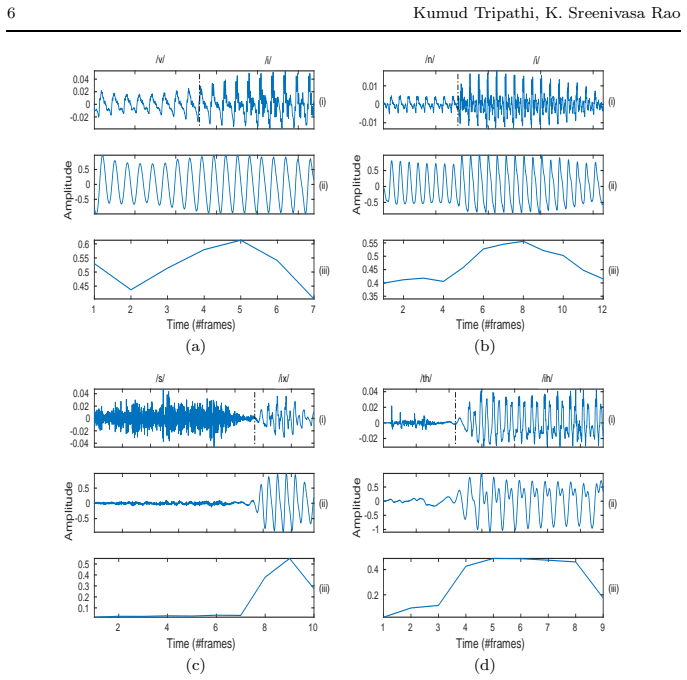
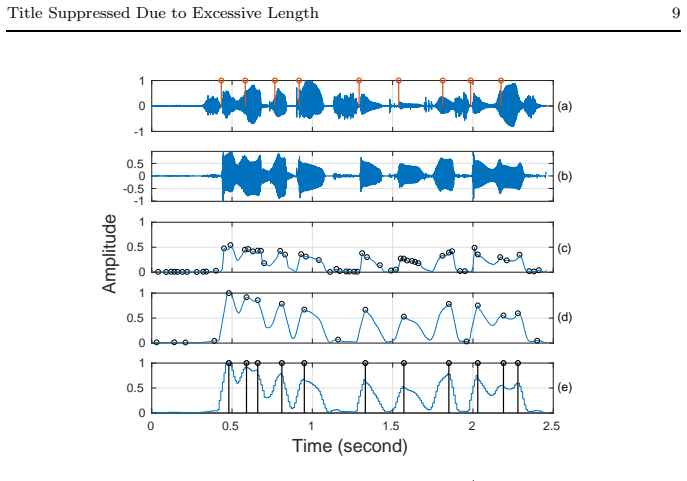
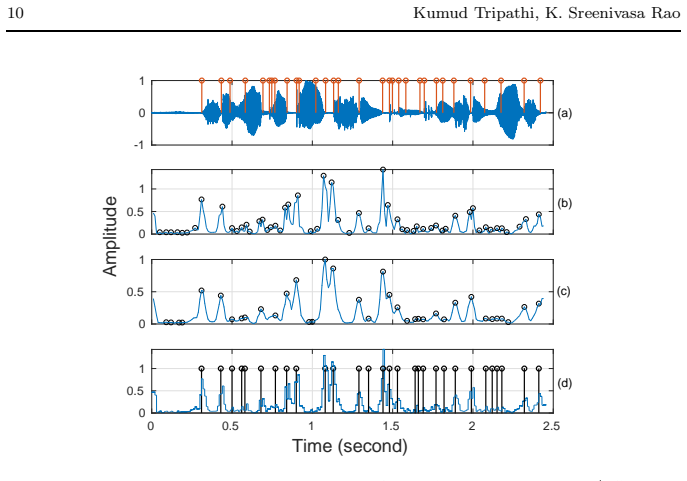
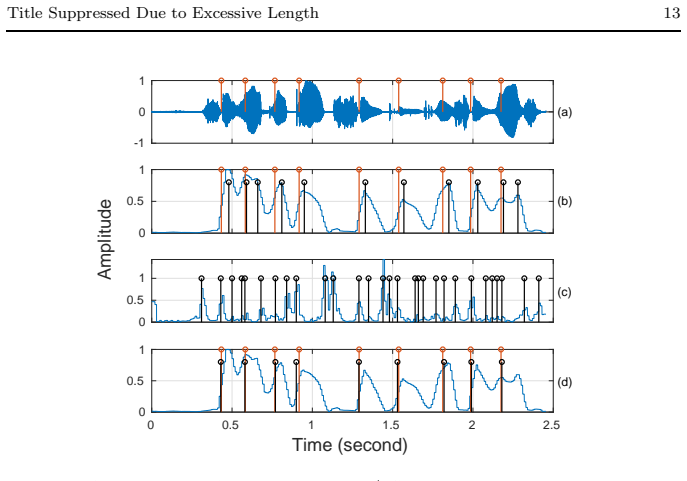
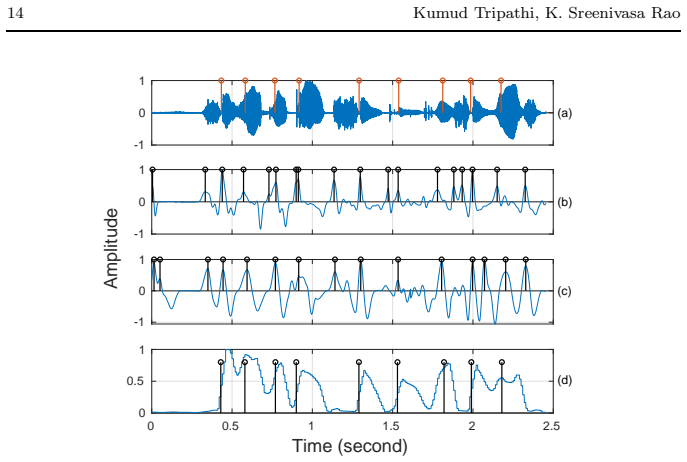
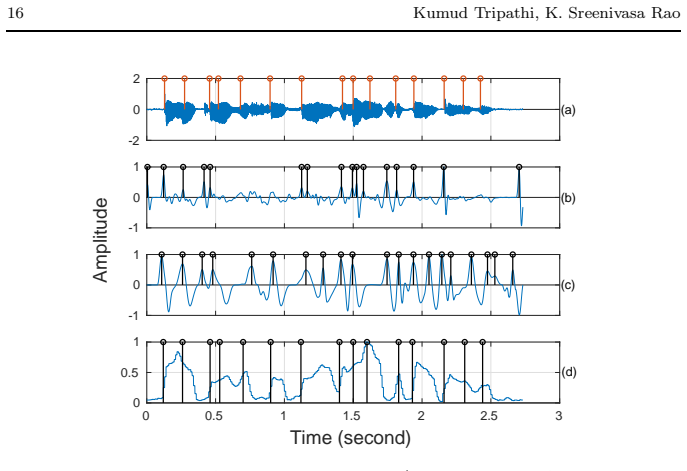
The load-bearing machinery is the two-stage correction rule. The CWT stage produces a mean-signal $\frac{1}{N}\sum_{q} C_x(p,q)$ from wavelet coefficients at several scales; its frame-wise average absolute magnitude, smoothed and thresholded, yields VOP hypotheses. The STM stage computes $S_g = \frac{1}{D}\sum_i r_i^2(g)$, a mean-squared spectral-transition measure per frame, whose peaks mark phone boundaries. The correction step then sets each detected VOP to the nearest phone boundary on its left. This rule is what turns a coarse 40 ms-level detector into one whose reported average deviation is about 7 ms.
What would settle it
Restrict the evaluation to a subset of TIMIT and Bengali utterances containing semivowel-vowel and diphthong transitions, and compare the corrected VOP positions against manual labels; if the nearest left STM boundary fails to match the marked onset for a substantial share, the correction rule is shifting those VOPs to the wrong place.
Extended reading notes
Core claim
The central discovery is that VOP candidates detected from CWT coefficients are systematically shifted to the right of the true onsets, and that this bias can be corrected without any training by snapping each candidate to the nearest detected phone boundary on its left. The paper's recipe is: compute CWT coefficients of the speech signal, average them over scales to form a mean-signal, take the average absolute magnitude (AAM) over 20 ms frames, smooth over 40 ms, retain local peaks above 15 percent of the smoothed maximum, and remove smaller peaks within a 50 ms window; separately compute STM from 39-dimensional MFCC features and keep phone-boundary peaks above 12 percent of the STM contour maximum; then replace each CWT VOP with the closest phone boundary to its left. The authors report that this yields an identification rate of 82 percent within 10 ms and an average deviation of about 7 ms on TIMIT, and that the advantage persists on Bengali conversation speech, where the 10 ms identification rate is 72 percent versus 45 percent for SE-GCI and 40 percent for COMB-ESM.
Load-bearing premise
The load-bearing premise is that for every CWT-detected VOP the nearest STM phone boundary to its left is the true vowel onset; that is plausible for simple consonant-to-vowel transitions but is not guaranteed for semivowel-vowel transitions, diphthongs, or cases where the CWT peak sits left of the true VOP.
Editorial extensions
If this is right
- If the claim holds, speech segmentation and consonant-vowel unit spotting can use VOPs accurate to roughly 7 ms instead of accepting 40 ms error bars.
- For Indian-language speech applications built on CV units, the method provides accurate onsets without training a vowel detector.
- Because the method is unsupervised and signal-based, it transfers to new languages without retraining, as the Bengali read and conversation results illustrate.
- In conversation speech, where vowels shorten and paralinguistic events create spurious peaks, the correction stage still reduces spurious rates to 7 percent versus 13 percent for SE-GCI and 15 percent for COMB-ESM in the Bengali data.
Reading between the lines
- Editorial extension: the same snap-to-nearest-left-phone-boundary correction could be applied to other VOP detectors, such as COMB-ESM or SE-GCI, and would likely reduce their deviation as well, since the bias correction is independent of the CWT front end.
- Editorial extension: the method's success depends on STM boundaries being accurate; on semivowel-vowel and diphthong transitions, where spectral changes are gradual, the nearest left boundary may be a spurious STM peak, so a targeted evaluation on those phone classes is the natural next test.
- Editorial extension: the approach suggests a symmetric counterpart for vowel end point detection by snapping to the nearest right phone boundary, an extension the authors mention as future work.
Signed reviews
Editorial analysis
A structured set of objections, weighed in public.
Referee Report
Summary. The paper proposes a two-stage method for vowel onset point (VOP) detection. In the first stage, the continuous wavelet transform (CWT) coefficients of the speech signal are averaged over scale to form a mean-signal, and VOP candidates are detected as peaks of the smoothed average absolute magnitude of this mean-signal. In the second stage, each detected VOP is corrected by relocating it to the nearest spectral-transition-measure (STM) phone boundary to its left. The method is evaluated on TIMIT and on Bengali read and conversation speech, and compared with two signal-processing baselines, COMB-ESM and SE-GCI. The central quantitative claim is an identification rate of 82% within 10 ms and an average deviation of about 7 ms on TIMIT (Table 3), compared with 62% and 51% for the baselines at the same tolerance. The paper also reports results for read and conversation modes of Bengali, where the proposed method shows smaller degradation in conversation mode than the baselines.
Significance. If the results are robust, the proposed method would be a simple, fully signal-processing-based approach that achieves substantially better VOP timing accuracy at low tolerances than two standard methods, and it addresses an under-studied speaking mode (conversation speech). The use of an unsupervised STM phone-boundary detector is a strength, as is the explicit comparison with two published baselines and the evaluation on two corpora. However, the significance is conditional on several unresolved points: the final VOP positions are, by construction, STM phone boundaries, so the reported accuracy is largely inherited from the STM stage rather than from the CWT analysis; the correction rule rests on an unquantified rightward-bias assumption; the mother wavelet and scales are unspecified; and the evaluation lacks independence between threshold tuning and testing, as well as any statistical significance testing. With these addressed, the contribution could be a meaningful practical improvement for applications needing VOPs within 10–20 ms.
major comments (5)
- [Section 3.3, steps 3–4] The correction rule defines every final VOP as the nearest STM phone boundary to the left of a CWT-detected VOP. This is valid only if CWT-detected VOPs are systematically to the right of true VOPs and if the nearest left STM boundary is the consonant–vowel boundary rather than a spurious or unrelated boundary. The paper's support for the rightward bias is a single unquantified statement, "detected VOPs are mostly occurring right side of the actual VOPs," based on a subset of TIMIT, and it does not examine the possibility that the nearest left STM boundary is a consonant–consonant transition or an intra-vowel spurious peak, even though Table 2 shows that 70% of STM boundaries are not VOPs. The Table 3 results (82% within 10 ms, 7 ms average deviation) are produced directly by this rule. Please provide a quantitative distribution of CWT VOP errors by direction and magnitude, and a breakdown of correction outcomes by phonetic context (CV, semivowel–vowel, diphthong, CC boundary) to demonstrate that the heuristic, not the CWT evidence, is not the source of the reported improvement.
- [Section 3.1, Eqs. (1)–(2)] The mother wavelet φ(t) and the set of scales qs are never specified. The CWT stage is the core of the proposed first stage, and its behavior—including the claims about suppressing nasals, fricatives, and unvoiced regions in Figure 1—depends entirely on these choices. Without specifying the wavelet family, the scale range, and the number of scales, the experiments cannot be reproduced, and the particular CWT implementation cannot be compared with other wavelet-based approaches. Please specify these parameters and justify them empirically or theoretically.
- [Section 3.1 (Table 1) and Section 3.2] The thresholds th1=15% and th2=12% are selected by experiments on a subset of TIMIT, and for Bengali the text states that "in a similar manner, experiments are performed with Bengali read and conversation speech signals," implying that thresholds are also tuned on the evaluation corpus. The paper does not state that the 120 TIMIT evaluation utterances (Section 4.1) are disjoint from the threshold-selection subset. If tuning and evaluation use the same corpus, the reported identification rates are not independent estimates of performance on unseen data. Please specify the exact tuning/evaluation split, or fix thresholds a priori, or use cross-validation, and report results accordingly.
- [Section 4.1 (Table 3)] The claim that the proposed method outperforms COMB-ESM and SE-GCI is based on single point estimates with no error bars, confidence intervals, or significance tests. With 120 TIMIT utterances and roughly 100 Bengali utterances per mode, per-utterance metrics are feasible. Please add a paired significance test (e.g., Wilcoxon signed-rank) for identification rate at each tolerance and for average deviation, or provide confidence intervals, so that the 20–30 percentage-point gaps at 10 ms can be assessed statistically rather than impressionistically.
- [Section 4.1] The derivation of ground-truth VOPs is not described. TIMIT provides phone segment labels, not vowel onset labels; the paper should state explicitly how the reference VOPs were computed (for example, as the boundary of the first vowel phone in each syllable) and what criterion was used for matching detected VOPs to reference VOPs when computing missed and spurious rates. The same information is needed for the Bengali corpus, including whether manual annotation or automatic segmentation was used. Without this, the evaluation is not reproducible.
minor comments (6)
- [Section 4 heading] The heading "Performance Evaluaion" contains a typo; it should read "Performance Evaluation."
- [Figures 5 and 6 captions] The captions of Figures 5 and 6 state that "Actual phone boundaries" and "detected phone boundaries" are marked, but the panels display VOPs, not phone boundaries; the captions should say "VOPs" to match panels (a) and (d).
- [Section 4.2] The dataset description is confusing: the text says "Altogether, 20 utterances are collected from 5 distinct speakers" and then "About 100 utterances from each mode are selected for evaluating"; please clarify whether the 20 utterances are a subset used for threshold tuning and what the relation is to the 100 utterances per mode used in the evaluation.
- [Section 3.1, paragraph 4] The text says that "the well-known difficulties in VOP detection are finding false VOPs in case of semi-vowels, nasals, and fricatives as they are periodic in nature," but fricatives are typically aperiodic; later in the same paragraph the paper states that CWT coefficients are "almost zero in fricatives and unvoiced speech regions," which is consistent with aperiodicity. Please reconcile this wording.
- [Eq. (1)] In the extracted text, the integral symbol in Eq. (1) appears garbled as "/uni222B.dsp"; please ensure the equation renders correctly in the final manuscript.
- [Section 3.1, paragraph 2] The claim that "there is no work related to CWT for VOP detection" is a strong negative claim; please soften it to "to the best of the authors' knowledge" or provide a brief literature survey to support it.
Circularity Check
Final VOP positions are defined as STM phone boundaries and thresholds are fitted to TIMIT, so the low-deviation accuracy is partly inherited from the boundary detector rather than independently derived from CWT.
-
self definitional
[Section 3.3, steps 3-4 (Two-Stage Method for VOP Detection)]
"For each detected VOP, find the left-most closest phone boundary (see in Figure 5(c)). 4. The position of the detected phone boundary is marked as the location of modified VOP, as shown in Figure 5(d)."
The algorithm defines the corrected VOP to be exactly an STM phone boundary. Therefore the reported 10 ms identification rate (82%) and 7 ms average deviation in Table 3 are properties of the STM boundary input after CWT-based gating, not of a CWT-derived onset position. Table 2 already shows STM alone detects 90% of VOPs within 10 ms when every boundary is treated as a VOP; the proposed output is a CWT-selected subset of those same boundaries. The low-deviation accuracy is thus imported from the STM boundary detector by construction. The rule also depends on the unquantified observation that CWT VOPs 'are mostly occurring right side of the actual VOPs'; if leftward errors or spurious left boundaries occur, the corrected position is wrong by construction.
-
fitted input called prediction
[Section 3.1 (Table 1) and Section 4.1]
"For determining VOPs, an optimal threshold (th1) is fixed at 15% of the maximum of smoothed AAM. This threshold is decided by estimating the errors for VOP detection ... These experiments are performed on a subset of TIMIT speech corpus."
The threshold th1=15% is selected by minimizing missed/spurious errors on a TIMIT subset, and the method is then evaluated on 120 randomly selected TIMIT utterances in Section 4.1. The headline IR and average-deviation numbers therefore are partly a fitted result rather than a parameter-free prediction. The same pattern occurs for th2=12% in Section 3.2, which is 'decided after analyzing the STM contour on a subset of TIMIT corpus.' This does not invalidate the whole comparison, since the baselines are also tested on TIMIT, but it means the reported advantage partially reflects threshold fitting on the target corpus.
full rationale
The most concrete circular element is the two-stage correction rule: the final VOP location is, by the paper's own step 4, set equal to an STM phone boundary. Consequently, the low-deviation accuracy (82% within 10 ms; 7 ms average deviation) is largely inherited from the STM boundary detector, with CWT acting mainly as a candidate gate that reduces the spurious rate. Additionally, the key thresholds are explicitly chosen on TIMIT and then evaluated on TIMIT, so the reported performance is partly a fitted result. This is not a total collapse: STM is an independent, externally cited unsupervised method, the CWT gating does add a non-trivial selection criterion, and the comparison against COMB-ESM and SE-GCI is an external empirical benchmark with quantitative tables. The 'mostly right side' heuristic is a genuine correctness risk but not itself a circularity. Because the central output is defined from an input and the thresholds are corpus-fitted, a moderate partial-circularity score of 4 is appropriate rather than a higher one.
Assumptions & free parameters
free parameters (4)
- th1 (CWT peak threshold) =
15% of max smoothed AAM
- th2 (STM phone-boundary threshold) =
12% of max STM contour amplitude
- VOP peak separation window =
50 ms
- Smoothing window for AAM =
40 ms
assumptions (5)
- domain assumption CWT mean-signal AAM peaks represent vowel regions and can be separated from semivowels, nasals, and fricatives by a fixed threshold.
- domain assumption The nearest phone boundary to the left of a CWT-detected VOP is the true VOP.
- domain assumption Only one VOP occurs within a 50 ms window.
- domain assumption STM detects phone boundaries accurately, with 90% within 20 ms.
- standard math CWT and STM are mathematically as defined in Eqs. (1)-(4) and standard signal processing.
Cite this review
Pith. "Pith review of VOP Detection for Read and Conversation Speech using CWT Coefficients and Phone Boundaries." pith.science (2026). https://pith.science/paper/63O2JPGE
@misc{pith2026190808668,
  author       = {Pith},
  title        = {Pith review of: VOP Detection for Read and Conversation Speech using CWT Coefficients and Phone Boundaries},
  year         = {2026},
  howpublished = {\url{https://pith.science/paper/63O2JPGE}},
  note         = {Machine review of arXiv:1908.08668}
}
read the original abstract
In this paper, we propose a novel approach for accurate detection of the vowel onset points (VOPs). VOP is the instant at which the vowel begins in the speech signal. Precise identification of VOPs is important for various speech applications such as speech segmentation and speech rate modification. The existing methods detect the majority of VOPs within 40 ms deviation, and it may not be appropriate for the above speech applications. To address this issue, we proposed a two-stage approach for accurate detection of VOPs. At the first stage, VOPs are detected using continuous wavelet transform coefficients, and the position of the detected VOPs are corrected using the phone boundaries in the second stage. The phone boundaries are detected by the spectral transition measure method. Experiments are done using TIMIT and Bengali speech corpora. Performance of the proposed approach is compared with two standard signal processing based methods. The evaluation results show that the proposed method performs better than the existing methods.
Figures

Figures from the paper (6 more)


Reference graph
Works this paper leans on
-
[1]
A. Batliner, R. Kompe, A. Kießling, E. N¨ oth, H. Niemann, C an you tell apart sponta- neous and read speech if you just look at prosody?, in: Speech Recognition and Coding, Springer, 1995, pp. 321–324. 20 Kumud Tripathi, K. Sreenivasa Rao
work page 1995
-
[2]
E. Blaauw, Phonetic characteristics of spontaneous and r ead-aloud speech, in: Phonetics and Phonology of Speaking Styles, 1991
work page 1991
- [3]
-
[4]
S. M. Prasanna, S. V. Gangashetty, B. Yegnanarayana, Sign ificance of vowel onset point for speech analysis, in: Proceedings of International Conf erence on signal processing and communications, Citeseer, 2001, pp. 81–88
work page 2001
-
[5]
B. D. Sarma, S. M. Prasanna, P. Sarmah, Consonant-vowel un it recognition using domi- nant aperiodic and transition region detection, Speech Com munication 92 (2017) 77–89
work page 2017
-
[6]
D. J. Hermes, Vowel-onset detection, The Journal of the Ac oustical Society of America 87 (2) (1990) 866–873
work page 1990
-
[7]
S. Deb, S. Dandapat, Emotion classification using segment ation of vowel-like and non- vowel-like regions, IEEE Transactions on Affective Computi ng
-
[8]
S. V. Gangashetty, C. C. Sekhar, B. Yegnanarayana, Detect ion of vowel onset points in continuous speech using autoassociative neural network models, in: Proceedings of INTERSPEECH, 2004, pp. 1081–1084
work page 2004
Show all 29 references
-
[9]
S. V. Gangashetty, C. C. Sekhar, B. Yegnanarayana, Spotti ng multilingual consonant- vowel units of speech using neural network models, in: Inter national Conference on Nonlinear Analyses and Algorithms for Speech Processing, S pringer, 2005, pp. 303–317
2005
-
[10]
S. V. Gangashetty, C. C. Sekhar, B. Yegnanarayana, Extra ction of fixed dimension patterns from varying duration segments of consonant-vowe l utterances, in: Proceedings of International Conference on Intelligent Sensing and Inf ormation Processing, IEEE, 2004, pp. 159–164
2004
-
[11]
S. M. Prasanna, B. Yegnanarayana, Detection of vowel ons et point events using excita- tion information, in: Proceedings of INTERSPEECH, 2005, pp . 1133–1136
2005
-
[12]
K. S. Rao, B. Yegnanarayana, Duration modification using glottal closure instants and vowel onset points, Speech communication 51 (12) (2009) 126 3–1269
2009
-
[13]
S. M. Prasanna, B. S. Reddy, P. Krishnamoorthy, Vowel ons et point detection using source, spectral peaks, and modulation spectrum energies, IEEE Transactions on audio, speech, and language processing 17 (4) (2009) 556–565
2009
-
[14]
A. K. Vuppala, J. Yadav, S. Chakrabarti, K. S. Rao, Vowel o nset point detection for low bit rate coded speech, IEEE Transactions on Audio, Speech, a nd Language Processing 20 (6) (2012) 1894–1903
2012
-
[15]
Furui, Recent advances in spontaneous speech recogni tion and understanding, in: Pro- ceedings of ISCA & IEEE workshop on spontaneous speech proce ssing and recognition, 2003
S. Furui, Recent advances in spontaneous speech recogni tion and understanding, in: Pro- ceedings of ISCA & IEEE workshop on spontaneous speech proce ssing and recognition, 2003
2003
-
[16]
Nakamura, K
M. Nakamura, K. Iwano, S. Furui, Differences between acou stic characteristics of spon- taneous and read speech and their effects on speech recogniti on performance, Computer Speech & Language 22 (2) (2008) 171–184
2008
-
[17]
W ang, C.-H
J.-F. W ang, C.-H. W u, S.-H. Chang, J.-Y. L. Lee, A hierarc hical neural network model based on a c/v segmentation algorithm for isolated mandarin speech recognition, IEEE Transactions on Signal Processing 39 (9) (1991) 2141–2146
1991
-
[18]
S. M. Prasanna, G. Pradhan, Significance of vowel-like re gions for speaker verification under degraded conditions, IEEE transactions on audio, spe ech, and language processing 19 (8) (2011) 2552–2565
2011
-
[19]
Kumar, S
A. Kumar, S. Shahnawazuddin, G. Pradhan, Exploring diffe rent acoustic modeling tech- niques for the detection of vowels in speech signal, in: Proc eedings of Twenty Second National Conference on Communication (NCC), IEEE, 2016, pp . 1–5
2016
-
[20]
Kumar, S
A. Kumar, S. Shahnawazuddin, G. Pradhan, Improvements i n the detection of vowel onset and offset points in a speech sequence, Circuits, syste ms, and signal processing 36 (6) (2017) 2315–2340
2017
-
[21]
B. D. Sarma, S. M. Prasanna, Analysis of spurious vowel-l ike regions (vlrs) detected by excitation source information, in: Proceedings of Annua l IEEE India Conference (INDICON), IEEE, 2013, pp. 1–5
2013
-
[22]
B. K. Khonglah, B. D. Sarma, S. Prasanna, Exploration of d eep belief networks for vowel-like regions detection, in: Proceedings of Annual IE EE India Conference (INDI- CON), IEEE, 2014, pp. 1–5
2014
-
[23]
Stephane, A wavelet tour of signal processing, The Spa rse W ay
M. Stephane, A wavelet tour of signal processing, The Spa rse W ay. Title Suppressed Due to Excessive Length 21
-
[24]
Madhavi, H
M. Madhavi, H. Patil, B. B. Vachhani, Spectral transitio n measure for detection of obstruents, in: Proceedings of 23rd European Signal Proces sing Conference (EUSIPCO), IEEE, 2015, pp. 330–334
2015
-
[25]
Dusan, L
S. Dusan, L. Rabiner, On the relation between maximum spe ctral transition positions and phone boundaries, in: Proceedings of INTERSPEECH, 2006 , p. 1317 1320
2006
-
[26]
Furui, On the role of spectral transition for speech pe rception, The Journal of the Acoustical Society of America 80 (4) (1986) 1016–1025
S. Furui, On the role of spectral transition for speech pe rception, The Journal of the Acoustical Society of America 80 (4) (1986) 1016–1025
1986
-
[27]
M. K. Reddy, K. S. Rao, Robust pitch extraction method for the hmm-based speech synthesis system, IEEE Signal Processing Letters 24 (8) (20 17) 1133–1137
-
[28]
J. S. Garofalo, L. F. Lamel, W. M. Fisher, J. G. Fiscus, D. S . Pallett, N. L. Dahlgren, The DARPA TIMIT acoustic-phonetic continuous speech corpu s cdrom, Linguistic Data Consortium
-
[29]
S. S. Kumar, K. S. Rao, D. Pati, Phonetic and prosodically rich transcribed speech corpus in Indian languages: Bengali and Odia, in: Proceedin gs of International Confer- ence on Oriental COCOSDA held jointly with Conference on Asi an Spoken Language Research and Evaluation (O...
2013
Reviewed August 14, 2026 · model on record in the stance chip above.
Discussion (0). Continue with ORCID to comment.