REVIEW 4 major objections 4 minor 16 references
Fractional operators via analytic interpolation of integer powers
T0 review · 4 major / 4 minor · reviewed 2026-08-14 · deepseek-v4-flash
Pith's one-line read Fractional powers of operators can be built by interpolating integer powers.
desk verdict The paper's central Shannon interpolation claim is false at x = -1, which breaks Theorem 3 and the alternate fractional Fourier transform; only the Newton-series part is sound. read the letter →
The pith
A machine-rendered reading of the paper's core claim, the machinery that carries it, and where it could break.
The reading
What carries the argument
The load-bearing machinery is the conversion of a scalar interpolation formula into an operator formula. The scalar Newton identity $$$x^{{\alpha}}$ = \sum_{n\ge 0}\left[\sum_{k=0}^{n}P_k(n)$x^{{k}}$\right]P_n(\$\alpha$),\qquad |x-1|<1,$$ with $P_n(\alpha)=(-1)^n\binom{\alpha}{n}$, and the scalar Shannon identity $$$x^{{\alpha}}$ = \sum_{n\in\mathbb{Z}}\mathrm{sinc}(\$\alpha$-n)$x^{{n}}$,\qquad |x|=1,$$ are each fed into a functional calculus: the holomorphic calculus for spectra inside $B(1,1)$ and the continuous functional calculus for unitaries. A periodic version of the Shannon identity turns the unitary case into finite trigonometric sums when $T^N=T$, and that is what produces the paper's fractional Fourier transform and fractional derivatives of sine and cosine.
What would settle it
Take $\alpha=1/3$ and compute $\sum_{n\in\mathbb{Z}}\mathrm{sinc}(1/3-n)(-1)^n$. The partial-fraction evaluation gives $\cos(\pi/3)=1/2$, while the principal branch of $(-1)^{1/3}$ is $e^{i\pi/3}$; a discrepancy here would show that the unitary formula fails for operators with $-1$ in the spectrum, such as the Fourier transform.
Extended reading notes
Core claim
The central claim is that nothing more than the integer powers of an operator is needed to define its fractional powers. For a bounded operator $T$ with spectrum strictly inside $B(z,|z|)$, the paper defines $$$T^{{\alpha}}$ = \sum_{n\ge 0}\left[\sum_{k=0}^{n}P_k(n)\$rho^{{\alpha-k}}$$T^{{k}}$\right]P_n(\$\alpha$),$$ where $P_n$ are the Pochhammer-Newton polynomials, and for unitary $T$ it defines $$$T^{{\alpha}}$ = \sum_{n\in\mathbb{Z}}\mathrm{sinc}(\$\alpha$-n)$T^{{n}}$.$$ These series are claimed to reproduce integer powers, to satisfy the semigroup property, and to give inverses when $T$ is unitary. The paper proves the operator identities by pushing the scalar interpolation identities through the holomorphic functional calculus (for the disk case) and the continuous functional calculus (for unitaries), then uses the results to identify fractional integrals with Riemann-Liouville integrals, to produce fractional derivatives on $L^2$, to derive an alternate fractional Fourier transform, and to interpolate Dirichlet series such as $\zeta(s)$.
Load-bearing premise
Both constructions rest on scalar identities that express fractional powers as infinite sums of integer powers; the unitary case requires the sinc identity to hold at every spectral value of unit modulus, including $x=-1$, where the paper's proof establishes convergence but not equality.
Editorial extensions
If this is right
- For the integration operator $J$, the interpolation series gives $J^{\alpha}=\sum_{n\ge 0}\left[\sum_{k=0}^nP_k(n)J^{k}\right]P_n(\alpha)$, and the paper shows this coincides with the Riemann-Liouville fractional integral.
- A fractional Fourier transform can be expressed as a linear combination of $f$, $\hat f$, $f(-x)$, and $\hat f(-x)$ with trigonometric coefficients in $\alpha$, so it is computable directly from a function and its Fourier transform.
- The Riemann zeta function is interpolated from its integer values by $\zeta(s)=\sum_{n\ge 0}\left[\sum_{k=0}^nP_k(n)\frac{1-2^{1-k}}{1-2^{1-s}}\zeta(k)\right]P_n(s)$, with a similar formula for $1/\zeta(s)$ via the Möbius function.
- Because fractional powers are approximated by finite sums of integer powers, the construction provides a numerical route to fractional evolution equations without solving for the semigroup generator.
Reading between the lines
- A necessary refinement: the scalar sinc identity at $x=-1$ is asserted on the strength of convergence, but direct evaluation gives $\sum_{n\in\mathbb{Z}}\mathrm{sinc}(\alpha-n)(-1)^n=\cos(\pi\alpha)$, which differs from the principal branch $(-1)^\alpha$ for noninteger $\alpha$; the unitary formula should therefore be read with a caveat for spectra containing $-1$.
- The same interpolation template could be applied to other analytic functions $f$ in place of $x^\alpha$, producing $f(T)$ from integer iterates whenever the scalar Newton or sinc series converges; testing this on exponentials would link the construction to semigroup generation.
- A truncated Newton series gives a parameter-free family of operators that approximate fractional powers; comparing its convergence rate on fractional diffusion against standard spectral methods would show where the interpolation is numerically competitive.
Signed reviews
Editorial analysis
A structured set of objections, weighed in public.
Referee Report
Summary. The paper proposes to construct fractional powers T^α of bounded linear operators by analytically interpolating the integer powers of T. Two series are used: a Newton-series expansion (Theorems 1 and 2, Eqs. (6)–(7)) for spectra contained in a disk, and a Shannon sampling series (Theorem 3, Eq. (8)) for unitary operators. The manuscript further derives a periodic sampling formula (Theorem 4) and applies the constructions to fractional integration and differentiation, to Dirichlet series and the Riemann zeta function (Theorem 5), and to an 'alternate fractional Fourier transform' (Proposition 9). The central claimed novelty is that fractional powers, including semigroup-property-preserving powers of unitary operators, can be built from integer powers alone.
Significance. The Newton-series branch of the paper is a legitimate binomial-series functional calculus under the stated spectral restrictions, and the exposition of that part is a useful point of reference. The paper contains no fitted parameters and no empirical predictions; its claims are formal identities. If the Shannon-sampling branch were correct, it would give an extremely simple formula for fractional powers of unitaries and a fractional Fourier transform as a four-term linear combination of the integer Fourier powers. However, the key scalar identity (Proposition 1) is false at x = -1, which invalidates Theorem 3 and the alternate fractional Fourier transform. The zeta-function application is a restatement of the standard identity η(s) = (1 - 2^{1-s})ζ(s) evaluated at integers rather than an independent construction. The paper would need a correct replacement for Proposition 1 to support its main claims; no such replacement is present.
major comments (4)
- [§2.2, Proposition 1 (Eq. 4)] Proposition 1 is false. For x = -1 and noninteger α, the series evaluates to Σ_{n∈Z} sinc(α-n)(-1)^n = (sin πα / π) Σ_{n∈Z} 1/(α-n) = cos πα, whereas the principal value of (-1)^α is e^{iπα}. The proof's Case 2 establishes convergence of the series at x = -1 but does not establish equality with (-1)^α; at α = 1/2 the series gives 0 instead of i. Since -1 lies on the unit circle, the claimed identity fails on the asserted domain |x| = 1.
- [§3.2, Theorem 3 (Eq. 8) and §4.3, Proposition 9] Because Proposition 1 fails at x = -1, Theorem 3 fails for unitary operators with -1 in the spectrum. For T = -I on C, Eq. (8) gives T^{1/2} = cos(π/2) I = 0, so (T^{1/2})^2 = 0 ≠ T = -I; the semigroup property, which the paper lists as a required property, is destroyed. The Fourier transform F satisfies F^4 = I and has -1 as an eigenvalue, so the 'alternate fractional Fourier transform' in Proposition 9 is not a fractional power of F and does not satisfy additivity.
- [§3.2, Theorem 4] The statement 'If T^N = T' is inconsistent with its proof and with its applications. Proposition 2 requires the sequence c_n to be N-periodic, which for c_n = T^n means T^N = I; the applications in Lemma 1 and Proposition 9 use D^4 = I and F^4 = I. As stated, Theorem 4 is not proved, and the applications rely on a different hypothesis than the one announced.
- [§4.2, Lemma 3 and Theorem 5] The zeta-function interpolation is not an independent derivation: it substitutes the known identity η(s) = (1 - 2^{1-s})ζ(s) and the integer values ζ(k) into the Newton-series formula. No convergence domain for the resulting Newton series is established, and the formula does not determine ζ beyond its integer values unless convergence is proved. The claim that this provides an interpolation procedure for the Riemann zeta function is therefore overstated.
minor comments (4)
- [§2.1, Definition 1] The expression for P_n(α) is difficult to verify as printed; the falling-factorial form, the Γ(n+1) factor, and the final gamma ratio should be reconciled with the standard definition of the binomial coefficient.
- [§4.1.2, Propositions 6 and 7] The fractional-derivative formulas do not specify the domain of f or the branch of λ^α used in the Fourier-series and Fourier-transform representations, even though the introduction states that the principal branch is used.
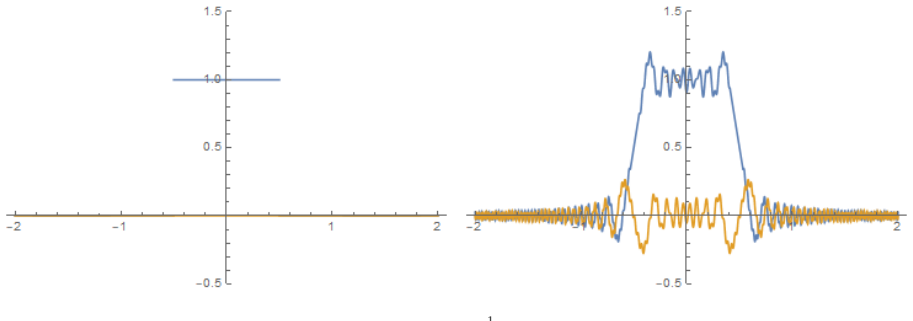
- [§4.3, Figures 1-3] The figures lack axis labels, legends, and the precise parameter values used for the comparison, so the plots are not reproducible from the information given.
- [References] Several classical sources are cited without page or theorem numbers (e.g., [11], [12], [14]), which makes it difficult to verify the convergence criteria invoked in the paper.
Circularity Check
No significant circularity: the paper constructs fractional powers by explicit interpolation identities and applies them through the functional calculus; there are no fitted parameters, no load-bearing self-citations, and no predictions that reduce to their inputs by construction.
full rationale
The paper's derivation chain is a mathematical construction, not an empirical fit. Fractional powers are defined by two interpolation mechanisms: the Newton/Pochhammer series (Theorem 1, Eq. 6) and Shannon/sinc interpolation (Theorem 3, Eq. 8). Both are applied to operators through the functional calculus, with the scalar identities taken from the binomial theorem and the Shannon sampling theorem. The integer-power reproduction at integer α is a property of the interpolating polynomials, not a separate prediction obtained by fitting; it follows from the standard identity P_n(m) = 0 for n > m. No parameter is fitted to a subset of data and then used to predict a closely related quantity. The zeta-function formulas in Theorem 5 and its corollaries are restatements of the classical identity η(s) = (1 − 2^{1−s})ζ(s) under Newton interpolation; while this is a repackaging of a known relation rather than an independent discovery, it is not circular reasoning because the derivation does not assume the conclusion. The references to functional calculus and sampling theory are standard external results, not self-citations, and no uniqueness theorem from the author's prior work is invoked. The paper even includes an honest limitation in Remark 2, noting that translation operators are not fractionalized by the sinc interpolation. The serious mathematical flaw — Proposition 1 is asserted at x = −1 where the sinc series evaluates to cos(πα) rather than (−1)^α for noninteger α — is a correctness error, not a circularity: the paper does not define the left-hand side in terms of the right-hand side, nor does it fit anything to force the equality. Therefore the appropriate circularity score is 0.
Assumptions & free parameters
assumptions (5)
- standard math Holomorphic functional calculus for bounded operators is valid for functions analytic on a neighborhood of the spectrum.
- domain assumption Shannon sampling theorem holds for tempered distributions and for the principal branch of x^α on the unit circle.
- standard math Every unitary operator has a continuous functional calculus and its spectrum lies on the unit circle.
- ad hoc to paper The Newton series for a Dirichlet series, including ζ, converges and equals the function on the claimed domain.
- domain assumption The spectrum of the integration operator J on T_ε is contained in B(ε/2, ε/2) and Theorem 2's limiting argument applies at the boundary.
Cite this review
Pith. "Pith review of Fractional operators via analytic interpolation of integer powers." pith.science (2026). https://pith.science/paper/63TRE5GA
@misc{pith2026190803604,
  author       = {Pith},
  title        = {Pith review of: Fractional operators via analytic interpolation of integer powers},
  year         = {2026},
  howpublished = {\url{https://pith.science/paper/63TRE5GA}},
  note         = {Machine review of arXiv:1908.03604}
}
read the original abstract
Although the study of functional calculus has already established necessary and sufficient conditions for operators to be fractionalized, this paper aims to use our well-conceived notion of integer powers of operators to construct non-integer powers of operators. In doing so, we not only provide a more intuitive understanding of fractional theories, but also provide a framework for producing new fractional theories. Such interpolations allow one to approximate fractional powers by finite sums of integer powers of operators, and thus may find much use in numerical analysis of fractional PDEs and the time-frequency analysis of the fractional Fourier transform. Further, these results provide an interpolation procedure for the Riemann zeta function.
Figures


Reference graph
Works this paper leans on
-
[1]
K. Diethelm and N.J. Ford, Analysis of fractional differential equations. Journal of Mathematical Analysis and Applications 265, No 2 (2002), 229–248
work page 2002
-
[2]
Hilfer, Applications of fractional calculus in physics
R. Hilfer, Applications of fractional calculus in physics . World Scientific (2000)
work page 2000
-
[3]
R.S. Babosa, J.A.T. Machado, B.M. Vinagre, and A.J. Calderon, Analysis of the van der pol os- cillator containing derivatives of fractional order. Journal of Vibration and Control 13, Nos 9-10 (2007), 1291–1301
work page 2007
-
[4]
Almeida, The fractional Fourier transform and time-frequency representations
L.B. Almeida, The fractional Fourier transform and time-frequency representations. IEEE Trans. Signal Process. 42 No 11 (1994), 3084–3091
work page 1994
-
[5]
H. M. Ozaktas, Z. Zalevsky, M.A. Kutay, The Fractional Fourier Transform with Applications in Optics and Signal Processing . John Wiley & Sons (2001)
work page 2001
- [6]
-
[7]
H¨ ormander,The analysis of linear partial differential operators III: pseudo-differential operators
L. H¨ ormander,The analysis of linear partial differential operators III: pseudo-differential operators. Springer (1987)
work page 1987
-
[8]
D.P. Herzog and N. Totz, An extension of H¨ ormanders hypoellipticity theorem. Potential Anal. 42 (2015), 403–433
work page 2015
Show all 16 references
-
[9]
Titchmarsh
E.C. Titchmarsh. The theory of the Riemann zeta-function. Oxford University Press (1986)
1986
-
[10]
Hille, R.S
E. Hille, R.S. Phillips. Functional analysis and semi-groups. American Mathematical Society (1975)
1975
-
[11]
Balakrishnan, Fractional powers of closed operators and the semigroups generated by them
A.V. Balakrishnan, Fractional powers of closed operators and the semigroups generated by them. Pacific journal of mathematics 10, No 2 (1960), 419–437
1960
-
[12]
Komatsu, Fractional powers of operators
H. Komatsu, Fractional powers of operators. Pacific journal of mathetmatics 19, No 2 (1966), 285–346
1966
-
[13]
Pr¨ uss and H
J. Pr¨ uss and H. Sohr, On operators with bounded imaginary powers in Banach spaces. Mathema- tische Zeitschrift 203, (1990), 429–452
1990
-
[14]
R.P. Boas Jr. and R.C. Buck, Ergebnisse der Mathematik und ihrer Grenzgebiete Bd. 19: polynomial expansions of analytic functions. Springer (1958). 13
1958
-
[15]
Klopfenstein, A note on Hilbert spaces of factorial series
K.F. Klopfenstein, A note on Hilbert spaces of factorial series. Indiana University Mathematics Journal 25 No 11 (1976), 1073–1081
1976
-
[16]
Whittaker, On the functions which are represented by the expansions of the interpolation theory
J.M. Whittaker, On the functions which are represented by the expansions of the interpolation theory. Proc. Royal Soc. Edinburgh 35 (1915), 181–194 . 14
1915
Reviewed August 14, 2026 · model on record in the stance chip above.
Discussion (0). Continue with ORCID to comment.