REVIEW 4 major objections 5 minor 1 cited by
Framed Blob Monoids
T0 review · 4 major / 5 minor · reviewed 2026-08-10 · deepseek-v4-flash
Pith's one-line read The framed blob monoid $Bl_{d,n}$ is isomorphic to the abacus blob monoid $Bl_{d,n}$, so every element has a normal form indexed by a matrix and bead exponents, and the monoid cardinality is $d^n$ times a weighted sum of blob-rank counts.
desk verdict Genuinely new counting results for framed blob monoids, but Theorem 4.8 is false for n=1 as stated; repairable by restricting to n≥2. read the letter →
The pith
A machine-rendered reading of the paper's core claim, the machinery that carries it, and where it could break.
The reading
What carries the argument
The central object is the indexing matrix $A$, a 2-row matrix with strictly increasing top row, nondecreasing bottom row, each bottom entry no larger than the top entry above it, and repeated bottom entries only allowed when they are zero; it encodes a normal form $U(A)$ of an element of the blob monoid. Around this skeleton, the matrices $L(A)$ and $R(A)$ record, column by column, what happens when the framing generator $z_j$ crosses $U(A)$ from the left or right: the crossing either commutes, shifts the bead index by 2, identifies $z_j$ with a neighbouring $z_i$, or moves the generator to the other side. The sets $\mathrm{Exp}_L(A)$ and $\mathrm{Exp}_R(A)$ then restrict the allowed bead exponents, so the normal form is finite and the cardinality is a product of powers of $d$. The numbers $\Omega^{(n)}_k$ and $\chi^{(n)}_k$ count the two ingredients of the final formulas, indexing matrices of blob-rank $k$ and Temperley-Lieb diagrams with $k$ exposed left arcs, and they are related by identities such as $\Omega^{(n)}_r=\chi^{(n+r+1)}_{2r+1}$.
What would settle it
For $d=2$ and $n=2$, the formula gives $|Bl_{2,2}|=4(2+3\cdot 2+4)=48$ and the connected framed monoid gives $8(2+3/2+1/4)=30$; enumerating all words in the two presentations up to the stated relations should reproduce these numbers. If two distinct indexing matrices $A,A'$ yield equal elements $U(A)=U(A')$ in $Bl_{d,n}$, or if the enumerated count differs from $d^n\sum_{k=0}^n\Omega^{(n)}_k d^k$, the normal form and cardinality theorem collapse.
Extended reading notes
Core claim
The paper's discovery is that attaching a cyclically ordered bead count to each arc of a blob diagram gives a monoid that is still completely controlled by the same finite skeleton: every element of $Bl_{d,n}$ has a unique expression as $\langle\alpha,A\rangle U(A)\langle A,\beta\rangle$, where $A$ is an indexing matrix encoding the underlying blob-diagram word, and $\alpha,\beta$ are bead-exponent vectors supported only on the positions singled out by the matrices $L(A)$ and $R(A)$. The proof that the presented monoid $Bl_{d,n}$ matches the diagrammatic monoid $Bl_{d,n}$ runs through Theorem 4.8, which uses these normal forms to bound the size of $Bl_{d,n}$ by the size of $Bl_{d,n}$. The same counting machinery yields the explicit cardinality formulas and, for the connected framing in which a new generator commutes with the blob generator, a normal form with a different bead-support rule and a different cardinality; equating the two counts shows the connected monoid is not isomorphic to the first for $d\ge 2$ and $n\ge 2$.
Load-bearing premise
The load-bearing premise is that Proposition 4.6, the unproved statement that left or right multiplication by a framing generator on a normal-form element falls into the same four exclusive patterns as in the abacus diagram monoid, is exactly true, and the definitional equality rule for abacus diagrams (same base diagram plus equal bead counts modulo $d$) is compatible with the product.
Editorial extensions
If this is right
- Every element of the framed blob monoid has a unique normal form indexed by a finite matrix and two bead-exponent vectors, giving a direct solution to the word problem for $Bl_{d,n}$.
- The two counting formulas force the polynomial identity $\sum_{k=0}^n \Omega^{(n)}_k d^k = \sum_{k=1}^n \chi^{(n)}_k(1+d)^k$ for every $d$, a Catalan-type combinatorial identity.
- For $d\ge 2$ and $n\ge 2$, the connected framed blob monoid has a different cardinality from $Bl_{d,n}$, so the two framizations are genuinely different monoids.
- The isomorphism between $Bl_{d,n}$ and $Bl_{d,n}$ identifies words in the presented monoid with beaded diagrams, so diagrammatic and algebraic arguments can be used interchangeably on the same object.
Reading between the lines
- The normal form suggests a natural grading on the monoid algebra by total bead count: since the cardinality is a polynomial in $d$ with nonnegative coefficients, one could ask whether it is the Hilbert series of a filtered algebra, a question the paper does not pursue.
- The identity $\Omega^{(n)}_r=\chi^{(n+r+1)}_{2r+1}$ is established through Pascal triangles, so a direct bijection between indexing matrices of blob-rank $r$ and Temperley-Lieb diagrams with $2r+1$ exposed arcs is a natural open combinatorial problem.
- The same bead-and-normal-form method should transfer to framizations of other diagram monoids with indexing-matrix normal forms, such as planar or Motzkin variants, with analogous cardinality polynomials.
Signed reviews
Editorial analysis
A structured set of objections, weighed in public.
Referee Report
Summary. The paper introduces the framed blob monoid Bl_{d,n} by generators and relations, and the abacus blob monoid Bl_{d,n} as a diagram monoid obtained by adding beads to Martin-Saleur blob diagrams. The central claims are that these two monoids are isomorphic (Theorem 4.8), that every element has a normal form encoded by an indexing matrix together with left and right exponent vectors, and that the common cardinality is d^n * sum_{k=0}^n Omega(n,k) d^k (Theorem 3.22), equivalently d^n * sum_{k=1}^n chi(n,k)(1+d)^k (Theorem 5.9). A second framization, the connected framed blob monoid Bl^c_{d,n}, is introduced via hook diagrams, and its cardinality is computed in Theorems 6.17 and 6.18, yielding a non-isomorphism result between the two framizations for d >= 2. The paper also develops recurrences and Pascal-triangle identities for the combinatorial numbers Omega(n,k) and chi(n,k).
Significance. The abacus model is a genuinely independent diagrammatic construction, and the cardinality formulas are parameter-free and structurally coherent: the formula d^n * sum Omega(n,k) d^k is obtained by counting normal forms, and the alternative formula in terms of exposed arcs checks out for small n. The paper also supplies explicit normal forms and combinatorial recurrences, which are useful for the framization program and for comparing framizations. At the same time, several load-bearing proofs are deferred as 'analogous', and one boundary case, n=1, makes the main isomorphism false as stated. The useful part of the contribution is therefore conditional on completing the missing proofs and restricting the main theorem appropriately.
major comments (4)
- [§4, Def. 4.1 and Thm 4.8] As stated, Theorem 4.8 is false for n=1, which is included in the standing assumption that d and n are positive integers (Section 2.1). For n=1, Definition 4.1 gives generators u0 and z1 with only u0^2 = u0 and z1^d = 1; relations (4.2)-(4.4) are vacuous or do not connect z1 with u0. Hence Bl_{d,1} is the free product of the two-element monoid {1,u0} and the cyclic group C_d, which is infinite for d >= 2, whereas the abacus blob monoid Bl_{d,1} has d + d^2 elements: one vertical arc without a blob carries d bead counts, and one with a blob splits into two components carrying d^2 bead counts. The epimorphism Phi : Bl_{d,1} -> Bl_{d,1} therefore cannot be injective. The theorem and the cardinality consequences need a restriction to n >= 2 plus a separate treatment of n=1.
- [§4, Prop. 4.6 and Cor. 4.7] The proof of Proposition 4.6 is omitted ('Analogous to the proof of Proposition 3.9'), but this is not a routine transcription: in the framed monoid the single-column commutations of Lemmas 4.4 and 4.5 do not cover the product z1 u0 corresponding to A = [0;0]. Proposition 4.6(i)(a) handles that case by keeping z1 on the left, and it is not shown that this exceptional case is compatible with the induction steps that prove the other cases in Proposition 3.9. Since Corollary 4.7 and the upper bound |Bl_{d,n}| <= |Bl_{d,n}| in Theorem 4.8 rest on the exhaustiveness of the six cases, a complete proof of Proposition 4.6 is load-bearing; the current 'completely analogous' references do not establish it.
- [§6, Lemma 6.16, Thms 6.17-6.18, Cor. 6.19] Lemma 6.16 is stated without proof and the reference 'Cf. Proposition 3.19' is not a proof; the connected formula |L'_0(A)| + |R'_0(A)| = n - r + 1 differs from the abacus identity n + r in the sign of r, so the analogy is only qualitative. Theorem 6.17, Theorem 6.18, the isomorphism of Corollary 6.19, and the non-isomorphism conclusion of Remark 6.20 all depend on this lemma. The omitted proof must account for the new generator z0 and for the fact that in the hook model blobbed arcs do not split into two bead-carrying components, which changes the counting; the present text asserts rather than proves this.
- [§3, Def. 3.1] The equality rule for d-abacus blob diagrams is introduced as a declaration ('we declare that two abacus blob diagrams are equal...'), but the paper never proves that this relation is a congruence for the concatenation product. All subsequent normal-form and cardinality statements are statements about equivalence classes under this rule, so a well-definedness check is necessary. In particular, if bead counts on corresponding components are equal modulo d before concatenation, one must show they remain so after deleting loops and sliding beads; this is plausible but not automatic, and it is not included in the text.
minor comments (5)
- [Theorems 5.9 and 6.18] The word 'cardilnality' should be 'cardinality' in both statements.
- [Proof of Cor. 3.14] The text contains 'Proposition ,3.9' with a spurious comma before the number.
- [Prop. 4.6(i)(a)] The displayed expression 'z1U[0 0]U[...]' lacks a matrix separator and is difficult to parse; it should be typeset as z1 U([0;0]) U(...) or with an explicit horizontal concatenation.
- [Just before Lemma 3.17] The notation L(A) and R(A) is overloaded: Definition 3.10 uses these names for certain 3 x n matrices, while immediately before Lemma 3.17 they are redefined as sets of pairs. This makes Section 3 unnecessarily confusing.
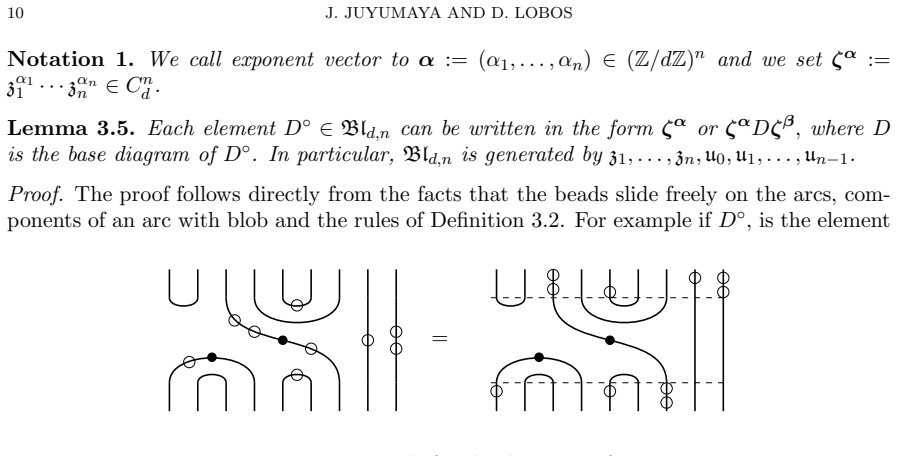
- [Definition 3.2] The local relations are displayed as '= k =' rather than as explicit equations; a redrawn figure or explicit equations would make the definition readable.
Circularity Check
No circularity: the cardinality is derived from an independent diagram count, not from the statement being proved.
full rationale
The central derivation computes |Bld,n| by first counting the abacus diagram monoid Bld,n directly (Theorem 3.22) and then proving an isomorphism Φ: Bld,n → Bld,n (Theorem 4.8). The count of Bld,n is self-contained: it uses the diagram equality rule (Definition 3.1) and the normal form Corollary 3.14, proved from Lemmas 3.7/3.8 and Proposition 3.9, all internal to the diagram monoid. The framed monoid's cardinality is not an input; the isomorphism proof bounds |Bld,n| from above via Corollary 4.7, which is asserted as 'completely analogous' to the abacus normal form, with Proposition 4.6 left unproved ('Analogous to the proof of Proposition 3.9'). That is an incompleteness and a potential correctness gap—indeed for n=1 the presented monoid appears infinite while the abacus monoid is finite, suggesting Theorem 4.8 as stated is false. However, an unproved analogy is not circular: no equation in the derivation is defined in terms of the target result, and no fitted parameter is renamed as a prediction. Self-citations to the authors' framization program (e.g., [3]) are contextual and not load-bearing for the cardinality computation. The two counting formulas (Theorems 3.22 and 5.9) are independent derivations from the same diagram set and are equated in Corollary 5.11 as a combinatorial identity, not as a circular reduction.
Assumptions & free parameters
assumptions (4)
- domain assumption Two abacus blob diagrams are equal iff their base diagrams are equal and the number of beads on each component is congruent modulo d (Definition 3.1).
- standard math Every element of the blob monoid admits the normal form Ui1,j1...Uip,jp (Proposition 2.3), with proof 'analogous' to [12, Lemma 4.1.2].
- domain assumption The concatenation product of blobbed TL-diagrams with loop erasure and blob merging is associative and defines a monoid (Section 2.4).
- standard math The number of indexing matrices is binom(2n,n) and the number of positive indexing matrices is the Catalan number Cn (Remark 2.5).
invented entities (3)
-
Blob monoid Bln
-
Abacus blob monoid Bld,n
-
Connected framed blob monoid Bl^c_{d,n}
Cite this review
Pith. "Pith review of Framed Blob Monoids." pith.science (2026). https://pith.science/paper/643PNJFJ
@misc{pith2026250114125,
  author       = {Pith},
  title        = {Pith review of: Framed Blob Monoids},
  year         = {2026},
  howpublished = {\url{https://pith.science/paper/643PNJFJ}},
  note         = {Machine review of arXiv:2501.14125}
}
read the original abstract
We introduce and study blob and framed blob monoids. In particular, several realizations of these monoids are given. We compute the cardinality of the framed blob monoid and derive some combinatorial formulas involving this cardinality.
Figures


Figures from the paper (8 more)



Forward citations
Cited by 1 Pith paper
-
Switchable Exchange Bias Resulting from Correlated Domain Structures in Orthogonally Coupled Antiferromagnet/Ferromagnet van der Waals Heterostructures
The authors claim that CrSBr induces stripe-like magnetic domains in Fe3GeTe2, producing robust, switchable exchange bias up to 132 K despite perpendicular easy axes.
Reference graph
Works this paper leans on
-
[1]
F. Aicardi, D. Arcis, J. Juyumaya, Brauer and Jones tied monoids , Journal of Pure and Applied Algebra 227, (2023), 107161
work page 2023
-
[2]
Aicardi, Francesca; Arcis, Diego; Juyumaya, Jes´ us Ramified inverse and planar monoids, Mosc. Math. J. 24 (2024), no. 3, 321–355
work page 2024
-
[3]
F. Aicardi, J. Juyumaya, P. Papi Framization and Deframization , arXiv:240510809
-
[4]
S. Al Harbat, C. Gonz´ alez, D. Plaza, Type ˜C Temperley-Lieb algebra quotients and Catalan combinatori cs, J. Comb. Theory A, 180:105411, 5, 2021
work page 2021
-
[5]
A. Cox, J. Graham, P. Martin (2003), The blob algebra in positive characteristic , Journal of Algebra, 266(2), 584-635
work page 2003
-
[6]
tom Dieck , Symmetriche und Br¨ ucken and Knotentheorie zu den Dynkin-D iagrammen vom Typ B , J
T. tom Dieck , Symmetriche und Br¨ ucken and Knotentheorie zu den Dynkin-D iagrammen vom Typ B , J. Reine Angew. Math , 451,(1994) 71-88. 32 J. JUYUMAYA AND D. LOBOS
work page 1994
- [7]
-
[8]
Framization of a Temperley-Lieb algebra of type B , J
Flores, M.; Goundaroulis, D. Framization of a Temperley-Lieb algebra of type B , J. Pure Appl. Algebra 224 (2020), no. 6, 106273, 29 pp
work page 2020
Show all 23 references
-
[9]
Pure Appl
Flores, Marcelo; Juyumaya, Jes´ us; Lambropoulou, Sofia , A framization of the Hecke algebra of type B , J. Pure Appl. Algebra 222 (2018), no. 4, 778–806
2018
-
[10]
Goundaroulis, Dimos; Juyumaya, Jes´ us; Kontogeorgis, Aristides; Lambropoulou, Sofia, Framization of the Temperley-Lieb algebra, Math. Res. Lett. 24 (2017), no. 2, 299–345
2017
-
[11]
Tom Halverson; Ram, Arun Partition algebras European J. Combin. 26 (2005), no. 6, 869-921
2005
-
[12]
Jones, Index of subfactors , Invent
V. Jones, Index of subfactors , Invent. Math., 72 (1983), 1-25
1983
-
[13]
Juyumaya, S
J. Juyumaya, S. Lambropoulou p− adic framed braids , Topology and its Applications, 154 (2007), 1804- 1826
2007
-
[14]
Juyumaya, S
J. Juyumaya, S. Lambropoulou p− adic framed braids II , Advances in Mathematic, 234(2) (2013), 149-191
2013
-
[15]
Knots Everything, 56 World Scientific Publishing Co
Juyumaya, Jes´ us; Lambropoulou, Sofia, On the framization of knot algebras , Ser. Knots Everything, 56 World Scientific Publishing Co. Pte. Ltd., Hackensack, NJ, 2 015, 297–333. ISBN: 978-981-4630-61-0
-
[16]
K. Ko, L. Smolinsky, The framed braid group and 3-manifolds. Proc. Amer. Math. Soc. 115 (1992), no. 2, 541-551
1992
-
[17]
Kudryavtseva; V
G. Kudryavtseva; V. Mazorchuk On presentations of Brauer-type monoids, Cent. Eur. J. Math. 4 (3) (2006) 403-434
2006
-
[18]
Abel Lacabanne, Loic Poulain d’Andecy Framization of Schur-Weyl duality and Yokonuma-Hecke type algebras, arXiv:2312.14796, 2023
2023 arXiv
-
[19]
Lau and D
K. Lau and D. FitzGerald. Ideal structure of the Kauffman and related monoids. Commun Algebra, 34(7):2617-2629, 2006
2006
-
[20]
Lobos, D
D. Lobos, D. Plaza S. Ryom-Hansen, The Nil-blob algebra: An incarnation of type ˜A1 Soergel calculus and of the truncated blob algebra , J. Algebra 570 (2021), 297-365
2021
-
[21]
P. P. Martin, Temperley-Lieb algebras for non planar statistical mechan ics-The partition algebra construc- tion, J. Knot theory and its Ramifications, 3, No.1 (1994), 51-82
1994
-
[22]
P. P. Martin, H. Saleur, The blob algebra and the periodic Temperley-Lieb algebra , Lett. Math. Phys. 30 (1994), 189-206
1994
-
[23]
Melvin, N.B
P. Melvin, N.B. Tufillaro, Templates and framed braids. Phys. Rev. A (3) 44 (1991), no. 6, R3419-R3422. IMUV, Universidad de V alpara´ıso, Gran Breta ˜na 1111, 2340000 V alpara´ıso, Chile. Email address : juyumaya@uv.cl IMUV, Universidad de V alpara´ıso, Gran Breta ˜na 1111, 23...
1991
Reviewed August 10, 2026 · model on record in the stance chip above.
Discussion (0). Continue with ORCID to comment.