REVIEW 3 major objections 3 minor 13 references
Accuracy Controlled Structure-Preserving ${\cal H}^2$-Matrix-Matrix Product in Linear Complexity with Change of Cluster Bases
T0 review · 3 major / 3 minor · reviewed 2026-08-14 · deepseek-v4-flash
Pith's one-line read An accuracy-controlled H2 matrix-matrix product can run in linear complexity.
desk verdict Real novelty, real gap: the new cluster-basis update is clever, but the paper asserts accuracy control without proving it, and the complexity claims outrun the data. read the letter →
The pith
A machine-rendered reading of the paper's core claim, the machinery that carries it, and where it could break.
The reading
What carries the argument
The load-bearing mechanism is the instantaneous renewal of the cluster bases. A cluster basis is a low-rank factor V_t shared by all admissible blocks in a row or column cluster and nested through transfer matrices T. The algorithm computes, for each cluster, a Gram-matrix sum of the actual matrix content that would be produced by the different multiplication cases, adds the original-basis contribution, and then takes an SVD, keeping singular vectors above epsilon_trunc. This yields new bases that represent the product's own content rather than the factors' content, and the same construction at non-leaf levels yields new transfer matrices. Once the bases exist, each admissible product block is just a coupling matrix of rank size, so the traversal stays within O($k_l^{3}$) per block.
What would settle it
Compute an H2-matrix product on a family where the exact product has off-diagonal ranks growing faster than the input rank model, for example by multiplying two H2 matrices engineered so the product's admissible blocks have quadratic-in-level rank, and measure raw wall time and memory without normalizing by $C_sp^{2}$ or C_sp. If the observed scaling departs from O(N) or O(N log N) on that family, the complexity claim would fail. A cheaper check is to rerun the paper's 3-D cube-array suite and plot raw time and memory versus N without dividing out C_sp, since Table III already reports C_sp growing from 16 to 126.
Extended reading notes
Core claim
The central claim is that an H2 matrix-matrix product can be both accuracy-controlled and structure-preserving at linear complexity if, during a bottom-up traversal, the product's cluster bases and transfer matrices are regenerated rather than reused. For each row and column cluster, the algorithm accumulates Gram matrices of the four block-multiplication cases (full times full, full times low-rank, low-rank times full, low-rank times low-rank), normalizes the contributions, and takes an SVD with truncation tolerance epsilon_trunc to produce the new cluster basis. The same procedure at non-leaf levels produces new transfer matrices. With the new bases in hand, all four cases reduce to coupling-matrix computations of rank size, so each level costs O($C_sp^{2}$ 2^l $k_l^{3}$) in time and O(C_sp 2^l $k_l^{2}$) in memory. The paper demonstrates the algorithm on capacitance extraction matrices and on 2-D and 3-D scattering problems with over a million unknowns, reporting that the relative error tracks epsilon_trunc.
Load-bearing premise
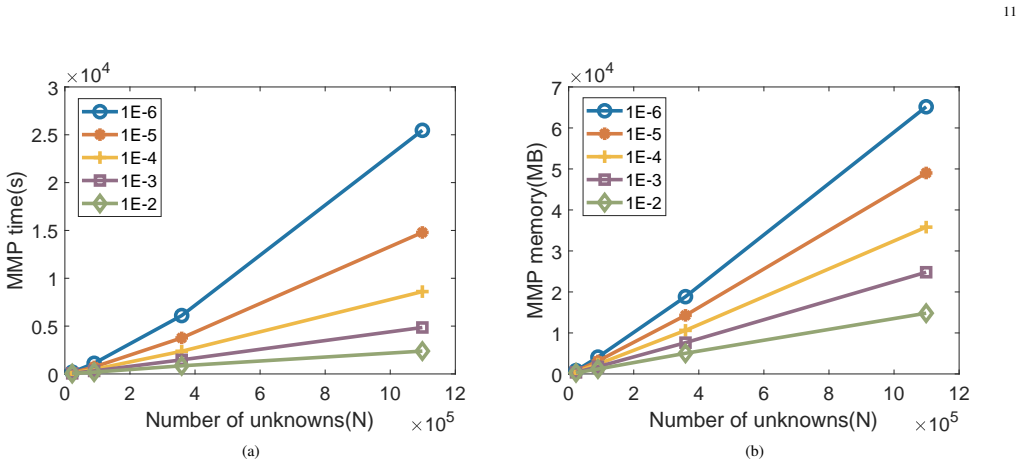
The complexity bounds in equations (55) through (58) require that the truncation ranks k_l of the newly generated product bases grow no faster than the ranks of the input H2-matrices (constant for static capacitance extraction, linear in electrical size for 3-D volume integral equations), and that the per-cluster block count C_sp remains a bounded constant; the paper's own 3-D cube-array test shows C_sp rising from 16 to 126 as N grows, so the raw scaling curves must be read accordingly.
Editorial extensions
If this is right
- H2 multiplication becomes a reliable building block for fast direct solvers: matrix inversion, LU factorization, and block solves can use it without the risk that formatted products silently lose accuracy.
- For constant-rank H2 matrices, two matrices can be multiplied in O(N) time and memory, putting matrix-matrix products on the same asymptotic footing as H2 matrix-vector products.
- For 3-D electrodynamic volume-integral equations, where rank grows linearly with electrical size, the product costs O(N log N) time and O(N) storage, allowing million-unknown products on a single core.
- The product retains H2 form with rank-minimized cluster bases, so downstream operations on C = A times B do not need to convert formats.
- Every multiplication and addition in the traversal is either exact or truncated with tolerance epsilon_trunc, giving a direct accuracy knob tied to a user-specified error.
Reading between the lines
- A natural extension is to use the same Gram-matrix/SVD basis-renewal idea in other hierarchical formats such as H-matrix, HSS, or HODLR; the per-level cost would change, but the accuracy-control mechanism should transfer.
- Because the new bases are built from the product content itself, the algorithm implicitly computes a near-optimal H2 approximation of the exact product; a direct dense-product comparison on small problems would quantify how close the SVD truncation comes to optimal.
- The complexity guarantee is conditional on product-rank growth; if multiplying certain operator classes produces intrinsically higher-rank off-diagonal blocks, raw complexity would degrade, so an a priori or adaptive rank estimator for the product would strengthen the method.
- The backward-split post-processing mirrors existing H2 backward transformations, so the new bases could be recycled into an accuracy-controlled H2 inverse or LU factorization by chaining this product with hierarchical inversion stages.
Signed reviews
Editorial analysis
A structured set of objections, weighed in public.
Referee Report
Summary. The manuscript proposes an H2-matrix-matrix product (MMP) algorithm that computes the cluster bases of the product matrix on the fly, by SVD-truncating sums of normalized Gram matrices formed from the four leaf-level and non-leaf-level multiplication cases. The claimed advantages are explicit accuracy control through a user-prescribed truncation parameter epsilon_trunc, preservation of the H2 structure, and linear (or O(N log N) for variable-rank 3-D problems) time and memory complexity. The algorithm is developed in detail in Sections III and IV, and numerical experiments for capacitance extraction and 2-D/3-D scattering up to about 1.5 million unknowns are reported in Section VI.
Significance. If fully established, the algorithm would be a useful contribution: an accuracy-controlled, structure-preserving H2-MMP with complexity matching the input rank model would remove a known limitation of existing formatted H2 multiplications, and the numerical results show credible scaling and monotone error reduction across large problems on a single core. The paper's strengths are the equation-level detail of the algorithm, the explicit treatment of all four multiplication cases at both leaf and non-leaf levels, and the large-scale experiments comparing against the existing formatted MMP. However, the central accuracy-control claim is not supported by a theorem or error bound, and the complexity analysis relies on unproved rank and sparsity-constant assumptions for the product matrix. These gaps are load-bearing and need to be addressed before the core claims can be accepted.
major comments (3)
- [V-A, Eqs. (9)-(16), (40)-(47), Table IV] The central claim that epsilon_trunc controls the accuracy of the computed product is asserted in Section V-A but is not proved. The SVD truncation of a sum of normalized Gram matrices controls a weighted sum of squared projection errors over the sampled blocks, not the worst-case error of any individual admissible block or the global assembled error ||C_H2 - A_H2 B_H2||. Row and column bases are truncated independently, and the non-leaf bases in (40)-(47) are built from collected blocks that already contain lower-level truncation errors, so any error propagation is recursive and unaccounted for. No lemma or theorem links the truncation of these Gram matrices to a bound on the final product error. The numerical data are consistent with monotone improvement as epsilon_trunc shrinks, but they do not supply the missing bound: in Table IV the relative error at epsilon_trunc=1e-4 grows from 1.48e-3 to 8.09e-3 as N grows, and at epsilon_trunc=1e-2 it reaches 6.58e-2, which is larger than the nominal tolerance.
- [V-B, Eqs. (53)-(58), Table III, Fig. 7] The complexity claims for variable-rank 3-D problems assume that the post-truncation ranks k_l of the product follow the same growth model as the input ranks from the authors' earlier work [5], and that C_sp is a bounded constant. Neither is proved for the product matrix C. In fact, Table III reports C_sp growing from 16 to 126 as N grows to about 1.5 million, so Fig. 7's normalization by C_sp^2 and C_sp removes a growth factor rather than demonstrating raw O(N log N) time and O(N) memory scaling. The raw scaling data should be shown and compared with the theoretical rates without dividing out the growth of C_sp, or an explicit bound on C_sp for the product matrices should be proved.
- [III-C, Eqs. (12), (16), (43), (47)] The normalization applied to the Gram matrices before summation is not specified. The text says only that the matrices are normalized because their magnitudes may differ greatly, but it does not state which norm is used (Frobenius, spectral, trace-normalized, etc.). Different normalization choices produce different truncated subspaces and different actual errors for the same epsilon_trunc, and no analysis is provided for the effect of this weighting. This is a free parameter in the algorithm and should be fixed and justified if the accuracy-control claim is to be reproducible and meaningful.
minor comments (3)
- [V-B] The sentence 'the cost of changing the cluster bases at the leaf level ... as can be seen from (13), (14), and (15)' appears to cite the column Gram matrix equations; the row cluster basis cost is described by (9)-(11), so the equation references should be corrected.
- [Eq. (17), case-4] The expression 'BjSBj,k' is typeset without a separating space and could be misread as a single symbol; it should be written as 'B_j S^B_{j,k}' for clarity.
- [Eqs. (9)-(16)] The notation O(C_sp) above the summation signs is nonstandard and potentially confusing; it should be stated explicitly that the number of terms is bounded by a constant multiple of C_sp or C_sp^2, respectively.
Circularity Check
No significant circularity: the cluster bases are computed adaptively from the product data via Gram-matrix SVDs, and the accuracy tolerance is a user input rather than a fitted parameter.
full rationale
The central derivation is self-contained in the sense required for circularity analysis. The new row and column cluster bases are obtained by truncated SVDs of Gram matrices built from the actual leaf- and non-leaf-level product blocks, e.g., Eqs. (9)-(16) and (40)-(47). This is adaptive low-rank compression of the product data itself, not a parameter fitted to a target quantity and then renamed as a prediction. The tolerance epsilon_trunc is a user-specified input, and the coupling-matrix formulas (17), (21), (48), and (52) exactly express each admissible block in the chosen bases once those bases are fixed. No equation in the paper defines the final product error in terms of epsilon_trunc, and the paper does not prove a bound linking the normalized Gram SVD truncation to the assembled product error; Section V-A merely asserts that 'the accuracy of the product is directly controlled by epsilon_trunc.' That is a missing error bound and a correctness/validation gap, not a circular reduction. The variable-rank complexity claims (57)-(58) import the rank-growth model from the authors' earlier work [5]. This is self-citation, but [5] is an external, falsifiable study of integral-operator ranks, and the present paper's target result, the accuracy-controlled H2 matrix-matrix product, is not an input to [5]. The paper does not prove that the post-truncation ranks of the product follow that model, and Table III shows C_sp growing with N; again, these are unverified assumptions or validation weaknesses rather than cases where a prediction reduces to its inputs by construction. Overall, no load-bearing circular step is identifiable in the derivation chain.
Assumptions & free parameters
free parameters (1)
- Normalization weighting for Gram matrix sums
assumptions (4)
- domain assumption H2-matrix nested cluster bases and strong admissibility with bounded C_sp (from [1])
- domain assumption Rank of the product's new cluster bases follows the input matrices' rank model (constant for electrostatic, linear in electrical size for 3D VIE from [5])
- domain assumption The exact product A*B is representable as an H2 matrix with the same block cluster tree as A and B
- ad hoc to paper SVD truncation of the normalized Gram matrix sum yields bases that represent all admissible product blocks to accuracy epsilon_trunc
Cite this review
Pith. "Pith review of Accuracy Controlled Structure-Preserving ${\cal H}^2$-Matrix-Matrix Product in Linear Complexity with Change of Cluster Bases." pith.science (2026). https://pith.science/paper/65LDJMT7
@misc{pith2026190805218,
  author       = {Pith},
  title        = {Pith review of: Accuracy Controlled Structure-Preserving $\cal H^2$-Matrix-Matrix Product in Linear Complexity with Change of Cluster Bases},
  year         = {2026},
  howpublished = {\url{https://pith.science/paper/65LDJMT7}},
  note         = {Machine review of arXiv:1908.05218}
}
abstract
${\cal H}^2$-matrix constitutes a general mathematical framework for efficient computation of both partial-differential-equation and integral-equation-based operators. Existing linear-complexity ${\cal H}^2$ matrix-matrix product (MMP) algorithm lacks explicit accuracy control, while controlling accuracy without compromising linear complexity is challenging. In this paper, we develop an accuracy controlled ${\cal H}^2$ matrix-matrix product algorithm by instantaneously changing the cluster bases during the matrix product computation based on prescribed accuracy. Meanwhile, we retain the computational complexity of the overall algorithm to be linear. Different from the existing ${\cal H}^2$ matrix-matrix product algorithm where formatted multiplications are performed using the original cluster bases, in the proposed algorithm, all additions and multiplications are either exact or computed based on prescribed accuracy. Furthermore, the original ${\cal H}^2$-matrix structure is preserved in the matrix product. While achieving optimal complexity for constant-rank matrices, the computational complexity of the proposed algorithm is also minimized for variable-rank ${\cal H}^2$-matrices. The proposed work serves as a fundamental arithmetic in the development of fast solvers for large-scale electromagnetic analysis. Applications to both large-scale capacitance extraction and electromagnetic scattering problems involving millions of unknowns on a single core have demonstrated the accuracy and efficiency of the proposed algorithm.
Figures


Figures from the paper (4 more)



Reference graph
Works this paper leans on
-
[5]
W. Chai and D. Jiao, “Theoretical study on the rank of integral operators for broadband electromagnetic modeling from static to electrodynamic frequencies,” IEEE Trans. Compon., Packag., and Manuf. Technol. , vol. 3, no. 12, pp. 2113-2126, Dec. 2013
work page 2013
-
[1]
H2-matrix in linear complexity,
S. Borm, “ H2-matrix in linear complexity,”Computing, vol. 77, pp. 1-28, Feb. 2006
work page 2006
-
[2]
Efficient Numerical Methods for Non-local Operators: H2- matrix compression, Algorithms and Analysis,
S. Borm, “Efficient Numerical Methods for Non-local Operators: H2- matrix compression, Algorithms and Analysis,” European Mathematical Society Tracts in Mathematics 14, 2006
work page 2006
-
[3]
H. Liu and D. Jiao, “Existence of H-matrix Representations of the Inverse Finite-Element Matrix of Electrodynamic Problems and H-Based Fast Direct Finite-Element Solvers,” IEEE Trans. MTT , vol. 58, no. 12, pp. 3697-3709, 2010
work page 2010
-
[4]
B. Zhou and D. Jiao, “Direct Finite Element Solver of Linear Complexity for Large-Scale 3-D Electromagnetic Analysis and Circuit Extraction,” IEEE Trans. MTT , vol. 63, no. 10, pp. 3066-3080, Oct. 2015
work page 2015
-
[6]
W. C. Chew, J. M. Jin, E. Michielssen, and J. M. Song, Fast and efficient algorithms in computational electromagnetics . Norwood, MA: Artech House, 2001
work page 2001
-
[7]
W. Chai and D. Jiao, “Dense matrix inversion of linear complexity for integral-equation based large-scale 3-D capacitance extraction,” IEEE Trans. MTT, vol. 59, no. 10, pp. 2404-2421, Oct. 2011
work page 2011
-
[8]
M. Ma and D. Jiao, “Accuracy-Controlled and Rank-Minimized H2- Matrix-Matrix Product with Change of Cluster Bases in Linear Com- plexity,” IEEE MTT-S International Conference on Numerical Electro- magnetic and Multiphysics Modeling and Optimization (NEMO), May 2019
work page 2019
Show all 13 references
-
[9]
A tetrahedral modeling method for electromagnetic scattering by arbitrarily shaped inhomogeneous dielectric bodies,
D. H. Schaubert, D. R. Wilton and A. W. Glisson, “A tetrahedral modeling method for electromagnetic scattering by arbitrarily shaped inhomogeneous dielectric bodies,” IEEE Trans. Antennas Propag. , vol. AP-32, no. 1, pp. 77-85, 1984
1984
-
[10]
An O(N ) iterative and O(N logN) direct volume integral equation solvers for large-scale electrodynamic analysis,
S. Omar and D. Jiao, “An O(N ) iterative and O(N logN) direct volume integral equation solvers for large-scale electrodynamic analysis,” the 2014 International Conference on Electromagnetics in Advanced Applications (ICEAA), Aug. 2014
2014
-
[11]
Minimal-rank H2-matrix based iterative and direct volume integral equation solvers for large-scale scattering analysis,
D. Jiao and S.Omar, “Minimal-rank H2-matrix based iterative and direct volume integral equation solvers for large-scale scattering analysis,”Proc. IEEE Int. Symp. Antennas Propag. , Jul. 2015
2015
-
[12]
Accuracy Controlled H2-Matrix-Matrix Product in Linear Complexity and Its Applications,
M. Ma and D. Jiao, “Accuracy Controlled H2-Matrix-Matrix Product in Linear Complexity and Its Applications,” 2018 IEEE International Symposium on Antennas and Propagation & USNCURSI National Radio Science Meeting, Jul. 2018
2018
-
[13]
Accuracy-Controlled and Structure-Preserved H2-Matrix-Matrix Product in Linear Complexity,
M. Ma and D. Jiao, “ Accuracy-Controlled and Structure-Preserved H2-Matrix-Matrix Product in Linear Complexity,” 2018 International Conference on Electromagnetics in Advanced Applications (ICEAA), Sep. 2018
2018
Reviewed August 14, 2026 · model on record in the stance chip above.
Discussion (0). Continue with ORCID to comment.