REVIEW 3 major objections 5 minor 10 references
Moments of the weighted Cantor measures
T0 review · 3 major / 5 minor · reviewed 2026-08-14 · deepseek-v4-flash
Pith's one-line read For weighted Cantor measures, moments decay polynomially unless the last weight is zero, with rate set by $\alpha_{N-1}$.
desk verdict Worth refereeing on the strength of the moment estimates, but only after the authors delete or fix the false total-variation continuity claim in Theorem 2.9. read the letter →
The pith
A machine-rendered reading of the paper's core claim, the machinery that carries it, and where it could break.
The reading
What carries the argument
The central object is the moment generating function $G_\alpha(z)=\sum_{m\ge0}I_m z^m/m!$, which Theorem 3.4 represents as the infinite product $\prod_{r=1}^\infty\sum_{n=0}^{N-1}\alpha_n\exp(nz/N^r)$. Truncating this product at $k$ factors yields coefficients $I_{m;k}$, and the Cauchy estimate in Theorem 3.6 bounds the coefficient error by $e m\sqrt{m-1}/N^k$; repeated squaring and truncation of the finite product give the computing algorithm. The decay theorem comes from measuring the tail mass $\mu^\alpha[1-1/N^k,1]=(\alpha_{N-1})^k$ and optimizing the resulting lower bound $I_m\ge(1-N^{-k})^m(\alpha_{N-1})^k$ over $k$.
What would settle it
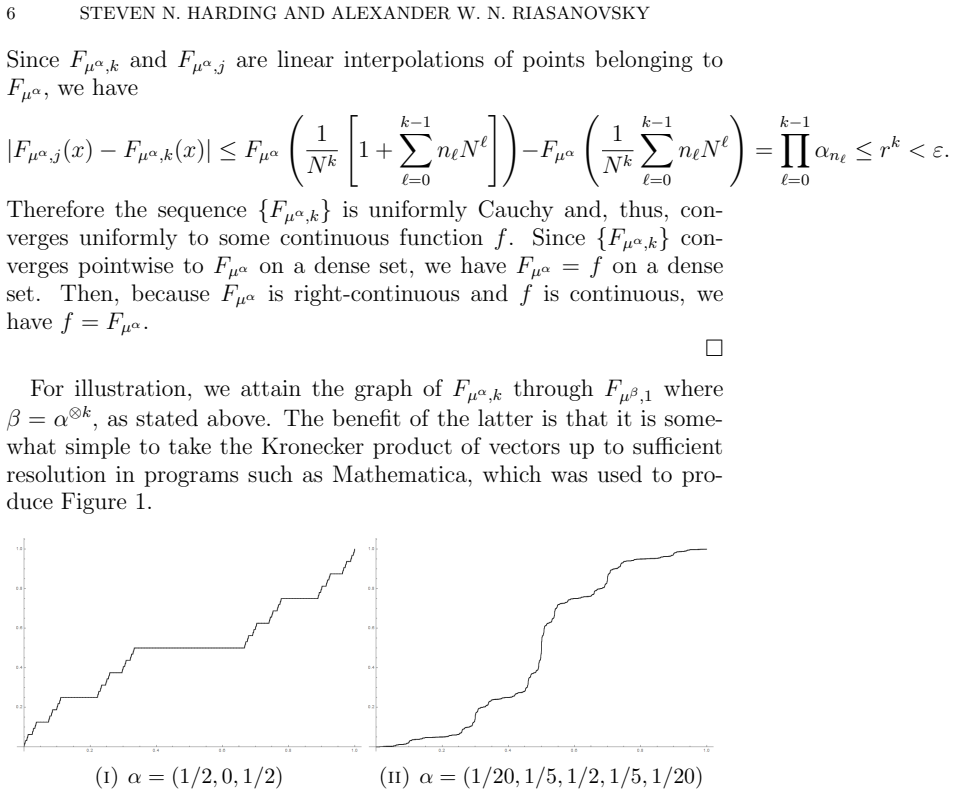
Take $N=3$ and $\alpha=(1/2,0,1/2)$, so $\gamma=\log_3 2$; compute the exact moments from the recurrence $I_m=(3^m-1)^{-1}\sum_{n=0}^2\alpha_n\sum_{i=0}^{m-1}\binom{m}{i}n^{m-i}I_i$ and check whether $\liminf_{m\to\infty}m^\gamma I_m$ is zero, which would contradict the theorem's lower bound $I_m\ge C(\alpha)m^{-\gamma}$.
Extended reading notes
Core claim
Theorem 3.9: if every weight is less than $1$ and the last weight $\alpha_{N-1}$ is zero, then $I_m\le((N-1)/N)^m$; if $\alpha_{N-1}>0$, there is a constant $C(\alpha)>0$ with $I_m\ge C(\alpha)m^{-\gamma}$ for all $m\ge1$, where $\gamma=\log_N(1/\alpha_{N-1})$. The paper also proves that the moment generating function is the entire infinite product $\prod_{r=1}^\infty\sum_{n=0}^{N-1}\alpha_n\exp(nz/N^r)$, and that retaining only the first $k$ factors of this product gives coefficients differing from the true moments by at most $e m\sqrt{m-1}/N^k$. For palindromic weights, the same machinery gives exponentially small moments for the measure shifted to $[-1/2,1/2]$.
Load-bearing premise
The algorithmic complexity claim assumes the truncation level $k$ can be fixed from the error tolerance $\varepsilon$ alone, whereas the proved error bound ties $k$ to the largest moment index $m$; if $m$ and $\varepsilon$ vary together, the stated speed is not uniform.
Editorial extensions
If this is right
- If the last weight is zero, the support lies in $[0,(N-1)/N]$, so every moment is bounded by $((N-1)/N)^m$.
- If the last weight is positive, the $m$-th moment cannot drop below an absolute constant times $m^{-\log_N(1/\alpha_{N-1})}$, the same power order found for classical Cantor distributions.
- Truncating the moment generating function after $k$ factors gives uniform error $O(m^{3/2}/N^k)$ for the first moments, so each extra factor buys another factor of $N$ in accuracy.
- The first $m$ moments can be estimated to uniform error $\varepsilon$ in $O(\log\log(1/\varepsilon)\,m\log m)$ time by repeated squaring and truncation.
- For palindromic weights, the shifted measure has moments bounded by $2^{-m}$, making its orthogonal polynomial coefficients easier to control.
Reading between the lines
- An implication left implicit is that the advertised $O(\log\log(1/\varepsilon)\,m\log m)$ complexity is valid when $m$ is fixed; if $m$ grows with $\varepsilon^{-1}$, the truncation level required by Theorem 3.6 also grows with $m$.
- A testable extension is to fit the observed decay rate of empirical moments and compare it with $\log_N(1/\alpha_{N-1})$ to identify an unknown self-similar weight vector.
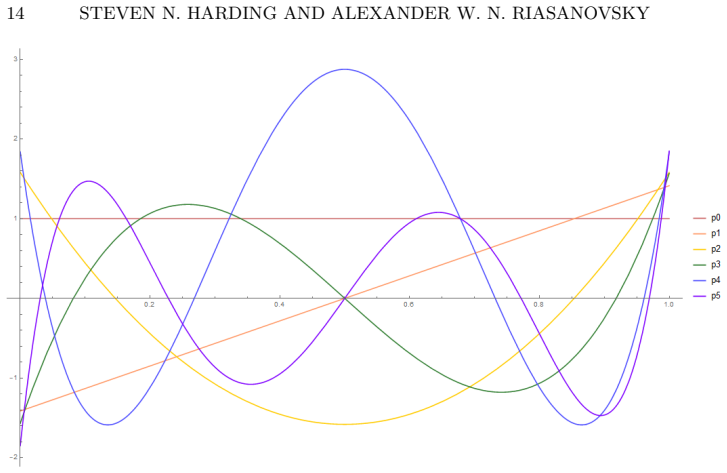
- Combining the moment estimates with the Legendre recursion of Proposition 2.11 gives a concrete way to compute orthonormal polynomial bases on non-spectral fractals.
- The exponential bound for the shifted palindromic case suggests recentering improves the conditioning of moment-based computations on fractal measures.
Signed reviews
Editorial analysis
A structured set of objections, weighed in public.
Referee Report
Summary. The paper studies α-weighted Cantor measures μ^α supported on [0,1], defined by the IFS φ_n(x)=(x+n)/N with weights α∈Δ_N. It derives a recurrence for the moments I_m (Theorem 3.2), an infinite product formula for the Laplace and moment generating functions (Theorem 3.4), an explicit error bound for moment approximations from truncated products (Theorem 3.6), an algorithm for estimating the first m moments (Remark 3.8), and one-sided decay estimates for I_m (Theorem 3.9). Section 2 contains auxiliary results on the distribution function, symmetry, continuity of μ^α in the weight vector, and a two-term recursion for Legendre polynomials. The main moment-theoretic claims are derived from definitions and cited results, with no parameter fitting or circularity.
Significance. If the moment-theoretic results are correct, the paper provides a useful toolkit: the recurrence (8) is explicit, Theorem 3.4 gives a compact product representation of the MGF, Theorem 3.6 gives a quantitative convergence rate, and Theorem 3.9 shows how the largest weight α_{N-1} controls the polynomial decay of moments, matching a known Grabner–Prodinger asymptotic. The algorithm in Remark 3.8 is clearly described and would be a practical contribution. However, the paper currently contains a false theorem on total-variation continuity (Theorem 2.9) and an unsupported complexity claim in the abstract and Remark 3.8; these issues must be corrected before the paper can be published.
major comments (3)
- [Theorem 2.9] The proof of Theorem 2.9 is invalid and the statement is false. The displayed estimate uses sums of the form Σ_P (F_μβ(x_{j+1}) − F_μβ(x_j))Δx_j, which are not Riemann–Stieltjes sums for μβ; the measure of an interval is Σ_P (F(x_{j+1}) − F(x_j)), with no Δx_j factor. Consequently the derived bound |μβ(I_n) − μα(I_n)| ≤ ε λ(I_n) does not follow. More seriously, the claimed total-variation convergence is false: for N=2, take α=(1/2,1/2), so μα is Lebesgue measure, and β=(p,1−p) with p→1/2. For p≠1/2, μβ is singular with respect to Lebesgue (its binary digits have limiting frequency p), so ‖μβ−μα‖_TV = 2 for every p≠1/2. The correct and useful statement is weak convergence, which follows directly from Proposition 2.8 via uniform convergence of the CDFs. The theorem and its proof should be replaced by this corrected statement, or the theorem should be removed if not needed later.
- [Remark 3.8 / Abstract] The complexity claim O((log log(1/ε))·m log m) is not justified as a two-variable asymptotic. Theorem 3.6 gives |I_m − I_{m;k}| ≤ e m√(m−1)/N^k. To guarantee uniform error ≤ ε one needs k = O(log(m^{3/2}/ε)) = O(log m + log(1/ε)). The algorithm in Remark 3.8 performs log_2(k) truncated products of degree-m polynomials, so the total cost is O((log log(1/ε) + log log m)·m log m). The stated bound in the abstract and Remark 3.8 therefore overstates the dependence on m. The authors should either state explicitly that the complexity claim is for fixed m as ε→0, or revise the claimed bound to include the log log m term.
- [Abstract] The abstract's statement that the paper 'characterize[s] precisely when the moments I_m exhibit either polynomial or exponential decay' overstates Theorem 3.9. That theorem proves only one-sided bounds: an upper bound I_m ≤ ((N−1)/N)^m when α_{N−1}=0, and a lower bound I_m ≥ C(α)m^{−γ} otherwise. It does not provide matching lower bounds in the first case or upper bounds in the second, so the decay regime is not fully classified. Please rephrase the abstract to describe these one-sided estimates accurately.
minor comments (5)
- [Section 3, before Eq. (6)] The use of the 'left-endpoint approximation' as a lower bound relies on the integrand x^m being increasing; this monotonicity should be stated explicitly before Corollary 3.3, since the inequality 0 ≤ I_m − (approximation) is otherwise not immediate.
- [End of Section 2] In the paragraph after Proposition 2.11, 'Theorem 2.11' should be 'Proposition 2.11'.
- [Throughout] There are several typographical errors: 'Gram Schmidt' should be 'Gram-Schmidt', 'immmmediately' should be 'immediately', and 'uniquess' should be 'uniqueness'.
- [Theorem 2.3 and References] The text attributes Theorem 2.3 to 'Pei' and cites [7], but the reference list gives 'Hsu E. P.'; please reconcile the author name in the text and the bibliography.
- [Remark 3.7] For the shifted measure ν^α, Remark 3.7 defines partial products H_{α;k}(s) but does not state an error bound analogous to Theorem 3.6. Since the algorithm is also claimed for the J_m, it would be helpful to state explicitly that the same kind of error estimate holds for the shifted moments.
Circularity Check
No circularity: the moment formulas, product expansion, error bounds, and decay theorems are derived from the defining invariance relation and standard cited theorems, with no fitted parameters.
full rationale
The paper's central results are self-contained derivations from the definition of the α-weighted Cantor measure (Equation (1)) and from Hutchinson's existence/uniqueness theorem, which is an external standard result. Theorem 3.2 derives the moment recurrence directly from the invariance identity (7), explicitly reproving the relation earlier shown in [2]; the recurrence is not assumed as an input. Theorem 3.4 derives the infinite product for the Laplace transform from Equation (7) and a dominated-convergence argument, so the moment generating function is not re-imported from a prior work. Theorem 3.6 obtains the truncation error bound from the identity Gα(z)=Gα;k(z)Gα(z/N^k), which follows from the product definition and is then estimated by Cauchy's integral formula and elementary calculus; this is a genuine analytic error estimate, not a fitted parameter renamed as a prediction. Theorem 3.9 uses only the self-similarity of the measure (µα[1−1/N^k,1]=(α_{N−1})^k) and elementary optimization to prove the polynomial lower bound. The only questionable point is the advertised O((log log(1/ε))·m log m) complexity in Remark 3.8: Theorem 3.6 requires k=O(log(m^{3/2}/ε)) for uniform error over the first m moments, so the two-variable complexity claim is not uniform in m. That is a correctness/rigor concern about an asymptotic claim, not a circularity: the algorithm's error estimate is not identical to its input by construction. There are no fit-for-prediction substitutions, no load-bearing self-citations (the authors cite no prior work of their own), and no imported uniqueness theorem that forces their choice of ansatz. The derivation chain therefore does not reduce to its own inputs.
Assumptions & free parameters
assumptions (5)
- standard math Hutchinson's theorem on existence and uniqueness of self-similar measures satisfying the invariance relation (Equation 1).
- standard math Pei's theorem (here cited as [7], listed under Hsu) on strict monotonicity, Holder continuity, and singularity of the CDF F_mu^alpha.
- standard math Standard complex analysis: entire functions, Cauchy integral formula, and Bounded Convergence Theorem.
- standard math Stirling approximation for factorials.
- domain assumption FFT-based polynomial multiplication has complexity O(m log m).
Cite this review
Pith. "Pith review of Moments of the weighted Cantor measures." pith.science (2026). https://pith.science/paper/65LZPDEJ
@misc{pith2026190805358,
  author       = {Pith},
  title        = {Pith review of: Moments of the weighted Cantor measures},
  year         = {2026},
  howpublished = {\url{https://pith.science/paper/65LZPDEJ}},
  note         = {Machine review of arXiv:1908.05358}
}
abstract
Based on the seminal work of Hutchinson, we investigate properties of {\em $\alpha$-weighted Cantor measures} whose support is a fractal contained in the unit interval. Here, $\alpha$ is a vector of nonnegative weights summing to $1$, and the corresponding weighted Cantor measure $\mu^\alpha$ is the unique Borel probability measure on $[0,1]$ satisfying $ \mu^\alpha(E) = \sum_{ n=0 }^{N-1} \alpha_n\mu^\alpha( \varphi_n^{-1}(E) )$ where $\varphi_n: x\mapsto (x+n)/N$. In Sections 1 and 2 we examine several general properties of the measure $\mu^\alpha$ and the associated Legendre polynomials in $L_{\mu^\alpha}^2[0,1]$. In Section 3, we (1) compute the Laplacian and moment generating function of $\mu^\alpha$, (2) characterize precisely when the moments $I_m = \int_{[0,1]}x^m\,d\mu^\alpha$ exhibit either polynomial or exponential decay, and (3) describe an algorithm which estimates the first $m$ moments within uniform error $\varepsilon$ in $O( (\log\log(1/\varepsilon))\cdot m\log m )$. We also state analogous results in the natural case where $\alpha$ is {\em palindromic} for the measure $\nu^{\alpha}$ attained by shifting $\mu^{\alpha}$ to $[-1/2,1/2]$.
Figures
Reference graph
Works this paper leans on
-
[1]
E., Fractals and self-similarity, Indian Univ
Hutchinson J. E., Fractals and self-similarity, Indian Univ. Math. J., 1981, 30, 713-747
work page 1981
-
[2]
Jorgensen P. E. T., Kornelson K. A., Shuman K. L., Iterated function systems, moments, and transformations of infinite matrices, Mem. Amer. Math. Soc., 2011, 213
work page 2011
-
[3]
Jorgensen P. E. T., Pedersen S., Dense analytic subspaces in fractal L2-spaces, J. Anal. Math., 1998, 75, 185-228
work page 1998
-
[4]
Dutkay D.E., Picioroaga G., Song M.-S., Orthonormal bases generated by Cuntz algebras, J. Math. Anal. Appl., 2014, 409, 1128-1139
work page 2014
-
[5]
Strichartz R. S., Mock fourier series and transforms associated with certain cantor measures, Journal d’Analyse Math´ ematique, 2000, 81, 209-238
work page 2000
-
[6]
Dovgoshey O., Martio O., Ryazanov V., Vuorinen M., The Cantor function, Expo. Math., 2006, 24, 1-37
work page 2006
-
[7]
P., A class of singular continuous functions, Elem
Hsu E. P., A class of singular continuous functions, Elem. Math., 1992, 47, 169-172
work page 1992
-
[8]
Bogachev V. I., Measure theory. Vol. II, Springer-Verlag, Berlin, 2007
work page 2007
Show all 10 references
-
[9]
(2019), The On-Line Encyclopedia of Integer Sequences, http://oeis.org
OEIS Foundation Inc. (2019), The On-Line Encyclopedia of Integer Sequences, http://oeis.org
2019
-
[10]
J., Prodinger H., Asymptotic analysis of the moments of the Cantor distribution, Statist
Grabner P. J., Prodinger H., Asymptotic analysis of the moments of the Cantor distribution, Statist. Probab. Lett., 1996, 26, 243-248 Iowa State University, Department of Mathematics, 411 Morrill Road, Ames, IA 50011, U.S.A.; E-mail: sharding@iastate.edu Iowa State University,...
1996
Reviewed August 14, 2026 · model on record in the stance chip above.
Discussion (0). Continue with ORCID to comment.