REVIEW 2 major objections 2 minor 278 references
First Light And Reionization Epoch Simulations (FLARES) XXI: The UV Indices of Galaxies in the Early Universe
T0 review · 2 major / 2 minor · reviewed 2026-05-14 · grok-4.3
Pith's one-line read UV absorption indices, especially the 1719 Å feature, correlate strongly with stellar metallicity in early-universe galaxies.
desk verdict FLARES XXI maps UV index behavior in simulated high-z galaxies and flags the 1719 Å feature as a clean metallicity tracer while most others rise monotonically with Z. read the letter →
The pith
A machine-rendered reading of the paper's core claim, the machinery that carries it, and where it could break.
The reading
What carries the argument
UV absorption line indices computed as equivalent widths from synthetic spectra of BPASS stellar populations applied to FLARES galaxies.
What would settle it
Measuring equivalent widths of the 1719 Å and other indices in JWST spectra of high-redshift galaxies and finding no correlation with independently estimated stellar metallicities would falsify the main claim.
Extended reading notes
Core claim
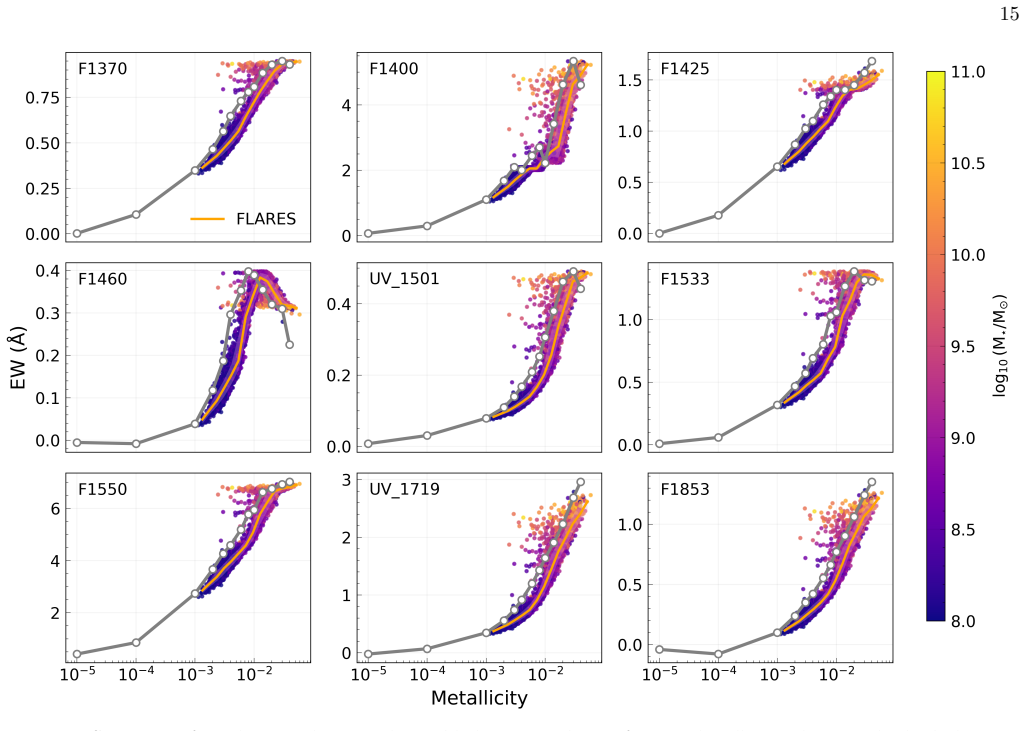
Using BPASS models and galaxies from the FLARES simulations, the study shows that UV indices increase monotonically with stellar metallicity across most cases, with the 1719 Å index providing a particularly consistent tracer while the 1460 Å feature responds more to nebular emission and bursty star formation.
Load-bearing premise
The BPASS stellar population synthesis models combined with FLARES simulation outputs accurately represent the stellar populations, metallicity distributions, and star formation histories in real high-redshift galaxies.
Editorial extensions
If this is right
- The 1719 Å index can serve as a practical tracer for stellar metallicity in JWST observations of reionization-era galaxies.
- Indices sensitive to star formation history, such as 1460 Å, require corrections when used for metallicity estimates in galaxies with bursty assembly.
- The mass-metallicity relation reproduced in FLARES provides a reference for how index strengths should behave across galaxy masses at high redshift.
- Monotonic increases in equivalent width with metallicity hold even in the complex enrichment environments supplied by the simulations.
Reading between the lines
- Multiple UV indices used together could help separate metallicity from star formation history effects in future spectra.
- Deviations from the predicted trends in real data might point to differences in initial mass function or dust properties not captured in the current models.
- These indices offer a route to map chemical enrichment progress across the reionization epoch without relying solely on emission lines.
Signed reviews
Editorial analysis
A structured set of objections, weighed in public.
Referee Report
Summary. The manuscript combines FLARES cosmological simulations with BPASS stellar population synthesis models via the Synthesizer package to compute equivalent widths of UV absorption indices in high-redshift galaxies. It reports that the 1719 Å index exhibits strong, consistent correlations with stellar metallicity while most indices show monotonic EW increases with Z⋆; some indices are more sensitive to SFH. The work reproduces a synthetic mass-metallicity relation from the simulated galaxies and positions the results as a theoretical benchmark for interpreting JWST rest-frame UV spectra.
Significance. If the central trends hold, the paper supplies a useful forward-modeling benchmark that directly tests simple SSP predictions against the complex metallicity distributions and assembly histories in FLARES. The identification of the 1719 Å feature as a relatively robust metallicity tracer, together with the explicit comparison to nebular emission and bursty SFH effects, offers concrete guidance for chemical-enrichment studies in the reionization epoch.
major comments (2)
- [Results] Results section (discussion of 1719 Å and monotonic trends): the claim of 'strong and consistent correlations' and 'monotonic increase' is presented without reported correlation coefficients, slopes, or uncertainties on the EW–Z⋆ relations, making it impossible to judge the statistical significance or scatter of the trends shown in the figures.
- [Methods / FLARES sample] Section describing FLARES galaxy sample: the exact selection criteria (stellar-mass range, redshift cuts, minimum particle number, etc.) and the procedure used to assign error bars or confidence intervals to the synthetic EWs are not stated, which is load-bearing for assessing whether the reported monotonicity is robust across the simulated population.
minor comments (2)
- Notation: ensure consistent use of Å units for all equivalent-width values and that the subscript ⋆ on Z⋆ is defined on first use.
- Figure captions: add explicit labels distinguishing the simple SSP tracks from the FLARES composite populations in any comparative plots.
Simulated Author's Rebuttal
We thank the referee for their constructive comments and positive recommendation for minor revision. We have revised the manuscript to incorporate quantitative statistical measures for the reported trends and to explicitly detail the FLARES sample selection criteria along with the error estimation procedure for the synthetic equivalent widths.
read point-by-point responses
-
Referee: [Results] Results section (discussion of 1719 Å and monotonic trends): the claim of 'strong and consistent correlations' and 'monotonic increase' is presented without reported correlation coefficients, slopes, or uncertainties on the EW–Z⋆ relations, making it impossible to judge the statistical significance or scatter of the trends shown in the figures.
Authors: We agree that the absence of quantitative statistics limits the ability to assess the strength and robustness of the trends. In the revised manuscript we have added Pearson correlation coefficients, linear-fit slopes, and 1σ uncertainties (derived from bootstrap resampling) for all EW–Z⋆ relations. These values are now reported in the text of Section 3 and in the captions of Figures 4–6. For the 1719 Å index the correlation coefficient is r = 0.87 ± 0.03 with a slope of 0.42 ± 0.05 Å dex⁻¹, confirming the strong, low-scatter relation highlighted in the original text. revision: yes
-
Referee: [Methods / FLARES sample] Section describing FLARES galaxy sample: the exact selection criteria (stellar-mass range, redshift cuts, minimum particle number, etc.) and the procedure used to assign error bars or confidence intervals to the synthetic EWs are not stated, which is load-bearing for assessing whether the reported monotonicity is robust across the simulated population.
Authors: We acknowledge that these details were inadvertently omitted. The revised Section 2 now states that the FLARES sample comprises all galaxies with stellar mass M⋆ ≥ 10⁸ M⊙ at redshifts 5 ≤ z ≤ 10 that contain at least 1000 stellar particles (ensuring well-sampled metallicity distributions). Synthetic EWs and their uncertainties are computed by averaging over 12 random lines of sight per galaxy; the reported error bars are the standard deviation of these sightline measurements, supplemented by bootstrap resampling of the stellar particles within each galaxy to capture sampling variance. These procedures are now fully documented. revision: yes
Circularity Check
No significant circularity: forward modeling from independent simulation and SPS inputs
full rationale
The paper's central results are obtained by applying the external BPASS stellar population synthesis models through the Synthesizer package to galaxy catalogs drawn from the FLARES cosmological simulations. Equivalent widths of UV indices are computed directly from the resulting synthetic spectra, and their monotonic trends with stellar metallicity and sensitivity to SFH are measured within that population. No index definitions or relations are fitted inside the paper; the reported correlations follow from the forward modeling. Prior FLARES papers are cited only for the simulation setup and are not used to justify uniqueness or to smuggle in ansatzes for the indices themselves. The derivation chain therefore remains independent of the target observables and does not reduce any claimed prediction to a self-definition or fitted input.
Assumptions & free parameters
free parameters (1)
- BPASS model parameters for UV spectra
assumptions (2)
- domain assumption BPASS models accurately predict UV absorption line strengths for given metallicities and star formation histories
- domain assumption FLARES simulations produce realistic metallicity distributions and assembly histories for high-redshift galaxies
Cite this review
Pith. "Pith review of First Light And Reionization Epoch Simulations (FLARES) XXI: The UV Indices of Galaxies in the Early Universe." pith.science (2026). https://pith.science/paper/65YR2R6S
@misc{pith2026260513472,
  author       = {Pith},
  title        = {Pith review of: First Light And Reionization Epoch Simulations (FLARES) XXI: The UV Indices of Galaxies in the Early Universe},
  year         = {2026},
  howpublished = {\url{https://pith.science/paper/65YR2R6S}},
  note         = {Machine review of arXiv:2605.13472}
}
abstract
UV absorption line indices trace both chemical enrichment and star formation histories in high-redshift galaxies, yet their reliability as tracers of stellar metallicity (\(Z_\star\)) remains uncertain. In this study, we combine synthetic spectral modelling and cosmological simulations to establish a theoretical framework for interpreting these features in the early Universe. Using the forward modelling package \texttt{Synthesizer}, we compute equivalent widths for a suite of UV indices based on BPASS stellar population synthesis models and investigate their sensitivity to metallicity, star formation history (SFH), and model assumptions. Certain indices, particularly the \(1719\,\text{\AA}\) feature, exhibit strong and consistent correlations with stellar metallicity, while others display increased sensitivity to SFH. To assess the impact of realistic galaxy assembly histories, we apply these models to galaxies drawn from the First Light and Reionization Epoch Simulations (\flares). The simulations provide diverse stellar populations with realistic metallicity distributions and SFHs, enabling an investigation of UV index behaviour within complex enrichment environments. We examine the relationship between galaxy properties and metallicity in \flares\ and reproduce a synthetic mass--metallicity relation (MZR). Across most indices, equivalent widths increase monotonically with metallicity, consistent with predictions from simple stellar population models. The \(1719\,\text{\AA}\) index emerges as one of the most reliable tracers of stellar metallicity, while the \(1460\,\text{\AA}\) feature shows enhanced sensitivity to nebular emission and bursty star formation. These results provide a theoretical benchmark for interpreting rest-frame UV spectra of high-redshift galaxies observed with \textit{JWST}.
Figures


Figures from the paper (10 more)



Reference graph
Works this paper leans on
-
[1]
, year = 1983, month = sep, volume =
The determination of cloud masses and dust characteristics from submillimetre thermal emission. , year = 1983, month = sep, volume =
work page 1983
-
[3]
Steidel and Mark Dickinson and Kurt L
Max Pettini and Melinda Kellogg and Charles C. Steidel and Mark Dickinson and Kurt L. Adelberger and Mauro Giavalisco , title =. The Astrophysical Journal , abstract =. doi:10.1086/306431 , url =
-
[4]
Dust Absorption and the Ultraviolet Luminosity Density at z -0.5ex 3 as Calibrated by Local Starburst Galaxies. , keywords =. doi:10.1086/307523 , archivePrefix =. astro-ph/9903054 , primaryClass =
-
[5]
Dust Grain Size Distributions and Extinction in the Milky Way, LMC, and SMC
Dust Grain-Size Distributions and Extinction in the Milky Way, Large Magellanic Cloud, and Small Magellanic Cloud. , keywords =. doi:10.1086/318651 , archivePrefix =. astro-ph/0008146 , primaryClass =
-
[7]
The Initial Mass Function of Stars: Evidence for Uniformity in Variable Systems
The Initial Mass Function of Stars: Evidence for Uniformity in Variable Systems. Science , keywords =. doi:10.1126/science.1067524 , archivePrefix =. astro-ph/0201098 , primaryClass =
-
[10]
Far-infrared spectral energy distribution fitting for galaxies near and far. , keywords =. doi:10.1111/j.1365-2966.2012.21455.x , archivePrefix =. 1206.1595 , primaryClass =
-
[11]
Simulations of the formation, evolution and clustering of galaxies and quasars , volume =. Nature , author =. 2005 , pages =. doi:10.1038/nature03597 , abstract =
-
[12]
Steven V. W. Beckwith and Massimo Stiavelli and Anton M. Koekemoer and John A. R. Caldwell and Henry C. Ferguson and Richard Hook and Ray A. Lucas and Louis E. Bergeron and Michael Corbin and Shardha Jogee and Nino Panagia and Massimo Robberto and Patricia Royle and Rachel S. Somerville and Megan Sosey , title =. , abstract =. doi:10.1086/507302 , url =
Show all 278 references
-
[13]
, keywords =
SUNRISE: polychromatic dust radiative transfer in arbitrary geometries. , keywords =. doi:10.1111/j.1365-2966.2006.10884.x , archivePrefix =. astro-ph/0604118 , primaryClass =
2006 doi
- [14]
-
[15]
Hunter, J. D. , Title =. Computing in Science & Engineering , Volume =
-
[16]
, keywords =
On the relation between the Schmidt and Kennicutt-Schmidt star formation laws and its implications for numerical simulations. , keywords =. doi:10.1111/j.1365-2966.2007.12639.x , archivePrefix =. 0709.0292 , primaryClass =
2007 doi
-
[17]
Dopita and Ralph S
Brent Groves and Michael A. Dopita and Ralph S. Sutherland and Lisa J. Kewley and Jörg Fischera and Claus Leitherer and Bernhard Brandl and Wil van Breugel , title =. The Astrophysical Journal Supplement Series , abstract =. doi:10.1086/528711 , url =
-
[18]
Journal of Computational Physics , author =
Modelling discontinuities and. Journal of Computational Physics , author =. 2008 , keywords =. doi:10.1016/j.jcp.2008.08.011 , abstract =
2008 doi
-
[19]
, keywords =
The effect of photoionization on the cooling rates of enriched, astrophysical plasmas. , keywords =. doi:10.1111/j.1365-2966.2008.14191.x , archivePrefix =. 0807.3748 , primaryClass =
2008 doi
-
[20]
, keywords =
Cosmological simulations of the growth of supermassive black holes and feedback from active galactic nuclei: method and tests. , keywords =. doi:10.1111/j.1365-2966.2009.15043.x , archivePrefix =. 0904.2572 , primaryClass =
2009 doi
-
[21]
, keywords =
Chemical enrichment in cosmological, smoothed particle hydrodynamics simulations. , keywords =. doi:10.1111/j.1365-2966.2009.15331.x , archivePrefix =. 0902.1535 , primaryClass =
2009 doi
-
[22]
, author =
Inviscid smoothed particle hydrodynamics , volume =. , author =. 2010 , note =. doi:10.1111/j.1365-2966.2010.17158.x , abstract =
2010 doi
- [23]
- [24]
-
[25]
HST WFC3 observations of very high redshift galaxies
The ultraviolet properties of star-forming galaxies - I. HST WFC3 observations of very high redshift galaxies. , keywords =. doi:10.1111/j.1365-2966.2011.19315.x , archivePrefix =. 1106.5977 , primaryClass =
2011 doi
- [26]
-
[27]
Di Matteo and N
T. Di Matteo and N. Khandai and C. DeGraf and Y. Feng and R. A. C. Croft and J. Lopez and V. Springel , title =. , abstract =. doi:10.1088/2041-8205/745/2/l29 , url =
-
[28]
RADMC-3D: A multi-purpose radiative transfer tool
- [29]
-
[30]
, keywords =
Simulating galactic outflows with thermal supernova feedback. , keywords =. doi:10.1111/j.1365-2966.2012.21704.x , archivePrefix =. 1203.5667 , primaryClass =
2012 doi
- [31]
-
[32]
M. L. N. Ashby and S. P. Willner and G. G. Fazio and J.-S. Huang and R. Arendt and P. Barmby and G. Barro and E. F. Bell and R. Bouwens and A. Cattaneo and D. Croton and R. Dav. , abstract =. doi:10.1088/0004-637x/769/1/80 , url =
- [34]
- [35]
-
[36]
and Ingargiola, Antonino , title =
Newville, Matthew and Stensitzki, Till and Allen, Daniel B. and Ingargiola, Antonino , title =. doi:10.5281/zenodo.11813 , url =
-
[37]
Masami Ouchi and Richard Ellis and Yoshiaki Ono and Kouichiro Nakanishi and Kotaro Kohno and Rieko Momose and Yasutaka Kurono and M. L. N. Ashby and Kazuhiro Shimasaku and S. P. Willner and G. G. Fazio and Yoichi Tamura and Daisuke Iono , title =. The Astrophysical Journal , a...
-
[38]
The Astrophysical Journal , abstract =
Renyue Cen and Taysun Kimm , title =. The Astrophysical Journal , abstract =. doi:10.1088/0004-637x/782/1/32 , url =
- [39]
- [40]
-
[41]
Carilli and Elisabete da Cunha and Jorge Gonz
Kazuaki Ota and Fabian Walter and Kouji Ohta and Bunyo Hatsukade and Chris L. Carilli and Elisabete da Cunha and Jorge Gonz. The Astrophysical Journal , abstract =. doi:10.1088/0004-637x/792/1/34 , url =
- [42]
- [43]
-
[44]
A&A , author =
Planck 2013 results. A&A , author =. 2014 , keywords =. doi:10.1051/0004-6361/201321529 , abstract =
2013 doi
- [45]
-
[47]
McLeod, D. J. and McLure, R. J. and Dunlop, J. S. and Robertson, B. E. and Ellis, R. S. and Targett, T. A. , title = ". , volume =. 2015 , month =. doi:10.1093/mnras/stv780 , url =
2015 doi
- [48]
- [49]
- [50]
- [51]
- [53]
- [54]
- [55]
-
[56]
Inoue, Akio K. and Tamura, Yoichi and Matsuo, Hiroshi and Mawatari, Ken and Shimizu, Ikkoh and Shibuya, Takatoshi and Ota, Kazuaki and Yoshida, Naoki and Zackrisson, Erik and Kashikawa, Nobunari and Kohno, Kotaro and Umehata, Hideki and Hatsukade, Bunyo and Iye, Masanori and M...
2016
-
[57]
M. L. Strandet and A. Weiss and J. D. Vieira and C. de Breuck and J. E. Aguirre and M. Aravena and M. L. N. Ashby and M. B. The Astrophysical Journal , abstract =. doi:10.3847/0004-637x/822/2/80 , url =
-
[58]
G. W. Roberts-Borsani and R. J. Bouwens and P. A. Oesch and I. Labbe and R. Smit and G. D. Illingworth and P. van Dokkum and B. Holden and V. Gonzalez and M. Stefanon and B. Holwerda and S. Wilkins , title =. , abstract =. doi:10.3847/0004-637x/823/2/143 , url =
- [59]
-
[60]
R. J. Bouwens and P. A. Oesch and I. Labb. , abstract =. doi:10.3847/0004-637x/830/2/67 , url =
- [61]
- [62]
-
[63]
Laporte and R
N. Laporte and R. S. Ellis and F. Boone and F. E. Bauer and D. Qu. Dust in the Reionization Era:. The Astrophysical Journal , abstract =. doi:10.3847/2041-8213/aa62aa , url =
- [64]
- [65]
-
[66]
Hayward and Henry C
Mohammadtaher Safarzadeh and Christopher C. Hayward and Henry C. Ferguson , title =. The Astrophysical Journal , abstract =. doi:10.3847/1538-4357/aa6c5b , url =
-
[68]
R. J. Bouwens and P. A. Oesch and G. D. Illingworth and R. S. Ellis and M. Stefanon , title =. , abstract =. doi:10.3847/1538-4357/aa70a4 , url =
- [69]
- [70]
- [71]
-
[73]
, author =
The evolution of the star formation rate function in the. , author =. 2017 , note =. doi:10.1093/mnras/stx2020 , abstract =
2017 doi
-
[74]
, keywords =
The evolving far-IR galaxy luminosity function and dust-obscured star formation rate density out to z≃5. , keywords =. doi:10.1093/mnras/stx1843 , archivePrefix =. 1706.00426 , primaryClass =
- [75]
- [76]
- [77]
- [78]
- [79]
- [80]
- [81]
- [82]
- [85]
- [86]
- [87]
-
[88]
, keywords =
The onset of star formation 250 million years after the Big Bang. , keywords =. doi:10.1038/s41586-018-0117-z , archivePrefix =. 1805.05966 , primaryClass =
- [89]
- [90]
- [92]
- [93]
- [94]
-
[95]
, keywords =
Early galaxy formation and its large-scale effects. , keywords =. doi:10.1016/j.physrep.2018.10.002 , archivePrefix =. 1809.09136 , primaryClass =
2018 doi
-
[96]
Inoue and Erik Zackrisson and Lise Christensen and Christian Binggeli and Yuichi Matsuda and Hiroshi Matsuo and Tsutomu T
Yoichi Tamura and Ken Mawatari and Takuya Hashimoto and Akio K. Inoue and Erik Zackrisson and Lise Christensen and Christian Binggeli and Yuichi Matsuda and Hiroshi Matsuo and Tsutomu T. Takeuchi and Ryosuke S. Asano and Kaho Sunaga and Ikkoh Shimizu and Takashi Okamoto and Na...
- [97]
- [98]
-
[99]
, keywords =
The Atacama Large Millimeter/submillimeter Array Spectroscopic Survey in the Hubble Ultra Deep Field: CO Emission Lines and 3 mm Continuum Sources. , keywords =. doi:10.3847/1538-4357/ab3105 , archivePrefix =. 1903.09161 , primaryClass =
1903 doi
-
[100]
, keywords =
The Brightest z 8 Galaxies over the COSMOS UltraVISTA Field. , keywords =. doi:10.3847/1538-4357/ab3792 , archivePrefix =. 1902.10713 , primaryClass =
1902 doi
-
[101]
, keywords =
The ALMA Spectroscopic Survey in the HUDF: CO Luminosity Functions and the Molecular Gas Content of Galaxies through Cosmic History. , keywords =. doi:10.3847/1538-4357/ab30fe , archivePrefix =. 1903.09164 , primaryClass =
1903 doi
- [102]
-
[103]
, keywords =
On the dust temperatures of high-redshift galaxies. , keywords =. doi:10.1093/mnras/stz2134 , archivePrefix =. 1902.10727 , primaryClass =
1902 doi
- [104]
- [105]
- [106]
-
[108]
, keywords =
From the far-ultraviolet to the far-infrared - galaxy emission at 0 z 10 in the SHARK semi-analytic model. , keywords =. doi:10.1093/mnras/stz2427 , archivePrefix =. 1908.03423 , primaryClass =
1908 doi
-
[109]
, keywords =
Discovery of Four Apparently Cold Dusty Galaxies at z = 3.62-5.85 in the COSMOS Field: Direct Evidence of Cosmic Microwave Background Impact on High-redshift Galaxy Observables. , keywords =. doi:10.3847/1538-4357/ab55d6 , archivePrefix =. 1906.00040 , primaryClass =
1906 doi
-
[110]
, keywords =
Red and dead CANDELS: massive passive galaxies at the dawn of the Universe. , keywords =. doi:10.1093/mnras/stz2615 , archivePrefix =. 1909.07996 , primaryClass =
1909 doi
-
[111]
Nature Methods , year = "2020", volume=
SciPy 1.0: Fundamental Algorithms for Scientific Computing in Python. Nature Methods , year = "2020", volume=
2020
-
[112]
, keywords =
High-redshift JWST predictions from IllustrisTNG: dust modelling and galaxy luminosity functions. , keywords =. doi:10.1093/mnras/staa137 , archivePrefix =. 1904.07238 , primaryClass =
1904 doi
-
[113]
, keywords =
ALMA uncovers the [C II] emission and warm dust continuum in a z = 8.31 Lyman break galaxy. , keywords =. doi:10.1093/mnras/staa509 , archivePrefix =. 2001.02812 , primaryClass =
2001 doi
-
[114]
, keywords =
A lack of evolution in the very bright end of the galaxy luminosity function from z ≃ 8 to 10. , keywords =. doi:10.1093/mnras/staa313 , archivePrefix =. 1911.12832 , primaryClass =
1911 doi
-
[115]
, keywords =
The ALPINE-ALMA [C II] Survey: Multiwavelength Ancillary Data and Basic Physical Measurements. , keywords =. doi:10.3847/1538-4365/ab7ccd , archivePrefix =. 1912.01621 , primaryClass =
1912 doi
-
[116]
, keywords =
Infrared luminosity functions and dust mass functions in the EAGLE simulation. , keywords =. doi:10.1093/mnras/staa990 , archivePrefix =. 2004.02713 , primaryClass =
2004 doi
-
[117]
, keywords =
Cosmic Dawn II (CoDa II): a new radiation-hydrodynamics simulation of the self-consistent coupling of galaxy formation and reionization. , keywords =. doi:10.1093/mnras/staa1266 , archivePrefix =. 1811.11192 , primaryClass =
-
[118]
, keywords =
Large Population of ALMA Galaxies at z > 6 with Very High [O III] 88 m to [C II] 158 m Flux Ratios: Evidence of Extremely High Ionization Parameter or PDR Deficit?. , keywords =. doi:10.3847/1538-4357/ab94bd , archivePrefix =. 1910.10927 , primaryClass =
1910 doi
-
[119]
, keywords =
The Dust Attenuation Law in Galaxies. , keywords =. doi:10.1146/annurev-astro-032620-021933 , archivePrefix =. 2001.03181 , primaryClass =
2001 doi
-
[120]
, keywords =
Warm dust in high-z galaxies: origin and implications. , keywords =. doi:10.1093/mnras/staa1959 , archivePrefix =. 2004.09528 , primaryClass =
2004 doi
-
[121]
, keywords =
The ALMA Spectroscopic Survey Large Program: The Infrared Excess of z = 1.5-10 UV-selected Galaxies and the Implied High-redshift Star Formation History. , keywords =. doi:10.3847/1538-4357/abb830 , archivePrefix =. 2009.10727 , primaryClass =
2009 doi
-
[122]
, keywords =
A redshift-dependent IRX- dust attenuation relation for TNG50 galaxies. , keywords =. doi:10.1093/mnras/staa1900 , archivePrefix =. 2001.04992 , primaryClass =
2001 doi
-
[123]
, keywords =
The nature of CR7 revealed with MUSE: a young starburst powering extended Ly emission at z = 6.6. , keywords =. doi:10.1093/mnras/staa2550 , archivePrefix =. 2008.01731 , primaryClass =
2008 doi
-
[124]
The nature, luminosity function, and star formation history of dusty galaxies up to z ≃ 6
The ALPINE-ALMA [CII] survey. The nature, luminosity function, and star formation history of dusty galaxies up to z ≃ 6. , keywords =. doi:10.1051/0004-6361/202038487 , archivePrefix =. 2006.04974 , primaryClass =
2006 doi
-
[125]
, keywords =
ALMA characterizes the dust temperature of z 5.5 star-forming galaxies. , keywords =. doi:10.1093/mnras/staa2545 , archivePrefix =. 2005.07716 , primaryClass =
2005 doi
-
[126]
Survey strategy, observations, and sample properties of 118 star-forming galaxies at 4 < z < 6
The ALPINE-ALMA [CII] survey. Survey strategy, observations, and sample properties of 118 star-forming galaxies at 4 < z < 6. , keywords =. doi:10.1051/0004-6361/201936965 , archivePrefix =. 1910.09517 , primaryClass =
1910 doi
-
[127]
Dust attenuation properties and obscured star formation at z 4.4-5.8
The ALPINE-ALMA [CII] survey. Dust attenuation properties and obscured star formation at z 4.4-5.8. , keywords =. doi:10.1051/0004-6361/202038163 , archivePrefix =. 2004.10760 , primaryClass =
2004 doi
-
[128]
, keywords =
The ALPINE-ALMA [CII] survey: Data processing, catalogs, and statistical source properties. , keywords =. doi:10.1051/0004-6361/202037649 , archivePrefix =. 2002.00962 , primaryClass =
2002 doi
-
[129]
Royal Society Open Science , keywords =
High-redshift star formation in the Atacama large millimetre/submillimetre array era. Royal Society Open Science , keywords =. doi:10.1098/rsos.200556 , archivePrefix =. 2004.00934 , primaryClass =
2004 doi
-
[130]
Rohatgi, Ankit , title =
-
[133]
Astronomy and Computing , keywords =
SKIRT 9: Redesigning an advanced dust radiative transfer code to allow kinematics, line transfer and polarization by aligned dust grains. Astronomy and Computing , keywords =. doi:10.1016/j.ascom.2020.100381 , archivePrefix =. 2003.00721 , primaryClass =
2020 doi
-
[134]
, keywords =
POWDERDAY: Dust Radiative Transfer for Galaxy Simulations. , keywords =. doi:10.3847/1538-4365/abc487 , archivePrefix =. 2006.10757 , primaryClass =
2006 doi
-
[135]
, keywords =
Reproducing submillimetre galaxy number counts with cosmological hydrodynamic simulations. , keywords =. doi:10.1093/mnras/staa4043 , archivePrefix =. 2006.15156 , primaryClass =
2006 doi
-
[136]
, keywords =
The IRX- relation of high-redshift galaxies. , keywords =. doi:10.1093/mnras/stab096 , archivePrefix =. 2009.13522 , primaryClass =
2009 doi
-
[137]
, keywords =
The Physical Drivers of the Luminosity-weighted Dust Temperatures in High-redshift Galaxies. , keywords =. doi:10.3847/1538-4357/abe401 , archivePrefix =. 2102.06250 , primaryClass =
-
[138]
Infrared luminosity functions, obscured star formation and dust temperature of high-redshift galaxies
High redshift JWST predictions from IllustrisTNG: III. Infrared luminosity functions, obscured star formation and dust temperature of high-redshift galaxies. arXiv e-prints , keywords =
-
[139]
arXiv e-prints , keywords =
Galaxy Morphologies Revealed with Subaru HSC and Super-Resolution Techniques I: Major Merger Fractions of L\_UV -0.5ex 3-15 L\_UV* Dropout Galaxies at z -0.5ex 4-7. arXiv e-prints , keywords =
-
[140]
, keywords =
Balmer breaks in simulated galaxies at z > 6. , keywords =. doi:10.1093/mnras/stz2387 , archivePrefix =. 1908.11393 , primaryClass =
1908 doi
-
[141]
B., et al., 2024, The Astrophysical Journal Letters, 965, L6
Bagley M. B., et al., 2024, The Astrophysical Journal Letters, 965, L6
2024
-
[143]
Boylan-Kolchin M., 2023, Nature Astronomy, 7, 731
2023
-
[144]
J., et al., 2024, Astronomy & Astrophysics, 690, A288
Bunker A. J., et al., 2024, Astronomy & Astrophysics, 690, A288
2024
-
[145]
Byrne C., Stanway E., Eldridge J., McSwiney L., Townsend O., 2022, Monthly Notices of the Royal Astronomical Society, 512, 5329
2022
-
[146]
Calabr \`o A., et al., 2021, Astronomy & Astrophysics, 646, A39
2021
-
[147]
C., 2017, SpectRes: Spectral Resampling for Python , https://github.com/carnallan/spectres
Carnall A. C., 2017, SpectRes: Spectral Resampling for Python , https://github.com/carnallan/spectres
2017
-
[148]
I., Lamers H., 1979, Astrophysical Journal Supplement Series, vol
Castor J. I., Lamers H., 1979, Astrophysical Journal Supplement Series, vol. 39, Apr. 1979, p. 481-511., 39, 481
1979
-
[150]
A., et al., 2015, @doi [ ] 10.1093/mnras/stv725 , 450, 1937
Crain R. A., et al., 2015, @doi [ ] 10.1093/mnras/stv725 , 450, 1937
2015 doi
-
[151]
Cullen F., et al., 2019, Monthly Notices of the Royal Astronomical Society, 487, 2038
2019
-
[152]
E., Bower R
De Rossi M. E., Bower R. G., Font A. S., Schaye J., Theuns T., 2017, Monthly Notices of the Royal Astronomical Society, 472, 3354
2017
-
[153]
Endsley R., et al., 2024, Monthly Notices of the Royal Astronomical Society, 533, 1111
2024
-
[154]
L., et al., 2016a, @doi [ApJ] 10.3847/0004-637X/821/2/122 , 821, 122
Faisst A. L., et al., 2016a, @doi [ApJ] 10.3847/0004-637X/821/2/122 , 821, 122
-
[155]
Faisst A., et al., 2016b, The Astrophysical Journal, 822, 29
-
[156]
N., O'Connell R
Fanelli M. N., O'Connell R. W., Burstein D., Wu C.-C., 1992, Astrophysical Journal Supplement Series (ISSN 0067-0049), vol. 82, no. 1, Sept. 1992, p. 197-245. Research supported by Arizona State University., 82, 197
1992
-
[157]
Ferreira L., et al., 2022, The Astrophysical Journal Letters, 938, L2
2022
-
[158]
Ferreira L., et al., 2023, The Astrophysical Journal, 955, 94
2023
-
[159]
P., et al., 2023, Publications of the Astronomical Society of the Pacific, 135, 068001
Gardner J. P., et al., 2023, Publications of the Astronomical Society of the Pacific, 135, 068001
2023
-
[160]
M., van Hoof P
Gunasekera C. M., van Hoof P. A., Chatzikos M., Ferland G. J., 2023, Research Notes of the AAS, 7, 246
2023
-
[161]
Holwerda B., et al., 2024, Monthly Notices of the Royal Astronomical Society, 529, 1067
2024
-
[162]
D., 2007, @doi [Computing in Science & Engineering] 10.1109/MCSE.2007.55 , 9, 90
Hunter J. D., 2007, @doi [Computing in Science & Engineering] 10.1109/MCSE.2007.55 , 9, 90
2007 doi
-
[163]
B., 2009, @doi [ApJ] 10.1088/0004-637X/700/2/1299 , 700, 1299
Jenkins E. B., 2009, @doi [ApJ] 10.1088/0004-637X/700/2/1299 , 700, 1299
2009 doi
-
[164]
S., et al., 2023, The Astrophysical Journal Letters, 946, L15
Kartaltepe J. S., et al., 2023, The Astrophysical Journal Letters, 946, L15
2023
-
[165]
Kotiwale G., et al., 2026, Astronomy & Astrophysics, 706, A165
2026
-
[166]
Kroupa P., 2001, Monthly Notices of the Royal Astronomical Society, 322, 231
2001
-
[167]
Le Fèvre O., Faisst A., et al., 2023, arXiv e-prints
2023
-
[168]
Leitherer C., et al., 1999, @doi [The Astrophysical Journal Supplement Series] 10.1086/313233 , 123, 3
1999 doi
-
[169]
A., Heckman T
Leitherer C., Tremonti C. A., Heckman T. M., Calzetti D., 2011, The Astronomical Journal, 141, 37
2011
-
[170]
C., Vijayan A
Lovell C. C., Vijayan A. P., Thomas P. A., Wilkins S. M., Barnes D. J., Irodotou D., Roper W., 2021, @doi [ ] 10.1093/mnras/staa3360 , https://ui.adsabs.harvard.edu/abs/2021MNRAS.500.2127L 500, 2127
2021 doi
-
[171]
C., Harrison I., Harikane Y., Tacchella S., Wilkins S
Lovell C. C., Harrison I., Harikane Y., Tacchella S., Wilkins S. M., 2023, Monthly Notices of the Royal Astronomical Society, 518, 2511
2023
-
[172]
C., Roper W
Lovell C. C., Roper W. J., Vijayan A. P., Wilkins S. M., Newman S., Seeyave L., 2025, The Open Journal of Astrophysics, 8
2025
-
[173]
Maiolino R., et al., 2008, @doi [A&A] 10.1051/0004-6361:200809691 , 488, 463–479
2008 doi
-
[174]
M., et al., 2025, The Astrophysical Journal, 994, 212
Morales A. M., et al., 2025, The Astrophysical Journal, 994, 212
2025
-
[175]
Ren W., et al., 2025, Monthly Notices of the Royal Astronomical Society, 544, 211
2025
-
[176]
A., Pettini M., Leitherer C., Bresolin F., Kudritzki R.-P., Steidel C
Rix S. A., Pettini M., Leitherer C., Bresolin F., Kudritzki R.-P., Steidel C. C., 2004, The Astrophysical Journal, 615, 98
2004
-
[178]
J., et al., 2026, @doi [Journal of Open Source Software] 10.21105/joss.09436 , 11, 9436
Roper W. J., et al., 2026, @doi [Journal of Open Source Software] 10.21105/joss.09436 , 11, 9436
2026 doi
-
[179]
E., et al., 2026, @doi [Monthly Notices of the Royal Astronomical Society] 10.1093/mnras/staf2023 , 546, xxx
Rowland L. E., et al., 2026, @doi [Monthly Notices of the Royal Astronomical Society] 10.1093/mnras/staf2023 , 546, xxx
2026 doi
-
[180]
Schaye J., et al., 2015, Monthly Notices of the Royal Astronomical Society, 446, 521
2015
-
[181]
Senchyna P., et al., 2017, Monthly Notices of the Royal Astronomical Society, 472, 2608
2017
-
[182]
E., Reddy N
Shapley A. E., Reddy N. A., Sanders R. L., Topping M. W., Brammer G. B., 2023, The Astrophysical Journal Letters, 950, L1
2023
-
[183]
2012, @doi [Monthly Notices of the Royal Astronomical Society] 10.1111/j.1745-3933.2012.01212.x , 422, L26
Sommariva V., Mannucci F., Cresci G., et al. 2012, @doi [Monthly Notices of the Royal Astronomical Society] 10.1111/j.1745-3933.2012.01212.x , 422, L26
2012 doi
-
[184]
R., Eldridge J
Stanway E. R., Eldridge J. J., 2018, @doi [ ] 10.1093/mnras/sty1353 , https://ui.adsabs.harvard.edu/abs/2018MNRAS.479...75S 479, 75
2018 doi
-
[185]
Vidal-Garc \' a A., Charlot S., Bruzual G., Hubeny I., 2017, Monthly Notices of the Royal Astronomical Society, 470, 3532
2017
-
[186]
P., Clay S
Vijayan A. P., Clay S. J., Thomas P. A., Yates R. M., Wilkins S. M., Henriques B. M., 2019, @doi [ ] 10.1093/mnras/stz1948 , https://ui.adsabs.harvard.edu/abs/2019MNRAS.489.4072V 489, 4072
2019 doi
-
[187]
P., Lovell C
Vijayan A. P., Lovell C. C., Wilkins S. M., Thomas P. A., Barnes D. J., Irodotou D., Kuusisto J., Roper W. J., 2021, @doi [ ] 10.1093/mnras/staa3715 , https://ui.adsabs.harvard.edu/abs/2021MNRAS.501.3289V 501, 3289
2021 doi
-
[188]
P., Thomas P
Vijayan A. P., Thomas P. A., Lovell C. C., Wilkins S. M., Greve T. R., Irodotou D., Roper W. J., Seeyave L. T., 2024, Monthly Notices of the Royal Astronomical Society, 527, 7337
2024
-
[189]
Virtanen P., et al., 2020, @doi [Nature Methods] https://doi.org/10.1038/s41592-019-0686-2 , https://rdcu.be/b08Wh 17, 261
2020 doi
-
[193]
M., Feng Y., Di Matteo T., Croft R., Lovell C
Wilkins S. M., Feng Y., Di Matteo T., Croft R., Lovell C. C., Thomas P., 2018, @doi [ ] 10.1093/mnras/stx2588 , https://ui.adsabs.harvard.edu/abs/2018MNRAS.473.5363W 473, 5363
2018 doi
-
[195]
M., et al., 2022b, arXiv e-prints, https://ui.adsabs.harvard.edu/abs/2022arXiv220409431W p
Wilkins S. M., et al., 2022b, arXiv e-prints, https://ui.adsabs.harvard.edu/abs/2022arXiv220409431W p. arXiv:2204.09431
-
[196]
J., Kewley L
Zahid H. J., Kewley L. J., Bresolin F., 2014, @doi [ApJ] 10.1088/0004-637X/791/2/130 , 791, 130
2014 doi
-
[197]
The properties of massive dusty galaxies at cosmic dawn
First Light And Reionisation Epoch Simulations (FLARES) - III. The properties of massive dusty galaxies at cosmic dawn. , keywords =. doi:10.1093/mnras/stac338 , archivePrefix =. 2108.00830 , primaryClass =
-
[198]
The size evolution of galaxies at z 5
First Light And Reionisation Epoch Simulations (FLARES) - IV. The size evolution of galaxies at z 5. , keywords =. doi:10.1093/mnras/stac1368 , archivePrefix =. 2203.12627 , primaryClass =
-
[199]
arXiv e-prints , keywords =
First Light And Reionisation Epoch Simulations (FLARES) V: The redshift frontier. arXiv e-prints , keywords =
-
[200]
The colour evolution of galaxies z = 5-15
First Light and Reionisation Epoch Simulations (FLARES) - VI. The colour evolution of galaxies z = 5-15. , keywords =. doi:10.1093/mnras/stac2548 , archivePrefix =. 2207.10920 , primaryClass =
-
[201]
, keywords =
First Light And Reionisation Epoch Simulations (FLARES) VII: The star formation and metal enrichment histories of galaxies in the early Universe. , keywords =. doi:10.1093/mnras/stac3281 , archivePrefix =. 2208.00976 , primaryClass =
-
[202]
The Emergence of Passive Galaxies in the Early Universe ( z > 5 )
FLARES VIII. The Emergence of Passive Galaxies in the Early Universe ( z > 5 ). arXiv e-prints , keywords =
-
[203]
arXiv e-prints , keywords =
FLARES IX: The Physical Mechanisms Driving Compact Galaxy Formation and Evolution. arXiv e-prints , keywords =
-
[204]
arXiv e-prints , keywords =
First Light and Reionisation Epoch Simulations (FLARES) X: Environmental Galaxy Bias and Survey Variance at High Redshift. arXiv e-prints , keywords =. doi:10.48550/arXiv.2301.09510 , archivePrefix =. 2301.09510 , primaryClass =
-
[205]
arXiv e-prints , keywords =
First Light And Reionisation Epoch Simulations (FLARES) XI: [OIII] emitting galaxies at 5<z<10. arXiv e-prints , keywords =. doi:10.48550/arXiv.2301.13038 , archivePrefix =. 2301.13038 , primaryClass =
-
[206]
arXiv e-prints , keywords =
First Light And Reionisation Epoch Simulations (FLARES) XII: The consequences of star-dust geometry on galaxies in the EoR. arXiv e-prints , keywords =. doi:10.48550/arXiv.2303.04177 , archivePrefix =. 2303.04177 , primaryClass =
- [207]
-
[208]
, keywords =
The 2017 Release Cloudy. , keywords =
2017
- [209]
-
[210]
, keywords =
On the impact of spectral template uncertainties in synthetic stellar populations. , keywords =. doi:10.1093/mnras/stad832 , archivePrefix =. 2303.16920 , primaryClass =
-
[211]
The Astronomical Journal , volume=
An ultraviolet spectroscopic atlas of local starbursts and star-forming galaxies: the legacy of FOS and GHRS , author=. The Astronomical Journal , volume=. 2011 , publisher=
2011
-
[212]
The Astrophysical Journal , volume=
Rest-UV absorption lines as metallicity estimator: the metal content of star-forming galaxies at z 5 , author=. The Astrophysical Journal , volume=. 2016 , publisher=
2016
-
[213]
Monthly Notices of the Royal Astronomical Society , volume=
Modelling ultraviolet-line diagnostics of stars, the ionized and the neutral interstellar medium in star-forming galaxies , author=. Monthly Notices of the Royal Astronomical Society , volume=. 2017 , publisher=
2017
-
[214]
IV-A library of mean stellar groups , author=
Spectral synthesis in the ultraviolet. IV-A library of mean stellar groups , author=. Astrophysical Journal Supplement Series (ISSN 0067-0049), vol. 82, no. 1, Sept. 1992, p. 197-245. Research supported by Arizona State University. , volume=
1992
-
[215]
The Astrophysical Journal Supplement Series , volume=
Starburst99: synthesis models for galaxies with active star formation , author=. The Astrophysical Journal Supplement Series , volume=. 1999 , publisher=
1999
-
[216]
, keywords =
On the Stellar Populations of Galaxies at z = 9-11: The Growth of Metals and Stellar Mass at Early Times. , keywords =. doi:10.3847/1538-4357/ac4cad , archivePrefix =. 2111.05351 , primaryClass =
- [217]
- [218]
-
[219]
arXiv e-prints , keywords =
Templates for Fitting Photometry of Ultra-High-Redshift Galaxies. arXiv e-prints , keywords =. doi:10.48550/arXiv.2208.07879 , archivePrefix =. 2208.07879 , primaryClass =
- [220]
-
[221]
, keywords =
The statistical properties of stars at redshift, z = 5, compared with the present epoch. , keywords =. doi:10.1093/mnras/stac3481 , archivePrefix =. 2211.15727 , primaryClass =
-
[222]
, keywords =
Stellar population synthesis at the resolution of 2003. , keywords =. doi:10.1046/j.1365-8711.2003.06897.x , archivePrefix =. astro-ph/0309134 , primaryClass =
2003 doi
-
[223]
, keywords =
Comprehensive Stellar Population Models and the Disentanglement of Age and Metallicity Effects. , keywords =. doi:10.1086/192096 , adsurl =
- [224]
-
[225]
Spectral evolution of galaxies. I. Early-type systems. , keywords =. doi:10.1086/161352 , adsurl =
- [226]
- [227]
-
[228]
, keywords =
From EMBER to FIRE: predicting high resolution baryon fields from dark matter simulations with deep learning. , keywords =. doi:10.1093/mnras/stab3088 , archivePrefix =. 2110.11970 , primaryClass =
- [229]
- [230]
-
[231]
The Journal of Open Source Software , keywords =
CMasher: Scientific colormaps for making accessible, informative and 'cmashing' plots. The Journal of Open Source Software , keywords =. doi:10.21105/joss.02004 , archivePrefix =. 2003.01069 , primaryClass =
2003 doi
- [232]
-
[233]
, keywords =
The [O III]+H equivalent width distribution at z ≃ 7: implications for the contribution of galaxies to reionization. , keywords =. doi:10.1093/mnras/staa3370 , archivePrefix =. 2005.02402 , primaryClass =
2005 doi
-
[234]
, keywords =
The VANDELS survey: Global properties of CIII] 1908 A emitting star-forming galaxies at z 3. , keywords =. doi:10.1051/0004-6361/202141651 , archivePrefix =. 2107.00660 , primaryClass =
1908 doi
- [235]
- [236]
- [237]
-
[238]
, keywords =
The Detection of Ionized Carbon Emission at z 8. , keywords =. doi:10.3847/2041-8213/ac1a79 , archivePrefix =. 2107.06295 , primaryClass =
-
[239]
arXiv e-prints , keywords =
Galaxy Formation and Reionization: Key Unknowns and Expected Breakthroughs by the James Webb Space Telescope. arXiv e-prints , keywords =
- [240]
-
[241]
, keywords =
Predictions for the intrinsic UV continuum properties of star-forming galaxies and the implications for inferring dust extinction. , keywords =. doi:10.1111/j.1365-2966.2012.21344.x , archivePrefix =. 1206.2732 , primaryClass =
2012 doi
- [242]
-
[243]
, keywords =
Nebular-line emission during the Epoch of Reionization. , keywords =. doi:10.1093/mnras/staa649 , archivePrefix =. 1904.07504 , primaryClass =
1904 doi
-
[244]
, keywords =
A machine learning approach to mapping baryons on to dark matter haloes using the EAGLE and C-EAGLE simulations. , keywords =. doi:10.1093/mnras/stab3221 , archivePrefix =. 2106.04980 , primaryClass =
- [245]
- [246]
- [247]
- [248]
-
[249]
New constraints on cosmic reionization from the luminosity and redshift-dependent fraction of Lyman emission
Keck spectroscopy of faint 3 < z < 7 Lyman break galaxies - I. New constraints on cosmic reionization from the luminosity and redshift-dependent fraction of Lyman emission. , keywords =. doi:10.1111/j.1365-2966.2010.17227.x , archivePrefix =. 1003.5244 , primaryClass =
2010 doi
- [250]
-
[251]
, keywords =
A remarkably high fraction of strong Ly emitters amongst luminous redshift 6.0 < z < 6.5 Lyman-break galaxies in the UKIDSS Ultra-Deep Survey. , keywords =. doi:10.1111/j.1365-2966.2012.20720.x , archivePrefix =. 1110.1722 , primaryClass =
2012 doi
- [252]
- [253]
-
[254]
Galaxy formation as a function of large-scale environment
Galaxies-intergalactic medium interaction calculation - I. Galaxy formation as a function of large-scale environment. , keywords =. doi:10.1111/j.1365-2966.2009.15402.x , archivePrefix =. 0906.4350 , primaryClass =
2009 doi
-
[255]
, keywords =
Introducing the THESAN project: radiation-magnetohydrodynamic simulations of the epoch of reionization. , keywords =. doi:10.1093/mnras/stab3710 , archivePrefix =. 2110.00584 , primaryClass =
- [256]
- [257]
- [258]
- [259]
-
[260]
, keywords =
Astraeus I: the interplay between galaxy formation and reionization. , keywords =. doi:10.1093/mnras/stab602 , archivePrefix =. 2004.08401 , primaryClass =
2004 doi
- [261]
- [262]
-
[263]
, keywords =
The contribution of high-redshift galaxies to cosmic reionization: new results from deep WFC3 imaging of the Hubble Ultra Deep Field. , keywords =. doi:10.1111/j.1365-2966.2010.17350.x , archivePrefix =. 0909.2255 , primaryClass =
2010 doi
-
[264]
, keywords =
Galaxies at z = 6-9 from the WFC3/IR imaging of the Hubble Ultra Deep Field. , keywords =. doi:10.1111/j.1365-2966.2009.16176.x , archivePrefix =. 0909.2437 , primaryClass =
2009 doi
-
[265]
, keywords =
New star-forming galaxies at z 7 from Wide Field Camera Three imaging. , keywords =. doi:10.1111/j.1365-2966.2010.17626.x , archivePrefix =. 1002.4866 , primaryClass =
2010 doi
- [266]
- [267]
- [268]
-
[269]
, keywords =
Recalibrating the cosmic star formation history. , keywords =. doi:10.1093/mnras/stz2894 , archivePrefix =. 1910.05220 , primaryClass =
1910 doi
- [270]
-
[271]
, keywords =
The Universe at z > 10: predictions for JWST from the UNIVERSEMACHINE DR1. , keywords =. doi:10.1093/mnras/staa3164 , archivePrefix =. 2007.04988 , primaryClass =
2007 doi
-
[272]
, keywords =
The formation of galaxies hosting z 6 quasars. , keywords =. doi:10.1111/j.1365-2966.2012.21047.x , archivePrefix =. 1111.0692 , primaryClass =
2012 doi
-
[273]
, keywords =
The ASTRID simulation: the evolution of supermassive black holes. , keywords =. doi:10.1093/mnras/stac351 , archivePrefix =. 2110.14154 , primaryClass =
-
[274]
arXiv e-prints , keywords =
A Census of the Bright z=8.5-11 Universe with the Hubble and Spitzer Space Telescopes in the CANDELS Fields. arXiv e-prints , keywords =
- [275]
-
[276]
, volume =
An analytic expression for the luminosity function for galaxies. , volume =. , author =. 1976 , pages =. doi:10.1086/154079 , abstract =
1976 doi
- [277]
- [278]
- [279]
-
[280]
MNRAS , author =
Populating a cluster of galaxies -. MNRAS , author =. 2001 , keywords =. doi:10.1046/j.1365-8711.2001.04912.x , abstract =
2001 doi
-
[281]
MNRAS , author =
Substructures in hydrodynamical cluster simulations , volume =. MNRAS , author =. 2009 , keywords =. doi:10.1111/j.1365-2966.2009.15034.x , abstract =
2009 doi
-
[282]
ApJ , author =
The evolution of large-scale structure in a universe dominated by cold dark matter , volume =. ApJ , author =. 1985 , keywords =. doi:10.1086/163168 , abstract =
1985 doi
- [283]
-
[284]
, keywords =
Evolutionary population synthesis: models, analysis of the ingredients and application to high-z galaxies. , keywords =. doi:10.1111/j.1365-2966.2005.09270.x , archivePrefix =. astro-ph/0410207 , primaryClass =
2005 doi
-
[285]
arXiv e-prints , keywords =
A Search for H-Dropout Lyman Break Galaxies at z -0.5ex 12-16. arXiv e-prints , keywords =
- [286]
-
[287]
, keywords =
A deeper view of extremely red galaxies: the redshift distribution in the GOODS/CDFS ISAAC field. , keywords =. doi:10.1111/j.1365-2966.2004.08044.x , archivePrefix =. astro-ph/0401047 , primaryClass =
2004 doi
- [288]
- [289]
-
[290]
AJ , keywords =
New Determinations of the UV Luminosity Functions from z 9 to 2 Show a Remarkable Consistency with Halo Growth and a Constant Star Formation Efficiency. AJ , keywords =. doi:10.3847/1538-3881/abf83e , archivePrefix =. 2102.07775 , primaryClass =
- [291]
-
[292]
, keywords =
The z = 9-10 galaxy population in the Hubble Frontier Fields and CLASH surveys: the z = 9 luminosity function and further evidence for a smooth decline in ultraviolet luminosity density at z 8. , keywords =. doi:10.1093/mnras/stw904 , archivePrefix =. 1602.05199 , primaryClass =
-
[293]
, keywords =
Array programming with NumPy. , keywords =. doi:10.1038/s41586-020-2649-2 , archivePrefix =. 2006.10256 , primaryClass =
2006 doi
-
[294]
, keywords =
The Impact of Dust on the Sizes of Galaxies in the Epoch of Reionization. , keywords =. doi:10.1093/mnras/stac380 , archivePrefix =. 2110.12075 , primaryClass =
-
[295]
R. J. Bouwens and G. D. Illingworth and P. A. Oesch and M. Trenti and I. Labb. doi:10.1088/0004-637x/803/1/34 , url =
- [296]
- [297]
- [298]
- [299]
-
[300]
Windhorst and Seth H
Linhua Jiang and Eiichi Egami and Xiaohui Fan and Rogier A. Windhorst and Seth H. Cohen and Romeel Dav. , abstract =. doi:10.1088/0004-637x/773/2/153 , url =
Reviewed May 14, 2026 · model on record in the stance chip above.
Discussion (0). Continue with ORCID to comment.