REVIEW 2 major objections 4 minor 8 references
Unbounded sequences of stable limit cycles in the delayed Duffing equation: an exact analysis
T0 review · 2 major / 4 minor · reviewed 2026-08-14 · deepseek-v4-flash
Pith's one-line read Delayed Duffing equation yields infinite stable limit cycles
desk verdict The exact lift construction is sound and genuinely new, but the stability half of the main theorem is imported from a companion paper and the one quantitative formula printed here has a sign problem, so the paper needs a fix before it fully stands alone. read the letter →
The pith
A machine-rendered reading of the paper's core claim, the machinery that carries it, and where it could break.
The reading
What carries the argument
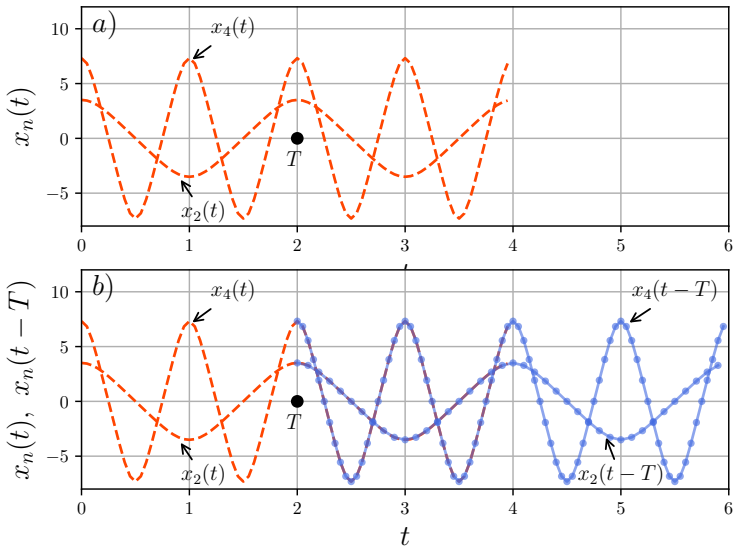
The load-bearing object is the lift identity $x(t-T)=(-1)^n x(t)$, which states that the delayed value is, up to sign, the current value for every member of the constructed family. Inserting this identity into the undelayed Duffing equation $x''+(-1)^n x+x^3=0$ reproduces exactly the delayed Duffing equation $x''(t)+x(t-T)+x^3(t)=0$. The explicit solutions are Jacobi elliptic functions $x_n(t)=A_n\,\mathrm{cn}(\omega_n t, m_n)$ with $\omega_n=\sqrt{A_n^2+(-1)^n}$ and $m_n=A_n^2/[2(A_n^2+(-1)^n)]$. The amplitude $A_n$ is fixed by the period condition $p_n=4K(m_n)/\omega_n=2T/n$, where $K$ is the complete elliptic integral of the first kind; as $n\to\infty$ this equation drives $p_n$ to zero and $A_n$ to infinity. This identity does the argument's work: it turns a countable subset of the continuum of ordinary Duffing periodic orbits into exact periodic orbits of the delay system.
What would settle it
Compute the dominant nontrivial Floquet exponent of the exact lifted cycle for one large odd $n$, say $n=101$ with $T=0.5$, using a high-precision DDE Floquet method; local asymptotic stability requires the real part to be negative. The conflict between the printed sign in equation (5.2) and the asserted stability makes this computation decisive: whichever sign the computation supports determines whether the theorem or the printed formula needs correction.
Extended reading notes
Core claim
The core claim is a symmetry-based exact correspondence between the ordinary Duffing oscillator and the delayed Duffing equation. Any positive-energy periodic solution $x_n$ of $x''+(-1)^n x+x^3=0$ with minimal period $p_n=2T/n$ satisfies $x_n(t-T)=(-1)^n x_n(t)$, and substituting this identity converts the undelayed equation into $x''+x(t-T)+x^3=0$. Thus every such ODE solution is an exact periodic solution of the DDE with delay $T$. The minimal periods $2T/n$ decrease to zero as $n$ increases, and since the Duffing period decreases monotonically with amplitude, the amplitudes $A_n$ increase to infinity; the paper supplies the exact equation $2T/n=4K(m_n)/\omega_n$ determining $A_n$, plus convergent series expansions for large $n$. The stability part, whose proof is deferred to the companion paper, is that for $T^2 < \tfrac{3}{2}\pi^2$ the odd-$n$ cycles are locally asymptotically stable for all sufficiently large $n$, while the even-$n$ cycles are linearly and nonlinearly unstable.
Load-bearing premise
The stability claim rests on the companion paper's Floquet analysis, which is cited but not carried out here; if that analysis is wrong, the assertion that large odd cycles are stable and large even cycles are unstable does not follow.
Editorial extensions
If this is right
- For every fixed delay satisfying $T^2 < \tfrac{3}{2}\pi^2$, the delayed Duffing equation has infinitely many coexisting stable limit cycles, one for each sufficiently large odd $n$, with amplitudes tending to infinity.
- The even-indexed members of the same exact family are unstable and appear to act as repelling boundaries between the basins of the stable odd cycles.
- The exact amplitude equation $2T/n=4K(m_n)/\omega_n$ makes each amplitude $A_n$ computable to arbitrary precision, and the convergent series expansions cover parameter ranges where direct numerics struggle.
- At the boundary $T^2=\tfrac{3}{2}\pi^2$, the odd cycles lose stability through a Neimark-Sacker torus bifurcation, producing additional periodic solutions that are not lifts of the undelayed Duffing orbits.
- The result confirms that the infinite-stable-cycle scenario previously obtained by averaging and harmonic balance is not an artifact of approximation: it is present in the exact equations.
Reading between the lines
- The lift mechanism is generic: any odd restoring force $g(x)$ should yield the same exact construction, so the delayed Duffing equation is a representative example of a whole class of delay systems with unbounded families of stable periodic orbits.
- Reading the paper's amplitude expansion at leading order predicts $A_n \sim \frac{\Gamma(1/4)^2}{2\sqrt{\pi}\,T}\,n$, so the cycle amplitudes grow linearly with the index $n$; numerical continuation for moderate $n$ could test this scaling directly.
- The stability theorem is stated for sufficiently large odd $n$, but the numerics in Section 6 show attraction to the $n=1$ cycle from a wide basin; an open question suggested by the paper is whether local stability actually extends to all odd $n$, not only large ones.
Signed reviews
Editorial analysis
A structured set of objections, weighed in public.
Referee Report
Summary. The manuscript studies the delayed Duffing equation x''(t)+x(t-T)+x^3(t)=0. Its central claim is that for any fixed delay T with 0<T^2<3\pi^2/2, the equation possesses an infinite, unbounded sequence of exact periodic solutions x_n with minimal period 2T/n and amplitudes A_n going to infinity; for all sufficiently large odd n these solutions are locally asymptotically stable, while for large even n they are linearly and nonlinearly unstable. Section 3 constructs these solutions by lifting periodic solutions of the non-delayed Duffing ODE (3.1) via the symmetry x_n(t-T)=(-1)^n x_n(t). Section 4 provides numerical and convergent series methods for computing the amplitudes A_n. Section 5 quotes stability theorems from the companion paper [Fie&al19], and Section 6 illustrates the results numerically for n=1,2.
Significance. The exact lift construction in Section 3 is a valuable and largely self-contained contribution: for even n the delay T is an integer multiple of the minimal period, and for odd n it is an odd multiple of the half-period, so the oddness symmetry (3.18) converts the ODE (3.16) into the DDE (1.1). The amplitude formulas are parameter-free, the elliptic-integral equation (4.2) is explicit, and the series expansions in Section 4 are claimed to be convergent, giving checkable quantitative predictions. If the stability claims are correct, the paper offers a clean exact counterpart to the earlier approximate analyses of Wahi-Chatterjee, Mitra et al., and Davidow et al. The main weakness is that the stability half of the abstract's claim is not proved in this manuscript, and the one quantitative stability formula printed, Eq. (5.2), has a sign that contradicts the stated theorems.
major comments (2)
- [Section 5, Eq. (5.2)] The printed formula \eta = (2/3)(-1)^{n+1}T^2 + \cdots gives a positive leading Floquet exponent for odd n and a negative one for even n. Since \eta is defined as the nontrivial exponent with real part closest to zero, this directly contradicts Theorem 5.1 (asymptotic stability for odd n) and Theorem 5.2 (instability for even n). The intended formula is presumably \eta = (2/3)(-1)^n T^2 + \cdots; as printed, the sign must be corrected or the sign convention clearly explained. This is load-bearing because Eq. (5.2) is the only quantitative stability asymptotics supplied in the paper.
- [Section 5] Theorems 5.1 and 5.2, which constitute the stability half of the central claim, are quoted from the companion paper [Fie&al19] and no proofs or Floquet-setup details are given in this manuscript; the text explicitly says 'For detailed mathematical proofs we have to refer to [Fie&al19]'. Since the abstract's assertion of asymptotically stable periodic solutions rests entirely on these imported results, the paper is not self-contained on its main advertised contribution. The authors should either include the stability proof (or at least a precise statement of all relevant Floquet exponents and their signs), or clearly mark the stability results as imported from the companion paper and verify that Eq. (5.2) is consistent with those results.
minor comments (4)
- [Section 5; Section 6] Theorem 5.1 and several later passages refer to 'the delayed Duffing equation (3.1)', but equation (3.1) is the non-delayed ODE; the DDE is equation (1.1). Please correct these cross-references.
- [Section 3.2 and 3.3] The monotonicity of the period-amplitude relation p(A) is asserted without proof. Existence of A_n follows from continuity and the endpoint limits, but the uniqueness implied by 'the amplitude A_n' and the use of a threshold n_0(T) depend on monotonicity; please add a proof or a precise reference.
- [Section 4] The notation m(A_n) and \omega(A_n) in Eq. (4.2) suppresses the parity dependence given in Eq. (3.10); a sentence making this explicit would improve readability.
- [Section 4, Eqs. (4.3)-(4.6)] The claim that the Taylor expansions are convergent would benefit from a brief justification, for example analyticity of K(m) at m=1/2 and the nonzero derivative of p(A) at A=\infty.
Circularity Check
No circular derivation: the exact lift and amplitude equation are self-contained; the stability theorem is imported from the authors' companion paper, which is a self-citation but not a circular input, and eq. (5.2) has a sign issue that is a correctness concern, not circularity.
full rationale
The derivation chain in Sections 3 and 4 does not close on itself. The lifted periodic solutions are constructed explicitly via the symmetry x_n(t-T)=(-1)^n x_n(t), using standard Jacobi-elliptic solutions of the non-delayed Duffing ODE, and the amplitudes A_n are defined by the implicit elliptic-integral equation (4.2), p_n=2T/n=4K(m(A_n))/omega(A_n). No parameter is fitted to the target property; the amplitude asymptotics are convergent series expansions rather than calibrated predictions. The stability half is the only part not proved in this text: Theorems 5.1 and 5.2 are quoted from [Fie&al19] with the sentence 'For detailed mathematical proofs we have to refer to [Fie&al19].' The authors overlap, so this is a genuine self-citation, but it is a separate parameter-free theorem with stated assumptions that do not include the target conclusion, so it functions as external proof rather than as a renamed input; I therefore treat it as a minor non-circular self-citation rather than as a circular step. I additionally note that the printed formula eta=2/3(-1)^{n+1}T^2+... appears to have the wrong sign for the claimed stability (odd n would give a positive exponent), which is a correctness/typo issue that should be corrected but is not an instance of circularity. No self-definitional, fitted-input, ansatz-smuggled, or renaming circularity was found.
Assumptions & free parameters
assumptions (5)
- standard math Exact periodic solutions of the non-delayed Duffing ODE x'' +/- x + x^3 = 0 are x_n(t)=A_n cn(omega_n t, m_n), with m_n and omega_n given by (3.10) and period p_n=4K(m_n)/omega_n.
- standard math The Hamiltonian H = (1/2)x_dot^2 + (1/2)(-1)^n x^2 + (1/4)x^4 is constant along solutions, and the selected orbits have H > 0.
- domain assumption For odd n, positive-energy solutions of the double-well Duffing ODE satisfy the half-period anti-symmetry x(t) = -x(t-p/2).
- ad hoc to paper The periodicity or anti-periodicity condition x_n(t-T) = (-1)^n x_n(t) with p_n = 2T/n maps the non-delayed ODE (3.1) to the delayed DDE (1.1).
- domain assumption The Floquet stability theorems 5.1 and 5.2 from [Fie&al19] are correct, including the threshold T^2 < 3π^2/2 and the existence of n0(T).
Cite this review
Pith. "Pith review of Unbounded sequences of stable limit cycles in the delayed Duffing equation: an exact analysis." pith.science (2026). https://pith.science/paper/66Q5NOD3
@misc{pith2026190806533,
  author       = {Pith},
  title        = {Pith review of: Unbounded sequences of stable limit cycles in the delayed Duffing equation: an exact analysis},
  year         = {2026},
  howpublished = {\url{https://pith.science/paper/66Q5NOD3}},
  note         = {Machine review of arXiv:1908.06533}
}
abstract
The delayed Duffing equation $\ddot{x}(t)+x(t-T)+x^3(t)=0$ is shown to possess an infinite and unbounded sequence of rapidly oscillating, asymptotically stable periodic solutions, for fixed delays such that $T^2<\tfrac{3}{2}\pi^2$. In contrast to several previous works which involved approximate solutions, the treatment here is exact.
Figures


Figures from the paper (5 more)


Reference graph
Works this paper leans on
-
[1]
P. Bogacki, L. F. Shampine. A 3(2) pair of Runge - Kutta formulas. Applied Mathematics Letters 2, 4, 321 ISSN 0893-9659, (1989)
work page 1989
-
[2]
M. Davidow, B. Shayak, R. H. Rand. Analysis of a remarkable singularity in a nonlinear DDE. Nonlinear Dynamics , (2017) 90:317-323
work page 2017
-
[3]
B. Fiedler, A. López Nieto, R.H. Rand, S.M. Sah, I. Schneider, B. de Wolff. Coexistence of infinitely many large, stable, rapidly oscillating periodic solutions in time-delayed Duffing oscillators. arXiv:1906.06602 (2019)
work page Pith review arXiv 2019
- [4]
-
[5]
I. Kovacic and M.J. Brennan (eds.). The Duffing Equation: Nonlinear Oscillators and their Behaviour. John Wiley & Sons, Chichester (2011)
work page 2011
- [6]
-
[7]
R.H. Rand. Topics in Nonlinear Dynamics with Computer Algebra, Computation in Education: Mathematics, Science and Engineering. Vol. 1, Gordon and Breach, Langhorne, PA (1994)
work page 1994
-
[8]
P. Wahi, A. Chatterjee. Averaging oscillations with small fractional damping and delayed terms. Nonlinear Dynamics , (2004) 38: 3–22
work page 2004
Reviewed August 14, 2026 · model on record in the stance chip above.
Discussion (0). Continue with ORCID to comment.