REVIEW 5 major objections 5 minor 21 references
ARCADE: A RAN Diagnosis Methodology in a Hybrid AI Environment for 6G Networks
T0 review · 5 major / 5 minor · reviewed 2026-08-06 · deepseek-v4-flash
Pith's one-line read ARCADE identifies cellular coverage anomalies using only georeferenced RSRP samples, with no design plans, KPIs, or analytical propagation models, and demonstrates how a hybrid AI architecture could enable this in 6G.
desk verdict A well-framed position paper that names a real RAN data-access problem and a plausible 6G architecture, but the ARCADE method itself is only a sketch, with no validation and a load-bearing gap around GP smoothing. read the letter →
The pith
A machine-rendered reading of the paper's core claim, the machinery that carries it, and where it could break.
The reading
What carries the argument
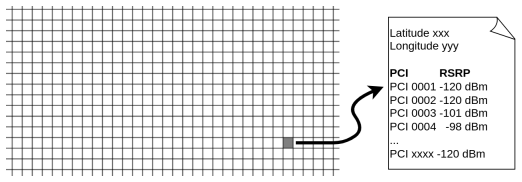
The load-bearing mechanism is the coverage-extrapolation and anomaly-emphasis pipeline. Sparse, georeferenced RSRP samples for each physical cell ID are interpolated over the full grid using a Gaussian process with a radial basis function kernel; the sample set is then separated into normal and abnormal regions, the abnormal regions are augmented to prevent them from being averaged away, and an artificial neural network is trained on the augmented field to produce a complete coverage model per cell. This model feeds a set of cluster-context indicators (Coverage Index, Interfering Index, Interfered Index, Overlap Index, Coverage Quality Index, and Coverage Matrix) that turn raw signal levels into judgments about whether a cell is over- or under-covering relative to its neighbors. The Gaussian-process-plus-augmentation-plus-neural-network chain is what is supposed to preserve anomaly structure while discarding measurement noise.
What would settle it
Feed ARCADE a synthetic or field dataset in which cell overshooting is known from antenna configurations and drive tests, with RSRP samples removed to simulate sparsity. If the pipeline's detected anomaly regions do not match the known overshoot regions substantially better than random or than a simple threshold on raw RSRP, the central claim fails. A more targeted test is to reconstruct a known coverage field with an implanted anomaly and check whether the anomaly remains visible after the Gaussian-process step and before the ANN stage.
Extended reading notes
Core claim
On its own terms, the paper's central claim is that coverage anomalies in a cellular system can be identified from georeferenced RSRP data alone, even when the data are sparse and the system is observed as a cluster of cells rather than a single site. The proposed pipeline treats each cell's signal measurements as points on a grid, uses Gaussian processes with a radial basis function kernel to extrapolate coverage over the whole area, classifies grid regions as normal or abnormal, augments the abnormal regions to keep them visible during training, and then trains an artificial neural network that models coverage for every grid element. Cell-level indicators — Coverage Index, Interfering Index, Interfered Index, Overlap Index, Coverage Quality Index, and a Coverage Matrix — are then used to judge each cell in the context of its neighbors and to diagnose the radio access network. The paper does not derive these indicators formally or report detection results; its contribution is the claim that the pipeline is sufficient, plus a concrete architecture for delivering its inputs in a future 6G network.
Load-bearing premise
The method's detection claim rests on the assumption that after sparse signal-strength data are filled in with Gaussian-process interpolation, the neural-network stage can still recognize distorted coverage areas as anomalies instead of smoothing them into the normal coverage picture.
Editorial extensions
If this is right
- Operators could diagnose radio access coverage problems from measurement data they already collect, without maintaining up-to-date design plans or KPI dashboards.
- Because the input is only georeferenced RSRP, MDT records and crowdsourced signal data become viable inputs for automated RAN diagnosis.
- In the proposed 6G hybrid architecture, AI agents embedded in base stations give the core analytics function access to measurement reports that current NWDAF cannot reach.
- MDT data can be used to train an ANN that infers coordinates for non-georeferenced measurement reports, increasing the volume of usable samples for ARCADE.
- ARCADE serves as a template for other access-network analytics applications that need raw RAN data in a future 6G core.
Reading between the lines
- The core risk the paper leaves implicit is that Gaussian-process interpolation is a smoothing operator, and the same smoothness that discards device noise may erase exactly the small anomaly regions the method is meant to find; a reconstruction-quality test on synthetic overshooting scenarios would settle this.
- The indicator names are presented without definitions or thresholds, so the actual detection performance is not yet a concrete, repeatable result even where the pipeline is fully described.
- Avoiding analytical propagation models does not mean avoiding propagation assumptions: the radial basis function kernel itself encodes a spatial-correlation model, and comparing ARCADE against simple path-loss baselines would reveal where the no-model claim is true.
- The hybrid AI-Agent plus evolved-NWDAF pattern could generalize beyond RAN to other raw-data sources isolated from the core, such as transport or edge infrastructure, but the paper demonstrates only the RAN case.
Editorial analysis
A structured set of objections, weighed in public.
Referee Report
Summary. The paper presents ARCADE, a proposed methodology for automated detection and diagnosis of cellular radio coverage anomalies, using only georeferenced RSRP measurements from a cluster of cells and avoiding RBS design plans, KPI-based management data, and analytical path-loss models. The methodology is described at a conceptual level: sparse RSRP samples are placed on a grid, coverage is extrapolated with a Gaussian process using an RBF kernel, anomaly regions are augmented, and an ANN is trained to model coverage; six named coverage/interference indicators are then to be used for diagnosis. The paper also situates ARCADE within a proposed hybrid 6G core architecture, the eNWDAF, previously introduced in a self-cited workshop paper, where AI-Agents in the RAN collect measurement data that the current 5G NWDAF cannot access. The authors state explicitly that a full description of ARCADE and its validation are left to future work, and no experimental data, simulations, ground truth, or comparisons with existing methods are provided.
Significance. If the method and architecture were validated, ARCADE would address a real operational problem: automating RAN anomaly diagnosis from sparse, low-cost measurement data without requiring design or KPI data. The paper's clear statement of the data-access limitations of the current 5G NWDAF and the idea of placing AI-Agents in the RAN as a hybrid alternative to fully centralized or fully distributed analytics are useful conceptual contributions. The paper is honest about its scope, explicitly deferring implementation and validation. However, the current manuscript contains no evidence for the central detection claim, and as a result the contribution is an architectural and methodological position statement rather than a validated system.
major comments (5)
- [Section 3.1 vs. Section 3.3] The paper contains an internal contradiction about prediction models. Section 3.1 states that 'ARCADE does not employ mathematical prediction models' and cites Okumura, Hata, and COST-231 as excluded examples. Section 3.3 then describes coverage extrapolation using Gaussian processes with an RBF kernel and training an artificial neural network. Gaussian process regression and ANNs are mathematical prediction models, so the claim as written is false. If the intended meaning is that ARCADE excludes only analytical/closed-form path-loss models while allowing data-driven models, this must be stated explicitly and consistently. The distinction is load-bearing because the novelty claims in Section 3.1 and Table 1 depend on the 'independence from analytical prediction models' criterion.
- [Section 3.3] The anomaly-extrapolation pipeline is circular as described. The text says 'Once the samples are classified, the total grid area is divided into normal and abnormal regions' and then applies sample augmentation to the anomaly areas before ANN training. However, no classification method that distinguishes coverage anomalies from measurement errors is presented anywhere in the paper. The augmentation step therefore presupposes exactly the anomaly labels that the overall method is supposed to produce. The manuscript needs a concrete, self-contained procedure for obtaining normal/abnormal labels, or a clear statement that this labeling is an unsupervised step independent of the ANN, together with the algorithm for doing it.
- [Section 3.3] The central technical assumption is unsupported: that Gaussian process extrapolation with an RBF kernel preserves coverage anomalies rather than smoothing them away. In data-sparse regions, the GP posterior mean regresses toward the prior mean, which can attenuate the very overshooting deviations that ARCADE aims to detect. No quantitative argument, simulation, synthetic-data experiment, or real-world case study is provided to show that this attenuation is small enough for the subsequent ANN to recover the anomalies. Without such evidence, the core claim in Section 3.1 that ARCADE enables automated identification of coverage anomalies from sparse RSRP data alone is unverified. I would expect at least a controlled experiment on synthetic RSRP fields with known anomaly injections and a comparison against a baseline (e.g., interpolation without augmentation, or a direct anomaly-detection method).
- [Section 3.4] The coverage and interference indicators are named but never defined. Section 3.4 lists Coverage Index, Interfering Index, Interfered Index, Overlap Index, Coverage Quality Index, and Coverage Matrix, but gives no formulas, no input data specification, no interpretation rules, and no description of how these indicators lead to a diagnosis. As written, the 'Coverage Anomaly Identification' section is a list of labels rather than a diagnostic method. This omission directly undermines the paper's stated goal of 'identifying and diagnosing anomalies.' At a minimum, each indicator needs a precise definition and a description of the decision procedure that identifies anomalous cells.
- [Sections 3 and 6] The paper explicitly states that a detailed description of ARCADE is deferred to future work and that 'the implementation of ARCADE must be completed' as a next step. There is no dataset, no ground-truth anomaly annotation, no comparison with any of the related works in Table 1, and no quantitative evaluation of any part of the pipeline. The paper therefore does not currently support its claim of presenting a methodology, because a methodology with no specified classification procedure, no parameter choices, no defined indicators, and no empirical validation is not yet a usable method. This is not a cosmetic omission; it is the difference between a position paper and a methodological contribution.
minor comments (5)
- [Table 1] The legend says 'Small dots indicate that a given criterion does not apply,' but the table uses circle symbols (○ and ○␣) rather than dots. The legend should be updated to match the actual symbols, and the meaning of the half-filled circle (○␣) should be explained.
- [Section 2] The paper says that a detailed overview of the hybrid approach 'cannot be included here' and refers the reader to [Neto et al. 2024]. Since the hybrid architecture is central to the positioning of ARCADE, at least a one-paragraph summary of how eNWDAF and AI-Agents collect and transport RAN data should be included; currently Section 5 assumes that the reader has access to the external workshop paper.
- [Section 5] There is a consistency issue about georeferencing. Section 3.2 says MDT data are georeferenced, while Section 5 says MR measurements lack georeferencing but MDT can train an ANN to infer MR coordinates. Clarify which data source ARCADE's georeferenced RSRP input is expected to use in practice, and reconcile the two descriptions.
- [Section 3.1] The acronym RBS is used without expansion at first use. Define 'Radio Base Station' when it first appears.
- [Title and abstract] The phrase 'hybrid AI environment' is not defined in the main text. Specify what makes the proposed environment hybrid (e.g., centralized eNWDAF plus distributed AI-Agents) at the point of first use, since this is the main claimed architectural contribution.
Circularity Check
The anomaly labels used to augment training data are the same labels the pipeline claims to output, and the 6G hybrid architecture is imported from a same-author citation; the central detection claim is therefore partially circular.
-
fitted input called prediction
[Section 3.3 (Coverage Extrapolation)]
"Once the samples are classified, the total grid area is divided into normal and abnormal regions, referring to areas where coverage is expected versus areas where coverage results from anomalies such as cell overshooting. Once each cell’s normal and abnormal regions are defined, sample augmentation is applied to the coverage anomaly areas. ... After this sequence of processes, the entire RF environment is ultimately described, enabling the classification of cells based on the normality of their coverage."
The pipeline establishes normal/abnormal labels before any modeling, then augments the anomaly regions so that the ANN "effectively captures potential overshooting effects." The ANN is trained on this augmented data, produces the coverage model, and the coverage model is used to classify cells by normality. The final anomaly classification is therefore a readback of the pre-supplied labels baked into the training data, not an independent detection from raw georeferenced RSRP. The paper never specifies an automatic, RSRP-only procedure for the initial sample classification; either that unspecified step is the real detector (making the ANN a post-processor) or the labels come from outside the claimed input.
-
self citation load bearing
[Sections 2 and 4 (Related Work; Evolved NWDAF and the Hybrid Approach)]
"The hybrid architecture for NWDAF and the definition of Enhanced Network Data Analytics Function (eNWDAF) were proposed in [Neto et al. 2024]. ... Due to space constraints, a detailed overview of the proposed hybrid approach for the NWDAF cannot be included here. However, a comprehensive discussion is available in [Neto et al. 2024]."
The eNWDAF and AI-Agent architecture is the foundation of the paper's "hybrid AI environment" framing, but it is not derived or validated in this manuscript; it is taken wholesale from Neto et al. (2024), which shares the present authors Oliveira, Moreira, and Silva. Because the paper's claimed demonstration of a 6G hybrid architecture rests on this self-cited prior work, the architectural half of the contribution reduces to a self-citation chain rather than to independent evidence. This does not affect the RSRP-processing steps directly, but it makes the overall "hybrid AI" claim dependent on the authors' own prior publication.
full rationale
ARCADE is not a fitted numerical study: there are no trained parameters, datasets, or benchmarks, so there is no classic "fit on subset, predict on superset" loop. The main circularity is methodological and central. Section 3.3 first classifies samples into normal and abnormal regions, then augments the abnormal regions before training the ANN, and finally uses the ANN-based coverage model to classify cells by the normality of their coverage. The anomaly concept therefore enters as an input label and reappears as the output classification; the paper even admits that "the potential confusion between coverage anomalies and measurement errors necessitates a sample classification methodology" without saying where that classification comes from. If the initial classification is automatic, it is the actual detector and the GP/ANN stage is post-processing; if it is manual or external, ARCADE does not rely solely on georeferenced RSRP. Either way the central claim is not independent. Separately, the eNWDAF/AI-Agent architecture that frames the "hybrid AI environment" is imported from a same-author citation (Neto et al. 2024) and is load-bearing for Sections 4 and 5, though it is not the core RSRP-detection claim. The paper's own statements that a detailed ARCADE description and implementation are deferred to future work, and the absence of any dataset or evaluation, mean these circularities are in the design description rather than demonstrated numerical results. On balance, the central detection methodology reduces by construction to the pre-supplied anomaly labels, giving a score of 6.
Assumptions & free parameters
free parameters (3)
- Gaussian process RBF kernel hyperparameters
- ANN architecture and training hyperparameters
- Sample augmentation quantity for anomaly regions
assumptions (4)
- domain assumption RSRP samples with geolocation are sufficient to detect coverage anomalies without design plans or KPIs
- domain assumption Coverage anomalies that cause overshooting are learnable from GP-extrapolated RSRP data with RBF kernels
- domain assumption The eNWDAF hybrid architecture from Neto et al. 2024 correctly extends NWDAF to access RAN data
- ad hoc to paper Augmenting anomaly regions before ANN training prevents overfitting in coverage modeling
invented entities (3)
-
eNWDAF (Enhanced Network Data Analytics Function)
-
AI-Agent
-
ARCADE coverage indicators (Coverage Index, Interfering Index, Interfered Index, Overlap Index, Coverage Quality Index, Coverage Matrix)
Cite this review
Pith. "Pith review of ARCADE: A RAN Diagnosis Methodology in a Hybrid AI Environment for 6G Networks." pith.science (2026). https://pith.science/paper/66VVOA3L
@misc{pith2026250717861,
  author       = {Pith},
  title        = {Pith review of: ARCADE: A RAN Diagnosis Methodology in a Hybrid AI Environment for 6G Networks},
  year         = {2026},
  howpublished = {\url{https://pith.science/paper/66VVOA3L}},
  note         = {Machine review of arXiv:2507.17861}
}
read the original abstract
Artificial Intelligence (AI) plays a key role in developing 6G networks. While current specifications already include Network Data Analytics Function (NWDAF) as a network element responsible for providing information about the core, a more comprehensive approach will be needed to enable automation of network segments that are not yet fully explored in the context of 5G. In this paper, we present Automated Radio Coverage Anomalies Detection and Evaluation (ARCADE), a methodology for identifying and diagnosing anomalies in the cellular access network. Furthermore, we demonstrate how a hybrid architecture of network analytics functions in the evolution toward 6G can enhance the application of AI in a broader network context, using ARCADE as a practical example of this approach.
Figures


Figures from the paper (1 more)

Reference graph
Works this paper leans on
-
[1]
System architecture for the 5g system (5gs)
3GPP (2023). System architecture for the 5g system (5gs). Technical Specification TS 23.501, 3rd Generation Partnership Project (3GPP). Release 18
work page 2023
-
[2]
3GPP (2024). 3rd generation partnership project; technical specification group radio access network; radio measurement collection for minimization of drive tests (mdt); overall description; stage 2. Technical Report TS 37.320, 3GPP
work page 2024
-
[3]
Abbas, K., Khan, T. A., Afaq, M., and Song, W.-C. (2022). Ensemble Learning -based Network Data Analytics for Network Slice Orchestration and Management : An Intent - Based Networking Mechanism . In NOMS 2022-2022 IEEE / IFIP Network Operations and Management Symposium , pages 1--5. ISSN: 2374-9709
work page 2022
-
[4]
Carmack, J. et al. (2021). Neural Network Generative Models for Radio Frequency Data . In 2021 IEEE 12th Annual Ubiquitous Computing , Electronics & Mobile Communication Conference ( UEMCON ) , pages 0577--0582, New York, NY, USA. IEEE
work page 2021
-
[5]
Cheerla, S., Ratnam, D. V., and Borra, H. S. (2018). Neural network-based path loss model for cellular mobile networks at 800 and 1800 MHz bands. AEU - International Journal of Electronics and Communications , 94:179--186
work page 2018
-
[6]
Deng, J. et al. (2021). A Digital Twin Approach for Self -optimization of Mobile Networks . In 2021 IEEE Wireless Communications and Networking Conference Workshops ( WCNCW ) , pages 1--6, Nanjing, China. IEEE
work page 2021
-
[7]
Dreifuerst, R. M. et al. (2021). Optimizing Coverage and Capacity in Cellular Networks using Machine Learning . In ICASSP 2021 - 2021 IEEE International Conference on Acoustics , Speech and Signal Processing ( ICASSP ) , pages 8138--8142, Toronto, ON, Canada. IEEE
work page 2021
-
[8]
Gehlot, A. et al. (2022). Application of Neural Network in the Prediction Models of Machine Learning Based Design . In 2022 ICSES , pages 1--6, Chennai, India. IEEE
work page 2022
Show all 21 references
-
[9]
Jeon, Y., Jeong, H., Seo, S., Kim, T., Ko, H., and Pack, S. (2022). A distributed nwdaf architecture for federated learning in 5g. In 2022 IEEE International Conference on Consumer Electronics (ICCE) , pages 1--2
2022
-
[10]
Kirkwood, C., Economou, T., Pugeault, N., and Odbert, H. (2022). Bayesian Deep Learning for Spatial Interpolation in the Presence of Auxiliary Information . Mathematical Geosciences , 54(3):507--531
2022
-
[11]
S., Gonçalves, M., Oliveira, D., Molinos, D., Moreira, R., and Silva, F
Neto, N. S., Gonçalves, M., Oliveira, D., Molinos, D., Moreira, R., and Silva, F. (2024). Evolved nwdaf towards a fully distributed artificial intelligence in the 6g network architecture. In Anais do IV Workshop de Redes 6G , pages 15--25, Porto Alegre, RS, Brasil. SBC
2024
-
[12]
X., Trestian, R., To, D., and Tatipamula, M
Nguyen, H. X., Trestian, R., To, D., and Tatipamula, M. (2021). Digital Twin for 5G and Beyond . IEEE Communications Magazine , 59(2):10--15
2021
-
[13]
Ojo, S., Imoize, A., and Alienyi, D. (2021). Radial basis function neural network path loss prediction model for LTE networks in multitransmitter signal propagation environments. International Journal of Communication Systems , 34(3):e4680
2021
-
[14]
Schölkopf, B. (2002). Learning with kernels: support vector machines, regularization, optimization, and beyond . Adaptive computation and machine learning. MIT Press, Cambridge, Mass
2002
-
[15]
Singh, Y. (2012). Comparison of Okumura , Hata and COST -231 Models on the Basis of Path Loss and Signal Strength . International Journal of Computer Applications , 59
2012
-
[16]
Skocaj, M. et al. (2022). Cellular Network Capacity and Coverage Enhancement with MDT Data and Deep Reinforcement Learning . Computer Communications , 195:403--415
2022
-
[17]
Tang, Z. et al. (2023). Multi- Output Gaussian Process - Based Data Augmentation for Multi - Building and Multi - Floor Indoor Localization . arXiv:2202.01980 [cs]
2023 arXiv
-
[18]
Wang, M. (2018). Anomaly Detection for Mobile Network Management . 9(2):19
2018
-
[19]
Wu, J., Li, R., An, X., Peng, C., Liu, Z., Crowcroft, J., and Zhang, H. (2021). Toward Native Artificial Intelligence in 6G Networks : System Design , Architectures , and Paradigms . arXiv:2103.02823 [cs] . arXiv: 2103.02823
2021 arXiv
-
[20]
and Peng, Y
Zhou, T. and Peng, Y. (2023). Gaussian process regression based on deep neural network for reliability analysis in high dimensions. Structural and Multidisciplinary Optimization , 66(6):131
2023
-
[21]
write newline
" write newline "" before.all 'output.state := FUNCTION fin.entry add.period write newline FUNCTION new.block output.state before.all = 'skip after.block 'output.state := if FUNCTION new.sentence output.state after.block = 'skip output.state before.all = 'skip after.sentence '...
Reviewed August 6, 2026 · model on record in the stance chip above.
Discussion (0). Continue with ORCID to comment.