REVIEW 2 major objections 5 minor 12 references
Linear Stochastic Dividend Model
T0 review · 2 major / 5 minor · reviewed 2026-08-14 · deepseek-v4-flash
Pith's one-line read Capping dividends by a stock fraction yields closed-form futures
desk verdict A genuinely useful single-factor dividend model with closed-form futures prices, but the uniqueness-in-law proof needs a patch before the paper is watertight. read the letter →
The pith
A machine-rendered reading of the paper's core claim, the machinery that carries it, and where it could break.
The reading
What carries the argument
The central object is the state space $E$ with the upper bound $D_t \le a X_t$, which couples the dividend rate to the stock price so dividends go to zero with the price. Carrying the argument is the linear drift structure of $(X_t, Y_t)$: the generator maps polynomials to polynomials ($G\mathrm{Pol}_n \subseteq \mathrm{Pol}_n$), which makes $(C_t, X_t, Y_t)$ a polynomial diffusion and yields the moment formula (12). The no-bubble result uses the linear ODE system for discounted expectations plus Barbalat's lemma to show $\lim_{T\to\infty} E_t[e^{-r(T-t)} X_T] = 0$.
What would settle it
Evaluate the diffusion coefficient of $Y_t/X_t$ from the SDEs (2)-(3) near the boundary $X_t = 0$; if it behaves like $1/\sqrt{X_t}$ and is not uniformly bounded on the state space, then the cited uniqueness theorem (Ikeda–Watanabe Theorem IV.3.3) does not apply and the model's pricing formulas are not attached to a single well-defined solution.
Extended reading notes
Core claim
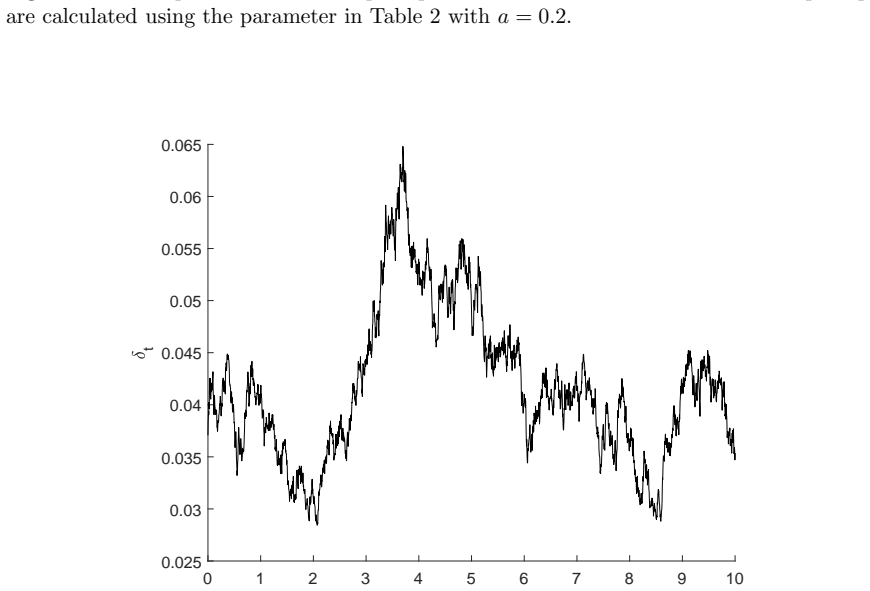
The paper claims that the SDE pair (2)-(3) defines a unique solution in $E = \{x>0, y\ge 0, 1^\top y \le ax\}$ under parameter conditions (4)-(5), with the stock price strictly positive and the dividend rate nonnegative; that the augmented process $(C_t, X_t, Y_t)$ is a polynomial diffusion so all conditional moments are available in closed form through the matrix-exponential formula $E_t[H_n(C_T,X_T,Y_T)] = e^{G_n(T-t)} H_n(C_t,X_t,Y_t)$; and that, when $1^\top b > 0$, the stock price equals the present value of all future dividends, so the model contains no bubble. On this basis futures prices are explicit and option prices are approximated by matching moments with the maximum-entropy density.
Load-bearing premise
The load-bearing step is the claim that $(\log X_t, Y_t/X_t)$ has uniformly bounded drift and diffusion coefficients; the diffusion of $Y_t/X_t$ near $X_t = 0$ involves a $1/\sqrt{X_t}$ factor, so that boundedness is not established and uniqueness in law is unsupported as written.
Editorial extensions
If this is right
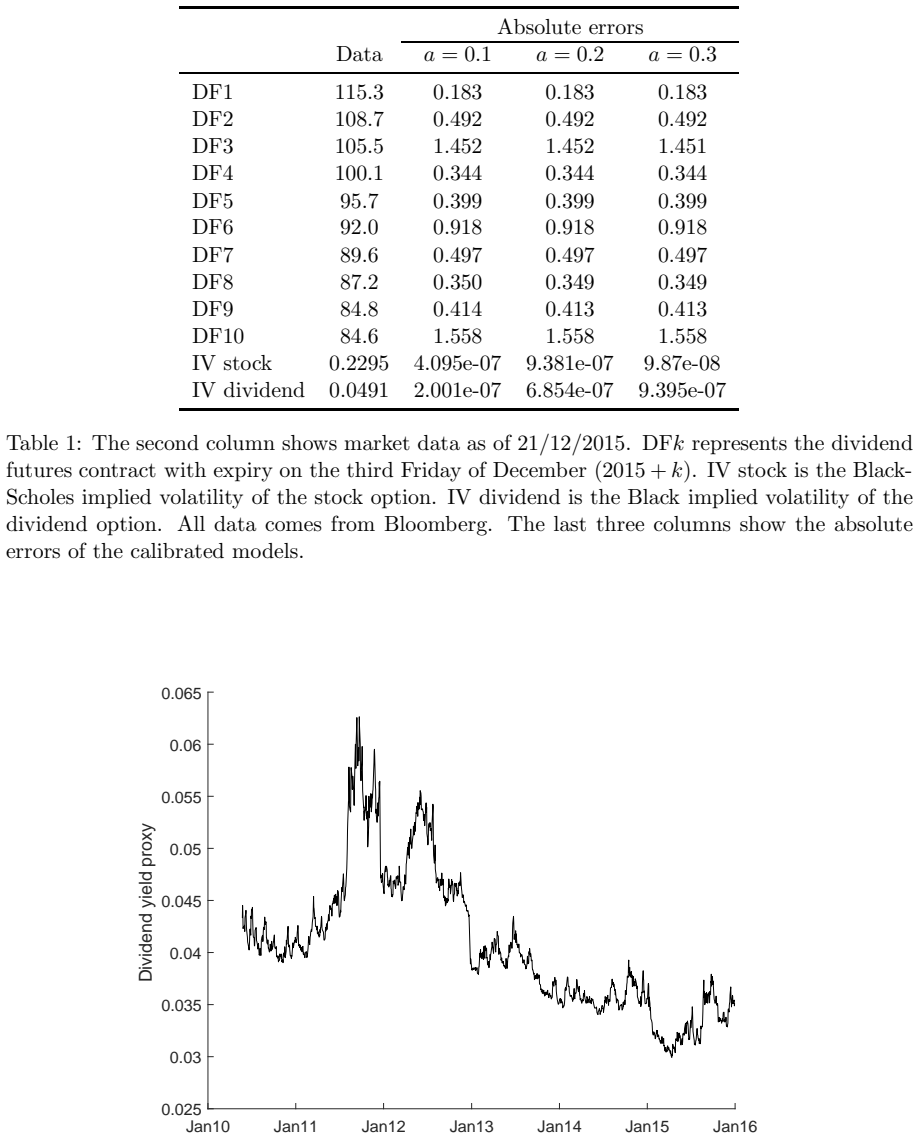
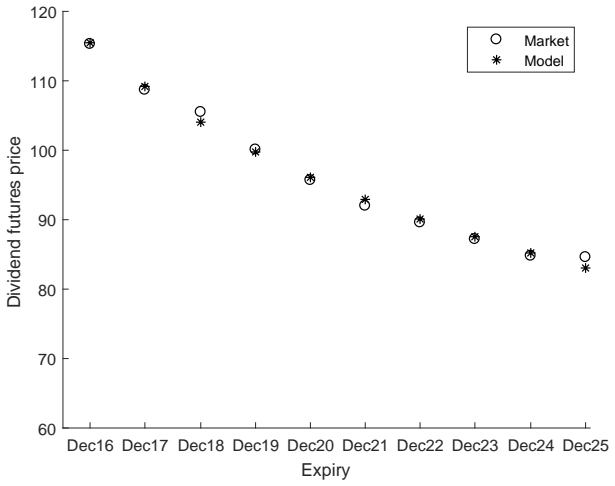
- Stock and dividend futures prices are available in closed form, and the volatility parameters $\sigma$ and $\nu$ do not enter futures prices, so they can be calibrated separately to derivatives.
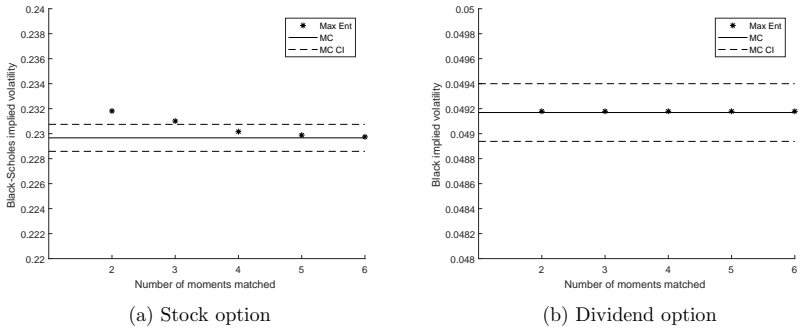
- Stock and dividend option prices can be approximated by a maximum-entropy density matched to the first $N$ moments, with $N$ as small as four for stock options and two for dividend options in the numerical study.
- Under the parameter condition $1^\top b > 0$, the stock price is equal to the present value of future dividends, ruling out a price bubble in the model.
- The single-factor specification reproduces the empirical pattern of low volatility in short-dated dividend futures and high volatility in long-dated ones and the stock.
- Adding jumps in the stock price preserves the polynomial property, so the same moment machinery extends to jump-diffusion versions.
Reading between the lines
- If the polynomial structure is the point, the same state-space-bound trick could be applied to other linear factor models, such as in credit or commodity markets, where a positive non-traded quantity must track a traded underlying.
- The no-bubble condition $1^\top b > 0$ is testable empirically: if the model is right, long-dated dividend futures should move one-for-one with the stock index, while short-dated ones should have their own dynamics.
- The moment-matching approach could be extended to more complex exotics, such as Asian options on cumulative dividends, because all mixed moments of $(C_T, X_T)$ are known in closed form.
- A potential route to discrete dividends is to define $D_t$ as an intensity and make actual payments a point process; the polynomial property would survive if the jump intensity is affine in the factors.
Signed reviews
Editorial analysis
A structured set of objections, weighed in public.
Referee Report
Summary. The paper introduces a continuous-time model for jointly pricing stock and dividend derivatives. The dividend rate D_t is a linear function of a factor process Y_t, and the stock price X_t is specified so that it remains positive while the dividend yield is bounded by a constant a. The dynamics form a polynomial diffusion, yielding closed-form conditional moments, futures prices, and maximum-entropy option approximations. A single-factor version is calibrated to Euro Stoxx 50 dividend futures and ATM options with small errors. The paper also proves absence of price bubbles under the condition 1^T b > 0 and extends the model with jumps in the stock price.
Significance. If the well-posedness gap identified below is fixed, this is a useful and tractable addition to the dividend-derivative literature. The main strengths are the closed-form linear derivative prices, the moment-based approximation for options, and the explicit no-bubble result showing that the stock price equals the present value of future dividends. The calibration exercise is transparent and demonstrates a good fit to a ten-maturity dividend futures curve plus two at-the-money options. The paper also gives self-contained computations of the generator and moment formula, and the jump extension preserves the polynomial structure.
major comments (2)
- [Appendix A.1 (Proof of Proposition 2.1)] The uniqueness-in-law proof is incomplete. The final paragraph states that (log X_t, Y_t/X_t) has a uniformly bounded drift and diffusion function, so uniqueness follows from Ikeda–Watanabe (1981, Theorem IV.3.3). The boundedness assertion is correct: Y_t/X_t lies in the compact simplex {z >= 0, 1^T z <= a}, and the diffusion coefficient of the transformed process contains no 1/sqrt(X_t) singularity. The problem is that boundedness alone is not a sufficient condition for weak uniqueness of a degenerate multi-dimensional SDE, and the hypotheses of Theorem IV.3.3 are neither stated nor verified. In particular, the diagonal diffusion coefficient nu_k sqrt(z_k (1 - 1^T z / a)) is not Lipschitz at z_k = 0, so a Lipschitz-based uniqueness theorem does not apply. Because the moment formula (12) and the futures pricing formulas (13)-(14) require expectations under a unique risk-neutral measure, this gap is load-bearing. A fix is likely available from the polynomial-diffusion well-posedness results of Filipović–Larsson (2016) or a Yamada–Watanabe argument for the diagonal coefficients, but the current text does not supply it.
- [Appendix A.1 (Proof of Proposition 2.1, existence step)] The existence step cites Ikeda–Watanabe Theorem IV.2.4 for an R^{1+d}-valued solution because the drift and dispersion coefficients satisfy a linear growth condition. However, the dispersion coefficient contains sqrt(x - 1^T y / a), which is not defined when x < 1^T y / a. To apply a global existence theorem, the coefficients must be extended from E to all of R^{1+d} in a way that preserves linear growth and continuity, and the extended system must be shown to have a solution that does not leave E before it is shown that it cannot leave E. As written, the existence argument is incomplete. This is a technical but fixable gap that should be addressed in the revision.
minor comments (5)
- [Introduction and Section 2] There are repeated words: 'of of' in the Introduction and 'linear hypercube model model' in Section 2.
- [Appendix A.1, equation (19)] The index in the minimum is written 'min_{l≠d}' and should be 'min_{l≠k}'.
- [Section 3.3] The maximum-entropy method should briefly discuss the existence and uniqueness of the exponential-form density for a given moment vector; not every moment sequence lies in the interior of the feasible set, and the numerical solver's behavior is not described.
- [Section 5, jump generator] In the expression for the jump generator, the term '− f − (x − 1^T y/a)z f_x' appears to be missing the second function evaluation; it should read 'f(c, x + (x - 1^T y/a)z, y) - f(c,x,y) - (x - 1^T y/a)z f_x'.
- [Appendix A.2] 'To proof that' should be 'To prove that'.
Circularity Check
No significant circularity: pricing formulas are derived from the specified SDEs; the one self-citation is methodological, and the perfect option fit is an acknowledged in-sample calibration.
full rationale
The derivation chain is self-contained. Proposition 2.1 imposes explicit parameter conditions (4)-(7) and sketches existence and boundary non-attainment using the generator and comparison arguments; Section 3 computes the generator G directly from the stated dynamics (2)-(3) and obtains the moment formula (12) and futures prices (13)-(14) as algebraic consequences, not as model inputs. Proposition 2.3 derives the no-bubble property from the linear ODE for conditional expectations and Barbalat's lemma; it does not assume equation (8). The numerical section calibrates b, beta, sigma, nu1, and D0 to market data; the 'perfect' match of the two at-the-money option implied volatilities is explicitly explained as a consequence of sigma and nu1 being free once dividend futures are matched, so it is an in-sample fit rather than a predicted out-of-sample quantity. The citations to Filipovic-Willems (2018) and Filipovic-Larsson (2016) are used for the max-entropy approximation scheme and polynomial-diffusion technology; the present paper verifies its own polynomial invariance ('It is easily verified that GPol_n subset Pol_n') and supplies its own boundary and no-bubble proofs. The cited framework is external and not load-bearing in the sense of assuming the target results. The only notable technical weakness is in Appendix A.1: the claim that uniform boundedness of the drift and diffusion of (log X_t, Y_t/X_t) suffices for uniqueness in law via Ikeda-Watanabe Theorem IV.3.3 is not substantiated by a statement and verification of that theorem's hypotheses, and the square-root coefficients are non-Lipschitz near zero. That is a correctness gap in an external theorem application, not a circularity, because it does not assume the uniqueness conclusion or any pricing formula.
Assumptions & free parameters
free parameters (7)
- a =
0.1, 0.2, 0.3
- r =
0.01
- b =
0.0103
- beta =
-0.3440
- sigma =
0.3621, 0.2813, 0.2614
- nu1 =
0.0220, 0.0194, 0.0187
- D0 =
0.0371
assumptions (5)
- standard math Linear growth of drift and dispersion coefficients guarantees weak existence of an R^{1+d}-valued solution to the SDE.
- standard math Polynomial diffusion theory, including Theorem 5.7 of Filipovic and Larsson (2016), provides boundary non-attainment criteria and closed-form moment formulas.
- ad hoc to paper The maximum-entropy problem with moment constraints has a unique solution of exponential form.
- domain assumption Continuously paid dividends are an acceptable approximation for index dividend derivatives.
- ad hoc to paper The transformed process (log X_t, Y_t/X_t) has uniformly bounded drift and diffusion.
invented entities (1)
-
Latent factor process Y_t
Cite this review
Pith. "Pith review of Linear Stochastic Dividend Model." pith.science (2026). https://pith.science/paper/6A3PJNHJ
@misc{pith2026190805850,
  author       = {Pith},
  title        = {Pith review of: Linear Stochastic Dividend Model},
  year         = {2026},
  howpublished = {\url{https://pith.science/paper/6A3PJNHJ}},
  note         = {Machine review of arXiv:1908.05850}
}
read the original abstract
In this paper we propose a new model for pricing stock and dividend derivatives. We jointly specify dynamics for the stock price and the dividend rate such that the stock price is positive and the dividend rate non-negative. In its simplest form, the model features a dividend rate that is mean-reverting around a constant fraction of the stock price. The advantage of directly specifying dynamics for the dividend rate, as opposed to the more common approach of modeling the dividend yield, is that it is easier to keep the distribution of cumulative dividends tractable. The model is non-affine but does belong to the more general class of polynomial processes, which allows us to compute all conditional moments of the stock price and the cumulative dividends explicitly. In particular, we have closed-form expressions for the prices of stock and dividend futures. Prices of stock and dividend options are accurately approximated using a moment matching technique based on the principle of maximal entropy.
Figures
Figures from the paper (1 more)
Reference graph
Works this paper leans on
-
[1]
Ackerer, D. and D. Filipovi \'c (2019). Linear credit risk models. Finance and Stochastics\/ , Forthcoming
work page 2019
-
[2]
Baskin, J. (1989). Dividend policy and the volatility of common stocks. Journal of Portfolio Management\/ 15\/ (3), 19
work page 1989
-
[3]
Buehler, H. (2018). Volatility and dividends II : Consistent cash dividends. Available at SSRN 2639318\/
work page 2018
-
[4]
Buehler, H., A. Dhouibi, and D. Sluys (2010). Stochastic proportional dividends. Working Paper\/
work page 2010
-
[5]
Filipovi \'c , D. and M. Larsson (2016). Polynomial diffusions and applications in finance. Finance and Stochastics\/ 20\/ (4), 931--972
2016
-
[6]
Filipovi \'c , D. and S. Willems (2018). A term structure model for dividends and interest rates. Swiss Finance Institute Research Paper\/
work page 2018
-
[7]
Guennoun, H. and P. Henry-Labordere (2017). Equity modeling with stochastic dividends. Available at SSRN 2960141\/
work page 2017
-
[8]
Hajek, B. (1985). Mean stochastic comparison of diffusions. Zeitschrift f \"u r Wahrscheinlichkeitstheorie und verwandte Gebiete\/ 68\/ (3), 315--329
work page 1985
Show all 12 references
-
[9]
Ikeda, N. and S. Watanabe (1981). Stochastic Differential Equations and Diffusion Processes , Volume 24. Elsevier
1981
-
[10]
Jaynes, E. T. (1982). On the rationale of maximum-entropy methods. Proceedings of the IEEE\/ 70\/ (9), 939--952
1982
-
[11]
Khalil, H. K. (2002). Nonlinear Systems\/ (3rd ed.). Prentice Hall
2002
-
[12]
Tunaru, R. (2018). Dividend derivatives. Quantitative Finance\/ 18\/ (1), 63--81
2018
Reviewed August 14, 2026 · model on record in the stance chip above.
Discussion (0). Continue with ORCID to comment.