REVIEW 2 major objections 4 minor 33 references
Open full-metric formation and local marked first-order asymptotic moduli of FIK blowdown singularities
T0 review · 2 major / 4 minor · reviewed 2026-08-14 · deepseek-v4-flash
Pith's one-line read FIK blowdown forms from every metric in an open full-metric neighborhood of an implanted exact core, with no symmetry or Kähler tuning, and a single restart-invariant amplitude governs its first-order asymptotics.
desk verdict Genuinely new open full-metric FIK formation theorem, but the load-bearing spectral certification is hand-verified and needs a referee who will check it line by line. read the letter →
The pith
A machine-rendered reading of the paper's core claim, the machinery that carries it, and where it could break.
The reading
What carries the argument
The argument is carried by the weighted FIK operator $A = \Delta_{\bar f} + 2\,\mathrm{Rm}$ on symmetric two-tensors over the shrinker, self-adjoint with respect to the Gaussian measure $d\nu = (4\pi)^{-2}e^{-\bar f}\,dV_{\bar g}$. A self-contained spectral certification — an $\mathrm{SU}(2)$ Peter–Weyl decomposition with highest-weight index $J$, an exact block inventory for $J \le 4$, and a uniform comparison for $J \ge 5$ — proves that the nonnegative spectral space $Z$ is exactly nine-dimensional: eigenvalue $1$ (the scaling/Ricci direction), eigenvalue $1 - 1/\sqrt{2}$ four times, eigenvalue $0$ four times (the pure diffeomorphism directions), and all remaining spectrum strictly negative with a fixed gap $\beta > 0$. Exact modulation turns those nine modes into feedback rather than tunable parameters: the slice conditions $\langle H, Z_\mu\rangle_{L^2_\nu} = 0$ determine the scale and gauge velocities $(a, b_1, \ldots, b_8)$ through a uniformly invertible $9 \times 9$ Gram system, and self-adjointness of $A$ cancels the entire nonnegative spectrum from the right-hand side. Receding-domain trapping closes a weighted energy estimate on domains $\{\bar f < 4e^\tau\}$ receding into the conical end, using the drift-adapted cutoff $\rho_\tau = \rho(e^{-\tau}\bar f)$, whose drift identity $(\partial_\tau - \Delta_{\bar f})\rho_\tau$ cancels the moving-boundary term, and corrected barriers $B = \exp(K\int^\tau q)\,B_0 - K_0 P_{\tau_1}(\tau)$ that absorb the modulation through the future phase tail. A controlled harmonic-map gauge $\partial_t F = \Delta_{\hat G, S} F$ factors the geometric phase out of the perturbation, and two-state comparison produces the restart-invariant amplitude $A_1 = \lambda_\infty^{-\gamma_1} V_\infty \in E_1$ in the first stable eigenspace.
What would settle it
Recompute the spectrum of $A = \Delta_{\bar f} + 2\,\mathrm{Rm}$ on the FIK shrinker independently — numerically or analytically — and look for any eigenvalue $\ge 0$ beyond the nine certified ones ($1$, four copies of $1 - 1/\sqrt{2}$, four copies of $0$); a single additional nonnegative eigenvalue would be an unstable direction that no exact slice can cancel, and the open basin would not exist. A cheaper check targets the two hand-verified pillars of the exhaustion: the uniform $J \ge 5$ coefficient comparison (Lemma A.9) and the exceptional-block counts (Corollary A.17), either of which, if wrong, would break the negative-gap assumption.
Extended reading notes
Core claim
The central claim, stated at the level of the paper's own theorems, is that FIK blowdown occurs from an open set of all nearby metrics, not merely along selected trajectories. Theorem A asserts that on the oriented blow-up $\hat X \cong X \# \mathbb{CP}^2$ of any closed connected oriented Riemannian four-manifold, given an implantation point and any $\varepsilon_T > 0$, there is a relatively $C^{2,\alpha}$-open neighborhood $\mathcal{U}$ of smooth metrics around an exact-FIK-core metric $G_*$ such that every $G_0 \in \mathcal{U}$ has singular time $0 < T(G_0) < \varepsilon_T$, obeys the Type-I bound $c \le (T(G_0)-t)\,\|\mathrm{Rm}_{G(t)}\|_{L^\infty} \le C$ near the singular time, keeps curvature uniformly bounded outside the implantation region, and has fixed-convention marked parabolic rescalings converging to the ancient FIK flow in $C^\infty_{\mathrm{loc}}$ along the full singular-time sequence, without passing to a subsequence; the transported exceptional sphere collapses with sharp FIK asymptotics for area, intrinsic diameter, and curvature. Theorem B refines this near a distinguished center $G_{ss}$: after one fixed positive-time restart, the marked first-profile coordinate $A_1 = \lambda_\infty^{-\gamma_1} V_\infty \in E_1$ is a split $C^1$ submersion and locally the projection onto $E_1$, its fibers form a local $C^1$ foliation whose leaves are exactly the marked first-order asymptotic classes, and the same amplitude determines the first quadratic corrections to the scale law and the phase.
Load-bearing premise
The construction stands on the hand-verified spectral certification that the nine scaling and diffeomorphism modes are the only nonnegative modes of the weighted FIK operator, with a strictly negative gap behind them: if even one additional unstable mode existed, the exact-modulation slice could not cancel it and the open-basin claim would collapse; a second fragile premise is the ordered threshold bootstrap whose constants must be fixed in a declared order so that later decreases never enter earlier radius inequalities.
Editorial extensions
If this is right
- FIK blowdown is an open singularity mechanism: every metric in an open full-metric neighborhood of an implanted exact core forms the same localized singularity, so no symmetry ansatz, Kähler condition, or finite-dimensional tuning is needed to realize it.
- The singular time can be prescribed arbitrarily small, and all curvature blow-up is confined to the prescribed implantation region, with the flow converging smoothly outside it.
- Marked parabolic rescalings converge to the ancient FIK flow along the full singular-time sequence without subsequence selection, and the transported exceptional sphere collapses with sharp FIK asymptotics for area, intrinsic diameter, and ambient curvature.
- Locally, marked first-order asymptotic agreement is an equivalence relation controlled by one coordinate: $A_1$ is a split $C^1$ submersion projecting onto $E_1$, its fibers form a local $C^1$ foliation, and the zero fiber is the marked strong-stable leaf.
- The amplitude $A_1$ determines the first quadratic response of the singularity — the leading corrections to $\lambda(t)/(T(G)-t)$ and to the phase — so first-order asymptotic data fix the leading nonlinear scale and phase behavior.
Reading between the lines
- If other noncompact asymptotically conical shrinkers admit the same certified spectral picture — a nonnegative space consisting exactly of the scaling and diffeomorphism modes, with a negative gap beyond — the same trunk of spectral certification, exact modulation, and receding-domain trapping could plausibly yield open full-metric formation basins for other singularity models.
- The paper proves openness but, by its own statement, no density in the space of all metrics; whether the basin is large in any measure-theoretic or topological sense is a natural question left open.
- Because $A_1$ is invariant under transported forward restarts and depends on the marking convention rather than on a time slice, it behaves like a scattering coordinate; a testable extension would be to track its transformation under equivariant re-marking by small diffeomorphisms and to ask whether it can serve as a coordinate on a moduli space of blowdown singularities across different host mani
Editorial analysis
A structured set of objections, weighed in public.
Referee Report
Summary. The paper claims two main results for the Feldman–Ilmanen–Knopf (FIK) blowdown singularity on a closed four-manifold. Theorem A asserts that, after implanting an exact FIK core on the oriented blow-up, there is a relatively C^{2,\alpha}-open neighborhood of smooth metrics whose Ricci flows all develop a localized FIK singularity within a prescribed time, with global Type-I curvature bounds, full-sequence marked convergence to the ancient FIK flow, and sharp exceptional-sphere collapse. Theorem B adds, on a smaller physical neighborhood and after one fixed positive-time restart, a marked first-order asymptotic coordinate A1 taking values in the first stable eigenspace E1, together with a local foliation by marked first-order asymptotic classes and quadratic response formulas for scale and phase. The proof is organized around a self-contained spectral certification, exact nine-dimensional modulation, receding-domain trapping, adaptive grafting, global continuation, and a two-state scattering comparison. The paper is unusually explicit about its scope: it does not assert density, quotient invariance, or continuation through the singularity, and it repeatedly separates the one-state formation branch from the two-state refinement.
Significance. If the results are correct, they constitute a major advance: the first open full-metric formation theorem for a finite-time singularity modeled on a noncompact, noncylindrical shrinker, on an arbitrary closed four-manifold and with no symmetry or Kähler hypothesis. The visible analytic core is coherent and carefully built: the drift-adapted cutoff identity (99), the exact Gram modulation system (127)-(130), the coercive slice Lemma 6.5, and the graft identities (155) and (158) are internally consistent. The paper also ships a self-contained spectral argument in Appendix A rather than importing the spectral input from prior work, and Theorem B's scope statement (Theorem B.IV) is commendably precise about what is not asserted. The central risk is the hand-verified spectral exhaustion: the negative gap of Theorem 2.4 is load-bearing for essentially every later estimate, and a missed nonnegative mode would invalidate the open-basin claim. The paper also has a complex multi-threshold bootstrap in Section 10 whose declared order of constants deserves a more formal dependency audit.
major comments (2)
- [Appendix A, Theorem 2.4 and Eq. (15)] The nine-dimensional spectral exhaustion is the load-bearing input of the paper: the exact modulation system (127)-(130), the coercivity Lemma 6.5, the three-region trapping Theorem 10.7, and the post-bootstrap recovery Proposition 10.9 all use the fixed negative gap beta. The proof of Theorem 2.4 delegates the decisive steps to hand-verified inventories: the uniform J>=5 comparison in Lemma A.9, the exceptional-block counts in Corollary A.17, and the radial block analysis in Propositions A.11 and A.14. In the version under review these appendices were only partially available, and the decisive counts are asserted rather than displayed in full. A single additional nonnegative eigenmode outside Z would leave an uncancelled growing direction and invalidate the open-basin claim. I therefore request a complete, independently checkable certification: full Wigner block tables for J<=4, a complete proof of Lemma A.9, and machine-checked certificates of the finite-dimensional algebra and eigenvalue counts, or an equally explicit reproducible verification.
- [Section 10.3, Theorem 10.7 and Remark 11.4] The three-region bootstrap depends on a declared order in which the package radius Gamma3reg is fixed before the thresholds epsilon_der, eta_der, delta_B, and epsilon_* are chosen, and later decreases of epsilon_K are claimed to enter no radius inequality. The current text states this order but does not provide a formal dependency lemma proving that the constants used in Lemma 10.4, particularly C0,bar, which is normalized after Gamma3reg, are independent of the later smallness choices. Since this bootstrap closes the continuation that underlies Theorem A, I recommend restructuring the proof as a staged lemma with an explicit dependency list showing that no later choice feeds back into an earlier inequality. This is a verifiability concern rather than a demonstrated error, but it is load-bearing for the central claim.
minor comments (4)
- [Title and Section 1] The title in the manuscript body reads 'OPEN FULL-METRIC FORMA TION' with an erroneous space in 'FORMATION'; this should be corrected.
- [Abstract and Section 1.2] The notation 'cU1' for the little-Hölder neighborhood is typographically confusing; I recommend using a distinct symbol such as \widehat U_1 and defining it once in both the abstract and the theorem statement.
- [Figure 1] The dependency graph is informative but dense; a short caption spelling out the meaning of the solid, dashed, and dotted arrows would improve readability.
- [Equation (38)] The tuple P_prep lists Kgr, Csc, crad, Crad, kappa_sep, kappa_Gram, kappa_map, kappa_har twice, once as entries and once as projections of P_prim_pre; using a distinct notation for the projections would eliminate a potential source of confusion.
Circularity Check
No circularity: the load-bearing spectral certification is re-derived in the paper itself, and nonlinear claims are tested against the fixed FIK background.
full rationale
No circular step is exhibited. The paper's decisive spectral input (Theorem 2.4, Appendix A) is re-derived from explicit FIK formulas, Wigner reduction, radial analysis, and uniform high-frequency comparison, rather than imported by citation; the text explicitly states 'For logical independence, this paper proves the exact spectral statement used by the nonlinear argument.' The nonlinear trapping and continuation arguments use externally established barrier machinery from Stolarski and the paper's own a priori estimates; constants are fixed in a declared order, but that ordering is a proof-management device, not a reduction of a prediction to an input. The first-profile amplitude A1 is defined from the scattering data and then shown to be a split C^1 submersion and equivalent to marked first-order agreement through Jacobi-field injectivity, so the equivalence is a theorem, not a definition. The quadratic response map c^(2) is described as computed from the model normal form, not fitted to the trajectories; no equation was located in which a claimed 'prediction' equals an input parameter by construction. The hand-verified spectral exhaustion is a correctness risk (a missed nonnegative eigenmode would collapse the proof), but not circularity: the conclusion is not assumed in the hypothesis. Self-citations to prior work on the nine-mode picture are present but not load-bearing, since the needed spectral statement is proved internally. The paper is therefore self-contained against external benchmarks for the purposes of circularity analysis, and the proper finding is no significant circularity.
Assumptions & free parameters
free parameters (5)
- Implantation scale A
- Normalized entrance time tau0
- Bootstrap rate pair (sigma, theta) =
0 < sigma < theta < beta
- Graft radius Gamma
- Restart time d > 0 (Theorem B)
assumptions (6)
- domain assumption FIK is a complete asymptotically conical gradient Kähler-Ricci shrinker with identities Ric + Hess f-bar = (1/2)g-bar, R-bar + |grad f-bar|^2 = f-bar, and the exact profile F(r) = 1/sqrt(2) - c0/r^2 - c0/(sqrt(2) r^4)
- standard math Short-time existence and DeTurck gauge for Ricci flow, including for C^{2,alpha} initial metrics
- standard math Peng Lu's local doubling-time theorem (pseudolocality-type curvature control)
- standard math Essential self-adjointness of semibounded generalized Schrödinger operators on complete manifolds
- ad hoc to paper Spectral exhaustion of the weighted FIK operator: nonnegative space is exactly the nine geometric modes and the remaining spectrum has a positive gap beta
- domain assumption Strict prepared entrance conditions (Definition 15.1) are realizable by the exact core and persist uniformly under perturbation through positive-time smoothing
invented entities (2)
-
Marked transported exceptional sphere Sigma_t(G0)
-
First-profile amplitude A1 = lambda_infty^{-gamma1} V_infty in E1
Cite this review
Pith. "Pith review of Open full-metric formation and local marked first-order asymptotic moduli of FIK blowdown singularities." pith.science (2026). https://pith.science/paper/6ALYQCFT
@misc{pith2026260808533,
  author       = {Pith},
  title        = {Pith review of: Open full-metric formation and local marked first-order asymptotic moduli of FIK blowdown singularities},
  year         = {2026},
  howpublished = {\url{https://pith.science/paper/6ALYQCFT}},
  note         = {Machine review of arXiv:2608.08533}
}
abstract
We prove that the Feldman--Ilmanen--Knopf (FIK) blowdown singularity has a nonempty open nonlinear formation basin in the full space of smooth Riemannian metrics and, on a smaller neighborhood, local marked first-order asymptotic moduli. Given a closed connected oriented Riemannian four-manifold, an implantation point, and a positive time bound, its oriented blow-up admits a relatively $C^{2,\alpha}$-open set of smooth metrics whose Ricci flows form, before that time, a localized FIK singularity with global Type-I curvature control. No symmetry, K\"ahler condition, or finite-dimensional tuning is imposed. Curvature stays uniformly bounded outside the implantation region; fixed-convention marked rescalings converge along the full singular-time sequence to the ancient FIK flow; and the exceptional sphere has sharp FIK asymptotics for area, intrinsic diameter, and curvature. To our knowledge, this is the first open full-metric formation theorem for a finite-time singularity modeled on a noncompact, noncylindrical shrinker. A self-contained spectral certification identifies the weighted FIK operator's nine-dimensional nonnegative space with the scaling and diffeomorphism directions, and exact modulation removes this block. On a smaller little-H\"older $h^{2,\alpha}$ neighborhood, a fixed positive-time restart yields the marked first-profile coordinate $\mathfrak{A}_1=\lambda_\infty^{-\gamma_1}V_\infty\in E_1$. This amplitude is a split $C^1$ submersion and locally the projection onto $E_1$. Equality of amplitudes characterizes marked first-order agreement; a transverse disk uniquely realizes each sufficiently small amplitude; normalized two-flow differences converge to the corresponding Jacobi field; and the amplitude determines the first quadratic scale and phase response. This gives a complete local marked first-order profile coordinate for FIK blowdown.
Figures
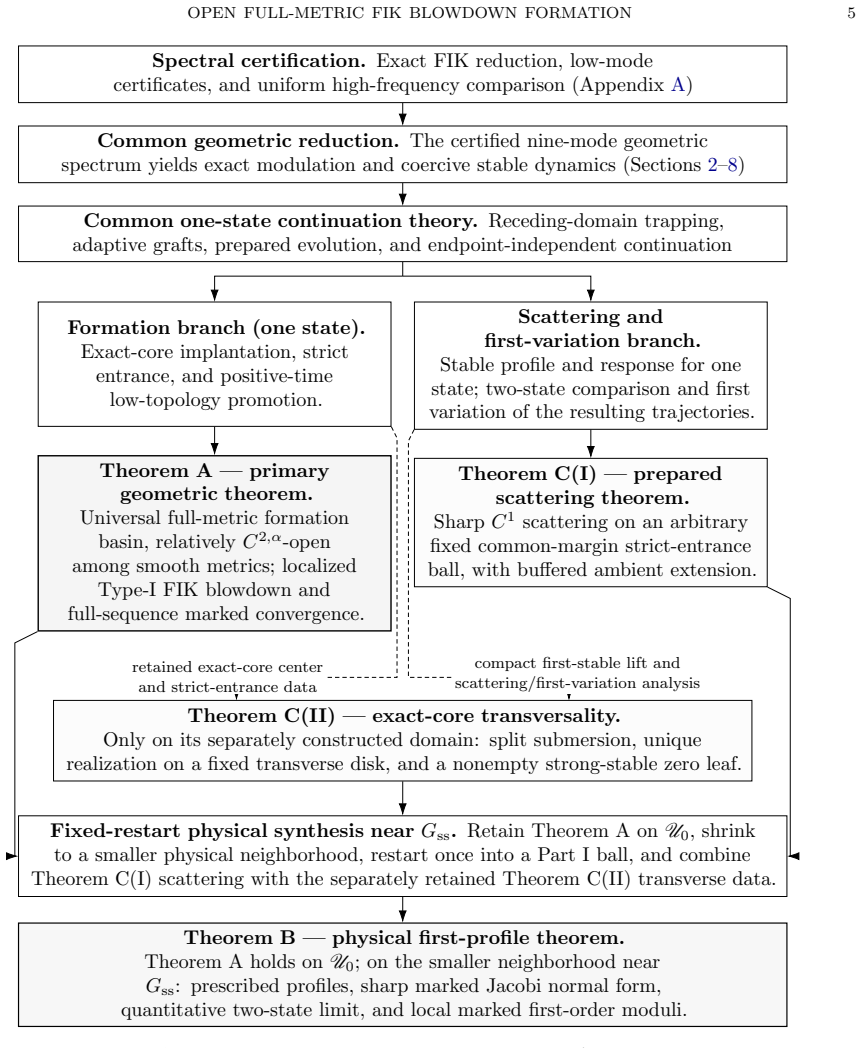
Reference graph
Works this paper leans on
-
[1]
S. Angenent and D. Knopf,An example of neckpinching for Ricci flow onS n+1, Math. Res. Lett.11(2004), no. 4, 493–518,doi:10.4310/MRL.2004.v11.n4.a8
-
[2]
Appleton,Eguchi–Hanson singularities inU(2)-invariant Ricci flow, Peking Math
A. Appleton,Eguchi–Hanson singularities inU(2)-invariant Ricci flow, Peking Math. J.6(2023), no. 1, 1–141,doi:10.1007/s42543-022-00048-y
-
[3]
E. Bahuaud, C. Guenther, and J. Isenberg,Convergence stability for Ricci flow, J. Geom. Anal.30(2020), no. 1, 310–336,doi:10.1007/s12220-018-00132-9
-
[4]
R. H. Bamler and B. Kleiner,Uniqueness and stability of Ricci flow through singularities, Acta Math.228 (2022), no. 1, 1–215,doi:10.4310/ACTA.2022.v228.n1.a1
-
[5]
M. Braverman, O. Milatovic, and M. A. Shubin,Essential self-adjointness of Schr¨ odinger-type operators on manifolds, Russian Math. Surveys57(2002), no. 4, 641–692,doi:10.1070/RM2002v057n04ABEH000532
-
[6]
H.-D. Cao, R. S. Hamilton, and T. Ilmanen,Gaussian densities and stability for some Ricci solitons, preprint (2004),arXiv:math/0404165
arXiv 2004
-
[7]
K. Choi and Y. Lai,Convergence of Ricci flow and long-time existence of harmonic map heat flow, preprint (2025),arXiv:2504.02804
arXiv 2025
-
[8]
C. Cifarelli, R. J. Conlon, and A. Deruelle,On finite time Type I singularities of the K¨ ahler–Ricci flow on compact K¨ ahler surfaces, J. Eur. Math. Soc.28(2026), no. 2, 463–504,doi:10.4171/JEMS/1485
Show all 33 references
-
[9]
T. H. Colding and W. P. Minicozzi,Singularities of Ricci flow and diffeomorphisms, Publ. Math. Inst. Hautes ´Etudes Sci.142(2025), 75–152,doi:10.1007/s10240-025-00157-1
2025 doi
-
[10]
R. J. Conlon, M. Hallgren, and Z. Ma,Non-collapsed finite time singularities of the Ricci flow on compact K¨ ahler surfaces are of Type I, preprint (2025),arXiv:2502.19804
2025 arXiv
-
[11]
D. M. DeTurck,Deforming metrics in the direction of their Ricci tensors, J. Differential Geom.18(1983), no. 1, 157–162,doi:10.4310/jdg/1214509286
1983
-
[12]
Enders, R
J. Enders, R. M¨ uller, and P. M. Topping,On Type-I singularities in Ricci flow, Comm. Anal. Geom.19 (2011), no. 5, 905–922,doi:10.4310/CAG.2011.v19.n5.a4
2011 doi
-
[13]
Feldman, T
M. Feldman, T. Ilmanen, and D. Knopf,Rotationally symmetric shrinking and expanding gradient K¨ ahler– Ricci solitons, J. Differential Geom.65(2003), no. 2, 169–209,doi:10.4310/jdg/1090511686
2003
-
[14]
Garfinkle, J
D. Garfinkle, J. Isenberg, D. Knopf, and H. Wu,Asymptotic behaviour of unstable perturbations of the Fubini–Study metric in Ricci flow, Nonlinearity38(2025), no. 7, 075015,doi:10.1088/1361-6544/addf09
2025 doi
-
[15]
Guenther, J
C. Guenther, J. Isenberg, and D. Knopf,Stability of the Ricci flow at Ricci-flat metrics, Comm. Anal. Geom.10(2002), no. 4, 741–777,doi:10.4310/CAG.2002.v10.n4.a4
2002 doi
-
[16]
Guo and J
B. Guo and J. Song,On Feldman–Ilmanen–Knopf conjecture for the blow-up behavior of the K¨ ahler Ricci flow, Math. Res. Lett.23(2016), no. 6, 1681–1719,doi:10.4310/MRL.2016.v23.n6.a6
2016 doi
-
[17]
R. S. Hamilton,Three-manifolds with positive Ricci curvature, J. Differential Geom.17(1982), no. 2, 255–306,doi:10.4310/jdg/1214436922
1982
-
[18]
Hughes,L 2-instability of the Taub–Bolt metric under the Ricci flow, preprint (2024),arXiv:2408.15269
J. Hughes,L 2-instability of the Taub–Bolt metric under the Ricci flow, preprint (2024),arXiv:2408.15269
2024 arXiv
-
[19]
Isenberg, D
J. Isenberg, D. Knopf, and N. ˇSeˇ sum,Ricci flow neckpinches without rotational symmetry, Comm. Partial Differential Equations41(2016), no. 12, 1860–1894,doi:10.1080/03605302.2016.1233982
2016
-
[20]
Isenberg, D
J. Isenberg, D. Knopf, and N. ˇSeˇ sum,Non-K¨ ahler Ricci flow singularities modeled on K¨ ahler–Ricci solitons, Pure Appl. Math. Q.15(2019), no. 2, 749–784,doi:10.4310/PAMQ.2019.v15.n2.a5
2019 doi
-
[21]
Kr¨ oncke,Stability of Einstein metrics under Ricci flow, Comm
K. Kr¨ oncke,Stability of Einstein metrics under Ricci flow, Comm. Anal. Geom.28(2020), no. 2, 351–394, doi:10.4310/CAG.2020.v28.n2.a5. OPEN FULL-METRIC FIK BLOWDOWN FORMATION 401
2020 doi
-
[22]
Li and B
Y. Li and B. Wang,On K¨ ahler Ricci shrinker surfaces, Acta Math.236(2026), no. 1, 1–50,doi:10.4310/ ACTA.2026.v236.n1.a1
2026
-
[23]
Lunardi,Analytic semigroups and optimal regularity in parabolic problems, Progress in Nonlinear Differ- ential Equations and their Applications, vol
A. Lunardi,Analytic semigroups and optimal regularity in parabolic problems, Progress in Nonlinear Differ- ential Equations and their Applications, vol. 16, Birkh¨ auser, Basel, 1995
1995
-
[24]
M´ aximo,On the blow-up of four-dimensional Ricci flow singularities, J
D. M´ aximo,On the blow-up of four-dimensional Ricci flow singularities, J. Reine Angew. Math.692(2014), 153–171,doi:10.1515/crelle-2012-0080
2014 doi
-
[25]
Naff and T
K. Naff and T. Ozuch,Linear stability of the blowdown Ricci shrinker in 4D, preprint (2025),arXiv: 2509.05470
2025
-
[26]
Perelman,The entropy formula for the Ricci flow and its geometric applications, preprint (2002),arXiv: math/0211159
G. Perelman,The entropy formula for the Ricci flow and its geometric applications, preprint (2002),arXiv: math/0211159
2002 arXiv
-
[27]
Lu,A local curvature bound in Ricci flow, Geom
P. Lu,A local curvature bound in Ricci flow, Geom. Topol.14(2010), no. 2, 1095–1110,doi:10.2140/gt. 2010.14.1095
2010 doi
-
[28]
Shi,Deforming the metric on complete Riemannian manifolds, J
W.-X. Shi,Deforming the metric on complete Riemannian manifolds, J. Differential Geom.30(1989), no. 1, 223–301,doi:10.4310/JDG/1214443292
1989
-
[29]
Song,Some Type I solutions of Ricci flow with rotational symmetry, Int
J. Song,Some Type I solutions of Ricci flow with rotational symmetry, Int. Math. Res. Not. IMRN (2015), no. 16, 7365–7381,doi:10.1093/imrn/rnu134
2015 doi
-
[30]
Song and B
J. Song and B. Weinkove,The K¨ ahler–Ricci flow on Hirzebruch surfaces, J. Reine Angew. Math.659 (2011), 141–168,doi:10.1515/crelle.2011.071
2011 doi
-
[31]
Song and B
J. Song and B. Weinkove,Contracting exceptional divisors by the K¨ ahler–Ricci flow, Duke Math. J.162 (2013), no. 2, 367–415,doi:10.1215/00127094-1962881
2013 doi
-
[32]
Stolarski,Closed Ricci flows with singularities modeled on asymptotically conical shrinkers, Geom
M. Stolarski,Closed Ricci flows with singularities modeled on asymptotically conical shrinkers, Geom. Topol. 30(2026), no. 4, 1277–1370,doi:10.2140/gt.2026.30.1277
2026 doi
-
[33]
Zettl,Sturm–Liouville theory, Mathematical Surveys and Monographs, vol
A. Zettl,Sturm–Liouville theory, Mathematical Surveys and Monographs, vol. 121, American Mathematical Society, Providence, RI, 2005,doi:10.1090/surv/121. Email address:hkshin@gmail.com
2005 doi
Reviewed August 14, 2026 · model on record in the stance chip above.
Discussion (0). Continue with ORCID to comment.