REVIEW 4 major objections 5 minor 24 references
Understanding Relative Network Delay inMicro-Energy Harvesting Wireless Networks
T0 review · 4 major / 5 minor · reviewed 2026-08-14 · deepseek-v4-flash
Pith's one-line read The paper derives a closed-form lower bound and a tighter upper bound on the delay-to-distance ratio in micro-energy harvesting wireless networks.
desk verdict Lemma 4.1's false independence assumption sinks the lower-bound theorem; only the upper bound is worth a second look. read the letter →
The pith
A machine-rendered reading of the paper's core claim, the machinery that carries it, and where it could break.
The reading
What carries the argument
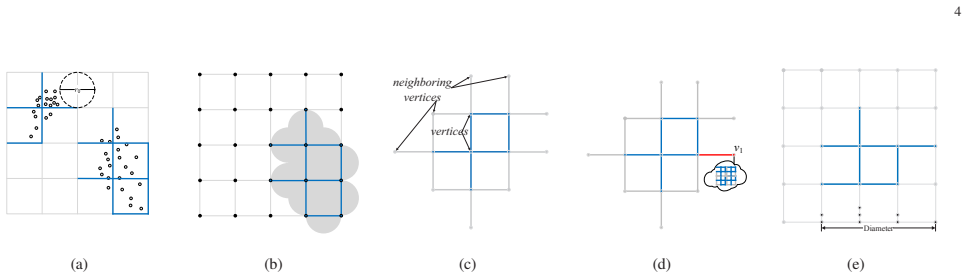
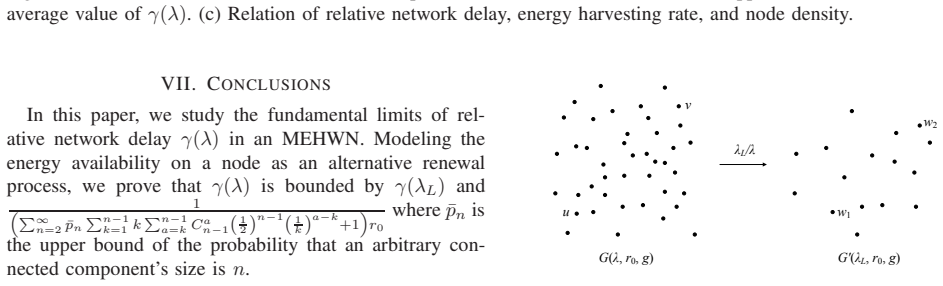
The machinery is a square-lattice overlay: each lattice edge is occupied with probability $p=1-e^{-\lambda\sqrt g \pi r_0^2/4}$, and occupied-edge components stand in for wireless clusters. Lemma 3.2 bounds the size distribution $\Pr\{S=n\}$ through a recurrence in the number of neighboring vertices, producing $\bar p_n$; Lemma 4.1 bounds the probability that an $n$-vertex component has horizontal diameter $k$ by treating the projections of the component's vertices as independent fair coin flips. Combining those two bounds yields the expected diameter that appears in the lower bound, while Theorem 5.2 obtains the upper bound by thinning the network to density $\lambda_L$ and routing through the long-term giant component.
What would settle it
For a straight horizontal connected component of $n$ vertices, the actual diameter is $n-1$ with probability 1. Lemma 4.1's right-hand side for $n=3$ and $k=2$ is $1/4$, so Eq. (10) would assert $1\le 1/4$ for that component; a reader can check whether the inequality holds for such straight components, and if it fails, the closed-form lower bound in Theorem 5.1 is not established. A simulation comparing empirical diameter distributions of lattice components with Eq. (10) would give the same answer.
Extended reading notes
Core claim
On the paper's own terms, the discovery is a closed-form expression for how much delay per unit distance a packet must suffer in an energy-harvesting network. For node density $\lambda$ between the long-term critical density $\lambda_L$ and the instantaneous critical density $\lambda_I$, the relative network delay $\gamma(\lambda)=\lim_{d(u,v)\to\infty}T_\lambda(u,v)/d(u,v)$ satisfies the closed-form lower bound $$\gamma(\$\lambda$) \ge \frac{1}{\bigl(\sum_{n=2}^\infty \bar p_n \sum_{k=1}^{n-1} k \sum_{a=k}^{n-1} \binom{n-1}{a}(1/2)^{n-1}(1/k)^{a-k}+1\bigr) r_0},$$ where $\bar p_n$ bounds the probability that a lattice connected component has $n$ vertices, and the upper bound $\gamma(\lambda)\le\gamma(\lambda_L)=\kappa E[T(e)]$, with $\kappa\approx1.7$ and $E[T(e)]=1/g-1$. The lower bound is the closed-form replacement for the approximated cluster size used in earlier work, and the upper bound removes a factor $\sqrt{\lambda/\lambda_L}$ from the previous bound. The paper claims these bounds hold in the random connection model with binary on/off energy harvesting and reports simulations consistent with them.
Load-bearing premise
The central derivation depends on treating the horizontal positions of the vertices in a connected component as independent fair coin flips relative to one selected vertex; in a valid lattice-connected component those positions are not independent, so the diameter bound feeding the lower-bound formula is not guaranteed to be a true upper bound.
Editorial extensions
If this is right
- Network designers can compute a guaranteed delay floor for a given node density and harvesting rate directly from the closed-form sum, without simulating the network.
- The upper bound says that above the long-term critical density, relative delay is no larger than the delay at that critical density, so density increases beyond $\lambda_L$ only help until the network percolates instantaneously.
- The bounds separate the energy-harvesting contribution, the per-hop waiting time $E[T(e)]=1/g-1$, from the topological contribution encoded in the geometric constants.
- At high harvesting probability the upper bound collapses, matching the simulation observation that the network percolates in the first time slot and relative delay approaches zero.
Reading between the lines
- A direct extension would replace Lemma 4.1's coin-flip independence with exact enumeration of connected lattice-animal projections; that would either repair the lower bound or show that only its constant changes.
- The lattice-diameter method could transfer to other duty-cycled or intermittently available wireless networks, but only if the projection independence is verified for those topologies.
- The binary on/off energy model ignores correlation in a node's availability across time slots; under a queued energy-storage model the per-hop waiting time would become history-dependent and the bounds would need a queueing correction.
- Even if the closed-form constant is not tight, the qualitative inverse relation between relative delay and $r_0$ times expected component diameter may survive, so the paper's structure is a plausible template for stronger bounds.
Signed reviews
Editorial analysis
A structured set of objections, weighed in public.
Referee Report
Summary. The paper studies the relative network delay γ(λ), defined as the asymptotic ratio of end-to-end delay to Euclidean distance, in a micro-energy harvesting wireless network modeled as a random connection model with binary on/off energy states. The authors couple the network to a square lattice, derive upper bounds on connected-component size and diameter, and from these obtain a closed-form lower bound on γ(λ) (Theorem 5.1). They also propose an upper bound γ(λ) ≤ γ(λ_L) = κ E[T(e)] (Theorem 5.2), claiming it is tighter than the bound of Zhao et al. Simulation results for λ ∈ [1.4, 2.8] are presented to support the bounds.
Significance. If the main theorems were correct, the paper would supply a parameter-free closed-form lower bound on relative network delay, a quantity for which prior work gave only approximations, and it would improve the upper bound of prior art. The problem is timely and the lattice-coupling approach is a reasonable strategy. However, the central diameter lemma is demonstrably false, so the lower-bound theorem is not established, and the numerical upper bound depends on empirically measured constants that are also used for validation. The paper provides no machine-checked proofs or reproducible code, and the theoretical contribution is therefore not currently supported.
major comments (4)
- [Section IV, Lemma 4.1, Eq. (10)] Lemma 4.1 is false. The proof assumes that, after randomly choosing one vertex of an n-vertex connected component, the horizontal projections of the other n−1 vertices are conditionally independent Bernoulli(0.5) relative to the chosen vertex's x-coordinate. In a lattice-connected component the geometry fixes these projections. For a straight horizontal component of n vertices, D(C_n(L)) = n−1 with probability 1, while Eq. (10) with k = n−1 evaluates to C(n−1, n−1)(1/2)^(n−1) = 2^(−(n−1)), which is less than 1 for n > 1. Thus Eq. (10) is not a valid upper bound on the conditional probability of a given diameter.
- [Section V.A, Theorem 5.1, Eq. (14)] The proof of Theorem 5.1 relies directly on Eq. (15), which is obtained by summing the false bound of Lemma 4.1. Since Lemma 4.1 is invalid, Eq. (15) is not an upper bound on E(D_g(λ)), and consequently the closed-form lower bound in Eq. (14) is unsupported. The lower-bound formula may be true for other reasons, but the proof given in the manuscript does not establish it.
- [Section III, Lemma 3.2] The derivation of the component-size bound is not rigorous. In the proof, the quantities s_i^(n−1) differ from group to group, yet the argument factors a single s_i^(n−1) out of the sum and later replaces it by its maximum 2n. The assertion that an n-size component generated from C_i^(n−1) must contain at least (s_i^(n−1) + 1) neighboring vertices is also stated without proof. Since the resulting bound ¯p_n is used in Theorem 5.1, this gap is load-bearing.
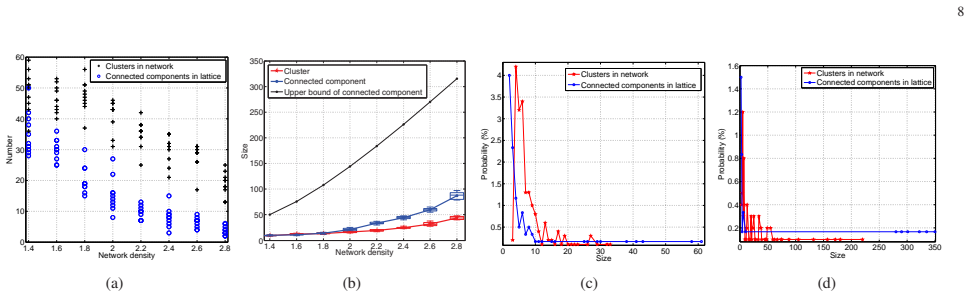
- [Section VI.B, Theorem 5.2] The numerical upper bound γ(λ) ≤ γ(λ_L) = κ E[T(e)] uses the values κ ≈ 1.7 and λ_L = 1.44, which are obtained from simulations, and the same simulations are then used to validate the bound. The paper does not derive κ or λ_L theoretically. Consequently, the claimed tightness of the upper bound in Fig. 3(b) is a partly circular empirical comparison rather than a parameter-free theoretical prediction.
minor comments (5)
- [Section II.B] The phrase 'alternative renewal process' should be 'alternating renewal process'.
- [Section VI] The text 'we tested 103 pairs of nodes in total' should read '10^3 pairs' (or '1000 pairs'), since 100 pairs repeated 10 times gives 1000 trials.
- [Section IV] The combination symbol C^a_{n−1} is used without a definition; it should be defined explicitly as the number of ways to choose a objects from n−1.
- [Section III, Definition 7] The statement that each vertex has 'zero to three' non-connected neighboring vertices appears inconsistent with a square lattice, where a vertex has four neighbors; please clarify whether oriented or boundary effects are intended.
- [Figs. 2 and 3] In Fig. 3(b), the legends 'Lower bound [20]' and 'Upper bound [20]' appear to refer to the bounds from reference [14] rather than from Liggett's ergodic theorem [20]; please correct the citations.
Circularity Check
Lower bound is self-contained; numerical upper-bound tightness rests on simulation-fitted κ, a partial fitted-input circularity.
-
fitted input called prediction
[Section VI.B (upper bound evaluation), Eq. (17), Fig. 3(b)]
"One critical information in the upper bound equation of γ(λ) is κ. We know κ is defined as NλL (d)/d when d → ∞. λL is the long-term critical network density, so it is equal to 1.44. To obtain this value, we randomly select two nodes in the network, and consider the number of hops along the shortest path between them as NλL (d). We find that the value of κ varies, depending on the distance between these two nodes. However, κ ≈ 1.7 given large amount of simulations."
The displayed numerical upper bound γ(λ) ≤ γ(λL) = κE[T(e)] is evaluated with κ ≈ 1.7 and λL = 1.44 estimated from the same simulations that are then used to 'verify' the upper bound. The theoretical inequality γ(λ) ≤ γ(λL) is independent, but the claimed tighter numerical bound and its simulation confirmation are partly a consistency check with a fitted constant rather than an independent prediction. The lower-bound formula itself contains no fitted parameters, so the circularity is partial and confined to the upper-bound tightness claim.
full rationale
The main closed-form lower bound (Theorem 5.1) is derived through Lemma 3.2, Lemma 4.1, and Lemma 5.1, none of which involves fitting to the delay data; the formula is parameter-free and not equivalent to its inputs by construction. The upper-bound theorem γ(λ) ≤ γ(λL) is also an independent inequality, relying on the thinning argument and the external percolation lemmas. However, the numerical evaluation of that bound uses κ ≈ 1.7 and λL = 1.44 measured from the same simulation setup that later appears as verification, so the simulation confirmation of the tighter upper bound is partially circular. The false-independence issue in Lemma 4.1 noted by the skeptic is a correctness concern, not a circularity: an unsupported or false lemma makes the proof invalid, but it does not make the claimed result identical to its inputs. Overall, the central lower-bound derivation is self-contained, and the circularity is limited to the empirical constant feeding the upper-bound validation, warranting a moderate score rather than a high one.
Assumptions & free parameters
free parameters (2)
- lambda_L (long-term critical density) =
1.44 (estimated from simulation)
- kappa (first-passage time constant at lambda_L) =
1.7 (from simulations)
assumptions (6)
- standard math Existence and uniqueness of percolation thresholds lambda_I and lambda_L, and a giant component for lambda above threshold.
- standard math Existence of the relative network delay limit via first-passage percolation and the subadditive ergodic theorem.
- domain assumption Nodes switch on and off independently with probability q, and links are independent with probability g = q^2 (binary energy harvesting model).
- domain assumption Per-link waiting delay is geometric with parameter g and dominates all other delays.
- ad hoc to paper In Lemma 4.1, projections of connected-component vertices onto the horizontal axis are independent Bernoulli(0.5) relative to a randomly chosen vertex.
- domain assumption Correspondence between network clusters and lattice connected components (Lemma 3.1), including the claim that no cluster node lies outside the union of occupied-edge circles.
Cite this review
Pith. "Pith review of Understanding Relative Network Delay inMicro-Energy Harvesting Wireless Networks." pith.science (2026). https://pith.science/paper/6AOWVNPS
@misc{pith2026190807334,
  author       = {Pith},
  title        = {Pith review of: Understanding Relative Network Delay inMicro-Energy Harvesting Wireless Networks},
  year         = {2026},
  howpublished = {\url{https://pith.science/paper/6AOWVNPS}},
  note         = {Machine review of arXiv:1908.07334}
}
read the original abstract
Micro-energy harvesting wireless network (MEHWN) enables a perpetual network deployment that cannot be achieved in traditional battery-operated counterparts. Despite its sustainability, end-to-end delay in an MEHWN could be very large, due to the large waiting delay on each hop in the network. In this work, we consider an MEHWN where every node constantly switches between on and off states, due to the limited amount of harvested energy. The network delay of an MEHWN is not well understood because of the energy uncertainty, asynchronized working schedules, and complex network topology in an MEHWN. To close this research gap, we define the relative network delay as the ratio between end-to-end delay and distance. Compared to previous works, we are able to identify a closed-form expression of the lower bound and a tighter upper bound of the relative network delay. The theoretical findings are verified in simulations. Our theoretical analysis deepens the understanding about the interplay of network delay, energy harvesting rate, and node density in an MEHWN.
Figures

Figures from the paper (1 more)
Reference graph
Works this paper leans on
-
[14]
S. Zhao, L. Fu, X. Wang, and Q. Zhang, “Fundamental relat ionship between nodedensity and delay in wireless ad hoc networks wi th unreliable links,” in Proceedings of the 17th Annual International Conference on Mobile Computing and Networking , ser. MobiCom ’11, 2011, pp. 337–348
work page 2011
-
[22]
Node density and delay in large-sca le wireless networks with unreliable links,
S. Zhao and X. Wang, “Node density and delay in large-sca le wireless networks with unreliable links,” Networking, IEEE/ACM Transactions on, vol. 22, no. 4, pp. 1150–1163, 2014
work page 2014
-
[1]
Harvest energy from the water: A self-sustained wire less water quality sensing system,
Q. Chen, Y . Liu, Q. Y ang, G. Liu, X. Shi, H. Gao, L. Su, and Q. Li, “Harvest energy from the water: A self-sustained wire less water quality sensing system,” ACM Transactions on Embedded and Computing System , 2017
work page 2017
-
[2]
Water-evaporation-induced electricity with nanostructured carbon materials,
G. Xue, Y . Xu, T. Ding, J. Li, J. Yin, W. Fei, Y . Cao, J. Y u, L. Y uan, L. Gong et al., “Water-evaporation-induced electricity with nanostructured carbon materials,” Nature Nanotechnology, 2017
work page 2017
-
[3]
Energy harvesting sens or nodes: Survey and implications,
S. Sudevalayam and P . Kulkarni, “Energy harvesting sens or nodes: Survey and implications,” Communications Surveys & Tutorials, IEEE, vol. 13, no. 3, pp. 443–461, 2011
work page 2011
-
[4]
Energy-harve sting wsns for structural health monitoring of underground train tunn els,
A. Cammarano, D. Spenza, and C. Petrioli, “Energy-harve sting wsns for structural health monitoring of underground train tunn els,” in INFOCOM, 2013 Proceedings IEEE , April 2013, pp. 9–10
work page 2013
-
[5]
Leakage- aware energy synchronization for wireless sensor networks ,
T. Zhu, Z. Zhong, Y . Gu, T. He, and Z.-L. Zhang, “Leakage- aware energy synchronization for wireless sensor networks ,” in Proceedings of the 7th International Conference on Mobile S ystems, Applications, and Services , ser. MobiSys ’09, 2009, pp. 319–332
work page 2009
-
[6]
Robust optimization of cog nitive radio networks powered by energy harvesting,
S. Gong, L. Duan, and P . Wang, “Robust optimization of cog nitive radio networks powered by energy harvesting,” in INFOCOM, 2015 Proceedings IEEE , April 2015, pp. 612–620
work page 2015
Show all 24 references
-
[7]
On the lim its of effective hybrid micro-energy harvesting on mobile crfid se nsors,
J. Gummeson, S. S. Clark, K. Fu, and D. Ganesan, “On the lim its of effective hybrid micro-energy harvesting on mobile crfid se nsors,” in Proceedings of the 8th International Conference on Mobile S ystems, Applications, and Services , ser. MobiSys ’10, 2010, pp. 195–208
2010
-
[8]
Meester, Continuum percolation
R. Meester, Continuum percolation . Cambridge University Press, 1996, no. 119
1996
-
[9]
First-passage percolati on, sub- additive processes, stochastic networks, and generalized renewal theory,
J. M. Hammersley and D. Welsh, “First-passage percolati on, sub- additive processes, stochastic networks, and generalized renewal theory,” in Bernoulli 1713, Bayes 1763, Laplace 1813 . Springer, 1965, pp. 61–110
1965
-
[10]
Optimal packet scheduling in a mu ltiple ac- cess channel with energy harvesting transmitters,
J. Y ang and S. Ulukus, “Optimal packet scheduling in a mu ltiple ac- cess channel with energy harvesting transmitters,” Communications and Networks, Journal of , vol. 14, no. 2, pp. 140–150, 2012
2012
-
[11]
Throughput optimal policies for ene rgy har- vesting wireless transmitters with non-ideal circuit powe r,
J. Xu and R. Zhang, “Throughput optimal policies for ene rgy har- vesting wireless transmitters with non-ideal circuit powe r,” Selected Areas in Communications, IEEE Journal on , vol. 32, no. 2, pp. 322– 332, 2014
2014
-
[12]
Energy-efficient re source allocation in ofdma systems with hybrid energy harvesting b ase station,
D. W. K. Ng, E. S. Lo, and R. Schober, “Energy-efficient re source allocation in ofdma systems with hybrid energy harvesting b ase station,” Wireless Communications, IEEE Transactions on , vol. 12, no. 7, pp. 3412–3427, 2013
2013
-
[13]
Energy-synchr onized computing for sustainable sensor networks,
T. Zhu, Z. Zhong, T. He, and Z.-L. Zhang, “Energy-synchr onized computing for sustainable sensor networks,” Ad Hoc Networks , vol. 11, no. 4, pp. 1392 – 1404, 2013
2013
-
[15]
The poisson point process,
R. Streit, “The poisson point process,” in Poisson Point Processes. Springer US, 2010, pp. 11–55. [Online]. Available: http://dx.doi.org/10.1007/978-1-4419-6923-1 2
2010 doi
-
[16]
State amplifi- cation and state masking for the binary energy harvesting ch annel,
K. Tutuncuoglu, O. Ozel, A. Y ener, and S. Ulukus, “State amplifi- cation and state masking for the binary energy harvesting ch annel,” in Information Theory W orkshop (ITW), 2014 IEEE . IEEE, 2014, pp. 336–340
2014
-
[17]
Improved capacity bounds for the binary energy har vesting channel,
——, “Improved capacity bounds for the binary energy har vesting channel,” in Information Theory (ISIT), 2014 IEEE International Symposium on . IEEE, 2014, pp. 976–980
2014
-
[18]
The bi nary energy harvesting channel with on-off fading,
O. Ozel, K. Tutuncuoglu, S. Ulukus, and A. Y ener, “The bi nary energy harvesting channel with on-off fading,” in Information Theory (ISIT), 2015 IEEE International Symposium on . IEEE, 2015, pp. 2722–2726
2015
-
[19]
Steady and fair rate a llocation for rechargeable sensors in perpetual sensor networks,
K.-W. Fan, Z. Zheng, and P . Sinha, “Steady and fair rate a llocation for rechargeable sensors in perpetual sensor networks,” in Pro- ceedings of the 6th ACM conference on Embedded network senso r systems. ACM, 2008, pp. 239–252
2008
-
[20]
An improved subadditive ergodic theore m,
T. M. Liggett, “An improved subadditive ergodic theore m,” The Annals of Probability , pp. 1279–1285, 1985
1985
-
[21]
Penrose, Random geometric graphs
M. Penrose, Random geometric graphs . Oxford University Press Oxford, 2003, vol. 5
2003
-
[23]
Distributed energy management al gorithm for large-scale wireless sensor networks,
Z. Kong and E. M. Y eh, “Distributed energy management al gorithm for large-scale wireless sensor networks,” in Proceedings of the 8th ACM International Symposium on Mobile Ad Hoc Networking and Computing, ser. MobiHoc ’07, 2007, pp. 209–218
2007
-
[24]
Latency of wir eless sensor networks with uncoordinated power saving mechanism s,
O. Dousse, P . Mannersalo, and P . Thiran, “Latency of wir eless sensor networks with uncoordinated power saving mechanism s,” in MobiHoc ’04 , 2004, pp. 109–120
2004
Reviewed August 14, 2026 · model on record in the stance chip above.
Discussion (0). Continue with ORCID to comment.